The Chinese Cultural Revolution
Understanding Mao's Decade of Chaos, Ideology, and Transformation
Discover how a decade of ideological fervor transformed China and reshaped global communism.
222 pages10 chaptersApr 25, 2026China History
About this book
The Chinese Cultural Revolution (1966-1976) stands as one of history's most consequential yet misunderstood political upheavals. This book provides a comprehensive examination of how Mao Zedong launched a radical campaign to purify communist ideology, mobilize youth through the Red Guards, and consolidate power—with catastrophic human consequences. You'll explore the ideological foundations that drove the movement, the mechanisms of mass mobilization and violence, the factional struggles that spiraled into chaos, and the profound impact on millions of Chinese citizens. Through careful analysis of primary sources, historical accounts, and scholarly perspectives, you'll understand how the Cultural Revolution emerged from specific political circumstances, how it unfolded across different regions and institutions, and how its legacy continues to shape contemporary China. This accessible yet rigorous exploration reveals the dangers of unchecked ideological extremism and offers essential lessons about power, control, and social transformation.
Table of contents
- IntroductionWhy the Cultural Revolution Matters Today, Scope and Approach of This Book, Key Themes and Questions We'll ExploreRead below
- Chapter 1: China Before the RevolutionThe Founding of the People's Republic and Early Communist Rule, The Great Leap Forward and Its Aftermath, Mao's Declining Influence and the Rise of Pragmatists, Ideological Tensions Within the Communist Party
- Chapter 2: Ideological Foundations of the RevolutionThe Theory of Continuous Revolution, Attacking the Four Olds: Culture, Customs, Habits, and Ideas, The Fear of Capitalist Restoration and Revisionism, Mao's Vision for a Purified Communist Society
- Chapter 3: The Launch and Early MobilizationThe May 16 Circular and Initial Attacks on Party Leadership, The Rise of the Red Guards and Youth Mobilization, Mass Rallies and the Cult of Mao, Early Violence and the Destruction of Cultural Heritage
- Chapter 4: Chaos and Factional ConflictRed Guard Factions and Competing Ideologies, Armed Struggle and Urban Warfare, Military Intervention and the Struggle for Control, Regional Variations in Revolutionary Intensity
- Chapter 5: Persecution and Human SufferingStruggle Sessions and Public Humiliation, Targeted Groups: Intellectuals, Officials, and the Bourgeoisie, Sent Down to the Countryside: Rustication and Exile, Estimating the Death Toll and Long-Term Trauma
- Chapter 6: Impact on Education and CultureThe Collapse of the Education System, Destruction of Cultural Heritage and Intellectual Life, The Lost Generation: Educational Gaps and Generational Trauma, Propaganda and Ideological Education as Replacement Learning
- Chapter 7: The Later Stages and DeclineThe Lin Biao Incident and Shifting Power Dynamics, The Gang of Four and Radical Factionalism, Mao's Declining Health and Succession Struggles, The Revolution Winds Down: 1973-1976
- Chapter 8: The Aftermath and Deng's ReformsMao's Death and the Arrest of the Gang of Four, Deng Xiaoping's Rise and the Rejection of Continuous Revolution, Economic Liberalization and Opening to the World, The Official Assessment: 70% Right, 30% Wrong
- Chapter 9: Global Context and Comparative PerspectivesThe Sino-Soviet Split and Competition for Communist Leadership, International Reactions and Western Perceptions, Comparing the Cultural Revolution to Other Mass Movements
- Chapter 10: Legacy and Contemporary RelevanceMemory, Commemoration, and Historical Reckoning in China, Lessons About Authoritarianism and Mass Mobilization, The Cultural Revolution's Shadow on Contemporary Chinese Politics
- ConclusionSynthesizing the Revolution's Meaning, Enduring Questions and Ongoing Debates
- Glossary of Key Terms
- Further Reading and Resources
Introduction
Between 1966 and 1976, China experienced one of the most dramatic and destructive political upheavals of the twentieth century. Mao Zedong, the founding leader of the People's Republic, launched what he called the Great Proletarian Cultural Revolution, a mass campaign designed to purge the Communist Party of ideological impurity and reignite the revolutionary spirit he believed was fading from Chinese society. What followed was a decade of extraordinary violence, social upheaval, and cultural destruction that touched virtually every family in the country and reshaped China in ways that are still felt today.
The scale of what happened is difficult to absorb. Universities and schools shut down for years. Millions of young people were organized into paramilitary groups called the Red Guards and sent into the streets to attack anyone deemed insufficiently revolutionary. Intellectuals, teachers, party officials, and ordinary citizens were dragged before public tribunals, beaten, humiliated, and in many cases killed. Ancient temples, books, artworks, and cultural artifacts were destroyed in the name of eliminating the "Four Olds." Scholars estimate that somewhere between 500,000 and two million people died as a direct result of the violence, though some estimates run considerably higher.[1] The full human cost, including those who suffered persecution, forced labor, and psychological trauma, numbered in the tens of millions.
Yet for all its enormity, the Cultural Revolution remains poorly understood outside of China, and even within China it is a subject that the government actively discourages open discussion about. In the West, it is often reduced to a few vivid images: teenagers waving the Little Red Book, Red Guards smashing statues, Mao standing before enormous crowds in Tiananmen Square. These images are real, but they capture only fragments of a far more complex story. Understanding the Cultural Revolution fully requires looking at the political calculations behind it, the ideological currents that drove it, the human experiences it produced, and the long shadow it cast over everything that came after.
This book is an attempt to provide that fuller understanding. It is written for anyone who wants to move beyond the surface-level images and grasp what actually happened, why it happened, and what it means. No prior expertise in Chinese history or communist theory is required, though some familiarity with twentieth-century history will help. The goal is to be rigorous without being inaccessible, and to be honest about the suffering involved without losing sight of the broader historical and political forces at work.
Why the Cultural Revolution Matters Today
It might be tempting to treat the Cultural Revolution as a closed chapter of history, a catastrophe that happened in a specific place and time and has since been resolved. That temptation should be resisted. The Cultural Revolution matters today for reasons that go well beyond academic interest in Chinese history. It offers some of the clearest and most instructive examples available of how political systems can mobilize entire populations in the service of destructive ideological goals, and what happens when they do.
Consider the mechanisms involved. Mao did not simply order violence from above and watch it unfold. He created conditions in which ordinary people, including teenagers and young adults, became enthusiastic participants in persecution. He used propaganda, mass rallies, ideological education, and the deliberate dismantling of existing authority structures to produce a society in which denouncing your neighbor, your teacher, or even your parents became not just acceptable but virtuous. Understanding how that process worked is directly relevant to understanding how similar dynamics operate in other contexts, both historical and contemporary.
The Cultural Revolution also matters because of what it reveals about the internal logic of authoritarian political systems. Mao launched the revolution partly because he felt his own position within the Communist Party was being undermined by pragmatic colleagues like Liu Shaoqi and Deng Xiaoping, who had moved to repair the damage caused by the disastrous Great Leap Forward. Rather than accept a reduced role, Mao went outside the party structure entirely, mobilizing the population directly against the party apparatus. This maneuver, using mass politics to circumvent institutional constraints, is a pattern that appears in other authoritarian contexts and deserves careful study.
For contemporary observers of China, the Cultural Revolution is especially significant. The Chinese Communist Party's official position, established under Deng Xiaoping in 1981, is that the revolution was a serious mistake for which Mao bears primary responsibility, though the party still credits him with being 70% correct
overall.[2] But open discussion of the period remains heavily restricted inside China. Survivors and their descendants carry memories that cannot be publicly shared. This enforced silence has its own consequences for how Chinese society understands its past and navigates its present.
Beyond China, the Cultural Revolution stands as one of history's most powerful case studies in the dangers of ideological extremism when combined with state power and mass mobilization. The specific ideology was Maoist communism, but the underlying dynamics, the demonization of designated enemies, the rewarding of denunciation, the destruction of institutions that might provide checks on power, are not unique to any single political tradition. Studying the Cultural Revolution carefully is one of the best ways to understand how these dynamics work and what conditions allow them to take hold.
Finally, the Cultural Revolution matters because of the people who lived through it. Tens of millions of Chinese citizens had their lives fundamentally altered by this decade of upheaval. They lost years of education, watched family members persecuted or killed, were sent to remote rural areas for years of forced labor, and were required to publicly denounce people they loved. Their experiences deserve to be understood and remembered, not only as historical data points but as human stories that illuminate what political extremism actually costs at the level of individual lives.
The Cultural Revolution was not an accident or an aberration. It was the product of specific choices, specific ideas, and specific political conditions. Understanding those choices, ideas, and conditions is the first step toward ensuring that the lessons it offers are not lost.
Scope and Approach of This Book
This book covers the Cultural Revolution from its ideological roots in the early years of the People's Republic through its formal end in 1976 and into the reform era that followed under Deng Xiaoping. It also situates the revolution within its global context, examining how it related to the Sino-Soviet split, how it was perceived internationally, and how it compares to other mass political movements of the twentieth century. The goal is to provide a complete picture, not just of what happened during the decade itself, but of where it came from and where it led.
The approach throughout is analytical and evidence-based. This book draws on a wide range of sources, including historical scholarship, memoirs and personal accounts from survivors, primary documents from the period, and the work of leading historians of modern China. Where scholars disagree, particularly on contested questions like the death toll or the degree of Mao's personal responsibility for specific events, those disagreements are acknowledged rather than papered over. History of this kind is rarely simple, and presenting it honestly means being upfront about what is known, what is disputed, and what remains uncertain.
One important methodological note concerns sources. Research on the Cultural Revolution faces genuine challenges. The Chinese government restricts access to many relevant archives. Survivor accounts, while invaluable, are inevitably shaped by individual experience and memory. Western scholarship, though extensive, has sometimes been colored by Cold War assumptions or by the political sympathies of individual researchers. This book tries to navigate these challenges by drawing on a diverse range of perspectives and by being transparent about the limitations of available evidence.
The book is organized chronologically in its core chapters, moving from the political background of the 1950s and early 1960s through the launch of the revolution, its escalation into factional violence, its later stages, and its eventual end. Thematic chapters on ideology, persecution, education, and cultural destruction are woven into this chronological structure to ensure that the human dimensions of the story receive the attention they deserve alongside the political narrative.
Throughout, the focus remains on making complex material genuinely accessible. Technical terms from Chinese politics and Marxist theory are explained when they appear. Historical figures are introduced with enough context to make their roles clear. Regional and local variations in how the revolution unfolded are acknowledged, because the Cultural Revolution was not a uniform experience across China's vast territory. What happened in Shanghai was different from what happened in rural Yunnan, and those differences matter for understanding the full picture.
This book does not take a politically partisan position on Chinese politics today, nor does it treat the Cultural Revolution as a simple morality tale with obvious heroes and villains. The reality was more complicated. Some people who participated in Red Guard violence were themselves later persecuted. Some officials who were targeted had themselves participated in earlier campaigns that caused great suffering. Acknowledging this complexity is not a way of excusing what happened. It is a way of understanding it accurately, which is the only foundation for drawing genuine lessons from it.
What this book does take a clear position on is the human cost. The suffering caused by the Cultural Revolution was real, it was enormous, and it was largely the result of deliberate political choices. Maintaining analytical balance does not mean treating the persecution of millions of people as a neutral historical fact to be described without moral weight. The goal is to combine clear-eyed analysis with honest acknowledgment of what this period meant for the people who lived through it.
Key Themes and Questions We'll Explore
Several major themes run through this book, and it is worth identifying them at the outset so you can track how they develop across the chapters. These are not just abstract intellectual concerns. They are the questions that make the Cultural Revolution worth studying carefully, and they are the questions that connect this specific historical episode to broader issues about politics, power, and human behavior.
The first and most fundamental theme is the relationship between ideology and power. Mao genuinely believed in the ideas he promoted, including the theory of continuous revolution, the danger of capitalist restoration, and the need to constantly purify the revolutionary movement. But he also used those ideas strategically to consolidate his own position and undermine rivals. Separating the sincere ideological commitment from the political calculation is one of the central interpretive challenges of Cultural Revolution history, and this book engages with it directly throughout.
A second major theme is mass mobilization and its consequences. The Cultural Revolution was not simply imposed from above by a dictator giving orders. It required the active participation of millions of ordinary people, many of whom embraced it with genuine enthusiasm, at least initially. Understanding why people participated, what motivated them, and how the movement sustained itself across a decade requires looking carefully at the social and psychological dynamics of mass political movements. This is one of the most important and transferable lessons the Cultural Revolution offers.
A third theme is the destruction of institutions. One of the most striking features of the Cultural Revolution is how systematically it dismantled the structures that normally provide stability and continuity in a society. Schools, universities, courts, local government bodies, and even the Communist Party itself were attacked and disrupted. The consequences of this institutional destruction lasted for decades and shaped the reform agenda that Deng Xiaoping pursued after Mao's death. Understanding what was destroyed helps explain what had to be rebuilt.
The theme of generational experience is also central to this book. The Cultural Revolution affected different generations in profoundly different ways. The young people who became Red Guards experienced it very differently from the intellectuals and officials who were its primary targets. The children who grew up during the revolution, denied normal education and exposed to constant political violence, carry a different set of experiences from those who were adults when it began. Tracking these generational differences is essential for understanding the full human impact of the period.
Throughout the chapters, several specific questions will guide the analysis:
- Why did Mao launch the Cultural Revolution when he did, and what did he actually hope to achieve?
- How did the movement's ideology translate into specific acts of violence and persecution at the local level?
- Why did factional conflict among Red Guard groups spiral so quickly into armed warfare?
- How did the Cultural Revolution affect China's economic development, its international relationships, and its internal political structures?
- What does the official Chinese assessment of the revolution tell us about how the Communist Party manages its own history?
- What lessons does the Cultural Revolution offer for understanding how authoritarian systems use mass politics, and how those lessons apply beyond the specific Chinese context?
These questions do not all have simple answers, and this book does not pretend otherwise. But working through them carefully, with attention to evidence and a willingness to sit with complexity, produces a much richer understanding of the Cultural Revolution than any simple narrative of heroes and villains could provide.
One question that deserves special attention is the question of memory and silence. In China today, the Cultural Revolution is not openly commemorated or discussed. There are no major public memorials to its victims. The subject is largely absent from school curricula. Survivors who wish to speak publicly about their experiences face significant social and political pressure not to do so. This enforced silence is itself a historical and political phenomenon worth examining. It shapes how younger generations of Chinese citizens understand their country's past, and it has implications for how China navigates questions of accountability and historical reckoning more broadly.[3]
It is also worth noting what this book is not trying to do. It is not a comprehensive biography of Mao Zedong, though Mao's personality, beliefs, and political calculations are central to the story. It is not a detailed military history of the factional conflicts that erupted during the revolution, though those conflicts are covered in significant depth. And it is not a policy prescription for contemporary China or any other country. The goal is historical understanding, pursued rigorously and presented accessibly, in the belief that understanding this period clearly is valuable in itself and provides a foundation for thinking more clearly about related issues in the present.
By the time you finish this book, you should have a solid grasp of what the Cultural Revolution was, how it worked, what it cost, and what it means. You should also have a set of analytical tools for thinking about mass political movements, ideological extremism, and the relationship between revolutionary ideology and political power that extend well beyond the specific Chinese context. The Cultural Revolution is a story about China, but it is also a story about human nature, political systems, and the conditions under which ordinary people become capable of extraordinary cruelty. That is why it still matters, and that is why it is worth understanding as clearly and honestly as possible.
Notes
Introduction
- 1. Walder, Andrew G. and Yang Su. 'The Cultural Revolution in the Countryside: Scope, Timing and Human Cost.' The China Quarterly 173 (2003): 74-99.
- 2. "Resolution on Certain Questions in the History of Our Party Since the Founding of the People's Republic of China. Adopted by the Sixth Plenary Session of the Eleventh Central Committee of the Communist Party of China," June 27, 1981
- 3. Jing, Jun. 'Displacement, Resettlement, Rehabilitation, Reparation, and Development, edited by Sanjeev Khagram. Cornell University Press, 2004
This is the end of the free sample. The full book has 10 chapters.
Want this book written for you?
Tell us your goals and background, and get your own version of this book, tailored by AI to you.


Benefits of AI-tailored books
- Read one book, not ten:
- all the China History knowledge you need, gathered into a single book.
- Save days of learning:
- tell us your goals, choose your topics, and the whole book is built around them.
- Learn effortlessly:
- China History book written for your specific background and expertise.
- Understand at a glance:
- includes charts, tables, timelines, checklists, decision trees, and more.
- Stay current:
- written the day you order it, not years ago.
- Trust what you read:
- every book is checked for accuracy, with real research when your subject needs it.
Create your unique book in 3 steps
- 1. Select your focus
Select the focus of your China History book and share your background
- 2. Personalize your book
Specify your goals and choose sub-topics to include
- 3. Get your tailored book
Your book is ready in 10 minutes. Read it online, download as EPUB or PDF, or send to Kindle.


Frequently asked questions
- What is TailoredRead?
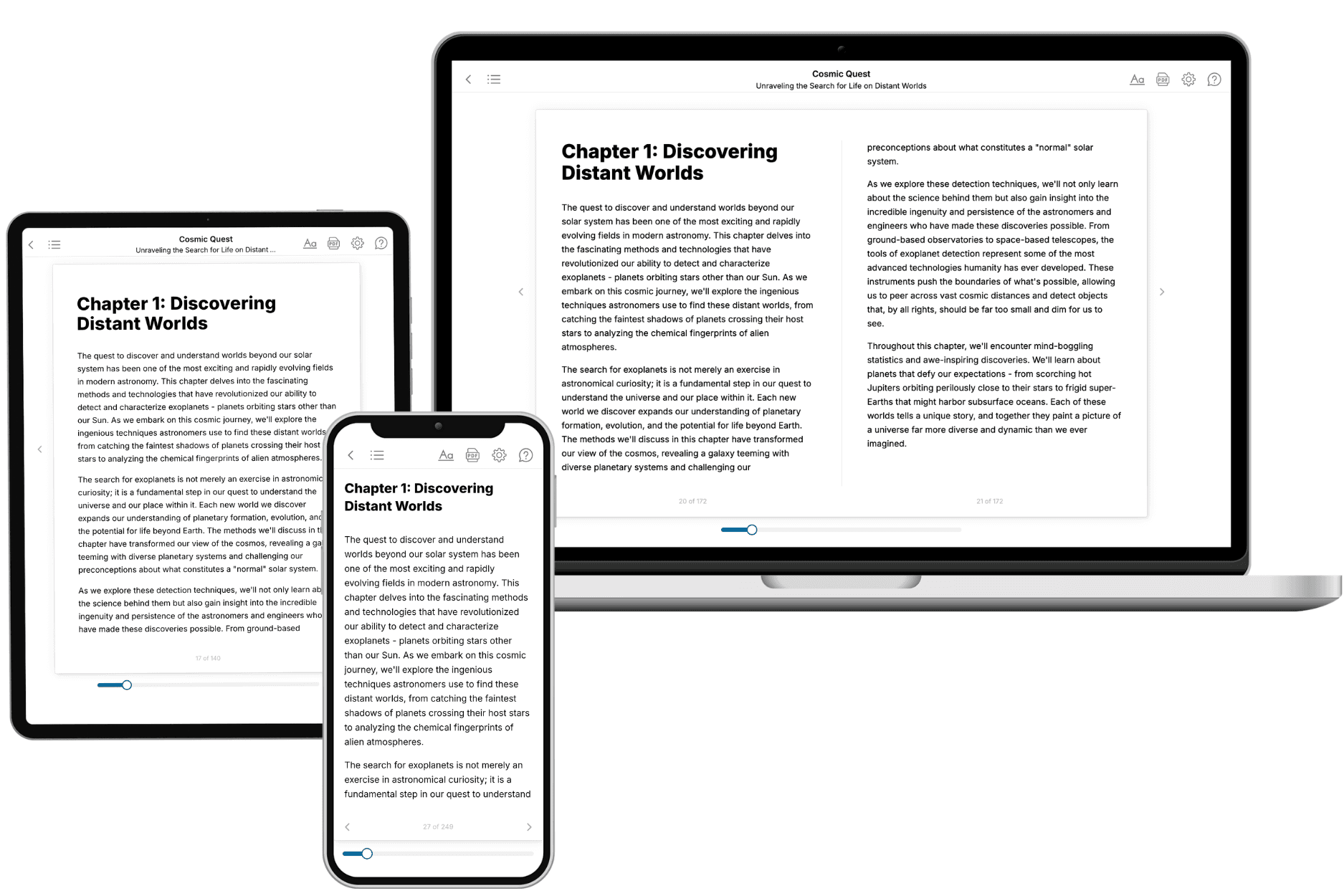
TailoredRead creates complete, full-length nonfiction ebooks, written specifically for you. Tell us what you want to learn and why, and TailoredRead writes you a complete ebook on it, with charts, tables, and diagrams throughout. Read it online, on Kindle, or on any e-reader, or download it as a PDF or EPUB. Every book is written fresh the day you order it.
- How is the book tailored to me?
Before anything is written, you answer a few short questions about your goals, your background, and the topics you care about. Your book is then planned around your answers: written at your level, focused on your goals, and covering the topics you chose, instead of the one-size-fits-all book a store sells everyone.
- Will it read like generic AI content?
No. Your book isn't a chat transcript: it's planned chapter by chapter before a single word is written, told in a clear book voice, and explains ideas visually with charts, tables, and diagrams. After writing, every book goes through an editorial pass that polishes chapters so the book reads consistent from start to finish. Judge for yourself: browse thousands of sample books on our Explore Books page.
- How accurate is the content?
Our AI first checks whether your subject needs live research. Niche and fast-moving subjects are researched before writing, and the book plan and chapters are grounded in what it finds. After writing, every book goes through a quality pass that checks its facts and consistency, and researched books list their sources in a Notes section at the back.
- How long is the book?
You choose the length: Comprehensive (250-300 pages), Detailed (150-200 pages), Essential (70-100 pages), or Short (30-50 pages).
- Does the book include visuals?
Yes. Every book includes visual elements such as timelines, checklists, step-by-step guides, decision trees, comparison tables, and matrices, and many include bar charts. A typical book includes dozens of these visual elements.
- Can I read it on Kindle? What formats can I download?
Yes. Every book can be read in our online reader or downloaded as a PDF or EPUB. The EPUB can be opened with Kindle, Apple Books, Kobo, and any e-reader. The Commercial and Author licenses also include an editable Word (DOCX) and Markdown download.
- How much does it cost?
About the price of a regular ebook. The exact price depends on your book's length and complexity, from $2 for the shortest books to $35 for the most comprehensive, and it's shown when you review your book, before you commit to anything. Each book is a one-time purchase, yours to keep, no subscription. Licenses that let you share, teach, or publish your book range from $35.99 to $49.99.
- Can I preview the book before purchasing?
Before you pay, you'll see what your book will cover: the title, a detailed description, the estimated length, and the complete chapter-by-chapter table of contents, so you know what you're getting before you decide. The full text itself is written after you purchase.
- How long does it take to create a book?
About 10 minutes. You can start reading the opening chapters while the rest is still being written.