Correlation vs Causation
Master the Critical Thinking Skills That Separate Sound Decisions from Flawed Reasoning
You'll develop the analytical rigor to spot the difference between coincidence and causation—a skill that transforms how you evaluate evidence, make decisions, and solve problems.
207 pages10 chaptersMay 25, 2026Critical Thinking
About this book
This book cuts through the confusion that leads professionals to draw wrong conclusions from data, make ineffective business decisions, and waste resources on solutions targeting the wrong root causes. You'll learn to identify confounding variables, recognize cognitive biases that trick you into false reasoning, and apply proven frameworks for determining whether relationships are truly causal. Through real-world examples from business, science, and everyday life, you'll master the tools that separate rigorous thinkers from those who mistake patterns for proof. Whether you're analyzing market trends, evaluating research claims, or troubleshooting organizational problems, these skills will sharpen your judgment and protect you from costly analytical mistakes.
Table of contents
- IntroductionWhy This Distinction Matters More Than You Think, The Hidden Cost of Confusing Correlation with Causation, What You'll Master in This BookRead below
- Chapter 1: Understanding CorrelationWhat Correlation Actually Means, How Correlation Is Measured and Interpreted, Real Examples of Correlation in Action
- Chapter 2: The Nature of CausationWhat True Causation Requires, Understanding Causal Mechanisms and Pathways, Clear Examples of Established Causal Relationships
- Chapter 3: The Critical DifferenceWhy Correlation Alone Proves Nothing, What Causation Requires Beyond Correlation, Common Mistakes in Reasoning
- Chapter 4: Confounding VariablesWhat Confounding Variables Are and How They Work, Techniques for Identifying Hidden Confounders, Methods for Controlling or Accounting for Confounders
- Chapter 5: Temporal Sequence and DirectionWhy Timing Is Essential but Not Sufficient, The Problem of Reverse Causality, When Causation Flows Both Ways
- Chapter 6: Research Methods and Evidence QualityRandomized Controlled Experiments: The Gold Standard, What Observational Studies Can and Cannot Tell Us, Understanding the Hierarchy of Evidence
- Chapter 7: Cognitive Biases That Mislead UsConfirmation Bias: Seeing What We Expect to See, Our Brain's Pattern-Seeking Nature, The Availability Heuristic and Memorable Examples
- Chapter 8: Complex Causal SystemsWhen Multiple Causes Contribute to One Effect, Feedback Loops and Circular Causation, Indirect Causal Pathways and Mediation
- Chapter 9: Practical Frameworks for AnalysisEssential Questions to Ask Before Accepting Causation, A Step-by-Step Framework for Causal Analysis, Applying Frameworks to Real Business Scenarios
- Chapter 10: Case Studies Across DomainsBusiness and Marketing: When Correlation Leads to Wrong Strategies, Health and Medicine: Distinguishing Association from Causation, Social Science: Untangling Complex Human Behavior
- ConclusionKey Takeaways for Sharper Thinking, Applying These Skills to Your Decisions
- Further Reading and Resources
Introduction
Every day, smart people draw wrong conclusions from perfectly good data. A company notices that sales spike whenever it runs a particular ad campaign, so it doubles the budget. A manager sees that employees who attend optional training sessions perform better, so she makes the sessions mandatory for everyone. A health journalist reports that people who drink red wine live longer, and millions of readers pour themselves a glass that evening. Each of these decisions feels logical. Each one is built on a foundation that may be completely false. The problem is not the data. The problem is the leap from these two things move together to one of them causes the other.
This leap is one of the most common and costly errors in human reasoning. It has a name: confusing correlation with causation. Correlation simply means that two variables tend to change together in a predictable pattern. Causation means that one variable actually produces a change in another. These are fundamentally different claims, and the gap between them is where bad decisions are born. The confusion is not a sign of low intelligence. It is a deeply human tendency, wired into the way our brains process patterns and build mental models of the world around us.
The good news is that this is a learnable skill. Distinguishing correlation from causation is not reserved for statisticians or academic researchers. It is a practical analytical capability that any professional can develop with the right frameworks and enough deliberate practice. This book gives you both. It walks you through the core concepts, the common traps, the cognitive biases that make us vulnerable, and the systematic tools that help you think more clearly about cause and effect. By the time you finish, you will approach data, research claims, and business decisions with a sharper, more disciplined eye.
The chapters ahead cover everything from the mathematics of measuring correlation to the psychology of why our brains jump to causal conclusions too quickly. You will explore real-world examples from business, medicine, social science, and everyday life. You will learn how to identify hidden confounding variables, how to evaluate the quality of evidence, and how to apply step-by-step frameworks when the stakes are high. This is not a book about becoming more skeptical for its own sake. It is about becoming more accurate, more effective, and more confident in the conclusions you draw and the actions you take.
Why This Distinction Matters More Than You Think
Most people learn the phrase "correlation does not imply causation" at some point in school or in a statistics course. They nod, they understand it in the abstract, and then they go right back to making causal assumptions from correlational data. This is not hypocrisy. It is a reflection of how difficult this distinction is to apply consistently in real situations, especially when the data looks compelling and the causal story feels intuitive. The phrase is easy to memorize. The habit of applying it rigorously is much harder to build.
Consider a well-known example that researchers have used to illustrate the problem. Studies have found a strong positive correlation between the number of firefighters sent to a fire and the amount of damage the fire causes. If you looked at this data without thinking carefully, you might conclude that firefighters cause damage. Obviously, that conclusion is absurd. The real explanation is a third variable: the size of the fire. Bigger fires cause more damage and also require more firefighters. The firefighters and the damage are both effects of the same underlying cause. This is a confounding variable, and it is the engine behind countless misleading correlations in the real world.[1]
The firefighter example is easy to see through because the causal story is obviously wrong. But most real-world cases are not so transparent. When a company sees that its highest-performing sales regions also have the most experienced managers, the causal story feels completely plausible. When a study finds that children who eat breakfast perform better in school, the mechanism seems obvious. When a business notices that customer satisfaction scores rise in the same quarters that a new product line launches, the connection feels natural. In each case, the correlation is real. The causal interpretation may not be.
The stakes of getting this wrong are significant. In business, misidentifying causation leads to wasted investment, failed initiatives, and missed opportunities. In medicine, it can lead to treatments that do not work or, worse, cause harm. In public policy, it can direct resources toward interventions that have no real effect on the problem they are meant to solve. In personal decision-making, it reinforces habits and beliefs that may be actively counterproductive. The cost of this confusion is not just intellectual. It is financial, physical, and organizational.
What makes this distinction so important is that it sits at the heart of every decision that involves cause and effect. And almost every meaningful decision does. When you ask what should we do to improve this outcome?
, you are implicitly asking a causal question. You are asking what intervention will produce a desired change. If your answer is based on correlation rather than causation, your intervention may do nothing at all. You will have spent time, money, and energy solving the wrong problem.
This is why the distinction matters more than most people realize. It is not a technical footnote for statisticians. It is the foundation of sound reasoning in any domain where you are trying to understand why something happens and what to do about it. That covers nearly every professional challenge worth taking seriously.
The encouraging reality is that developing this skill does not require a PhD in statistics. It requires a clear understanding of the core concepts, a set of practical questions to ask when evaluating evidence, and the discipline to slow down before jumping to conclusions. All of that is within reach, and this book is designed to get you there efficiently.
The Hidden Cost of Confusing Correlation with Causation
The costs of this confusion are rarely labeled as such. When a marketing campaign fails to move the needle, the post-mortem usually blames execution, timing, or market conditions. When a management initiative does not improve performance, the explanation tends to focus on employee resistance or poor rollout. Rarely does anyone step back and ask whether the original assumption about cause and effect was correct in the first place. This is how the confusion stays hidden. The errors it produces get attributed to other causes, and the flawed reasoning goes unchallenged.
One of the most instructive business examples comes from the early days of data-driven marketing. Companies noticed that customers who received more email communications tended to spend more money. The obvious conclusion was that more emails caused more spending. Many companies responded by dramatically increasing their email frequency. What actually happened in many cases was that the relationship ran in the opposite direction: customers who were already highly engaged and likely to spend more were also more likely to open and respond to emails. The emails were not driving the spending. The spending behavior was driving the email engagement metrics. Companies that missed this distinction ended up annoying their customer base and increasing unsubscribe rates.[2]
In medicine, the consequences can be even more serious. For decades, observational studies suggested that hormone replacement therapy (HRT) reduced the risk of heart disease in postmenopausal women. The correlation was consistent across multiple large studies. Many physicians recommended HRT partly on this basis. When randomized controlled trials were finally conducted, they found the opposite: HRT actually increased cardiovascular risk in some populations. The observational studies had been confounded by a phenomenon called the "healthy user bias." Women who chose to take HRT tended to be healthier, more health-conscious, and more engaged with medical care overall. Their better heart health was not caused by HRT. It was caused by the same underlying factors that led them to seek HRT in the first place.[3]
In organizational settings, the confusion between correlation and causation drives a particular kind of waste that is almost invisible: the resources spent on interventions that target symptoms rather than causes. A company might notice that its highest-performing teams have more frequent one-on-one meetings between managers and employees. It rolls out a company-wide policy requiring weekly one-on-ones. The meetings happen, but performance does not improve. Why? Because the meetings were a symptom of good management, not the cause of it. Good managers naturally have more meaningful conversations with their teams. Mandating the meetings without addressing the underlying quality of management produces the form without the substance.
The hidden cost also shows up in what does not get done. When resources flow toward interventions based on false causal assumptions, they are not flowing toward interventions that might actually work. This is the opportunity cost of flawed reasoning. Every dollar spent on a solution targeting the wrong root cause is a dollar not spent on a solution that could make a real difference. Over time, these opportunity costs compound into significant organizational disadvantage.
There is also a reputational cost. Professionals who consistently draw wrong causal conclusions from data lose credibility, even when the errors are not immediately obvious. Decision-makers who invest in initiatives that fail to produce results eventually face questions about their analytical judgment. In a world where data is increasingly central to professional decision-making, the ability to reason carefully about cause and effect is becoming a core competency, not an optional extra.
The most dangerous kind of mistake is the one that feels like good reasoning. When a causal story is plausible and the correlation is strong, the error is almost invisible until the intervention fails. Building the habit of questioning causal assumptions before acting on them is the most reliable protection against this kind of costly mistake.
Understanding these costs is not meant to make you paralyzed by uncertainty. It is meant to motivate the investment in better analytical habits. The goal is not to stop making decisions under uncertainty. It is to make better decisions by being clearer about what the evidence actually supports and what it does not.
What You'll Master in This Book
This book is organized to build your understanding progressively, starting with the foundational concepts and moving toward practical application. Each chapter addresses a specific aspect of the correlation-causation problem, and together they form a complete toolkit for more rigorous analytical thinking. Here is a clear picture of what you will gain from each part of the journey.
The first section of the book establishes the conceptual foundation. Chapter 1 covers correlation in depth: what it actually means statistically, how it is measured, and how to interpret correlation coefficients correctly. You will learn why a correlation of 0.9 is not necessarily more meaningful than a correlation of 0.3, and why the strength of a correlation tells you nothing about whether it reflects a causal relationship. Chapter 2 then turns to causation, defining what it actually requires and exploring the concept of causal mechanisms. Understanding what causation means precisely is essential before you can reliably distinguish it from correlation. Chapter 3 brings these two concepts together and examines the critical difference between them, including the most common reasoning mistakes that professionals make when moving from data to conclusions.
The middle section of the book digs into the specific challenges that make causal reasoning difficult in practice. Chapter 4 is dedicated to confounding variables, which are the hidden factors that create the illusion of causation where none exists. You will learn concrete techniques for identifying potential confounders and methods for controlling or accounting for them in your analysis. Chapter 5 addresses the role of time in causal reasoning. The cause must precede the effect, but timing alone is not enough to establish causation. This chapter also covers the problem of reverse causality, where the assumed direction of cause and effect is actually backwards. Chapter 6 examines research methods and evidence quality, explaining why randomized controlled experiments are the gold standard for establishing causation and what observational studies can and cannot tell you.
The later chapters address the human side of the problem. Even with strong analytical skills, cognitive biases can lead you astray. Chapter 7 covers the most relevant biases in detail:
- Confirmation bias, which leads you to notice evidence that supports your existing beliefs and overlook evidence that contradicts them
- Pattern-seeking, the brain's tendency to find meaningful connections even in random data
- The availability heuristic, which causes memorable examples to feel more representative than they actually are
Chapter 8 moves into the territory of complex causal systems, where simple two-variable thinking breaks down. Real-world causal relationships often involve multiple contributing causes, feedback loops where effects circle back to influence their own causes, and indirect pathways where the connection between cause and effect runs through intermediate variables. This chapter gives you the conceptual tools to think about causation in more realistic, nuanced terms.
Chapter 9 is where everything comes together in a practical framework. You will get a set of essential questions to ask before accepting any causal claim, along with a step-by-step process for conducting your own causal analysis. This framework is designed to be usable in real professional situations, not just in academic research settings. The chapter includes worked examples showing how to apply the framework to realistic business scenarios.
Chapter 10 presents detailed case studies from three domains: business and marketing, health and medicine, and social science. These cases illustrate how the concepts and frameworks from earlier chapters apply to real situations with real stakes. They also show the range of ways that the correlation-causation confusion manifests across different fields, reinforcing the universality of the problem and the tools for addressing it.
By the end of this book, you will have developed a set of specific, transferable capabilities. Here is what that looks like in practice:
- You will be able to read a research finding or business report and immediately identify whether the causal claims are supported by the evidence presented
- You will know how to generate a list of plausible confounding variables for any observed correlation and assess how likely they are to explain the relationship
- You will understand the difference between different types of evidence and know how much weight to give each type when making decisions
- You will recognize the cognitive biases that make causal reasoning difficult and have concrete strategies for counteracting them
- You will be able to apply a structured analytical framework to complex causal questions in your own professional context
These are not abstract academic skills. They are practical capabilities that will change how you evaluate information, how you design initiatives, and how you explain your reasoning to others. In a professional environment where data is abundant but good judgment is scarce, these skills are a genuine competitive advantage.
One important note about the approach taken throughout this book: the goal is not to make you so skeptical that you refuse to draw any conclusions from data. Productive decision-making requires acting on the best available evidence, even when that evidence is imperfect. The goal is calibrated confidence: knowing how much certainty your evidence actually supports, being clear about the assumptions you are making, and remaining open to revising your conclusions when better evidence emerges. That is what rigorous thinking looks like in practice, and that is what this book is designed to help you achieve.
The journey from pattern-noticing to sound causal reasoning is one of the most valuable intellectual investments you can make as a professional. The concepts are accessible, the frameworks are practical, and the payoff is immediate. Every chapter builds directly on the last, so the understanding you develop compounds as you move through the book. Start with an open mind and a willingness to question assumptions you may have held for years. That willingness is the most important thing you bring to this material, and it will serve you well long after you finish the final page.
Notes
Introduction
This is the end of the free sample. The full book has 10 chapters.
Want this book written for you?
Tell us your goals and background, and get your own version of this book, tailored by AI to you.


Benefits of AI-tailored books
- Read one book, not ten:
- all the Critical Thinking knowledge you need, gathered into a single book.
- Save days of learning:
- tell us your goals, choose your topics, and the whole book is built around them.
- Learn effortlessly:
- Critical Thinking book written for your specific background and expertise.
- Understand at a glance:
- includes charts, tables, timelines, checklists, decision trees, and more.
- Stay current:
- written the day you order it, not years ago.
- Trust what you read:
- every book is checked for accuracy, with real research when your subject needs it.
Create your unique book in 3 steps
- 1. Select your focus
Select the focus of your Critical Thinking book and share your background
- 2. Personalize your book
Specify your goals and choose sub-topics to include
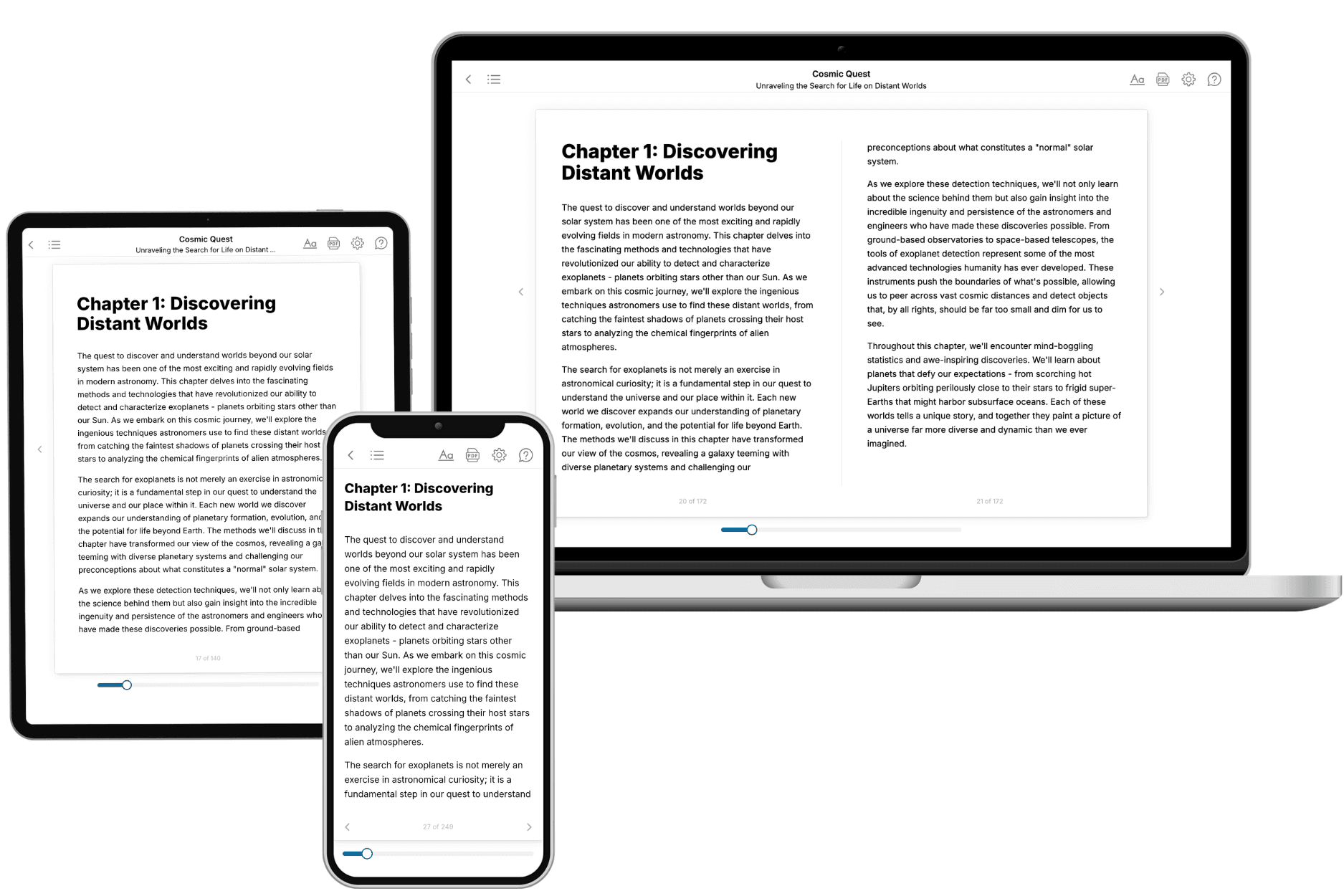
- 3. Get your tailored book
Your book is ready in 10 minutes. Read it online, download as EPUB or PDF, or send to Kindle.
Frequently asked questions
- What is TailoredRead?
TailoredRead creates complete, full-length nonfiction ebooks, written specifically for you. Tell us what you want to learn and why, and TailoredRead writes you a complete ebook on it, with charts, tables, and diagrams throughout. Read it online, on Kindle, or on any e-reader, or download it as a PDF or EPUB. Every book is written fresh the day you order it.
- How is the book tailored to me?
Before anything is written, you answer a few short questions about your goals, your background, and the topics you care about. Your book is then planned around your answers: written at your level, focused on your goals, and covering the topics you chose, instead of the one-size-fits-all book a store sells everyone.
- Will it read like generic AI content?
No. Your book isn't a chat transcript: it's planned chapter by chapter before a single word is written, told in a clear book voice, and explains ideas visually with charts, tables, and diagrams. After writing, every book goes through an editorial pass that polishes chapters so the book reads consistent from start to finish. Judge for yourself: browse thousands of sample books on our Explore Books page.
- How accurate is the content?
Our AI first checks whether your subject needs live research. Niche and fast-moving subjects are researched before writing, and the book plan and chapters are grounded in what it finds. After writing, every book goes through a quality pass that checks its facts and consistency, and researched books list their sources in a Notes section at the back.
- How long is the book?
You choose the length: Comprehensive (250-300 pages), Detailed (150-200 pages), Essential (70-100 pages), or Short (30-50 pages).
- Does the book include visuals?
Yes. Every book includes charts, tables, and diagrams: timelines, checklists, step-by-step guides, decision trees, comparison tables, matrices, and bar charts. A typical book includes dozens of these visual elements.
- Can I read it on Kindle? What formats can I download?
Yes. Every book can be read in our online reader or downloaded as a PDF or EPUB. The EPUB can be opened with Kindle, Apple Books, Kobo, and any e-reader. The Commercial and Author licenses also include an editable Word (DOCX) and Markdown download.
- How much does it cost?
About the price of a regular ebook. The exact price depends on your book's length and complexity, from $2 for the shortest books to $35 for the most comprehensive, and it's shown when you review your book, before you commit to anything. Each book is a one-time purchase, yours to keep, no subscription. Licenses that let you share, teach, or publish your book range from $35.99 to $49.99.
- Can I preview the book before purchasing?
Before you pay, you'll see what your book will cover: the title, a detailed description, the estimated length, and the complete chapter-by-chapter table of contents, so you know what you're getting before you decide. The full text itself is written after you purchase.
- How long does it take to create a book?
About 10 minutes. You can start reading the opening chapters while the rest is still being written.