Counting Sort Mastery
A Practical Guide to Understanding and Implementing Linear-Time Sorting
Most sorting algorithms compare elements to determine order, but what if you could sort without any comparisons at all?
191 pages9 chaptersMar 12, 2026Algorithms
About this book
Counting sort breaks this paradigm by leveraging the structure of your data itself. If you've struggled to understand why counting sort is so fast, when it actually makes sense to use it, or how to implement it correctly in your projects, this book provides the clarity you need. Rather than abstract theory, you'll learn through concrete examples, step-by-step walkthroughs, and practical implementations. Discover how counting sort achieves linear time complexity, why stability matters in real applications, and how to recognize when this algorithm is the right choice for your problem. Whether you're preparing for technical interviews, optimizing performance-critical code, or simply deepening your algorithmic knowledge, this guide transforms counting sort from a mysterious concept into a tool you can confidently apply.
Table of contents
- IntroductionWhy Sorting Matters in Computer Science, Beyond Comparison-Based Sorting, What You'll Learn in This Book, How to Use This GuideRead below
- Chapter 1: Sorting Fundamentals and Algorithm BasicsUnderstanding the Sorting Problem, Algorithm Analysis: Time and Space Complexity, The Limits of Comparison-Based Sorting
- Chapter 2: Introduction to Counting SortThe Core Concept Behind Counting Sort, When Counting Sort Makes Sense, Key Assumptions and Constraints
- Chapter 3: Step-by-Step Mechanics of Counting SortPhase 1: Counting Occurrences, Phase 2: Computing Cumulative Counts, Phase 3: Placing Elements in Output, Complete Worked Example with Visualization
- Chapter 4: Implementing Counting Sort in CodeBasic Implementation from Scratch, Implementations in Python, Java, and C++, Handling Edge Cases and Variations
- Chapter 5: Stability and Advanced PropertiesUnderstanding Stability in Sorting, Implementing Stable Counting Sort, Why Stability Matters in Practice
- Chapter 6: Complexity Analysis and PerformanceTime Complexity: Achieving O(n+k), Space Complexity and Memory Trade-offs, Comparing Counting Sort to Other Algorithms
- Chapter 7: Variations and ExtensionsHandling Negative Numbers, Adapting for Different Data Types, Counting Sort as Foundation for Radix Sort
- Chapter 8: Real-World Applications and Use CasesPractical Scenarios Where Counting Sort Shines, Case Studies: Grades, Scores, and Histograms, Applications in Data Processing and Networking
- Chapter 9: Choosing the Right Sorting AlgorithmDecision Framework for Algorithm Selection, Understanding Space-Time Trade-offs, Practical Recommendations for Different Scenarios
- ConclusionKey Takeaways, Next Steps in Your Algorithmic Journey
- Appendix: Quick Reference and ResourcesAlgorithm Pseudocode, Complexity Comparison Cheatsheet, Further Reading and Learning Resources
Introduction
Sorting is one of the most studied problems in all of computer science, and for good reason. Nearly every software system you interact with relies on sorted data in some form, whether it's a search engine ranking results, a database retrieving records, or a mobile app displaying a list of contacts. Over decades of research, computer scientists have developed dozens of sorting algorithms, each with its own strengths, weaknesses, and ideal use cases. Most of these algorithms share a common approach: they compare elements against each other to figure out the right order. But there's a different class of algorithms that takes a completely different path.
Counting sort belongs to that different class. Instead of asking "is this element larger or smaller than that one?", counting sort asks "how many times does each value appear?" That shift in perspective is what makes it so powerful in the right circumstances. By counting occurrences and using those counts to calculate positions, counting sort can sort a list of integers in linear time, meaning the time it takes grows proportionally to the size of the input rather than faster. For the right kind of data, this is a significant advantage over even the best comparison-based algorithms.
This book is designed to take you from a basic familiarity with sorting algorithms to a confident, practical understanding of counting sort. You'll learn not just how it works, but why it works, when to use it, and how to implement it correctly. The goal isn't to memorize an algorithm. The goal is to understand it deeply enough that you can adapt it, optimize it, and recognize the problems it's best suited to solve. Whether you're preparing for a technical interview, working on performance-sensitive code, or simply filling a gap in your algorithmic knowledge, this guide is built to give you exactly that.
The chapters ahead move from foundational concepts to practical implementation to real-world application. Along the way, you'll find concrete examples, step-by-step walkthroughs, and working code in multiple programming languages. Each section builds on the last, so by the time you reach the end, counting sort won't feel like an abstract concept from a textbook. It will feel like a tool you actually know how to use.
Why Sorting Matters in Computer Science
Sorting might seem like a simple, almost mundane task. You have a list of things, and you want them in order. But the implications of sorting reach into almost every corner of software development. Sorted data enables binary search, which reduces lookup time from O(n) to O(log n). Sorted records make database queries dramatically faster. Sorted inputs simplify algorithms for finding duplicates, computing medians, and merging datasets. In short, sorting is often the preprocessing step that makes everything else efficient.
Consider a practical example. Imagine you're building a leaderboard for an online game with one million players. If player scores are unsorted, finding the top 100 players requires scanning every single record. That's one million comparisons every time someone checks the leaderboard. If scores are kept sorted, the top 100 are always right at the front of the list. The difference in user experience and server load is enormous. This kind of scenario plays out constantly in real systems, from e-commerce product rankings to social media feeds to financial transaction logs.
Sorting also serves as a benchmark for algorithmic thinking. When computer scientists want to understand the limits of what's computationally possible, sorting is one of the first problems they analyze. The famous comparison-based lower bound proof, which shows that no comparison-based algorithm can sort faster than O(n log n) in the worst case, is a cornerstone result in theoretical computer science.[1] Understanding why that bound exists, and how algorithms like counting sort sidestep it, teaches you something fundamental about the relationship between data structure and algorithmic efficiency.
Beyond theory, sorting is a topic that comes up constantly in technical interviews. Companies like Google, Amazon, and Microsoft regularly ask candidates to implement sorting algorithms, analyze their complexity, or explain when one algorithm is preferable to another. Knowing counting sort well, including its mechanics, its constraints, and its trade-offs, gives you a concrete advantage in those conversations. It demonstrates that you understand algorithms at a deeper level than just memorizing pseudocode.
It's also worth noting that sorting performance can have real business impact. A study by Google found that a 500-millisecond increase in search page load time reduced traffic by 20%.[2] While many factors contribute to page load time, data processing speed, including sorting, is a meaningful part of the picture. In high-throughput systems processing millions of records per second, choosing the right sorting algorithm can be the difference between a system that scales and one that doesn't.
Sorting matters, in other words, not just as an academic exercise but as a practical engineering concern. The more sorting algorithms you understand deeply, the better equipped you are to make smart decisions when performance counts. Counting sort is one of the most powerful tools in that toolkit, and it's one that many developers overlook or misunderstand.
Beyond Comparison-Based Sorting
Most sorting algorithms you've likely encountered, including quicksort, mergesort, heapsort, and bubble sort, are comparison-based. They work by comparing pairs of elements and using the result of those comparisons to determine order. This approach is intuitive and general-purpose. It works on any data type that can be compared: numbers, strings, dates, custom objects. But it comes with a fundamental cost.
The theoretical lower bound for comparison-based sorting is O(n log n). This isn't a limitation of any particular algorithm. It's a mathematical fact about the problem itself. To sort n elements using only comparisons, you need at least O(n log n) comparisons in the worst case, no matter how clever your algorithm is.[3] The proof relies on information theory: there are n! possible orderings of n elements, and each comparison can only distinguish between two possibilities, so you need at least log₂(n!) comparisons, which is Θ(n log n).
Non-comparison-based sorting algorithms escape this bound by using additional information about the data. Instead of treating elements as black boxes that can only be compared, they exploit the structure of the values themselves. Counting sort, for example, works specifically with integers in a known range. Radix sort works with integers or strings of fixed length. Bucket sort works with uniformly distributed floating-point numbers. Each of these algorithms uses knowledge about the data to sort faster than O(n log n).
This is a crucial conceptual shift. When you use a comparison-based algorithm, you're asking: "What is the relative order of these two elements?" When you use counting sort, you're asking: "How many elements have each possible value?" The second question can be answered in a single pass through the data, which is why counting sort achieves O(n + k) time, where n is the number of elements and k is the range of values. If k is small relative to n, this is dramatically faster than O(n log n).
A concrete illustration: Suppose you need to sort 10,000 exam scores, each between 0 and 100. A comparison-based algorithm like mergesort would need roughly
10,000 × log₂(10,000) ≈ 133,000operations. Counting sort would need roughly10,000 + 101 ≈ 10,101operations. That's more than 13 times faster, and the advantage grows as the number of elements increases.
The trade-off, of course, is that counting sort isn't universally applicable. It requires integer data (or data that can be mapped to integers) within a bounded range. If you're sorting arbitrary strings or floating-point numbers with high precision, counting sort isn't the right tool. Understanding when these constraints are met, and when they aren't, is a key part of using counting sort effectively. That judgment is something this book will help you develop.
Non-comparison-based sorting also opens the door to a family of related algorithms. Counting sort is the foundation for radix sort, which extends linear-time sorting to larger ranges by sorting digit by digit. Understanding counting sort deeply means you'll also understand why radix sort works, how to implement it, and when it's the right choice. The concepts build on each other in a way that makes mastering counting sort a genuinely high-leverage investment of your learning time.
What You'll Learn in This Book
This book covers counting sort from the ground up, starting with the foundational concepts you need and building toward practical mastery. Each chapter is designed to add a specific layer of understanding, so that by the end, you have a complete and usable picture of the algorithm. Here's a brief overview of what each part of the book covers.
Chapter 1 establishes the foundations. It covers what sorting actually means as a computational problem, how to analyze algorithms using Big O notation, and why comparison-based algorithms have an inherent speed limit. If you're already comfortable with these concepts, you can move through this chapter quickly. If any of them feel fuzzy, this chapter will sharpen your understanding before the more specific material begins.
Chapters 2 and 3 introduce counting sort itself. Chapter 2 explains the core idea and the conditions under which counting sort is the right choice. Chapter 3 walks through the algorithm step by step, covering the three phases: counting occurrences, computing cumulative counts, and placing elements in the output array. A complete worked example with visual diagrams makes the mechanics concrete and easy to follow.
Chapter 4 moves into implementation. You'll see working code in Python, Java, and C++, along with explanations of the key decisions in each implementation. Edge cases are covered explicitly, including empty arrays, single-element arrays, and arrays where all elements are the same value. This chapter is designed to be practical and immediately usable.
Chapters 5 and 6 go deeper into the algorithm's properties. Chapter 5 covers stability, explaining what it means for a sorting algorithm to be stable, how to implement counting sort in a way that preserves stability, and why stability matters in real applications. Chapter 6 provides a rigorous complexity analysis, breaking down exactly where the O(n + k) time complexity comes from and how memory usage scales with input size.
Chapters 7 and 8 expand the picture. Chapter 7 covers variations and extensions, including how to handle negative numbers, how to adapt the algorithm for different data types, and how counting sort serves as the building block for radix sort. Chapter 8 explores real-world applications, with case studies drawn from education, data processing, image processing, and networking.
Chapter 9 ties everything together with a decision framework for choosing the right sorting algorithm. You'll come away with a clear mental model for evaluating any sorting problem and selecting the best approach, whether that's counting sort, a comparison-based algorithm, or something else entirely. The conclusion and appendix provide a summary of key takeaways, suggestions for further learning, and a quick-reference guide you can return to whenever you need it.
How to Use This Guide
This book is written for intermediate computer science students and software developers who already have some familiarity with algorithms and data structures. You don't need to be an expert, but you should be comfortable with basic concepts like arrays, loops, and Big O notation. If those terms are unfamiliar, spending a few hours with an introductory algorithms resource before starting this book will make the material much easier to absorb.
The chapters are designed to be read in order, because each one builds on the previous. That said, if you already have a solid grasp of sorting fundamentals and Big O analysis, you can skim Chapter 1 and jump directly into Chapter 2. Similarly, if you're primarily interested in implementation, you can read Chapters 2 and 3 for the conceptual foundation and then go straight to Chapter 4 for the code. The book is structured to support both linear reading and targeted reference.
The code examples in this book are written to be readable and educational rather than maximally optimized. The goal is to make the algorithm's logic as clear as possible, not to squeeze out every last microsecond of performance. Once you understand the algorithm well, you'll be in a much better position to optimize it for your specific use case. Comments in the code explain the purpose of each step, so you can follow along even if you're not deeply familiar with the language being used.
To get the most out of this book, try to implement the algorithm yourself after reading each chapter. Don't just read the code examples. Type them out, run them, and experiment with different inputs. Change the range of values. Try sorting strings by mapping them to integers. Break the algorithm intentionally and see what happens. Active engagement with the material is far more effective than passive reading, especially for algorithmic content where the details matter.
Here are a few specific suggestions for making the most of your time with this book:
- Keep a code editor open while reading Chapters 3 and 4, and implement each phase of the algorithm as you learn it.
- After reading Chapter 6, try to derive the time complexity yourself before reading the explanation. This kind of active recall strengthens understanding significantly.
- When you reach Chapter 9, think of a real project you've worked on or are currently working on, and apply the decision framework to a sorting problem from that project.
- Use the appendix as a quick reference when you need to recall the pseudocode or complexity figures without re-reading entire chapters.
If you're using this book to prepare for technical interviews, pay particular attention to Chapters 3, 5, and 6. Interviewers frequently ask candidates to explain how counting sort works, why it's stable, and what its complexity is. Being able to answer those questions clearly and confidently, with concrete examples, will set you apart from candidates who have only memorized the algorithm without truly understanding it.
Finally, it's worth setting realistic expectations. Counting sort is not a universal solution. It's a specialized tool that works brilliantly in specific circumstances and poorly in others. By the end of this book, you'll know exactly what those circumstances are. That kind of precise, nuanced understanding is what separates developers who can apply algorithms thoughtfully from those who apply them mechanically. That's the goal, and this book is designed to get you there.
This is the end of the free sample. The full book has 9 chapters.
Want this book written for you?
Tell us your goals and background, and get your own version of this book, tailored by AI to you.


Benefits of AI-tailored books
- Read one book, not ten:
- all the Algorithms knowledge you need, gathered into a single book.
- Save days of learning:
- tell us your goals, choose your topics, and the whole book is built around them.
- Learn effortlessly:
- Algorithms book written for your specific background and expertise.
- Understand at a glance:
- includes charts, tables, timelines, checklists, decision trees, and more.
- Stay current:
- written the day you order it, not years ago.
- Trust what you read:
- every book is checked for accuracy, with real research when your subject needs it.
Create your unique book in 3 steps
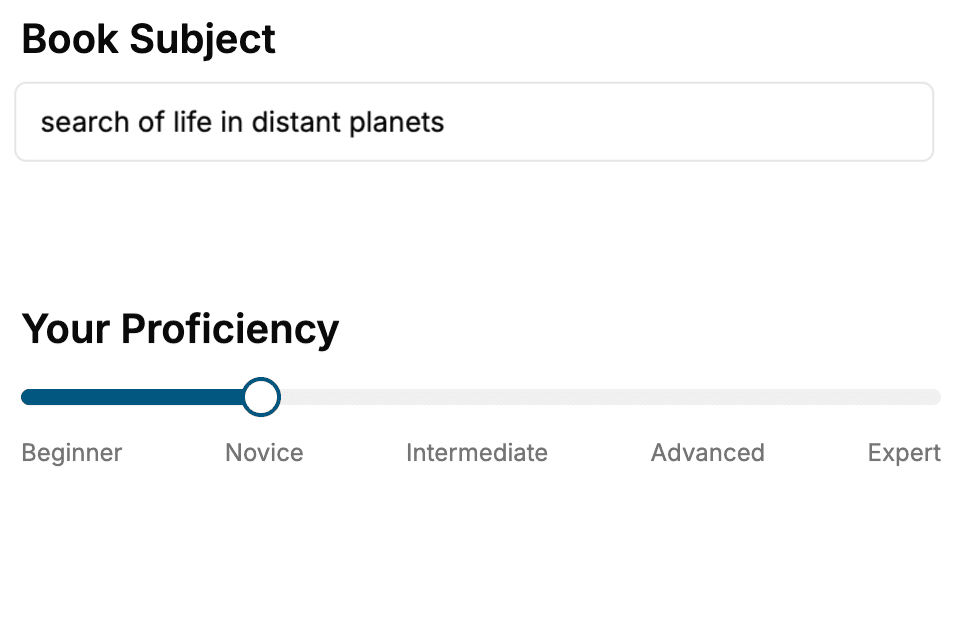
- 1. Select your focus
Select the focus of your Algorithms book and share your background
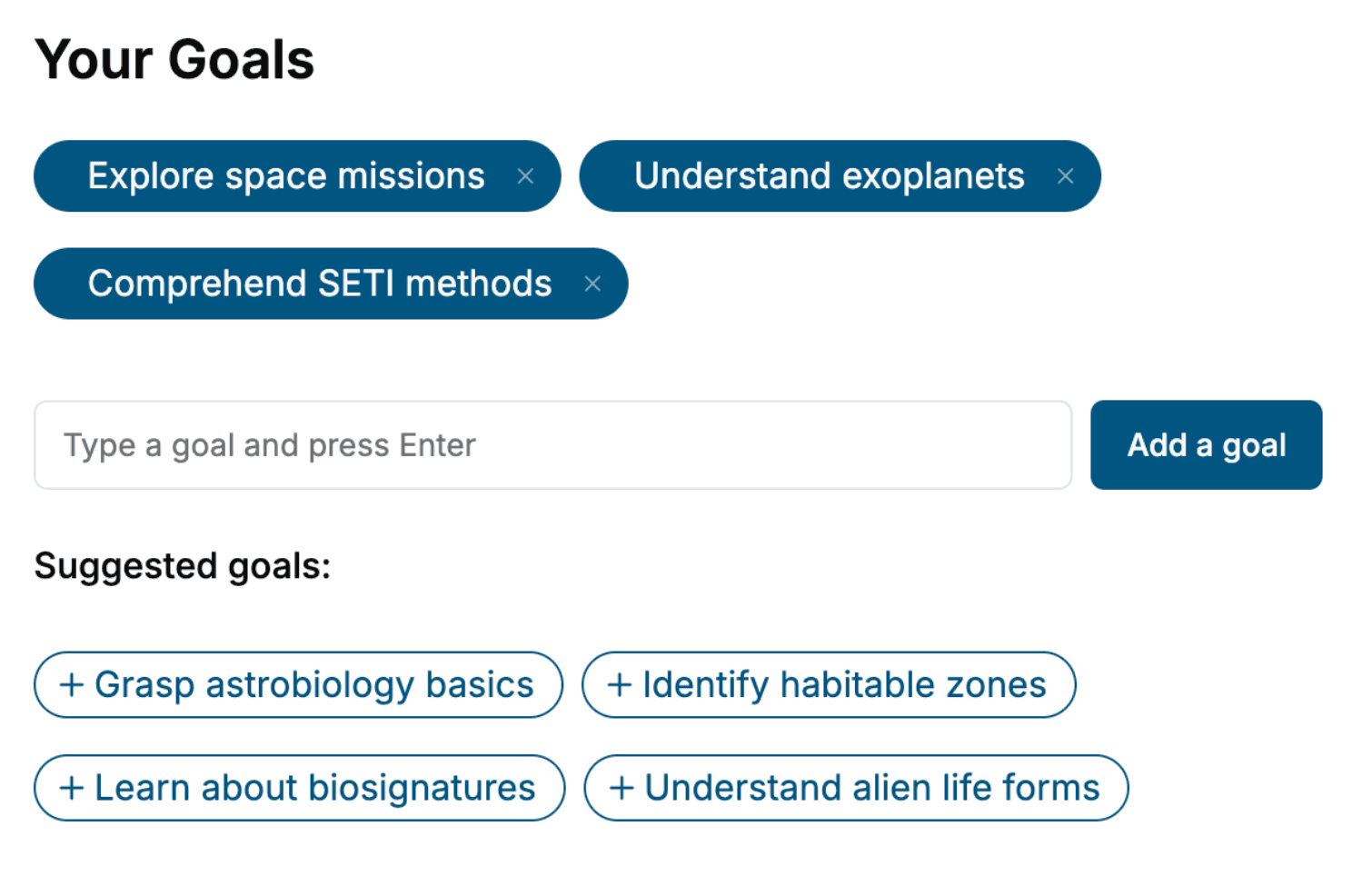
- 2. Personalize your book
Specify your goals and choose sub-topics to include
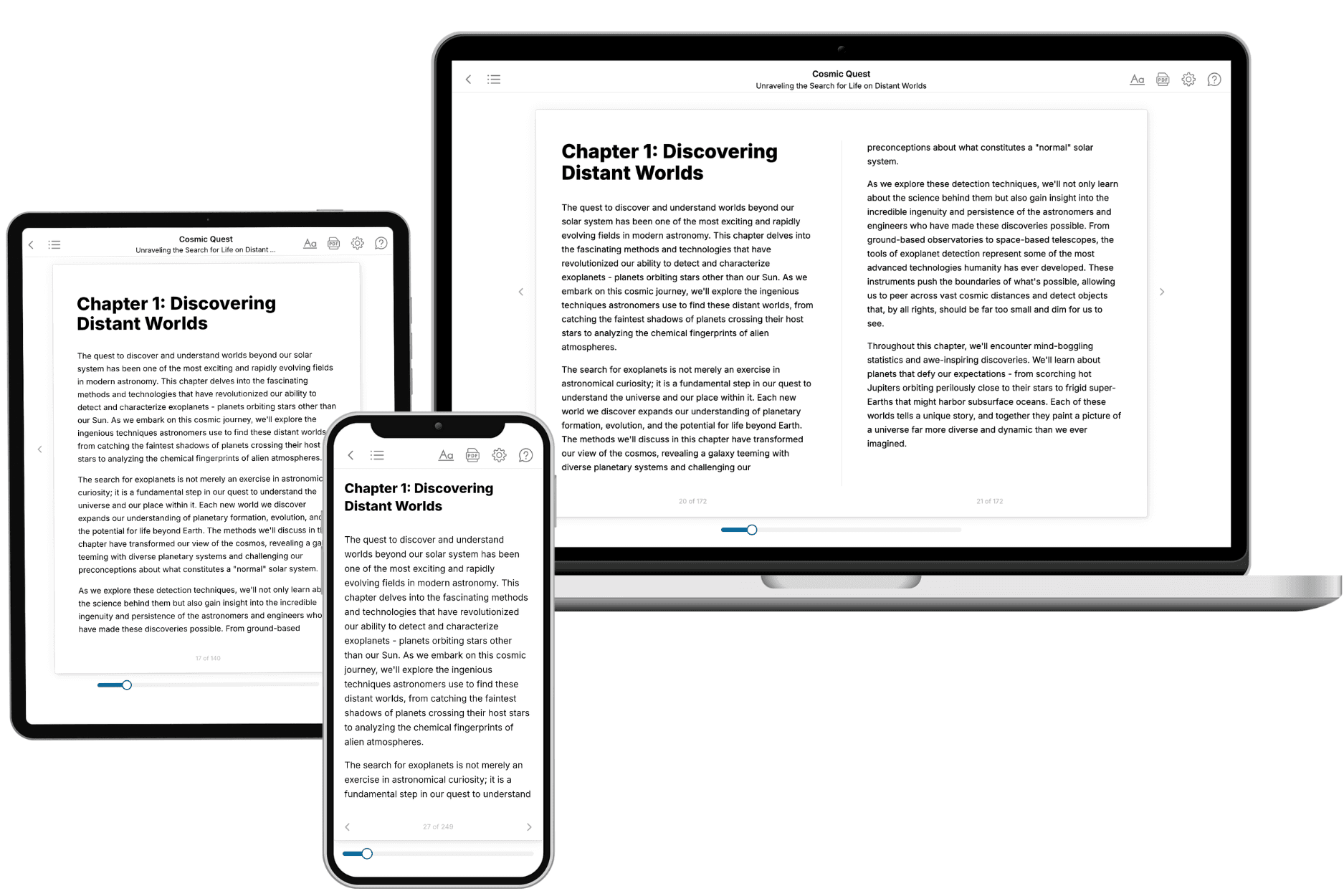
- 3. Get your tailored book
Your book is ready in 10 minutes. Read it online, download as EPUB or PDF, or send to Kindle.
Frequently asked questions
- What is TailoredRead?
TailoredRead creates complete, full-length nonfiction ebooks, written specifically for you. Tell us what you want to learn and why, and TailoredRead writes you a complete ebook on it, with charts, tables, and diagrams throughout. Read it online, on Kindle, or on any e-reader, or download it as a PDF or EPUB. Every book is written fresh the day you order it.
- How is the book tailored to me?
Before anything is written, you answer a few short questions about your goals, your background, and the topics you care about. Your book is then planned around your answers: written at your level, focused on your goals, and covering the topics you chose, instead of the one-size-fits-all book a store sells everyone.
- Will it read like generic AI content?
No. Your book isn't a chat transcript: it's planned chapter by chapter before a single word is written, told in a clear book voice, and explains ideas visually with charts, tables, and diagrams. After writing, every book goes through an editorial pass that polishes chapters so the book reads consistent from start to finish. Judge for yourself: browse thousands of sample books on our Explore Books page.
- How accurate is the content?
Our AI first checks whether your subject needs live research. Niche and fast-moving subjects are researched before writing, and the book plan and chapters are grounded in what it finds. After writing, every book goes through a quality pass that checks its facts and consistency, and researched books list their sources in a Notes section at the back.
- How long is the book?
You choose the length: Comprehensive (250-300 pages), Detailed (150-200 pages), Essential (70-100 pages), or Short (30-50 pages).
- Does the book include visuals?
Yes. Every book includes charts, tables, and diagrams: timelines, checklists, step-by-step guides, decision trees, comparison tables, matrices, and bar charts. A typical book includes dozens of these visual elements.
- Can I read it on Kindle? What formats can I download?
Yes. Every book can be read in our online reader or downloaded as a PDF or EPUB. The EPUB can be opened with Kindle, Apple Books, Kobo, and any e-reader. The Commercial and Author licenses also include an editable Word (DOCX) and Markdown download.
- How much does it cost?
About the price of a regular ebook. The exact price depends on your book's length and complexity, from $2 for the shortest books to $35 for the most comprehensive, and it's shown when you review your book, before you commit to anything. Each book is a one-time purchase, yours to keep, no subscription. Licenses that let you share, teach, or publish your book range from $35.99 to $49.99.
- Can I preview the book before purchasing?
Before you pay, you'll see what your book will cover: the title, a detailed description, the estimated length, and the complete chapter-by-chapter table of contents, so you know what you're getting before you decide. The full text itself is written after you purchase.
- How long does it take to create a book?
About 10 minutes. You can start reading the opening chapters while the rest is still being written.