Complexity Theory Books
Explore tailored Complexity Theory books created by our AI
Imagine a world where you can effortlessly solve complex optimization problems, revolutionizing industries from logistics to circuit design. In "The Traveling Salesman's Dilemma," you'll dive deep into one of computer science's most intriguing puzzles: the Traveling Salesman Problem (TSP). This book takes you on an exhilarating journey through the realm of NP-Complete problems, unraveling the mysteries that have captivated computer scientists for decades. As you progress through the pages, you'll gain a solid foundation in computational complexity theory and discover how the TSP serves as a gateway to understanding a wide array of challenging problems. You'll explore cutting-edge algorithms and heuristics designed to tackle the TSP, equipping you with practical tools to approach similar optimization challenges in your own work. By the time you finish this book, you'll have a newfound appreciation for the elegance and importance of the Traveling Salesman Problem. You'll be able to analyze complex problems through the lens of NP-Completeness, and apply your knowledge to real-world scenarios. Whether you're a computer science student, a software engineer, or an algorithm enthusiast, this book will empower you to think critically about computational efficiency and inspire you to contribute to the ongoing quest for better solutions in the field of computer science.
Cracking the Code
A Practical Guide to Algorithmic Optimization and NP-Complete Problems
Most people assume that if a problem is important enough, there must be a fast way to solve it. The reality is far more nuanced. Some problems are fundamentally harder than others—not because we haven't found the right algorithm yet, but because of deep mathematical properties that may make efficient solutions impossible. This book demystifies algorithmic optimization and computational complexity, showing you how to recognize which problems are tractable and which require creative workarounds. You'll learn why some optimization challenges that seem simple are actually among the hardest problems in computer science, and discover practical techniques—from dynamic programming to approximation algorithms—that let you solve real-world problems even when perfect solutions are out of reach. Whether you're designing systems, optimizing code, or tackling research challenges, understanding these principles transforms how you approach computational problems.
The Shortest Path
Mastering Algorithms and Complexity in Graph Optimization
You're staring at a complex optimization problem, knowing there must be an efficient solution, but the sheer number of possible approaches feels overwhelming. Whether you're routing delivery trucks, finding optimal network paths, or solving maze-like puzzles, the challenge isn't just finding a solution—it's finding the best one efficiently. This comprehensive guide cuts through the complexity of shortest path algorithms and their relationship to computational theory. You'll discover why some problems that seem similar have vastly different computational requirements, and learn to recognize when a problem crosses the line from efficiently solvable to computationally intractable. Through clear explanations and practical examples, you'll master the fundamental algorithms that power everything from GPS navigation to internet routing protocols. Beyond just learning algorithms, you'll develop the analytical skills to choose the right approach for your specific constraints. You'll understand when Dijkstra's algorithm is overkill, when A* heuristics can save the day, and how to recognize when you're facing an NP-Complete variant that requires entirely different strategies. Each concept builds naturally on the previous, creating a solid foundation for tackling increasingly complex optimization challenges. By the end, you'll have the confidence to approach any shortest path problem with a clear understanding of the trade-offs involved and the tools needed to implement efficient, elegant solutions that scale with real-world demands.
You understand the basics of machine learning, but you're hitting a wall when trying to optimize complex models or scale algorithms to real-world datasets. The problem isn't your coding skills—it's that you're missing the theoretical foundation that explains why certain problems are fundamentally hard to solve. This book reveals how computational complexity theory and NP-completeness directly impact your machine learning work. You'll discover why some optimization problems resist efficient solutions, how to recognize when you're facing an NP-hard problem, and what strategies actually work when exact solutions are computationally infeasible. Through clear explanations and practical examples, you'll learn to make strategic decisions about algorithm selection, approximation techniques, and system architecture that separate effective ML practitioners from those constantly fighting intractable problems. By connecting theory to practice, you'll develop the intuition to anticipate computational bottlenecks before they derail your projects.
You'll gain complete mastery over one of computer science's most elegant and powerful sorting algorithms. This comprehensive guide takes you from basic concepts to advanced optimizations, ensuring you can implement mergesort confidently in any programming language and optimize it for real-world applications. Starting with the fundamental divide-and-conquer principle, you'll discover how mergesort breaks down complex sorting problems into manageable pieces. Through clear explanations and practical examples, you'll learn to analyze time and space complexity, implement both recursive and iterative versions, and understand when mergesort outperforms other sorting algorithms. You'll explore advanced topics including parallel processing techniques, memory optimization strategies, and hybrid approaches that combine mergesort with other algorithms for maximum efficiency. Each concept builds naturally on the previous one, creating a solid foundation for tackling more complex algorithmic challenges. By the end, you'll possess the deep understanding needed to ace technical interviews, optimize sorting operations in production code, and apply divide-and-conquer thinking to solve a wide range of computational problems beyond sorting.
What if the secret to understanding artificial intelligence isn't learning complex mathematics, but rather grasping a single elegant principle that explains how all computation works? This book reveals how Turing completeness—the concept that certain systems can compute anything that is computable—forms the theoretical backbone of every AI algorithm you encounter. Rather than treating AI as a black box, you'll discover how algorithms are systematic procedures grounded in decades of computer science theory. You'll explore why some problems are solvable by algorithms while others are fundamentally impossible, how computational limits shape what AI can and cannot do, and why understanding these principles transforms you from a passive user of AI tools into someone who truly comprehends how they function. Whether you're curious about machine learning, neural networks, or the future of artificial intelligence, this book provides the conceptual foundation that makes everything else click into place.
This book guides you through the essential landscape of classification algorithms and reduction techniques that form the backbone of modern computer science. You'll start by understanding how problems are categorized and why this matters, then progress through increasingly sophisticated classification strategies. The journey takes you from fundamental concepts like problem structure and complexity analysis into practical reduction techniques that transform hard problems into manageable ones. Along the way, you'll discover how to recognize patterns across different domains, implement algorithms efficiently, and make informed decisions about which approach fits your specific challenge. By the end, you'll have internalized the mental models that expert computer scientists use daily—the ability to see connections between problems, understand trade-offs, and select optimal solutions. Whether you're preparing for technical interviews, building production systems, or advancing your algorithmic thinking, this book provides both the theoretical foundation and practical tools you need to excel.
Most practitioners treat evolutionary algorithms as black boxes, hoping they'll work without understanding why they succeed or fail. This uncertainty leads to wasted computational resources, missed optimization opportunities, and poor algorithm selection decisions. Runtime analysis transforms this guesswork into precision by revealing exactly how long evolutionary algorithms take to solve problems and why. This book bridges theory and practice, showing you how to predict algorithm performance before running expensive simulations, understand the mathematical forces driving evolutionary computation, and strategically tune parameters for maximum efficiency. Whether you're designing new algorithms, optimizing existing ones, or selecting the right approach for your problem, runtime analysis provides the analytical framework you need. Discover how mutation rates, population dynamics, and selection mechanisms interact mathematically, learn to interpret theoretical bounds and their practical implications, and gain confidence in your algorithmic decisions through rigorous analysis rather than trial-and-error.
Why do some algorithms feel intuitive while others remain mysterious, even after you've implemented them dozens of times? Depth-first search stands at the intersection of elegant simplicity and profound computational power, yet many practitioners never fully grasp its time complexity implications or recognize its hidden applications. This book bridges that gap by building your understanding from foundational graph theory through advanced algorithmic applications. You'll discover why DFS behaves the way it does, when to choose it over alternative approaches, and how to analyze its performance across different scenarios. Through clear explanations and practical examples, you'll develop an intuitive sense for recognizing DFS-solvable problems and implementing efficient solutions. Whether you're preparing for technical interviews, optimizing production code, or simply deepening your algorithmic knowledge, this comprehensive guide provides the insights you need to think like an expert about one of computer science's most versatile techniques.
This book takes you through the mathematical and computational foundations that make encryption possible. You'll start by understanding what makes a problem computationally hard, then explore how computer scientists use reductions to prove that encryption algorithms are secure. Rather than treating encryption as a black box, you'll learn the actual reasoning behind why we trust certain algorithms with our most sensitive data. The journey moves from foundational complexity theory through symmetric and asymmetric encryption systems, examining real algorithms like AES and RSA through the lens of computational reductions. You'll discover how hardness assumptions connect theory to practice, why certain problems remain unsolved despite decades of research, and what challenges quantum computing presents to current systems. By the end, you'll understand not just how encryption works, but why it works—and what could break it.
Gain mastery over the theoretical foundations that underpin all of computer science and mathematics. This comprehensive guide takes you from basic Turing machine concepts to advanced topics in recursion theory and mathematical logic, providing the deep understanding you need to tackle complex computational problems with confidence. You'll discover how Turing machines define the very limits of computation, explore the elegant mathematics behind decidability and undecidability, and learn to apply these powerful concepts to real-world scenarios. Through clear explanations, worked examples, and progressive skill-building exercises, you'll develop an intuitive grasp of computability theory that will enhance your problem-solving abilities across multiple domains. Whether you're strengthening your theoretical computer science foundation or preparing for advanced study, this book provides the comprehensive coverage and practical insights you need. You'll emerge with a sophisticated understanding of how computation works at its most fundamental level, equipped with the knowledge to analyze computational problems with mathematical precision and theoretical rigor. The concepts you master here will transform how you think about algorithms, complexity, and the nature of computation itself, giving you the theoretical tools to excel in advanced computer science, mathematics, and logic.
You'll gain a powerful new perspective on deep learning by understanding how complex neural network problems reduce to simpler algorithmic challenges. This book teaches you to think like a computer scientist, breaking down sophisticated deep learning tasks into their fundamental computational components. Rather than treating neural networks as black boxes, you'll learn to analyze their algorithmic structure, understand their computational complexity, and recognize how different architectures relate to classical algorithms. Through practical examples and clear explanations, you'll discover how reductions illuminate why certain deep learning approaches work, how to optimize them, and how to innovate with new techniques. Whether you're designing neural networks, debugging training procedures, or exploring cutting-edge architectures, this algorithmic perspective will deepen your intuition and expand your problem-solving toolkit. Perfect for those ready to move beyond memorizing architectures to truly understanding the computational principles that drive modern deep learning.
Unraveling the Knapsack Problem
A Deep Dive into NP-Completeness and Algorithmic Optimization
Imagine mastering one of the most intriguing puzzles in computer science, a problem that has captivated mathematicians and computer scientists for decades. "Unraveling the Knapsack Problem" is your gateway to this fascinating world of algorithmic challenges and optimization techniques. This book takes you on an exhilarating exploration of the Knapsack Problem, a classic example of NP-completeness that has far-reaching implications in fields ranging from resource allocation to cryptography. You'll delve into the problem's core concepts, uncover its various forms, and learn how it connects to other fundamental problems in computer science. Through clear explanations, practical examples, and hands-on exercises, you'll gain a deep understanding of dynamic programming, approximation algorithms, and heuristic approaches used to tackle this computational puzzle. You'll discover how the Knapsack Problem serves as a building block for solving real-world optimization challenges and gain insights into the broader landscape of computational complexity. Whether you're a computer science student, a software engineer, or an algorithm enthusiast, this book will equip you with the knowledge and tools to approach complex optimization problems with confidence. By the end, you'll have a robust understanding of the Knapsack Problem and its place in the realm of NP-complete problems, empowering you to apply these concepts to your own projects and research.
Combinatorial optimization problems are everywhere, yet many professionals struggle to efficiently solve them in real-world scenarios. You've likely encountered the frustration of tackling NP-hard problems, only to find your solutions falling short in terms of performance or accuracy. "Mastering Combinatorial Optimization" is your comprehensive guide to conquering these challenges. This book bridges the gap between theoretical concepts and practical applications, providing you with a toolkit of powerful algorithms and techniques. You'll dive deep into the world of decision problems, exploring cutting-edge approaches to tackle issues in scheduling, routing, and resource allocation. Through clear explanations and hands-on examples, you'll learn how to model complex problems, design efficient algorithms, and implement effective solutions. By the end of this book, you'll have the confidence and skills to tackle even the most daunting combinatorial optimization challenges, opening up new possibilities in your work and research.
Dive deep into one of computer science's most elegant algorithmic concepts and discover how minimum spanning trees bridge the gap between theoretical complexity and practical problem-solving. You'll explore the mathematical foundations that make these algorithms work, from the greedy choice property to the cut theorem, while building intuition through visual examples and step-by-step implementations. This comprehensive guide takes you beyond basic algorithm memorization to true understanding. You'll master both Kruskal's and Prim's approaches, learning when to apply each method for optimal performance. Through carefully crafted examples, you'll see how MST algorithms solve real-world challenges in network design, data clustering, and approximation strategies for computationally harder problems. The journey continues with an exploration of computational complexity theory, where you'll understand why MST problems belong to the polynomial-time class while many related graph problems remain NP-complete. You'll gain insights into algorithm analysis, optimization techniques, and the elegant mathematical proofs that guarantee correctness. By the end, you'll possess both the theoretical knowledge and practical skills to implement, optimize, and apply minimum spanning tree algorithms confidently in your own projects, while appreciating their place in the broader landscape of algorithmic problem-solving.
Mastering Bin Packing
Unraveling the Complexity of NP-Complete Problems in Computer Science
Optimize your problem-solving skills and tackle one of computer science's most intriguing challenges: the Bin Packing problem. This comprehensive guide takes you on a deep dive into the world of NP-Complete problems, focusing on Bin Packing as a prime example. You'll gain a thorough understanding of the problem's complexity, its real-world applications, and cutting-edge algorithms designed to solve it efficiently. From theoretical foundations to practical implementations, this book equips you with the knowledge and tools to approach Bin Packing problems with confidence. You'll explore various approximation algorithms, heuristics, and metaheuristics that offer near-optimal solutions, and learn how to analyze their performance and trade-offs. Whether you're a computer science student looking to expand your algorithmic toolkit or a professional seeking to apply Bin Packing techniques in your work, this book provides the insights and strategies you need to excel. By the end, you'll have a solid grasp of Bin Packing's place in the landscape of computational complexity and be well-prepared to tackle similar challenging problems in your future endeavors.
Algorithmic Clustering
Mastering Computational Complexity and Pattern Discovery in Data
You'll gain deep expertise in the mathematical foundations and practical applications of clustering algorithms that power modern data analysis. This comprehensive guide takes you beyond basic concepts to explore the computational complexity landscape of clustering problems, helping you understand when and why different algorithms succeed or fail. You'll discover how to analyze algorithm performance, select optimal approaches for specific datasets, and implement efficient solutions that scale with your data. From classical methods like k-means and hierarchical clustering to advanced techniques including spectral clustering and approximation algorithms, you'll build a complete toolkit for tackling complex pattern recognition challenges. The book bridges theory and practice by examining real-world applications while maintaining rigorous mathematical treatment of complexity analysis. You'll learn to evaluate clustering quality, handle high-dimensional data, and leverage parallel computing approaches for large-scale problems. Whether you're optimizing recommendation systems, analyzing biological data, or building machine learning pipelines, this book provides the algorithmic foundation and complexity insights needed to make informed decisions about clustering methodology and implementation strategies.
Strategic Algorithms
Mastering Algorithmic Game Theory for Advanced Decision Problems
Level up your problem-solving skills with "Strategic Algorithms: Mastering Algorithmic Game Theory for Advanced Decision Problems." This comprehensive guide takes you on a deep dive into the fascinating world of algorithmic game theory, equipping you with powerful tools to tackle complex decision-making scenarios in computer science. You'll gain a thorough understanding of the fundamental concepts and advanced techniques in algorithmic game theory, learning how to apply these principles to real-world problems. From analyzing strategic interactions to designing efficient algorithms, this book covers it all. By the time you finish reading, you'll be able to model intricate decision problems, develop optimal strategies, and implement cutting-edge algorithms. Whether you're working on resource allocation, network design, or multi-agent systems, the knowledge you gain from this book will give you a significant edge in your field.
Decoding Time Complexity
A Deep Dive into Recursion Theory and Logic
Master the intricacies of Time Complexity and revolutionize your approach to algorithm analysis. This comprehensive guide takes you on an in-depth exploration of Time Complexity through the lenses of Recursion Theory and Logic. You'll gain a profound understanding of how algorithms behave as input sizes grow, enabling you to design more efficient solutions to complex problems. Uncover the fundamental principles that govern Time Complexity and learn how to apply them in real-world scenarios. From basic concepts to advanced techniques, this book equips you with the tools to analyze, compare, and optimize algorithms with confidence. You'll explore the intricate relationships between Time Complexity, Recursion Theory, and Logic, uncovering insights that will elevate your problem-solving skills to new heights. Whether you're a computer science student, a software engineer, or a curious mind eager to delve into the theoretical foundations of computing, this book offers a clear and engaging path to mastery. By the end, you'll possess a powerful framework for understanding and manipulating Time Complexity, empowering you to tackle algorithmic challenges with newfound expertise and insight.
Discover how search algorithms form the backbone of modern computing, from the apps on your phone to the systems powering the internet. This book takes you on a practical journey through the world of search algorithms, starting with fundamental concepts and progressing to sophisticated techniques used in production systems. You'll learn why a simple linear search fails at scale, how binary search achieves logarithmic speed, and why hash-based approaches revolutionized data retrieval. Through clear explanations, real-world examples, and hands-on insights, you'll understand not just how these algorithms work, but when and why to use them. Whether you're preparing for technical interviews, building scalable systems, or simply deepening your computer science knowledge, this book equips you with the algorithmic thinking needed to solve complex search problems efficiently. By the end, you'll see search algorithms not as abstract concepts, but as practical tools that directly impact performance, cost, and user satisfaction in the systems you build.
Counting Sort Mastery
A Practical Guide to Understanding and Implementing Linear-Time Sorting
Most sorting algorithms compare elements to determine order, but what if you could sort without any comparisons at all? Counting sort breaks this paradigm by leveraging the structure of your data itself. If you've struggled to understand why counting sort is so fast, when it actually makes sense to use it, or how to implement it correctly in your projects, this book provides the clarity you need. Rather than abstract theory, you'll learn through concrete examples, step-by-step walkthroughs, and practical implementations. Discover how counting sort achieves linear time complexity, why stability matters in real applications, and how to recognize when this algorithm is the right choice for your problem. Whether you're preparing for technical interviews, optimizing performance-critical code, or simply deepening your algorithmic knowledge, this guide transforms counting sort from a mysterious concept into a tool you can confidently apply.
Depth-First Search
Mastering the Fundamental Algorithm That Powers Modern Computing
What if the algorithm you learned in your first data structures course holds the key to solving some of computing's most challenging problems? Depth-first search appears deceptively simple, yet it powers everything from web crawlers and compiler design to game AI and network topology analysis. This book takes you beyond the textbook definition to explore how DFS actually works in practice. You'll discover why this traversal strategy excels at certain problems while struggling with others, master both recursive and iterative implementations, and learn to recognize the hidden DFS patterns in complex computational challenges. Through clear explanations, practical examples, and real-world applications, you'll develop an intuitive understanding of when and how to apply DFS effectively. Whether you're preparing for technical interviews, building sophisticated software systems, or simply want to think more algorithmically, this comprehensive guide provides the depth and clarity you need to truly master one of computer science's most versatile algorithms.
Your path to becoming a more effective programmer starts with understanding how data flows through your applications and how algorithms shape performance. This comprehensive guide takes you beyond basic JavaScript syntax into the fundamental concepts that separate good developers from great ones. You'll discover how to implement and optimize essential data structures using ES5 JavaScript, from simple arrays and objects to complex trees and graphs. Each concept builds naturally on the previous one, with practical examples that demonstrate real-world applications. Rather than memorizing abstract theories, you'll learn to recognize patterns and choose the right tools for specific programming challenges. The book emphasizes hands-on learning through progressive exercises that reinforce core concepts. You'll explore time and space complexity analysis, master recursive problem-solving techniques, and understand when different approaches offer the best trade-offs. Every algorithm and data structure is presented with clear ES5 implementations that you can immediately apply to your projects. By the end of this journey, you'll possess the analytical skills to evaluate algorithmic efficiency, the practical knowledge to implement sophisticated data structures, and the confidence to tackle complex programming problems with elegant, performant solutions.
Many programmers and computer science students believe that nondeterministic finite automata are purely academic concepts with little practical relevance. This misconception prevents them from leveraging one of the most elegant and powerful tools in computational theory. This comprehensive guide bridges the gap between abstract theory and practical application, showing you how NFAs form the backbone of pattern matching algorithms, lexical analyzers, and text processing systems. You'll discover how major programming languages and database systems use NFA-based techniques to handle regular expressions, and why understanding nondeterminism is crucial for designing efficient algorithms. Through clear explanations, visual diagrams, and hands-on examples, you'll master the fundamental concepts of nondeterministic finite automata, learn to construct and optimize them, and understand their relationship to deterministic automata and regular expressions. The book progresses systematically from basic definitions to advanced topics like state minimization and epsilon transitions. Whether you're preparing for technical interviews, working on compiler design, or simply want to deepen your understanding of computational theory, this book provides the knowledge and practical skills you need to confidently work with nondeterministic finite automata in both academic and professional settings.
Picture yourself confidently selecting the perfect algorithm for any pathfinding challenge, whether you're optimizing network routing, planning efficient delivery routes, or solving complex computational problems. You'll have the deep understanding to analyze time complexity trade-offs and implement solutions that scale beautifully from small datasets to massive real-world applications. This comprehensive guide takes you beyond basic algorithm knowledge into the nuanced world of shortest path computation. You'll explore the mathematical foundations, analyze time complexity characteristics, and discover when to apply Dijkstra's algorithm versus Bellman-Ford, Floyd-Warshall, or specialized variants. Each algorithm is presented with clear explanations, visual representations, and practical implementation details that bridge theory with application. You'll master the art of choosing optimal data structures, understanding how priority queue implementations affect performance, and recognizing when graph preprocessing can dramatically improve query times. The book covers both classic algorithms and modern optimizations, providing you with a complete toolkit for tackling pathfinding challenges in any domain. By the final page, you'll possess the analytical skills to evaluate algorithm suitability, implement efficient solutions, and optimize performance for your specific use cases. Whether you're building navigation systems, analyzing social networks, or solving logistics problems, you'll have the expertise to choose and implement the most effective shortest path algorithms.
You'll navigate the landscape of automated verification, starting with the fundamental concepts that make model checking possible and progressing through increasingly sophisticated techniques used in industry today. This book demystifies how computers can automatically prove that systems work correctly—from simple state machines to complex concurrent programs. You'll learn why satisfiability matters, how temporal logics express system requirements, and why state space explosion remains the central challenge in verification. Through clear explanations and practical insights, you'll discover how modern SAT solvers achieve remarkable efficiency, explore different model checking approaches from explicit-state to symbolic methods, and understand when and how to apply these techniques to real problems. Whether you're verifying hardware designs, ensuring software correctness, or validating security protocols, this book equips you with both the theoretical foundations and practical knowledge to leverage model checking effectively in your work.
Imagine understanding the profound connection between the strangest phenomenon in quantum physics and the security of every encrypted message sent across the internet. Quantum entanglement—Einstein's "spooky action at a distance"—isn't just a curiosity of the subatomic world. It's reshaping the landscape of computational complexity and challenging the very foundations of algorithmic security. This book bridges the gap between quantum mechanics and computer science, exploring how entangled particles create computational advantages that threaten traditional one-way functions. You'll discover why the correlations between entangled systems cannot be replicated by classical algorithms, how quantum computers exploit these correlations to solve problems once thought intractable, and what this means for the future of cryptography and secure communication. Through clear explanations and rigorous analysis, you'll gain insight into Bell's theorem, quantum algorithms, post-quantum cryptography, and the fundamental limits of computation. Whether you're designing algorithms, researching quantum systems, or simply fascinated by the intersection of physics and computer science, this book provides the conceptual tools and technical understanding to navigate the quantum computational revolution.
Many people assume that proof of work is simply about computers solving random puzzles, but the reality is far more elegant and mathematically profound. Proof of work is built on the foundation of one-way functions—mathematical operations that are trivially easy to compute in one direction yet computationally impossible to reverse. This book explores the sophisticated algorithms and mathematical principles that make proof of work systems secure, efficient, and economically viable. You'll discover how hash functions create computational barriers, why certain problems are perfect for validation, and how adjusting difficulty maintains system stability. Whether you're interested in blockchain technology, cryptographic security, or the fundamental algorithms that protect digital systems, this book provides the conceptual clarity and technical depth needed to understand how computational work becomes proof of trust.
Metaheuristics Mastery
Solving Complex Problems with Intelligent Search Algorithms
Master the art of solving computationally hard problems with metaheuristic algorithms. You'll progress from understanding why traditional algorithms fail on complex optimization challenges to implementing and tuning sophisticated search strategies that deliver practical solutions. This book bridges the gap between theoretical computer science and real-world application, showing you how genetic algorithms, simulated annealing, particle swarm optimization, and other metaheuristics work under the hood. Learn to formulate decision problems effectively, select the right algorithm for your constraints, and evaluate performance rigorously. Through concrete examples and implementation guidance, you'll gain the confidence to tackle NP-hard problems, combinatorial optimization challenges, and complex search spaces that would otherwise be intractable. Whether you're optimizing logistics networks, designing machine learning hyperparameters, or solving scheduling problems, this book equips you with proven techniques and practical wisdom for making intelligent algorithmic choices.
You stand at the intersection of practical programming and theoretical computer science, ready to discover the mathematical elegance that underlies object-oriented programming languages. This comprehensive guide bridges the gap between the code you write daily and the formal principles that make it work. Through systematic exploration of formal language theory, you'll uncover how object-oriented concepts like inheritance, polymorphism, and encapsulation are grounded in mathematical structures. You'll learn to analyze algorithms within OOP contexts, understanding not just how they work, but why they work and how to optimize them using theoretical insights. Each chapter builds upon rigorous foundations while maintaining practical relevance, showing you how formal methods can improve your code quality, performance, and maintainability. You'll master the art of translating abstract mathematical concepts into concrete programming solutions, developing an intuitive understanding of when and how to apply different algorithmic approaches. By the end of this exploration, you'll possess a deeper appreciation for the theoretical underpinnings of object-oriented programming, enabling you to write more sophisticated, efficient, and mathematically sound code that stands the test of time and complexity.
Breadth-First Search Mastery
From Theory to Real-World Applications in Modern Computing
Many developers treat breadth-first search as just another algorithm to memorize for interviews, missing its elegant power to solve real problems efficiently. This book reveals why BFS is fundamentally different from other search approaches and when it's the right tool for the job. You'll move beyond textbook examples to understand how BFS powers social network recommendations, GPS navigation, puzzle solvers, and web crawlers. Through clear explanations, practical code examples, and step-by-step visualizations, you'll learn to implement BFS correctly, optimize it for performance, and recognize opportunities to apply it in your own projects. Whether you're preparing for technical interviews, building production systems, or simply deepening your algorithmic thinking, this guide equips you with both the conceptual foundation and practical skills to use BFS confidently and effectively.
Topological Sorting Mastery
From Dependency Resolution to Efficient Algorithm Design
What if the key to solving complex dependency problems in your code lies in a single, elegant algorithm? Topological sorting is far more than a theoretical computer science concept—it's a practical tool that powers build systems, task schedulers, and dependency resolvers across the software industry. This book bridges the gap between academic understanding and real-world application, guiding you through the fundamentals of topological sorting while equipping you with the knowledge to recognize and solve dependency challenges in your own projects. Whether you're optimizing a compiler, managing project workflows, or designing distributed systems, you'll discover how topological sorting provides the foundation for efficient, correct solutions. Through clear explanations, practical examples, and implementation strategies, you'll move from understanding the theory to confidently applying these algorithms in production environments.
Zero Knowledge Proofs
Master the Cryptography Behind Proving Without Revealing
Navigate the sophisticated world of zero knowledge proofs and discover how to prove knowledge without revealing secrets. This comprehensive guide takes you from foundational cryptographic concepts through advanced proof systems used in cutting-edge applications. You'll explore the mathematical principles that make zero knowledge proofs possible, understand the critical properties that define secure proof systems, and examine how these technologies are reshaping authentication, privacy, and blockchain systems. Through clear explanations and practical insights, you'll learn to evaluate different proof systems, understand their trade-offs, and recognize where zero knowledge proofs solve real-world security challenges. Whether you're building cryptographic systems, exploring blockchain technology, or advancing your cryptography expertise, this book equips you with the knowledge to understand and implement zero knowledge proofs effectively.
Quantum Algorithms Demystified
Master the Computational Power of the Quantum Realm
Discover how quantum algorithms harness the strange rules of quantum mechanics to solve problems exponentially faster than classical computers. This book bridges the gap between theoretical physics and practical quantum computing, providing you with a clear understanding of why quantum algorithms work and how they're reshaping technology. You'll explore the fundamental principles of quantum superposition and entanglement, then progress through landmark algorithms like Shor's factorization and Grover's search. Each concept builds logically, with intuitive explanations that make complex mathematics accessible. Whether you're curious about quantum computing's potential to revolutionize cryptography, drug discovery, or optimization, this guide equips you with the knowledge to understand the quantum advantage. By the end, you'll grasp not just how these algorithms function, but why they represent a fundamental shift in computational power and what challenges remain before quantum computers become mainstream.
Many students approach bioinformatics thinking it's primarily about biology, only to discover they need deep algorithmic expertise. This book bridges that gap by teaching you the computational methods that actually power modern biological research. You'll learn how fundamental algorithms—dynamic programming, graph theory, and probabilistic models—solve real problems in sequence analysis, genome assembly, and protein prediction. Rather than abstract theory, each algorithm is grounded in biological context: why Smith-Waterman alignment matters for finding similar proteins, how De Bruijn graphs assemble genomes from millions of fragments, and why Hidden Markov Models predict gene structures. You'll develop practical problem-solving skills by understanding complexity analysis, algorithm design patterns, and optimization techniques. Whether you're preparing for advanced bioinformatics research, building computational biology tools, or simply connecting your computer science knowledge to biological applications, this book provides the foundational knowledge and analytical frameworks you need to think algorithmically about biological data.
Discover how zero-knowledge proofs revolutionize cryptographic verification by enabling you to prove knowledge without revealing secrets. This comprehensive guide takes you from foundational concepts through advanced implementations, showing how these powerful techniques integrate with cipher block chaining and modern cryptographic systems. You'll explore the mathematical principles that make zero-knowledge proofs secure, understand interactive and non-interactive proof systems, and learn how to evaluate their practical applications in authentication, blockchain, and privacy-preserving technologies. Whether you're developing secure systems, implementing cryptographic protocols, or seeking to understand the cutting edge of verification technology, this book provides the knowledge and practical insights needed to work confidently with zero-knowledge proofs in real-world scenarios.
Patterns in Motion
How Cellular Automata Reveal the Hidden Calculus of Change
What if the mathematics of continuous change could emerge from simple discrete rules? Most people encounter derivatives and differentiation in the smooth, continuous world of calculus, while cellular automata seem to belong to an entirely different realm of discrete computation. Yet these two mathematical frameworks share profound connections that illuminate how complexity arises from simplicity and how local interactions generate global patterns. This book reveals the surprising bridges between cellular automata and calculus, showing you how discrete systems can approximate continuous processes and how differentiation concepts apply to grid-based worlds. You'll discover how simple rules governing individual cells create intricate patterns whose evolution can be analyzed using derivative-like tools. Through clear explanations and visual intuition, you'll explore how spatial and temporal changes in cellular automata mirror the rates of change studied in calculus, and how these discrete systems can even solve differential equations numerically. Whether you're fascinated by emergent complexity, interested in computational approaches to mathematical problems, or curious about the deep unity underlying different branches of mathematics, this book will reshape how you think about change, patterns, and the relationship between discrete and continuous worlds.
Breadth First Search Mastery
Navigate Graphs Like a Pro with BFS Algorithms
You'll progress from understanding the fundamental mechanics of Breadth First Search to confidently applying it to complex graph problems. This book starts with the core concepts—how BFS explores graphs level-by-level using a queue—and builds toward practical implementation strategies and real-world applications. You'll learn why BFS is the optimal choice for shortest path problems in unweighted graphs, how to implement it correctly while avoiding common pitfalls, and when to use BFS versus competing algorithms. Through detailed code examples, complexity analysis, and step-by-step walkthroughs, you'll develop the intuition needed to recognize BFS opportunities in technical interviews and production systems. Whether you're solving social network problems, optimizing game AI, or building web crawlers, this book equips you with the knowledge and confidence to leverage BFS effectively in any scenario.
Matrix Multiplication Mastery
From Naive Algorithms to Cutting-Edge Optimization Techniques
Most programmers implement matrix multiplication the same way they learned it in school—three nested loops with O(n³) time complexity. While this works for small matrices, it becomes a computational bottleneck for large-scale applications in machine learning, scientific computing, and data analysis. The problem isn't that you're doing something wrong; it's that you're missing decades of algorithmic innovation. This book reveals how researchers have systematically reduced matrix multiplication complexity from O(n³) to O(n^2.807) and beyond, and more importantly, how you can apply these techniques to your own work. You'll explore the mathematical principles behind Strassen's algorithm, understand why divide-and-conquer strategies work, and learn how to optimize for real hardware constraints. Whether you're building machine learning systems, solving scientific simulations, or simply want to write faster code, understanding matrix multiplication algorithms gives you powerful tools to dramatically improve performance.
Automata Unveiled
Mastering the Foundations of Formal Languages and Computation
Are you ready to unravel the mysteries of computation at its core? "Automata Unveiled" takes you on an exhilarating journey through the fascinating world of Automata Theory, a cornerstone of computer science that underpins the very essence of computation and formal languages. This book demystifies complex concepts, presenting them in a clear, engaging manner that bridges the gap between theory and practical application. You'll explore the intricate dance of finite automata, push down automata, and Turing machines, understanding how these abstract models power the technologies we use every day. From parsing programming languages to designing efficient algorithms, "Automata Unveiled" equips you with the tools to tackle real-world computational challenges. Each chapter builds upon the last, gradually expanding your knowledge and intuition about formal languages and computation. Whether you're a computer science student looking to excel in your studies or a professional aiming to sharpen your algorithmic thinking, this book is your gateway to mastering the elegant and powerful world of Automata Theory. Prepare to see computation in a whole new light and unlock a deeper understanding of the machines that drive our digital world.
Dive into the fascinating world of data structures and unlock the power of efficient problem-solving in computer science. "Data Structures Demystified" is your comprehensive guide to understanding and implementing the fundamental building blocks that drive modern algorithms and software development. This book takes you on a journey through the intricate landscape of data structures, from basic concepts to advanced applications. You'll explore how these structures form the backbone of efficient algorithms and learn to harness their potential in solving complex computational problems. With a focus on practical implementation and real-world examples, you'll gain the skills to choose the right data structure for any given task and optimize your code for peak performance. Whether you're a computer science student looking to solidify your understanding or a professional programmer aiming to enhance your problem-solving toolkit, this book provides the knowledge and insights you need to excel. By the end of your journey, you'll have a deep appreciation for the elegance and power of data structures, and the confidence to tackle even the most challenging algorithmic problems with ease.
Related books you may like:
What if your app could serve twice as many users simply by making it accessible? Millions of people with disabilities want to use Android apps but face barriers created by poor design choices. This book shows you how to remove those barriers and build applications that work seamlessly for everyone. You'll learn the practical techniques for implementing screen reader support, voice control, and other assistive technologies. Discover how semantic markup, proper content descriptions, and inclusive design patterns create apps that are easier to use for all users. Through real-world examples and step-by-step guidance, you'll master the Android Accessibility Framework and understand WCAG 2.1 standards. Learn testing strategies that reveal accessibility issues before your users encounter them. By the end, you'll have the knowledge to make accessibility a core part of your development process, not an afterthought—expanding your market reach while creating genuinely inclusive digital experiences.
Imagine delivering software that consistently meets stakeholder expectations, where every feature works exactly as intended, and your team moves with confidence through changes and refactoring. This is the reality when you master acceptance test-driven development. This comprehensive guide takes you beyond the basics to show you how ATDD transforms the way teams develop software. You'll learn how to write acceptance tests that serve as living documentation, collaborate effectively with business stakeholders to define clear acceptance criteria, and integrate ATDD seamlessly into your Extreme Programming workflow. Whether you're struggling with unclear requirements, dealing with late-stage defect discovery, or simply want to elevate your development practices, this book provides practical strategies, real-world examples, and proven techniques. You'll understand not just the "how" but the "why" behind acceptance test-driven development, enabling you to make informed decisions about implementation in your own context. Master this essential XP practice and watch your team's productivity and code quality soar.
Take your TypeScript skills from intermediate to advanced in just 30 days with a structured, project-driven approach. This book guides you through focused techniques that matter most: mastering advanced types like generics and conditional types, writing reliable async code with proper error handling, integrating TypeScript with modern frameworks, and building confidence through comprehensive testing strategies. Each day builds on the previous one, combining theory with hands-on coding projects that you'll actually use. You'll refactor real code, understand why type safety matters, and develop the patterns that separate good TypeScript developers from great ones. By day 30, you'll have the skills to write safer, more maintainable code and the portfolio projects to prove it. This isn't theory—it's practical, accelerated learning designed for developers ready to level up.
Discover how to build software that meets expectations from day one. Acceptance test-driven development (ATDD) transforms how teams define, test, and deliver quality software by writing acceptance tests before development begins. This practical guide shows you how to collaborate with stakeholders to define clear acceptance criteria, automate those criteria into executable tests, and use them to guide development and beta testing efforts. You'll learn to bridge the communication gap between business requirements and technical implementation, reduce costly defects discovered late in the cycle, and create living documentation that keeps pace with your product. Whether you're a QA professional, beta tester, or developer, this book provides actionable strategies, real-world examples, and proven frameworks to implement ATDD in your organization. Move beyond traditional testing approaches and join teams that are catching defects earlier, improving stakeholder alignment, and delivering software with confidence.
Building systems that reliably handle data is one of the hardest challenges in backend development. Without a solid understanding of ACID properties, you risk data corruption, lost transactions, and system failures that cascade through your application. This book demystifies the four pillars of database reliability—Atomicity, Consistency, Isolation, and Durability—and shows you exactly how to apply them in real-world scenarios. You'll learn why these properties matter, how they work under the hood, and how to leverage them when designing transactions, choosing databases, and handling failures. Whether you're building a financial system that can't afford to lose a penny or a high-traffic application that needs to scale, understanding ACID properties gives you the confidence to make architectural decisions that keep your data safe and your systems running smoothly.
Create a Complexity Theory Book Tailored to You
Create an AI-crafted book tailored to your goals, interests, and background






Benefits of AI-tailored books
- Read one book, not ten:
- all the Complexity Theory knowledge you need, gathered into a single book.
- Save days of learning:
- tell us your goals, choose your topics, and the whole book is built around them.
- Learn effortlessly:
- Complexity Theory book written for your specific background and expertise.
- Understand at a glance:
- includes charts, tables, timelines, checklists, decision trees, and more.
- Stay current:
- written the day you order it, not years ago.
- Trust what you read:
- every book is checked for accuracy, with real research when your subject needs it.
Create your unique book in 3 steps
- 1. Select your focus
Select the focus of your Complexity Theory book and share your background
- 2. Personalize your book
Specify your goals and choose sub-topics to include
- 3. Get your tailored book
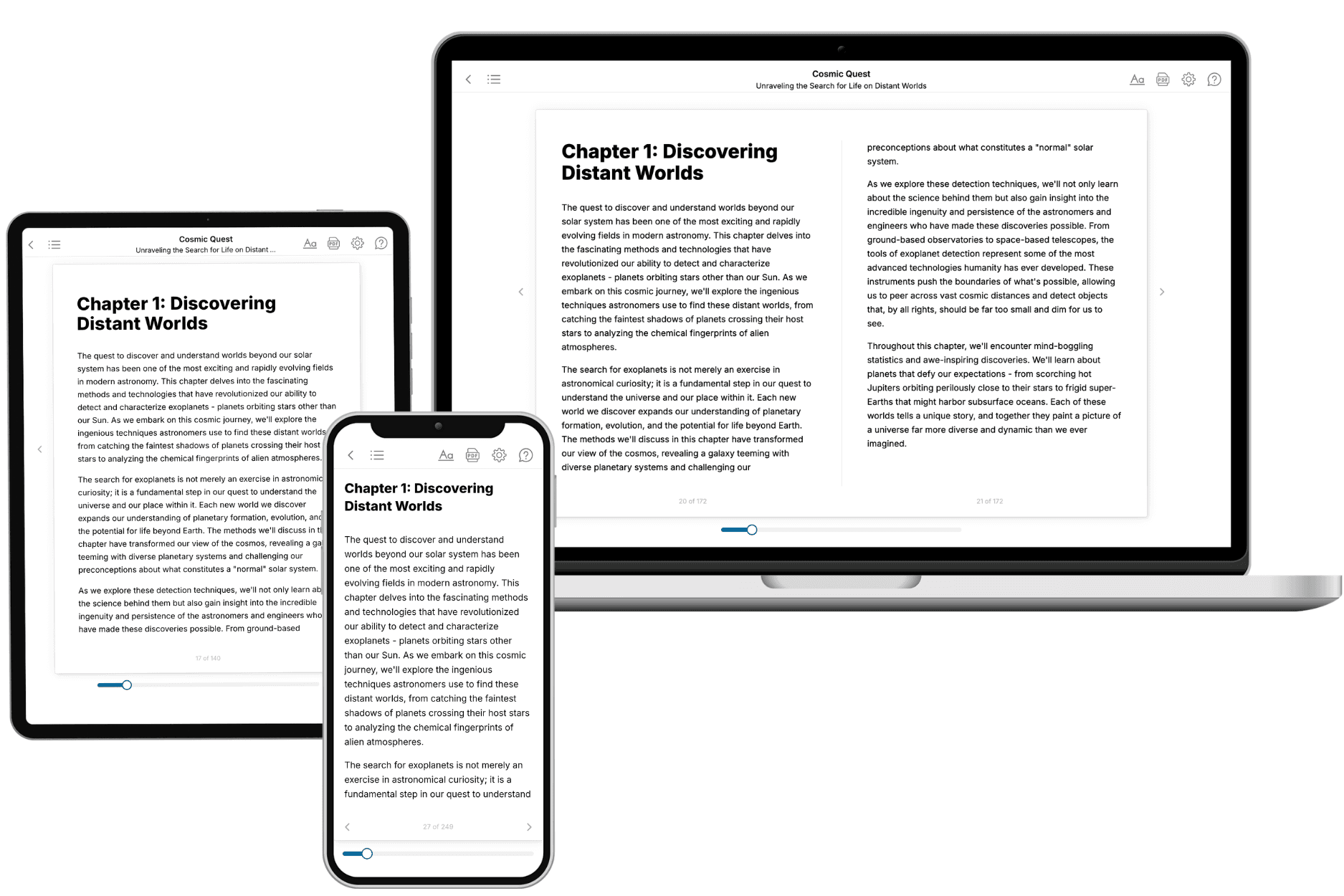
Your book is ready in 10 minutes. Read it online, download as EPUB or PDF, or send to Kindle.

Start from a template
Frequently asked questions
- What is TailoredRead?
TailoredRead creates complete, full-length nonfiction ebooks, written specifically for you. Tell us what you want to learn and why, and TailoredRead writes you a complete ebook on it, with charts, tables, and diagrams throughout. Read it online, on Kindle, or on any e-reader, or download it as a PDF or EPUB. Every book is written fresh the day you order it.
- How is the book tailored to me?
Before anything is written, you answer a few short questions about your goals, your background, and the topics you care about. Your book is then planned around your answers: written at your level, focused on your goals, and covering the topics you chose, instead of the one-size-fits-all book a store sells everyone.
- Will it read like generic AI content?
No. Your book isn't a chat transcript: it's planned chapter by chapter before a single word is written, told in a clear book voice, and explains ideas visually with charts, tables, and diagrams. After writing, every book goes through an editorial pass that polishes chapters so the book reads consistent from start to finish. Judge for yourself: browse thousands of sample books on our Explore Books page.
- How accurate is the content?
Our AI first checks whether your subject needs live research. Niche and fast-moving subjects are researched before writing, and the book plan and chapters are grounded in what it finds. After writing, every book goes through a quality pass that checks its facts and consistency, and researched books list their sources in a Notes section at the back.
- How long is the book?
You choose the length: Comprehensive (250-300 pages), Detailed (150-200 pages), Essential (70-100 pages), or Short (30-50 pages).
- Does the book include visuals?
Yes. Every book includes charts, tables, and diagrams: timelines, checklists, step-by-step guides, decision trees, comparison tables, matrices, and bar charts. A typical book includes dozens of these visual elements.
- Can I read it on Kindle? What formats can I download?
Yes. Every book can be read in our online reader or downloaded as a PDF or EPUB. The EPUB can be opened with Kindle, Apple Books, Kobo, and any e-reader. The Commercial and Author licenses also include an editable Word (DOCX) and Markdown download.
- How much does it cost?
About the price of a regular ebook. The exact price depends on your book's length and complexity, from $2 for the shortest books to $35 for the most comprehensive, and it's shown when you review your book, before you commit to anything. Each book is a one-time purchase, yours to keep, no subscription. Licenses that let you share, teach, or publish your book range from $35.99 to $49.99.
- Can I preview the book before purchasing?
Before you pay, you'll see what your book will cover: the title, a detailed description, the estimated length, and the complete chapter-by-chapter table of contents, so you know what you're getting before you decide. The full text itself is written after you purchase.
- How long does it take to create a book?
About 10 minutes. You can start reading the opening chapters while the rest is still being written.