Shortest Path Problems Explained
Algorithmic techniques and complexity insights for graph optimization
You're staring at a complex optimization problem, knowing there must be an efficient solution, but the sheer number of possible approaches feels overwhelming.
315 pages16 chaptersOct 4, 2025Computer Science and Algorithms
About this book
Whether you're routing delivery trucks, finding optimal network paths, or solving maze-like puzzles, the challenge isn't just finding a solution—it's finding the best one efficiently. This comprehensive guide cuts through the complexity of shortest path algorithms and their relationship to computational theory. You'll discover why some problems that seem similar have vastly different computational requirements, and learn to recognize when a problem crosses the line from efficiently solvable to computationally intractable. Through clear explanations and practical examples, you'll master the fundamental algorithms that power everything from GPS navigation to internet routing protocols. Beyond just learning algorithms, you'll develop the analytical skills to choose the right approach for your specific constraints. You'll understand when Dijkstra's algorithm is overkill, when A* heuristics can save the day, and how to recognize when you're facing an NP-Complete variant that requires entirely different strategies. Each concept builds naturally on the previous, creating a solid foundation for tackling increasingly complex optimization challenges. By the end, you'll have the confidence to approach any shortest path problem with a clear understanding of the trade-offs involved and the tools needed to implement efficient, elegant solutions that scale with real-world demands.
Table of contents
- IntroductionOptimization Problems Are Everywhere, Why Computational Complexity Matters, How This Book Is Structured, What You Need to KnowRead below
- Chapter 1: Foundations of Graph TheoryGraph Fundamentals and Terminology, Graph Representation Methods, Weighted Graphs and Distance Metrics, Special Graph Types and Properties
- Chapter 2: Computational Complexity FundamentalsBig O Notation and Algorithm Analysis, P vs NP: The Great Divide, NP-Complete Problems and Reductions, Other Important Complexity Classes
- Chapter 3: Basic Shortest Path AlgorithmsBreadth-First Search for Unweighted Graphs, Dijkstra's Algorithm for Non-Negative Weights, Bellman-Ford Algorithm for Negative Weights, Comparing Basic Algorithms
- Chapter 4: Advanced Single-Source AlgorithmsPriority Queue Optimizations, Fibonacci Heaps and Performance, Shortest Path Faster Algorithm (SPFA), Bidirectional Search Techniques
- Chapter 5: All-Pairs Shortest Path ProblemsFloyd-Warshall Algorithm, Johnson's Algorithm for Sparse Graphs, Matrix Multiplication Approaches, Transitive Closure and Reachability
- Chapter 6: Heuristic Search MethodsA* Algorithm and Admissible Heuristics, Designing Effective Heuristics, Iterative Deepening A* (IDA*), Beam Search and Approximation Methods
- Chapter 7: Dynamic Programming ApproachesDynamic Programming Principles, Optimal Substructure in Path Problems, Memoization and State Space Design, Space and Time Optimizations
- Chapter 8: Algorithms for Specialized GraphsDirected Acyclic Graphs (DAGs), Planar Graph Algorithms, Tree and Forest Shortest Paths, Grid Graphs and Geometric Problems
- Chapter 9: Preprocessing and Query OptimizationContraction Hierarchies, Hub Labeling Techniques, Landmark-Based Preprocessing, Arc Flags and Goal-Directed Search
- Chapter 10: NP-Complete Shortest Path VariantsThe Longest Path Problem, Constrained Shortest Path Problems, K-Shortest Paths Complexity, Reduction Techniques and Proofs
- Chapter 11: Approximation AlgorithmsApproximation Ratios and Guarantees, FPTAS for Path Problems, Greedy Approximation Strategies, Randomized Approximation Algorithms
- Chapter 12: Network Flows and Shortest PathsMinimum Cost Flow Problems, Successive Shortest Path Algorithm, Cycle-Canceling Algorithms, Capacity Scaling Techniques
- Chapter 13: Parallel and Distributed AlgorithmsParallel Dijkstra Implementations, Distributed Bellman-Ford, GPU-Accelerated Path Finding, MapReduce and Big Graph Processing
- Chapter 14: Real-World Applications and Case StudiesGPS and Navigation Systems, Internet and Network Routing, Video Game Pathfinding, Logistics and Supply Chain Optimization
- Chapter 15: Implementation and Performance ConsiderationsChoosing the Right Data Structures, Memory Usage and Cache Efficiency, Numerical Precision and Stability, Benchmarking and Testing Strategies
- Chapter 16: Advanced Topics and Future DirectionsQuantum Shortest Path Algorithms, Machine Learning Enhanced Pathfinding, Dynamic and Temporal Graphs, Current Research Frontiers
- ConclusionKey Takeaways and Insights, Guidelines for Algorithm Selection
- Glossary
- Further Reading
Introduction
Every day, millions of people rely on algorithms to find the shortest route to their destination, whether they're navigating city streets with GPS or routing data packets across the internet. Behind these seemingly simple requests lies a rich mathematical landscape filled with elegant algorithms, computational challenges, and fundamental questions about what can be computed efficiently. The study of shortest path problems sits at the intersection of graph theory, algorithm design, and computational complexity theory, offering insights that extend far beyond finding routes on a map.
The beauty of shortest path problems lies in their deceptive simplicity. At first glance, finding the shortest path between two points seems straightforward—just explore all possible routes and pick the best one. However, this naive approach quickly becomes impractical as the size of the problem grows. A city with just 20 intersections connected in a grid pattern has over a million possible paths between opposite corners. Real-world networks contain thousands or millions of nodes, making brute-force approaches computationally impossible. This explosion of possibilities forces us to develop sophisticated algorithms that can navigate these vast solution spaces efficiently.
What makes shortest path problems particularly fascinating is how small changes in problem constraints can dramatically alter the computational difficulty. Adding negative edge weights transforms a problem solvable in polynomial time into one requiring more sophisticated techniques. Introducing additional constraints can push a problem from the realm of efficient algorithms into the territory of NP-Complete problems, where no known polynomial-time solutions exist. Understanding these boundaries between tractable and intractable problems is crucial for anyone working with optimization challenges in computer science.
This book will guide you through the landscape of shortest path algorithms and their relationship to computational complexity theory. You'll discover why some algorithms work brilliantly for certain types of graphs but fail miserably for others, and learn to recognize the subtle problem variations that can make the difference between a solution that runs in seconds versus one that would take centuries to complete. Through concrete examples and practical implementations, you'll develop the intuition needed to choose the right algorithmic approach for your specific constraints and requirements.
Optimization Problems Are Everywhere
Shortest path problems appear in countless real-world scenarios, often disguised as seemingly unrelated optimization challenges. When a delivery company plans routes for its trucks, they're solving multiple shortest path problems simultaneously, considering factors like distance, traffic patterns, delivery time windows, and vehicle capacity constraints. The GPS navigation system in your car doesn't just find the geographically shortest route—it weighs factors like current traffic conditions, road types, and your stated preferences for highways versus local roads to optimize your total travel time.
In the digital realm, internet routing protocols use shortest path algorithms to determine how data packets should travel across the global network infrastructure. When you stream a video or download a file, routers throughout the internet are constantly solving shortest path problems to ensure your data takes efficient routes to its destination. These algorithms must adapt dynamically as network conditions change, links fail, or new routes become available. The Border Gateway Protocol (BGP), which manages routing between different internet service providers, essentially maintains a massive distributed shortest path computation across the entire internet.
Social networks present another fascinating application domain for shortest path algorithms. When LinkedIn suggests how you might be connected to someone, it's computing shortest paths through the social graph. The famous "six degrees of separation" concept is fundamentally about shortest paths in social networks. Similarly, recommendation systems often use shortest path concepts to find relationships between users, products, or content items. A movie recommendation might be based on finding short paths through a graph where nodes represent movies and edges represent similarity or user preferences.
Game development relies heavily on pathfinding algorithms to create believable artificial intelligence. When a character in a video game navigates around obstacles to reach a target, the underlying system is solving shortest path problems in real-time. However, game pathfinding introduces unique constraints—paths must not only be optimal but also appear natural and avoid computational bottlenecks that could cause frame rate drops. This has led to specialized variants of classical algorithms optimized for interactive applications.
Financial markets present more abstract but equally important applications of shortest path concepts. Arbitrage detection involves finding cycles in currency exchange graphs where the product of exchange rates exceeds one, essentially finding "negative cycles" in a logarithmically transformed graph. Portfolio optimization problems often involve finding paths through risk-return spaces, and high-frequency trading systems use shortest path algorithms to route orders through complex networks of exchanges and market makers.
Supply chain optimization represents one of the most economically significant applications of shortest path algorithms. Companies like Amazon must solve massive shortest path problems to determine optimal warehouse locations, shipping routes, and inventory distribution strategies. These problems involve multiple objectives—minimizing cost, delivery time, and environmental impact while maximizing reliability and customer satisfaction. The complexity increases when considering dynamic factors like seasonal demand patterns, supplier reliability, and transportation capacity constraints.
Biological and medical applications showcase the versatility of shortest path concepts in scientific research. Protein folding simulations use shortest path algorithms to explore conformational spaces, seeking the minimum energy configurations that determine protein structure. Drug discovery involves finding shortest paths through chemical space, where nodes represent molecular compounds and edges represent possible chemical transformations. Epidemiological models use shortest path concepts to understand how diseases spread through populations, helping public health officials design intervention strategies.
Urban planning and infrastructure design rely on shortest path algorithms to optimize everything from public transportation networks to utility distribution systems. When city planners design bus routes, they're solving complex shortest path problems that must balance coverage, efficiency, and equity. Emergency services use shortest path algorithms not just for routing ambulances and fire trucks, but for optimizing the placement of emergency facilities to minimize response times across entire metropolitan areas.
Why Computational Complexity Matters
Understanding computational complexity is crucial because it determines whether your algorithmic solutions will scale to real-world problem sizes. Consider the difference between an algorithm that runs in O(n²) time versus one that runs in O(n³) time. For a small graph with 100 nodes, the difference might be negligible—10,000 operations versus 1,000,000 operations. However, for a graph with 10,000 nodes, the difference becomes dramatic: 100 million operations versus 1 trillion operations. This thousand-fold difference can mean the difference between a solution that runs in seconds versus one that takes hours or days to complete.
The distinction between polynomial-time and exponential-time algorithms becomes even more critical as problem sizes grow. An algorithm with O(2^n) complexity might work fine for problems with 20 variables, requiring about one million operations. However, increasing the problem size to just 40 variables would require over one trillion operations—a computationally infeasible amount. This exponential growth explains why certain problems that seem conceptually simple become practically impossible to solve exactly for large instances.
Real-world applications often involve graphs with millions or billions of nodes and edges. Social networks like Facebook or LinkedIn contain billions of users and trillions of connections. The internet routing infrastructure involves hundreds of thousands of autonomous systems with complex interconnection patterns. Transportation networks in major metropolitan areas can involve millions of road segments and intersections. For these massive graphs, the difference between an O(n log n) algorithm and an O(n²) algorithm can determine whether a solution is practically feasible.
Complexity analysis also helps explain why certain problem variants are much harder than others. The shortest path problem in graphs with non-negative edge weights can be solved efficiently using Dijkstra's algorithm in O((V + E) log V) time. However, if we modify the problem to find the longest simple path (without cycles), the problem becomes NP-Complete, meaning no known polynomial-time algorithm exists. This dramatic difference in complexity arises from subtle changes in problem structure that fundamentally alter the computational landscape.
Understanding complexity classes like P, NP, and NP-Complete provides a framework for recognizing when you're facing a computationally intractable problem. When you encounter an optimization problem in practice, complexity theory helps you determine whether to search for an exact polynomial-time algorithm, develop approximation algorithms, or use heuristic approaches. This knowledge prevents you from spending months trying to find efficient exact algorithms for problems that are provably intractable.
The practical implications of complexity theory extend beyond algorithm selection to system design and resource planning. If you're building a system that needs to solve shortest path problems in real-time, understanding the complexity of different variants helps you make informed trade-offs between solution quality and response time. You might choose to preprocess data using expensive algorithms during off-peak hours to enable fast query responses during peak usage periods.
Complexity analysis also reveals opportunities for algorithmic improvements through problem structure exploitation. Many real-world graphs have special properties—they might be planar, have small treewidth, or exhibit hierarchical structure. Recognizing these properties allows you to apply specialized algorithms that achieve better complexity bounds than general-purpose approaches. For example, shortest path problems on planar graphs can be solved more efficiently than on general graphs, and road networks often have hierarchical structure that enables dramatic speedups through preprocessing techniques.
The relationship between theoretical complexity and practical performance is nuanced and depends on constant factors, implementation details, and problem characteristics. An algorithm with better asymptotic complexity might perform worse on small instances due to higher constant factors or more complex implementation requirements. Understanding both theoretical complexity and practical performance considerations enables you to make informed decisions about algorithm selection and implementation strategies for your specific use cases.
How This Book Is Structured
This book follows a carefully designed progression that builds your understanding from fundamental concepts to advanced techniques and real-world applications. The early chapters establish the mathematical foundations you'll need, covering graph theory basics and computational complexity fundamentals. These chapters provide the vocabulary and conceptual framework that will be essential for understanding the more sophisticated algorithms and analysis techniques presented later. Even if you have some background in these areas, these foundational chapters will ensure you have a solid understanding of the specific concepts and notation used throughout the book.
The middle chapters form the core of the book, presenting the major shortest path algorithms in order of increasing sophistication. You'll start with basic algorithms like breadth-first search and Dijkstra's algorithm, understanding not just how they work but why they work and when they're appropriate. Each algorithm presentation includes detailed complexity analysis, implementation considerations, and practical examples that illustrate both strengths and limitations. The progression moves from single-source algorithms to all-pairs algorithms, then to specialized techniques for particular graph types and problem variants.
Advanced chapters explore cutting-edge techniques and the boundaries of computational tractability. You'll learn about preprocessing methods that can dramatically speed up query times, heuristic search techniques that provide excellent practical performance, and approximation algorithms for problems that are too hard to solve exactly. These chapters also delve into the fascinating world of NP-Complete shortest path variants, helping you understand why small changes in problem formulation can lead to dramatic differences in computational difficulty.
The book's structure emphasizes the deep connections between different algorithmic approaches and problem domains. Dynamic programming chapters show how optimal substructure principles apply across many shortest path variants. Network flow chapters reveal the mathematical relationships between shortest paths and flow optimization. Parallel algorithm chapters demonstrate how classical sequential algorithms can be adapted for modern multi-core and distributed computing environments.
Each chapter includes extensive examples and case studies drawn from real-world applications. Rather than presenting algorithms in abstract mathematical terms, you'll see how they apply to concrete problems like GPS navigation, internet routing, game pathfinding, and logistics optimization. These examples help solidify your understanding while demonstrating the practical relevance of the theoretical concepts. Implementation details and performance considerations are woven throughout, ensuring you can translate theoretical knowledge into working code.
The book's organization allows for multiple reading paths depending on your background and interests. Computer science students might work through the chapters sequentially to build a comprehensive understanding of the field. Practicing software engineers might focus on specific algorithm families relevant to their current projects, using the extensive cross-references to understand dependencies and relationships. Researchers might concentrate on the advanced chapters dealing with complexity theory and cutting-edge techniques.
Special attention is paid to the relationship between theory and practice throughout the book. While theoretical analysis provides crucial insights into algorithm behavior and scalability, practical performance depends on many factors not captured by asymptotic complexity analysis. Implementation chapters discuss data structure choices, memory access patterns, numerical precision issues, and other factors that significantly impact real-world performance. This balanced approach ensures you can both understand the theoretical foundations and successfully implement efficient solutions.
The book concludes with forward-looking chapters that explore emerging research directions and future challenges in shortest path algorithms. Topics include quantum algorithms, machine learning enhanced pathfinding, dynamic graph algorithms, and the challenges posed by massive-scale networks. These chapters provide context for understanding how the field continues to evolve and identify opportunities for future research and development.
What You Need to Know
This book assumes you have a solid foundation in computer science fundamentals, particularly data structures and algorithms. You should be comfortable with basic data structures like arrays, linked lists, stacks, queues, and trees, and understand their time and space complexity characteristics. Familiarity with hash tables and their applications is important, as many shortest path algorithms rely on efficient lookup operations. You should also understand basic sorting algorithms and their complexity analysis, as these concepts provide important context for understanding more sophisticated algorithmic techniques.
Mathematical maturity is essential for following the complexity analysis and correctness proofs presented throughout the book. You should be comfortable with mathematical induction, basic discrete mathematics, and elementary probability theory. While the book doesn't assume advanced mathematical background, you should be able to follow logical arguments, understand mathematical notation, and work with concepts like asymptotic analysis and recurrence relations. Basic linear algebra concepts, particularly matrix operations, will be helpful for understanding all-pairs shortest path algorithms and network flow applications.
Programming experience in at least one modern programming language is crucial for understanding the implementation discussions and code examples. While the book uses pseudocode for algorithm descriptions, implementation sections include examples in languages like Python, Java, and C++. You don't need to be expert in any particular language, but you should understand fundamental programming concepts like recursion, object-oriented design, and basic algorithm implementation techniques. Experience with debugging and performance optimization will help you appreciate the practical considerations discussed throughout the book.
Some exposure to graph theory concepts will be helpful, though the book includes a comprehensive review of necessary graph theory foundations. You should understand what graphs, vertices, and edges represent, and be familiar with basic graph terminology. If you've encountered concepts like graph traversal, connectivity, or cycles in previous coursework or projects, you'll have a head start, but these concepts are thoroughly explained when they become relevant to shortest path algorithms.
Basic understanding of computational complexity theory will enhance your appreciation of the book's content, though again, necessary concepts are explained as they arise. If you've encountered Big O notation and understand the difference between polynomial and exponential time algorithms, you'll be well-prepared for the complexity analysis discussions. Familiarity with concepts like NP-Completeness is helpful but not required, as the book includes a comprehensive introduction to these topics.
For readers interested in the more advanced chapters, some additional background may be useful. The parallel algorithms chapter assumes basic understanding of concurrent programming concepts and parallel computing architectures. The network flow chapters benefit from some exposure to linear programming or optimization theory, though the necessary concepts are introduced as needed. The machine learning enhanced pathfinding sections assume familiarity with basic machine learning concepts like supervised learning and neural networks.
Most importantly, you should approach this book with curiosity and willingness to work through challenging concepts. Shortest path algorithms and complexity theory involve sophisticated mathematical ideas that require careful study and practice to master. The book includes numerous exercises and examples to help reinforce your understanding, but you'll get the most benefit by actively engaging with the material, implementing algorithms, and experimenting with different approaches on various problem instances.
If you find that you're missing some of the assumed background, don't be discouraged. The book includes extensive references to additional resources for filling in knowledge gaps. Many concepts are explained from first principles, and the progressive structure ensures that each chapter builds naturally on previous material. With persistence and active engagement, you can successfully master the material even if your background in some areas is limited. The key is to take time with the foundational concepts and ensure you understand them thoroughly before moving on to more advanced topics.
This is the end of the free sample. The full book has 16 chapters.
Want this book written for you?
Tell us your goals and background, and get your own version of this book, tailored by AI to you.


Benefits of AI-tailored books
- Read one book, not ten:
- all the Computer Science and Algorithms knowledge you need, gathered into a single book.
- Save days of learning:
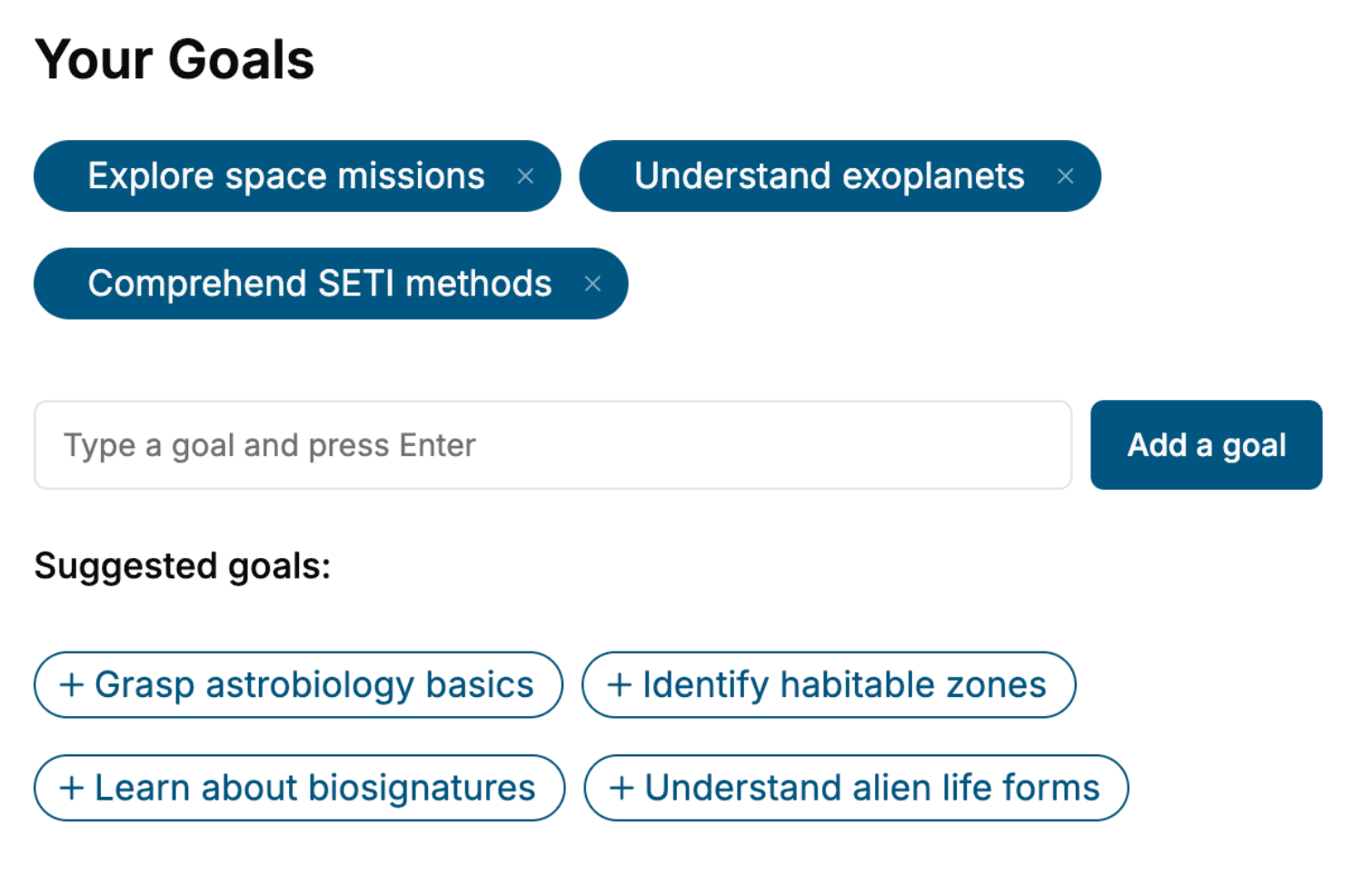
- tell us your goals, choose your topics, and the whole book is built around them.
- Learn effortlessly:
- Computer Science and Algorithms book written for your specific background and expertise.
- Understand at a glance:
- includes charts, tables, timelines, checklists, decision trees, and more.
- Stay current:
- written the day you order it, not years ago.
- Trust what you read:
- every book is checked for accuracy, with real research when your subject needs it.
Create your unique book in 3 steps
- 1. Select your focus
Select the focus of your Computer Science and Algorithms book and share your background
- 2. Personalize your book
Specify your goals and choose sub-topics to include
- 3. Get your tailored book
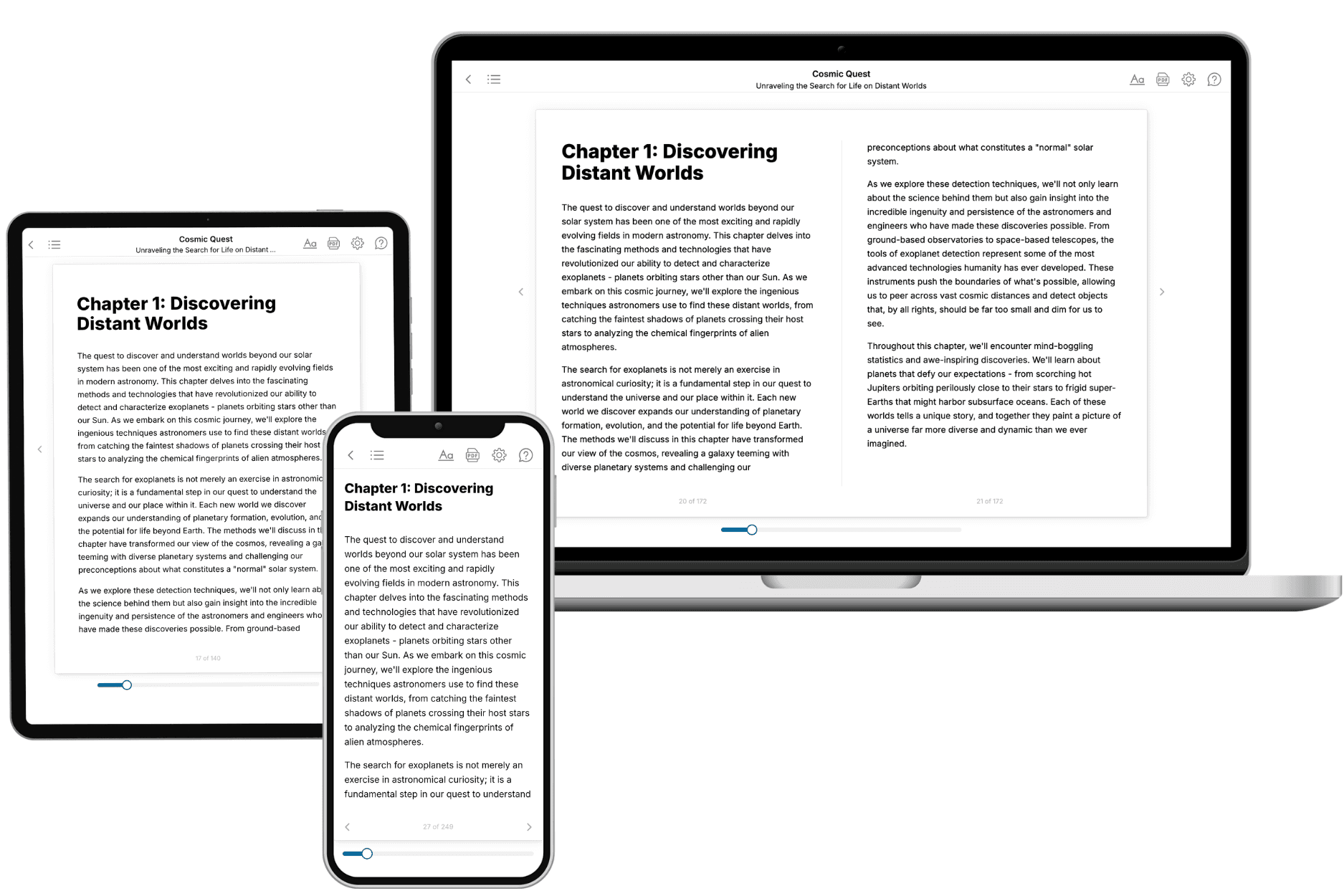
Your book is ready in 10 minutes. Read it online, download as EPUB or PDF, or send to Kindle.

Frequently asked questions
- What is TailoredRead?
TailoredRead creates complete, full-length nonfiction ebooks, written specifically for you. Tell us what you want to learn and why, and TailoredRead writes you a complete ebook on it, with charts, tables, and diagrams throughout. Read it online, on Kindle, or on any e-reader, or download it as a PDF or EPUB. Every book is written fresh the day you order it.
- How is the book tailored to me?
Before anything is written, you answer a few short questions about your goals, your background, and the topics you care about. Your book is then planned around your answers: written at your level, focused on your goals, and covering the topics you chose, instead of the one-size-fits-all book a store sells everyone.
- Will it read like generic AI content?
No. Your book isn't a chat transcript: it's planned chapter by chapter before a single word is written, told in a clear book voice, and explains ideas visually with charts, tables, and diagrams. After writing, every book goes through an editorial pass that polishes chapters so the book reads consistent from start to finish. Judge for yourself: browse thousands of sample books on our Explore Books page.
- How accurate is the content?
Our AI first checks whether your subject needs live research. Niche and fast-moving subjects are researched before writing, and the book plan and chapters are grounded in what it finds. After writing, every book goes through a quality pass that checks its facts and consistency, and researched books list their sources in a Notes section at the back.
- How long is the book?
You choose the length: Comprehensive (250-300 pages), Detailed (150-200 pages), Essential (70-100 pages), or Short (30-50 pages).
- Does the book include visuals?
Yes. Every book includes visual elements such as timelines, checklists, step-by-step guides, decision trees, comparison tables, and matrices, and many include bar charts. A typical book includes dozens of these visual elements.
- Can I read it on Kindle? What formats can I download?
Yes. Every book can be read in our online reader or downloaded as a PDF or EPUB. The EPUB can be opened with Kindle, Apple Books, Kobo, and any e-reader. The Commercial and Author licenses also include an editable Word (DOCX) and Markdown download.
- How much does it cost?
About the price of a regular ebook. The exact price depends on your book's length and complexity, from $2 for the shortest books to $35 for the most comprehensive, and it's shown when you review your book, before you commit to anything. Each book is a one-time purchase, yours to keep, no subscription. Licenses that let you share, teach, or publish your book range from $35.99 to $49.99.
- Can I preview the book before purchasing?
Before you pay, you'll see what your book will cover: the title, a detailed description, the estimated length, and the complete chapter-by-chapter table of contents, so you know what you're getting before you decide. The full text itself is written after you purchase.
- How long does it take to create a book?
About 10 minutes. You can start reading the opening chapters while the rest is still being written.