D-Day: The Normandy Landings
How Operation Overlord Changed the Course of World War II
What if the Normandy Landings had failed?
222 pages11 chaptersFeb 15, 2026World War II
About this book
This question haunted Allied commanders as they planned Operation Overlord, the most ambitious military operation ever attempted. On June 6, 1944, over 150,000 troops stormed the beaches of Normandy in a desperate gamble to liberate Western Europe from Nazi occupation. This book reveals the extraordinary story behind this pivotal moment—from the strategic brilliance that deceived German high command to the raw courage of soldiers facing machine gun fire on blood-soaked beaches. You'll discover how meticulous planning, technological innovation, and sheer determination overcame seemingly impossible odds. Through detailed accounts of the planning phase, the invasion itself, and the brutal campaign that followed, you'll understand why D-Day remains one of history's most consequential military operations. Whether you're a history buff or simply curious about how this turning point unfolded, this comprehensive guide illuminates the decisions, sacrifices, and human stories that changed the course of World War II and shaped the modern world.
Table of contents
- IntroductionWhy Normandy Matters Today, What This Book Covers, The War Before D-DayRead below
- Chapter 1: The Strategic ImperativeAllied War Goals and the Need for Invasion, German Defensive Strategy in France, Why Normandy Was Chosen
- Chapter 2: Planning Operation OverlordBuilding the Command Structure, Solving Unprecedented Logistical Challenges, Assembling Ships, Troops, and Equipment
- Chapter 3: Deception and IntelligenceOperation Fortitude: The Grand Deception, Gathering Intelligence on German Positions, The Role of Code-Breaking in Planning
- Chapter 4: The Invasion ForceAmerican Troops and Commanders, British and Canadian Forces, Specialized Units and Support Forces
- Chapter 5: June 6, 1944: The Assault BeginsAirborne Drops Behind Enemy Lines, The Beach Landings: Hour by Hour, The Cost of the First Day
- Chapter 6: The Five BeachesUtah Beach: American Success, Omaha Beach: The Bloodiest Sector, Gold, Sword, and Juno: British and Canadian Advances
- Chapter 7: Establishing the BeachheadSecuring Initial Objectives, Building Supply Lines and Reinforcements, German Counterattack Attempts
- Chapter 8: The Normandy CampaignFighting in the Bocage: Hedgerow Warfare, The Capture of Cherbourg, The Struggle for Caen
- Chapter 9: Human Stories and SacrificeVoices from the Beaches, The Impact on French Civilians, Medical Teams and Rescue Operations
- Chapter 10: The Breakout and LiberationOperation Cobra: Breaking Out of Normandy, The Falaise Pocket and German Collapse, The Path to Paris and Beyond
- Chapter 11: Legacy and Historical SignificanceD-Day as a Turning Point in World War II, Military Lessons and Innovations, Why D-Day Still Matters
- ConclusionRemembering the Sacrifice, Enduring Lessons from Normandy
- Further Reading and Resources
Introduction
The gray waters of the English Channel churned beneath thousands of vessels on the morning of June 6, 1944. Inside cramped landing craft, soldiers from a dozen nations prepared to storm the beaches of Normandy in what would become the largest amphibious invasion in human history. Many of these young men—some barely out of their teens—would not survive the day. Yet their collective sacrifice would crack open Hitler's Fortress Europe and set in motion the liberation of an entire continent. Operation Overlord, as the invasion was codenamed, represented a gamble of staggering proportions. If it failed, the war might drag on for years, costing millions more lives and potentially allowing Nazi Germany to consolidate its grip on Europe.
Understanding D-Day requires more than knowing the basic facts of the invasion. The Normandy Landings emerged from years of strategic debate, meticulous planning, and unprecedented cooperation among Allied nations. Behind the dramatic images of soldiers wading through surf under machine gun fire lies a complex story of intelligence operations, technological innovation, and logistical miracles. The invasion succeeded not through a single brilliant stroke, but through the coordination of countless moving parts—from the deception campaigns that fooled German commanders about where the attack would come, to the engineers who designed specialized equipment to overcome beach obstacles, to the supply officers who calculated how to feed and arm an invasion force across open water.
This book takes you beyond the familiar narrative of D-Day to explore the full scope of Operation Overlord and the Normandy campaign that followed. You'll discover why Allied commanders chose Normandy over other potential invasion sites, how they solved seemingly impossible logistical challenges, and what happened in the brutal weeks after the initial landings as Allied forces fought to break out of their beachhead. More importantly, you'll understand why this operation mattered so profoundly—not just as a military turning point, but as a demonstration of what free nations could accomplish when they united against tyranny. The lessons of Normandy extend far beyond military history, touching on leadership, courage, sacrifice, and the terrible cost of defending democratic values.
The story of D-Day belongs to the soldiers who fought there, but it also belongs to anyone who values freedom and wants to understand how it was preserved at a critical moment in history. Whether you're a dedicated student of World War II or approaching this subject with fresh curiosity, this book will deepen your appreciation for the complexity, courage, and consequences of the Normandy Landings. The invasion was not inevitable, nor was its success guaranteed. Every decision, from the highest strategic level to the split-second choices made by individual soldiers on the beaches, shaped the outcome of this pivotal operation.
Why Normandy Matters Today
Eight decades have passed since the Normandy Landings, yet this operation continues to resonate in our contemporary world. D-Day represents more than a historical milestone—it stands as a testament to what coordinated international action can achieve when facing existential threats. In an era when global cooperation often seems fragile, the Allied coalition that planned and executed Operation Overlord demonstrates the power of nations setting aside differences to pursue a common goal. The United States, Britain, Canada, and other Allied nations pooled their resources, shared intelligence, and subordinated national pride to unified command structures. This level of cooperation required trust, compromise, and a shared understanding that the stakes transcended individual national interests.
The military innovations developed for D-Day continue to influence modern warfare and crisis response. The specialized landing craft designed for the invasion became templates for amphibious operations that followed. The artificial harbors called Mulberries, which the Allies towed across the Channel to provide port facilities where none existed, showcased engineering ingenuity that still inspires solutions to logistical challenges today. The coordination between air, sea, and land forces established principles of combined arms operations that remain fundamental to military doctrine. Even the deception operations that misled German commanders about Allied intentions have modern parallels in information warfare and strategic communications. Military academies worldwide still study Operation Overlord as a masterclass in planning, execution, and adaptation under uncertainty.
Beyond military applications, D-Day offers profound lessons about leadership under pressure and decision-making with incomplete information. General Dwight D. Eisenhower, the Supreme Allied Commander, faced an agonizing choice when weather conditions threatened to derail the invasion. He could postpone the operation and risk losing the element of surprise, or proceed despite marginal conditions and potentially send thousands of men to their deaths in a failed assault. His decision to proceed, made with full awareness of the consequences, exemplifies the burden of command and the weight of responsibility that leaders must bear. The invasion also demonstrates how organizations can maintain focus and coordination across vast distances and complex hierarchies when united by clear objectives and shared values.
The human dimension of D-Day remains powerfully relevant to contemporary audiences. The soldiers who stormed the beaches came from diverse backgrounds—farmers, factory workers, students, and professionals who had been civilians just months or years earlier. They faced terror, witnessed unimaginable carnage, and yet pressed forward because they understood the stakes. Their letters home, oral histories, and memoirs reveal universal truths about courage, fear, camaraderie, and sacrifice that transcend their specific historical moment. These personal accounts remind us that history is made by individuals, not abstract forces, and that ordinary people can accomplish extraordinary things when circumstances demand it. The veterans of D-Day, now nearly all gone, left behind testimonies that continue to inspire and instruct new generations.
The Normandy Landings also serve as a sobering reminder of war's terrible cost. Over 4,400 Allied soldiers died on D-Day itself, with thousands more wounded or missing[1]. The Normandy campaign that followed claimed over 200,000 Allied casualties and similar numbers of German casualties, while French civilian deaths exceeded 20,000. These numbers represent individual tragedies—families shattered, potential unfulfilled, futures erased. When we study D-Day, we must hold in tension both the necessity of the operation and the devastating human price it exacted. This dual awareness guards against romanticizing war while still honoring the sacrifice of those who fought. The beaches of Normandy, now peaceful and dotted with memorials, stand as permanent reminders that freedom often comes at a cost measured in human lives.
Understanding D-Day also provides essential context for comprehending the post-war world order. The success of Operation Overlord accelerated Germany's defeat and shaped the political landscape of Europe for decades to come. The invasion demonstrated American military power and commitment to European security, establishing patterns of transatlantic cooperation that led to NATO and other enduring alliances. The operation's success also influenced the division of Europe between Western and Soviet spheres of influence, as the race to defeat Germany determined which forces would occupy which territories. The world we inhabit today—with its particular alliance structures, international institutions, and geopolitical tensions—was shaped in part by the decisions made and battles fought in Normandy during the summer of 1944.
Finally, D-Day matters because it represents a moment when the outcome of history hung in the balance. The invasion was not foreordained to succeed. German forces might have repelled the landings, weather might have scattered the invasion fleet, or logistical failures might have left Allied troops stranded without supplies. The fact that Operation Overlord succeeded despite these risks should not make us complacent about its significance. Rather, understanding how close the operation came to failure—and how many things had to go right for it to succeed—should deepen our appreciation for this pivotal moment. History is not inevitable; it is made through human choices, preparation, and sometimes fortune. The Normandy Landings remind us that determined action, even in the face of daunting odds, can change the course of events and shape the future in profound ways.
What This Book Covers
This book provides a comprehensive examination of Operation Overlord from its strategic origins through its lasting impact on World War II and beyond. Rather than focusing exclusively on the dramatic events of June 6, 1944, this narrative encompasses the full arc of the Normandy campaign, from the initial planning stages through the breakout from the beachhead and the liberation of France. This broader scope allows you to understand D-Day not as an isolated event, but as the culmination of extensive preparation and the beginning of a grueling campaign that would last for months. The invasion itself, while dramatic and consequential, represented just the first step in a complex military operation that required sustained effort and continued sacrifice.
The early chapters explore the strategic context that made the Normandy invasion necessary and possible. You'll discover why Allied leaders concluded that a cross-Channel invasion was essential to defeating Nazi Germany, despite the enormous risks involved. The book examines alternative strategies that were considered and rejected, including continued focus on the Mediterranean theater or waiting for strategic bombing to weaken Germany sufficiently. You'll learn about the debates among Allied commanders regarding timing, location, and scale of the invasion. These strategic discussions reveal the difficult trade-offs inherent in military planning—balancing the desire to strike quickly against the need for thorough preparation, weighing the advantages of surprise against the requirements of overwhelming force, and coordinating the priorities of different Allied nations with sometimes divergent interests.
Substantial attention is devoted to the planning phase of Operation Overlord, which consumed over a year of intensive work by thousands of military planners, intelligence officers, and logisticians. This section reveals the extraordinary complexity of mounting an amphibious invasion across defended beaches. You'll explore how planners addressed challenges including:
- Assembling sufficient landing craft to transport over 150,000 troops in the initial assault
- Coordinating naval bombardment, air support, and ground forces across five separate beach sectors
- Developing specialized equipment like amphibious tanks and obstacle-clearing devices
- Creating artificial harbors to supply the invasion force until a major port could be captured
- Training troops for the specific conditions they would face on the Normandy beaches
- Maintaining operational security while preparing an invasion force of unprecedented size
The book dedicates considerable space to the deception operations that proved crucial to the invasion's success. Operation Fortitude, the elaborate scheme to convince German commanders that the main Allied attack would come at Pas-de-Calais rather than Normandy, represents one of the most successful strategic deceptions in military history. You'll learn how the Allies created phantom armies, fed false intelligence to German spies, and manipulated German perceptions through carefully orchestrated signals. The deception campaign succeeded so thoroughly that German forces remained convinced for weeks after D-Day that Normandy was merely a diversion, causing them to withhold reinforcements that might have pushed the Allies back into the sea. This section demonstrates how intelligence operations and psychological warfare can be as decisive as firepower in determining military outcomes.
The heart of the book provides detailed accounts of the invasion itself, examining each of the five beach sectors—Utah, Omaha, Gold, Juno, and Sword—and the airborne operations that preceded the beach landings. Rather than presenting a single unified narrative, this approach allows you to understand how the invasion unfolded differently in each sector based on terrain, German defenses, and the performance of attacking forces. You'll discover why American forces at Utah Beach achieved their objectives with relatively light casualties while troops at Omaha Beach faced a near-disaster that almost resulted in the evacuation of that sector. The experiences of British and Canadian forces at Gold, Juno, and Sword beaches receive equal attention, correcting the sometimes American-centric narratives of D-Day. These detailed accounts draw on firsthand testimonies from soldiers who participated in the invasion, providing human perspectives on the chaos, terror, and courage that characterized the landings.
Following the initial invasion, the book traces the Normandy campaign through the summer of 1944. This coverage includes the struggle to expand the beachhead, the capture of the port of Cherbourg, the brutal fighting in the bocage hedgerow country, and the eventual breakout that led to the liberation of France. Many popular accounts of D-Day end with the successful establishment of the beachhead, but the fighting that followed was equally important and often more costly. The Battle of Caen, which lasted for weeks and reduced the city to rubble, demonstrated that German forces remained formidable opponents even after the surprise of the invasion had passed. Operation Cobra, the American breakout operation, and the subsequent encirclement of German forces in the Falaise Pocket, showed how the Allies eventually translated their beachhead into a war-winning advance. This extended coverage ensures you understand the full scope of the Normandy campaign, not just its dramatic opening act.
Throughout the book, attention is paid to the human experiences of soldiers, commanders, and civilians caught up in the invasion. Personal accounts and oral histories bring the statistics and strategic discussions to life, reminding us that military operations consist of individual human beings facing extraordinary circumstances. You'll encounter stories of remarkable courage, such as the medics who treated wounded soldiers under fire, and moments of tragedy, such as the paratroopers who drowned in flooded fields behind the beaches. The impact on French civilians, who endured both German occupation and the destruction wrought by the liberation campaign, receives appropriate attention. These human stories prevent the narrative from becoming an abstract discussion of strategy and tactics, grounding the history in the lived experiences of those who were there.
The final chapters examine the legacy and lasting significance of the Normandy Landings. This analysis considers D-Day's impact on the course of World War II, its influence on subsequent military operations, and its place in historical memory. You'll explore how the invasion demonstrated the effectiveness of Allied cooperation and combined arms warfare, lessons that influenced military doctrine for decades. The book also addresses how D-Day has been remembered and commemorated, from the immediate post-war period through contemporary memorial practices. This concluding section connects the historical events of 1944 to their ongoing relevance, helping you understand why the Normandy Landings continue to command attention and respect eighty years after they occurred. The goal is not merely to recount what happened, but to illuminate why it mattered then and why it continues to matter now.
The War Before D-Day
To understand the Normandy Landings, you must first grasp the strategic situation that made the invasion both necessary and possible. By early 1944, World War II had been raging for more than four years, and Nazi Germany controlled most of continental Europe. The German conquest of France in 1940 had been swift and devastating, taking just six weeks to defeat what was considered one of Europe's premier military powers. Following France's surrender, Britain stood alone against Germany for over a year, enduring the Blitz and fighting a desperate battle for survival. The entry of the Soviet Union into the war in June 1941, following Germany's invasion, and the United States in December 1941, after Pearl Harbor, transformed the conflict into a truly global struggle. By 1944, the Allies possessed the resources and manpower to challenge German dominance, but they needed a strategy to bring those advantages to bear.
The strategic bombing campaign against Germany, which intensified throughout 1942 and 1943, had inflicted significant damage on German industry and cities, but it had not broken German resistance or forced a surrender. American and British bombers flew thousands of sorties, losing thousands of aircraft and aircrew, yet Germany continued to produce weapons and field armies. The campaign in North Africa, which ended with Allied victory in May 1943, and the subsequent invasions of Sicily and Italy demonstrated that the Allies could conduct successful amphibious operations and defeat German forces in direct combat. However, the Italian campaign bogged down in difficult terrain against determined German resistance, making it clear that Italy would not provide a rapid route to Germany's heartland. These experiences convinced Allied leaders that a direct assault on German-occupied France was essential to achieving victory within a reasonable timeframe.
The Soviet Union's situation added urgency to Allied planning for a second front in Western Europe. Following the initial German invasion in 1941, Soviet forces had suffered catastrophic losses, with millions of soldiers killed or captured. The tide began to turn with the Soviet victory at Stalingrad in early 1943, followed by the massive tank battle at Kursk in the summer of that year. By 1944, Soviet forces were advancing westward, pushing German armies back toward Poland and the Balkans. However, this advance came at an enormous cost in Soviet lives—casualties that dwarfed those suffered by Western Allies. Soviet leader Joseph Stalin repeatedly pressed his Western allies to open a second front in France, arguing that Soviet forces were bearing the brunt of the fighting against Germany. This pressure influenced Allied planning, though Western leaders also had their own strategic reasons for wanting to liberate France and advance into Germany from the west.
The German defensive position in France appeared formidable on paper. Hitler had ordered the construction of the Atlantic Wall, an extensive system of fortifications stretching from Norway to the Spanish border. This defensive network included concrete bunkers, artillery positions, beach obstacles, minefields, and strongpoints designed to repel any invasion attempt. Field Marshal Erwin Rommel, assigned to inspect and strengthen these defenses in late 1943, worked energetically to improve them, adding millions of mines and obstacles. German propaganda portrayed the Atlantic Wall as impregnable, and Allied planners took the defenses seriously. However, the Atlantic Wall had significant weaknesses. German forces were spread thinly along thousands of miles of coastline, making it impossible to defend everywhere with equal strength. Many of the troops manning the defenses were not first-line combat units but rather older soldiers, those recovering from wounds, or conscripts from occupied territories with questionable loyalty to Germany.
Allied advantages by 1944 were substantial and growing. The United States had transformed its economy into an arsenal of democracy, producing ships, aircraft, tanks, and weapons in quantities that Germany could not match. American shipyards were launching Liberty ships faster than German U-boats could sink them, solving the Battle of the Atlantic that had threatened to strangle Britain's supply lines. Allied air forces had achieved air superiority over Western Europe, meaning that German forces would face constant air attack while Allied troops would enjoy air support. The breaking of German codes, particularly the Enigma cipher used for military communications, gave Allied commanders unprecedented insight into German plans and dispositions. This intelligence advantage, combined with successful deception operations, would prove crucial to the invasion's success. The Allies also benefited from experience gained in previous amphibious operations in North Africa, Sicily, and Italy, which had taught valuable lessons about what worked and what didn't in opposed landings.
The political dimension of the invasion planning was as complex as the military aspects. The Allied coalition included nations with different strategic priorities, military traditions, and political systems. American military leaders, particularly General George C. Marshall, the U.S. Army Chief of Staff, favored a direct approach—building up forces in Britain and launching a cross-Channel invasion as soon as possible. British leaders, scarred by the memory of World War I's trench warfare and more recent disasters like the Dieppe Raid of 1942, were more cautious, preferring to weaken Germany through peripheral operations before attempting a direct assault on France. Prime Minister Winston Churchill advocated for continued operations in the Mediterranean and even proposed invasions through the Balkans. These strategic debates were resolved through a series of conferences in 1943, including meetings at Casablanca, Washington, Quebec, and Tehran, where Allied leaders hammered out a unified strategy that prioritized the cross-Channel invasion for 1944.
The selection of commanders for Operation Overlord reflected both military considerations and political realities. General Dwight D. Eisenhower, who had commanded Allied forces in North Africa and the Mediterranean, was appointed Supreme Allied Commander in December 1943. Eisenhower's diplomatic skills and ability to manage the egos and interests of different Allied nations made him well-suited for this role, even though he had less combat experience than some other candidates. British General Bernard Montgomery was appointed to command all ground forces for the initial phase of the invasion, while British Admiral Bertram Ramsay would oversee naval operations and British Air Chief Marshal Trafford Leigh-Mallory would coordinate air support. American generals Omar Bradley and George Patton would command U.S. ground forces. This command structure balanced American and British leadership roles while placing overall authority in American hands, reflecting the United States' growing dominance within the Allied coalition.
By the spring of 1944, southern England had become a vast military camp. Over 1.5 million American troops had crossed the Atlantic, joining British, Canadian, and other Allied forces in preparation for the invasion. Ports, airfields, and training areas throughout England bustled with activity as the invasion force prepared. The buildup was so massive that it could not be concealed from German intelligence, but the Allies worked to ensure that German commanders remained uncertain about where and when the invasion would come. This strategic context—the years of fighting that preceded D-Day, the buildup of Allied strength, the weakening of German defenses, and the political negotiations that shaped Allied strategy—set the stage for the Normandy Landings. The invasion did not emerge from nowhere; it was the product of years of planning, preparation, and hard-won experience. Understanding this context helps explain both why the invasion was necessary and why Allied leaders believed it could succeed despite the enormous risks involved.
Notes
Introduction
- 1. Antony Beevor, D-Day: The Battle for Normandy, Viking Press, 2009
This is the end of the free sample. The full book has 11 chapters.
Want this book written for you?
Tell us your goals and background, and get your own version of this book, tailored by AI to you.


Benefits of AI-tailored books
- Read one book, not ten:
- all the World War II knowledge you need, gathered into a single book.
- Save days of learning:
- tell us your goals, choose your topics, and the whole book is built around them.
- Learn effortlessly:
- World War II book written for your specific background and expertise.
- Understand at a glance:
- includes charts, tables, timelines, checklists, decision trees, and more.
- Stay current:
- written the day you order it, not years ago.
- Trust what you read:
- every book is checked for accuracy, with real research when your subject needs it.
Create your unique book in 3 steps
- 1. Select your focus
Select the focus of your World War II book and share your background
- 2. Personalize your book
Specify your goals and choose sub-topics to include
- 3. Get your tailored book
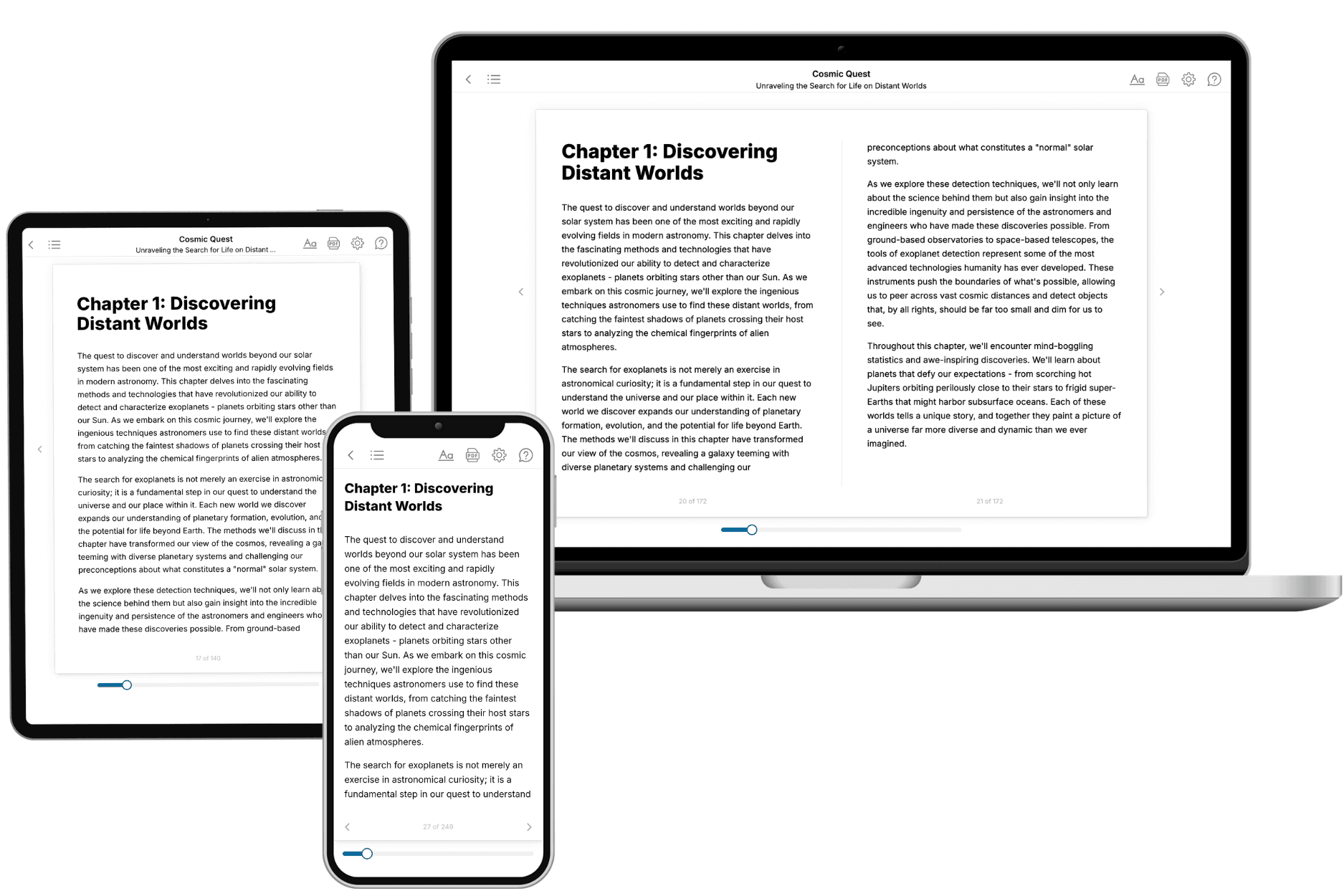
Your book is ready in 10 minutes. Read it online, download as EPUB or PDF, or send to Kindle.

Frequently asked questions
- What is TailoredRead?
TailoredRead creates complete, full-length nonfiction ebooks, written specifically for you. Tell us what you want to learn and why, and TailoredRead writes you a complete ebook on it, with charts, tables, and diagrams throughout. Read it online, on Kindle, or on any e-reader, or download it as a PDF or EPUB. Every book is written fresh the day you order it.
- How is the book tailored to me?
Before anything is written, you answer a few short questions about your goals, your background, and the topics you care about. Your book is then planned around your answers: written at your level, focused on your goals, and covering the topics you chose, instead of the one-size-fits-all book a store sells everyone.
- Will it read like generic AI content?
No. Your book isn't a chat transcript: it's planned chapter by chapter before a single word is written, told in a clear book voice, and explains ideas visually with charts, tables, and diagrams. After writing, every book goes through an editorial pass that polishes chapters so the book reads consistent from start to finish. Judge for yourself: browse thousands of sample books on our Explore Books page.
- How accurate is the content?
Our AI first checks whether your subject needs live research. Niche and fast-moving subjects are researched before writing, and the book plan and chapters are grounded in what it finds. After writing, every book goes through a quality pass that checks its facts and consistency, and researched books list their sources in a Notes section at the back.
- How long is the book?
You choose the length: Comprehensive (250-300 pages), Detailed (150-200 pages), Essential (70-100 pages), or Short (30-50 pages).
- Does the book include visuals?
Yes. Every book includes charts, tables, and diagrams: timelines, checklists, step-by-step guides, decision trees, comparison tables, matrices, and bar charts. A typical book includes dozens of these visual elements.
- Can I read it on Kindle? What formats can I download?
Yes. Every book can be read in our online reader or downloaded as a PDF or EPUB. The EPUB can be opened with Kindle, Apple Books, Kobo, and any e-reader. The Commercial and Author licenses also include an editable Word (DOCX) and Markdown download.
- How much does it cost?
About the price of a regular ebook. The exact price depends on your book's length and complexity, from $2 for the shortest books to $35 for the most comprehensive, and it's shown when you review your book, before you commit to anything. Each book is a one-time purchase, yours to keep, no subscription. Licenses that let you share, teach, or publish your book range from $35.99 to $49.99.
- Can I preview the book before purchasing?
Before you pay, you'll see what your book will cover: the title, a detailed description, the estimated length, and the complete chapter-by-chapter table of contents, so you know what you're getting before you decide. The full text itself is written after you purchase.
- How long does it take to create a book?
About 10 minutes. You can start reading the opening chapters while the rest is still being written.