The Decision Maker's Playbook
Master the Art and Science of Smart Choices in Work and Life
You face decisions every day—some routine, others life-changing.
191 pages9 chaptersAug 20, 2026Decision Making
About this book
Yet most people never receive formal training in how to make them well. The result? Missed opportunities, costly mistakes, and chronic second-guessing that drains your confidence and energy. This book cuts through the complexity. You'll discover why your brain often leads you astray, how to recognize the thinking traps that sabotage your choices, and exactly what to do instead. Rather than offering vague inspiration, you'll learn battle-tested frameworks used by successful leaders, entrepreneurs, and problem-solvers across industries. Whether you're deciding between job offers, solving a persistent workplace problem, or navigating a major life transition, these practical tools work. You'll learn to separate signal from noise, evaluate options systematically, and make decisions you can stand behind. Most importantly, you'll develop the confidence that comes from knowing you've thought things through properly.
Table of contents
- IntroductionWhy Your Decisions Matter More Than You Think, The Common Traps That Derail Smart People, How to Use This Book to Transform Your Decision-MakingRead below
- Chapter 1: Understanding Your Decision-Making BrainThe Two Systems of Thinking, Recognizing Your Cognitive Biases, How Emotions Shape Your Choices
- Chapter 2: Defining the Real ProblemSymptom Versus Root Cause: Why This Distinction Changes Everything, Asking Better Questions to Uncover What Really Matters, Reframing the Challenge to Open New Possibilities
- Chapter 3: Gathering Information StrategicallyDistinguishing Signal from Noise, Practical Research Methods That Actually Work, Knowing When You Have Enough Information
- Chapter 4: Generating and Evaluating OptionsTechniques for Generating More and Better Options, Establishing Clear Criteria for Evaluation, Comparing Options Systematically
- Chapter 5: Leveraging Diverse PerspectivesWhy Different Viewpoints Improve Decisions, How to Seek Input Without Creating Confusion, Managing Disagreement and Conflicting Advice
- Chapter 6: Balancing Analysis and IntuitionWhen Your Gut Feeling Is Actually Valuable, Integrating Analytical and Intuitive Thinking, Building Pattern Recognition Through Experience
- Chapter 7: Managing Time Pressure and UncertaintyMaking Good Decisions Under Time Pressure, Deciding When You Don't Have Perfect Information, Planning for Multiple Possible Futures
- Chapter 8: Making the Decision and Taking ActionReaching the Commitment Point, Communicating Your Decision Effectively, Planning for Successful Implementation
- Chapter 9: Learning from Your DecisionsConducting a Post-Decision Review, Extracting Lessons from Both Successes and Failures, Building Your Personal Decision Journal
- ConclusionYour Decision-Making Advantage Starts Now
- Further Reading and Resources
Introduction
A hiring manager once spent six weeks comparing two candidates on paper, building spreadsheets that scored each one on a dozen weighted criteria. When the deadline arrived, she ignored her own spreadsheet and hired the candidate who had made her laugh during the interview. Eighteen months later, that hire had become one of her best performers. Was the spreadsheet a waste of time, or did it quietly shape her judgment even as her gut made the final call? That question sits at the center of this book. Decisions rarely come from pure logic or pure instinct alone, they come from the interaction between the two, and most people never learn how to manage that interaction on purpose.
Every choice, from what to eat for breakfast to whether to accept a job offer across the country, runs through the same basic decision-making machinery. That machinery was built over thousands of years for a world of immediate physical threats, not spreadsheets, quarterly targets, or thirty-year mortgages. The mismatch between the tools your brain gives you and the problems you actually face today explains why smart, capable people still make choices they regret. This mismatch is not a personal failing. It is a design feature that can be understood, worked around, and in many cases turned into an advantage once you know where to look.
This book treats decision-making the way a coach treats a physical skill: as something built through repetition, feedback, and the right technique rather than raw talent. A basketball player does not improve free throws by wanting to badly enough. They improve by breaking the shot into components, practicing each one, and reviewing footage to spot what went wrong. The same logic applies to choosing a business strategy, a life partner, or a response to a workplace conflict. Chapter by chapter, this book breaks decision-making into its component parts and gives you specific techniques for each one, so the whole process becomes something you can run deliberately instead of something that just happens to you.
The chapters ahead move through a rough sequence that mirrors how a decision actually unfolds: understanding your own mental machinery, defining the real problem, gathering the right information, generating and weighing options, bringing in outside perspectives, blending analysis with intuition, handling time pressure, committing to action, and finally learning from the outcome. Each part builds on the one before it, though the skills also work independently once you have them. You do not need to read this book cover to cover before you can use it. A single chapter, applied to a single decision this week, can already change how that decision turns out.
Before diving into methods, it helps to understand why this subject deserves serious attention in the first place, what specifically goes wrong for capable people, and how to get the most out of the frameworks that follow. Those three questions form the rest of this introduction.
Why Your Decisions Matter More Than You Think
People tend to notice the dramatic decisions, the job offer, the marriage proposal, the investment, and overlook the small ones that quietly accumulate into a life or a career. A study of daily decision volume by researchers at Cornell University estimated that the average adult makes roughly 35,000 decisions per day, the overwhelming majority of them unconscious or automatic[1]. Most of those choices carry negligible weight on their own. But a handful each week, which project to prioritize, whether to speak up in a meeting, how to respond to a difficult email, sit at forks in the road that compound over months and years into the shape of a career or a relationship.
Compounding is the mechanism that makes small decisions matter so much. A single choice to skip a workout barely registers. A pattern of choosing convenience over commitment, repeated daily for a year, reshapes a body. The same logic applies to professional life. Choosing to send a mediocre first draft instead of pushing for one more revision might save twenty minutes today, but repeated hundreds of times across a career, it defines whether colleagues see you as reliable or sloppy. Decisions are rarely judged fairly in isolation. They are judged, fairly or not, by the pattern they form over time.
Consider two managers at the same company facing similar workloads. One habitually delays hard conversations with underperforming team members, hoping the problem resolves itself. The other addresses issues within a week of noticing them, even when the conversation is uncomfortable. Over a single quarter, the difference between these two approaches might look trivial. Over three years, the first manager has accumulated a team full of unresolved friction and quiet resentment, while the second has built a team that trusts her judgment. Neither manager made one big decision that determined this outcome. Both made the same small decision repeatedly, and the compounding did the rest.
Beyond compounding, decisions matter because they are one of the few things genuinely within your control. You cannot control the market downturn, the reorganization announced by leadership, or a family member's illness. You can control how you decide to respond to each of those events, and that response often matters more than the event itself. Two people can lose the same job. One spends three months paralyzed by resentment before starting a halfhearted search. The other spends a week processing the loss, then methodically works through a plan for what comes next. The job loss was identical. The decisions that followed were not, and those decisions determined two very different next chapters.
There is also a cost to poor decision-making that rarely shows up on any balance sheet: the quiet erosion of confidence that comes from constantly second-guessing yourself. Someone who has made a string of impulsive or poorly reasoned choices starts to distrust their own judgment, which makes the next decision even harder and slower. This creates a downward spiral where hesitation replaces action, and opportunities pass by simply because the decision-maker could not commit. Learning to decide well is not only about the immediate outcome of any single choice. It is about protecting the underlying confidence that lets you act decisively the next time, and the time after that.
The flip side of this spiral is just as real. Every time you work through a decision using a clear process rather than pure anxiety, you build evidence that you can trust your own thinking. This evidence accumulates the same way poor outcomes do, except in your favor. A person who has successfully navigated five difficult decisions using a repeatable method approaches the sixth with less dread and more clarity, because the process itself has become familiar. That familiarity is not confidence built on hope. It is confidence built on a track record, which is a far more durable foundation for facing whatever comes next.
Organizations understand this dynamic even when individuals do not. Companies that invest in decision-making training for managers report measurable gains in speed and quality of execution, because much of the friction inside organizations comes from unclear or delayed decisions rather than bad strategy. A McKinsey survey of corporate executives found that most respondents believed at least half the time spent on decision-making within their organization was used ineffectively[2]. That inefficiency is not a mystery. It comes from unclear ownership, poorly defined criteria, and meetings that revisit the same options without ever converging. The same patterns show up in personal life, just with different stakes.
None of this means every decision deserves the same weight of deliberation. Treating a choice of lunch order with the same rigor as a choice of career path is its own kind of dysfunction, and later chapters address how to calibrate effort to stakes. But the broader point stands regardless of scale: decisions are the mechanism through which intention becomes reality. A goal without a corresponding sequence of decisions is just a wish. Improving the quality of your decisions is, in a very literal sense, improving the quality of the path between where you are and where you want to be.
The Common Traps That Derail Smart People
Intelligence and decision quality are far less correlated than most people assume. A person can hold an advanced degree, run complex financial models for a living, and still walk into predictable thinking traps when the decision becomes personal. This happens because most decision failures are not failures of intellect, they are failures of process and awareness. Later chapters explore the mechanics of System 1 Thinking and System 2 Thinking in depth, but it helps here to name the specific traps that catch smart people off guard, because recognizing the pattern by name is often the first step toward avoiding it.
The first common trap is overconfidence in incomplete information. A manager reviewing three months of sales data might feel certain about a full-year projection, ignoring that three months is a small and possibly unrepresentative sample. The trap is not stupidity, it is the brain's tendency to build a coherent story from whatever data is available and then mistake coherence for accuracy. A story that feels complete is not the same as a story that is complete. The fix explored later in this book involves deliberately asking what information is missing before acting on what is already visible.
A second trap is anchoring on the first number or option encountered. Negotiators know this well: whoever names a number first tends to pull the entire conversation toward that figure, even when the number was arbitrary. The same thing happens outside negotiation. A homebuyer who sees a listing price of $450,000 will judge every subsequent house relative to that number, even if the first listing was itself overpriced. Once an anchor is set, it takes deliberate effort to evaluate a decision on its own merits rather than in relation to that first impression.
A third trap, closely related, is sunk cost attachment. Once time, money, or emotional energy has gone into a path, people resist abandoning it even when new information clearly shows it is the wrong path. A startup founder who has spent three years and significant savings on a product idea will often keep pushing long after the market has signaled disinterest, because stopping means admitting the investment is gone. Economically, that investment is already gone whether the founder continues or stops. The decision going forward should rest entirely on future prospects, not on what has already been spent, yet almost no one finds this easy in practice.
A fourth trap is mistaking urgency for importance. Inboxes and notifications create a constant sense that whatever arrived most recently deserves immediate attention. This trains people to spend their decision-making energy on low-stakes, time-sensitive items while high-stakes, non-urgent decisions, like long-term career planning or a strategic pivot, get pushed indefinitely. The urgent email about a meeting time gets answered within minutes. The decision about whether the current job still fits a five-year goal gets postponed for months, sometimes years, simply because nothing forces it to the top of the list.
A fifth trap worth naming here is decision fatigue, the well-documented decline in decision quality that sets in after a long sequence of choices, even trivial ones. Judges reviewing parole cases have been shown to grant parole far more often early in the day or right after a break than late in a session, a pattern that has little to do with the merits of the cases and everything to do with mental depletion[3]. The practical lesson is not that you need the willpower of a judge, it is that scheduling your hardest decisions for whenever energy happens to be lowest is setting yourself up for a worse outcome than the decision itself deserves.
A sixth trap is seeking comfort instead of accuracy when gathering opinions. Most people, without realizing it, ask for input from those most likely to agree with the direction they have already chosen. A person leaning toward quitting a job will describe the situation to a friend in a way that practically guarantees a sympathetic you should quit
response. This is not dishonest, it is a natural pull toward validation over challenge. The problem is that validation-seeking input rarely improves a decision, it mostly just makes the decision-maker feel better about a choice that may still be flawed.
A seventh trap, and one of the most costly, is treating every decision as if it were irreversible. This creates paralysis, because the pressure of a permanent choice feels far heavier than the pressure of a temporary one. In reality, many decisions that feel irreversible in the moment can be revisited, adjusted, or reversed with some cost but not catastrophic cost. Someone deciding between two job offers is not choosing a permanent identity, they are choosing a next step that can be revised again in a year or two if it does not work out. Later material on Reversible vs. Irreversible Decision distinctions gives a concrete way to sort which decisions genuinely deserve the extra weight and which do not.
What makes all seven of these traps dangerous is that they do not feel like traps from the inside. Overconfidence feels like clarity. Anchoring feels like reasonable comparison. Sunk cost attachment feels like loyalty or persistence. Each trap wears the disguise of a virtue, which is exactly why intelligence alone provides no protection against them. A person can be fully aware, in the abstract, that sunk costs should not influence decisions, and still fall for the trap the moment it involves their own three years of work rather than someone else's hypothetical example.
Recognizing a trap by name, in the moment it is happening, is a skill that improves with deliberate practice, not a switch that flips on once and stays on. The traps described here reappear throughout the chapters ahead in more detail, alongside specific countermeasures for each one. For now, the goal is simply to build the habit of pausing before a significant decision and asking a direct question: which of these seven patterns might be shaping how this feels right now? That single pause, done consistently, catches a surprising number of avoidable mistakes before they turn into costly ones.
How to Use This Book to Transform Your Decision-Making
Reading about decision-making and actually improving at it are two different activities, and the gap between them is where most self-improvement efforts quietly fail. A person can finish a book on negotiation and still freeze up in the next salary discussion, because reading built awareness without building a rehearsed response. To get real value from what follows, treat this book less like a novel to finish and more like a manual to apply, one decision at a time, starting with whatever choice is already sitting on your plate this week.
The most direct way to start is to pick one real, current decision before reading any further chapters. It does not need to be dramatic. It could be whether to accept a project assignment, how to handle a strained relationship with a colleague, or whether to move to a new city. Keep that specific decision in mind chapter by chapter, and each time a new framework appears, run it against that real situation immediately instead of filing it away as theory. A tool tested against a live decision sticks in memory far better than one read in the abstract.
Each chapter in this book is built to stand largely on its own, which means you can jump to whichever one matches your most pressing need right now rather than reading strictly in order. Someone facing a decision under a tight deadline might benefit most from the chapter on managing time pressure and uncertainty before circling back to the earlier material on defining the real problem. Someone stuck on a decision that keeps getting derailed by conflicting advice from family members might head straight to the chapter on leveraging diverse perspectives. There is no penalty for reading out of sequence, only a benefit to reading with an actual decision in mind.
That said, the chapters do build a logical arc for a reason, and working through them in order at least once gives the fullest picture of how the pieces connect. Understanding the brain's dual-process architecture in the next chapter makes the later material on balancing analysis and intuition click into place far faster, because you will already recognize which system is driving a given impulse. Similarly, the chapter on defining the real problem sets up everything that follows, since even the most rigorous evaluation of options is wasted effort if it is aimed at the wrong problem in the first place.
A practical habit worth adopting from the very first chapter onward is keeping a simple written record of decisions as they happen, not just their outcomes. This does not need to be elaborate. A single page per decision noting what was decided, why, what information was used, and what was expected to happen is enough to start. Chapter 9 develops this practice into a full Decision Journal, but starting the habit now, even in a rough form, means you will already have real material to work with once that chapter arrives, rather than trying to reconstruct memories of past decisions from scratch.
Resist the temptation to treat every framework in this book as mandatory for every decision. A choice about which vendor to hire for a minor office supply contract does not need a full Decision Matrix with weighted Evaluation Criteria, it needs five minutes of reasonable judgment. Applying heavy machinery to light decisions is its own form of inefficiency, one that leads people to abandon good frameworks altogether because they felt exhausting to use even once. Reserve the more detailed tools for decisions where the stakes, complexity, or irreversibility genuinely justify the extra time.
On the other hand, do not assume you already know which decisions deserve that extra weight. It is common to underestimate the stakes of decisions that feel routine, such as how to respond to a passive-aggressive email from a coworker, simply because they do not carry an obvious price tag. A poorly handled response can damage a working relationship for months, which is a real cost even though no invoice reflects it. Part of the value of the frameworks ahead is learning to spot which seemingly minor decisions are actually carrying more weight than they first appear.
Expect some discomfort along the way, particularly in the chapters dealing with cognitive bias and root cause analysis. It is genuinely uncomfortable to trace a recurring problem, whether a pattern of failed projects at work or a repeated conflict at home, back to a root cause that implicates your own habits or blind spots rather than external circumstances. That discomfort is not a sign that the process is going wrong. It is usually a sign that the process is working, since the most useful insights tend to be the ones that were previously easier to avoid than to face directly.
Progress in this domain rarely looks like a sudden transformation. It looks more like a gradual tightening of the gap between the decision you make and the decision you would have made with unlimited time and perfect calm reflection. Someone who has internalized these frameworks still feels the pull of anchoring, sunk cost, or urgency bias, they simply notice the pull faster and correct for it sooner. The goal is not to become a purely rational calculating machine, which is neither possible nor desirable, but to become someone whose fast, intuitive judgment and slow, careful reasoning work together instead of working against each other.
By the time you reach the concluding chapter, the aim is not that you will have memorized every framework in perfect detail, but that a handful of them will have become close to automatic, woven into how you naturally approach a hard choice. That shift, from consciously applying a technique to simply thinking that way by default, is the real marker of a skill that has been learned rather than just studied. The next chapter starts exactly where that shift needs to begin: inside the two competing systems your brain uses every time it makes a choice.
Notes
Introduction
- 1. Joel Hoomans, "35,000 Decisions: The Great Choices of Strategic Leaders," Roberts Wesleyan University, 2015
- 2. Aaron De Smet and others, "Decision Making in the Age of Urgency," McKinsey and Company, 2019
- 3. Shai Danziger and others, "Extraneous Factors in Judicial Decisions," Proceedings of the National Academy of Sciences, 2011
This is the end of the free sample. The full book has 9 chapters.
Want this book written for you?
Tell us your goals and background, and get your own version of this book, tailored by AI to you.


Benefits of AI-tailored books
- Read one book, not ten:
- all the Decision Making knowledge you need, gathered into a single book.
- Save days of learning:
- tell us your goals, choose your topics, and the whole book is built around them.
- Learn effortlessly:
- Decision Making book written for your specific background and expertise.
- Understand at a glance:
- includes charts, tables, timelines, checklists, decision trees, and more.
- Stay current:
- written the day you order it, not years ago.
- Trust what you read:
- every book is checked for accuracy, with real research when your subject needs it.
Create your unique book in 3 steps
- 1. Select your focus
Select the focus of your Decision Making book and share your background
- 2. Personalize your book
Specify your goals and choose sub-topics to include
- 3. Get your tailored book
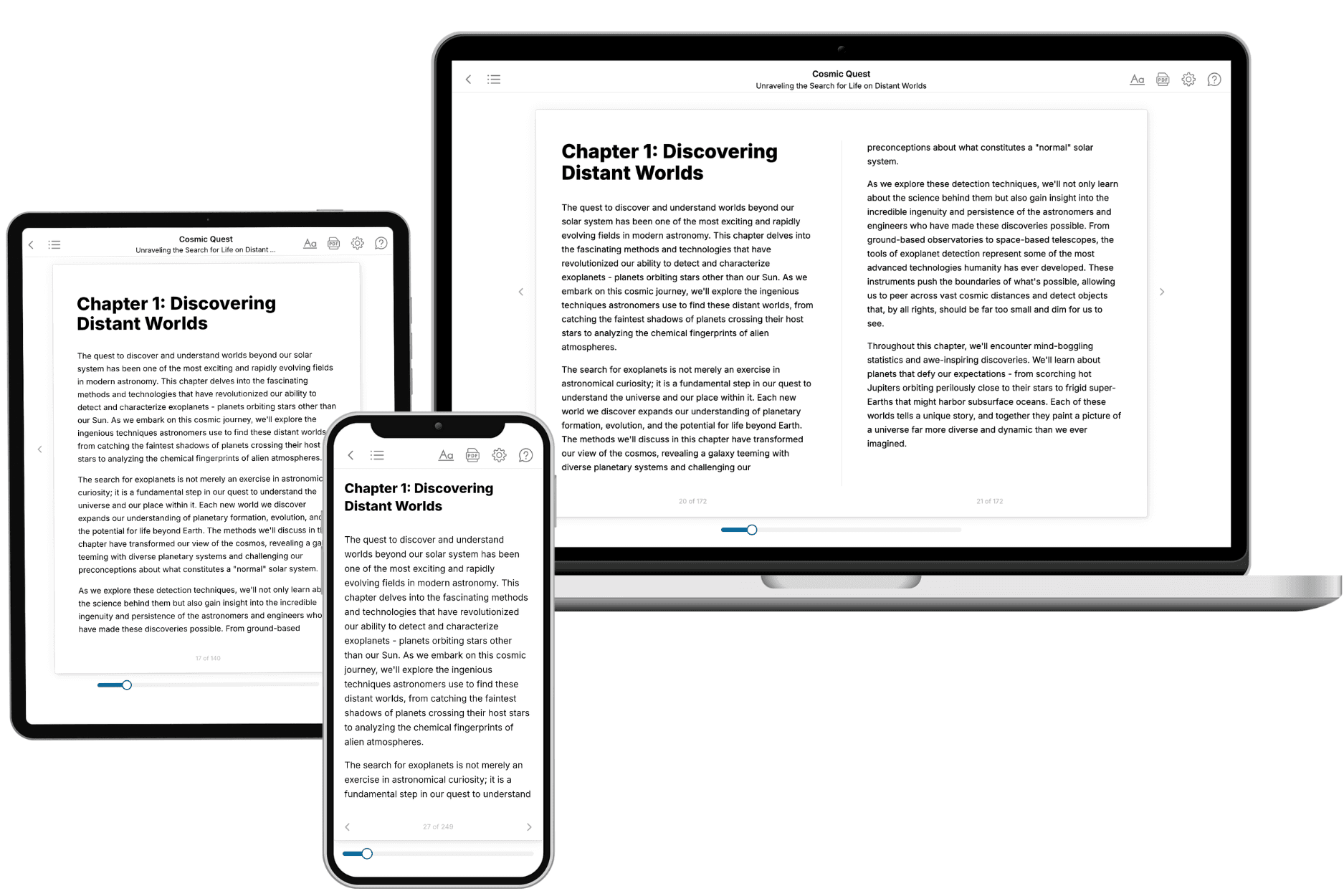
Your book is ready in 10 minutes. Read it online, download as EPUB or PDF, or send to Kindle.
Frequently asked questions
- What is TailoredRead?
TailoredRead creates complete, full-length nonfiction ebooks, written specifically for you. Tell us what you want to learn and why, and TailoredRead writes you a complete ebook on it, with charts, tables, and diagrams throughout. Read it online, on Kindle, or on any e-reader, or download it as a PDF or EPUB. Every book is written fresh the day you order it.
- How is the book tailored to me?
Before anything is written, you answer a few short questions about your goals, your background, and the topics you care about. Your book is then planned around your answers: written at your level, focused on your goals, and covering the topics you chose, instead of the one-size-fits-all book a store sells everyone.
- Will it read like generic AI content?
No. Your book isn't a chat transcript: it's planned chapter by chapter before a single word is written, told in a clear book voice, and explains ideas visually with charts, tables, and diagrams. After writing, every book goes through an editorial pass that polishes chapters so the book reads consistent from start to finish. Judge for yourself: browse thousands of sample books on our Explore Books page.
- How accurate is the content?
Our AI first checks whether your subject needs live research. Niche and fast-moving subjects are researched before writing, and the book plan and chapters are grounded in what it finds. After writing, every book goes through a quality pass that checks its facts and consistency, and researched books list their sources in a Notes section at the back.
- How long is the book?
You choose the length: Comprehensive (250-300 pages), Detailed (150-200 pages), Essential (70-100 pages), or Short (30-50 pages).
- Does the book include visuals?
Yes. Every book includes charts, tables, and diagrams: timelines, checklists, step-by-step guides, decision trees, comparison tables, matrices, and bar charts. A typical book includes dozens of these visual elements.
- Can I read it on Kindle? What formats can I download?
Yes. Every book can be read in our online reader or downloaded as a PDF or EPUB. The EPUB can be opened with Kindle, Apple Books, Kobo, and any e-reader. The Commercial and Author licenses also include an editable Word (DOCX) and Markdown download.
- How much does it cost?
About the price of a regular ebook. The exact price depends on your book's length and complexity, from $2 for the shortest books to $35 for the most comprehensive, and it's shown when you review your book, before you commit to anything. Each book is a one-time purchase, yours to keep, no subscription. Licenses that let you share, teach, or publish your book range from $35.99 to $49.99.
- Can I preview the book before purchasing?
Before you pay, you'll see what your book will cover: the title, a detailed description, the estimated length, and the complete chapter-by-chapter table of contents, so you know what you're getting before you decide. The full text itself is written after you purchase.
- How long does it take to create a book?
About 10 minutes. You can start reading the opening chapters while the rest is still being written.