Demography Mastery
Your Personalized 30-Day System for Population Insights and Economic Development Excellence
Master the demographic foundations that drive economic development and policy decisions.
238 pages11 chaptersFeb 22, 2026DemographyCreated by Abison
About this book
This 30-day system breaks down complex population concepts into daily, actionable lessons designed specifically for economics students. You'll progress from demographic fundamentals to advanced forecasting techniques, learning to interpret fertility data, analyze mortality patterns, evaluate age structures, and project population changes with confidence. Each day builds systematically on the previous, connecting demographic trends to economic outcomes through real-world examples and practical applications. By day 30, you'll understand how population dynamics shape labor markets, economic growth, and policy effectiveness—the insights that separate top performers in economics courses from the rest. This isn't theoretical knowledge divorced from reality; it's the demographic literacy that economists, policymakers, and development professionals use daily to make decisions affecting millions of people.
Table of contents
- IntroductionWhy Demography Matters for Economics, How to Use This 30-Day System, What You'll Master by Day 30Read below
- Chapter 1: Demographic Foundations and Core ConceptsWhat Is Demography and Why It Matters, Key Demographic Indicators and Definitions, Understanding Demographic Data Sources and Census Methods
- Chapter 2: Population Trends and Global PatternsGlobal Population Growth Patterns and Trajectories, Regional Population Disparities and Development Levels, Population Momentum and Future Growth Projections
- Chapter 3: Fertility Analysis and Birth Rate DynamicsFertility Rate Fundamentals and Measurement, Fertility Decline Mechanisms and Socioeconomic Drivers, The Fertility-Education Linkage and Human Capital Development
- Chapter 4: Mortality Analysis and Life Expectancy TrendsMortality Rate Patterns and Cause Analysis, Life Expectancy Trends and Mortality Compression Theory, Infant Mortality Trends and Development Indicators
- Chapter 5: Age Structure and Population CompositionPopulation Pyramid Interpretation and Age Distribution Analysis, Dependency Ratios and Economic Burden Assessment, Age Structure Implications for Labor Markets and Growth
- Chapter 6: Migration Patterns and Urbanization DynamicsInternational Migration Flows and Economic Effects, Urbanization Demographics and Rural-Urban Transitions, Migration's Socioeconomic Impact on Regional Economies
- Chapter 7: Population Aging and Economic ImplicationsAging Population Economics and Fiscal Challenges, Gender Demographic Patterns and Imbalances, Policy Responses to Population Aging
- Chapter 8: Demographic Data Interpretation and Statistical AnalysisCensus Data Analysis and Interpretation Techniques, Statistical Analysis Tools for Demographic Research, Cohort Analysis Methods and Life Table Construction
- Chapter 9: Population-Economy Relationships and DevelopmentPopulation-Economy Links and Economic Growth Impacts, Socioeconomic Indicators and Development Measurement, Poverty-Fertility Correlation and Development Dynamics
- Chapter 10: Demographic Forecasting and Population ProjectionsDemographic Forecasting Models and Projection Techniques, Population Carrying Capacity and Sustainability Analysis, Scenario Planning and Demographic Uncertainty
- Chapter 11: Population Policy Design and ImplementationPolicy Implications of Demographic Change, Education Demographics and Human Capital Policy, Policy Design Framework for Demographic Challenges
- ConclusionYour Demographic Mastery Journey Complete, Next Steps in Your Economic Development Studies
- Glossary of Demographic Terms
- Further Reading and Resources
Introduction
Every major economic story of the last century has a demographic subplot. The postwar boom in the United States was fueled by a surge of young workers and consumers. Japan's economic stagnation since the 1990s tracks almost perfectly with its aging population and shrinking workforce. China's extraordinary growth over four decades was powered, in part, by a massive working-age population and a falling dependency ratio. These are not coincidences. Population dynamics and economic outcomes are deeply, structurally connected, and understanding that connection is one of the most powerful analytical tools an economist can develop.
Yet demography often gets treated as a background subject in economics education, something you glance at before moving on to the "real" models. That's a mistake. When you ignore population structure, you miss why savings rates differ between countries, why some labor markets tighten while others flood with workers, and why certain social programs become fiscally unsustainable over time. Demographic literacy is not a soft skill or a supplementary topic. It is a core competency for anyone who wants to analyze economies with precision and credibility.
This book exists to close that gap. Over 30 structured days, you will move from foundational demographic concepts to advanced forecasting techniques, building a complete analytical toolkit along the way. Each chapter connects population data to economic outcomes in concrete, practical terms. The goal is not just to help you pass your course, though it will absolutely do that. The goal is to give you a way of seeing the world that most economics students never fully develop: the ability to read a population trend and understand what it means for growth, policy, labor, and development.
Whether you are preparing for an exam, working on a research paper, or simply trying to make sense of why the global economy behaves the way it does, this system gives you the structure and the substance to get there. Start here, follow the progression, and by day 30 you will think about economies in a fundamentally richer way.
Why Demography Matters for Economics
Demography is the scientific study of populations: their size, structure, distribution, and how they change over time. At first glance, counting people might seem like a straightforward administrative task. In practice, it is one of the most consequential forms of analysis in the social sciences. Population data tells you who is working, who is dependent, who is consuming, who is saving, and who will be doing all of those things in 20 years. That information sits at the heart of economic planning, policy design, and market forecasting.
Consider a simple but powerful example. In 2000, South Korea had a total fertility rate of about 1.47 children per woman, already well below the replacement level of 2.1. By 2023, that number had fallen to approximately 0.72, the lowest ever recorded for a major economy.[1] What does that mean economically? It means South Korea faces a shrinking workforce, rising pension costs, declining domestic consumption, and enormous pressure on its healthcare system, all within a single generation. No macroeconomic model can accurately forecast South Korea's trajectory without accounting for these demographic realities.
The connection between demography and economics runs through several key channels. Understanding these channels is the first step toward demographic literacy:
- Labor supply: The size and age structure of a population directly determines how many workers are available, and at what skill levels.
- Savings and investment: Working-age adults save more than the young or the elderly, so a population's age distribution shapes national savings rates and capital availability.
- Consumer demand: Different age groups consume different goods and services, meaning demographic shifts alter the structure of entire markets.
- Fiscal sustainability: Pension systems, healthcare programs, and education spending all depend on the ratio of contributors to beneficiaries, which is a demographic variable.
- Productivity and innovation: Research suggests that younger, growing populations tend to generate more entrepreneurial activity and technological adoption.
The demographic dividend is one of the clearest illustrations of how population structure drives economic outcomes. When a country moves through the demographic transition, fertility falls faster than mortality, creating a temporary window where the working-age population is large relative to dependents. Economists estimate that this dividend accounted for roughly one-third of East Asia's economic miracle between 1965 and 1990.[2] Countries that managed this window well, investing in education and infrastructure, captured enormous gains. Those that did not largely missed the opportunity.
Demography also matters because its effects are slow-moving and highly predictable. Unlike financial markets or commodity prices, population trends unfold over decades. The people who will be in the workforce in 2040 are already born. The age structure of 2050 is largely determined by today's fertility and mortality rates. This predictability makes demographic analysis uniquely valuable for long-range economic planning. You can see the future, at least in broad strokes, if you know how to read the data.
For economics students specifically, demographic fluency opens doors that pure theory cannot. When you can connect a country's age pyramid to its savings rate, or link urbanization trends to regional wage differentials, you demonstrate a level of analytical sophistication that stands out in coursework, research, and professional settings. Demography is not just background knowledge. It is a lens that sharpens every other economic analysis you do.
Finally, it is worth noting that demographic analysis is increasingly data-rich and technically demanding. Modern demographers use life tables, cohort-component models, regression analysis, and geographic information systems to extract insights from population data. These are not abstract academic tools. They are the same methods used by central banks, international development organizations, and private sector analysts to make decisions affecting billions of people. Learning them gives you real, transferable analytical power.
How to Use This 30-Day System
This book is built as a progressive learning system, not a reference encyclopedia. Each chapter builds directly on the concepts introduced before it. That structure is intentional. Demographic analysis is cumulative: you cannot meaningfully interpret a population pyramid without understanding fertility and mortality rates first, and you cannot build a credible population projection without mastering both age structure and cohort analysis. Skipping ahead is possible, but you will get far more out of the material if you follow the sequence.
The 30-day framework maps onto the book's 11 chapters, with each chapter covering roughly two to three days of focused study. Here is how to think about the pacing:
- Days 1–3 (Chapter 1): Demographic foundations, core concepts, and data sources. This is your vocabulary-building phase.
- Days 4–6 (Chapter 2): Global population trends and regional patterns. You start seeing the big picture.
- Days 7–9 (Chapter 3): Fertility analysis and birth rate dynamics. You learn to measure and interpret one of demography's most important variables.
- Days 10–12 (Chapter 4): Mortality analysis and life expectancy. The other side of the population equation.
- Days 13–15 (Chapter 5): Age structure and population composition. You start connecting structure to economic outcomes.
- Days 16–18 (Chapter 6): Migration and urbanization. You add the spatial and movement dimensions to your analysis.
- Days 19–21 (Chapter 7): Population aging and its economic implications. A critical topic for contemporary policy analysis.
- Days 22–24 (Chapter 8): Statistical tools and data interpretation. You develop technical analytical skills.
- Days 25–27 (Chapter 9): Population-economy relationships and development. You integrate everything into economic frameworks.
- Days 28–30 (Chapters 10–11): Forecasting, projections, and policy design. You apply your full toolkit to real-world problems.
Within each chapter, the subchapters follow a consistent structure. They open with the core concept explained clearly, move into the mechanisms and evidence behind it, and close with practical applications and examples. This pattern repeats throughout the book so you always know where you are in the learning arc. Concepts are introduced with definitions, illustrated with real-world cases, and then connected to economic analysis.
To get the most out of each study session, use the following approach. Before reading a subchapter, spend two minutes thinking about what you already know about the topic. This activates prior knowledge and makes new information stick better. While reading, pay close attention to the examples and data points. Do not just skim past them. They are doing real analytical work, showing you how abstract concepts translate into concrete observations. After reading, try to summarize the key idea in one or two sentences without looking at the text. If you can do that, you have understood it. If you cannot, re-read the section.
The book also works well as an exam preparation tool. If you are studying for a specific assessment, use the chapter structure to identify which topics your course covers and prioritize accordingly. The glossary at the back of the book gives you quick-reference definitions for all key terms. The further reading section points you toward primary sources and academic literature if you need to go deeper on any topic for a research paper or extended assignment.
One practical note on data: demographic statistics change over time, and some figures cited in this book reflect data available at the time of writing. When you are working on current assignments or research, always verify key statistics against the most recent releases from sources like the United Nations Population Division, the World Bank, or your country's national statistics office. The analytical frameworks in this book are durable. The specific numbers should always be checked against current data.
Finally, treat this as an active learning experience, not passive reading. The concepts here are not difficult in the way that advanced mathematics is difficult. They require careful thinking and the willingness to connect ideas across chapters. If you bring that mindset to each session, 30 days is genuinely enough time to develop a strong, working command of demographic analysis and its economic applications.
What You'll Master by Day 30
By the time you finish this book, you will have built a complete, integrated understanding of how population dynamics shape economic outcomes. That is a broad claim, so it is worth being specific about what mastery actually looks like in practice. The following is not a vague promise of "deeper understanding." It is a concrete list of skills and competencies you will have developed, organized by the type of analytical task they enable.
Conceptual mastery: You will be able to define, explain, and apply the full vocabulary of demographic analysis without hesitation. This includes:
- Crude birth rates, crude death rates, and natural increase rates
- Total fertility rate (TFR) and net reproduction rate (NRR)
- Age-specific mortality rates and standardized death rates
- Dependency ratios (youth, old-age, and total)
- The demographic transition model and its four stages
- Population momentum and its implications for future growth
- The demographic dividend and its economic conditions
Data interpretation skills: You will be able to look at a population pyramid and immediately identify whether a country is in early, middle, or late demographic transition. You will be able to read a life table and extract meaningful information about survival probabilities and life expectancy at different ages. You will understand how census data is collected, what its limitations are, and how to adjust for common sources of error. These are skills that directly translate into better exam performance and stronger research papers.
Analytical frameworks: You will have internalized several powerful frameworks for connecting demographic data to economic outcomes. For example, you will understand how the cohort-component method works for population projection, why the Lee-Carter model is used for mortality forecasting, and how Bongaarts' proximate determinants framework explains fertility variation across countries.[3] These are not just names to memorize. They are tools you will know how to use.
Consider what this looks like in a real exam scenario. Suppose you are given a question asking you to analyze the economic implications of Nigeria's current demographic profile. By day 30, here is how you will approach it:
Nigeria has a young, rapidly growing population with a TFR of approximately 5.1 and a median age of around 18 years. Its population pyramid is strongly bottom-heavy, indicating high youth dependency. The working-age share of the population is growing but has not yet peaked, suggesting Nigeria is in the early stages of a potential demographic dividend. However, capturing that dividend requires significant investment in education and job creation. Without those investments, the large youth cohort risks becoming a source of unemployment pressure rather than economic growth. Fiscal implications include rising demand for education spending and healthcare, while pension pressures remain relatively low for now but will intensify as the population ages over the coming decades.
That kind of structured, evidence-linked analysis is exactly what top-performing economics students produce. It is not the result of memorizing facts. It is the result of understanding how demographic variables connect to economic mechanisms, which is precisely what this book teaches.
Forecasting and projection skills: You will understand how demographers build population projections, what assumptions drive different scenarios, and how to interpret the uncertainty ranges that responsible forecasters always include. You will know why the UN publishes low, medium, and high fertility variants in its World Population Prospects, and what those variants mean for economic planning. This is directly applicable to any course assignment involving future economic scenarios or policy analysis.
Policy analysis capability: You will be able to evaluate demographic policies, such as pronatalist incentives, immigration reform, pension restructuring, and education investment, with a clear understanding of the demographic mechanisms they are trying to influence. You will know what the evidence says about which interventions work, which do not, and why. This makes your policy analysis far more grounded and credible than arguments based purely on economic theory.
Cross-country comparative analysis: You will be comfortable comparing demographic profiles across countries at different stages of development and drawing meaningful economic conclusions from those comparisons. You will understand why Germany and Japan face similar aging challenges despite very different cultural contexts, why sub-Saharan Africa's demographic trajectory differs fundamentally from South Asia's, and what those differences imply for global economic patterns over the next 30 years.
Perhaps most importantly, you will finish this book with a habit of mind: the instinct to ask demographic questions when analyzing economic problems. When you read about a country's growth slowdown, you will automatically wonder about its age structure. When you see a labor market tightening, you will think about cohort sizes and migration flows. When a pension system comes under fiscal pressure, you will look at the dependency ratio first. That instinct, once developed, does not go away. It makes you a better economist, a sharper analyst, and a more informed citizen. That is what 30 days of focused demographic study can genuinely deliver.
Notes
Introduction
- 1. Statistics Korea, Birth Statistics, Korean Statistical Information Service, 2023
- 2. D. E. Bloom and others, "Population Dynamics and Economic Growth in Asia," Population and Development Review, 2000
- 3. J. Bongaarts, "A Framework for Analyzing the Proximate Determinants of Fertility," Population and Development Review, 1978
This is the end of the free sample. The full book has 11 chapters.
Want this book written for you?
Tell us your goals and background, and get your own version of this book, tailored by AI to you.


Benefits of AI-tailored books
- Read one book, not ten:
- all the Demography knowledge you need, gathered into a single book.
- Save days of learning:
- tell us your goals, choose your topics, and the whole book is built around them.
- Learn effortlessly:
- Demography book written for your specific background and expertise.
- Understand at a glance:
- includes charts, tables, timelines, checklists, decision trees, and more.
- Stay current:
- written the day you order it, not years ago.
- Trust what you read:
- every book is checked for accuracy, with real research when your subject needs it.
Create your unique book in 3 steps
- 1. Select your focus
Select the focus of your Demography book and share your background
- 2. Personalize your book
Specify your goals and choose sub-topics to include
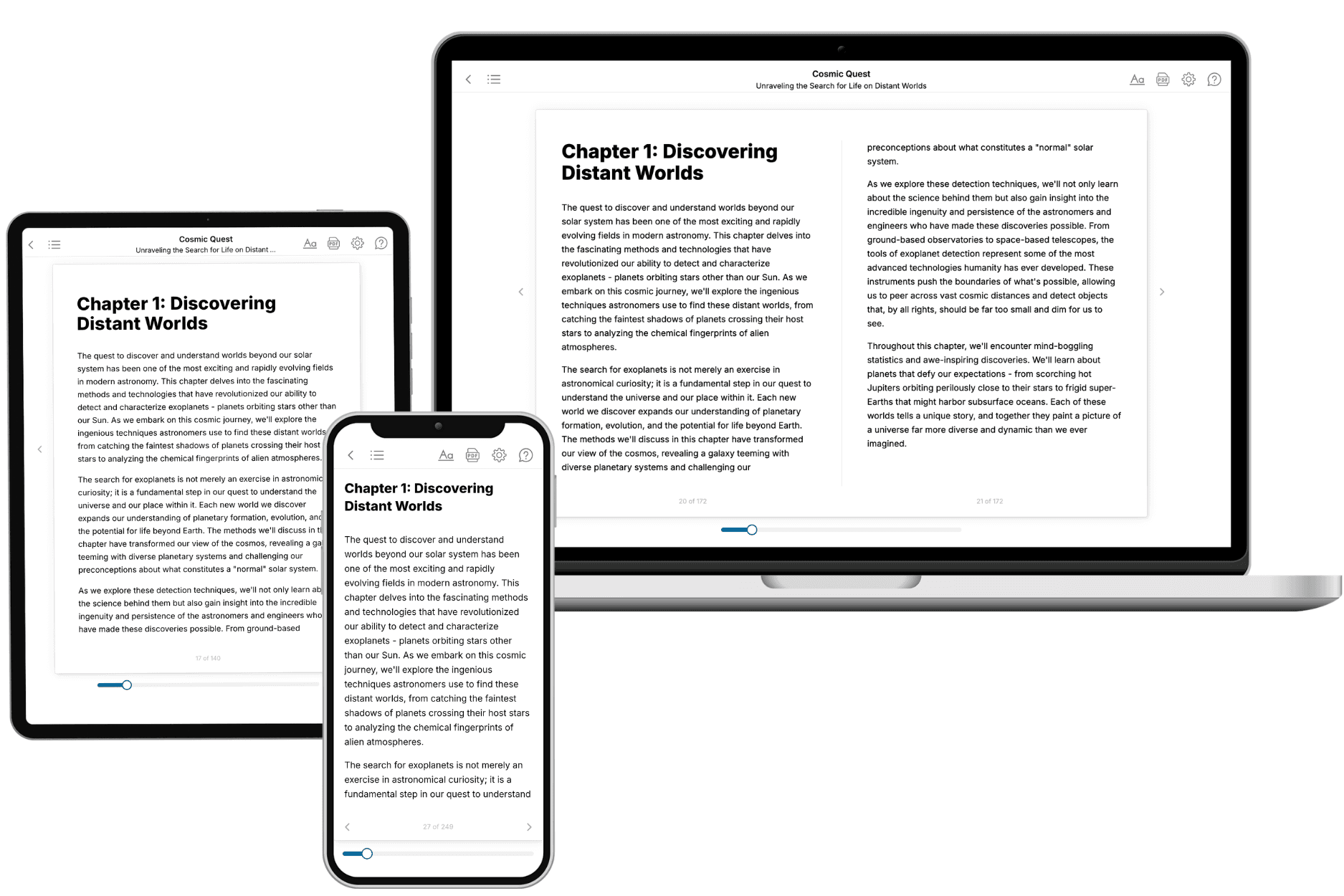
- 3. Get your tailored book
Your book is ready in 10 minutes. Read it online, download as EPUB or PDF, or send to Kindle.
Frequently asked questions
- What is TailoredRead?
TailoredRead creates complete, full-length nonfiction ebooks, written specifically for you. Tell us what you want to learn and why, and TailoredRead writes you a complete ebook on it, with charts, tables, and diagrams throughout. Read it online, on Kindle, or on any e-reader, or download it as a PDF or EPUB. Every book is written fresh the day you order it.
- How is the book tailored to me?
Before anything is written, you answer a few short questions about your goals, your background, and the topics you care about. Your book is then planned around your answers: written at your level, focused on your goals, and covering the topics you chose, instead of the one-size-fits-all book a store sells everyone.
- Will it read like generic AI content?
No. Your book isn't a chat transcript: it's planned chapter by chapter before a single word is written, told in a clear book voice, and explains ideas visually with charts, tables, and diagrams. After writing, every book goes through an editorial pass that polishes chapters so the book reads consistent from start to finish. Judge for yourself: browse thousands of sample books on our Explore Books page.
- How accurate is the content?
Our AI first checks whether your subject needs live research. Niche and fast-moving subjects are researched before writing, and the book plan and chapters are grounded in what it finds. After writing, every book goes through a quality pass that checks its facts and consistency, and researched books list their sources in a Notes section at the back.
- How long is the book?
You choose the length: Comprehensive (250-300 pages), Detailed (150-200 pages), Essential (70-100 pages), or Short (30-50 pages).
- Does the book include visuals?
Yes. Every book includes charts, tables, and diagrams: timelines, checklists, step-by-step guides, decision trees, comparison tables, matrices, and bar charts. A typical book includes dozens of these visual elements.
- Can I read it on Kindle? What formats can I download?
Yes. Every book can be read in our online reader or downloaded as a PDF or EPUB. The EPUB can be opened with Kindle, Apple Books, Kobo, and any e-reader. The Commercial and Author licenses also include an editable Word (DOCX) and Markdown download.
- How much does it cost?
About the price of a regular ebook. The exact price depends on your book's length and complexity, from $2 for the shortest books to $35 for the most comprehensive, and it's shown when you review your book, before you commit to anything. Each book is a one-time purchase, yours to keep, no subscription. Licenses that let you share, teach, or publish your book range from $35.99 to $49.99.
- Can I preview the book before purchasing?
Before you pay, you'll see what your book will cover: the title, a detailed description, the estimated length, and the complete chapter-by-chapter table of contents, so you know what you're getting before you decide. The full text itself is written after you purchase.
- How long does it take to create a book?
About 10 minutes. You can start reading the opening chapters while the rest is still being written.