Discrete Mathematics for Network Design
Build Efficient, Scalable Networks Using Proven Mathematical Principles
Network design decisions often feel overwhelming when you lack a systematic framework for evaluating options.
238 pages11 chaptersFeb 14, 2026Discrete Mathematics
About this book
Without mathematical grounding, you're left guessing about topology choices, routing strategies, and resource allocation—decisions that directly impact performance, cost, and reliability. This book bridges the gap between abstract mathematics and practical network engineering. You'll discover how graph theory reveals optimal network structures, how combinatorics solves resource allocation puzzles, and how algorithm analysis predicts real-world performance. Each concept connects directly to tangible network design challenges: minimizing latency, reducing costs, improving redundancy, and scaling efficiently. Rather than overwhelming you with proofs, this guide focuses on understanding the principles and applying them to networks you'll actually build. You'll work through concrete examples, see how mathematical models translate to design decisions, and learn when to prioritize mathematical optimality versus practical constraints. Whether you're designing enterprise networks, optimizing data center architectures, or planning infrastructure expansion, these mathematical tools become your competitive advantage.
Table of contents
- IntroductionWhy Discrete Mathematics Matters for Networks, How to Use This Book, What You'll Learn and AccomplishRead below
- Chapter 1: Graph Theory FoundationsRepresenting Networks as Graphs, Vertices, Edges, and Network Components, Essential Graph Properties and Metrics
- Chapter 2: Network Topology and ConnectivityCommon Network Topologies and Their Characteristics, Analyzing Network Connectivity and Resilience, Spanning Trees and Minimum Spanning Trees
- Chapter 3: Combinatorics and Resource AllocationFundamental Counting Principles in Network Design, Permutations and Combinations for Configuration Options, Optimizing Resource Distribution Across Networks
- Chapter 4: Network Flows and RoutingUnderstanding Network Flow Models, Maximum Flow and Minimum Cut Theorems, Applying Flow Algorithms to Routing Decisions
- Chapter 5: Algorithm Analysis and PerformanceUnderstanding Computational Complexity, Big-O Notation and Performance Prediction, Choosing Algorithms Based on Network Scale
- Chapter 6: Shortest Path and Distance MetricsDefining Distance in Network Contexts, Dijkstra and Bellman-Ford Algorithms, Optimizing Latency and Hop Counts
- Chapter 7: Matching and Graph ColoringSolving Matching Problems in Networks, Graph Coloring for Frequency and Channel Assignment, Practical Applications in Wireless and Spectrum Networks
- Chapter 8: Number Theory and Network SecurityModular Arithmetic in Network Protocols, Number Theory Foundations for Secure Communication, Ensuring Data Integrity with Mathematical Checks
- Chapter 9: Probability and Network ReliabilityProbability Fundamentals for Network Events, Modeling Network Failures and Outages, Calculating Network Reliability and Availability
- Chapter 10: Optimization Techniques in Network DesignLinear Programming for Network Optimization, Heuristic and Approximation Algorithms, Balancing Cost, Performance, and Reliability
- Chapter 11: Real-World Network Design Case StudiesDesigning Scalable Data Center Networks, Enterprise Network Architecture and Optimization, Wireless Network Planning and Optimization
- ConclusionKey Takeaways and Next Steps, Continuing Your Mathematical Network Design Journey
- Glossary
- Further Reading and Resources
Introduction
Network design decisions carry significant consequences. When you choose a topology, select routing protocols, or allocate bandwidth across network segments, you're making choices that affect performance, cost, and reliability for years to come. Yet many network professionals approach these decisions without a systematic framework, relying instead on intuition, vendor recommendations, or simply copying existing designs. This approach works until it doesn't—until you face a scaling challenge, a performance bottleneck, or a budget constraint that demands a more rigorous solution.
Discrete mathematics provides the systematic framework that transforms network design from guesswork into engineering. The mathematical concepts you'll explore in this book aren't abstract academic exercises. They're practical tools that reveal why certain network configurations outperform others, how to predict bottlenecks before they occur, and where to invest resources for maximum impact. Graph theory shows you which topologies provide optimal redundancy. Combinatorics helps you evaluate configuration options systematically. Algorithm analysis predicts how your network will perform as it scales. These mathematical principles have guided the design of the internet itself, and they'll guide your design decisions too.
This book bridges the gap between mathematical theory and network engineering practice. You won't find lengthy proofs or abstract theorems disconnected from real applications. Instead, you'll discover how mathematical concepts translate directly into design decisions you make every day. Each chapter connects mathematical principles to concrete network challenges: reducing latency, improving fault tolerance, optimizing costs, and scaling efficiently. You'll learn when mathematical optimality matters and when practical constraints should take precedence. By the end, you'll possess a toolkit of mathematical techniques that make you a more effective, confident network designer.
The networks you design today must handle tomorrow's demands. Traffic patterns shift, applications evolve, and business requirements change. Networks built on mathematical foundations adapt more gracefully to these changes because the underlying principles remain constant. When you understand the mathematics behind network design, you're not just following best practices—you're equipped to evaluate new technologies, assess vendor claims critically, and make informed trade-offs. This mathematical literacy becomes your competitive advantage in a field where technology changes rapidly but fundamental principles endure.
Why Discrete Mathematics Matters for Networks
Networks are inherently discrete systems. Unlike continuous systems where values change smoothly, networks consist of distinct components: routers, switches, links, and packets. Data flows in discrete units, routing decisions happen at specific nodes, and connections either exist or they don't. This discrete nature makes networks a perfect match for discrete mathematics, which deals with countable, distinct objects rather than continuous quantities. When you represent a network as a mathematical graph, with devices as vertices and connections as edges, you unlock centuries of mathematical insights about connectivity, optimization, and efficiency.
Consider a practical scenario: you're designing a network to connect five regional offices, and you need to determine the minimum number of connections required to ensure every office can communicate with every other office. Without mathematical tools, you might overengineer the solution, adding unnecessary links that increase costs. Or you might underengineer it, creating a fragile network vulnerable to single points of failure. Graph theory provides the answer immediately: a spanning tree requires exactly four connections to connect five nodes, and you can calculate precisely how many additional links you need for desired redundancy levels. This isn't theoretical knowledge—it's a practical tool that saves money and improves reliability.
The mathematical approach reveals non-obvious insights that intuition misses. Network engineers often assume that adding more connections always improves performance, but graph theory shows this isn't necessarily true. Beyond certain thresholds, additional links provide diminishing returns or even introduce complexity that degrades performance. Similarly, the shortest physical path between two points isn't always the fastest route when you account for congestion, processing delays, and protocol overhead. Mathematical models help you quantify these trade-offs and make decisions based on data rather than assumptions.
Discrete mathematics also provides a common language for discussing network design. When you describe a network topology using precise mathematical terms—degree distribution, diameter, clustering coefficient—you communicate unambiguously with colleagues, vendors, and stakeholders. This precision eliminates the confusion that arises from vague descriptions like "highly connected" or "reasonably redundant." Mathematical notation lets you document design decisions in ways that others can verify, reproduce, and build upon. Your network designs become more than tribal knowledge; they become documented engineering artifacts.
The scalability challenges facing modern networks demand mathematical rigor. A design approach that works for a ten-node network may fail catastrophically at a hundred nodes or a thousand nodes. Algorithm analysis, a core topic in discrete mathematics, helps you predict how network protocols and routing algorithms will perform as your network grows. You'll learn to recognize when an algorithm's computational complexity makes it unsuitable for large-scale deployment, and you'll discover alternative approaches that scale efficiently. This foresight prevents costly redesigns and ensures your network architecture can accommodate future growth.
Security considerations also benefit from mathematical foundations. Modern cryptographic protocols rely on number theory, a branch of discrete mathematics, to protect data in transit. Understanding the mathematical principles behind encryption, hashing, and digital signatures helps you make informed decisions about security protocols and key management. You'll recognize why certain key lengths provide adequate security while others don't, and you'll understand the computational trade-offs between security strength and performance. This knowledge is increasingly critical as networks face sophisticated threats and regulatory compliance requirements.
Resource allocation problems pervade network design, and combinatorics provides systematic methods for solving them. How many IP addresses do you need for a subnet? How should you assign VLANs to minimize broadcast traffic? Which channels should wireless access points use to avoid interference? These questions involve counting, arranging, and selecting from discrete options—precisely what combinatorics addresses. Rather than trial and error, you'll apply proven mathematical techniques that guarantee optimal or near-optimal solutions. The time you save in planning and troubleshooting justifies the effort of learning these methods.
Perhaps most importantly, discrete mathematics develops your analytical thinking skills. Network troubleshooting requires breaking complex problems into manageable components, identifying patterns, and reasoning systematically from observations to conclusions. These are exactly the skills that mathematical problem-solving cultivates. When you work through mathematical proofs and derivations, you're training your mind to think rigorously about cause and effect, to question assumptions, and to verify solutions. These cognitive skills transfer directly to network engineering, making you more effective at diagnosing problems, evaluating solutions, and communicating technical concepts.
The investment in learning discrete mathematics pays dividends throughout your career. Technologies change—protocols evolve, vendors come and go, and specific products become obsolete. But mathematical principles remain constant. The graph theory you learn today will still apply to networks decades from now, regardless of whether they're built on fiber optics, wireless technologies, or quantum communication systems. By grounding your knowledge in mathematics, you build a foundation that doesn't depreciate with time. You become adaptable, capable of learning new technologies quickly because you understand the underlying principles they're built upon.
How to Use This Book
This book is structured to build your knowledge progressively, starting with foundational concepts and advancing to sophisticated applications. Each chapter focuses on a specific area of discrete mathematics and demonstrates its relevance to network design through concrete examples and practical applications. You don't need to read the chapters in strict sequence, but the early chapters establish terminology and concepts that later chapters build upon. If you're already comfortable with graph theory basics, you might skip ahead to network flows or optimization techniques. However, even familiar topics may offer new perspectives when viewed through the lens of network engineering.
The chapters follow a consistent structure designed to maximize learning efficiency. Each begins with a clear statement of the mathematical concepts covered and the network design problems they address. You'll then explore the mathematical principles themselves, presented with minimal jargon and maximum clarity. Rather than formal proofs, you'll find intuitive explanations that build understanding. The focus then shifts to application: how do these mathematical concepts translate into network design decisions? You'll work through detailed examples that show the mathematics in action, solving real network design challenges. Each chapter concludes with key takeaways that summarize the most important concepts and their practical implications.
The examples throughout this book use realistic network scenarios you're likely to encounter in professional practice. You'll see how to apply graph theory to data center network design, how combinatorics helps with IP address planning, and how probability theory informs redundancy decisions. These aren't toy problems with artificially simple numbers—they reflect the complexity and constraints of actual network environments. When examples include calculations, you'll find step-by-step workings that show the process, not just the final answer. This transparency helps you understand the methodology so you can apply it to your own unique situations.
Mathematical notation appears throughout the book, but always with clear explanations of what each symbol means. If you see G = (V, E) representing a graph with vertex set V and edge set E, the surrounding text will explain this notation before using it. You don't need to memorize notation—the book provides reminders when reintroducing concepts after several chapters. The goal is comprehension, not memorization. You should understand what the mathematics means and how to use it, even if you need to look up specific formulas or notation when applying them to your own work.
Active engagement accelerates learning. As you read, pause periodically to consider how the concepts apply to networks you've designed or maintained. When you encounter an example, try working through it yourself before reading the solution. Sketch graphs on paper to visualize network topologies. Calculate metrics for your own networks using the formulas presented. This active practice transforms passive reading into genuine skill development. The mathematical concepts become tools you can actually use, not just ideas you've read about. Consider keeping a notebook where you work through examples and jot down insights about how specific concepts apply to your work environment.
The book includes references to additional resources for readers who want to explore topics in greater depth. These references point to academic papers, textbooks, and online resources that provide more rigorous mathematical treatments or additional applications. You don't need to consult these references to benefit from this book—they're optional enrichment for curious readers. However, if a particular topic resonates with your work or interests, these references provide pathways for deeper exploration. The field of network mathematics is vast, and this book serves as your entry point, not an exhaustive treatment of every possible topic.
Different readers will approach this book with different backgrounds and goals. If you're a network engineer with limited mathematical background, focus on understanding the concepts and applications rather than mathematical rigor. The intuitive explanations and practical examples will give you the tools you need without requiring advanced mathematical prerequisites. If you're a computer science student or someone with stronger mathematical training, you might appreciate the connections between abstract mathematical concepts and concrete engineering applications. You might also explore the referenced materials for more formal treatments. The book accommodates both audiences by emphasizing understanding and application over mathematical formalism.
Consider forming a study group with colleagues who share your interest in improving their network design skills. Discussing the concepts with others reinforces your understanding and exposes you to different perspectives. You might work through examples together, debate the trade-offs in different design approaches, or collaborate on applying the techniques to actual network projects at your organization. Teaching concepts to others is one of the most effective ways to solidify your own understanding. When you can explain why a particular topology provides better fault tolerance or how to calculate expected network availability, you've truly mastered the material.
The ultimate goal is practical application. As you progress through the book, look for opportunities to apply what you're learning to real network design challenges. Start small—perhaps use graph metrics to evaluate an existing network topology, or apply combinatorial methods to optimize VLAN assignments. As your confidence grows, tackle more substantial projects: redesigning a network segment for better performance, planning a network expansion using optimization techniques, or conducting a reliability analysis using probability theory. These real-world applications cement your learning and demonstrate the value of mathematical approaches to network design. Your growing toolkit of mathematical techniques will become second nature, informing your design decisions even when you're not consciously thinking about the underlying mathematics.
What You'll Learn and Accomplish
By working through this book, you'll develop a comprehensive understanding of how discrete mathematics applies to network design. You'll learn to represent networks as mathematical graphs, enabling you to analyze their properties systematically. This representation isn't just academic—it's the foundation for understanding network topology, evaluating connectivity, and identifying potential vulnerabilities. You'll be able to look at a network diagram and immediately recognize its mathematical properties: its degree distribution, diameter, and connectivity characteristics. These insights inform design decisions about where to add redundancy, how to optimize routing, and where bottlenecks might emerge as traffic grows.
Graph theory will become one of your primary analytical tools. You'll master essential concepts like paths, cycles, trees, and connectivity, understanding how each relates to network behavior. You'll learn to calculate important graph metrics—degree centrality, betweenness centrality, clustering coefficient—and interpret what these metrics reveal about network performance and resilience. More importantly, you'll understand which metrics matter for different design objectives. When optimizing for low latency, you'll focus on diameter and average path length. When designing for fault tolerance, you'll examine connectivity and the presence of articulation points. This targeted analysis helps you focus on the metrics that actually matter for your specific design goals.
Network topology selection will shift from guesswork to informed decision-making. You'll understand the mathematical trade-offs between different topologies: star, ring, mesh, tree, and hybrid configurations. Each topology has characteristic properties that make it suitable for certain applications and problematic for others. A star topology minimizes cabling and simplifies management but creates a single point of failure. A full mesh provides maximum redundancy but becomes prohibitively expensive as the network grows. You'll learn to quantify these trade-offs mathematically, calculating the number of links required, the average path length, and the impact of node or link failures. These calculations inform budget discussions and help you justify design decisions to stakeholders.
Routing and network flow problems will become tractable through mathematical modeling. You'll learn algorithms for finding shortest paths, calculating maximum flow, and identifying minimum cuts. These aren't just theoretical exercises—they directly address practical questions like: What's the fastest route between two network segments? How much traffic can this network segment handle before congestion occurs? Which link, if it fails, would most severely impact network capacity? You'll be able to model your network mathematically, apply proven algorithms, and obtain quantitative answers to these questions. This capability transforms capacity planning from guesswork into engineering.
Resource allocation decisions will benefit from combinatorial analysis. You'll learn systematic methods for counting configuration options, evaluating permutations and combinations, and optimizing resource distribution. These techniques apply to numerous network design challenges:
- IP address planning: Calculating subnet sizes and address requirements for network segments
- VLAN assignment: Determining optimal VLAN configurations to minimize broadcast traffic
- Channel allocation: Assigning wireless channels to minimize interference
- Load balancing: Distributing traffic across multiple paths or servers
- Redundancy planning: Determining how many backup components to provision
Algorithm analysis will help you predict network performance and scalability. You'll learn to evaluate the computational complexity of routing protocols, switching algorithms, and network management tools. This knowledge helps you avoid algorithms that work well in small networks but become bottlenecks at scale. You'll understand Big-O notation and what it reveals about how algorithms perform as input size grows. When evaluating routing protocols, you'll be able to assess whether their computational requirements are reasonable for your network size. When selecting network management tools, you'll recognize whether their algorithms will scale to your environment or become performance bottlenecks.
Network reliability and availability calculations will become part of your design process. Using probability theory, you'll learn to model component failures, calculate system reliability, and determine expected availability. These calculations inform decisions about redundancy investments: How much does adding a redundant link improve overall availability? What's the expected downtime for different network configurations? Which components are most critical to overall reliability? You'll be able to quantify the reliability improvements from different design choices, helping you allocate budget to the redundancy investments that provide the greatest benefit. This quantitative approach to reliability engineering replaces vague notions of "high availability" with specific, measurable targets.
Optimization techniques will help you balance competing objectives in network design. Real networks must satisfy multiple constraints simultaneously: minimize cost, maximize performance, ensure adequate redundancy, and meet service level agreements. You'll learn optimization methods that help you navigate these trade-offs systematically. Linear programming techniques let you model network design as an optimization problem with constraints, finding solutions that optimize your objective function while satisfying all requirements. When exact optimization is computationally infeasible, you'll learn heuristic and approximation algorithms that find good solutions efficiently. These techniques are particularly valuable for large-scale network design where exhaustive evaluation of all options is impossible.
Security considerations will be informed by number theory and cryptographic principles. You'll understand the mathematical foundations of encryption, hashing, and digital signatures. This knowledge helps you make informed decisions about security protocols, key lengths, and cryptographic algorithms. You'll recognize why certain mathematical properties make some algorithms secure while others are vulnerable. When evaluating security products or protocols, you'll be able to assess their mathematical foundations rather than relying solely on vendor claims. This mathematical literacy is increasingly important as networks face sophisticated threats and must comply with stringent security requirements.
Perhaps most valuable, you'll develop a systematic problem-solving approach that applies across diverse network design challenges. The mathematical methods you learn provide frameworks for breaking complex problems into manageable components, analyzing each component rigorously, and synthesizing solutions. This structured thinking helps you tackle novel problems you haven't encountered before. When you face a new network design challenge, you'll be able to identify which mathematical tools apply, model the problem appropriately, and work toward a solution methodically. This problem-solving capability extends beyond the specific examples in this book, making you more effective at addressing whatever network design challenges you encounter in your career.
By the end of this book, you'll possess a toolkit of mathematical techniques that make you a more capable, confident network designer. You'll make design decisions based on quantitative analysis rather than intuition alone. You'll communicate design rationale clearly using precise mathematical language. You'll predict how networks will perform before building them, avoiding costly mistakes. You'll optimize resource allocation to achieve better performance at lower cost. Most importantly, you'll understand the fundamental principles that underlie network design, giving you knowledge that remains relevant regardless of how specific technologies evolve. This mathematical foundation becomes your competitive advantage in a field where technology changes rapidly but fundamental principles endure.
This is the end of the free sample. The full book has 11 chapters.
Want this book written for you?
Tell us your goals and background, and get your own version of this book, tailored by AI to you.


Benefits of AI-tailored books
- Read one book, not ten:
- all the Discrete Mathematics knowledge you need, gathered into a single book.
- Save days of learning:
- tell us your goals, choose your topics, and the whole book is built around them.
- Learn effortlessly:
- Discrete Mathematics book written for your specific background and expertise.
- Understand at a glance:
- includes charts, tables, timelines, checklists, decision trees, and more.
- Stay current:
- written the day you order it, not years ago.
- Trust what you read:
- every book is checked for accuracy, with real research when your subject needs it.
Create your unique book in 3 steps
- 1. Select your focus
Select the focus of your Discrete Mathematics book and share your background
- 2. Personalize your book
Specify your goals and choose sub-topics to include
- 3. Get your tailored book
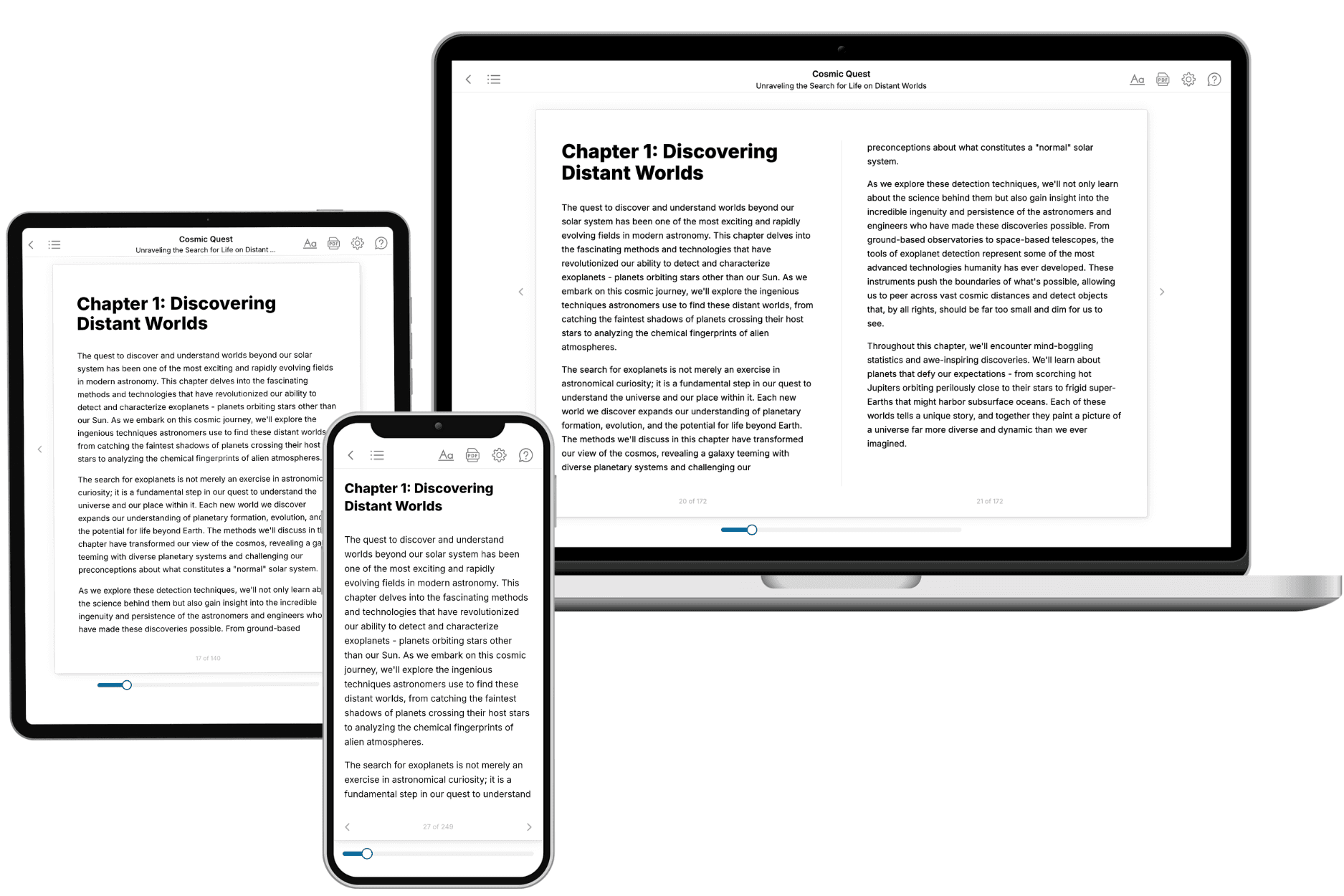
Your book is ready in 10 minutes. Read it online, download as EPUB or PDF, or send to Kindle.

Frequently asked questions
- What is TailoredRead?
TailoredRead creates complete, full-length nonfiction ebooks, written specifically for you. Tell us what you want to learn and why, and TailoredRead writes you a complete ebook on it, with charts, tables, and diagrams throughout. Read it online, on Kindle, or on any e-reader, or download it as a PDF or EPUB. Every book is written fresh the day you order it.
- How is the book tailored to me?
Before anything is written, you answer a few short questions about your goals, your background, and the topics you care about. Your book is then planned around your answers: written at your level, focused on your goals, and covering the topics you chose, instead of the one-size-fits-all book a store sells everyone.
- Will it read like generic AI content?
No. Your book isn't a chat transcript: it's planned chapter by chapter before a single word is written, told in a clear book voice, and explains ideas visually with charts, tables, and diagrams. After writing, every book goes through an editorial pass that polishes chapters so the book reads consistent from start to finish. Judge for yourself: browse thousands of sample books on our Explore Books page.
- How accurate is the content?
Our AI first checks whether your subject needs live research. Niche and fast-moving subjects are researched before writing, and the book plan and chapters are grounded in what it finds. After writing, every book goes through a quality pass that checks its facts and consistency, and researched books list their sources in a Notes section at the back.
- How long is the book?
You choose the length: Comprehensive (250-300 pages), Detailed (150-200 pages), Essential (70-100 pages), or Short (30-50 pages).
- Does the book include visuals?
Yes. Every book includes charts, tables, and diagrams: timelines, checklists, step-by-step guides, decision trees, comparison tables, matrices, and bar charts. A typical book includes dozens of these visual elements.
- Can I read it on Kindle? What formats can I download?
Yes. Every book can be read in our online reader or downloaded as a PDF or EPUB. The EPUB can be opened with Kindle, Apple Books, Kobo, and any e-reader. The Commercial and Author licenses also include an editable Word (DOCX) and Markdown download.
- How much does it cost?
About the price of a regular ebook. The exact price depends on your book's length and complexity, from $2 for the shortest books to $35 for the most comprehensive, and it's shown when you review your book, before you commit to anything. Each book is a one-time purchase, yours to keep, no subscription. Licenses that let you share, teach, or publish your book range from $35.99 to $49.99.
- Can I preview the book before purchasing?
Before you pay, you'll see what your book will cover: the title, a detailed description, the estimated length, and the complete chapter-by-chapter table of contents, so you know what you're getting before you decide. The full text itself is written after you purchase.
- How long does it take to create a book?
About 10 minutes. You can start reading the opening chapters while the rest is still being written.