Epistemic Injustice
How Knowledge Systems Silence Voices and What We Can Do About It
You navigate a world where knowledge is power, yet not everyone's voice carries equal weight.
191 pages8 chaptersJan 30, 2026Philosophy
About this book
This book examines the hidden mechanisms that determine whose expertise we trust, whose experiences we believe, and whose perspectives shape our understanding of reality. Through clear explanations and real-world examples, you'll discover how epistemic injustice—the wronging of people in their capacity as knowers—operates in workplaces, classrooms, courtrooms, and communities. You'll learn to identify testimonial injustice, where credibility is unfairly withheld, and hermeneutical injustice, where entire groups lack the language to name their experiences. More importantly, you'll gain practical tools to challenge these injustices in your own life and institutions. This exploration moves beyond abstract philosophy to show you how recognizing these patterns can transform how you listen, learn, and advocate for more equitable knowledge systems.
Table of contents
- IntroductionWhy Knowledge Matters: Power and Credibility, What Is Epistemic Injustice?, Your Journey AheadRead below
- Chapter 1: The Foundations of Epistemic InjusticeEpistemology Basics: What Is Knowledge?, Knowledge as a Social Practice, When Knowledge Becomes Injustice
- Chapter 2: Testimonial Injustice: The Credibility GapUnderstanding Testimonial Injustice, How Prejudice Shapes Credibility Judgments, Real-World Examples Across Contexts, The Consequences of Being Disbelieved
- Chapter 3: Hermeneutical Injustice: The Missing LanguageUnderstanding Hermeneutical Injustice, When Concepts Don't Exist, The Power of Naming and Language, Historical and Contemporary Examples
- Chapter 4: Power Structures and Knowledge SystemsHow Power Embeds Itself in Knowledge, Institutional Gatekeeping and Expertise, Whose Knowledge Counts as Valid?, Intersectionality and Multiple Injustices
- Chapter 5: Recognizing Epistemic Injustice in Daily LifeEpistemic Injustice in the Workplace, Epistemic Injustice in Healthcare Settings, Epistemic Injustice in Educational Institutions, Epistemic Injustice in Personal Relationships
- Chapter 6: Your Own Credibility JudgmentsExamining Your Own Credibility Biases, The Hidden Assumptions We Bring, Developing Epistemic Humility
- Chapter 7: Resistance and Counter-NarrativesEpistemic Resistance: Reclaiming Authority, The Power of Counter-Narratives, Building Collective Knowledge Communities, Testimony as an Act of Resistance
- Chapter 8: Practical Strategies for ChangeIndividual Accountability and Action, Advocating for Institutional Reform, Creating More Inclusive Knowledge Spaces, Amplifying Marginalized Voices
- ConclusionMoving Forward: Your Role in Epistemic Justice, Final Reflections
- Glossary
- Further Reading and Resources
Introduction
Every day, you make decisions about whom to believe. When a colleague describes a problem at work, when a friend shares a personal experience, when an expert offers advice—you constantly evaluate credibility. These judgments feel natural, almost automatic. Yet beneath this everyday practice lies a complex web of assumptions about knowledge, authority, and trustworthiness. Sometimes these judgments reflect genuine assessment of evidence and expertise. Other times, they reveal something more troubling: systematic patterns of dismissal that track along lines of gender, race, class, disability, and other social identities. When these patterns emerge, when certain voices are consistently doubted while others are automatically trusted, we encounter a profound form of injustice that operates at the level of knowledge itself.
This book explores epistemic injustice—the wronging of people specifically in their capacity as knowers. Unlike other forms of injustice that deny resources, opportunities, or rights, epistemic injustice strikes at something more fundamental: your ability to contribute to shared understanding, to have your experiences recognized, and to be heard as a credible voice. When you experience epistemic injustice, you're not just disagreed with or proven wrong. Instead, you're denied the basic respect owed to you as someone capable of knowing and communicating truth. This denial can be subtle—a slight hesitation before someone accepts your account, a need to provide extra evidence that others wouldn't face. Or it can be dramatic—having your testimony completely dismissed, lacking the very words to describe what you've experienced, or being systematically excluded from conversations where decisions about knowledge are made.
The concept of epistemic injustice, developed most comprehensively by philosopher Miranda Fricker in 2007, has transformed how we understand the relationship between knowledge and power[1]. It reveals that knowledge systems are not neutral arbiters of truth but social practices shaped by historical inequalities and ongoing prejudices. Recognizing epistemic injustice matters because it affects everything from courtroom verdicts to medical diagnoses, from workplace dynamics to intimate relationships. When we fail to see these patterns, we perpetuate them. When we learn to identify them, we gain tools to challenge knowledge systems that silence voices and to build more equitable ways of learning from each other. This introduction will guide you through the core concepts you'll need for this journey and explain why understanding epistemic injustice can change how you navigate the world.
Why Knowledge Matters: Power and Credibility
Knowledge is not simply an abstract philosophical concern—it's a form of power that shapes material realities. When your knowledge is recognized and valued, doors open. Your testimony influences decisions. Your expertise commands respect and compensation. Your perspective shapes policies and practices. Conversely, when your knowledge is dismissed or devalued, you lose more than an argument. You lose influence over decisions that affect your life. You're excluded from conversations that determine collective understanding. You may even begin to doubt your own perceptions and experiences. This connection between knowledge and power means that who gets heard, whose expertise counts, and whose experiences are believed are questions of justice, not just epistemology.
Consider how credibility operates in professional settings. When two people with identical qualifications present the same idea, research consistently shows that social identity affects how that idea is received. Studies have documented that women in male-dominated fields must provide more evidence for their claims than male colleagues, that Black professionals face greater skepticism about their expertise than white counterparts, and that people with disabilities encounter assumptions of cognitive incapacity regardless of their actual abilities[2]. These patterns aren't about individual prejudice alone—they reflect systematic credibility deficits that track social identity. The consequences are tangible: missed promotions, dismissed innovations, and exclusion from decision-making processes.
The relationship between knowledge and power extends beyond professional contexts into every domain of social life. In healthcare, whose descriptions of symptoms are taken seriously determines who receives timely diagnosis and treatment. In legal systems, whose testimony is believed shapes verdicts and sentences. In educational settings, whose learning styles are accommodated and whose cultural knowledge is valued affects who succeeds and who struggles. In political discourse, whose experiences are recognized as legitimate shapes policy priorities and resource allocation. Each of these domains involves judgments about credibility—assessments of who knows what they're talking about and whose perspective deserves consideration. When these judgments systematically disadvantage certain groups, knowledge itself becomes a site of injustice.
Understanding this connection between knowledge and power requires recognizing that credibility is not purely individual. You don't build credibility solely through your actions and accomplishments. Instead, you inherit what philosopher Miranda Fricker calls credibility excess or credibility deficit based on social stereotypes and historical patterns of privilege and marginalization. If you belong to groups historically associated with authority and expertise, you likely receive more credibility than your actual knowledge warrants. If you belong to groups historically excluded from knowledge production, you likely face skepticism even when you possess genuine expertise. These inherited credibility levels operate largely beneath conscious awareness, shaping interactions in ways that feel natural but reflect deep structural inequalities.
The stakes of these credibility judgments become clear when we examine specific cases. When medical professionals dismiss women's pain reports as exaggerated or emotional, women experience delayed diagnoses of serious conditions, including heart attacks and endometriosis. When police officers discount testimony from residents of marginalized communities, crimes go unsolved and perpetrators remain free. When teachers assume that students from certain backgrounds lack academic potential, those students receive less challenging instruction and fewer opportunities. When hiring managers question the technical competence of candidates from underrepresented groups, talented individuals are excluded from fields where their contributions could be transformative. In each case, credibility judgments based on prejudice rather than evidence produce concrete harms that compound over time.
Recognizing knowledge as a form of power also means understanding that struggles over credibility are struggles over authority and resources. When marginalized groups challenge dominant narratives—whether about their own experiences, about historical events, or about how social systems operate—they're not simply offering alternative viewpoints. They're contesting who has the authority to define reality and whose perspective shapes collective understanding. These contests matter because they determine whose needs are recognized, whose suffering is acknowledged, and whose solutions are implemented. The fight for epistemic justice is therefore inseparable from broader struggles for social justice. You cannot achieve equality in material conditions while maintaining inequality in whose knowledge counts and whose voice is heard.
This understanding of knowledge and power sets the stage for examining specific forms of epistemic injustice. When you grasp that credibility is distributed unequally along social lines, you can begin to see how this inequality operates in practice. You can start to notice moments when someone's testimony is dismissed not because of evidence but because of who they are. You can recognize situations where entire groups lack the conceptual resources to articulate their experiences. And you can appreciate why addressing these injustices requires more than individual good intentions—it demands systematic examination of how knowledge systems privilege some voices while silencing others. The remainder of this book will equip you with the concepts and tools needed for this examination.
What Is Epistemic Injustice?
Epistemic injustice occurs when someone is wronged specifically in their capacity as a knower—as someone who possesses knowledge, who can communicate truth, and who deserves to be heard and believed. This definition distinguishes epistemic injustice from other forms of wrongdoing. If someone steals your property, that's an injustice, but not an epistemic one. If someone denies you a job opportunity, that's unjust, but it becomes epistemic injustice only if the denial stems from prejudiced judgments about your credibility or expertise. Epistemic injustice targets your status as a knower, undermining your ability to contribute to shared understanding and to have your perspective recognized as legitimate. This targeting can be intentional or unconscious, individual or institutional, but it always involves a failure to grant someone the epistemic respect they deserve.
The concept encompasses two primary forms, each operating through different mechanisms. Testimonial injustice occurs when prejudice causes a listener to assign deflated credibility to a speaker's testimony. Imagine a woman engineer whose technical explanations are doubted by colleagues who readily accept the same explanations from male engineers. Or consider a person of color whose account of experiencing discrimination is dismissed as oversensitivity by those who haven't faced similar treatment. In these cases, the speaker possesses genuine knowledge and communicates it clearly, but prejudice prevents the listener from recognizing that knowledge. The injustice lies not in disagreement—reasonable people can disagree about evidence and interpretation—but in the systematic credibility deficit that tracks social identity rather than actual epistemic authority.
The second primary form, hermeneutical injustice, operates at a deeper level. It occurs when someone lacks the conceptual resources to understand or communicate their own experience because the collective interpretive resources of their society have a gap where the concept they need should be. Before the term "sexual harassment" entered common usage in the 1970s, women who experienced unwanted sexual attention in the workplace lacked a shared concept to name what was happening to them. They might have felt uncomfortable, violated, or angry, but without the concept of sexual harassment, they struggled to articulate their experience in ways that others would recognize as describing a legitimate wrong. This is hermeneutical injustice—not being disbelieved, but lacking the very language needed to make yourself understood.
These two forms of epistemic injustice often interact and compound each other. Consider someone experiencing workplace bullying before that concept was widely recognized. They face hermeneutical injustice because they lack the conceptual framework to clearly articulate what's happening. When they try to describe their experience using available concepts—perhaps calling it "difficult management" or "personality conflicts"—they may also face testimonial injustice if listeners dismiss their concerns as oversensitivity or inability to handle normal workplace stress. The combination creates a double bind: you lack the words to describe your experience, and when you try anyway, you're not believed. This compounding effect makes epistemic injustice particularly pernicious and difficult to address.
Understanding epistemic injustice requires recognizing several key features that distinguish it from simple disagreement or misunderstanding:
- Systematic patterns: Epistemic injustice involves patterns of credibility deficit or conceptual gaps that consistently affect certain social groups rather than random individuals
- Identity-based prejudice: The injustice stems from prejudices about social identity—gender, race, class, disability, sexuality, age—rather than from evidence-based assessment of knowledge or expertise
- Epistemic harm: The primary harm is to someone's capacity as a knower, though this often produces additional practical and psychological harms
- Power asymmetries: Epistemic injustice reflects and reinforces broader power inequalities, with marginalized groups disproportionately experiencing credibility deficits and conceptual gaps
- Structural dimensions: While individuals commit epistemic injustice, the phenomenon is sustained by institutional practices and cultural norms that systematically privilege certain voices
The concept of epistemic injustice helps explain phenomena that might otherwise seem disconnected. Why do women's pain reports receive less aggressive treatment than men's? Testimonial injustice rooted in stereotypes about women being emotional or exaggerating. Why did it take so long for workplace sexual harassment to be recognized as a serious problem? Hermeneutical injustice—the lack of a shared concept meant individual experiences remained isolated and unnamed. Why do expert witnesses from marginalized communities face more aggressive cross-examination than similarly credentialed white witnesses? Testimonial injustice based on racial prejudice affecting credibility judgments. Recognizing these patterns as instances of epistemic injustice reveals their common structure and suggests common strategies for addressing them.
Epistemic injustice also involves what Fricker calls epistemic objectification—treating someone as a source of information rather than as a knower in their own right. When researchers extract knowledge from indigenous communities without acknowledging those communities as knowledge producers, when journalists quote marginalized people only as examples rather than as analysts, when institutions use people's experiences as data without recognizing their interpretive authority—these practices objectify people epistemically. They take knowledge from people without granting them the status of knowers. This objectification is particularly insidious because it can appear to value marginalized voices while actually denying them epistemic agency and authority.
The harms of epistemic injustice extend beyond immediate interactions. When you're repeatedly disbelieved or lack concepts to articulate your experience, you may begin to doubt your own knowledge and perceptions. This epistemic self-doubt represents an internalization of injustice, where you come to accept the deflated credibility that others assign you. You might second-guess your interpretations, hesitate to speak up, or defer to others even in areas where you possess expertise. This internalized epistemic injustice can be more damaging than external dismissal because it undermines your confidence in your own cognitive capacities. Recognizing and resisting this internalization becomes crucial for maintaining epistemic agency in the face of systematic credibility deficits.
Understanding what epistemic injustice is—and what it isn't—provides the foundation for the detailed exploration that follows. This book will examine each form of epistemic injustice in depth, explore how power structures embed themselves in knowledge systems, and provide practical strategies for recognizing and addressing these injustices in your own life and institutions. The goal is not simply theoretical understanding but practical wisdom: the ability to see epistemic injustice when it occurs, to understand its mechanisms and consequences, and to develop more just practices of knowledge exchange and validation.
Your Journey Ahead
This book is structured to take you from foundational concepts to practical application, building your understanding progressively while providing concrete tools for recognizing and addressing epistemic injustice. Each chapter focuses on a specific aspect of the phenomenon, combining philosophical analysis with real-world examples and actionable strategies. You'll move from understanding what epistemic injustice is to recognizing it in various contexts, examining your own credibility judgments, and developing practices that promote epistemic justice. The journey requires both intellectual engagement and honest self-reflection, as you'll need to examine not only how others commit epistemic injustice but also how you might inadvertently participate in these patterns.
The first chapter establishes philosophical foundations by exploring basic epistemology—the study of knowledge itself. You'll learn what philosophers mean by knowledge, how knowledge functions as a social practice rather than purely individual achievement, and how injustice can infect knowledge systems. This foundation is essential because epistemic injustice isn't simply about being mean or unfair—it's about specific failures in how we recognize and validate knowledge. Understanding these foundations will help you see why epistemic injustice is a distinct form of wrongdoing that requires its own analysis and remedies. You'll also encounter key concepts like epistemic agency, testimonial exchange, and hermeneutical resources that will recur throughout the book.
Chapters two and three dive deep into the two primary forms of epistemic injustice. Chapter two examines testimonial injustice in detail, exploring how prejudice shapes credibility judgments, providing examples across different contexts, and analyzing the consequences of being systematically disbelieved. You'll learn to distinguish testimonial injustice from reasonable disagreement and to recognize the subtle ways credibility deficits operate. Chapter three turns to hermeneutical injustice, examining what happens when conceptual gaps prevent people from understanding their own experiences. You'll explore historical examples of concepts that emerged to fill such gaps and consider contemporary experiences that may still lack adequate conceptual frameworks. These chapters provide the analytical tools you'll need to identify epistemic injustice when you encounter it.
Chapter four broadens the lens to examine how power structures embed themselves in knowledge systems. You'll explore institutional gatekeeping, the politics of expertise, and how decisions about whose knowledge counts as valid reflect and reinforce social hierarchies. This chapter introduces intersectionality—the recognition that people hold multiple social identities that interact to shape their experiences of privilege and marginalization. Understanding intersectionality is crucial for recognizing that epistemic injustice doesn't affect everyone in the same way. A Black woman professional, for example, faces distinct credibility challenges that differ from those faced by white women or Black men, as gender and racial prejudices combine in specific ways. This chapter will help you see epistemic injustice as a structural phenomenon, not just a series of individual failures.
Chapter five brings these concepts into everyday life by examining epistemic injustice in specific contexts:
- Workplace settings: How credibility deficits affect professional advancement, whose ideas get credited, and who gets heard in meetings
- Healthcare environments: How testimonial injustice affects diagnosis and treatment, particularly for women, people of color, and people with disabilities
- Educational institutions: How assumptions about who can learn what shape educational opportunities and outcomes
- Personal relationships: How epistemic injustice operates in intimate contexts, affecting whose feelings are validated and whose perspectives are respected
Chapter six turns the lens inward, asking you to examine your own credibility judgments and the hidden assumptions you bring to evaluating others' claims. This chapter may be uncomfortable—it requires honest acknowledgment that you likely participate in epistemic injustice, even unintentionally. You'll learn about implicit biases, explore how stereotypes affect your assessments of credibility, and develop practices of epistemic humility. The goal isn't to paralyze you with guilt but to cultivate awareness and accountability. You'll discover that recognizing your own potential for epistemic injustice is the first step toward developing more just practices of listening and learning.
Chapter seven explores resistance and counter-narratives, examining how people experiencing epistemic injustice fight back. You'll learn about epistemic resistance—the various strategies marginalized groups use to reclaim their authority as knowers. You'll explore the power of counter-narratives that challenge dominant stories and create alternative frameworks for understanding. You'll discover how collective knowledge communities provide epistemic resources that mainstream institutions deny. This chapter is crucial because it moves beyond viewing marginalized people as passive victims of epistemic injustice to recognizing them as active agents who create knowledge and challenge unjust systems. You'll see that addressing epistemic injustice isn't something privileged people do for marginalized people—it's a collaborative project that requires recognizing and supporting existing resistance efforts.
The final chapter provides practical strategies for change at both individual and institutional levels. You'll learn specific actions you can take to promote epistemic justice in your own interactions: how to listen more carefully, how to check your credibility judgments, how to amplify marginalized voices without appropriating them, and how to create more inclusive knowledge spaces. You'll also explore institutional reforms that can address systematic epistemic injustice: changes to hiring and promotion practices, reforms to educational curricula, modifications to healthcare protocols, and adjustments to legal procedures. This chapter emphasizes that addressing epistemic injustice requires both personal accountability and structural change—neither alone is sufficient.
Throughout this journey, you'll encounter several recurring themes. First, epistemic injustice is both individual and structural—it involves personal failures of credibility judgment and systematic patterns embedded in institutions. Second, recognizing epistemic injustice requires examining power—who has it, how it operates, and how it shapes what counts as knowledge. Third, addressing epistemic injustice demands both intellectual understanding and practical action—you need to know what it is and what to do about it. Fourth, epistemic justice is not a destination but an ongoing practice—you'll never perfectly avoid epistemic injustice, but you can develop habits and systems that reduce it. Finally, this work is fundamentally collaborative—it requires listening to those who experience epistemic injustice and supporting their efforts to reclaim epistemic authority.
As you read, you'll benefit from approaching the material with both critical engagement and self-reflection. Question the arguments presented. Consider whether the examples resonate with your experience. Think about times you've experienced credibility deficits or lacked concepts to articulate your experience. Reflect on times you may have dismissed someone's testimony or failed to recognize their expertise. Discuss these ideas with others whose perspectives differ from yours. The goal is not to memorize definitions but to develop practical wisdom—the ability to recognize epistemic injustice in real time and to respond in ways that promote more just knowledge practices. This wisdom develops through practice, through making mistakes and learning from them, and through ongoing commitment to epistemic justice as a core value.
The journey ahead is challenging but essential. Epistemic injustice shapes every domain of social life, from the most intimate relationships to the largest institutions. Learning to recognize and address it will change how you listen, how you evaluate claims, and how you participate in collective knowledge production. You'll develop greater awareness of your own credibility judgments and the assumptions underlying them. You'll become more attuned to moments when voices are silenced or perspectives dismissed. You'll gain tools for creating more inclusive spaces where diverse forms of knowledge are recognized and valued. Most importantly, you'll understand that knowledge is not neutral—it's a site of power and struggle, and working toward epistemic justice is inseparable from working toward justice more broadly. Let's begin.
This is the end of the free sample. The full book has 8 chapters.
Want this book written for you?
Tell us your goals and background, and get your own version of this book, tailored by AI to you.


Benefits of AI-tailored books
- Read one book, not ten:
- all the Philosophy knowledge you need, gathered into a single book.
- Save days of learning:
- tell us your goals, choose your topics, and the whole book is built around them.
- Learn effortlessly:
- Philosophy book written for your specific background and expertise.
- Understand at a glance:
- includes charts, tables, timelines, checklists, decision trees, and more.
- Stay current:
- written the day you order it, not years ago.
- Trust what you read:
- every book is checked for accuracy, with real research when your subject needs it.
Create your unique book in 3 steps
- 1. Select your focus
Select the focus of your Philosophy book and share your background
- 2. Personalize your book
Specify your goals and choose sub-topics to include
- 3. Get your tailored book
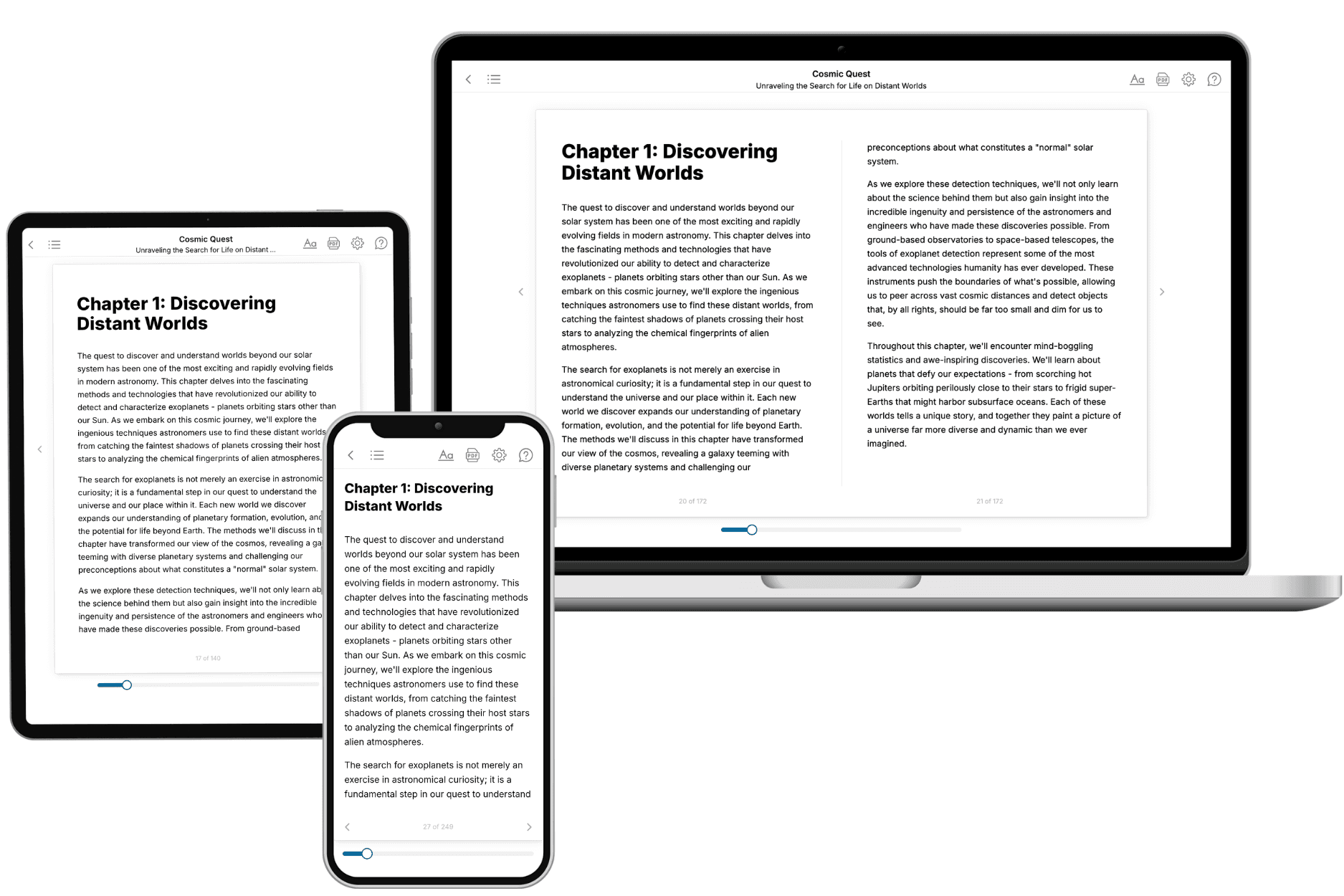
Your book is ready in 10 minutes. Read it online, download as EPUB or PDF, or send to Kindle.
Frequently asked questions
- What is TailoredRead?
TailoredRead creates complete, full-length nonfiction ebooks, written specifically for you. Tell us what you want to learn and why, and TailoredRead writes you a complete ebook on it, with charts, tables, and diagrams throughout. Read it online, on Kindle, or on any e-reader, or download it as a PDF or EPUB. Every book is written fresh the day you order it.
- How is the book tailored to me?
Before anything is written, you answer a few short questions about your goals, your background, and the topics you care about. Your book is then planned around your answers: written at your level, focused on your goals, and covering the topics you chose, instead of the one-size-fits-all book a store sells everyone.
- Will it read like generic AI content?
No. Your book isn't a chat transcript: it's planned chapter by chapter before a single word is written, told in a clear book voice, and explains ideas visually with charts, tables, and diagrams. After writing, every book goes through an editorial pass that polishes chapters so the book reads consistent from start to finish. Judge for yourself: browse thousands of sample books on our Explore Books page.
- How accurate is the content?
Our AI first checks whether your subject needs live research. Niche and fast-moving subjects are researched before writing, and the book plan and chapters are grounded in what it finds. After writing, every book goes through a quality pass that checks its facts and consistency, and researched books list their sources in a Notes section at the back.
- How long is the book?
You choose the length: Comprehensive (250-300 pages), Detailed (150-200 pages), Essential (70-100 pages), or Short (30-50 pages).
- Does the book include visuals?
Yes. Every book includes charts, tables, and diagrams: timelines, checklists, step-by-step guides, decision trees, comparison tables, matrices, and bar charts. A typical book includes dozens of these visual elements.
- Can I read it on Kindle? What formats can I download?
Yes. Every book can be read in our online reader or downloaded as a PDF or EPUB. The EPUB can be opened with Kindle, Apple Books, Kobo, and any e-reader. The Commercial and Author licenses also include an editable Word (DOCX) and Markdown download.
- How much does it cost?
About the price of a regular ebook. The exact price depends on your book's length and complexity, from $2 for the shortest books to $35 for the most comprehensive, and it's shown when you review your book, before you commit to anything. Each book is a one-time purchase, yours to keep, no subscription. Licenses that let you share, teach, or publish your book range from $35.99 to $49.99.
- Can I preview the book before purchasing?
Before you pay, you'll see what your book will cover: the title, a detailed description, the estimated length, and the complete chapter-by-chapter table of contents, so you know what you're getting before you decide. The full text itself is written after you purchase.
- How long does it take to create a book?
About 10 minutes. You can start reading the opening chapters while the rest is still being written.