The Ethics of Research
Navigating Moral Responsibility in the Pursuit of Knowledge
Research drives progress, but it also raises profound moral questions.
222 pages10 chaptersJan 10, 2026Medical Ethics
About this book
How do you ensure participants are truly protected? When does pursuing knowledge cross ethical lines? What happens when your interests conflict with your responsibilities? This book addresses the tension between scientific ambition and ethical obligation. You'll discover why research ethics matters beyond compliance—it's about respecting human dignity and building trust in knowledge itself. Through real-world scenarios and practical frameworks, you'll learn to navigate informed consent, manage conflicts of interest, recognize misconduct, and protect vulnerable populations. Whether you're designing studies, reviewing proposals, or conducting fieldwork, you'll gain clarity on the principles that guide responsible research and the tools to apply them confidently. This is essential reading for anyone committed to advancing knowledge ethically.
Table of contents
- IntroductionWhy Research Ethics Matters, What This Book Covers, How to Use This BookRead below
- Chapter 1: Foundations of Research EthicsHistorical Context and Key Turning Points, The Four Pillars: Respect, Beneficence, Justice, and Integrity, Ethical Frameworks and Approaches
- Chapter 2: Institutional Oversight and GovernanceUnderstanding Institutional Review Boards, The Review Process and Approval Pathways, Other Oversight Bodies and Regulatory Frameworks
- Chapter 3: Informed Consent and Participant AutonomyCore Principles of Informed Consent, Designing and Implementing Consent Processes, Navigating Consent in Complex Situations
- Chapter 4: Managing Conflicts of Interest and BiasIdentifying and Disclosing Conflicts of Interest, Sources of Bias in Research Design and Conduct, Strategies for Managing and Mitigating Bias
- Chapter 5: Research Misconduct and IntegrityDefining Fabrication, Falsification, and Plagiarism, Consequences and Detection of Misconduct, Building a Culture of Research Integrity
- Chapter 6: Protecting Vulnerable PopulationsUnderstanding Vulnerability and Risk, Enhanced Protections and Ethical Considerations, Justice, Equity, and Inclusive Research
- Chapter 7: Data Privacy, Confidentiality, and SecurityPrivacy Rights and Confidentiality Obligations, Protecting Data and Managing Identifiable Information, Regulatory Compliance and Legal Requirements
- Chapter 8: Ethical Considerations in Research DesignEthical Implications of Study Design Choices, Assessing Risk and Benefit, Considering Alternatives and Minimizing Harm
- Chapter 9: Ethical Communication and DisseminationResponsible Reporting and Transparency, Authorship, Credit, and Acknowledgment, Communicating with the Public and Media
- Chapter 10: Navigating Real-World Ethical DilemmasCase Studies and Ethical Dilemmas, A Framework for Ethical Decision-Making, When and How to Seek Ethical Guidance
- ConclusionYour Commitment to Ethical Research, Moving Forward with Confidence
- Glossary of Key Terms
- Further Reading and Resources
Introduction
Research shapes the world we live in. It informs medical treatments, influences public policy, drives technological innovation, and expands our understanding of human behavior and the natural world. Every day, researchers across disciplines design studies, collect data, and draw conclusions that affect real people's lives. Yet with this power to generate knowledge comes profound responsibility. The pursuit of discovery must be balanced against the rights, dignity, and welfare of those who participate in research and those who will be affected by its outcomes. This balance is not always easy to strike, and the ethical questions that arise in research are rarely simple or straightforward.
Consider a clinical trial testing a promising new cancer treatment. Researchers must decide who gets access to the experimental drug and who receives the standard treatment or placebo. They must determine how much information to share with participants about potential risks that are not yet fully understood. They must navigate relationships with pharmaceutical companies funding the research while maintaining scientific objectivity. They must protect participants' medical information while contributing to the broader scientific knowledge base. Each of these decisions carries ethical weight, and getting them wrong can cause real harm—to individuals, to communities, and to public trust in research itself.
This book addresses the ethical dimensions of research that you encounter whether you're designing studies, reviewing proposals, collecting data, or overseeing research programs. It recognizes that you already bring knowledge and experience to this work, but that ethical challenges continue to evolve as research methods advance, regulations change, and societal expectations shift. The goal is not to provide simple answers to complex questions, but to equip you with frameworks, principles, and practical guidance for navigating ethical dilemmas with confidence and integrity. Research ethics is not an obstacle to overcome or a box to check—it is fundamental to conducting research that is both scientifically sound and morally defensible.
The ethical landscape of research has been shaped by historical events that revealed the consequences of unchecked scientific ambition. From the Nuremberg trials that exposed horrific medical experiments conducted without consent, to the Tuskegee syphilis study that exploited vulnerable populations, to more recent cases of data fabrication and conflicts of interest, the research community has learned painful lessons about what happens when ethical considerations are ignored or subordinated to other goals. These events led to the development of ethical codes, regulatory frameworks, and oversight mechanisms designed to protect research participants and ensure accountability. Understanding this history is essential because it reminds us why research ethics matters and what is at stake when ethical principles are compromised.
Today's research environment is more complex than ever before. Studies increasingly cross international borders, involve diverse populations, and generate massive amounts of sensitive data. Funding pressures, publication demands, and career incentives can create conflicts between researchers' interests and their ethical obligations. New technologies—from genetic sequencing to artificial intelligence—raise novel ethical questions that existing frameworks may not fully address. Social media and digital platforms enable new forms of research but also new forms of privacy intrusion. In this context, ethical research requires more than following rules; it demands critical thinking, moral courage, and a commitment to principles that transcend specific regulations or institutional requirements.
This introduction sets the stage for the chapters that follow by establishing why research ethics matters, what this book covers, and how you can use it most effectively. Whether you work in academic research, clinical trials, social science fieldwork, or organizational research, the principles and practices discussed here apply to your work. The aim is to help you move beyond compliance thinking toward a deeper understanding of the moral foundations of research and the practical skills needed to uphold ethical standards in real-world situations. Research ethics is not a separate domain from good research—it is integral to the scientific enterprise and essential to maintaining the trust that makes research possible.
Why Research Ethics Matters
Research ethics matters because research involves human beings—as participants, as researchers, and as members of society who will be affected by research outcomes. Unlike purely theoretical inquiry, empirical research creates relationships and obligations. When someone agrees to participate in your study, they place trust in you to treat them with respect, protect their welfare, and use the information they provide responsibly. This trust is not automatic; it must be earned through ethical conduct and can be destroyed by a single breach. The history of research is marked by cases where this trust was violated, with devastating consequences for individuals and lasting damage to public confidence in science.
The principle of respect for persons recognizes that research participants are autonomous agents with the right to make informed decisions about their involvement in research. This means more than obtaining a signature on a consent form. It requires ensuring that people genuinely understand what they are agreeing to, that they are free to decline or withdraw without penalty, and that their choices are honored throughout the research process. When researchers fail to respect autonomy—by deceiving participants, coercing involvement, or ignoring withdrawal requests—they treat people as mere means to an end rather than as individuals with inherent dignity and rights.
Beyond protecting individual participants, research ethics serves broader social functions that are essential to the scientific enterprise itself. Public trust in research depends on the belief that studies are conducted honestly, that findings are reported accurately, and that researchers prioritize truth over personal gain. When high-profile cases of research misconduct emerge—fabricated data, undisclosed conflicts of interest, or exploitation of vulnerable populations—they erode this trust and make it harder for all researchers to recruit participants, secure funding, and have their findings taken seriously. A single ethical failure can cast doubt on an entire field of study.
Research ethics also matters because of the power imbalances inherent in the research relationship. Researchers typically have more education, resources, and authority than participants. They control what questions are asked, how data is interpreted, and how findings are disseminated. Participants, especially those from marginalized or vulnerable populations, may feel pressure to comply with researcher requests even when doing so is not in their best interest. Without ethical guardrails, these power differentials can lead to exploitation, where the burdens of research fall disproportionately on those with the least power while the benefits accrue to those who are already privileged.
The consequences of unethical research extend beyond immediate harm to participants. Consider the long-term impact of the Tuskegee syphilis study, which ran from 1932 to 1972. Researchers withheld treatment from African American men with syphilis to study the disease's natural progression, even after effective treatment became available. The study caused immeasurable suffering and death, but its legacy continues to affect medical research today. It contributed to deep-seated mistrust of medical institutions among African American communities, making it harder to recruit participants for legitimate studies that could benefit these populations[1]. This illustrates how ethical failures create ripple effects that persist for generations.
Research ethics is also essential for scientific validity. Ethical lapses often correlate with methodological problems. When researchers fabricate data, they undermine the integrity of the scientific record. When conflicts of interest go undisclosed, they raise questions about whether findings were influenced by financial incentives rather than evidence. When selection bias excludes certain populations from research, it limits the generalizability of results. Ethical research and rigorous research are not competing priorities—they are mutually reinforcing. Studies that fail ethical standards often fail scientific standards as well.
Furthermore, research ethics matters because it reflects our values as a society. The protections we afford research participants, the standards we set for scientific integrity, and the oversight mechanisms we establish all express collective judgments about what matters morally. When we require informed consent, we affirm the value of individual autonomy. When we mandate special protections for children or prisoners, we acknowledge that justice requires treating vulnerable populations with extra care. When we prohibit deception except under narrow circumstances, we signal that honesty and transparency are foundational values. Research ethics is not just about preventing harm—it is about actively promoting human dignity and social justice.
The practical reality is that ethical research is also legally required in most contexts. Federal regulations in the United States, such as the Common Rule, establish minimum standards for research involving human subjects. Professional associations publish ethical codes that members are expected to follow. Institutions create policies and oversight mechanisms to ensure compliance. Violating these requirements can result in serious consequences:
- Suspension or termination of research projects and loss of funding
- Institutional sanctions, including loss of privileges or employment
- Legal liability for harm caused to participants
- Damage to professional reputation and career prospects
- Criminal prosecution in cases of serious misconduct
However, viewing research ethics solely through the lens of compliance misses the deeper point. Regulations establish minimum standards, but ethical research often requires going beyond what is legally mandated. Rules cannot anticipate every situation you will encounter, and they cannot substitute for moral judgment. A study can be technically compliant with regulations while still being ethically problematic. For example, a consent form might meet all legal requirements but be written in language that participants cannot understand. A study might receive IRB approval but still exploit power imbalances in ways that harm participants. Ethical research requires not just following rules but cultivating the wisdom to recognize ethical issues and the courage to address them even when doing so is inconvenient or costly.
Ultimately, research ethics matters because it is inseparable from the purpose of research itself. The goal of research is to generate knowledge that benefits humanity—to cure diseases, solve social problems, understand our world, and improve lives. But knowledge gained through unethical means is tainted. It comes at too high a cost and undermines the very values that make the pursuit of knowledge worthwhile. When you conduct research ethically, you honor the trust that participants place in you, contribute to the integrity of your field, and advance knowledge in ways that are consistent with human dignity and social justice. This is not an optional add-on to research—it is what makes research worth doing.
What This Book Covers
This book provides a comprehensive framework for understanding and applying research ethics across diverse research contexts. It is organized around the key ethical principles, practical challenges, and decision-making processes that you will encounter throughout the research lifecycle—from initial study design through data collection, analysis, and dissemination of findings. While the book draws on examples from multiple disciplines, the principles and frameworks presented are broadly applicable whether you conduct biomedical research, social science studies, clinical trials, or organizational research. The focus is on research involving human participants, though many of the concepts also apply to other forms of research.
The book begins by establishing foundational knowledge in Chapter 1, which explores the historical context that shaped modern research ethics. You will learn about key events—such as the Nuremberg trials, the Tuskegee syphilis study, and the Willowbrook hepatitis experiments—that revealed the need for ethical oversight and led to the development of ethical codes and regulations. The chapter then introduces the four pillars of research ethics: respect for persons, beneficence, justice, and integrity. These principles, derived from the Belmont Report and other foundational documents, provide a framework for analyzing ethical issues and making principled decisions. The chapter also examines different ethical frameworks, including consequentialism, deontology, and virtue ethics, and how they inform research practice.
Chapter 2 addresses institutional oversight and governance, focusing on the role of Institutional Review Boards (IRBs) and other oversight bodies. You will gain a clear understanding of what IRBs do, how the review process works, and what different levels of review (exempt, expedited, and full board) entail. The chapter demystifies the IRB process and helps you prepare effective submissions. It also covers other regulatory frameworks and oversight mechanisms, including data safety monitoring boards, ethics committees in international contexts, and professional association standards. The goal is to help you navigate oversight requirements efficiently while understanding their purpose and value.
Informed consent, one of the most fundamental ethical requirements in research, is the focus of Chapter 3. This chapter goes beyond the mechanics of obtaining signatures to explore what genuine informed consent requires. You will learn about the core elements of consent—disclosure, comprehension, voluntariness, and competence—and how to design consent processes that truly respect participant autonomy. The chapter addresses challenging situations such as research with individuals who have diminished capacity to consent, emergency research where prospective consent is not possible, and studies involving deception. Practical guidance is provided on creating consent documents that are clear and accessible, conducting consent conversations effectively, and maintaining consent as an ongoing process rather than a one-time event.
Chapter 4 tackles conflicts of interest and bias, which are pervasive in research and can compromise both ethical integrity and scientific validity. The chapter helps you identify different types of conflicts—financial, professional, personal—and understand why disclosure alone is often insufficient. You will learn about sources of bias in research design, data collection, analysis, and interpretation, and how bias can lead to results that are misleading or harmful. The chapter provides concrete strategies for managing conflicts and mitigating bias, including:
- Structural safeguards such as independent data monitoring and blinded analysis
- Transparency practices including pre-registration of studies and open data sharing
- Institutional policies that limit certain types of financial relationships
- Peer review and replication as mechanisms for detecting and correcting bias
Research misconduct—fabrication, falsification, and plagiarism—is examined in Chapter 5. This chapter defines what constitutes research misconduct and distinguishes it from honest error or differences in interpretation. You will learn about the factors that contribute to misconduct, from individual pressures to systemic incentives that reward quantity over quality. The chapter discusses how misconduct is detected, investigated, and sanctioned, and the devastating consequences it has for individuals, institutions, and scientific fields. More importantly, it explores how to build a culture of research integrity through mentorship, training, institutional policies, and practices that promote transparency and accountability.
Chapter 6 focuses on vulnerable populations who require enhanced protections in research. The chapter begins by defining vulnerability—not as an inherent characteristic of certain groups, but as a function of circumstances that may limit autonomy, increase susceptibility to coercion, or heighten risk of harm. You will learn about special considerations for research involving children, prisoners, pregnant women, individuals with cognitive impairments, and economically or socially marginalized populations. The chapter emphasizes the tension between protecting vulnerable populations and ensuring they are not excluded from research that could benefit them. It provides guidance on applying the principle of justice to ensure that the burdens and benefits of research are distributed equitably.
Data privacy, confidentiality, and security are critical concerns in an era of big data and digital research, and Chapter 7 addresses these issues comprehensively. You will learn about the distinction between privacy, confidentiality, and anonymity, and the legal and ethical obligations researchers have to protect participant information. The chapter covers practical strategies for data protection, including de-identification techniques, secure storage and transmission, and access controls. It also addresses regulatory requirements such as HIPAA in the United States and GDPR in Europe, and how to navigate situations where legal obligations to protect confidentiality may conflict with other duties, such as mandatory reporting requirements.
Chapter 8 examines ethical considerations in research design, demonstrating how ethical issues are embedded in methodological choices. You will learn how decisions about study design, sampling, measurement, and analysis have ethical implications. The chapter provides a framework for assessing the risk-benefit ratio of proposed research and determining whether risks are justified by potential benefits. It discusses alternatives to traditional research designs that may reduce harm, such as community-based participatory research, and emphasizes the importance of scientific validity as an ethical requirement—invalid research cannot generate benefits that justify exposing participants to risk.
The ethical responsibilities of researchers extend beyond data collection to how findings are communicated and disseminated, which is the focus of Chapter 9. This chapter addresses responsible reporting, including the obligation to report findings accurately and completely, the problems of selective reporting and publication bias, and the importance of transparency about methods and limitations. You will learn about ethical issues in authorship and credit, including criteria for authorship, the problem of guest and ghost authorship, and how to acknowledge contributions fairly. The chapter also covers communication with the public and media, including the risks of hype and misrepresentation and the responsibility to communicate uncertainty appropriately.
Chapter 10 brings together the principles and frameworks from earlier chapters to help you navigate real-world ethical dilemmas. Through detailed case studies drawn from diverse research contexts, you will practice applying ethical reasoning to complex situations where principles may conflict and there are no clear right answers. The chapter provides a structured framework for ethical decision-making that you can use when facing difficult choices. It also offers guidance on when and how to seek ethical consultation, whether from IRBs, ethics committees, colleagues, or professional organizations. The goal is to build your confidence in recognizing ethical issues and addressing them proactively.
Throughout the book, you will find practical tools and resources designed to support ethical research practice:
- Concrete examples and case studies that illustrate how ethical principles apply in specific situations
- Checklists and frameworks for assessing ethical issues and making decisions
- Sample language and templates for consent documents, conflict of interest disclosures, and other materials
- References to key regulations, guidelines, and professional standards
- Discussion of common pitfalls and how to avoid them
- Guidance on building ethical considerations into research planning from the outset
The book concludes with a glossary of key terms and a curated list of further reading and resources for continued learning. Research ethics is a dynamic field that continues to evolve as new technologies emerge, social norms shift, and our understanding of ethical issues deepens. This book provides a solid foundation, but it is not the final word. You will need to stay informed about developments in your field, engage with ongoing debates about ethical issues, and continue to refine your ethical judgment through experience and reflection. The resources section points you toward organizations, publications, and tools that can support your ongoing development as an ethical researcher.
How to Use This Book
This book is designed to be both a comprehensive guide that you can read cover to cover and a practical reference that you can consult when facing specific ethical challenges. How you use it will depend on your role, experience level, and immediate needs. If you are new to research or to research ethics, reading the book sequentially will build your knowledge systematically, starting with foundational principles and progressing to more complex applications. If you are an experienced researcher facing a particular ethical issue, you can turn directly to the relevant chapter for targeted guidance. The book's structure supports both approaches.
Each chapter is designed to be relatively self-contained while also building on concepts introduced earlier. Cross-references throughout the text point you to related discussions in other chapters, allowing you to follow connections between topics. For example, when Chapter 3 discusses informed consent with vulnerable populations, it references the more detailed treatment of vulnerability in Chapter 6. When Chapter 8 addresses risk-benefit assessment in research design, it connects to the discussion of beneficence in Chapter 1. These connections help you see how different aspects of research ethics relate to each other and reinforce the idea that ethical research requires integrating multiple considerations.
To get the most value from this book, approach it actively rather than passively. As you read, consider how the principles and practices discussed apply to your own research context. Ask yourself questions such as:
- How would this principle apply to the studies I conduct or review?
- What ethical challenges have I encountered that relate to this topic?
- How might I handle a similar situation differently based on what I am learning?
- What policies or practices at my institution support or hinder ethical research?
- What additional information or guidance do I need on this topic?
The case studies and examples throughout the book are particularly valuable for developing ethical reasoning skills. When you encounter a case study, pause before reading the analysis. Consider how you would approach the situation. What ethical issues do you identify? What principles are at stake? What options are available, and what are the consequences of each? What additional information would you need to make a decision? Then compare your analysis to the discussion provided. This active engagement helps you develop the habit of ethical reflection that is essential for navigating real-world dilemmas.
If you are using this book in an educational setting—whether as an instructor teaching research ethics or as a student taking a course—several features support learning and discussion. The case studies can serve as the basis for class discussions or written assignments. The frameworks and checklists can be applied to students' own research proposals or to published studies. The discussion questions implicit in the text can be made explicit to prompt reflection and debate. Group discussions of ethical dilemmas are particularly valuable because they expose you to different perspectives and reasoning approaches, helping you recognize that ethical issues are often complex and that reasonable people may disagree about the best course of action.
For those in research oversight roles—IRB members, ethics committee chairs, research administrators, or compliance officers—this book can serve as a resource for training and decision-making. The chapters on institutional oversight, informed consent, and vulnerable populations are particularly relevant to your work. You might use sections of the book as training materials for new IRB members or as a reference when reviewing challenging protocols. The frameworks for ethical analysis can help structure committee discussions and ensure that all relevant considerations are addressed. The book can also help you communicate with researchers about why certain ethical requirements exist and how to meet them effectively.
If you are a research mentor or supervisor, this book can guide your conversations with trainees about research ethics. Rather than treating ethics as a separate topic covered once in a training session, integrate ethical discussions into regular research meetings. When reviewing a trainee's research proposal, use the frameworks in this book to discuss ethical considerations. When challenges arise during data collection, use them as teaching moments to explore how ethical principles apply in practice. Model ethical decision-making by thinking aloud about the ethical dimensions of your own research choices. Creating a research environment where ethical issues are discussed openly and regularly is one of the most effective ways to promote research integrity.
The book also supports self-directed learning and professional development. You might read one chapter per month and discuss it with colleagues, creating an informal ethics reading group. You might use the book to prepare for ethics certification exams or to fulfill continuing education requirements. You might return to specific chapters when planning a new study or when facing an ethical challenge in ongoing research. Keep the book accessible so you can consult it when questions arise. Research ethics is not something you master once and then forget—it requires ongoing attention and reflection throughout your career.
As you use this book, remember that it provides guidance, not rigid rules. Ethical research requires judgment, and judgment develops through experience, reflection, and dialogue with others. The goal is not to memorize correct answers but to develop the capacity to recognize ethical issues, analyze them systematically, consider multiple perspectives, and make principled decisions even in the face of uncertainty or competing pressures. This capacity—what might be called ethical competence—is built gradually through practice and cannot be reduced to a checklist or algorithm.
Finally, use this book as a starting point for deeper engagement with research ethics in your field and context. The references and resources provided throughout the text point you toward additional sources of guidance. Seek out ethics training opportunities offered by your institution or professional associations. Participate in ethics discussions and consultations. Stay informed about emerging ethical issues and debates in your field. Research ethics is a collective enterprise, and your engagement contributes to the ongoing work of ensuring that research is conducted in ways that respect human dignity, advance knowledge responsibly, and serve the common good.
The chapters that follow provide the knowledge, frameworks, and practical guidance you need to conduct research ethically and to navigate the complex moral terrain of modern research. Whether you are designing your first study or have decades of research experience, whether you work in a highly regulated clinical context or in exploratory social science research, the principles and practices discussed here are relevant to your work. Approach this material with an open mind, a critical eye, and a commitment to the values that make research both scientifically rigorous and morally defensible. Your dedication to ethical research matters—for the participants who trust you, for the integrity of your field, and for the advancement of knowledge that benefits all of humanity.
Notes
Introduction
- 1. Vanessa N. Gamble, "Under the Shadow of Tuskegee," American Journal of Public Health, 1997
This is the end of the free sample. The full book has 10 chapters.
Want this book written for you?
Tell us your goals and background, and get your own version of this book, tailored by AI to you.


Benefits of AI-tailored books
- Read one book, not ten:
- all the Medical Ethics knowledge you need, gathered into a single book.
- Save days of learning:
- tell us your goals, choose your topics, and the whole book is built around them.
- Learn effortlessly:
- Medical Ethics book written for your specific background and expertise.
- Understand at a glance:
- includes charts, tables, timelines, checklists, decision trees, and more.
- Stay current:
- written the day you order it, not years ago.
- Trust what you read:
- every book is checked for accuracy, with real research when your subject needs it.
Create your unique book in 3 steps
- 1. Select your focus
Select the focus of your Medical Ethics book and share your background
- 2. Personalize your book
Specify your goals and choose sub-topics to include
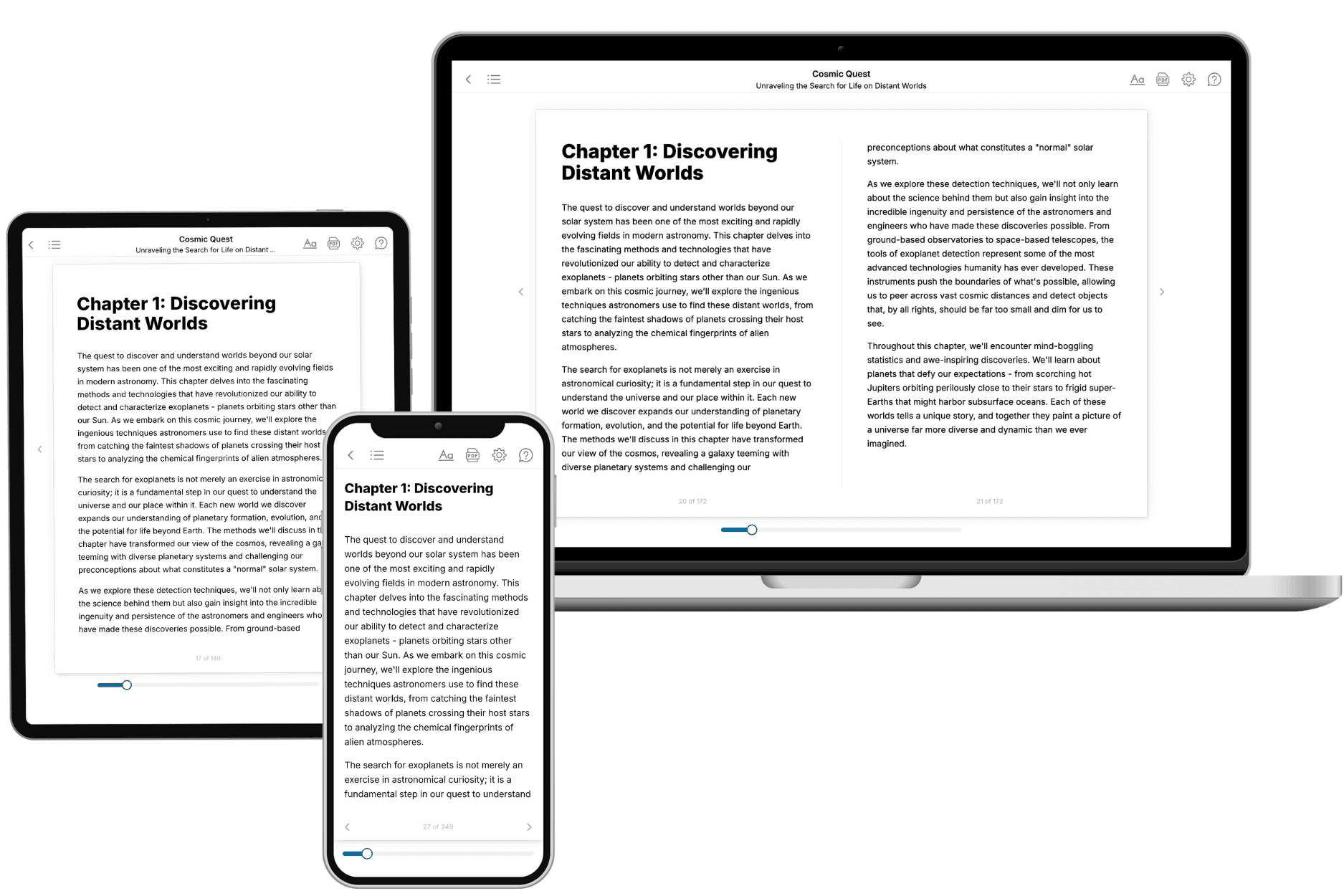
- 3. Get your tailored book
Your book is ready in 10 minutes. Read it online, download as EPUB or PDF, or send to Kindle.
Frequently asked questions
- What is TailoredRead?
TailoredRead creates complete, full-length nonfiction ebooks, written specifically for you. Tell us what you want to learn and why, and TailoredRead writes you a complete ebook on it, with charts, tables, and diagrams throughout. Read it online, on Kindle, or on any e-reader, or download it as a PDF or EPUB. Every book is written fresh the day you order it.
- How is the book tailored to me?
Before anything is written, you answer a few short questions about your goals, your background, and the topics you care about. Your book is then planned around your answers: written at your level, focused on your goals, and covering the topics you chose, instead of the one-size-fits-all book a store sells everyone.
- Will it read like generic AI content?
No. Your book isn't a chat transcript: it's planned chapter by chapter before a single word is written, told in a clear book voice, and explains ideas visually with charts, tables, and diagrams. After writing, every book goes through an editorial pass that polishes chapters so the book reads consistent from start to finish. Judge for yourself: browse thousands of sample books on our Explore Books page.
- How accurate is the content?
Our AI first checks whether your subject needs live research. Niche and fast-moving subjects are researched before writing, and the book plan and chapters are grounded in what it finds. After writing, every book goes through a quality pass that checks its facts and consistency, and researched books list their sources in a Notes section at the back.
- How long is the book?
You choose the length: Comprehensive (250-300 pages), Detailed (150-200 pages), Essential (70-100 pages), or Short (30-50 pages).
- Does the book include visuals?
Yes. Every book includes charts, tables, and diagrams: timelines, checklists, step-by-step guides, decision trees, comparison tables, matrices, and bar charts. A typical book includes dozens of these visual elements.
- Can I read it on Kindle? What formats can I download?
Yes. Every book can be read in our online reader or downloaded as a PDF or EPUB. The EPUB can be opened with Kindle, Apple Books, Kobo, and any e-reader. The Commercial and Author licenses also include an editable Word (DOCX) and Markdown download.
- How much does it cost?
About the price of a regular ebook. The exact price depends on your book's length and complexity, from $2 for the shortest books to $35 for the most comprehensive, and it's shown when you review your book, before you commit to anything. Each book is a one-time purchase, yours to keep, no subscription. Licenses that let you share, teach, or publish your book range from $35.99 to $49.99.
- Can I preview the book before purchasing?
Before you pay, you'll see what your book will cover: the title, a detailed description, the estimated length, and the complete chapter-by-chapter table of contents, so you know what you're getting before you decide. The full text itself is written after you purchase.
- How long does it take to create a book?
About 10 minutes. You can start reading the opening chapters while the rest is still being written.