The Foundations of Justice
Understanding the Philosophy Behind Law and Legal Systems
What makes a law legitimate?
191 pages9 chaptersEnglishJun 25, 2026Philosophy of Law
About this book
Is law simply a tool for maintaining order, or does it embody deeper principles of justice and morality? These questions sit at the heart of philosophy of law—a field that examines the foundations, nature, and purpose of legal systems. This book guides you through the essential philosophical frameworks that shape how we understand law, justice, and rights. You'll explore competing theories about what law fundamentally is, examine how different cultures and traditions justify their legal systems, and discover how philosophical thinking can help you critically evaluate the laws that govern society. Whether you're interested in understanding legal theory, questioning the legitimacy of existing laws, or simply deepening your philosophical knowledge, this book provides the conceptual tools to think more clearly about one of humanity's most important institutions. By the end, you'll see law not as arbitrary rules, but as a reflection of profound philosophical choices about how we should live together.
Table of contents
- IntroductionWhy Philosophy of Law Matters, What You'll Learn in This Book, How to Use This BookRead below
- Chapter 1: What Is Law? Defining the Fundamental ConceptLaw Beyond Simple Rules, Law as a Social Institution, Distinguishing Law from Morality and Custom
- Chapter 2: Natural Law Theory: Law Rooted in Reason and NatureOrigins of Natural Law Philosophy, Universal Principles and Human Nature, Natural Law in Modern Legal Systems
- Chapter 3: Legal Positivism: Law as Command and ConventionThe Basics of Legal Positivism, Separating Law from Morality, The Rule of Recognition and Legal Validity
- Chapter 4: Justice and Fairness: Competing ConceptionsWhat Is Justice?, Distributive Justice and Fair Distribution, Retributive Justice and Punishment, Procedural Justice and Fair Process
- Chapter 5: Rights: Philosophical Foundations and JustificationsWhat Are Rights and Why Do They Matter?, The Natural Rights Tradition, Rights as Social Constructs
- Chapter 6: Legal Authority and Legitimacy: Why Should We Obey the Law?Sources of Legal Authority, Consent and Democratic Legitimacy, The Obligation to Obey the Law
- Chapter 7: Law and Morality: Intersection and ConflictThe Relationship Between Law and Morality, Unjust Laws and Civil Disobedience, The Moral Limits of Legal Authority
- Chapter 8: Legal Interpretation: Philosophy of Meaning and ApplicationThe Challenge of Interpreting Legal Texts, Originalism and Living Constitutionalism, Precedent, Analogy, and Legal Reasoning
- Chapter 9: Punishment and Responsibility: Philosophical JustificationsWhy Do We Punish? Philosophical Theories, Moral Responsibility and Criminal Liability, Proportionality and the Limits of Punishment
- ConclusionSynthesizing Key Insights, Applying Philosophy of Law to Your Life
- Further Reading and Resources
Introduction
Every day, laws shape what you can do, what you must do, and what happens if you don't comply. Speed limits, contracts, property rights, criminal codes — these rules govern nearly every corner of human life. But here's a question that rarely gets asked: why should any of this bind you? Not in a rebellious sense, but in a genuinely philosophical one. What gives a law its authority? What separates a legitimate legal rule from an arbitrary command issued by someone with power? These are not just academic puzzles. They are questions that cut to the heart of how societies organize themselves and how individuals relate to the communities they live in.
Philosophy of law, sometimes called jurisprudence, is the branch of philosophy that takes these questions seriously. It asks what law fundamentally is, not just how it works in practice. It examines whether law and morality are connected or separate, whether rights are discovered or invented, and whether obedience to law is ever truly obligatory. These questions have occupied some of history's greatest thinkers, from Aristotle and Aquinas to Hobbes, Locke, Bentham, and Rawls. Their answers have shaped constitutions, court decisions, and entire legal traditions across the world.
This book is an invitation to think carefully about those foundations. It is not a law textbook in the conventional sense. You won't find case summaries or procedural rules here. Instead, you'll find the philosophical frameworks that sit beneath legal systems — the ideas that explain why those systems look the way they do, why they sometimes fail, and how they might be improved. Whether you are drawn to philosophy, curious about law, or simply want to understand the world more deeply, this book gives you the conceptual tools to engage with one of humanity's most consequential institutions.
The questions explored here are not merely historical curiosities. They are alive in contemporary debates about criminal justice reform, constitutional interpretation, human rights, civil disobedience, and the legitimacy of government authority. When activists argue that a law is unjust, they are making a philosophical claim. When judges interpret a constitution, they are applying a theory of legal meaning. When citizens debate whether to follow a law they disagree with, they are wrestling with questions of obligation and legitimacy that philosophers have debated for centuries. Understanding those debates makes you a sharper, more informed participant in those conversations.
Why Philosophy of Law Matters
It might be tempting to think that law is simply a practical matter — a set of rules that keeps society running smoothly. On this view, philosophy seems like an unnecessary detour. But this practical picture of law actually rests on philosophical assumptions that are worth examining. When you say a law is "valid," you are implicitly appealing to some standard of validity. When you say a law is "unfair," you are invoking a theory of justice. Philosophy of law makes those hidden assumptions visible and subjects them to critical scrutiny.
Consider a concrete example. In the 1930s and 1940s, Nazi Germany had a fully functioning legal system. Laws were passed through official channels, enforced by courts, and backed by state power. By a purely procedural standard, those laws were "valid." Yet most people today would say they were profoundly unjust and that individuals had no moral obligation to follow them. This intuition raises a deep philosophical question: can a law be legally valid but morally illegitimate? The answer you give to that question determines how you think about the relationship between law and morality, and it has enormous practical consequences for how legal systems should be designed and evaluated.[1]
Philosophy of law also matters because legal systems are not neutral. Every legal system embeds particular values, priorities, and assumptions about human nature and social life. A legal system that prioritizes individual property rights reflects a different philosophical vision than one that prioritizes collective welfare. A system that grounds rights in divine law operates on different premises than one that grounds them in social contract theory. Understanding these philosophical foundations helps you see legal systems not as inevitable or natural, but as choices — choices that can be questioned, challenged, and changed.
There is also a deeply personal dimension to these questions. At some point in life, most people encounter a law or rule that strikes them as wrong. Maybe it's a policy they find discriminatory, a regulation they think is unjust, or a legal outcome that seems to contradict basic fairness. Philosophy of law gives you a framework for thinking through those reactions rigorously. It helps you distinguish between "I don't like this law" and "this law is philosophically indefensible" — a distinction that matters enormously for how you respond.
Beyond individual situations, philosophy of law shapes the big picture of how societies evolve. Legal reforms throughout history — the abolition of slavery, the expansion of voting rights, the recognition of civil liberties — were driven by philosophical arguments about justice, rights, and human dignity. Those arguments didn't emerge from nowhere. They were built on philosophical traditions that gave reformers the language and concepts to articulate why existing laws were wrong and what better laws would look like. Philosophy, in this sense, is not just an academic exercise. It is a tool for social change.
Finally, philosophy of law sharpens your thinking in ways that extend far beyond legal questions. The skills involved — analyzing concepts, evaluating arguments, identifying hidden assumptions, thinking about competing values — are transferable to almost any domain of intellectual or practical life. Engaging seriously with jurisprudence makes you a better reasoner, a more careful reader of arguments, and a more thoughtful participant in democratic life. These are not small benefits.
A useful way to think about it: Law is like the visible surface of a deep ocean. What you see above the waterline — statutes, court decisions, legal procedures — is shaped by powerful currents running far below. Philosophy of law is the study of those currents. Without understanding them, you can only react to the surface. With them, you can understand why the water moves the way it does.
The stakes of getting these philosophical questions right are high. Legal systems that rest on flawed philosophical foundations tend to produce injustice, even when they function efficiently. A system that defines rights too narrowly will fail to protect people who deserve protection. A system that grounds authority in tradition alone will struggle to adapt to changing moral understanding. Philosophy of law is not a luxury for academics. It is a necessity for anyone who cares about whether the laws governing their society are genuinely just.
What You'll Learn in This Book
This book is organized around the central questions that define philosophy of law. Each chapter takes on one of those questions directly, introduces the major philosophical positions that have been developed in response, and examines how those positions play out in real legal contexts. The goal is not to give you a single "correct" answer to each question — in many cases, no such answer exists. The goal is to give you the conceptual vocabulary and analytical tools to think through these questions yourself.
The journey begins with the most fundamental question of all: What is law? Chapter 1 examines what distinguishes law from other social rules, customs, and moral norms. This might seem obvious at first, but the closer you look, the more complex it becomes. Law is not simply whatever the government says it is, nor is it simply whatever is morally right. Understanding what law actually is requires careful philosophical analysis.
From there, the book explores the two most influential philosophical traditions in jurisprudence:
- Natural law theory (Chapters 2), which holds that law is grounded in universal moral principles discoverable through reason. On this view, an unjust law is not truly a law at all.
- Legal positivism (Chapter 3), which holds that law is a social fact — a system of rules created by human institutions — and that its validity is separate from its moral content.
These two traditions represent fundamentally different visions of what law is and where it gets its authority. Understanding both is essential for thinking clearly about any legal question.
Chapter 4 turns to the concept of justice itself. Justice is the goal that legal systems are supposed to serve, but what does justice actually mean? The chapter examines three major conceptions: distributive justice (how goods and burdens should be shared), retributive justice (how wrongdoing should be responded to), and procedural justice (whether the process of applying law is fair). Each conception has different implications for how legal systems should be designed.
Chapter 5 explores rights — one of the most powerful and contested concepts in both philosophy and law. Where do rights come from? Are they natural features of human beings, or are they social constructs created by legal and political systems? How do we decide which rights deserve legal protection? These questions are not just theoretical. They determine how courts interpret constitutions and how societies respond to claims of injustice.
Chapters 6 and 7 address the relationship between law and political authority. Chapter 6 asks why legal authority is legitimate and whether there is a genuine moral obligation to obey the law. Chapter 7 examines the intersection of law and morality more directly, including the difficult question of what to do when a law is unjust. This chapter engages with the tradition of civil disobedience and the philosophical arguments that have been used to justify it.
Chapter 8 takes up the philosophy of legal interpretation. When a judge applies a law to a specific case, they must interpret what the law means. But interpretation is not a mechanical process. It involves philosophical choices about the purpose of law, the role of original intent, and the relationship between legal texts and changing social circumstances. The debate between originalism and living constitutionalism, for example, is fundamentally a philosophical debate about meaning and authority.
Finally, Chapter 9 examines the philosophy of punishment. Why do legal systems punish people at all? What justifies the state in imposing suffering on individuals? The chapter explores retributive, deterrence-based, and rehabilitative theories of punishment, and examines how philosophical commitments shape criminal justice policy in practice.
By the end of this book, you will have a working understanding of the major philosophical frameworks in jurisprudence, the ability to apply those frameworks to real legal questions, and a clearer sense of your own philosophical commitments about law and justice. That is a genuinely powerful set of tools.
How to Use This Book
This book is designed to be read sequentially, but it is also structured so that individual chapters can stand on their own if you have a particular interest in one topic. The early chapters build foundational concepts — especially the distinction between natural law and legal positivism — that reappear throughout the rest of the book. If you read the chapters in order, you'll find that later discussions build naturally on earlier ones. If you jump to a specific chapter, a brief review of Chapters 1 through 3 will give you the context you need.
Each chapter follows a consistent structure designed to make the material as accessible as possible. It begins by framing the central question clearly, then introduces the major philosophical positions that address that question. It uses concrete examples — drawn from history, legal cases, and everyday situations — to illustrate abstract ideas. It also identifies the practical implications of each philosophical position, so you can see how theoretical commitments translate into real-world legal outcomes.
You don't need a background in philosophy or law to engage with this material. The book assumes intellectual curiosity and a willingness to think carefully, but it does not assume prior expertise. Technical terms are introduced gradually and explained clearly when they appear. Where philosophical debates involve specialized vocabulary, that vocabulary is unpacked in plain language before being used analytically.
That said, this book does ask something of you. Philosophy is not a passive activity. It requires you to hold competing ideas in mind simultaneously, to question your own assumptions, and to follow arguments wherever they lead — even when the conclusions are uncomfortable. Some of the positions examined here will challenge intuitions you may hold strongly. That discomfort is a sign that the philosophical work is happening. The goal is not to make you agree with any particular position, but to make you think more rigorously about all of them.
Here are a few practical suggestions for getting the most out of each chapter:
- Pause at the examples. When a concrete case or scenario is introduced, take a moment to think through your own reaction before reading the analysis. Your initial intuition is philosophically interesting data.
- Notice where you disagree. If an argument strikes you as wrong, try to articulate exactly why. Identifying the specific premise you reject is more valuable than a general sense of disagreement.
- Connect ideas across chapters. The philosophical traditions covered here are not isolated. Natural law theory, for example, has implications for how you think about rights, punishment, and legal interpretation. Look for those connections as you read.
- Apply the frameworks to current events. Philosophy of law is most alive when it connects to real debates. As you read, think about how the frameworks discussed apply to legal controversies you're aware of — constitutional disputes, criminal justice debates, human rights questions.
It's also worth saying something about the tone and approach of this book. Philosophy of law is a field where reasonable, thoughtful people disagree profoundly. Natural lawyers and legal positivists have been arguing for centuries, and neither side has definitively won. This book presents those debates fairly, giving each major position its strongest possible formulation before examining its weaknesses. The aim is not to advocate for a particular philosophical school, but to help you understand the landscape well enough to navigate it yourself.
One thing this book does take a clear position on: the questions matter. Whether law derives its authority from reason, consent, utility, or tradition is not a merely academic question. It shapes how legal systems are built, how courts make decisions, how citizens relate to their governments, and how societies respond to injustice. Engaging seriously with these questions is one of the most important things a thoughtful person can do. This book is an invitation to do exactly that.
A note on examples and cases: Throughout this book, historical legal cases and philosophical thought experiments are used to illustrate key ideas. These examples are chosen for their philosophical clarity, not necessarily their legal complexity. In some cases, the philosophical point is more important than the legal details. Where a case is discussed, the focus is on what it reveals about the underlying philosophical question, not on providing a comprehensive legal analysis.
Philosophy of law has a long and rich history, but it is also a living field. New challenges — from artificial intelligence and digital rights to global governance and climate law — are raising philosophical questions that earlier thinkers could not have anticipated. The frameworks you'll encounter in this book are not museum pieces. They are active tools being used right now by legal scholars, judges, activists, and policymakers to think through some of the most pressing questions of our time. By the end of this book, you'll be equipped to join that conversation — not just as an observer, but as a genuine participant.
The foundations of justice are worth understanding. They shape every law that governs your life, every right you can claim, and every obligation you bear as a member of a society. Let's begin.
Notes
Introduction
- 1. Lon L. Fuller, "Positivism and Fidelity to Law," Harvard Law Review, 1958
This is the end of the free sample. The full book has 9 chapters.
Want this book written for you?
Tell us your goals and background, and get your own version of this book, tailored by AI to you.


Benefits of AI-tailored books
- Read one book, not ten:
- all the Philosophy of Law knowledge you need, gathered into a single book.
- Save days of learning:
- tell us your goals, choose your topics, and the whole book is built around them.
- Learn effortlessly:
- Philosophy of Law book written for your specific background and expertise.
- Understand at a glance:
- includes charts, tables, timelines, checklists, decision trees, and more.
- Stay current:
- written the day you order it, not years ago.
- Trust what you read:
- every book is checked for accuracy, with real research when your subject needs it.
Create your unique book in 3 steps
- 1. Select your focus
Select the focus of your Philosophy of Law book and share your background
- 2. Personalize your book
Specify your goals and choose sub-topics to include
- 3. Get your tailored book
Your book is ready in 10 minutes. Read it online, download as EPUB or PDF, or send to Kindle.


Frequently asked questions
- What is TailoredRead?
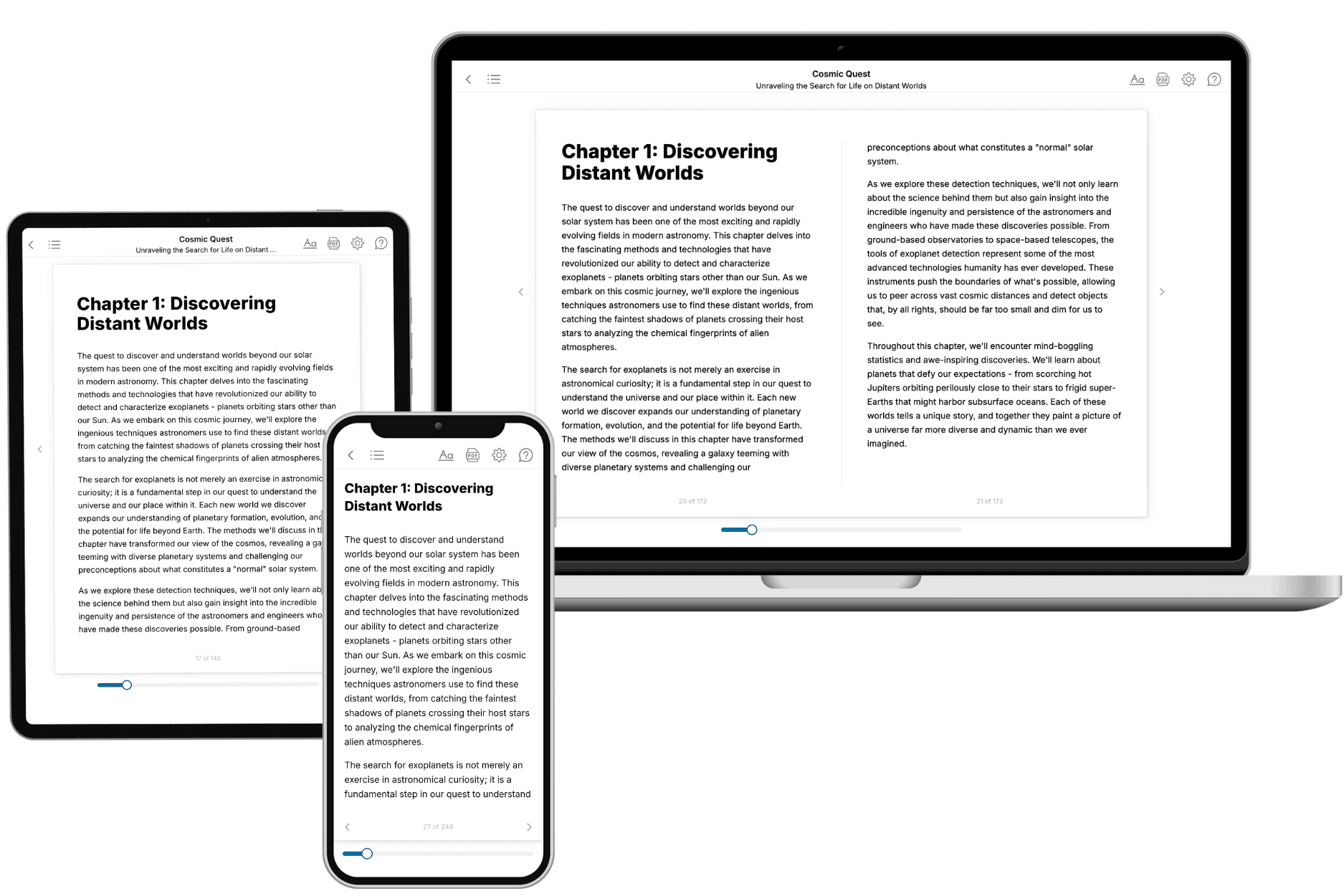
TailoredRead creates complete, full-length nonfiction ebooks, written specifically for you. Tell us what you want to learn and why, and TailoredRead writes you a complete ebook on it, with charts, tables, and diagrams throughout. Read it online, on Kindle, or on any e-reader, or download it as a PDF or EPUB. Every book is written fresh the day you order it.
- How is the book tailored to me?
Before anything is written, you answer a few short questions about your goals, your background, and the topics you care about. Your book is then planned around your answers: written at your level, focused on your goals, and covering the topics you chose, instead of the one-size-fits-all book a store sells everyone.
- Will it read like generic AI content?
No. Your book isn't a chat transcript: it's planned chapter by chapter before a single word is written, told in a clear book voice, and explains ideas visually with charts, tables, and diagrams. After writing, every book goes through an editorial pass that polishes chapters so the book reads consistent from start to finish. Judge for yourself: browse thousands of sample books on our Explore Books page.
- How accurate is the content?
Our AI first checks whether your subject needs live research. Niche and fast-moving subjects are researched before writing, and the book plan and chapters are grounded in what it finds. After writing, every book goes through a quality pass that checks its facts and consistency, and researched books list their sources in a Notes section at the back.
- How long is the book?
You choose the length: Comprehensive (250-300 pages), Detailed (150-200 pages), Essential (70-100 pages), or Short (30-50 pages).
- Does the book include visuals?
Yes. Every book includes charts, tables, and diagrams: timelines, checklists, step-by-step guides, decision trees, comparison tables, matrices, and bar charts. A typical book includes dozens of these visual elements.
- Can I read it on Kindle? What formats can I download?
Yes. Every book can be read in our online reader or downloaded as a PDF or EPUB. The EPUB can be opened with Kindle, Apple Books, Kobo, and any e-reader. The Commercial and Author licenses also include an editable Word (DOCX) and Markdown download.
- How much does it cost?
About the price of a regular ebook. The exact price depends on your book's length and complexity, from $2 for the shortest books to $35 for the most comprehensive, and it's shown when you review your book, before you commit to anything. Each book is a one-time purchase, yours to keep, no subscription. Licenses that let you share, teach, or publish your book range from $35.99 to $49.99.
- Can I preview the book before purchasing?
Before you pay, you'll see what your book will cover: the title, a detailed description, the estimated length, and the complete chapter-by-chapter table of contents, so you know what you're getting before you decide. The full text itself is written after you purchase.
- How long does it take to create a book?
About 10 minutes. You can start reading the opening chapters while the rest is still being written.