The Framing Effect
How the Way You Present Information Changes Everything
You make decisions every day, but are you really choosing what you want—or are you being subtly guided by how the choice is presented?
191 pages9 chaptersFeb 25, 2026Decision Making and Problem Solving
About this book
The framing effect is one of the most powerful forces shaping your decisions, yet most people never recognize it happening. When a doctor describes a surgery as having a "90% survival rate" versus a "10% mortality rate," your comfort level shifts dramatically, even though the information is identical. This same phenomenon influences your career choices, financial decisions, relationships, and how you solve problems. This book reveals how framing works, why your brain falls for it, and most importantly, how to use this knowledge to make better decisions and communicate more effectively. You'll discover why people become risk-averse with gains but risk-seeking with losses, how to recognize when you're being manipulated through framing, and how to strategically reframe challenges to unlock new solutions. Whether you're a leader, professional, or simply someone who wants to make more intentional choices, understanding the framing effect is essential to navigating a world designed to influence your thinking.
Table of contents
- IntroductionWhy Framing Matters More Than You Think, The Asian Disease Problem: A Classic Example, How to Use This BookRead below
- Chapter 1: Understanding the Framing EffectWhat Is Framing?, The Science Behind Framing, Framing vs. Content: Why Presentation Trumps Reality, How Researchers Discovered the Framing Effect
- Chapter 2: Gain and Loss FramingThe Gain Frame: Why We Play It Safe, The Loss Frame: Why We Take Risks, Prospect Theory: The Framework Explaining It All, Real-World Examples of Gain and Loss Framing
- Chapter 3: Framing in Decision-MakingHow Framing Hijacks Your Decisions, Financial Decisions: Investments, Savings, and Risk, Medical Decisions: Health Choices and Treatment Options, Career and Life Decisions: Jobs, Relationships, and Major Changes
- Chapter 4: Recognizing Framing in the WildFraming in Media and News, Framing in Marketing and Advertising, Framing in Politics and Persuasion, Framing in the Workplace and Organizations
- Chapter 5: Cognitive Biases and FramingFraming and Anchoring: When First Numbers Stick, Framing and Confirmation Bias: Seeing What We Expect, Framing and the Availability Heuristic: What's Easy to Remember, The Bias Ecosystem: How Framing Works With Other Biases
- Chapter 6: Protecting Yourself from Manipulative FramingRecognizing When You're Being Framed, Critical Thinking Strategies to Counter Framing, Asking Better Questions to Uncover Hidden Frames, Seeking Alternative Frames and Perspectives
- Chapter 7: Strategic Framing for Better OutcomesEthical Framing: Influence Without Manipulation, Framing for Persuasion and Communication, Framing for Leadership and Organizational Change, Framing for Problem-Solving and Innovation
- Chapter 8: Reframing: Changing Your Mental ModelsWhat Is Reframing and Why It Works, Reframing Challenges as Opportunities, Reframing Failures and Setbacks, Reframing Perspectives: Seeing Through Others' Eyes
- Chapter 9: Framing in Practice: Real-World ApplicationsBusiness Case Studies: Framing in Action, Personal Decision-Making: Applying Framing Knowledge, Negotiation and Conflict Resolution Through Reframing
- ConclusionKey Takeaways: What You've Learned, Moving Forward: Your Next Steps
- Further Reading and Resources
Introduction
Imagine two doctors describing the same surgical procedure to two different patients. The first doctor says, This surgery has a 90% survival rate.
The second says, There is a 10% chance you won't survive this surgery.
The information is mathematically identical. The risk is exactly the same. Yet research consistently shows that patients hearing the first version are far more likely to agree to the procedure than those hearing the second.[1] Same facts. Different frame. Completely different decision.
This is the framing effect in action, and it is happening to you every single day. It shapes which job offer you accept, how you respond to feedback at work, whether you feel good or terrible about a financial outcome, and even how you vote. The framing effect is not a quirk that only affects people who are uninformed or careless. It affects economists, doctors, executives, and researchers who study it for a living. It is one of the most robust and well-replicated findings in all of behavioral science, and understanding it changes how you see almost every decision you make.
This book is built around a simple but powerful idea: the way information is presented to you is not neutral. Every message, every statistic, every choice you encounter has been packaged in a particular way, and that packaging influences your response far more than most people realize. Once you understand how framing works, you gain two enormous advantages. First, you become harder to manipulate. Second, you become a more effective communicator and decision-maker yourself. Those two advantages compound over time in ways that touch every area of your professional and personal life.
The chapters ahead move from the foundational science of framing through its real-world applications in finance, medicine, media, politics, and leadership. Along the way, you will find concrete tools for recognizing when framing is working on you, strategies for reframing problems to unlock better solutions, and frameworks for using framing ethically in your own communication. This is not a book about tricks or manipulation. It is a book about clarity, awareness, and the kind of deliberate thinking that leads to genuinely better outcomes.
Why Framing Matters More Than You Think
Most people believe their decisions are driven by facts. You gather information, weigh the options, and choose the best one. That is the rational model of decision-making, and it is largely a myth. Decades of research in cognitive psychology and behavioral economics have shown that human decisions are profoundly shaped by context, emotion, and presentation. The framing effect sits at the center of this reality. It demonstrates, repeatedly and across cultures, that the same objective information can produce opposite decisions depending on how it is packaged.[2]
Consider what this means in practice. A product labeled 95% fat-free
sells better than one labeled contains 5% fat,
even though both descriptions are identical.[3] A financial advisor who describes an investment as having a 70% chance of success
gets more buy-in than one who describes the same investment as having a 30% chance of failure.
A manager who frames a budget cut as protecting the core team
faces less resistance than one who frames it as eliminating 20% of positions.
In each case, the underlying reality is unchanged. Only the frame has shifted.
The reason framing has such power comes down to how the human brain processes information. Your brain does not operate like a calculator, processing every input with equal weight and precision. Instead, it uses mental shortcuts, emotional signals, and pattern recognition to make fast judgments. These shortcuts are efficient and often useful, but they also make you vulnerable to the way information is presented. When something is framed as a loss, your brain responds with urgency and anxiety. When it is framed as a gain, your brain responds with calm and caution. These emotional responses happen before conscious reasoning even begins.
This matters enormously in professional settings. Think about how often decisions at work are shaped by the way a proposal is presented rather than its actual merits. A project pitched as an opportunity to capture new market share
gets funded. The same project pitched as a response to competitive pressure
gets scrutinized. The business case may be identical, but the frame activates different emotional and cognitive responses in the audience. Leaders who understand this dynamic can communicate more effectively, build stronger cases, and guide their teams toward better outcomes.
Framing also matters because it is everywhere and largely invisible. Unlike obvious forms of persuasion, such as a salesperson applying direct pressure, framing works quietly in the background. You rarely notice it happening. A news headline, a product description, a performance review, a negotiation offer: all of these carry embedded frames that shape your interpretation before you have a chance to think critically. The first step toward better decision-making is simply recognizing that this invisible force exists and that it is constantly at work.
The good news is that awareness is genuinely protective. Research suggests that when people are explicitly told that a message has been framed in a particular way, the framing effect weakens significantly.[4] You do not need to become a perfectly rational decision-maker, which is an impossible standard anyway. You just need to develop the habit of asking: How is this information being presented to me, and what might I be missing because of that presentation? That single question, asked consistently, can transform the quality of your decisions.
Beyond protecting yourself, understanding framing gives you a genuine communication advantage. Whether you are presenting a business case, negotiating a salary, coaching a team member, or simply trying to resolve a disagreement, the way you frame your message determines how it lands. This is not about spin or deception. It is about understanding how human minds actually work and communicating in ways that connect with that reality. The most effective communicators in any field are, whether they know it or not, skilled framers.
The Asian Disease Problem: A Classic Example
In 1981, psychologists Amos Tversky and Daniel Kahneman published one of the most influential studies in the history of decision research. They presented participants with a scenario that has since become the defining illustration of the framing effect. The scenario, known as the Asian Disease Problem, goes like this: imagine the United States is preparing for an outbreak of an unusual disease expected to kill 600 people. Two alternative programs to combat the disease have been proposed.[5]
One group of participants was shown what researchers called the gain frame:
Program A: If Program A is adopted, 200 people will be saved.
Program B: If Program B is adopted, there is a one-third probability that 600 people will be saved and a two-thirds probability that no people will be saved.
When presented with these options, 72% of participants chose Program A. The certain outcome of saving 200 lives felt safer and more appealing than the gamble of Program B, even though the expected value of both programs is identical (200 lives saved on average). This is classic risk-averse behavior. When people see a guaranteed gain, they tend to take the sure thing rather than risk losing it.
A second group of participants was shown the exact same scenario, but framed differently using what researchers called the loss frame:
Program C: If Program C is adopted, 400 people will die.
Program D: If Program D is adopted, there is a one-third probability that nobody will die and a two-thirds probability that 600 people will die.
Now the results flipped dramatically. When presented with this version, 78% of participants chose Program D, the risky option. Facing the certainty of 400 deaths felt intolerable, so people gambled on the chance that nobody would die at all. The underlying math is identical to the first version. Programs A and C describe the same outcome. Programs B and D describe the same outcome. Only the language changed, from lives saved to lives lost, and that single shift reversed the majority preference.
This finding was not a fluke or a laboratory curiosity. Tversky and Kahneman replicated it across multiple studies, and subsequent researchers have confirmed the basic pattern in hundreds of experiments across different cultures, age groups, and professional backgrounds.[6] The pattern holds even when participants are warned about the framing effect before making their choice. Even experts in statistics and decision theory show the effect, though to a somewhat reduced degree. This is not a problem of ignorance. It is a feature of how human cognition works.
What makes the Asian Disease Problem so powerful as a teaching tool is its clarity. There is no ambiguity about whether the two versions describe the same situation. They do, and any reasonably numerate person can verify that in seconds. Yet the emotional response to 200 people will be saved
is fundamentally different from the emotional response to 400 people will die.
The first activates a sense of achievement and security. The second activates a sense of threat and urgency. These emotional signals drive behavior before rational analysis has a chance to intervene.
The implications extend far beyond public health policy. Every time a financial product is described in terms of potential returns rather than potential losses, the same mechanism is at work. Every time a performance review focuses on what an employee has achieved rather than what they have failed to do, the same mechanism shapes the response. Every time a negotiator frames a concession as a gift rather than a retreat, the same mechanism influences the other party's perception. The Asian Disease Problem is not just a famous experiment. It is a window into the fundamental architecture of human judgment.
Understanding this experiment also reveals something important about the limits of purely rational decision-making models. For decades, economists assumed that people make choices based on objective expected value: the probability of an outcome multiplied by its magnitude. The Asian Disease Problem showed definitively that this model is wrong. People do not evaluate outcomes in absolute terms. They evaluate them relative to a reference point, and whether that reference point is framed as a gain or a loss changes everything. This insight became the foundation of prospect theory, which you will explore in depth in Chapter 2.
One practical takeaway from this experiment is immediately useful. When you face an important decision, try writing out the options in both gain and loss frames before you choose. If you are evaluating a business investment, describe it both as potential profit of $50,000
and as potential loss of $50,000 if it fails.
If you are considering a career change, describe it both as gaining new opportunities
and as leaving behind current security.
Seeing both frames side by side does not eliminate the emotional pull of each, but it does give your rational mind a better chance to weigh in before you commit.
How to Use This Book
This book is organized to build your understanding progressively, starting with the science and moving toward practical application. Each chapter adds a layer to your mental model of framing, so reading in order will give you the strongest foundation. That said, if you are already familiar with the basics of behavioral economics and want to jump straight to application, the later chapters are designed to stand on their own as well.
Here is a brief map of what lies ahead:
- Chapters 1 and 2 cover the foundational science: what framing is, how researchers discovered it, and the gain-loss distinction that drives most framing effects. These chapters give you the conceptual vocabulary you will use throughout the rest of the book.
- Chapter 3 applies framing to real decision-making contexts, including financial choices, medical decisions, and major life changes. This is where the science becomes personal.
- Chapter 4 trains you to spot framing in the wild, in news media, advertising, politics, and workplace communication. Think of this as developing a new kind of perceptual skill.
- Chapter 5 explores how framing interacts with other cognitive biases, including anchoring, confirmation bias, and the availability heuristic. Understanding these connections makes you more resilient across a wider range of situations.
- Chapter 6 gives you a practical toolkit for protecting yourself from manipulative framing, including specific questions to ask and habits to build.
- Chapters 7 and 8 shift to the offensive side of framing: how to use it ethically and strategically in your own communication, leadership, and problem-solving.
- Chapter 9 brings everything together through real-world case studies and applied scenarios in business, negotiation, and personal decision-making.
Throughout the book, you will find concrete examples drawn from research, business, and everyday life. These are not decorative. They are the core of how framing knowledge becomes usable. Abstract principles about cognitive bias are easy to nod along with and then forget. Specific, vivid examples stick in memory and activate recognition when you encounter similar situations in real life. Pay attention to the examples, and try to connect each one to situations you have personally experienced.
You will also find practical frameworks and checklists at key points in the book. These are designed to be used, not just read. Consider keeping a notebook or a digital document where you apply these frameworks to real decisions you are currently facing. The gap between understanding framing intellectually and actually using that understanding in the moment is significant. The only way to close that gap is through deliberate practice, and the best practice material is your own life.
A word about what this book is not. It is not a guide to manipulating people. The distinction between ethical framing and manipulation is real and important, and Chapter 7 addresses it directly. Ethical framing means presenting true information in a way that highlights what is genuinely relevant to your audience. Manipulation means distorting, hiding, or misrepresenting information to push people toward choices that serve your interests at their expense. This book is firmly on the side of the former. The goal is to help you communicate more clearly and make better decisions, not to give you tools for exploiting others.
It is also worth noting that becoming aware of framing does not make you immune to it. That is not a realistic goal, and anyone who promises otherwise is selling something. What awareness does is slow down your automatic responses enough to allow more deliberate thinking. You will still feel the pull of a well-crafted loss frame. You will still respond emotionally to the way a choice is presented. The difference is that you will increasingly notice those responses and have the option to examine them before acting. That pause, that moment of recognition, is where better decisions are made.
Finally, approach this material with curiosity rather than defensiveness. Discovering that your decisions are influenced by framing is not a sign of weakness or gullibility. It is a sign that you are human. The researchers who discovered these effects, including Nobel Prize-winning economists and some of the sharpest minds in cognitive science, were themselves subject to the same biases they studied. The point is not to feel bad about being human. The point is to understand how your mind actually works so you can work with it more skillfully. That is a genuinely exciting project, and this book is your starting point.
As you move through the chapters, you will likely start noticing framing everywhere: in the news you read, the meetings you attend, the conversations you have, and the choices you face. That heightened awareness is the first and most important outcome of this book. Once you can see the frame, you are no longer entirely inside it. And that changes everything.
Notes
Introduction
- 1. B. J. McNeil and others, "On the elicitation of preferences for alternative therapies," New England Journal of Medicine, 1982
- 2. D. Kahneman, Thinking, Fast and Slow, Farrar, Straus and Giroux, 2011
- 3. I. P. Levin and G. J. Gaeth, "How consumers are affected by the framing of attribute information before and after consuming the product," Journal of Consumer Research, 1988
- 4. I. P. Levin and others, "All frames are not created equal," Organizational Behavior and Human Decision Processes, 1998
- 5. A. Tversky and D. Kahneman, "The framing of decisions and the psychology of choice," Science, 1981
- 6. A. Kühberger, "The influence of framing on risky decisions," Organizational Behavior and Human Decision Processes, 1998
This is the end of the free sample. The full book has 9 chapters.
Want this book written for you?
Tell us your goals and background, and get your own version of this book, tailored by AI to you.


Benefits of AI-tailored books
- Read one book, not ten:
- all the Decision Making and Problem Solving knowledge you need, gathered into a single book.
- Save days of learning:
- tell us your goals, choose your topics, and the whole book is built around them.
- Learn effortlessly:
- Decision Making and Problem Solving book written for your specific background and expertise.
- Understand at a glance:
- includes charts, tables, timelines, checklists, decision trees, and more.
- Stay current:
- written the day you order it, not years ago.
- Trust what you read:
- every book is checked for accuracy, with real research when your subject needs it.
Create your unique book in 3 steps
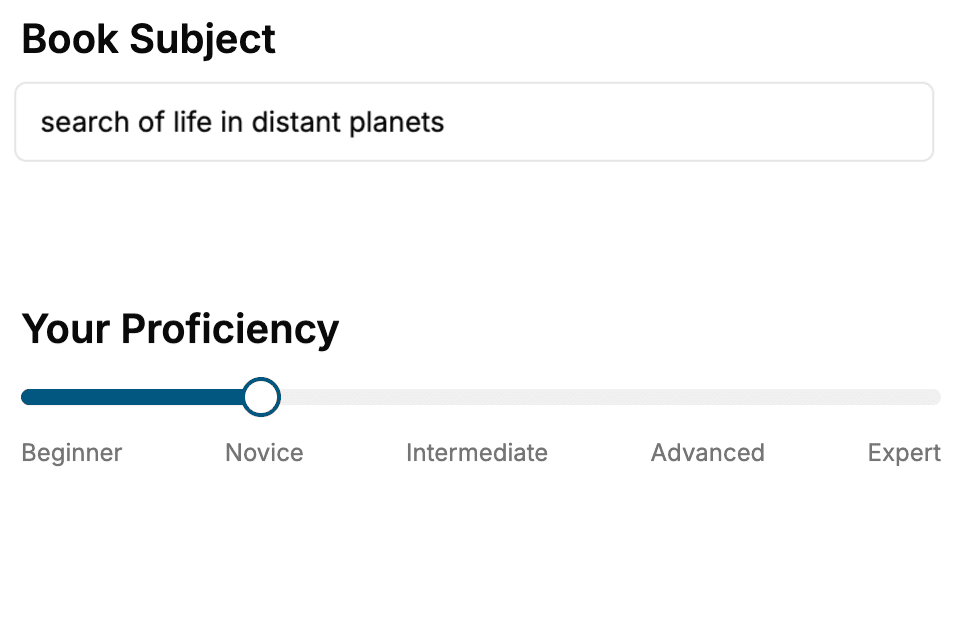
- 1. Select your focus
Select the focus of your Decision Making and Problem Solving book and share your background
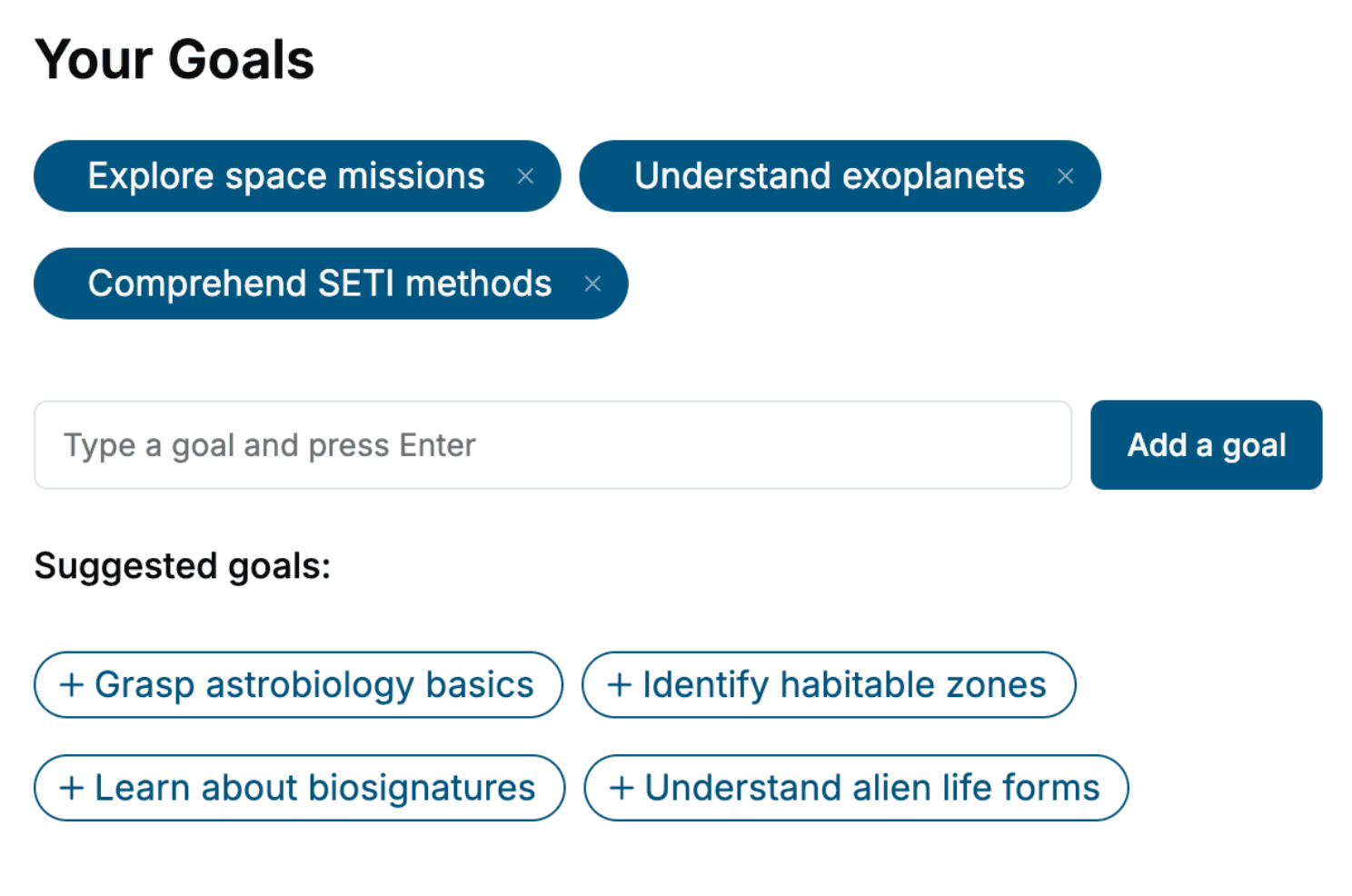
- 2. Personalize your book
Specify your goals and choose sub-topics to include
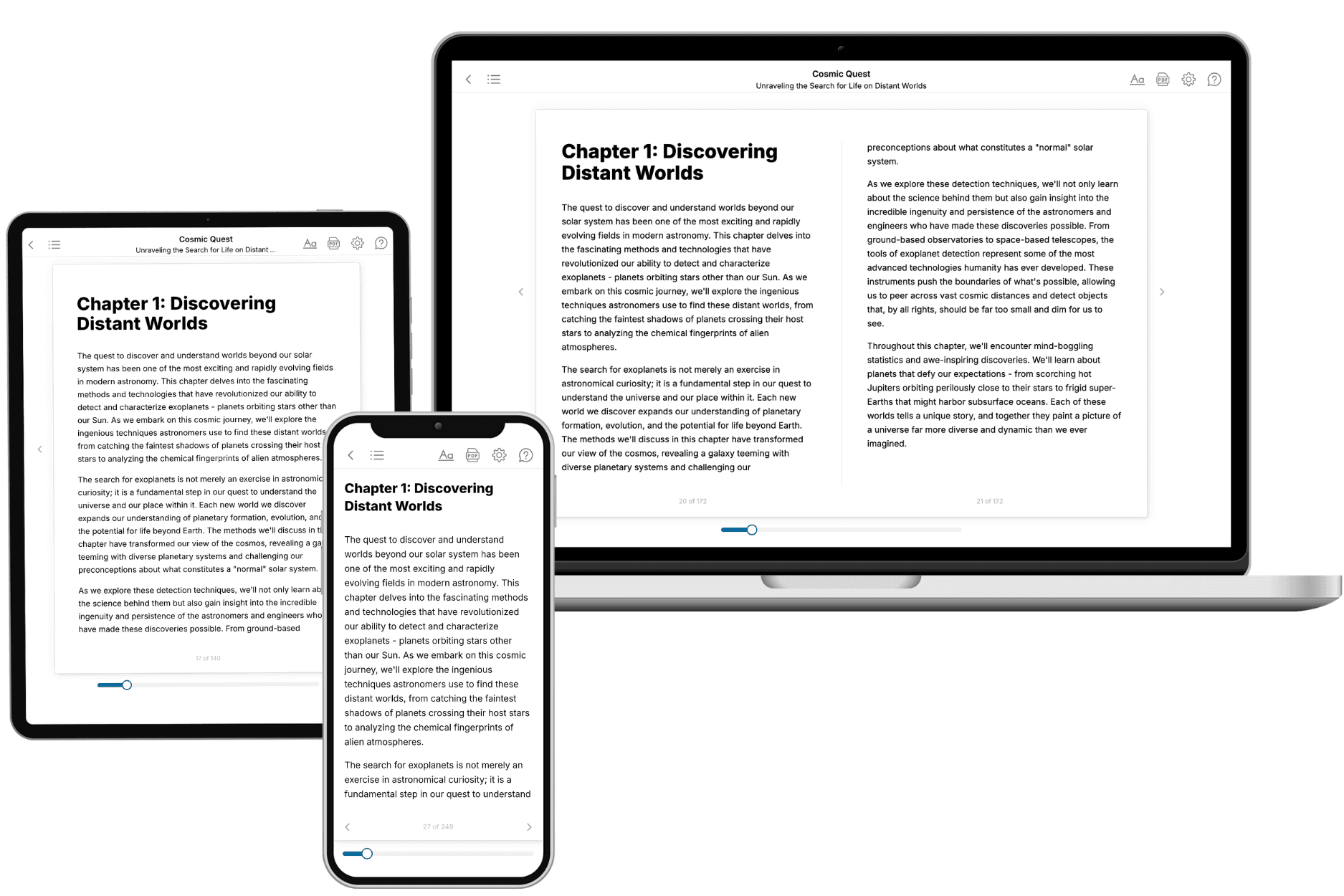
- 3. Get your tailored book
Your book is ready in 10 minutes. Read it online, download as EPUB or PDF, or send to Kindle.
Frequently asked questions
- What is TailoredRead?
TailoredRead creates complete, full-length nonfiction ebooks, written specifically for you. Tell us what you want to learn and why, and TailoredRead writes you a complete ebook on it, with charts, tables, and diagrams throughout. Read it online, on Kindle, or on any e-reader, or download it as a PDF or EPUB. Every book is written fresh the day you order it.
- How is the book tailored to me?
Before anything is written, you answer a few short questions about your goals, your background, and the topics you care about. Your book is then planned around your answers: written at your level, focused on your goals, and covering the topics you chose, instead of the one-size-fits-all book a store sells everyone.
- Will it read like generic AI content?
No. Your book isn't a chat transcript: it's planned chapter by chapter before a single word is written, told in a clear book voice, and explains ideas visually with charts, tables, and diagrams. After writing, every book goes through an editorial pass that polishes chapters so the book reads consistent from start to finish. Judge for yourself: browse thousands of sample books on our Explore Books page.
- How accurate is the content?
Our AI first checks whether your subject needs live research. Niche and fast-moving subjects are researched before writing, and the book plan and chapters are grounded in what it finds. After writing, every book goes through a quality pass that checks its facts and consistency, and researched books list their sources in a Notes section at the back.
- How long is the book?
You choose the length: Comprehensive (250-300 pages), Detailed (150-200 pages), Essential (70-100 pages), or Short (30-50 pages).
- Does the book include visuals?
Yes. Every book includes charts, tables, and diagrams: timelines, checklists, step-by-step guides, decision trees, comparison tables, matrices, and bar charts. A typical book includes dozens of these visual elements.
- Can I read it on Kindle? What formats can I download?
Yes. Every book can be read in our online reader or downloaded as a PDF or EPUB. The EPUB can be opened with Kindle, Apple Books, Kobo, and any e-reader. The Commercial and Author licenses also include an editable Word (DOCX) and Markdown download.
- How much does it cost?
About the price of a regular ebook. The exact price depends on your book's length and complexity, from $2 for the shortest books to $35 for the most comprehensive, and it's shown when you review your book, before you commit to anything. Each book is a one-time purchase, yours to keep, no subscription. Licenses that let you share, teach, or publish your book range from $35.99 to $49.99.
- Can I preview the book before purchasing?
Before you pay, you'll see what your book will cover: the title, a detailed description, the estimated length, and the complete chapter-by-chapter table of contents, so you know what you're getting before you decide. The full text itself is written after you purchase.
- How long does it take to create a book?
About 10 minutes. You can start reading the opening chapters while the rest is still being written.