Gaussian Process Regression
A Practical Guide to Probabilistic Modeling for Quantitative Research
Many practitioners treat regression as a simple point-prediction problem, missing the critical insight that uncertainty quantification is often more valuable than the prediction itself.
207 pages9 chaptersDec 17, 2025Machine Learning
About this book
Gaussian Process Regression offers a fundamentally different approach—one that naturally provides not just predictions, but principled estimates of confidence around those predictions. This book bridges the gap between theoretical understanding and practical application, guiding you through the mathematical foundations while keeping your focus on real-world implementation. You'll learn how kernel functions encode domain knowledge, why hyperparameter tuning matters more than you might think, and how to navigate the computational challenges that arise with larger datasets. Whether you're building financial models, optimizing experimental designs, or making data-driven decisions under uncertainty, this guide equips you with the conceptual clarity and practical skills to deploy GPR effectively. Discover when GPR outperforms traditional methods, how to validate your models rigorously, and how to integrate probabilistic predictions into your quantitative research workflow.
Table of contents
- IntroductionWhy Gaussian Process Regression Matters in Quantitative Research, Beyond Point Predictions: The Power of Uncertainty Quantification, How This Book Is Organized, What You Need to Know Before StartingRead below
- Chapter 1: Foundations of Gaussian ProcessesWhat Is a Gaussian Process?, From Distributions to Stochastic Processes, Formal Definition and Key Properties, Building Intuition Through Visualization
- Chapter 2: Kernel Functions and Covariance StructuresUnderstanding Covariance and Correlation, Introduction to Kernel Functions, Common Kernels: RBF, Matérn, Linear, and Periodic, Combining Kernels for Complex Relationships
- Chapter 3: Mathematical Framework of GPRThe Joint Gaussian Distribution, Conditioning and Bayesian Inference, Deriving the Predictive Distribution, Interpreting Mean and Variance in Predictions
- Chapter 4: Hyperparameter Optimization and Model SelectionWhat Are Hyperparameters and Why They Matter, Marginal Likelihood and Evidence Maximization, Optimization Methods: Gradient Descent and Beyond, Comparing Models and Avoiding Overfitting
- Chapter 5: Computational Considerations and ScalabilityUnderstanding Computational Complexity, Sparse Approximations and Inducing Points, Variational Inference for Scalability, Practical Strategies for Large Datasets
- Chapter 6: Implementing GPR in PracticeChoosing and Using GPR Libraries, Data Preparation and Preprocessing, Training Your First GPR Model, Making Predictions and Interpreting Results
- Chapter 7: Model Validation and DiagnosticsCross-Validation Strategies for GPR, Diagnostic Plots and Visual Inspection, Assessing Uncertainty Calibration, Performance Metrics Beyond RMSE
- Chapter 8: Advanced Topics and ExtensionsMulti-Output Gaussian Processes, Non-Gaussian Likelihoods and Classification, Deep Gaussian Processes, Bayesian Optimization with Gaussian Processes
- Chapter 9: Real-World Applications in Quantitative ResearchFinancial Modeling and Risk Assessment, Experimental Design and Sequential Decision-Making, Time Series Forecasting with Uncertainty, Case Studies from Industry and Research
- ConclusionKey Takeaways and Next Steps, The Future of Gaussian Processes in Quantitative Research
- Appendix: Mathematical ReferenceLinear Algebra Review, Probability Theory Essentials, Optimization Algorithms Reference
- Further Reading and Resources
Introduction
Quantitative research demands more than just predictions. When you build a model to forecast financial returns, optimize an experimental design, or guide strategic decisions, the confidence you have in those predictions often matters more than the predictions themselves. Traditional regression methods excel at producing point estimates, but they struggle to answer the question that keeps researchers and practitioners awake at night: How certain should I be about this prediction? Gaussian Process Regression offers a fundamentally different paradigm—one that treats uncertainty not as an afterthought, but as a central feature of the modeling process. This approach transforms regression from a deterministic exercise into a probabilistic framework that quantifies what you know and, equally important, what you don't know.
The power of Gaussian Process Regression lies in its mathematical elegance and practical utility. Unlike traditional methods that require you to specify a functional form upfront—linear, polynomial, or otherwise—GPR learns the structure of relationships directly from data through kernel functions. These kernels encode assumptions about smoothness, periodicity, and correlation in a flexible yet principled way. The result is a model that adapts to complex patterns while maintaining mathematical rigor. For practitioners in quantitative research, this flexibility means you can tackle problems where the underlying relationships are unknown or highly nonlinear, all while obtaining well-calibrated uncertainty estimates that inform risk-aware decision-making.
This book bridges the gap between theoretical understanding and practical implementation. You won't find abstract mathematics divorced from application, nor will you encounter cookbook recipes without conceptual foundation. Instead, each chapter builds your understanding systematically, moving from core concepts to advanced techniques while maintaining focus on real-world deployment. Whether you're working with limited data in experimental settings, building financial models that require robust uncertainty quantification, or optimizing complex systems through sequential decision-making, this guide equips you with the knowledge and skills to apply GPR effectively. The journey begins with understanding why GPR matters and culminates in deploying sophisticated models that deliver actionable insights.
Why Gaussian Process Regression Matters in Quantitative Research
Quantitative research operates at the intersection of data, uncertainty, and decision-making. Traditional regression methods like ordinary least squares or regularized linear models have served researchers well for decades, but they share a fundamental limitation: they produce point predictions without principled uncertainty quantification. When you fit a linear regression model, you receive coefficients and predictions, but the confidence intervals rely on strong assumptions about residual distributions and model specification. In practice, these assumptions often fail, leaving you with overconfident predictions that underestimate true uncertainty. Gaussian Process Regression addresses this limitation by treating functions themselves as random variables, providing a complete probability distribution over possible functions consistent with your data.
The distinction between point predictions and probability distributions has profound implications for research and decision-making. Consider a financial analyst forecasting quarterly returns for portfolio optimization. A traditional model might predict a return of 8%, but without reliable uncertainty estimates, the analyst cannot distinguish between a confident prediction with narrow bounds and a speculative guess with wide uncertainty. GPR naturally provides both the mean prediction and the variance, enabling the analyst to quantify risk explicitly. This probabilistic framework supports more sophisticated decision-making strategies, such as optimizing for risk-adjusted returns or identifying scenarios where additional data collection would most reduce uncertainty.
GPR excels in scenarios that challenge traditional methods. When working with small datasets—common in experimental research, clinical trials, or early-stage product development—GPR's Bayesian foundation allows you to incorporate prior knowledge and avoid overfitting. The model automatically balances complexity against available evidence through its marginal likelihood, a built-in mechanism for model selection. In domains with complex nonlinear relationships, such as chemical process optimization or environmental modeling, GPR's kernel functions capture intricate patterns without requiring you to specify functional forms manually. The flexibility to combine kernels enables you to encode domain knowledge directly into the model structure, creating custom covariance functions that reflect your understanding of the problem.
The computational landscape of quantitative research has evolved dramatically, and GPR has evolved with it. While classical GPR implementations scale poorly to large datasets due to cubic computational complexity, modern approximation techniques like sparse Gaussian processes and variational inference have made GPR practical for datasets with thousands or even millions of observations. Software libraries such as GPflow, GPyTorch, and scikit-learn provide optimized implementations that leverage GPU acceleration and automatic differentiation. These advances mean you can deploy GPR in production environments, not just academic exercises, making it a viable tool for real-world quantitative research applications.
Beyond prediction, GPR serves as a foundation for advanced techniques that extend its utility. Bayesian optimization, which uses GPR to guide sequential experimental design, has become the gold standard for hyperparameter tuning in machine learning and optimization of expensive black-box functions. Multi-output Gaussian processes enable joint modeling of related quantities, capturing correlations that improve prediction accuracy. Deep Gaussian processes combine the flexibility of neural networks with the uncertainty quantification of GPs, pushing the boundaries of what's possible in probabilistic modeling. Understanding GPR opens doors to these advanced methods, making it a cornerstone skill for practitioners in quantitative research.
The adoption of GPR in industry and research continues to accelerate across diverse domains. In pharmaceutical research, GPR guides dose-response modeling and clinical trial design. Financial institutions use GPR for volatility forecasting and derivative pricing. Environmental scientists apply GPR to spatial interpolation and climate modeling. Robotics researchers leverage GPR for model-based reinforcement learning and control. This widespread adoption reflects a growing recognition that uncertainty quantification is not a luxury but a necessity. As quantitative research becomes increasingly data-driven and high-stakes, the ability to model uncertainty rigorously distinguishes sophisticated practitioners from those relying on outdated methods.
Learning GPR represents an investment in your quantitative research capabilities that pays dividends across multiple dimensions. You gain a deeper understanding of probabilistic modeling, Bayesian inference, and the role of prior knowledge in machine learning. You develop intuition for how kernel functions encode assumptions and how those assumptions influence predictions. You acquire practical skills in model validation, hyperparameter optimization, and computational efficiency. Most importantly, you learn to think probabilistically about predictions, moving beyond the false certainty of point estimates to embrace the nuanced reality of uncertainty. This shift in perspective fundamentally changes how you approach quantitative problems, leading to more robust analyses and better-informed decisions.
Beyond Point Predictions: The Power of Uncertainty Quantification
The conventional approach to regression treats prediction as a deterministic problem: given input features, produce an output value. This paradigm pervades machine learning and statistics, from linear regression to neural networks. While these methods often include mechanisms for estimating uncertainty—such as confidence intervals or bootstrap resampling—these estimates typically rely on asymptotic approximations or distributional assumptions that may not hold in practice. The result is a disconnect between the uncertainty estimates your model reports and the true uncertainty in your predictions. Gaussian Process Regression fundamentally reframes the problem by treating the function you're trying to learn as inherently uncertain, representing it as a probability distribution over functions rather than a single best guess.
This probabilistic perspective transforms how you interpret and use predictions. Instead of receiving a single number, you obtain a predictive distribution characterized by a mean and variance at each input location. The mean represents your best estimate given the data, while the variance quantifies your uncertainty about that estimate. This variance is not uniform across the input space—it increases in regions far from observed data and decreases near training points. This behavior aligns with intuition: you should be more confident about predictions in well-explored regions and less confident when extrapolating. Traditional methods struggle to capture this spatially-varying uncertainty naturally, often requiring ad-hoc adjustments or ensemble methods that lack theoretical grounding.
The practical implications of principled uncertainty quantification extend across the research pipeline. During exploratory analysis, uncertainty estimates help you identify regions where your model is reliable versus where it's speculating. This information guides data collection strategies, directing resources toward regions of high uncertainty where additional observations would most improve model performance. In decision-making contexts, uncertainty estimates enable risk-aware optimization. Rather than optimizing expected outcomes alone, you can incorporate uncertainty into objective functions, balancing expected performance against risk. This approach is particularly valuable in high-stakes domains like medical treatment planning, financial portfolio management, or safety-critical engineering applications.
Consider a concrete example from experimental design in materials science. A researcher seeks to optimize the composition of an alloy to maximize strength while minimizing cost. Traditional regression might identify a composition with predicted strength of 500 MPa, but without reliable uncertainty estimates, the researcher cannot assess whether this prediction is trustworthy or whether nearby compositions might perform better. GPR provides not just the prediction but also the uncertainty, revealing that the predicted optimum has high variance due to sparse data in that region. Armed with this information, the researcher can conduct targeted experiments to reduce uncertainty around the predicted optimum, or choose a slightly suboptimal composition with lower uncertainty and higher confidence. This decision-making process is impossible without principled uncertainty quantification.
Uncertainty quantification also plays a critical role in model validation and diagnostics. Well-calibrated uncertainty estimates should accurately reflect prediction errors: approximately 95% of true values should fall within 95% confidence intervals. When uncertainty estimates are poorly calibrated—either overconfident or underconfident—it signals problems with model specification, kernel choice, or hyperparameter settings. GPR's probabilistic framework makes calibration assessment straightforward through techniques like probability integral transform plots and prediction interval coverage analysis. These diagnostic tools help you identify when your model is trustworthy and when it requires refinement, providing a feedback loop that improves model quality iteratively.
The value of uncertainty quantification becomes even more apparent in sequential decision-making scenarios. Bayesian optimization, a powerful application of GPR, uses uncertainty estimates to balance exploration and exploitation. The algorithm selects new evaluation points by considering both predicted performance (exploitation) and prediction uncertainty (exploration). This strategy efficiently navigates complex optimization landscapes, finding global optima with fewer evaluations than grid search or random sampling. The acquisition functions that guide this process—expected improvement, upper confidence bound, and probability of improvement—all depend critically on GPR's uncertainty estimates. Without reliable uncertainty quantification, these strategies degrade to greedy optimization that easily gets trapped in local optima.
Beyond individual predictions, GPR's uncertainty quantification enables sophisticated inference about function properties. You can compute not just predictions at specific points but also integrals, derivatives, and other functionals of the underlying function, each with associated uncertainty. This capability supports applications like estimating total resource consumption by integrating a predicted consumption rate over time, or identifying optimal operating points by finding where the derivative of a predicted response surface equals zero. Each of these derived quantities inherits uncertainty from the underlying GP, providing a complete probabilistic picture. Traditional methods require separate analyses for each functional, often with incompatible uncertainty estimates that complicate interpretation.
The shift from point predictions to probability distributions represents a maturation of quantitative research methodology. As datasets grow larger and decisions become more consequential, the limitations of deterministic predictions become increasingly apparent. Uncertainty quantification is not merely a technical nicety but a fundamental requirement for responsible data-driven decision-making. Gaussian Process Regression provides the mathematical framework and practical tools to meet this requirement, offering uncertainty estimates that are principled, interpretable, and actionable. By embracing this probabilistic perspective, you position yourself at the forefront of modern quantitative research, equipped to tackle complex problems with the rigor they demand.
How This Book Is Organized
This book follows a carefully structured progression from foundational concepts to advanced applications, designed to build your understanding systematically while maintaining practical relevance throughout. The organization reflects a pedagogical philosophy that balances mathematical rigor with implementation details, ensuring you develop both conceptual clarity and hands-on skills. Each chapter builds on previous material while remaining relatively self-contained, allowing you to focus on specific topics of interest after completing the foundational chapters. The structure supports multiple reading paths depending on your background and goals, whether you're seeking theoretical depth, practical implementation guidance, or both.
The journey begins with Chapter 1: Foundations of Gaussian Processes, which establishes the conceptual framework for everything that follows. You'll learn what Gaussian processes are, how they relate to familiar probability distributions, and why they provide a natural framework for regression. The chapter emphasizes intuition and visualization, helping you develop mental models that make subsequent mathematical details more accessible. By the end of this chapter, you'll understand GPs as distributions over functions and grasp how this perspective differs from traditional parametric modeling approaches. This foundation is essential for appreciating the power and flexibility of GPR in later chapters.
Chapter 2: Kernel Functions and Covariance Structures dives into the heart of what makes Gaussian processes flexible and powerful. Kernels encode assumptions about function properties—smoothness, periodicity, linearity—and directly determine model behavior. You'll explore common kernel families, understand their properties and use cases, and learn how to combine kernels to capture complex patterns. This chapter emphasizes the connection between kernel choice and domain knowledge, showing how thoughtful kernel design can dramatically improve model performance. The practical guidance on kernel selection and combination provides tools you'll use in every GPR application throughout your career.
With intuition and kernel knowledge established, Chapter 3: Mathematical Framework of GPR presents the formal mathematics underlying Gaussian process regression. You'll work through the derivation of the predictive distribution, understanding how conditioning on observed data transforms a prior distribution over functions into a posterior distribution that incorporates evidence. The chapter maintains accessibility by connecting each mathematical step to intuitive interpretations and practical implications. While this chapter is more mathematically intensive than earlier ones, it provides the rigorous foundation necessary for understanding hyperparameter optimization, model selection, and advanced extensions covered later.
Chapter 4: Hyperparameter Optimization and Model Selection addresses one of the most critical practical aspects of GPR: tuning the parameters that control kernel behavior and noise levels. You'll learn about marginal likelihood maximization, gradient-based optimization methods, and strategies for avoiding local optima. The chapter also covers model comparison techniques that help you choose between different kernel specifications and assess whether GPR is appropriate for your problem. This material bridges theory and practice, showing how mathematical principles translate into concrete implementation decisions that determine model success or failure.
Computational efficiency becomes the focus in Chapter 5: Computational Considerations and Scalability. Classical GPR scales poorly to large datasets, but modern approximation techniques make it practical for real-world applications. You'll explore sparse approximations, inducing point methods, and variational inference approaches that reduce computational complexity while maintaining prediction quality. The chapter provides practical guidance on when to use each technique and how to balance computational cost against accuracy. This knowledge is essential for deploying GPR in production environments where computational resources are constrained and dataset sizes exceed what classical methods can handle.
Chapter 6: Implementing GPR in Practice shifts focus to hands-on implementation, guiding you through the process of building, training, and deploying GPR models using modern software libraries. You'll learn about data preprocessing, library selection, model training workflows, and prediction generation. The chapter includes concrete examples with code snippets and practical tips for avoiding common pitfalls. By working through these examples, you'll develop the practical skills necessary to apply GPR to your own research problems, moving from theoretical understanding to working implementations.
Model validation receives thorough treatment in Chapter 7: Model Validation and Diagnostics, which covers techniques for assessing whether your GPR model is performing well and producing reliable uncertainty estimates. You'll learn about cross-validation strategies adapted to GPR's unique characteristics, diagnostic plots that reveal model deficiencies, and methods for assessing uncertainty calibration. The chapter emphasizes that validation is not a one-time check but an iterative process that guides model refinement. These techniques help you build confidence in your models and identify when additional data or different modeling approaches are necessary.
Chapter 8: Advanced Topics and Extensions explores sophisticated techniques that extend GPR's capabilities beyond standard regression. You'll encounter multi-output Gaussian processes for modeling related quantities jointly, non-Gaussian likelihoods for classification and count data, deep Gaussian processes that combine GP flexibility with neural network expressiveness, and Bayesian optimization for sequential experimental design. While these topics are advanced, the chapter maintains accessibility by building on foundations established earlier. This material opens doors to cutting-edge research and applications, showing how GPR serves as a foundation for diverse probabilistic modeling techniques.
Chapter 9: Real-World Applications in Quantitative Research brings everything together through detailed case studies from finance, experimental design, time series forecasting, and other domains. These applications demonstrate how the concepts and techniques from earlier chapters combine to solve real problems. You'll see how practitioners navigate trade-offs, make modeling decisions, and interpret results in context. The case studies provide templates you can adapt to your own research problems, illustrating best practices and common challenges. This chapter reinforces that GPR is not just a theoretical tool but a practical methodology for addressing complex quantitative research questions.
The book concludes with a Conclusion that synthesizes key takeaways and provides guidance on next steps for continuing your GPR journey. An Appendix offers mathematical reference material on linear algebra, probability theory, and optimization algorithms, serving as a quick reference when you need to refresh foundational concepts. Finally, Further Reading and Resources points you toward additional materials for deepening your expertise, including seminal papers, advanced textbooks, and software documentation. This comprehensive structure ensures you have the resources needed to master GPR and apply it effectively in your quantitative research endeavors.
What You Need to Know Before Starting
This book assumes you bring intermediate-level knowledge of statistics, mathematics, and programming to your reading. You should be comfortable with fundamental statistical concepts including probability distributions, expectation and variance, conditional probability, and basic inference. Familiarity with regression analysis—both linear and nonlinear—provides helpful context for understanding how GPR differs from traditional approaches. You don't need to be an expert in these areas, but you should be able to follow discussions that reference normal distributions, covariance matrices, and likelihood functions without needing to review basic definitions. If these concepts feel unfamiliar, spending time with an introductory statistics textbook before diving into GPR will make your learning experience more productive.
Mathematical prerequisites center on linear algebra and calculus. You should understand vectors and matrices, including operations like matrix multiplication, inversion, and transposition. Concepts like eigenvalues, eigenvectors, and positive definiteness appear throughout GPR theory, so familiarity with these topics is valuable. On the calculus side, you need comfort with derivatives and partial derivatives, as optimization procedures rely heavily on gradient computation. Multivariate calculus concepts like the chain rule and gradient vectors are particularly relevant. The appendix provides reference material on these topics, but the main chapters assume you can follow mathematical derivations that use these tools without extensive explanation of the underlying mathematics.
Programming skills are essential for practical implementation of GPR models. While the book is not tied to a specific programming language, examples and discussions assume familiarity with Python or a similar high-level language commonly used in data science and machine learning. You should be comfortable with basic programming constructs, data structures, and the use of scientific computing libraries like NumPy for numerical operations. Experience with machine learning libraries such as scikit-learn provides helpful context, though it's not strictly required. The implementation chapters include code examples that you can adapt to your needs, but you'll get more value from these examples if you can read and modify code confidently.
Conceptual prerequisites include understanding of the machine learning workflow and model evaluation principles. You should know the distinction between training and test data, understand why overfitting is problematic, and be familiar with cross-validation as a model assessment technique. Experience with hyperparameter tuning, even in simpler models, provides useful context for understanding GPR's hyperparameter optimization procedures. If you've worked with regularization techniques like ridge regression or lasso, you'll find helpful parallels in how GPR balances model complexity against data fit. These concepts form the practical foundation on which GPR builds, and familiarity with them helps you appreciate GPR's advantages and limitations.
While not strictly required, exposure to Bayesian thinking enhances your understanding of GPR's philosophical foundations. GPR is fundamentally a Bayesian method, treating unknown functions as random variables and updating beliefs based on observed data. If you've encountered Bayesian inference in other contexts—such as Bayesian parameter estimation or Bayesian networks—you'll recognize familiar patterns in GPR's approach to uncertainty quantification. However, the book develops Bayesian concepts as needed, so prior Bayesian experience is helpful but not essential. The key is openness to probabilistic thinking and comfort with the idea that models should quantify uncertainty rather than produce deterministic predictions.
Practical experience with real-world data analysis problems provides valuable context for appreciating GPR's strengths and appropriate use cases. If you've struggled with uncertainty quantification in previous projects, encountered datasets too small for traditional methods to work well, or needed to model complex nonlinear relationships without knowing the functional form, you'll immediately recognize scenarios where GPR excels. Experience with the limitations of traditional regression methods—such as poorly calibrated confidence intervals or difficulty capturing complex patterns—motivates the need for GPR's more sophisticated approach. This practical background helps you understand not just how GPR works but when and why to use it.
The book is designed for intermediate practitioners, meaning you should have completed foundational coursework or self-study in statistics and machine learning but may not have specialized in probabilistic modeling or Bayesian methods. If you're a graduate student in a quantitative field, a data scientist with a few years of experience, or a researcher looking to expand your methodological toolkit, you're in the target audience. The material assumes you can learn from mathematical derivations but emphasizes intuition and practical application over mathematical abstraction. If you find certain sections challenging, the book provides references to additional resources and includes an appendix with mathematical background material to support your learning.
Finally, successful engagement with this book requires intellectual curiosity and willingness to invest time in understanding concepts deeply rather than seeking quick recipes. GPR is more sophisticated than many traditional regression methods, and that sophistication brings both power and complexity. You'll need to think carefully about kernel selection, hyperparameter optimization, and model validation rather than applying default settings blindly. The reward for this investment is a flexible, principled modeling framework that handles uncertainty rigorously and adapts to diverse problem structures. Approach the material with patience, work through examples carefully, and don't hesitate to revisit earlier chapters as you progress. The effort you invest in mastering GPR will pay dividends throughout your quantitative research career, opening doors to sophisticated analyses and better-informed decisions.
This is the end of the free sample. The full book has 9 chapters.
Want this book written for you?
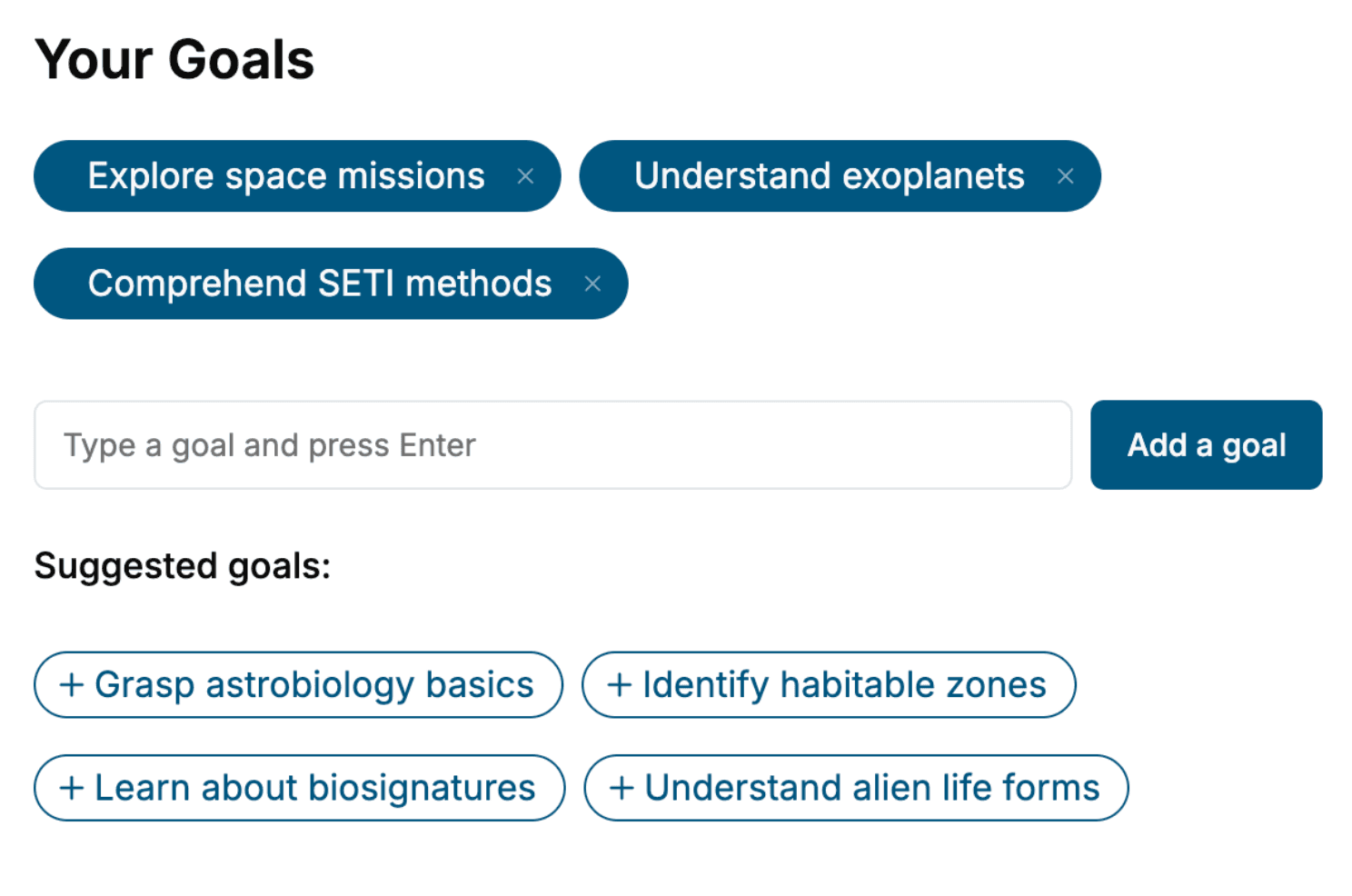
Tell us your goals and background, and get your own version of this book, tailored by AI to you.


Benefits of AI-tailored books
- Read one book, not ten:
- all the Machine Learning knowledge you need, gathered into a single book.
- Save days of learning:
- tell us your goals, choose your topics, and the whole book is built around them.
- Learn effortlessly:
- Machine Learning book written for your specific background and expertise.
- Understand at a glance:
- includes charts, tables, timelines, checklists, decision trees, and more.
- Stay current:
- written the day you order it, not years ago.
- Trust what you read:
- every book is checked for accuracy, with real research when your subject needs it.
Create your unique book in 3 steps
- 1. Select your focus
Select the focus of your Machine Learning book and share your background
- 2. Personalize your book
Specify your goals and choose sub-topics to include
- 3. Get your tailored book
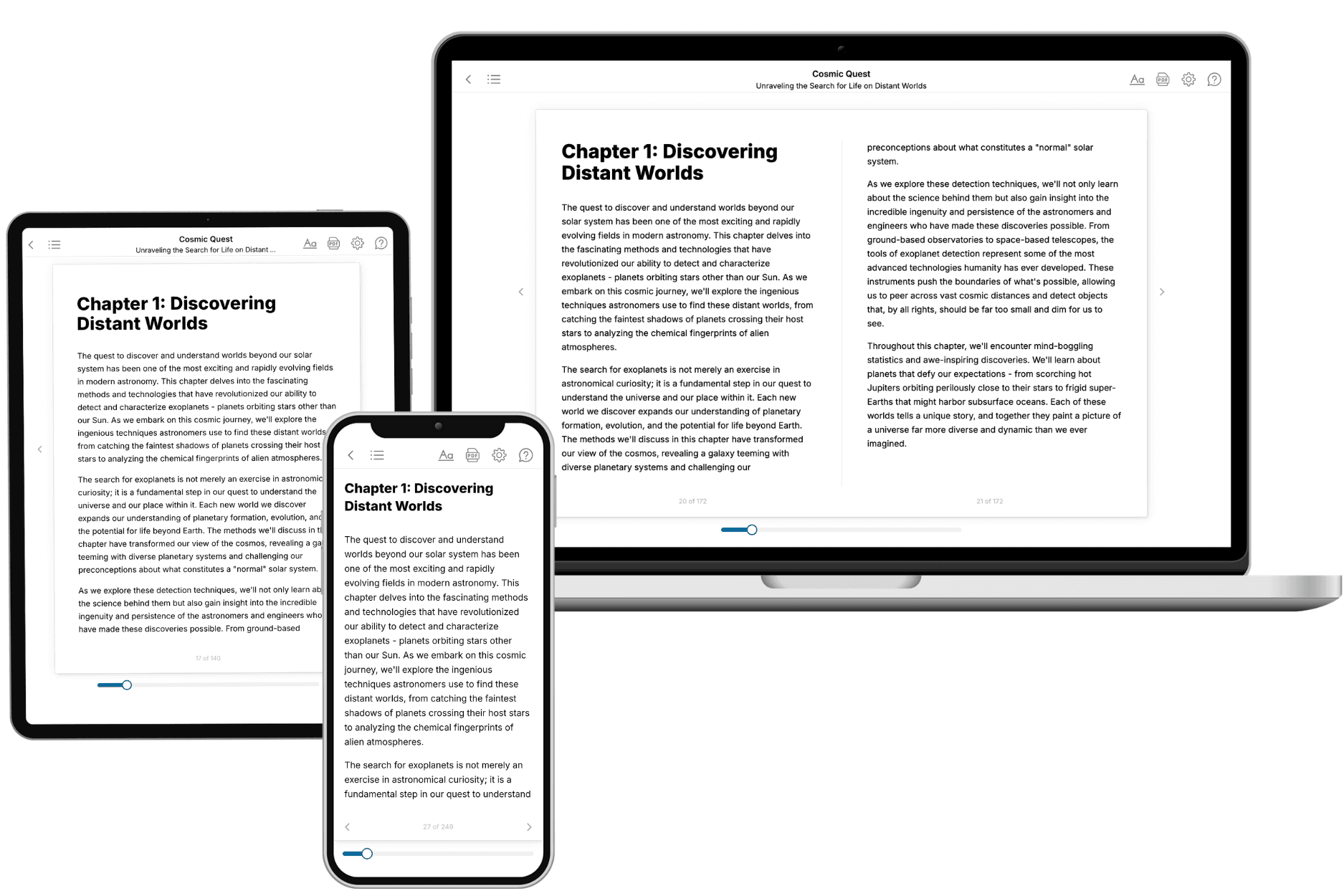
Your book is ready in 10 minutes. Read it online, download as EPUB or PDF, or send to Kindle.

Frequently asked questions
- What is TailoredRead?
TailoredRead creates complete, full-length nonfiction ebooks, written specifically for you. Tell us what you want to learn and why, and TailoredRead writes you a complete ebook on it, with charts, tables, and diagrams throughout. Read it online, on Kindle, or on any e-reader, or download it as a PDF or EPUB. Every book is written fresh the day you order it.
- How is the book tailored to me?
Before anything is written, you answer a few short questions about your goals, your background, and the topics you care about. Your book is then planned around your answers: written at your level, focused on your goals, and covering the topics you chose, instead of the one-size-fits-all book a store sells everyone.
- Will it read like generic AI content?
No. Your book isn't a chat transcript: it's planned chapter by chapter before a single word is written, told in a clear book voice, and explains ideas visually with charts, tables, and diagrams. After writing, every book goes through an editorial pass that polishes chapters so the book reads consistent from start to finish. Judge for yourself: browse thousands of sample books on our Explore Books page.
- How accurate is the content?
Our AI first checks whether your subject needs live research. Niche and fast-moving subjects are researched before writing, and the book plan and chapters are grounded in what it finds. After writing, every book goes through a quality pass that checks its facts and consistency, and researched books list their sources in a Notes section at the back.
- How long is the book?
You choose the length: Comprehensive (250-300 pages), Detailed (150-200 pages), Essential (70-100 pages), or Short (30-50 pages).
- Does the book include visuals?
Yes. Every book includes charts, tables, and diagrams: timelines, checklists, step-by-step guides, decision trees, comparison tables, matrices, and bar charts. A typical book includes dozens of these visual elements.
- Can I read it on Kindle? What formats can I download?
Yes. Every book can be read in our online reader or downloaded as a PDF or EPUB. The EPUB can be opened with Kindle, Apple Books, Kobo, and any e-reader. The Commercial and Author licenses also include an editable Word (DOCX) and Markdown download.
- How much does it cost?
About the price of a regular ebook. The exact price depends on your book's length and complexity, from $2 for the shortest books to $35 for the most comprehensive, and it's shown when you review your book, before you commit to anything. Each book is a one-time purchase, yours to keep, no subscription. Licenses that let you share, teach, or publish your book range from $35.99 to $49.99.
- Can I preview the book before purchasing?
Before you pay, you'll see what your book will cover: the title, a detailed description, the estimated length, and the complete chapter-by-chapter table of contents, so you know what you're getting before you decide. The full text itself is written after you purchase.
- How long does it take to create a book?
About 10 minutes. You can start reading the opening chapters while the rest is still being written.