The Genetic Code Unlocked
Hands-On Experiments in Biotechnology and Genetic Engineering
Master the fundamentals of genetic engineering through hands-on experimentation and clear scientific explanation.
253 pages12 chaptersApr 4, 2026Biotechnology
About this book
This book guides you through the essential techniques and concepts that form the foundation of modern biotechnology, from DNA extraction to gene editing. You'll learn how to design and conduct meaningful experiments in your own lab space, understand the molecular mechanisms behind genetic modification, and explore real-world applications that are transforming medicine and agriculture. Each chapter combines theoretical knowledge with practical protocols, troubleshooting tips, and safety guidelines. Whether you're preparing for advanced studies, pursuing a career in biotechnology, or simply curious about how genetic engineering works, you'll gain the confidence and competence to engage with this rapidly evolving field. Discover how cutting-edge techniques like CRISPR are making genetic engineering more accessible than ever before.
Table of contents
- IntroductionWhy Genetic Engineering Matters Today, What You'll Learn in This Book, How to Use This Book for Maximum Learning, Safety and Ethical FoundationsRead below
- Chapter 1: The Foundations of Genetic EngineeringUnderstanding DNA Structure and Function, The Central Dogma: From DNA to Proteins, How Genetic Variation Occurs in Nature
- Chapter 2: Essential Laboratory Equipment and SetupMust-Have Equipment for Genetic Engineering, Setting Up Your Experimental Workspace, Implementing Safety Protocols and Containment
- Chapter 3: DNA Extraction: Your First ExperimentPrinciples Behind DNA Extraction, Step-by-Step DNA Extraction Protocol, Troubleshooting Common Extraction Problems
- Chapter 4: Polymerase Chain Reaction (PCR): Amplifying DNAHow PCR Works: The Three-Step Cycle, Designing and Running Your First PCR Experiment, Analyzing PCR Results with Gel Electrophoresis
- Chapter 5: Plasmids and Vectors: Delivery Systems for GenesWhat Plasmids Are and How They Work, Choosing the Right Vector for Your Experiment, Isolating and Preparing Plasmids
- Chapter 6: Restriction Enzymes and DNA CloningHow Restriction Enzymes Cut DNA Precisely, Ligating DNA Fragments Together, Conducting Your First Cloning Experiment
- Chapter 7: Bacterial Transformation: Introducing Genes into CellsCompetent Cells and Transformation Techniques, Performing Bacterial Transformation, Selecting and Screening Transformed Colonies
- Chapter 8: CRISPR-Cas9: The Gene-Editing RevolutionUnderstanding CRISPR-Cas9 Molecular Machinery, Designing Guide RNAs for Precision Editing, CRISPR Applications and Limitations
- Chapter 9: Gene Expression and Protein ProductionChoosing Expression Systems for Your Genes, Inducing and Optimizing Protein Production, Detecting and Analyzing Expressed Proteins
- Chapter 10: Real-World Applications and Case StudiesGenetic Engineering in Medicine and Therapeutics, Crop Improvement and Agricultural Biotechnology, Environmental Remediation and Synthetic Biology
- Chapter 11: Bioinformatics and Computational ToolsAnalyzing DNA and Protein Sequences, Using Computational Tools for Experiment Design, Interpreting Bioinformatics Results
- Chapter 12: Troubleshooting and Advanced Problem-SolvingDiagnosing Common Experimental Failures, Optimization Strategies for Better Results, Moving Beyond Basic Protocols
- ConclusionYour Next Steps in Genetic Engineering, Ethical Considerations and Responsible Innovation
- Glossary of Key Terms
- Further Reading and Resources
Introduction
Something remarkable has happened in biology over the past few decades. Techniques that once required multimillion-dollar facilities and teams of specialized researchers can now be performed in modest lab spaces by motivated learners with the right knowledge and equipment. Genetic engineering, once the exclusive domain of elite research institutions, has become increasingly accessible. The tools have become cheaper, the protocols more refined, and the educational resources more plentiful. This shift represents one of the most significant democratizations of scientific practice in modern history.
This book exists because understanding genetic engineering is no longer optional for anyone serious about biology, medicine, agriculture, or environmental science. The techniques covered here, from DNA extraction and PCR amplification to bacterial transformation and CRISPR-based gene editing, form the practical backbone of modern biotechnology. These are not abstract concepts reserved for graduate students. They are learnable, doable, and deeply illuminating when approached with the right guidance. Each experiment in this book is designed to connect what you read to what you actually observe in a tube, on a gel, or under a microscope.
The goal here is not just to teach you procedures. It is to help you think like a genetic engineer. That means understanding why each step in a protocol exists, what can go wrong and why, and how the molecular events happening at a scale too small to see translate into visible, measurable results. It also means developing a sense of scientific judgment, knowing when your results are telling you something useful and when they are telling you to start over. This combination of practical skill and analytical thinking is what separates someone who follows a recipe from someone who truly understands the science.
Before diving into the first chapter, this introduction lays out the context and framework for everything that follows. You will find out why genetic engineering matters so much right now, what specific knowledge and skills this book will build, how to get the most out of the structure and experiments, and what safety and ethical principles should guide every step of your work. Think of this section as your orientation before entering the lab. It is worth reading carefully, even if you are eager to get started with the hands-on content.
Why Genetic Engineering Matters Today
Genetic engineering is not a future technology. It is a present one, already woven into the fabric of everyday life in ways most people do not realize. The insulin used by millions of people with diabetes worldwide is produced by genetically engineered bacteria. Many of the crops that feed billions of people have been modified to resist pests, tolerate drought, or produce higher yields. Vaccines developed at record speed during recent global health crises relied on genetic engineering techniques to identify targets and produce components. The field is not on the horizon. It is already here, and it is accelerating.[1]
The medical implications alone are staggering. Gene therapies are now approved treatments for conditions that were once considered untreatable, including certain inherited blindness disorders and some forms of cancer. CRISPR-based therapies have entered clinical trials for sickle cell disease, with early results showing remarkable promise. Researchers are engineering immune cells to seek out and destroy tumors with a precision that traditional chemotherapy cannot match. Each of these breakthroughs traces directly back to the foundational techniques you will learn in this book.
Agriculture has been transformed just as dramatically. Genetically modified crops now account for a significant portion of global production of soybeans, corn, and cotton.[2] Beyond simple pest resistance, researchers are engineering crops to produce higher levels of specific nutrients, survive in changing climate conditions, and even fix their own nitrogen from the atmosphere, potentially reducing the need for synthetic fertilizers. These developments carry enormous implications for food security in a world with a growing population and increasingly unpredictable weather patterns.
Environmental applications are perhaps the most underappreciated frontier. Scientists are engineering microorganisms capable of breaking down plastic waste, cleaning up oil spills, and sequestering carbon from the atmosphere. Synthetic biology, a field that combines genetic engineering with engineering principles, is producing organisms designed from the ground up to perform specific environmental functions. These are not science fiction scenarios. Many are already in field trials or early deployment.
Understanding genetic engineering also matters for informed citizenship. Debates about GMO labeling, gene drive technology in wild populations, and the ethics of human germline editing are happening in legislatures, courtrooms, and public forums right now. These are not purely technical debates. They involve values, risk assessment, and social priorities. But they are impossible to engage with meaningfully without a solid grasp of what the science actually involves. This book gives you that foundation, so you can participate in these conversations with knowledge rather than just opinion.
Finally, genetic engineering matters because it is one of the most intellectually rich fields in all of science. It sits at the intersection of chemistry, physics, computer science, and biology. It requires creative problem-solving, careful observation, and rigorous logic. For anyone who loves science, engaging with genetic engineering at a practical level is one of the most rewarding things you can do. The experiments in this book are designed to give you that experience directly.
What You'll Learn in This Book
This book is organized as a progressive journey through the core techniques and concepts of genetic engineering. Each chapter builds on the ones before it, so the knowledge accumulates in a logical sequence. By the time you reach the final chapters, you will have a comprehensive toolkit of both practical skills and theoretical understanding. Here is a clear picture of what that journey covers.
The first section of the book establishes the molecular foundations. You will develop a solid understanding of DNA structure, how genetic information flows from DNA to RNA to protein, and how natural genetic variation arises. This is not just background reading. These concepts are the lens through which every experiment in the book makes sense. When you understand why DNA has a double helix structure, for example, you understand why certain extraction steps are necessary and why PCR works the way it does.
The practical core of the book covers the essential techniques of molecular biology in a hands-on format:
- DNA extraction from biological samples, including the principles behind cell lysis, protein removal, and DNA precipitation
- Polymerase Chain Reaction (PCR), the technique that allows you to amplify specific DNA sequences from tiny starting amounts
- Gel electrophoresis, used to visualize and analyze DNA fragments by size
- Restriction enzyme digestion and DNA ligation, the molecular scissors and glue of classical cloning
- Plasmid preparation and bacterial transformation, the process of introducing new genetic material into living cells
- CRISPR-Cas9 gene editing, including guide RNA design and the molecular mechanisms of targeted genome modification
- Protein expression and analysis, covering how to get cells to produce a protein of interest and how to detect it
Beyond the bench techniques, this book also covers the computational side of modern genetic engineering. Bioinformatics tools are now essential for designing experiments, analyzing sequences, and interpreting results. You will learn how to use freely available software and databases to search for gene sequences, design PCR primers, predict protein structures, and evaluate CRISPR guide RNA candidates. These skills are increasingly expected even in entry-level biotechnology roles.
The book also dedicates significant attention to troubleshooting. Every experienced scientist knows that experiments fail regularly, and that failure is often more informative than success. Each major technique chapter includes a troubleshooting section that walks through the most common problems, their likely causes, and how to fix them. A dedicated chapter on advanced problem-solving brings these threads together into a systematic framework for diagnosing and resolving experimental issues.
Real-world applications are woven throughout the book and given dedicated treatment in a full chapter covering medicine, agriculture, and environmental science. These case studies are not just inspiring stories. They are designed to show you exactly how the techniques you are learning connect to outcomes that matter in the real world. Seeing that connection makes the technical work more meaningful and helps you understand the broader context of what you are doing.
By the end of this book, you will be able to design a simple genetic engineering experiment from scratch, execute the core protocols with confidence, interpret your results critically, and troubleshoot when things go wrong. You will also have a clear picture of where the field is heading and how to continue developing your skills beyond what this book covers. That combination of practical competence and forward-looking awareness is the real goal.
How to Use This Book for Maximum Learning
This book is designed to be used actively, not just read passively. The most effective approach is to treat each chapter as a unit of learning that combines reading, reflection, and hands-on practice. Reading a protocol without doing it is a bit like reading about swimming without getting in the water. You will understand the words, but you will not develop the feel for what the technique actually involves. Wherever possible, plan to run the experiments alongside the chapters that describe them.
The chapters are sequenced deliberately, and working through them in order is strongly recommended, especially if you are new to molecular biology lab work. The early chapters on DNA structure and laboratory setup are not just introductory filler. They establish vocabulary, concepts, and practical habits that every later chapter assumes you have. Skipping ahead to CRISPR without understanding plasmids, or attempting transformation without understanding competent cells, will leave you confused about why steps are done the way they are.
That said, the book is also designed to be a useful reference once you have worked through it. Each technique chapter is written to be reasonably self-contained, with enough context that you can return to it when you need a refresher on a specific protocol. The glossary at the back defines all key terms, and the further reading section points you toward deeper resources for every major topic. Think of the book as both a course and a reference manual.
Here are some specific strategies for getting the most out of each chapter:
- Read the theory section first before looking at the protocol. Understanding the molecular mechanism behind a technique helps you follow the steps with comprehension rather than just compliance.
- Write out your predictions before running an experiment. What do you expect to see? Why? This habit builds scientific thinking and makes your results more meaningful.
- Record everything in a lab notebook, including things that seem unimportant. The temperature of your room, the age of your reagents, the exact timing of each step. These details matter when you need to troubleshoot.
- Read the troubleshooting section before you start, not just when something goes wrong. Knowing the common failure modes in advance helps you avoid them.
- Revisit the theory after running the experiment. Your practical experience will give the molecular explanations a new layer of meaning.
The bioinformatics chapter deserves special mention. Computational tools are most useful when you are actively designing an experiment, not just reading about them in the abstract. The best time to work through that chapter is when you are planning a PCR experiment or designing a CRISPR guide RNA, so you can apply the tools to a real problem you are trying to solve. The chapter is written with that kind of active use in mind.
If you are working through this book as part of a course or study group, the experiments are well-suited to collaborative work. Many of the protocols involve multiple simultaneous steps that benefit from having more than one pair of hands. Discussing your results with others also deepens understanding in ways that solo study cannot replicate. Explaining why you think your gel showed a faint band, or why your transformation efficiency was lower than expected, forces you to articulate your reasoning in ways that reveal gaps in your understanding.
For those who are more advanced and already familiar with some of these techniques, the book still offers value in the form of integrated context, troubleshooting frameworks, and the connections drawn between individual techniques and broader applications. The CRISPR chapter, the bioinformatics chapter, and the advanced problem-solving chapter are likely to be the most useful entry points for readers with existing lab experience. Even experienced practitioners often find that revisiting foundational techniques with fresh eyes reveals things they had previously taken for granted.
Safety and Ethical Foundations
Safety is not a formality in genetic engineering. It is a genuine and ongoing responsibility. Before any experiment begins, before any reagent is opened or any protocol is followed, you need to understand the safety principles that govern this kind of work. This section introduces those principles at a foundational level. Chapter 2 covers them in much greater practical detail, including specific protocols for your workspace. But the mindset needs to be established here, at the very beginning.
The organisms and materials used in the experiments in this book are selected specifically for their safety profile. The bacterial strains used for transformation experiments are Escherichia coli K-12 derivatives, which are classified as Biosafety Level 1 (BSL-1) organisms. This means they are considered to pose minimal risk to healthy adults and are widely used in educational settings around the world.[3] Even so, good microbiological practice requires treating all biological materials with appropriate care, including proper disposal and decontamination.
Chemical safety is equally important. Several reagents used in molecular biology, including ethidium bromide (a common DNA stain), certain detergents, and some buffer components, require careful handling and proper disposal. This book consistently flags hazardous materials and provides guidance on safer alternatives where they exist. For example, safer DNA staining alternatives to ethidium bromide, such as SYBR Safe, are recommended throughout the protocols. These alternatives are not just more convenient. They reflect a genuine commitment to minimizing risk.
Personal protective equipment (PPE) is non-negotiable. The minimum standard for all experiments in this book is:
- Nitrile gloves (not latex, due to allergy concerns) worn at all times when handling biological materials or chemicals
- Safety glasses or goggles whenever working with liquids, especially during centrifugation or when using UV light sources
- A lab coat or dedicated clothing that is not worn outside the experimental workspace
- Closed-toe shoes to protect against spills
The ethical dimensions of genetic engineering are just as important as the safety ones, and they deserve serious attention. The techniques in this book are powerful. That power comes with responsibility. At the level of experiments covered here, the ethical considerations are relatively straightforward, but they are worth making explicit. You should never attempt to modify organisms in ways that could make them more harmful, more transmissible, or more environmentally persistent without proper institutional oversight and regulatory approval. The experiments in this book are designed to stay well within safe and legal boundaries.
Broader ethical questions about genetic engineering, including debates about GMO crops, human gene editing, and the use of gene drives in wild populations, are addressed in the applications chapter and the conclusion. These are genuinely complex issues where reasonable people disagree, and this book does not pretend otherwise. What it does insist on is that these debates be engaged with honestly, with a clear understanding of what the science actually says and what remains uncertain. Ethical reasoning in science requires the same rigor as experimental reasoning.
Regulatory awareness is also part of responsible practice. In the United States, work involving recombinant DNA is governed by guidelines from the National Institutes of Health (NIH), and certain types of experiments require institutional review and approval.[4] If you are working in an academic or professional setting, your institution will have a biosafety committee that oversees this kind of work. If you are working independently, it is your responsibility to understand and comply with applicable regulations in your jurisdiction. This book provides guidance on what those regulations generally involve, but it is not a substitute for consulting the actual guidelines and, where necessary, seeking expert advice.
One final point on the subject of ethics: intellectual honesty is a core scientific value. Record your results accurately, even when they are not what you hoped for. Do not selectively report data or adjust your observations to fit your expectations. The history of science is full of examples where honest reporting of unexpected results led to major discoveries, and full of cautionary tales where the opposite happened. The habits of integrity you build now, in these early experiments, will define the kind of scientist you become.
Good science and good ethics are not in tension. They reinforce each other. A scientist who cuts corners on safety or honesty is not just behaving badly. They are doing worse science.
With these foundations in place, you are ready to begin. The chapters ahead will take you from the molecular structure of DNA all the way through to cutting-edge gene editing and real-world applications. Each step of that journey is grounded in the same principles introduced here: rigorous thinking, careful practice, honest reporting, and a genuine respect for the power of the tools you are learning to use. The science of genetic engineering is extraordinary. Approaching it with the seriousness it deserves makes the experience all the more rewarding.
Notes
Introduction
- 1. National Academies of Sciences, Engineering, and Medicine, Preparing for Future Products of Biotechnology, The National Academies Press, 2017
- 2. USDA Economic Research Service, Recent Trends in GE Adoption, United States Department of Agriculture, 2023
- 3. Centers for Disease Control and Prevention, Biosafety in Microbiological and Biomedical Laboratories (BMBL), 6th Edition, U.S. Department of Health and Human Services, 2020
- 4. National Institutes of Health, "NIH Guidelines for Research Involving Recombinant or Synthetic Nucleic Acid Molecules," Office of Science Policy, 2019
This is the end of the free sample. The full book has 12 chapters.
Want this book written for you?
Tell us your goals and background, and get your own version of this book, tailored by AI to you.


Benefits of AI-tailored books
- Read one book, not ten:
- all the Biotechnology knowledge you need, gathered into a single book.
- Save days of learning:
- tell us your goals, choose your topics, and the whole book is built around them.
- Learn effortlessly:
- Biotechnology book written for your specific background and expertise.
- Understand at a glance:
- includes charts, tables, timelines, checklists, decision trees, and more.
- Stay current:
- written the day you order it, not years ago.
- Trust what you read:
- every book is checked for accuracy, with real research when your subject needs it.
Create your unique book in 3 steps
- 1. Select your focus
Select the focus of your Biotechnology book and share your background
- 2. Personalize your book
Specify your goals and choose sub-topics to include
- 3. Get your tailored book
Your book is ready in 10 minutes. Read it online, download as EPUB or PDF, or send to Kindle.

Frequently asked questions
- What is TailoredRead?
TailoredRead creates complete, full-length nonfiction ebooks, written specifically for you. Tell us what you want to learn and why, and TailoredRead writes you a complete ebook on it, with charts, tables, and diagrams throughout. Read it online, on Kindle, or on any e-reader, or download it as a PDF or EPUB. Every book is written fresh the day you order it.
- How is the book tailored to me?
Before anything is written, you answer a few short questions about your goals, your background, and the topics you care about. Your book is then planned around your answers: written at your level, focused on your goals, and covering the topics you chose, instead of the one-size-fits-all book a store sells everyone.
- Will it read like generic AI content?
No. Your book isn't a chat transcript: it's planned chapter by chapter before a single word is written, told in a clear book voice, and explains ideas visually with charts, tables, and diagrams. After writing, every book goes through an editorial pass that polishes chapters so the book reads consistent from start to finish. Judge for yourself: browse thousands of sample books on our Explore Books page.
- How accurate is the content?
Our AI first checks whether your subject needs live research. Niche and fast-moving subjects are researched before writing, and the book plan and chapters are grounded in what it finds. After writing, every book goes through a quality pass that checks its facts and consistency, and researched books list their sources in a Notes section at the back.
- How long is the book?
You choose the length: Comprehensive (250-300 pages), Detailed (150-200 pages), Essential (70-100 pages), or Short (30-50 pages).
- Does the book include visuals?
Yes. Every book includes visual elements such as timelines, checklists, step-by-step guides, decision trees, comparison tables, and matrices, and many include bar charts. A typical book includes dozens of these visual elements.
- Can I read it on Kindle? What formats can I download?
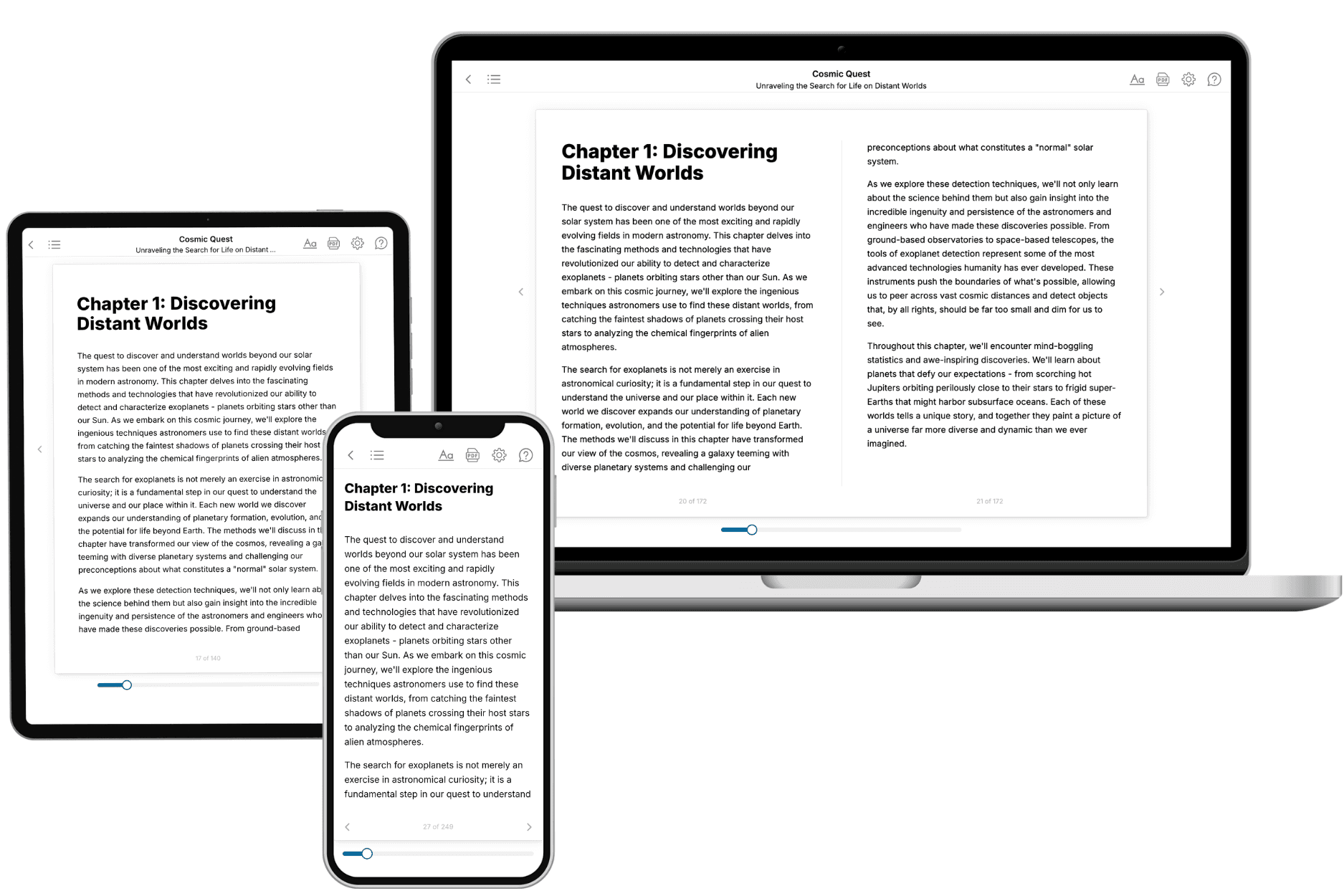
Yes. Every book can be read in our online reader or downloaded as a PDF or EPUB. The EPUB can be opened with Kindle, Apple Books, Kobo, and any e-reader. The Commercial and Author licenses also include an editable Word (DOCX) and Markdown download.
- How much does it cost?
About the price of a regular ebook. The exact price depends on your book's length and complexity, from $2 for the shortest books to $35 for the most comprehensive, and it's shown when you review your book, before you commit to anything. Each book is a one-time purchase, yours to keep, no subscription. Licenses that let you share, teach, or publish your book range from $35.99 to $49.99.
- Can I preview the book before purchasing?
Before you pay, you'll see what your book will cover: the title, a detailed description, the estimated length, and the complete chapter-by-chapter table of contents, so you know what you're getting before you decide. The full text itself is written after you purchase.
- How long does it take to create a book?
About 10 minutes. You can start reading the opening chapters while the rest is still being written.