The Geography of Crisis
How Climate Change Reshapes Communities, Economies, and Human Societies
Climate change isn't just melting ice caps and rising temperatures—it's fundamentally reshaping where people live, how they work, and whether their communities can survive.
191 pages8 chaptersMar 9, 2026Climate Change
About this book
The challenge is that most discussions treat climate change as a purely environmental problem, missing the human dimension entirely. This book bridges that gap by exploring climate change through the lens of human geography and social sciences, revealing how shifting climate patterns disrupt migration, destabilize economies, deepen inequality, and reshape societies. You'll discover why some communities are far more vulnerable than others, how climate impacts ripple through global supply chains, and why traditional adaptation strategies often fail. More importantly, you'll learn how understanding these geographic and social dimensions opens pathways to meaningful resilience and action. Whether you're concerned about your own community's future or seeking to understand global climate justice, this book provides the frameworks and evidence you need to grasp climate change as the human crisis it truly is.
Table of contents
- IntroductionWhy Geography Matters in Climate Conversations, The Human Dimension of Climate Change, How to Use This BookRead below
- Chapter 1: Climate Change as a Geographic PhenomenonUnderstanding Spatial Patterns of Climate Impacts, Regional Variations and Local Manifestations, How Global Processes Create Local Consequences
- Chapter 2: Vulnerability and InequalityWhat Makes Communities Vulnerable?, How Inequality Amplifies Climate Risk, Global Disparities in Climate Exposure and Capacity
- Chapter 3: Migration, Displacement, and Demographic ChangeClimate-Driven Migration Patterns, Forced Displacement and Climate Refugees, Long-Term Demographic Reshaping
- Chapter 4: Economic Disruption and LivelihoodsAgriculture, Food Systems, and Rural Livelihoods, Global Supply Chains and Economic Cascades, Labor Markets and Employment Transformation
- Chapter 5: Urban Climate ChallengesUrban Heat Islands and Extreme Weather, Infrastructure Vulnerability in Cities, Inequality Within Urban Spaces
- Chapter 6: Social Systems Under StressPublic Health and Disease Patterns, Education and Social Cohesion, Conflict, Governance, and Social Stability
- Chapter 7: Adaptation and Resilience StrategiesTypes of Adaptation: Technical, Social, and Institutional, Building Community Resilience, Recognizing Adaptation Limits and Loss
- Chapter 8: Pathways to ActionIndividual and Household Responses, Community-Level Initiatives, Systemic Change and Policy Solutions
- ConclusionAn Interconnected Future, Your Role in the Response
- Glossary of Key Terms
- Further Reading and Resources
Introduction
Picture a farmer in Bangladesh watching the river that borders her fields creep closer every monsoon season. Picture a family in Phoenix, Arizona, deciding whether to run the air conditioning they can barely afford during a summer that now stretches well into October. Picture a fishing village in Kiribati holding community meetings about whether to relocate their entire population to another country before the ocean swallows their island entirely. These are not hypothetical scenarios pulled from a distant future. They are happening right now, and they share a common thread: climate change is not an abstract environmental problem. It is a deeply human one, playing out across specific places, specific communities, and specific lives.
Most conversations about climate change focus on the physical science, and for good reason. Understanding rising temperatures, shifting precipitation patterns, and sea level rise is essential. But that framing leaves out something critical: the geography of who gets hurt, how badly, and why. The same degree of warming does not land equally on every community. A coastal city with strong infrastructure and wealthy residents can absorb a storm surge that would devastate a low-lying rural community with no flood barriers and no savings. The physical event may be identical, but the human outcome is completely different. Geography, inequality, and social structure determine the real-world consequences of climate change just as much as the climate science itself.
This book was written to fill that gap. It approaches climate change through the lens of human geography and social science, asking not just what is happening to the planet, but what is happening to the people on it. You will find here a structured exploration of how climate change reshapes migration patterns, disrupts economies, deepens existing inequalities, strains social systems, and forces communities to make impossible choices. You will also find frameworks for understanding resilience and action, because understanding the problem clearly is the first step toward responding to it meaningfully. The goal is not to overwhelm you with the scale of the crisis, but to give you the analytical tools to see it clearly and to recognize where real change is possible.
The chapters ahead move from the broad to the specific and back again. They draw on research from geography, economics, sociology, public health, and political science to build a picture of climate change as a social phenomenon with geographic roots. Each chapter is designed to stand on its own as a focused exploration of one dimension of the crisis, while also connecting to the larger argument running through the book: that climate change is fundamentally a human geography issue, and that understanding it that way changes both how we see the problem and how we respond to it.
Why Geography Matters in Climate Conversations
Geography is often misunderstood as simply the study of maps and physical landscapes. In reality, it is the study of relationships between people and places, including how physical environments shape human life and how human activity transforms physical environments. When applied to climate change, this perspective reveals something that purely scientific accounts often miss: the consequences of a warming planet are not distributed randomly. They follow patterns shaped by location, history, politics, and power.
Consider the difference between two countries facing rising sea levels. The Netherlands has spent centuries engineering its relationship with water, building an elaborate system of dikes, pumps, and flood barriers that protect a country where roughly a third of the land sits below sea level.[1] The Marshall Islands, by contrast, is a low-lying Pacific nation with limited financial resources and no comparable infrastructure. Both face the same physical threat from rising oceans. But their geographic, economic, and political circumstances produce radically different levels of vulnerability. Geography, in this sense, is not just about where you are on a map. It is about what resources, institutions, and histories come with that location.
This geographic lens also helps explain why climate change so often intersects with existing injustices. Communities that were historically marginalized, whether through colonialism, racial discrimination, or economic exclusion, tend to occupy more vulnerable physical spaces. In the United States, for example, research has consistently shown that low-income communities and communities of color are more likely to live near industrial pollution sources, in flood-prone areas, and in neighborhoods with less green space to buffer extreme heat.[2] These patterns did not emerge by accident. They reflect decades of discriminatory housing policy, zoning decisions, and disinvestment. Climate change does not create these vulnerabilities from scratch. It amplifies them.
Geography also matters because effective responses to climate change must be place-specific. A flood management strategy that works in a dense urban delta will not translate directly to a semi-arid rural region facing drought. A community relocation program that makes sense for a small island nation raises entirely different ethical and logistical questions when applied to a city of millions. Understanding the geographic dimensions of climate change is not just an academic exercise. It is a practical requirement for designing interventions that actually work in the real world.
There is also a temporal dimension to geographic thinking that is worth naming early. Climate change does not just affect places as they are today. It reshapes them over time, sometimes gradually and sometimes with sudden, catastrophic force. Coastlines that were stable for generations are now eroding. Agricultural zones that supported specific crops for centuries are shifting northward or becoming too hot and dry for traditional farming. Rivers fed by glaciers are changing their seasonal flow patterns as those glaciers shrink. Understanding these changes requires thinking about geography not as a static backdrop but as a dynamic system that is actively being rewritten by a warming climate.
Finally, geography matters because it connects the local to the global in ways that are easy to overlook. A drought in one region can drive up food prices worldwide. A flood that disrupts a major port can ripple through global supply chains for months. A wave of climate-driven migration from one country can reshape the politics of receiving nations thousands of miles away. These connections are geographic in nature, running along trade routes, migration corridors, and ecological systems that link distant places in ways that are not always visible until something goes wrong. Seeing those connections clearly is one of the most valuable things a geographic perspective offers.
Key insight: Geography is not just the backdrop to climate change. It is one of the primary mechanisms through which climate change produces human consequences. Where you live, what resources surround you, and what history shaped your community all determine how climate change affects your life.
Throughout this book, geographic thinking will serve as a consistent analytical tool. It will help explain why some communities are far more exposed to climate hazards than others, why some have far greater capacity to adapt, and why solutions that ignore geographic context so often fall short. Learning to think geographically about climate change is not just intellectually useful. It is essential for anyone who wants to understand the crisis as it actually unfolds in the real world.
The Human Dimension of Climate Change
When climate change makes headlines, the images tend to be dramatic and physical: melting glaciers, flooded streets, wildfire smoke turning skies orange. These images are real and important, but they can inadvertently frame climate change as something that happens to landscapes rather than to people. The human dimension of climate change is just as real, just as dramatic, and in many ways far more complex. It involves decisions people make under pressure, systems that fail at the worst possible moments, and communities that must somehow hold together while the ground beneath them shifts.
The human dimension begins with the body. Extreme heat is now the deadliest weather-related hazard in many parts of the world, killing more people annually than hurricanes, floods, and tornadoes combined in the United States.[3] But heat does not kill randomly. It kills the elderly, the very young, outdoor workers, and people without access to air conditioning at dramatically higher rates than the general population. A heat wave is a physical event, but who survives it is a social question. It depends on income, housing quality, neighborhood design, access to cooling centers, and whether anyone checks on you when temperatures spike.
The human dimension extends to livelihoods and economic security. Consider what happens to a smallholder farmer in sub-Saharan Africa when rainfall patterns shift and the rains that once arrived reliably in April now come weeks late, or not at all. That farmer does not just lose a harvest. She may lose the ability to repay a loan, feed her children, or keep her children in school. The economic shock ripples outward through her household, her community, and eventually the regional economy. Climate change, in this sense, is not just an environmental stressor. It is an economic one, with consequences that compound over time and interact with every other form of vulnerability a household or community faces.
The human dimension also includes the psychological and cultural costs of climate change, which are often the least visible but among the most profound. Researchers have documented a phenomenon sometimes called solastalgia, a form of distress caused by environmental change in one's home environment.[4] For Indigenous communities whose cultural identity, spiritual practices, and traditional knowledge are tied to specific landscapes, the transformation of those landscapes by climate change represents a loss that goes far beyond the economic. When a glacier that has been part of a community's identity for generations disappears, or when a coastline that anchored a culture's stories and ceremonies is swallowed by the sea, the damage is real even if it does not show up in GDP statistics.
Migration is one of the most visible human responses to climate change, and it illustrates the complexity of the human dimension well. People do not move simply because conditions become difficult. They move when conditions become intolerable and when they have the resources to move. This means that the most vulnerable people, those with the fewest resources, are often the least able to migrate even when staying becomes dangerous. They become trapped in place, facing escalating risks without the option of leaving. Meanwhile, those who do migrate face their own challenges: discrimination in receiving communities, loss of social networks, and the psychological burden of displacement. Migration is not a clean solution to climate vulnerability. It is a human response full of trade-offs, costs, and unintended consequences.
Social cohesion, the bonds of trust and mutual support that hold communities together, is another dimension of climate change that deserves more attention than it typically receives. Research on disaster recovery consistently shows that communities with strong social networks recover faster and more completely than those where social ties are weak.[5] But climate change can erode those networks over time. When people are forced to migrate, when economic stress increases competition for resources, or when repeated disasters exhaust community goodwill and capacity, the social fabric frays. This makes communities less resilient to the next shock, creating a downward spiral that is difficult to reverse.
Understanding the human dimension of climate change also means grappling with questions of justice and responsibility. The countries and communities that have contributed least to greenhouse gas emissions are, in many cases, the ones facing the most severe consequences. Bangladesh contributes less than 0.5% of global carbon emissions but ranks among the most climate-vulnerable nations on earth, facing rising seas, intensifying cyclones, and increasing salinity in its agricultural land.[6] This disparity is not just a moral problem, though it is certainly that. It is also a practical one, because it shapes the politics of international climate negotiations, the willingness of nations to cooperate, and the likelihood that effective global action will actually happen.
The human dimension, in short, is where climate change becomes real. It is where the physics of a warming atmosphere translates into a child missing school because the classroom is too hot, a fisherman unable to find the fish that used to be abundant in his waters, or a city planner trying to figure out how to protect aging infrastructure from storms that are stronger than anything the engineers who built it ever anticipated. This book keeps that human dimension at the center of every chapter, because that is where the most important questions about climate change actually live.
A note on scale: The human dimension of climate change operates simultaneously at multiple scales, from the individual body to the global economy. One of the analytical challenges this book addresses is how to think across those scales without losing sight of either the big picture or the lived experience of specific people in specific places.
How to Use This Book
This book is designed for readers who already have some foundational knowledge of climate science and want to go deeper into the human and geographic dimensions of the crisis. You do not need to be an expert in geography, economics, or social science to follow the arguments here. The writing aims to be clear and accessible throughout, with technical terms explained when they appear. What you do need is a willingness to think across disciplines and to sit with complexity, because climate change does not respect the boundaries between academic fields, and neither does this book.
The chapters are organized to build on each other, but they are also designed to be read independently if you have a specific area of interest. Here is a brief map of what each chapter covers:
- Chapter 1 establishes the geographic framework, explaining how climate impacts vary across space and why location shapes vulnerability in fundamental ways.
- Chapter 2 examines vulnerability and inequality, exploring why some communities face far greater risks than others and how social structures amplify climate exposure.
- Chapter 3 focuses on migration and displacement, tracing how climate change is already reshaping where people live and what happens when communities are forced to move.
- Chapter 4 explores economic disruption, from the impacts on agriculture and rural livelihoods to the cascading effects on global supply chains and labor markets.
- Chapter 5 turns to cities, examining the specific challenges urban environments face and the deep inequalities within urban spaces that determine who bears the greatest burden.
- Chapter 6 looks at social systems under stress, including public health, education, governance, and the links between climate change and conflict.
- Chapter 7 shifts toward solutions, examining different types of adaptation strategies and the limits of what adaptation can achieve.
- Chapter 8 closes with pathways to action at the individual, community, and systemic levels, offering concrete frameworks for meaningful engagement.
Each chapter follows a similar structure. It opens with a concrete example or scenario that grounds the discussion in a specific place and situation. It then builds out the analytical framework, drawing on research and evidence from multiple disciplines. It closes with practical implications, connecting the analysis to real-world decisions and actions. This structure is intentional. The goal is always to move between the abstract and the concrete, between the global pattern and the local experience, because that movement is where genuine understanding develops.
Throughout the book, you will encounter case studies drawn from a wide range of geographic contexts, including South Asia, sub-Saharan Africa, the Pacific Islands, Latin America, North America, and Europe. This geographic breadth is deliberate. Climate change is a global phenomenon, and understanding it requires looking beyond the contexts most familiar to readers in wealthy, English-speaking countries. At the same time, the book does not treat all places as equivalent. It pays close attention to the specific histories, power dynamics, and social structures that make each context distinct.
You will also notice that this book does not shy away from difficult questions. It engages honestly with the limits of adaptation, the failures of international climate governance, and the ways in which well-intentioned interventions can sometimes make things worse. This honesty is not meant to be discouraging. It is meant to be useful. Understanding where approaches have failed is essential for designing better ones, and pretending that the path forward is straightforward would be a disservice to the complexity of the challenge.
A few practical suggestions for getting the most out of this book:
- Read actively. When a case study describes a community facing a specific climate challenge, pause and think about whether similar dynamics exist in places you know. The analytical frameworks here are most useful when applied to real situations.
- Follow the footnotes. The citations throughout the book point to primary research, reports, and deeper explorations of specific topics. If a particular issue resonates with you, the footnotes are a roadmap for going further.
- Use the glossary. Key terms are defined in the glossary at the back of the book. When a technical term appears in the text, it is worth checking the glossary if the meaning is not immediately clear from context.
- Engage with the Further Reading section. The resources listed there are curated for readers who want to explore specific topics in greater depth, including academic research, policy reports, and accessible books for general audiences.
- Connect the chapters. The issues covered in each chapter do not exist in isolation. Migration connects to economic disruption. Urban inequality connects to public health. Governance failures connect to vulnerability. Keeping those connections in mind as you read will help you build a more integrated understanding of the crisis.
One more thing worth saying at the outset: this book takes seriously both the severity of the climate crisis and the reality of human agency. The evidence for significant, ongoing harm is overwhelming and is presented honestly here. But the evidence for human capacity to adapt, innovate, organize, and respond is equally real. Communities around the world are already developing creative, effective responses to climate challenges, often with limited resources and against significant odds. Those stories are part of this book too, not as feel-good counterweights to the bad news, but as genuine evidence of what is possible when people understand the problem clearly and act with purpose.
Climate change is the defining challenge of this era. Understanding it as a human geography issue, rather than purely an environmental one, is not just an intellectual exercise. It is a prerequisite for responding to it effectively. That is what this book is for, and that is the journey the chapters ahead invite you to take.
A word on terminology: This book uses the terms climate change and climate crisis interchangeably, reflecting both the scientific consensus on ongoing change and the urgency of its human consequences. Where specific scientific terms are used, they are defined in context and in the glossary. The goal throughout is clarity, not jargon.
Notes
Introduction
- 1. Delta Programme Commissioner, Delta Programme 2021: Keeping the Netherlands Safe, Liveable and Competitive, Ministry of Infrastructure and Water Management, Netherlands, 2020
- 2. R. D. Bullard, Dumping in Dixie, Westview Press, 2000
- 3. Centers for Disease Control and Prevention, Heat-Related Illness, CDC, Atlanta, GA, 2023
- 4. G. Albrecht and others, Solastalgia: The Distress Caused by Environmental Change, Australasian Psychiatry, 15(S1), S95-S98, 2007
- 5. D. P. Aldrich, Building Resilience, University of Chicago Press, 2012
- 6. D. Eckstein and others, Global Climate Risk Index 2021, Germanwatch, 2021
This is the end of the free sample. The full book has 8 chapters.
Want this book written for you?
Tell us your goals and background, and get your own version of this book, tailored by AI to you.


Benefits of AI-tailored books
- Read one book, not ten:
- all the Climate Change knowledge you need, gathered into a single book.
- Save days of learning:
- tell us your goals, choose your topics, and the whole book is built around them.
- Learn effortlessly:
- Climate Change book written for your specific background and expertise.
- Understand at a glance:
- includes charts, tables, timelines, checklists, decision trees, and more.
- Stay current:
- written the day you order it, not years ago.
- Trust what you read:
- every book is checked for accuracy, with real research when your subject needs it.
Create your unique book in 3 steps
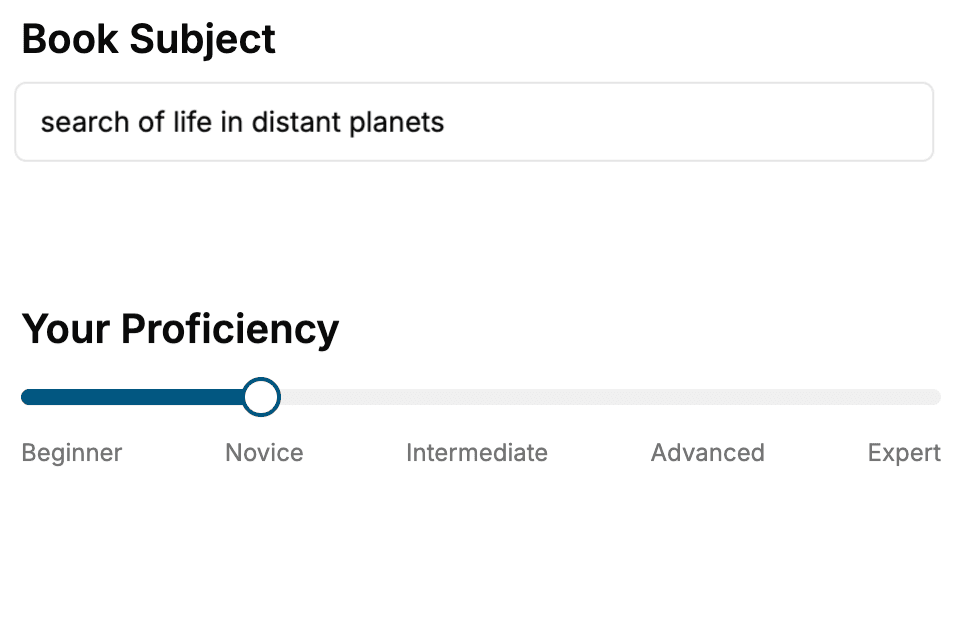
- 1. Select your focus
Select the focus of your Climate Change book and share your background
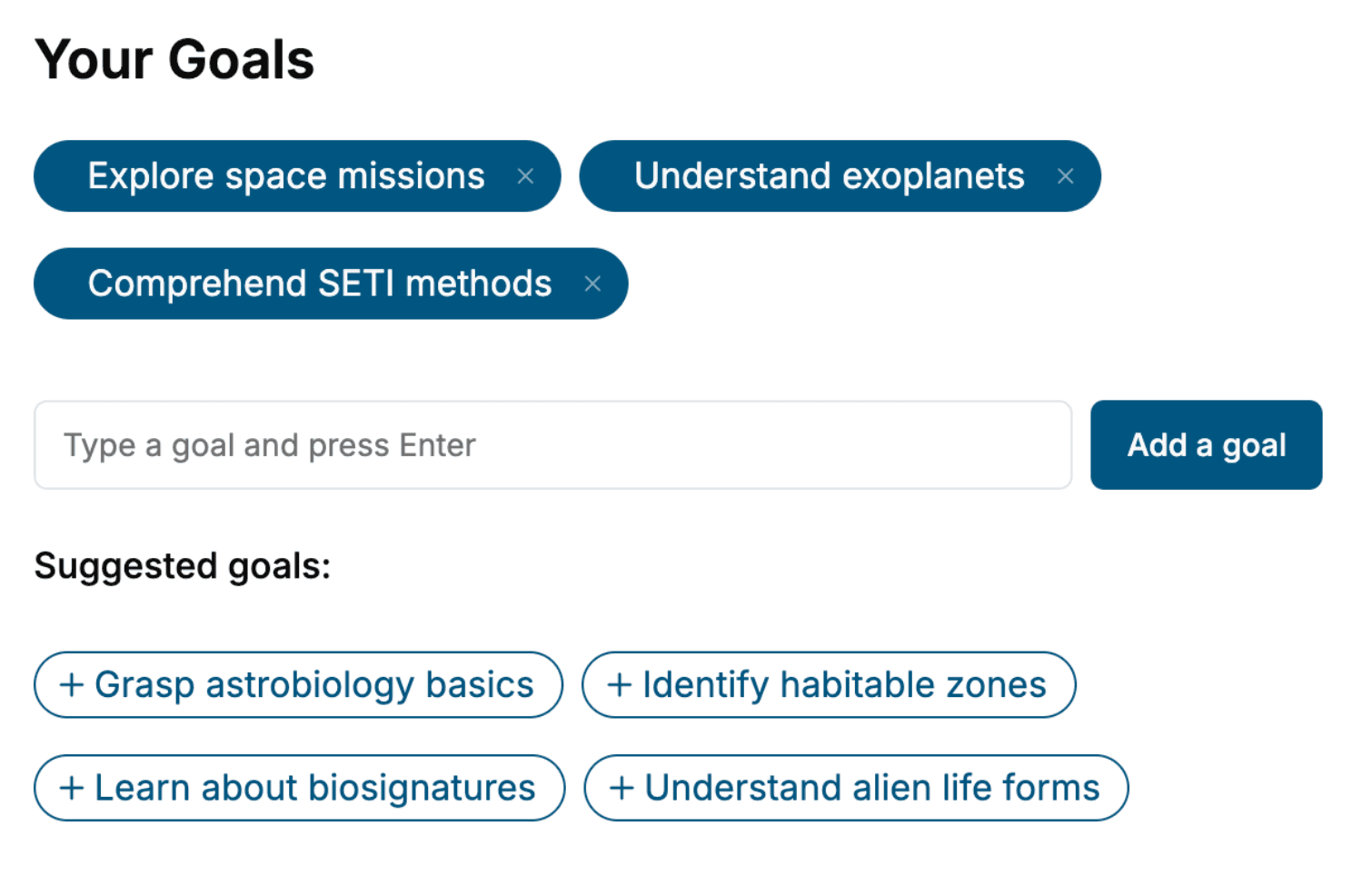
- 2. Personalize your book
Specify your goals and choose sub-topics to include
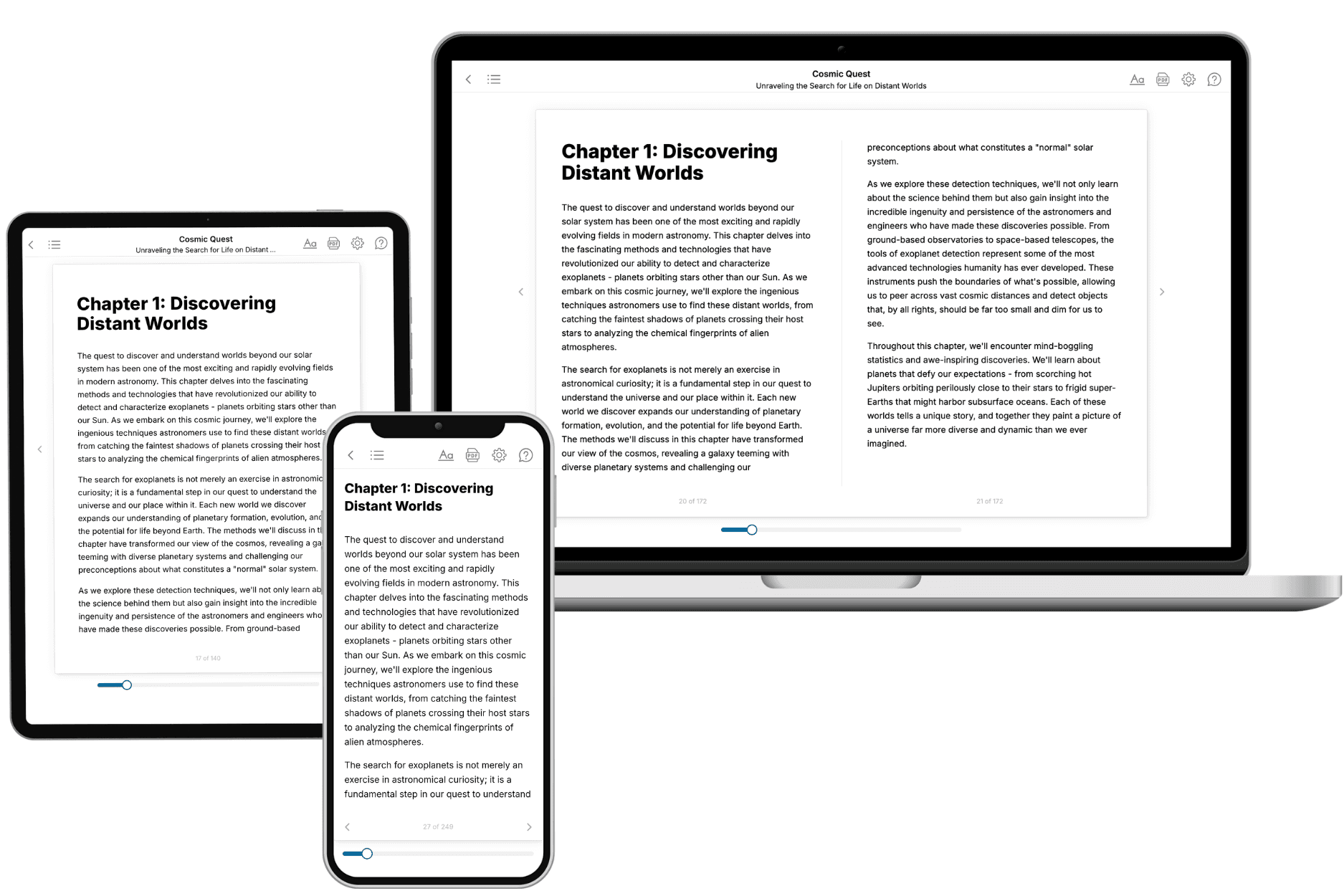
- 3. Get your tailored book
Your book is ready in 10 minutes. Read it online, download as EPUB or PDF, or send to Kindle.
Frequently asked questions
- What is TailoredRead?
TailoredRead creates complete, full-length nonfiction ebooks, written specifically for you. Tell us what you want to learn and why, and TailoredRead writes you a complete ebook on it, with charts, tables, and diagrams throughout. Read it online, on Kindle, or on any e-reader, or download it as a PDF or EPUB. Every book is written fresh the day you order it.
- How is the book tailored to me?
Before anything is written, you answer a few short questions about your goals, your background, and the topics you care about. Your book is then planned around your answers: written at your level, focused on your goals, and covering the topics you chose, instead of the one-size-fits-all book a store sells everyone.
- Will it read like generic AI content?
No. Your book isn't a chat transcript: it's planned chapter by chapter before a single word is written, told in a clear book voice, and explains ideas visually with charts, tables, and diagrams. After writing, every book goes through an editorial pass that polishes chapters so the book reads consistent from start to finish. Judge for yourself: browse thousands of sample books on our Explore Books page.
- How accurate is the content?
Our AI first checks whether your subject needs live research. Niche and fast-moving subjects are researched before writing, and the book plan and chapters are grounded in what it finds. After writing, every book goes through a quality pass that checks its facts and consistency, and researched books list their sources in a Notes section at the back.
- How long is the book?
You choose the length: Comprehensive (250-300 pages), Detailed (150-200 pages), Essential (70-100 pages), or Short (30-50 pages).
- Does the book include visuals?
Yes. Every book includes charts, tables, and diagrams: timelines, checklists, step-by-step guides, decision trees, comparison tables, matrices, and bar charts. A typical book includes dozens of these visual elements.
- Can I read it on Kindle? What formats can I download?
Yes. Every book can be read in our online reader or downloaded as a PDF or EPUB. The EPUB can be opened with Kindle, Apple Books, Kobo, and any e-reader. The Commercial and Author licenses also include an editable Word (DOCX) and Markdown download.
- How much does it cost?
About the price of a regular ebook. The exact price depends on your book's length and complexity, from $2 for the shortest books to $35 for the most comprehensive, and it's shown when you review your book, before you commit to anything. Each book is a one-time purchase, yours to keep, no subscription. Licenses that let you share, teach, or publish your book range from $35.99 to $49.99.
- Can I preview the book before purchasing?
Before you pay, you'll see what your book will cover: the title, a detailed description, the estimated length, and the complete chapter-by-chapter table of contents, so you know what you're getting before you decide. The full text itself is written after you purchase.
- How long does it take to create a book?
About 10 minutes. You can start reading the opening chapters while the rest is still being written.