The Gesture Revolution
How Touchless Technology Is Reshaping Human-Machine Interaction
You're watching technology evolve faster than ever, but gesture control remains a mystery—is it hype or the future?
207 pages9 chaptersAug 17, 2026Human-Computer Interaction
About this book
The challenge is separating real innovation from marketing noise while understanding how this technology will reshape the products you use, the businesses you work in, and the decisions you need to make today. This book cuts through the complexity to reveal what gesture control actually is, how it works, and why it matters. You'll discover the science behind touchless sensing, explore real-world applications transforming industries from automotive to healthcare, and understand the genuine opportunities and limitations that define this technology. Whether you're evaluating gesture control for your organization, curious about emerging tech trends, or simply want to understand the forces reshaping human-machine interaction, this guide provides the clarity and insight you need to navigate the gesture revolution with confidence.
Table of contents
- IntroductionWhy Gesture Control Matters Now, What You'll Learn in This Book, How to Use This GuideRead below
- Chapter 1: Understanding Gesture Control FundamentalsDefining Gesture Control and Touchless Interaction, The Evolution from Touch-Based to Touchless Interfaces, Why Gesture Control Is Emerging Now
- Chapter 2: The Technology Behind Gesture RecognitionComputer Vision: Seeing and Interpreting Movement, Depth Sensing and 3D Spatial Recognition, AI and Machine Learning: Making Sense of Gestures, Sensor Technologies: ToF Cameras and Infrared Systems
- Chapter 3: The Current Market and Key PlayersMarket Growth and Adoption Trends, Major Technology Companies and Innovators, Competitive Dynamics and Market Positioning
- Chapter 4: Gesture Control in Automotive and TransportationFrom Luxury Features to Mainstream Adoption, In-Cabin Control and Driver Interaction, Safety Implications and Regulatory Considerations
- Chapter 5: Healthcare, Enterprise, and Industrial ApplicationsHealthcare: Hygiene, Precision, and Patient Care, Enterprise and Workplace Automation, Industrial Robotics and Manufacturing Control
- Chapter 6: Consumer Electronics and Smart Home IntegrationGaming and Entertainment Experiences, Smart Home and IoT Device Control, Wearable Gesture Control Devices
- Chapter 7: Challenges, Limitations, and Realistic ExpectationsAccuracy Challenges Across Users and Environments, Gesture Ambiguity and Cultural Interpretation, Privacy and Surveillance Concerns, Environmental Sensitivity and Operational Constraints
- Chapter 8: Multimodal Interfaces and the Future of InteractionCombining Gestures with Voice and Touch, Designing Intuitive Multimodal Experiences, Practical Implementation Strategies
- Chapter 9: Strategic Implications for Business and InnovationBuilding Your Gesture Control Adoption Roadmap, Making Smart Investment and Technology Decisions, Gaining Competitive Advantage Through Gesture Innovation
- ConclusionKey Takeaways and Moving Forward, Staying Informed in a Rapidly Evolving Landscape
- Glossary of Key Terms
- Further Reading and Resources
Introduction
A shopper waves a hand near a store display and a screen changes without anyone touching a button. A surgeon flicks a finger in the air to scroll through a scan while their hands stay sterile. A driver rotates a finger near the dashboard to turn up the volume without glancing away from the road. None of these moments look like science fiction anymore. They are quiet, ordinary interactions happening right now, built on cameras, sensors, and software that can watch a hand move and translate that movement into a command. That shift, from pressing something to simply moving, is the subject of this book.
What makes this moment different from earlier waves of touchless gimmickry is that the underlying technology has finally caught up to the idea. Cameras got smaller and cheaper. Chips got fast enough to process video in real time. Machine learning models got good enough to tell the difference between a wave and a stretch. The result is a technology stack that no longer needs a research lab budget to deploy, which is why it is showing up in cars, hospitals, factories, living rooms, and phones at the same time. This introduction sets up why that spread matters, what the rest of the book will walk through, and how to get the most out of reading it.
The purpose here is not to hype gesture control as a miracle interface that replaces everything else. It is to give a clear, grounded picture of what the technology can actually do today, where it still struggles, and how organizations and individuals can think about adopting it wisely. Readers of this book tend to be professionals and decision-makers who need to separate genuine capability from marketing claims, whether they are choosing a vendor, designing a product, or simply trying to understand a trend reshaping the devices around them.
Three short subchapters follow this one. The first explains why gesture control deserves attention right now rather than five years ago or five years from now. The second maps out the full arc of the book so you know what is coming and can skip ahead if a particular application area is more relevant to your work. The third offers practical guidance on how to read the book depending on your goals, whether that means reading cover to cover or treating it as a reference to dip into.
Why Gesture Control Matters Now
Technologies often sit in labs for decades before they become usable products, and gesture control is a good example of that pattern. Early motion-sensing systems existed long before most people ever tried one, but they were clumsy, expensive, or limited to narrow use cases like industrial control rooms. What has changed is not the basic idea of tracking a hand in space. What has changed is the combination of cheaper sensors, more powerful processors, and smarter software that finally makes the idea work reliably enough for everyday use. That combination is why gesture control has moved from a novelty demo to a feature people expect in cars, phones, and appliances.
A second reason this matters now is timing tied to broader shifts in how people think about touching shared surfaces. The years following the global health crisis pushed businesses and consumers to reconsider elevators, kiosks, checkout counters, and medical equipment as places where touch carries hidden risk. That period accelerated interest in touchless alternatives across many industries, from retail to healthcare to public transit. Gesture control was one of the clearest answers available, since it lets someone control a screen or a device without making contact at all. That hygiene-driven push gave the technology a real-world proving ground it might not have gotten otherwise.
But hygiene alone does not explain why gesture control is sticking around rather than fading once health concerns eased. The deeper driver is that gestures are how humans already communicate, long before they ever learned to tap a screen or click a mouse. Pointing, waving, pinching, and swiping are movements people use instinctively, which means a well-designed gesture interface can feel more natural than a menu of buttons ever could. This is the same reason touchscreens felt revolutionary compared to physical keypads: they removed a layer of translation between intention and action. Gesture control promises to remove another layer, letting the body itself become the interface.
Consider a practical example from the automotive world, covered in depth later in this book. A driver adjusting a stereo used to glance down at a dial or a touchscreen, taking their eyes off the road for a second or two. A gesture-based system lets that same driver rotate a hand in the air near the dashboard, without ever looking away from traffic. That single design change speaks to a much larger point: gesture control is not just about convenience or novelty, it is increasingly framed as a safety feature. The chapter on in-cabin control explores how automakers are using this exact logic to justify moving gesture systems from luxury trims into everyday vehicles.
The market data backs up the sense that this is a moment of acceleration rather than steady, incremental growth. The touchless segment of the broader interaction technology market is expanding at a notably fast pace, a trend explored in detail in the chapter on market growth and adoption trends. Investment from major technology companies, chip makers, and specialized startups signals that this is not a fringe bet but a mainstream one. Companies that once treated gesture control as an experimental add-on are now building it into core product roadmaps, which changes the competitive calculus for everyone else in adjacent industries.
It also matters that gesture control is spreading horizontally across very different sectors at the same time, rather than maturing in one industry before moving to the next. Gaming and entertainment popularized the idea that a camera could track a full body in a living room. Automotive companies proved gestures could work reliably inside a moving vehicle. Healthcare settings demonstrated that gesture control could solve a genuine sterility problem in operating rooms. Each of these sectors validated the technology in its own way, and each success made it easier for the next industry to justify trying it. That cross-pollination is part of why the pace of adoption feels different this time.
None of this means gesture control is a guaranteed fit for every product or every context, and later chapters spend real time on the friction points that temper the enthusiasm. Cameras struggle in poor lighting. Systems can misread gestures that mean different things in different cultures. Privacy concerns arise whenever a camera is always watching a room, even if it is only looking for hand movements. Taking these limitations seriously from the start is part of what separates a useful understanding of this technology from a hype-driven one, and this book treats both the promise and the limits with equal weight.
Understanding why gesture control matters now also means understanding who is driving it forward and why they are willing to spend heavily on it. Large technology companies see gesture control as a way to differentiate hardware in a market where screens and processors have become commoditized. Component makers see it as a growth category for specialized chips and sensors. Automakers see it as both a safety story and a premium-feel story that can be marketed to buyers. Each of these motivations reinforces the others, creating a feedback loop where more investment leads to better technology, which leads to more adoption, which justifies more investment. That loop is the real engine behind the current moment, more than any single breakthrough.
What You'll Learn in This Book
This book is organized to move from foundational understanding toward practical application, so each section builds on the one before it. The early chapters establish what gesture control actually is, how it differs from touch-based interaction, and what technical components make it possible. Readers who already understand the basics of computer vision or sensor hardware may find some of this familiar, but the goal is to make sure everyone starts from the same shared vocabulary before moving into applications and strategy.
The chapter on fundamentals draws a clear line between gesture control and other forms of touchless interaction, since these terms are often used loosely in marketing materials. It also traces how interfaces evolved from physical buttons to touchscreens to gesture-based systems, showing that this is a continuous story of removing friction between intention and action rather than a sudden leap. That historical framing helps explain why gesture control feels like a natural next step rather than an isolated invention.
From there, the book moves into the technology stack itself: how computer vision systems interpret movement, how depth sensing and three-dimensional spatial recognition work, how artificial intelligence and machine learning models make sense of raw sensor data, and how specific hardware like time-of-flight cameras and infrared sensors capture the information in the first place. This section is written for readers who want to understand the mechanics without needing an engineering degree, using plain explanations rather than deep technical jargon wherever possible.
A dedicated chapter surveys the market landscape, covering growth trends, the major companies shaping the space, and the competitive dynamics between established giants and specialized challengers. This section matters most for readers evaluating vendors or trying to understand where the industry is headed, since it maps out who is winning, why, and what that means for anyone trying to enter or partner within this space.
Several chapters then dig into specific application domains in detail. The automotive chapter explores how gesture control moved from a luxury differentiator into a mainstream safety feature, with attention to in-cabin control design and regulatory considerations. The healthcare and enterprise chapter looks at high-stakes settings where hygiene and precision are non-negotiable, including sterile-field interaction in operating rooms and gesture-controlled industrial robotics on factory floors. The consumer electronics chapter covers gaming, entertainment, smart home devices, and wearables, the settings where most people first encounter gesture control in their daily lives.
A full chapter is dedicated to the challenges and limitations that any honest treatment of this technology has to confront. This includes accuracy gaps across different users and environments, the problem of gesture ambiguity and cultural interpretation, privacy and surveillance risks tied to always-on cameras, and environmental sensitivity issues like poor lighting or cluttered backgrounds. These are not minor footnotes. They are central to making realistic decisions about where and how to deploy gesture control, and this book treats them as seriously as it treats the technology's strengths.
The later chapters shift toward synthesis and strategy. One chapter examines how gesture control fits into multimodal interfaces that combine gestures with voice and touch, since real-world products rarely rely on gesture alone. Another chapter is aimed squarely at business leaders, walking through how to build a gesture adoption roadmap, how to weigh build-versus-buy-versus-partner decisions, and how to identify genuine competitive advantage rather than chasing a trend for its own sake. This is where the book moves from explanation into actionable guidance.
By the end, the goal is for readers to be able to evaluate a gesture control claim, a product pitch, or a strategic proposal with a clear sense of what is technically realistic, what is genuinely new, and what questions to ask before committing resources. The book closes with a conclusion that pulls the key takeaways together, along with a glossary and further reading section for anyone who wants to go deeper into specific technical or industry topics covered along the way.
How to Use This Guide
This book is designed to work both as a linear read and as a reference you return to when a specific question comes up. If your goal is to build a broad, well-rounded understanding of gesture control, reading the chapters in order makes the most sense, since the technology chapters lay the groundwork that the application and strategy chapters build on. If instead you already have a working knowledge of the underlying technology and just want to know how gesture control applies to your industry, it is entirely reasonable to jump directly to the automotive, healthcare, or consumer electronics chapters and treat the earlier material as background you can revisit later.
For readers in product management or technology strategy roles, the most immediately useful sections are likely the market landscape chapter, the challenges and limitations chapter, and the strategic implications chapter near the end. Together these three sections give a realistic picture of who the competitors are, what can go wrong in a deployment, and how to structure decisions about investment and adoption. Reading those three chapters together, even before working through the earlier technical material in full, can give a fast, practical orientation for someone facing a near-term decision.
For readers who are more curious than they are under pressure to make a decision, a slower pace through the whole book will pay off. The technology chapter in particular rewards patience, since understanding how depth sensing and computer vision actually work makes the later application chapters much easier to evaluate critically. Once you understand, for example, why infrared sensing struggles in direct sunlight, you will immediately understand why outdoor gesture interfaces face different design challenges than indoor ones, a point that recurs across several later chapters.
Throughout the book, key terms are introduced and used consistently so that a phrase like Context-Aware Interaction or Gesture Ambiguity means the same thing wherever it appears. The glossary at the end of the book collects these terms in one place, which is useful if you skip around and encounter a term before its full explanation. Treat the glossary as a quick-reference tool rather than something to read cover to cover, and use it whenever a term feels unfamiliar or when you want a quick refresher before a meeting or a presentation.
Several chapters include specific examples drawn from real product categories and use cases, and these are worth paying close attention to rather than skimming past. A described scenario, such as a driver adjusting a dashboard control without looking away from the road, is meant to ground an abstract concept in something concrete and memorable. When evaluating a vendor pitch or a product proposal later, it can help to mentally compare the pitch against these grounded examples, asking whether the proposed system solves a real friction point in the same way or whether it is gesture control for its own sake.
If you are reading this book to prepare for an internal decision, such as whether to invest in gesture control for a product line or an operational process, consider keeping notes as you read through the challenges and limitations chapter in particular. That chapter is intentionally structured to raise the hard questions an organization should answer before committing budget: how accurate does the system need to be for your specific users, what privacy safeguards are required for your specific environment, and how sensitive is your intended use case to lighting or spatial constraints. Turning those questions into a working checklist as you read will make the later strategic implications chapter far more actionable when you reach it.
Finally, treat this as a living topic rather than a fixed one. Gesture control technology is improving quickly, and specific products, companies, and capabilities mentioned throughout the book will continue to evolve after publication. The final chapter includes guidance on staying informed as the landscape shifts, and the further reading section offers starting points for tracking new developments. The goal of this book is not to give you a snapshot that expires the moment the market moves, but to give you a durable framework for evaluating whatever comes next in touchless interaction.
This is the end of the free sample. The full book has 9 chapters.
Want this book written for you?
Tell us your goals and background, and get your own version of this book, tailored by AI to you.


Benefits of AI-tailored books
- Read one book, not ten:
- all the Human-Computer Interaction knowledge you need, gathered into a single book.
- Save days of learning:
- tell us your goals, choose your topics, and the whole book is built around them.
- Learn effortlessly:
- Human-Computer Interaction book written for your specific background and expertise.
- Understand at a glance:
- includes charts, tables, timelines, checklists, decision trees, and more.
- Stay current:
- written the day you order it, not years ago.
- Trust what you read:
- every book is checked for accuracy, with real research when your subject needs it.
Create your unique book in 3 steps
- 1. Select your focus
Select the focus of your Human-Computer Interaction book and share your background
- 2. Personalize your book
Specify your goals and choose sub-topics to include
- 3. Get your tailored book
Your book is ready in 10 minutes. Read it online, download as EPUB or PDF, or send to Kindle.


Frequently asked questions
- What is TailoredRead?
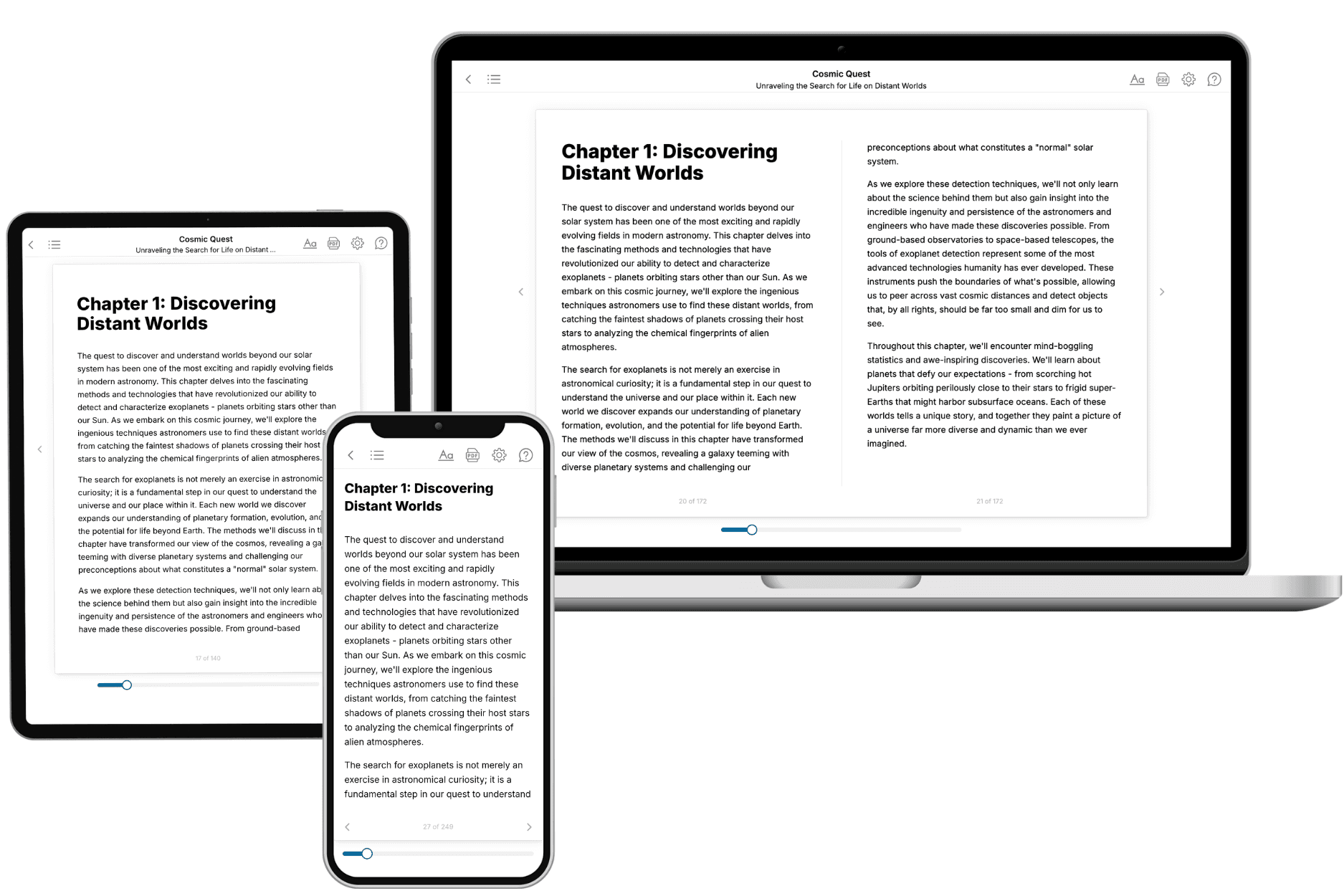
TailoredRead creates complete, full-length nonfiction ebooks, written specifically for you. Tell us what you want to learn and why, and TailoredRead writes you a complete ebook on it, with charts, tables, and diagrams throughout. Read it online, on Kindle, or on any e-reader, or download it as a PDF or EPUB. Every book is written fresh the day you order it.
- How is the book tailored to me?
Before anything is written, you answer a few short questions about your goals, your background, and the topics you care about. Your book is then planned around your answers: written at your level, focused on your goals, and covering the topics you chose, instead of the one-size-fits-all book a store sells everyone.
- Will it read like generic AI content?
No. Your book isn't a chat transcript: it's planned chapter by chapter before a single word is written, told in a clear book voice, and explains ideas visually with charts, tables, and diagrams. After writing, every book goes through an editorial pass that polishes chapters so the book reads consistent from start to finish. Judge for yourself: browse thousands of sample books on our Explore Books page.
- How accurate is the content?
Our AI first checks whether your subject needs live research. Niche and fast-moving subjects are researched before writing, and the book plan and chapters are grounded in what it finds. After writing, every book goes through a quality pass that checks its facts and consistency, and researched books list their sources in a Notes section at the back.
- How long is the book?
You choose the length: Comprehensive (250-300 pages), Detailed (150-200 pages), Essential (70-100 pages), or Short (30-50 pages).
- Does the book include visuals?
Yes. Every book includes charts, tables, and diagrams: timelines, checklists, step-by-step guides, decision trees, comparison tables, matrices, and bar charts. A typical book includes dozens of these visual elements.
- Can I read it on Kindle? What formats can I download?
Yes. Every book can be read in our online reader or downloaded as a PDF or EPUB. The EPUB can be opened with Kindle, Apple Books, Kobo, and any e-reader. The Commercial and Author licenses also include an editable Word (DOCX) and Markdown download.
- How much does it cost?
About the price of a regular ebook. The exact price depends on your book's length and complexity, from $2 for the shortest books to $35 for the most comprehensive, and it's shown when you review your book, before you commit to anything. Each book is a one-time purchase, yours to keep, no subscription. Licenses that let you share, teach, or publish your book range from $35.99 to $49.99.
- Can I preview the book before purchasing?
Before you pay, you'll see what your book will cover: the title, a detailed description, the estimated length, and the complete chapter-by-chapter table of contents, so you know what you're getting before you decide. The full text itself is written after you purchase.
- How long does it take to create a book?
About 10 minutes. You can start reading the opening chapters while the rest is still being written.