The Gnostic Gospels and Early Christianity
Understanding the Hidden Teachings That Shaped Religious History
This book takes you through the fascinating world of Gnosticism, a movement that challenged the foundations of early Christianity.
222 pages10 chaptersJul 24, 2026Religious History
About this book
You'll discover how Gnostic Christians understood Jesus, salvation, and the divine in radically different ways than the mainstream church that eventually dominated history. Starting with the historical context of the first centuries CE, you'll explore the core beliefs that made Gnosticism so controversial—including its vision of a flawed creator god and a hidden, transcendent divine reality. You'll examine the remarkable Nag Hammadi texts that were buried for 1,600 years, revealing sophisticated theological ideas that scholars had only glimpsed through the writings of their critics. Throughout, you'll understand why church authorities worked so hard to suppress these teachings and how Gnosticism's influence persisted in unexpected ways. Whether you're studying religious history, exploring alternative Christian perspectives, or simply curious about the diversity of early Christian thought, this book provides the context and clarity you need to grasp this complex and compelling movement.
Table of contents
- IntroductionWhat Is Gnosticism?, Why Study Gnosticism Today?, How to Use This BookRead below
- Chapter 1: The Historical Context of Early ChristianityThe First-Century Mediterranean World, Jewish Roots and Early Christian Communities, The Emergence of Gnostic Movements
- Chapter 2: Core Gnostic Beliefs and CosmologyDualism and the Two Divine Realms, The Demiurge: A Flawed Creator God, Gnosis: Divine Knowledge and Salvation, The Material World and the Problem of Evil
- Chapter 3: Gnostic Views of Jesus and RedemptionJesus in Gnostic Thought, Docetism and the Nature of Jesus's Body, Salvation Through Knowledge, Not Faith
- Chapter 4: The Nag Hammadi Discovery and Primary SourcesThe Discovery in 1945, Major Gnostic Texts and Their Contents, Interpreting Gnostic Literature and Symbolism, Challenges in Textual Analysis and Dating
- Chapter 5: Major Gnostic Schools and FiguresValentinianism: The Most Influential School, Other Gnostic Movements and Sects, Key Gnostic Teachers and Leaders
- Chapter 6: Gnosticism and Philosophical InfluencesPlatonism and Gnostic Thought, Jewish Mysticism and Kabbalah Connections, Zoroastrianism and Dualistic Influences
- Chapter 7: The Orthodox Response and SuppressionEarly Church Fathers and Their Critiques, The Establishment of Christian Orthodoxy, Persecution and the Elimination of Gnostic Texts, Why Gnosticism Was Rejected by Mainstream Christianity
- Chapter 8: Gnostic Ethics, Sexuality, and the BodyAsceticism and Rejection of the Material World, Attitudes Toward Sexuality and Reproduction, Ethical Implications of Gnostic Belief Systems
- Chapter 9: The Decline of Gnosticism and Its LegacyGnosticism in Late Antiquity and Beyond, Medieval Heresies and Gnostic Echoes, Modern Esoteric Movements and Gnostic Influence
- Chapter 10: Gnosticism and Modern Biblical ScholarshipScholarly Debates About Gnosticism's Origins, Gnosticism's Relationship to New Testament Texts, Contemporary Interpretations and Controversies
- ConclusionKey Takeaways, Gnosticism and Religious Diversity
- Glossary of Key Terms
- Further Reading and Resources
Introduction
Sometime around 367 CE, the bishop of Alexandria sent a letter to the churches under his authority. In it, Athanasius listed exactly which texts were acceptable for Christian use and instructed his congregations to set aside any others. That letter, known as his Festal Letter, is one of the earliest surviving attempts to draw a firm boundary around Christian scripture. What it was pushing out included a wide range of writings that presented Jesus, God, and salvation in ways that looked nothing like the emerging mainstream. Many of those texts belonged to the tradition now called Gnosticism.[1]
For more than a thousand years after that, most of those excluded writings were known only through the attacks of their opponents. Church fathers like Irenaeus of Lyon quoted Gnostic ideas at length, but only to refute them. Scholars trying to understand what Gnostic Christians actually believed were working almost entirely from hostile summaries. That situation changed dramatically in 1945, when a collection of ancient texts was unearthed near the Egyptian town of Nag Hammadi. The Nag Hammadi Library gave the world direct access to Gnostic voices for the first time in centuries, and the field of early Christian studies has never been the same.
What those texts revealed was not a fringe cult or a simple heresy. Gnosticism was a sophisticated, diverse, and intellectually serious movement that drew on Jewish scripture, Greek philosophy, and early Christian tradition to construct a radically different picture of the cosmos and humanity's place in it. Its followers asked hard questions: Why does a good God allow suffering? What is the self, really? Is the physical world something to be embraced or escaped? Their answers were unconventional, sometimes startling, and always worth understanding on their own terms. This book is an invitation to do exactly that.
What Is Gnosticism?
The word Gnosticism comes from the Greek word gnosis, which simply means "knowledge." But the knowledge at the center of Gnostic religion was not the kind you find in a textbook. It was direct, experiential, inner knowledge of the divine, the kind of knowing that transforms the person who receives it. A Gnostic was not someone who had learned the right doctrines or performed the right rituals. A Gnostic was someone who had awakened to the truth of their own divine origin and, through that awakening, found the path back to the true God.
That definition sounds simple, but Gnosticism itself was anything but. The term covers a wide range of movements, schools, and teachers active primarily between the first and fifth centuries CE. These groups shared certain broad tendencies, but they disagreed on specifics in ways that matter. Scholars today sometimes debate whether "Gnosticism" is even a useful category, since the people it describes never called themselves by that name and held quite different beliefs from one another.[2] For the purposes of this book, the term is used as a working label for a cluster of related religious movements that shared a recognizable set of concerns and ideas.
Several features appear consistently enough across Gnostic texts to count as defining characteristics. The most important is a sharp distinction between the true, transcendent God and the lesser being responsible for creating the physical world. That lesser creator, known as the Demiurge, is not evil in every Gnostic system, but is always inferior, ignorant, or flawed in some way. The material world he made reflects those flaws. Human beings, in this view, are divine sparks trapped in physical bodies, exiled from their true home in the spiritual realm called the Pleroma, which means "fullness" in Greek.
Salvation, in Gnostic thought, means escaping that exile. It is not achieved through faith in Christ's atoning death, as in mainstream Christianity, but through Gnosis: the awakening recognition of one's true divine nature. The Gnostic Redeemer, often identified with Jesus, comes not to die for human sin but to deliver this saving knowledge to those capable of receiving it. This is a fundamentally different soteriology, meaning a different theory of how humans are saved, and it put Gnostic Christians on a collision course with the proto-orthodox church from very early on.
The major Gnostic schools included Valentinianism, founded by the teacher Valentinus in the second century CE, and Sethianism, a distinct tradition that placed the biblical figure of Seth at the center of its mythology. Other important figures included Basilides, who taught in Alexandria, and Marcion, whose radical rejection of the Hebrew Bible pushed him toward the edges of even Gnostic thought. Each of these traditions produced its own texts, rituals, and communities, and each chapter of this book will help you navigate their differences.
Gnosticism is best understood not as a single religion but as a family of related religious experiments, all asking the same urgent question: how does a divine being find its way home through a world that was never meant to be its prison?
One more clarification is worth making at the start. Gnosticism is not the same as Docetism, though the two are often confused. Docetism is the specific belief that Jesus only appeared to have a physical body, that his humanity was an illusion. Many Gnostic texts do hold Docetic views, but Docetism is a single theological position, while Gnosticism is a much broader religious tradition. Similarly, Gnosticism is not identical to Gnostic Dualism, though dualism is one of its most consistent features. Keeping these distinctions clear will help you read the primary sources and the scholarship around them with much greater precision.
Understanding what Gnosticism is also means understanding what it is not. It was not simply a corruption of Christianity imported from outside. Many scholars now believe that Gnostic Christianity developed alongside proto-orthodox Christianity, drawing on the same Jewish and early Christian sources, rather than branching off from an already-established orthodoxy. The relationship between these movements was more like siblings arguing over an inheritance than a parent correcting a wayward child. That reframing changes everything about how you read the history of early Christianity.
Why Study Gnosticism Today?
The most immediate reason to study Gnosticism is that it opens a window onto a version of early Christianity that most people never knew existed. The Christianity that survived and became the dominant religion of the Western world was one option among many in the first three centuries CE. Gnostic Christians read some of the same texts, revered Jesus, gathered in communities, and developed sophisticated theologies. Understanding them means understanding that the history of Christianity involved real choices, real conflicts, and real losers, not just an inevitable march toward a single truth.
The discovery of the Nag Hammadi Library made this point impossible to ignore. Before 1945, most people encountered Gnosticism only through the polemical writings of its opponents, particularly Irenaeus of Lyon, whose massive work Against Heresies (written around 180 CE) described Gnostic beliefs in detail in order to demolish them.[3] Reading Gnostic ideas through Irenaeus is a bit like learning about a political movement only from its most hostile critics. The Nag Hammadi texts gave scholars the Gnostic side of the conversation, and the picture that emerged was far more nuanced and intellectually serious than the heresiologists had suggested.
Studying Gnosticism also illuminates the process by which Christian orthodoxy was constructed. The formation of the biblical canon, the development of creeds, the consolidation of episcopal authority: all of these processes were shaped in part by the need to define Christianity against Gnostic alternatives. The Heresiological Literature produced by church fathers like Irenaeus, Tertullian, and Hippolytus was not just theological argument. It was institution-building, an effort to draw boundaries and enforce them. Understanding that process helps explain why certain texts were included in the New Testament and others were not.
There are also genuinely interesting philosophical questions at stake. Gnostic thinkers wrestled seriously with the problem of evil, asking why a good God would create a world full of suffering. Their answer, that the material world was made by a lesser, flawed deity rather than the true God, is not the only possible answer, but it is a coherent one that takes the problem seriously. Their engagement with Middle Platonism, Merkabah Mysticism, and Zoroastrian Dualism shows a tradition in active dialogue with the best philosophical resources of its time.
Gnosticism also has a long afterlife that reaches into the present. The medieval movement known as Catharism, which flourished in southern France before being violently suppressed in the thirteenth century, shared many structural features with ancient Gnosticism, including a dualistic cosmology and a rejection of the material world. Manichaeism, the religion founded by the prophet Mani in the third century CE, drew heavily on Gnostic ideas and spread from Persia to China and North Africa. In the modern period, Gnostic themes appear in Jungian psychology, in various esoteric and New Age movements, and in popular culture from Philip K. Dick's novels to certain science fiction films. Tracing these connections is part of understanding what Gnosticism actually was.
For anyone interested in Biblical studies specifically, Gnosticism raises important questions about the relationship between Gnostic texts and the New Testament. Some scholars have argued that the Gospel of Thomas, one of the most studied texts from the Nag Hammadi Library, preserves sayings of Jesus that are as old as or older than those in the canonical gospels.[4] Others dispute this strongly. The debate is not settled, and it touches on fundamental questions about how the New Testament was formed and what sources its authors used. Engaging with Gnosticism means engaging with those questions directly.
Finally, studying Gnosticism is simply intellectually rewarding. These texts are strange, beautiful, and sometimes baffling. The Gospel of Philip uses the imagery of the bridal chamber as a metaphor for spiritual union with the divine. The Gospel of Truth, likely written by Valentinus himself, reads almost like a meditation or a sermon, dense with imagery and allusion. The Gospel of Judas, published in 2006 from a manuscript that had been circulating on the antiquities market for decades, presents Judas not as a traitor but as Jesus's most trusted disciple, the one entrusted with the deepest secrets.[5] Reading these texts requires patience and context, but the rewards are considerable.
The Walter Bauer Thesis, proposed by the German scholar Walter Bauer in 1934, argued that in many regions of the early Christian world, what later became "heresy" was actually the original form of Christianity, and that orthodoxy was imposed later by the Roman church.[6] Bauer's specific historical arguments have been challenged and revised, but his core insight, that the categories of orthodoxy and heresy were constructed rather than given, has permanently changed how scholars approach early Christian diversity. Gnosticism sits at the center of that debate, and understanding it means understanding one of the most important arguments in the history of religious scholarship.
How to Use This Book
This book is designed for readers who are curious and engaged but who do not necessarily have a background in theology, ancient languages, or academic religious studies. No prior knowledge of Gnosticism is assumed. Technical terms are introduced carefully and explained in context, and a glossary at the back of the book provides quick reference definitions for the most important concepts. The goal throughout is clarity without oversimplification: these are genuinely complex ideas, and they deserve to be treated with care.
The book moves in a roughly logical sequence, building from historical context toward theological content and then outward to legacy and scholarship. Here is a brief map of what each section covers:
- The opening chapter establishes the historical world in which Gnosticism emerged, covering the first-century Mediterranean environment, the Jewish roots of early Christianity, and the conditions that made Gnostic movements possible.
- The second chapter goes deep into Gnostic cosmology and belief, explaining the Demiurge, the Pleroma, the Archons, and the concept of Divine Sparks trapped in matter.
- The third chapter examines how Gnostic thinkers understood Jesus, including the Docetic view of his body and the idea of salvation through Gnosis rather than faith.
- The fourth chapter covers the Nag Hammadi discovery as a historical and scholarly event, introducing the major texts and the challenges of interpreting them.
- The fifth chapter surveys the major Gnostic schools and teachers, from Valentinianism to Sethianism to Basilides and Marcion.
- The sixth chapter traces the philosophical influences on Gnostic thought, including Middle Platonism, Merkabah Mysticism, and Zoroastrian Dualism.
- The seventh chapter examines the orthodox response, including the Heresiological Literature, Canon Formation, and the active suppression of Gnostic texts.
- The eighth chapter addresses Gnostic ethics, including the two opposing stances of Gnostic Asceticism and Gnostic Libertinism, and what they reveal about Gnostic views of the body.
- The ninth chapter traces the decline of organized Gnosticism and its long legacy through Catharism, Manichaeism, and modern esoteric movements.
- The tenth chapter surveys contemporary scholarship, including ongoing debates about Gnosticism's origins, its relationship to Second Temple Judaism, and its connections to the New Testament.
Each chapter can be read on its own if you are interested in a specific topic, but the book rewards sequential reading. Concepts introduced early, like the Demiurge or the Pleroma, reappear throughout, and later chapters assume familiarity with the material covered earlier. If you encounter a term you do not recognize, the glossary is the fastest place to look it up.
Throughout the book, primary sources are quoted directly wherever possible. Reading the actual words of Gnostic texts, even in translation, is a different experience from reading descriptions of them. When the Gospel of Thomas has Jesus say, If you bring forth what is within you, what you bring forth will save you. If you do not bring forth what is within you, what you do not bring forth will destroy you,
that saying carries a weight and strangeness that no paraphrase can fully capture.[7] The primary sources are the heart of the subject, and this book tries to keep them visible.
The book also takes seriously the scholarly debates that surround Gnosticism. There is genuine disagreement among experts about when Gnosticism originated, how it relates to Second Temple Judaism, whether the Gospel of Thomas is early or late, and whether "Gnosticism" is even a coherent category. These debates are not just academic squabbles. They reflect real uncertainty about the evidence and real differences in interpretive method. Where the evidence is contested, this book says so, rather than presenting one position as settled fact.
A note on terminology: the word Syncretism appears frequently in discussions of Gnosticism, referring to the way Gnostic thinkers combined elements from different religious and philosophical traditions. This is not a criticism. All religious traditions develop through contact and exchange with other traditions. Calling Gnosticism syncretic simply means acknowledging that it drew on a wide range of sources, which is one of the things that makes it so intellectually interesting. Similarly, the term proto-orthodox is used throughout to describe the strand of early Christianity that eventually became mainstream, without implying that it was the only legitimate form of Christianity from the beginning.
One practical suggestion: keep a notebook or a set of notes as you read. Gnostic mythology involves a large cast of divine figures, cosmic events, and technical terms, and it helps to build up a personal reference as you go. Jotting down the key features of the Pleroma, or the names of the major Archons, or the differences between Valentinianism and Sethianism, will make later chapters much easier to follow. The glossary at the back of the book is a starting point, but your own notes will be more useful because they will reflect the connections you are making as you read.
The study of Gnosticism is, at its best, a study of what happens when human beings push hard against the boundaries of received religion and ask whether the official answers are really good enough. The Gnostic thinkers of the second and third centuries were not satisfied with easy answers about God, creation, and human suffering. They built elaborate alternative visions of the cosmos, wrote challenging and beautiful texts, and paid a real historical price for their heterodoxy. Their questions are still worth asking, and their answers are still worth understanding, even for those who ultimately reject them.
Notes
Introduction
- 1. Athanasius of Alexandria, Festal Letter 39, 367 CE
- 2. Michael Allen Williams, Rethinking "Gnosticism, " Princeton University Press, 1996
- 3. Irenaeus of Lyon, Against Heresies, circa 180 CE
- 4. Helmut Koester, Ancient Christian Gospels, Trinity Press International, 1990
- 5. Rodolphe Kasser and others, "The Gospel of Judas," National Geographic Society, 2006
- 6. Walter Bauer, Orthodoxy and Heresy in Earliest Christianity, Fortress Press, 1934
- 7. Gospel of Thomas, Saying 70, Nag Hammadi Library, circa 2nd century CE
This is the end of the free sample. The full book has 10 chapters.
Want this book written for you?
Tell us your goals and background, and get your own version of this book, tailored by AI to you.


Benefits of AI-tailored books
- Read one book, not ten:
- all the Religious History knowledge you need, gathered into a single book.
- Save days of learning:
- tell us your goals, choose your topics, and the whole book is built around them.
- Learn effortlessly:
- Religious History book written for your specific background and expertise.
- Understand at a glance:
- includes charts, tables, timelines, checklists, decision trees, and more.
- Stay current:
- written the day you order it, not years ago.
- Trust what you read:
- every book is checked for accuracy, with real research when your subject needs it.
Create your unique book in 3 steps
- 1. Select your focus
Select the focus of your Religious History book and share your background
- 2. Personalize your book
Specify your goals and choose sub-topics to include
- 3. Get your tailored book
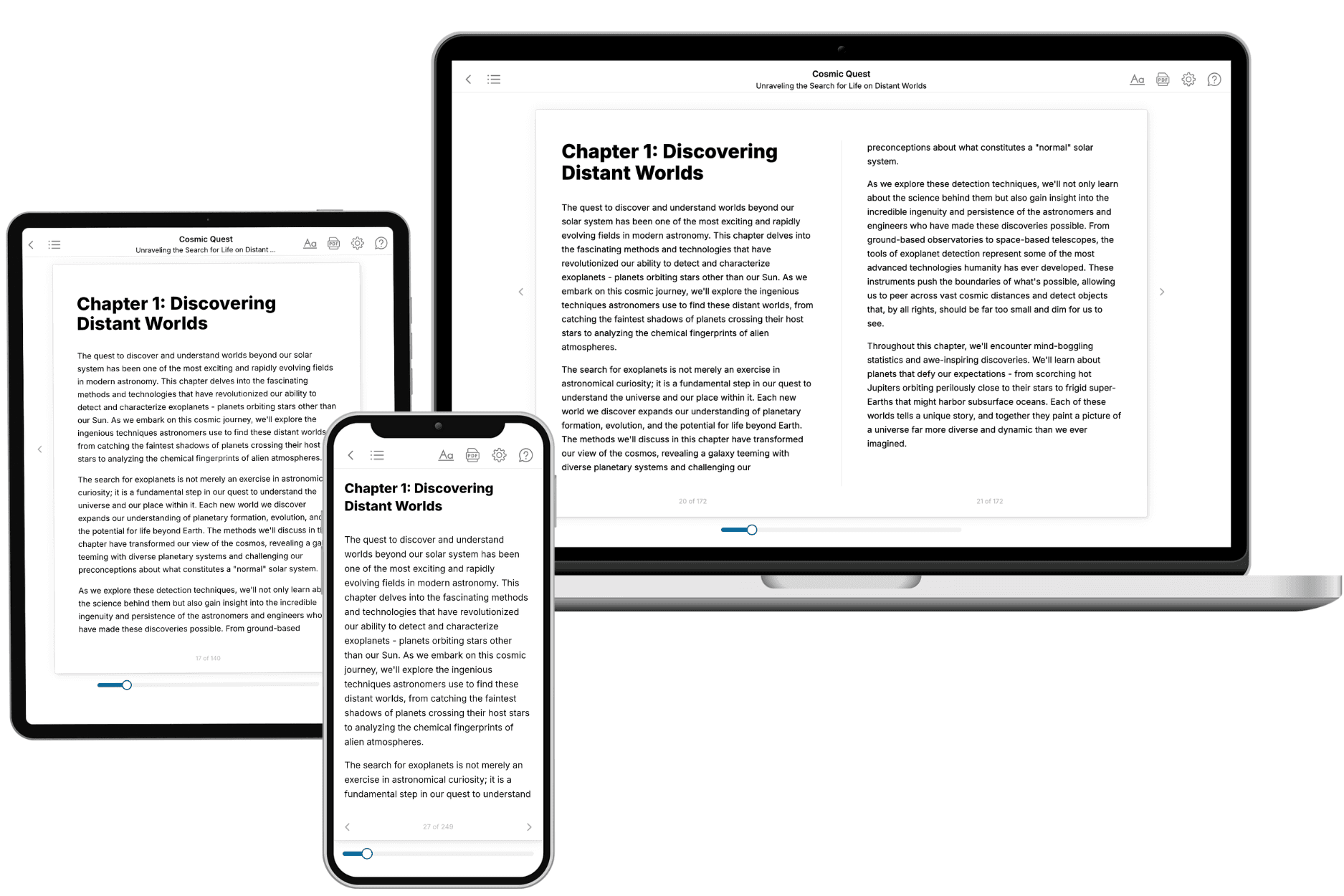
Your book is ready in 10 minutes. Read it online, download as EPUB or PDF, or send to Kindle.
Frequently asked questions
- What is TailoredRead?
TailoredRead creates complete, full-length nonfiction ebooks, written specifically for you. Tell us what you want to learn and why, and TailoredRead writes you a complete ebook on it, with charts, tables, and diagrams throughout. Read it online, on Kindle, or on any e-reader, or download it as a PDF or EPUB. Every book is written fresh the day you order it.
- How is the book tailored to me?
Before anything is written, you answer a few short questions about your goals, your background, and the topics you care about. Your book is then planned around your answers: written at your level, focused on your goals, and covering the topics you chose, instead of the one-size-fits-all book a store sells everyone.
- Will it read like generic AI content?
No. Your book isn't a chat transcript: it's planned chapter by chapter before a single word is written, told in a clear book voice, and explains ideas visually with charts, tables, and diagrams. After writing, every book goes through an editorial pass that polishes chapters so the book reads consistent from start to finish. Judge for yourself: browse thousands of sample books on our Explore Books page.
- How accurate is the content?
Our AI first checks whether your subject needs live research. Niche and fast-moving subjects are researched before writing, and the book plan and chapters are grounded in what it finds. After writing, every book goes through a quality pass that checks its facts and consistency, and researched books list their sources in a Notes section at the back.
- How long is the book?
You choose the length: Comprehensive (250-300 pages), Detailed (150-200 pages), Essential (70-100 pages), or Short (30-50 pages).
- Does the book include visuals?
Yes. Every book includes charts, tables, and diagrams: timelines, checklists, step-by-step guides, decision trees, comparison tables, matrices, and bar charts. A typical book includes dozens of these visual elements.
- Can I read it on Kindle? What formats can I download?
Yes. Every book can be read in our online reader or downloaded as a PDF or EPUB. The EPUB can be opened with Kindle, Apple Books, Kobo, and any e-reader. The Commercial and Author licenses also include an editable Word (DOCX) and Markdown download.
- How much does it cost?
About the price of a regular ebook. The exact price depends on your book's length and complexity, from $2 for the shortest books to $35 for the most comprehensive, and it's shown when you review your book, before you commit to anything. Each book is a one-time purchase, yours to keep, no subscription. Licenses that let you share, teach, or publish your book range from $35.99 to $49.99.
- Can I preview the book before purchasing?
Before you pay, you'll see what your book will cover: the title, a detailed description, the estimated length, and the complete chapter-by-chapter table of contents, so you know what you're getting before you decide. The full text itself is written after you purchase.
- How long does it take to create a book?
About 10 minutes. You can start reading the opening chapters while the rest is still being written.