Human-Centered AI
Making Smarter Decisions When Humans and Machines Work Together
Most AI systems fail not because of flawed algorithms, but because they don't account for how humans actually think and make decisions.
191 pages8 chaptersApr 15, 2026Artificial Intelligence
About this book
You face a critical challenge: deploying machine learning and AI tools that people will trust, understand, and use effectively—without blindly following their recommendations or ignoring their insights. This book bridges the gap between decision theory, artificial intelligence, and human psychology. You'll learn how cognitive biases affect both human judgment and machine learning outcomes, why transparency matters more than accuracy alone, and how to design interfaces that help people make better decisions with AI assistance. Through practical frameworks and real-world examples, discover how to build systems where humans and machines genuinely complement each other, where users understand what they're relying on, and where ethical considerations shape every design choice. Whether you're developing AI products, implementing machine learning in organizations, or simply trying to make better decisions with AI tools, this book provides the insights you need to create human-centered intelligent systems.
Table of contents
- IntroductionWhy Human-Computer Interaction Matters in the Age of AI, The Collaboration Gap: Where AI Systems Fail, What You'll Learn in This BookRead below
- Chapter 1: Foundations of Human Decision-MakingRational vs. Actual: How Humans Really Decide, Cognitive Biases and Mental Shortcuts, Why Context and Emotion Shape Decisions
- Chapter 2: Machine Learning and Decision TheoryHow Machine Learning Systems Make Predictions, Optimization and Trade-offs in Algorithm Design, Understanding Uncertainty and Confidence in ML Models
- Chapter 3: The Psychology of Human-AI InteractionBuilding and Maintaining Trust in AI Systems, Automation Bias: Over-Relying on Machine Recommendations, How Users Form Mental Models of AI Systems
- Chapter 4: Designing for Understanding and TransparencyMaking AI Decisions Explainable to Users, Interface Design for AI-Assisted Decision-Making, Communicating Uncertainty and Limitations Effectively
- Chapter 5: Bias, Fairness, and Ethical ConsiderationsWhere Bias Enters AI Systems, Fairness Frameworks and Ethical Design Principles, Designing for Human Oversight and Intervention
- Chapter 6: Feedback Loops and Continuous ImprovementDesigning Effective Feedback Mechanisms, How Systems Learn from Human Decisions, Avoiding Reinforcement of Errors and Biases
- Chapter 7: Real-World Applications and Case StudiesAI in Healthcare: Supporting Clinical Decision-Making, Business Intelligence: Balancing Automation and Human Judgment, Lessons from Successes and Failures
- Chapter 8: Building and Evaluating Human-Centered AI SystemsUser Research and Requirements Gathering, Metrics Beyond Accuracy: Measuring Real-World Impact, Iterative Design and User Testing
- ConclusionKey Takeaways for Human-Centered AI, The Future of Human-AI Collaboration
- Glossary
- Further Reading and Resources
Introduction
There is a quiet crisis unfolding inside organizations that have invested heavily in artificial intelligence. The algorithms are sophisticated. The data pipelines are clean. The dashboards are polished. And yet, something keeps going wrong. Doctors override AI diagnostic tools without reading the reasoning behind them. Loan officers rubber-stamp algorithmic credit decisions without questioning the inputs. Customer service teams ignore AI-generated recommendations because they don't trust where those recommendations come from. The technology works, but the collaboration between humans and machines does not.
This is not primarily a technical problem. The failure point is almost never the model itself. It is the space between the model's output and the human being who has to act on it. That space is filled with psychology, habit, organizational culture, interface design, and a dozen other factors that most AI development teams never think about. When you ignore that space, you get systems that are accurate in testing and useless in practice. When you design for it deliberately, you get something genuinely powerful: a partnership where humans and machines each do what they are best at.
This book is about that space. It draws on decision theory, cognitive psychology, human-computer interaction research, and practical experience with AI deployment to give you a clear picture of how humans and machines actually work together, and how to make that collaboration smarter. Whether you are building AI products, rolling out machine learning tools inside an organization, or simply trying to use AI-assisted tools more effectively in your own work, the frameworks and principles here will help you think more clearly about what good human-AI collaboration looks like and how to achieve it.
The ideas in this book are grounded in a simple but often overlooked truth: AI systems do not make decisions in isolation. They make recommendations, predictions, and classifications that humans then interpret, accept, reject, or ignore. The quality of the final outcome depends on both sides of that interaction. A brilliant algorithm paired with a confusing interface and no explanation of its reasoning will produce worse real-world results than a simpler model that communicates clearly and earns genuine user trust. Understanding this dynamic is the foundation of everything that follows.
Why Human-Computer Interaction Matters in the Age of AI
Human-computer interaction, often abbreviated as HCI, is the study of how people engage with computing systems. For decades, HCI research focused on questions like: How do users navigate a menu? How quickly can someone learn a new interface? What makes a button easy to find? These are still important questions, but the rise of AI has added a much more complex layer. Now the question is not just how people use a tool, but how they think about a tool that appears to think for itself.
When a system gives you a recommendation, your brain does something interesting. It does not simply evaluate the recommendation on its merits. It also forms a judgment about the system itself. Is this trustworthy? Does it understand my situation? Has it been right before? These judgments happen quickly, often unconsciously, and they shape how you respond to AI outputs in ways that have nothing to do with the underlying algorithm's actual accuracy. This is why HCI matters so much in the age of AI: the human response to the system is as important as the system's technical performance.[1]
Consider a concrete example. A major hospital system deployed an AI tool to flag patients at high risk of sepsis, a life-threatening condition that requires fast intervention. The model was genuinely good, with strong sensitivity and specificity in clinical trials. But when it went live, nurses began ignoring the alerts within a few weeks. Why? The alerts came with no explanation of which signals triggered them, they fired too frequently on patients who turned out to be fine, and the interface made it just as easy to dismiss an alert as to act on it. The algorithm was not the problem. The human-system interaction was.[2]
This pattern repeats across industries. In financial services, trading algorithms generate signals that analysts dismiss because they cannot explain the reasoning to their managers. In hiring, AI screening tools get bypassed by recruiters who feel the system does not understand the nuances of their roles. In manufacturing, predictive maintenance systems go unused because floor workers were never trained to interpret the confidence scores the system displays. In every case, the gap is not technical. It is human.
HCI research gives us tools to close that gap. It tells us how people form mental models of systems they interact with, how interface design shapes interpretation of data, and how trust is built or destroyed through repeated interactions. These insights are not optional extras for AI development. They are core requirements. An AI system that people do not understand, trust, or use correctly is not a functioning AI system, regardless of its benchmark scores.
The good news is that the principles of effective human-AI interaction are learnable and applicable. They are not vague platitudes about "putting humans first." They are specific, testable design choices about how to present information, how to communicate uncertainty, how to structure feedback, and how to give users the right level of control. This book walks through those principles in detail, with practical examples at every step.
One more thing is worth noting here. The stakes of getting this right are rising fast. AI systems are now involved in decisions about medical treatment, criminal sentencing, credit access, job applications, and child welfare assessments. In these high-stakes contexts, a poorly designed human-AI interface is not just an inconvenience. It can cause real harm to real people. Understanding how humans interact with AI is not just a product design question. It is an ethical imperative.
The Collaboration Gap: Where AI Systems Fail
The collaboration gap is the distance between what an AI system is capable of and what it actually delivers in practice, once real humans are involved. This gap is almost always larger than developers expect and smaller than skeptics claim. Understanding where it comes from is the first step toward closing it. The gap has several distinct sources, and each one requires a different kind of solution.
The first source is misaligned expectations. When users do not have an accurate picture of what an AI system can and cannot do, they either over-rely on it or under-use it. Both failure modes are costly. Over-reliance, sometimes called automation bias, leads people to accept AI recommendations without applying their own judgment, even when the system is clearly wrong. Under-use leads people to ignore genuinely valuable insights because they do not trust the system or do not understand its outputs. Research consistently shows that both problems are common and that neither goes away on its own.[3]
The second source is poor communication of uncertainty. Machine learning models do not produce certainties. They produce probabilities, confidence intervals, and predictions that come with varying degrees of reliability depending on how similar the current situation is to the training data. Most AI interfaces hide this complexity behind a single number or a simple recommendation. When users do not know how confident the system is, they cannot calibrate their own response appropriately. A recommendation that is 95% reliable should be treated very differently from one that is 60% reliable, but if the interface presents both the same way, users have no way to make that distinction.
The third source is lack of explainability. People are more willing to act on a recommendation when they understand the reasoning behind it. This is not irrational. Understanding the reasoning allows you to check whether the system's logic applies to your specific situation, to catch cases where the model is extrapolating beyond its training data, and to take responsibility for the decision in a way that makes sense to you and to others. When AI systems operate as black boxes, users are left with a binary choice: trust it completely or ignore it entirely. Neither option is good.
A 2019 study of radiologists using AI-assisted image analysis found that when the AI provided a confidence score alongside its diagnosis, radiologists made better decisions than when they used either the AI alone or their own judgment alone. But when the AI provided only a binary recommendation with no confidence information, radiologists performed no better than they would have without the AI at all.[4]
The fourth source of the collaboration gap is workflow mismatch. AI systems are often designed in isolation from the actual workflows they are meant to support. The result is a tool that requires users to change how they work in order to use it, rather than fitting naturally into existing processes. When using the AI tool creates friction, people find workarounds. They check the AI output after they have already made their decision, or they use it only when they have extra time, or they delegate it to a junior team member who has no authority to act on its recommendations. In each case, the system's potential value is lost.
The fifth source is feedback absence. In most AI deployments, users never find out whether their AI-assisted decisions were correct. A doctor who accepts an AI diagnosis does not always learn whether the patient recovered. A loan officer who approves a credit application does not always see the repayment outcome. Without feedback, users cannot learn to calibrate their trust in the system. They cannot develop the intuition for when to follow the AI and when to override it. The system cannot improve based on real-world outcomes. Everyone is flying blind.
Closing the collaboration gap requires addressing all five of these sources. That means designing for accurate user expectations, communicating uncertainty clearly, providing meaningful explanations, fitting into real workflows, and building feedback loops that help both humans and systems improve over time. These are the themes that run through every chapter of this book. They are not abstract ideals. Each one has concrete, practical implications for how you design, deploy, and evaluate AI systems.
It is also worth being honest about what closing the collaboration gap does not mean. It does not mean making AI systems so simple that they lose their power. It does not mean always deferring to human judgment, which is itself subject to serious and well-documented biases. And it does not mean designing systems that tell users what they want to hear. The goal is genuine collaboration: a partnership where the AI contributes its strengths and the human contributes theirs, and where the interface between them is designed to make that partnership work as well as possible.
The collaboration gap is not inevitable. It is a design problem, and design problems have solutions. The rest of this book is about finding those solutions systematically, drawing on the best available research and the most instructive real-world examples to give you a practical toolkit for building AI systems that actually work when humans are in the loop.
What You'll Learn in This Book
This book is organized to build your understanding progressively, starting with the foundations of human decision-making and machine learning, then moving through the psychology of human-AI interaction, interface design, ethics, feedback systems, and real-world applications. Each chapter is designed to be both conceptually grounded and practically useful. You will come away from each one with frameworks you can apply immediately, not just ideas to think about.
Here is a brief map of what each part of the book covers:
- Chapter 1: Foundations of Human Decision-Making. Before you can design AI systems that work with human judgment, you need to understand how human judgment actually works. This chapter covers the psychology of decision-making, including the difference between how we think we decide and how we actually decide, the cognitive biases that affect everyone, and the role of context and emotion in shaping choices.
- Chapter 2: Machine Learning and Decision Theory. This chapter gives you a clear, non-technical picture of how machine learning systems make predictions, what trade-offs are built into algorithm design, and how to think about uncertainty and confidence in model outputs. You do not need to be a data scientist to benefit from this chapter, but you will come away thinking more clearly about what ML systems can and cannot do.
- Chapter 3: The Psychology of Human-AI Interaction. Trust is the central currency of human-AI collaboration. This chapter examines how trust in AI systems is built and broken, how automation bias leads people to over-rely on machine recommendations, and how users form mental models of AI systems that shape their behavior in ways that are often invisible to designers.
- Chapter 4: Designing for Understanding and Transparency. Explainability is not just a technical feature. It is a design discipline. This chapter covers how to make AI decisions understandable to non-expert users, how interface design shapes interpretation of AI outputs, and how to communicate uncertainty and limitations in ways that help rather than confuse.
- Chapter 5: Bias, Fairness, and Ethical Considerations. AI systems inherit and amplify the biases present in their training data and design choices. This chapter examines where bias enters AI systems, how to think about fairness in a rigorous way, and how to design for meaningful human oversight and intervention.
- Chapter 6: Feedback Loops and Continuous Improvement. The relationship between human decisions and machine learning outcomes is dynamic. This chapter covers how to design feedback mechanisms that help systems improve over time, how systems learn from human decisions, and how to avoid the dangerous pattern of reinforcing errors through poorly designed feedback loops.
- Chapter 7: Real-World Applications and Case Studies. Theory becomes clearer through examples. This chapter examines AI deployment in healthcare and business analytics in depth, drawing out lessons from both successes and failures that apply across many other domains.
- Chapter 8: Building and Evaluating Human-Centered AI Systems. The final chapter brings everything together into a practical framework for building and assessing AI systems with human factors at the center. It covers user research, evaluation metrics that go beyond accuracy, and iterative design processes that keep real users involved throughout development.
Throughout the book, you will find specific frameworks and tools that you can put to work right away. These include a trust calibration checklist for evaluating whether your AI system is likely to be over-trusted or under-trusted by its users, a bias audit framework for identifying where bias may have entered your system, and a set of interface design principles specifically tailored to AI-assisted decision-making contexts. Each of these is grounded in research and tested against real-world examples.
You will also find that this book takes a deliberately balanced view of AI capabilities. It does not argue that AI is always better than human judgment, nor that human judgment should always override AI recommendations. The evidence is more nuanced than either of those positions. In some domains and for some types of decisions, well-designed AI systems outperform human experts consistently. In others, human judgment adds critical value that no current algorithm can replicate. The skill is knowing which situation you are in, and designing your system accordingly.
One thing this book does not do is pretend that human-centered AI design is easy. It requires genuine investment in understanding your users, honest assessment of your system's limitations, and willingness to make design choices that prioritize real-world effectiveness over impressive benchmark numbers. It also requires ongoing attention, because the relationship between a system and its users evolves over time in ways that are not always predictable. But the investment is worth it. Systems designed with human factors at the center consistently outperform those that treat the human as an afterthought.
The field of human-centered AI is moving quickly. New research on explainability, fairness, and human-AI teaming is published every month. New deployment contexts are emerging as AI tools reach into more areas of professional and personal life. This book gives you a foundation that will remain relevant as the field evolves, because it is grounded in principles of human psychology and decision-making that do not change as fast as the technology does. The specific tools will evolve. The underlying human factors will not.
Finally, a word about who this book is for. It is written for professionals who work with AI systems in some capacity, whether as designers, developers, product managers, organizational leaders, or informed users. It assumes you have some familiarity with technology and decision-making, but it does not assume a background in machine learning or cognitive science. Technical concepts are explained clearly when they appear, and the focus throughout is on practical understanding rather than mathematical depth. If you have ever wondered why a smart AI system failed in practice, or how to build one that actually works when real people use it, this book is for you.
The collaboration between humans and machines is one of the defining challenges of this era. Getting it right matters enormously, for the organizations that deploy these systems, for the people who use them, and for the individuals whose lives are affected by the decisions they produce. The pages that follow are a guide to getting it right, one design choice at a time.
Notes
Introduction
- 1. R. Parasuraman and V. Riley, "Humans and automation," Human Factors, 1997
- 2. M. P. Sendak and others, "Real-World Integration of a Sepsis Deep Learning Technology into Routine Clinical Care," JMIR Medical Informatics, 2020
- 3. M. L. Cummings, Automation Bias in Intelligent Time Critical Decision Support Systems, AIAA 1st Intelligent Systems Technical Conference, 2017
- 4. P. Tschandl and others, "Human-computer collaboration for skin cancer recognition," Nature Medicine, 2019
This is the end of the free sample. The full book has 8 chapters.
Want this book written for you?
Tell us your goals and background, and get your own version of this book, tailored by AI to you.


Benefits of AI-tailored books
- Read one book, not ten:
- all the Artificial Intelligence knowledge you need, gathered into a single book.
- Save days of learning:
- tell us your goals, choose your topics, and the whole book is built around them.
- Learn effortlessly:
- Artificial Intelligence book written for your specific background and expertise.
- Understand at a glance:
- includes charts, tables, timelines, checklists, decision trees, and more.
- Stay current:
- written the day you order it, not years ago.
- Trust what you read:
- every book is checked for accuracy, with real research when your subject needs it.
Create your unique book in 3 steps
- 1. Select your focus
Select the focus of your Artificial Intelligence book and share your background
- 2. Personalize your book
Specify your goals and choose sub-topics to include
- 3. Get your tailored book
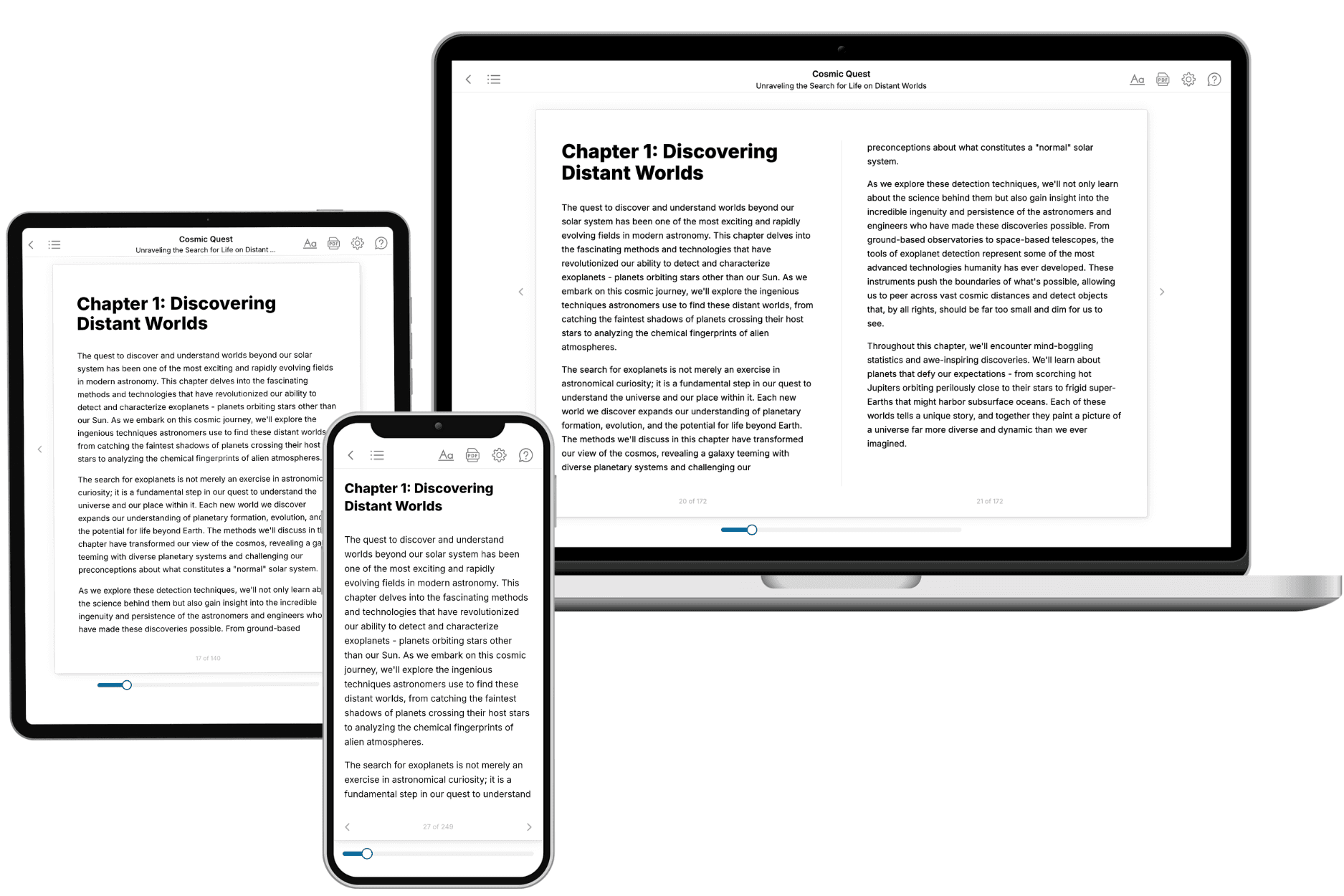
Your book is ready in 10 minutes. Read it online, download as EPUB or PDF, or send to Kindle.

Frequently asked questions
- What is TailoredRead?
TailoredRead creates complete, full-length nonfiction ebooks, written specifically for you. Tell us what you want to learn and why, and TailoredRead writes you a complete ebook on it, with charts, tables, and diagrams throughout. Read it online, on Kindle, or on any e-reader, or download it as a PDF or EPUB. Every book is written fresh the day you order it.
- How is the book tailored to me?
Before anything is written, you answer a few short questions about your goals, your background, and the topics you care about. Your book is then planned around your answers: written at your level, focused on your goals, and covering the topics you chose, instead of the one-size-fits-all book a store sells everyone.
- Will it read like generic AI content?
No. Your book isn't a chat transcript: it's planned chapter by chapter before a single word is written, told in a clear book voice, and explains ideas visually with charts, tables, and diagrams. After writing, every book goes through an editorial pass that polishes chapters so the book reads consistent from start to finish. Judge for yourself: browse thousands of sample books on our Explore Books page.
- How accurate is the content?
Our AI first checks whether your subject needs live research. Niche and fast-moving subjects are researched before writing, and the book plan and chapters are grounded in what it finds. After writing, every book goes through a quality pass that checks its facts and consistency, and researched books list their sources in a Notes section at the back.
- How long is the book?
You choose the length: Comprehensive (250-300 pages), Detailed (150-200 pages), Essential (70-100 pages), or Short (30-50 pages).
- Does the book include visuals?
Yes. Every book includes charts, tables, and diagrams: timelines, checklists, step-by-step guides, decision trees, comparison tables, matrices, and bar charts. A typical book includes dozens of these visual elements.
- Can I read it on Kindle? What formats can I download?
Yes. Every book can be read in our online reader or downloaded as a PDF or EPUB. The EPUB can be opened with Kindle, Apple Books, Kobo, and any e-reader. The Commercial and Author licenses also include an editable Word (DOCX) and Markdown download.
- How much does it cost?
About the price of a regular ebook. The exact price depends on your book's length and complexity, from $2 for the shortest books to $35 for the most comprehensive, and it's shown when you review your book, before you commit to anything. Each book is a one-time purchase, yours to keep, no subscription. Licenses that let you share, teach, or publish your book range from $35.99 to $49.99.
- Can I preview the book before purchasing?
Before you pay, you'll see what your book will cover: the title, a detailed description, the estimated length, and the complete chapter-by-chapter table of contents, so you know what you're getting before you decide. The full text itself is written after you purchase.
- How long does it take to create a book?
About 10 minutes. You can start reading the opening chapters while the rest is still being written.