The Impressionists
How a Radical Vision Transformed Art and Changed the World
Most people think of Impressionism as a purely aesthetic movement—beautiful paintings of water lilies and haystacks.
191 pages9 chaptersMay 15, 2026Art History
About this book
But this overlooks the real story: a group of artists who risked everything to paint in a radically new way, facing mockery from the art establishment and financial ruin for decades. This book reveals the human drama behind the masterpieces. You'll discover how Claude Monet nearly went blind chasing light, how Berthe Morisot fought against a society that deemed women unsuitable for serious art, and how a chance meeting in a studio led to a revolution. Through intimate biographical narratives, you'll understand not just what the Impressionists painted, but why their vision mattered—and how their struggle to capture fleeting moments of light fundamentally changed how we see the world. This is the story of ambition, friendship, heartbreak, and the transformative power of artistic courage.
Table of contents
- IntroductionWhy Impressionism Still Matters Today, Beyond the Paintings: The Human Stories, How to Read This BookRead below
- Chapter 1: The World Before ImpressionismThe Stranglehold of Academic Tradition, The Salon System and Its Gatekeepers, Seeds of Change: Realism and Photography
- Chapter 2: Claude Monet: The VisionaryEarly Struggles and Artistic Formation, The Obsession with Light and Series Paintings, Giverny and the Final Vision
- Chapter 3: Pierre-Auguste Renoir: The HumanistFrom Porcelain Painter to Fine Artist, The Philosophy of Joy and Color, Evolution of Style and Personal Challenges
- Chapter 4: Edgar Degas: The OutsiderClassical Training and Unconventional Vision, Modern Subjects: Dancers, Laundresses, and Urban Life, Isolation, Blindness, and Artistic Persistence
- Chapter 5: Berthe Morisot and Women ImpressionistsBreaking Barriers in a Male-Dominated World, Berthe Morisot's Radical Intimacy, Mary Cassatt, Marie Bracquemond, and Forgotten Voices
- Chapter 6: The Birth of a MovementThe Plein Air Revolution, The First Independent Exhibition of 1874, From Ridicule to Gradual Recognition
- Chapter 7: Artistic Innovation and TechniqueColor Theory and Optical Mixing, Brushwork, Composition, and Capturing Moments, The Influence of Photography on Perspective
- Chapter 8: Hardship, Friendship, and CommunityFinancial Struggles and Survival, Artistic Bonds and Mutual Support, Dealers and Collectors Who Believed
- Chapter 9: The Impressionist LegacyInfluence on Modern Art and Beyond, Cultural Impact: From Literature to Music, Lasting Lessons About Vision and Persistence
- ConclusionWhy Their Story Still Resonates
- Further Reading and Resources
Introduction
Walk into any major museum in the world and you will almost certainly find a crowd gathered in front of an Impressionist painting. People lean in close, then step back, watching the loose brushstrokes dissolve into shimmering light. Children point at the water lilies. Adults stand quietly, something stirring in them that they may not be able to name. Impressionism is, by almost any measure, the most beloved movement in the history of Western art. Its paintings sell for hundreds of millions of dollars at auction. Its exhibitions draw record-breaking crowds. Its imagery appears on coffee mugs, tote bags, and screensavers around the world.
But that popularity comes with a cost. When something becomes universally beloved, it tends to get flattened. The rough edges get smoothed away. The struggle disappears. What remains is a pleasant surface: soft colors, dappled light, scenes of leisure and beauty. Most people encounter Impressionism as a kind of visual comfort food, something warm and familiar that asks nothing difficult of them. And in that comfort, the real story gets lost entirely.
The real story is far more interesting. The artists who created these paintings were not celebrated geniuses working in peaceful studios. They were radicals. They were rejected, mocked, and financially ruined for years, sometimes for decades. They fought against one of the most powerful cultural institutions in the world, the French Academy and its annual Salon, which controlled what counted as legitimate art. They painted in ways that critics called sloppy, unfinished, and even childish. They organized their own exhibitions out of desperation, not confidence. And they kept painting anyway, through poverty and illness and self-doubt, because they believed they were seeing something true that the art world refused to acknowledge.
This book tells that story. It is a story about artistic courage, yes, but also about friendship, rivalry, heartbreak, and the slow, grinding work of changing how an entire culture sees the world. It is about specific human beings with specific struggles, not abstract geniuses floating above ordinary life. Understanding who these artists were, and what they were up against, transforms the experience of looking at their paintings. A Monet haystack is no longer just a pretty picture. It becomes evidence of an obsession, a philosophical argument about light and time, painted by a man who was sometimes so broke he could not afford canvas.
Why Impressionism Still Matters Today
It is worth asking, seriously, why a painting movement from nineteenth-century France should matter to anyone living today. The honest answer is that Impressionism did not just change painting. It changed how human beings understand the act of seeing itself. Before the Impressionists, the dominant tradition in Western art held that a painting should present a stable, finished, idealized version of reality. The world in a painting was more perfect than the world outside. The Impressionists rejected that idea completely. They argued, through their brushes, that reality is not stable or finished. It is constantly shifting, shaped by light, atmosphere, and the particular moment in which you happen to be looking at it.
That sounds like a technical argument about painting. But it is actually a profound philosophical claim. The Impressionists were saying that perception matters. That the way you see something is as real and as valid as the thing itself. That a haystack at dawn and a haystack at dusk are, in a meaningful sense, two entirely different objects. This idea rippled outward far beyond painting. It influenced the stream-of-consciousness techniques of writers like Marcel Proust and Virginia Woolf. It shaped the harmonic experiments of composers like Claude Debussy, who explicitly credited Impressionist painters as an influence on his music.[1] It even anticipated ideas in modern psychology about how the brain constructs visual experience.
There is also a more immediate reason Impressionism matters. The movement offers one of history's clearest examples of what happens when a small group of committed people refuses to accept the judgment of established institutions. The Impressionists were told, repeatedly and by people with genuine authority, that their work was not good enough. They were told this by Salon juries, by critics, by collectors, and sometimes by their own families. They kept going anyway. The result was not just a body of beautiful paintings. It was a fundamental shift in what art could be and who got to decide.
That lesson has obvious relevance today, in any field where established gatekeepers control access to audiences and legitimacy. The Impressionists did not wait for permission. They created their own exhibition spaces, built their own networks of support, and found their own collectors. They essentially invented the model of the independent artist working outside institutional structures, a model that now defines enormous swaths of creative culture. Understanding how they did it, and what it cost them, is genuinely useful knowledge.
Impressionism also matters because it is the hinge point of modern art. Without it, there is no Post-Impressionism, no Fauvism, no Cubism, no Abstract Expressionism. Every major movement in twentieth-century art traces its lineage back to the moment when Monet, Renoir, Degas, Morisot, and their colleagues decided that capturing a fleeting impression of light was more honest than producing a polished academic composition. The entire trajectory of modern visual culture runs through that decision. To understand Impressionism is to understand the root system of the modern artistic world.
Finally, and perhaps most simply, Impressionism matters because the paintings are genuinely extraordinary. Not in the comfortable, decorative way that their ubiquity might suggest, but in a deeper way that becomes visible once you know the context. When you understand that Monet painted his late water lily panels while nearly blind, working from memory and instinct as much as sight, those enormous canvases become something almost unbearable in their beauty and determination. Context does not diminish art. It amplifies it.
The Impressionists did not set out to create a movement. They set out to paint honestly. The movement was what happened when honesty turned out to be revolutionary.
This book is built on the conviction that knowing the human stories behind the paintings makes them more powerful, not less. The goal is not to reduce great art to biography, but to restore the full weight of what these artists actually accomplished by showing what it cost them to accomplish it.
Beyond the Paintings: The Human Stories
Every painting in a museum has a life before it reaches the wall. It begins somewhere specific: a particular morning, a particular field, a particular moment of frustration or inspiration in a particular studio. The Impressionist paintings that now hang in the Musée d'Orsay, the Art Institute of Chicago, and the National Gallery in London all began in circumstances that were often chaotic, financially desperate, and emotionally complicated. Recovering those circumstances is not just interesting. It is essential to understanding what the paintings actually are.
Consider Claude Monet. The image most people carry of him is the one from his later years: a bearded patriarch in a wide-brimmed hat, tending his famous garden at Giverny, surrounded by water lilies and weeping willows. That image is real, but it represents only the final chapter of a life that included years of grinding poverty, the death of his first wife while he was too poor to pay for her funeral, and a period of such severe depression that he destroyed dozens of his own canvases. The garden at Giverny was not a retreat from struggle. It was something he built, deliberately and at great expense, as a subject to paint. It was his final artistic argument, made physical.
Or consider Berthe Morisot, whose name is far less familiar than Monet's despite the fact that she was one of the most technically accomplished and conceptually daring painters of the entire movement. Morisot participated in seven of the eight Impressionist exhibitions, more than almost any other member of the group. She was a central figure, not a peripheral one. But because she was a woman working in a society that regarded female artists as hobbyists at best, her reputation was systematically diminished during her lifetime and for decades afterward. Recovering her story is not just a matter of historical fairness. It reveals something important about how artistic canons are constructed and who gets left out.
The human stories in this book are organized around individual artists, but they are not isolated biographies. The Impressionists were deeply interconnected. They met in studios and cafés, criticized each other's work, lent each other money, and sometimes fell into bitter disagreements. Their relationships shaped their art in ways that are visible on the canvas if you know what to look for. Renoir and Monet painted side by side at La Grenouillère in 1869, producing works so similar in subject and approach that they read almost as a conversation between two people working out the same problem from slightly different angles.[2] Understanding that context changes how you see both paintings.
The stories also include figures who are not painters at all but who were essential to the movement's survival. Paul Durand-Ruel, the art dealer who staked his own financial future on the Impressionists when no one else would, is one of the unsung heroes of art history. Without his willingness to buy paintings that no one else wanted, to store them in his own home when he ran out of gallery space, and to keep paying artists who were producing work the market rejected, the movement might have collapsed entirely in the 1870s. His story is part of the Impressionist story, and it belongs here.
What emerges from these interconnected stories is a picture of a community under pressure. The Impressionists were not a formal school with a manifesto and a set of rules. They were a loose group of friends and colleagues who shared certain convictions about painting and who supported each other, imperfectly and sometimes contentiously, through years of public failure. That community was their greatest resource. It is also one of the most instructive things about them. Artistic revolutions, it turns out, are not usually the work of lone geniuses. They are the work of groups of people who find each other at the right moment and decide, together, to try something new.
The personal struggles documented in this book are not included for dramatic effect. They are included because they are inseparable from the art. When Degas's eyesight began to fail in the 1890s, he shifted from painting to sculpture, producing wax figures that he could shape by touch as much as by sight. Those sculptures, particularly his famous series of dancers, are among the most remarkable objects in the history of art. They exist because of his disability, not in spite of it. Understanding that does not make them more pitiable. It makes them more astonishing.
The goal, throughout this book, is to restore the full human dimension to artists who have been turned into icons. Icons are static. Human beings are not. The Impressionists changed their minds, made mistakes, contradicted themselves, and grew in ways that sometimes surprised even them. Following that growth, painting by painting and year by year, is one of the great pleasures this subject offers.
How to Read This Book
This book is designed to work on multiple levels at once. You can read it straight through, from the opening chapter on the world before Impressionism to the final reflections on the movement's legacy, and it will tell a coherent, chronological story. But you can also use it as a reference, moving between chapters based on which artists or themes interest you most. Each chapter is written to stand on its own while also connecting to the larger narrative.
The structure moves from context to biography to technique to legacy. Here is a quick map of what each section covers:
- Chapter 1 sets the scene by describing the art world the Impressionists were born into: the Academic tradition, the Salon system, and the early stirrings of change brought by Realism and photography.
- Chapters 2 through 5 focus on individual artists: Monet, Renoir, Degas, and the women of Impressionism, led by Berthe Morisot. Each chapter combines biography with close attention to specific paintings and artistic development.
- Chapter 6 tells the story of the movement as a collective enterprise, from the plein air revolution to the landmark first independent exhibition of 1874.
- Chapter 7 goes deeper into technique, explaining color theory, brushwork, and the influence of photography in terms that are accessible without being oversimplified.
- Chapter 8 examines the social and economic world of the Impressionists: their financial struggles, their friendships, and the dealers and collectors who made their survival possible.
- Chapter 9 traces the movement's legacy into modern art, literature, music, and contemporary culture.
You do not need any specialized knowledge of art history to read this book. The writing assumes that you are curious and engaged, not that you already know the difference between impasto and glazing. Technical terms are explained when they appear, and the focus throughout is on ideas and human experience rather than academic classification. If you have some background in art history, you will find new angles on familiar material. If you are coming to this subject relatively fresh, you will find a clear and welcoming entry point.
One practical suggestion: if you have access to a smartphone or tablet while reading, consider looking up the paintings mentioned in the text as you encounter them. This book describes specific works in detail, but descriptions of visual art are always a pale substitute for the actual image. The Musée d'Orsay, the Metropolitan Museum of Art, and the Art Institute of Chicago all maintain excellent online collections with high-resolution images that are freely accessible.[3] Pausing to look at a painting while reading about the circumstances of its creation is one of the most rewarding ways to use this book.
A note on names and terminology: the word "Impressionism" was originally an insult. The critic Louis Leroy coined it in 1874 to mock Monet's painting Impression, Sunrise, arguing that the work looked like an unfinished sketch rather than a serious composition. The artists eventually adopted the term themselves, partly out of defiance and partly because it actually described something real about their approach. Throughout this book, the term is used in its now-standard sense, referring to the loose group of artists who participated in the independent exhibitions between 1874 and 1886, along with their immediate predecessors and close associates.
It is also worth noting that the Impressionists were not a monolithic group with identical views. They disagreed about technique, about politics, about who should be included in their exhibitions, and about the direction the movement should take. Degas, for instance, disliked the term "Impressionism" and preferred to think of himself as an independent realist. Renoir eventually drifted away from the group's approach and returned to a more classical style. These tensions and contradictions are part of the story, and this book does not smooth them over. A movement that produced genuine disagreement was a movement that was genuinely alive.
What unites all the figures in this book, despite their differences, is a shared commitment to looking honestly at the world and finding new ways to put what they saw onto canvas. That commitment sounds simple. In practice, it required extraordinary courage, because the world they were looking at honestly was not the world that the art establishment wanted to see. They painted modern life: cafés and racetracks, laundresses and ballet dancers, suburban gardens and industrial riverbanks. They painted the world as it actually was in the second half of the nineteenth century, not as academic tradition said it should be represented. That decision, more than any technical innovation, is what made them revolutionary.
The chapters that follow are an invitation to see that revolution clearly, in all its difficulty and beauty. The paintings are waiting. So are the stories behind them. Both are richer than you might expect, and both will change the way you look at the world outside the museum walls.
Art is not made in a vacuum. It is made by specific people, in specific circumstances, fighting specific battles. Knowing those battles does not diminish the art. It reveals what the art was actually for.
One final thought before the story begins. The Impressionists spent years being told that what they were doing was not art. Critics wrote that their paintings looked like they had been made by someone who had never learned to draw. Collectors refused to buy them. The Salon rejected them year after year. And yet they kept painting, kept exhibiting, kept believing that they were onto something true. That persistence, more than any individual painting, is their greatest achievement. It is also the thing that makes their story worth telling, and worth reading, more than a century after the last of them put down their brushes.
Notes
Introduction
- 1. Arthur B. Wenk, "The Composer as Poet in La Mer," 19th-Century Music, 1976
- 2. John House, Monet: Nature into Art, Yale University Press, 1986
- 3. Musée d'Orsay online collection: www.musee-orsay.fr; Metropolitan Museum of Art online collection: www.metmuseum.org; Art Institute of Chicago online collection: www.artic.edu
This is the end of the free sample. The full book has 9 chapters.
Want this book written for you?
Tell us your goals and background, and get your own version of this book, tailored by AI to you.


Benefits of AI-tailored books
- Read one book, not ten:
- all the Art History knowledge you need, gathered into a single book.
- Save days of learning:
- tell us your goals, choose your topics, and the whole book is built around them.
- Learn effortlessly:
- Art History book written for your specific background and expertise.
- Understand at a glance:
- includes charts, tables, timelines, checklists, decision trees, and more.
- Stay current:
- written the day you order it, not years ago.
- Trust what you read:
- every book is checked for accuracy, with real research when your subject needs it.
Create your unique book in 3 steps
- 1. Select your focus
Select the focus of your Art History book and share your background
- 2. Personalize your book
Specify your goals and choose sub-topics to include
- 3. Get your tailored book
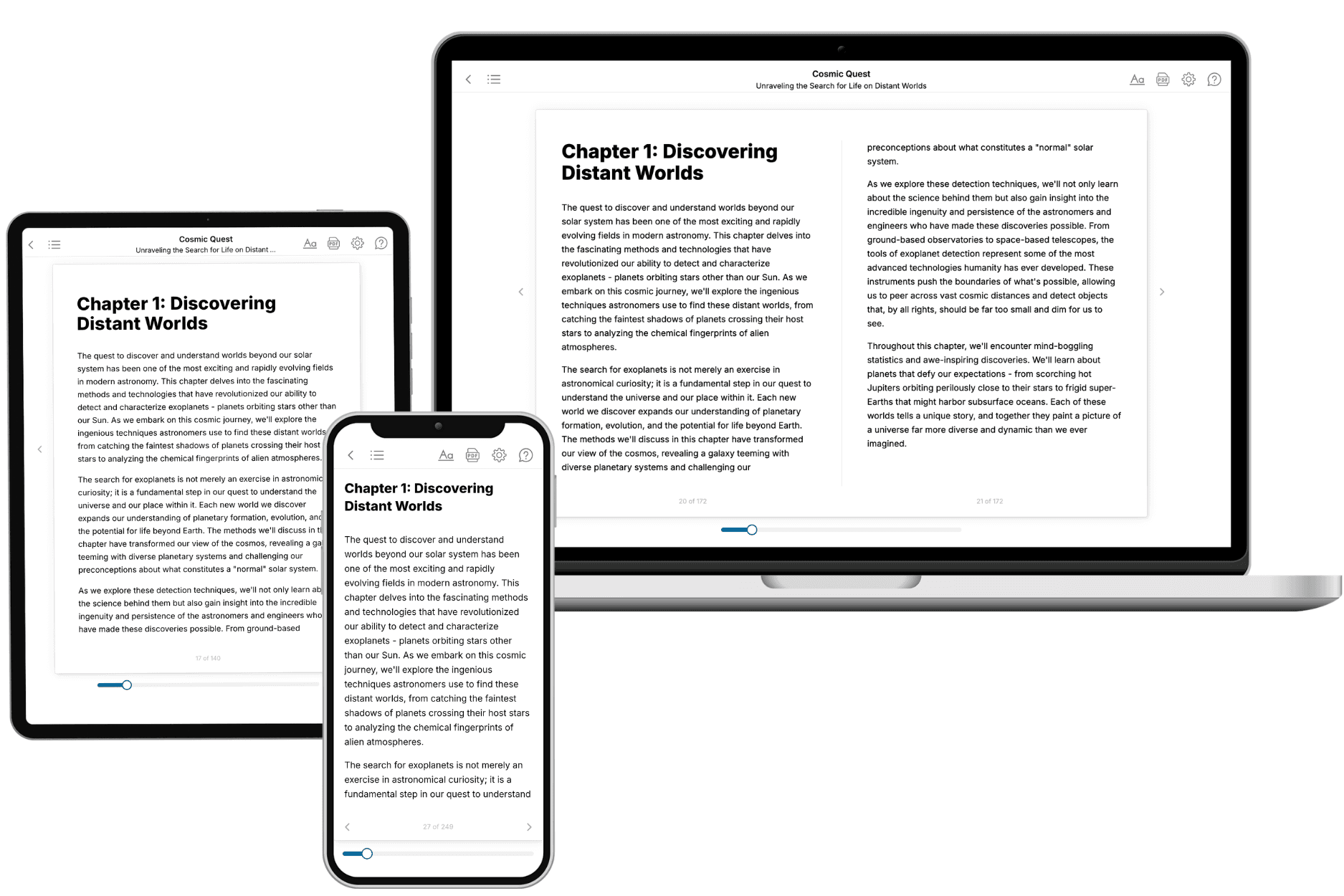
Your book is ready in 10 minutes. Read it online, download as EPUB or PDF, or send to Kindle.
Frequently asked questions
- What is TailoredRead?
TailoredRead creates complete, full-length nonfiction ebooks, written specifically for you. Tell us what you want to learn and why, and TailoredRead writes you a complete ebook on it, with charts, tables, and diagrams throughout. Read it online, on Kindle, or on any e-reader, or download it as a PDF or EPUB. Every book is written fresh the day you order it.
- How is the book tailored to me?
Before anything is written, you answer a few short questions about your goals, your background, and the topics you care about. Your book is then planned around your answers: written at your level, focused on your goals, and covering the topics you chose, instead of the one-size-fits-all book a store sells everyone.
- Will it read like generic AI content?
No. Your book isn't a chat transcript: it's planned chapter by chapter before a single word is written, told in a clear book voice, and explains ideas visually with charts, tables, and diagrams. After writing, every book goes through an editorial pass that polishes chapters so the book reads consistent from start to finish. Judge for yourself: browse thousands of sample books on our Explore Books page.
- How accurate is the content?
Our AI first checks whether your subject needs live research. Niche and fast-moving subjects are researched before writing, and the book plan and chapters are grounded in what it finds. After writing, every book goes through a quality pass that checks its facts and consistency, and researched books list their sources in a Notes section at the back.
- How long is the book?
You choose the length: Comprehensive (250-300 pages), Detailed (150-200 pages), Essential (70-100 pages), or Short (30-50 pages).
- Does the book include visuals?
Yes. Every book includes charts, tables, and diagrams: timelines, checklists, step-by-step guides, decision trees, comparison tables, matrices, and bar charts. A typical book includes dozens of these visual elements.
- Can I read it on Kindle? What formats can I download?
Yes. Every book can be read in our online reader or downloaded as a PDF or EPUB. The EPUB can be opened with Kindle, Apple Books, Kobo, and any e-reader. The Commercial and Author licenses also include an editable Word (DOCX) and Markdown download.
- How much does it cost?
About the price of a regular ebook. The exact price depends on your book's length and complexity, from $2 for the shortest books to $35 for the most comprehensive, and it's shown when you review your book, before you commit to anything. Each book is a one-time purchase, yours to keep, no subscription. Licenses that let you share, teach, or publish your book range from $35.99 to $49.99.
- Can I preview the book before purchasing?
Before you pay, you'll see what your book will cover: the title, a detailed description, the estimated length, and the complete chapter-by-chapter table of contents, so you know what you're getting before you decide. The full text itself is written after you purchase.
- How long does it take to create a book?
About 10 minutes. You can start reading the opening chapters while the rest is still being written.