The Indian Removal Act
Understanding America's Forced Displacement of Native Nations and Its Lasting Legacy
Discover how a single piece of legislation fundamentally altered the course of American history and the lives of thousands of Native Americans.
207 pages10 chaptersJul 27, 2026Native American History
About this book
This book traces the origins, implementation, and devastating consequences of the Indian Removal Act of 1830—a federal policy that forcibly displaced Native nations from their ancestral homelands. You'll explore the political motivations behind the act, the harrowing experiences of those forced westward on the Trail of Tears, and the profound ways this policy violated treaties and constitutional principles. Through careful examination of primary sources, historical accounts, and contemporary perspectives, you'll understand how this act represents a critical chapter in American civil rights history. You'll also discover how Native nations resisted removal, adapted to new territories, and continue to fight for justice and sovereignty today. This comprehensive exploration reveals the human cost of westward expansion and provides essential context for understanding ongoing Native American struggles and the importance of honoring indigenous rights and self-determination.
Table of contents
- IntroductionWhy This History Matters Today, What You'll Learn in This Book, How to Approach This MaterialRead below
- Chapter 1: America Before RemovalNative Nations of the Southeast, Early European Contact and Conflict, Colonial Expansion and Land Pressure
- Chapter 2: The Road to RemovalWestward Expansion and Manifest Destiny, Economic Interests in Native Lands, Political Pressures and State Conflicts
- Chapter 3: The Indian Removal Act of 1830Andrew Jackson and the Jackson Administration, Congressional Debate and Passage, The Act's Legal Framework and Provisions
- Chapter 4: Broken Treaties and Legal ViolationsHistory of Treaties with Native Nations, Supreme Court Cases and Legal Challenges, Constitutional Violations and Federal Authority
- Chapter 5: The Trail of TearsThe Forced Migration Process, Human Suffering and Loss of Life, Cultural Disruption and Family Separation
- Chapter 6: Removal of the Five Civilized TribesThe Cherokee Removal, The Creek and Chickasaw Removals, The Choctaw and Seminole Removals
- Chapter 7: Resistance and ResilienceNative American Opposition to Removal, Legal and Political Resistance Efforts, Strategies for Cultural Survival and Adaptation
- Chapter 8: Life in Indian TerritorySettling New Lands in the West, Reconstructing Communities and Governance, Ongoing Challenges and Conflicts
- Chapter 9: The Removal Act's Place in Civil Rights HistorySystemic Injustice and Marginalization, Pattern of Federal Government Violations, Connections to Broader Civil Rights Struggles
- Chapter 10: Legacy and Contemporary ImpactIntergenerational Trauma and Health Disparities, Ongoing Sovereignty and Land Rights Issues, Modern Native American Communities Today
- ConclusionLessons from History, Moving Forward with Understanding and Justice
- Further Reading and Resources
Introduction
On May 28, 1830, President Andrew Jackson signed a bill into law that would displace tens of thousands of Native Americans from lands their nations had occupied for generations. The Indian Removal Act authorized the federal government to negotiate the exchange of Native-held lands in the eastern United States for territory west of the Mississippi River. On paper, the word "negotiate" made it sound voluntary. In practice, the process that followed was coercive, violent, and deadly. The gap between what the law claimed to do and what it actually did is one of the most revealing fault lines in American history.
The scale of what followed is difficult to absorb in the abstract. Entire nations were uprooted. The Cherokee, Choctaw, Creek, Chickasaw, and Seminole peoples, collectively known as the Five Civilized Tribes, were forced from their homelands in the Southeast and marched hundreds of miles to Indian Territory in present-day Oklahoma. Thousands died along the way from disease, exposure, and starvation. Families were separated. Sacred sites were abandoned. Legal systems, agricultural networks, and cultural institutions that had taken generations to build were shattered in a matter of years. The Trail of Tears is the name most associated with this suffering, but it represents only one part of a much larger catastrophe.
What makes the Indian Removal Act so significant, beyond the immediate human cost, is what it reveals about how the United States government operated when economic interests and racial ideology collided with legal and moral obligations. Existing treaties were ignored. Supreme Court rulings were defied. Constitutional principles were bent to serve political goals. The removal era did not happen in a vacuum or by accident. It was the product of deliberate choices made by elected officials, backed by popular sentiment, and enabled by institutional structures that failed to protect the people they were supposed to serve. Understanding those choices, and why they were made, is essential to understanding American history honestly.
This book approaches that history with care and directness. The goal is not to reduce a complex era to simple villains and victims, but to examine the forces, decisions, and consequences that shaped one of the most consequential federal policies in American history. The removal era touches on questions that remain urgent today: How does a government justify displacing people from their homes? What happens when law is used as a tool of dispossession rather than protection? How do communities survive, resist, and rebuild after catastrophic loss? These are not only historical questions. They are questions that Native American nations are still living with, and that American society has not yet fully reckoned with.
Why This History Matters Today
The Indian Removal Act is not a closed chapter. Its consequences are still visible in the demographics, health outcomes, land ownership patterns, and political struggles of Native American communities across the United States. When researchers study health disparities among Native populations, or when tribal nations fight legal battles over sovereignty and land rights, the removal era is part of the context. The displacement of the 1830s did not simply end when the last forced march concluded. It set in motion a chain of losses, adaptations, and injustices that continued for generations and persist in different forms today.
Consider what intergenerational trauma means in concrete terms. A community that loses its land also loses the economic foundation that land provided. A people forced to abandon sacred sites loses access to the spiritual and cultural practices tied to those places. Children raised in the aftermath of displacement grow up in communities shaped by grief, poverty, and disrupted identity. These effects compound across generations. The research on intergenerational trauma in Native communities consistently points back to the removal era and the policies that followed it as foundational sources of ongoing harm.[1]
Understanding this history also matters for how Americans think about systemic injustice more broadly. The Indian Removal Act is a case study in how a democratic government can enact policies that are simultaneously legal, popular, and profoundly unjust. The act passed Congress. It was signed by a president. It was implemented by federal agencies. And it violated treaties, defied court rulings, and caused mass death. That combination, legal process producing catastrophic injustice, is not unique to the removal era. Recognizing it in this historical context builds the analytical tools needed to identify similar patterns elsewhere in American history and in the present.
There is also a more personal dimension to why this history matters. For the millions of Americans with Native ancestry, the removal era is not a distant abstraction. It is family history. It is the reason certain communities ended up in Oklahoma rather than Georgia, or in Kansas rather than Mississippi. It is the reason certain languages nearly disappeared, certain ceremonies were nearly lost, and certain family structures were permanently altered. Engaging seriously with this history is a form of respect for the people who lived through it and for their descendants who carry its weight.
For Americans without Native ancestry, this history matters because it is part of the national story. The United States was built, in part, on the dispossession of Native peoples. The cotton economy that fueled Southern wealth and national growth in the early 19th century depended on access to land that was taken from Native nations. The ideology of Manifest Destiny that drove westward expansion was used to justify removal as natural and inevitable. These are not footnotes to American history. They are central to understanding how the country developed and who paid the price for that development.
Engaging with this history honestly does not require guilt as a permanent emotional state. What it does require is accuracy, context, and a willingness to follow the evidence where it leads. The removal era is well-documented. Primary sources, including congressional debates, military records, missionary accounts, and the testimonies of Native people themselves, provide a detailed picture of what happened and why. This book draws on that record to present the history as clearly and completely as possible.
The stakes of getting this history right extend beyond the past. Tribal sovereignty, land rights, treaty obligations, and federal trust responsibility are all live legal and political issues in the United States today. Courts still hear cases that turn on the interpretation of 19th-century treaties. Congress still debates the scope of federal obligations to Native nations. Understanding the removal era provides essential background for following those contemporary debates with any real comprehension of what is at stake.
What You'll Learn in This Book
This book is organized to take you through the removal era in a logical sequence, from the world that existed before removal to the world that exists because of it. Each section builds on the previous one, so that by the end, you have a complete picture of how the Indian Removal Act came to be, how it was carried out, how Native nations responded, and what its consequences have been across nearly two centuries.
The opening chapters establish the world before removal. The Native nations of the Southeast were not primitive or disorganized societies waiting to be displaced. They were sophisticated political entities with complex governance structures, agricultural systems, trade networks, and cultural traditions. The Cherokee Nation, for example, had developed a written constitution, a bilingual newspaper, and a system of representative government by the time removal was imposed on them. Understanding what existed before removal is essential to grasping the full scale of what was destroyed.
From there, the book examines the forces that made removal feel inevitable to white American policymakers in the early 19th century. These forces included:
- The explosive growth of the cotton economy and its insatiable demand for new agricultural land
- The ideology of Manifest Destiny, which framed westward expansion as divinely ordained and racially justified
- State-level political pressure, particularly from Georgia, Alabama, and Mississippi, which wanted Native lands opened to white settlement
- Andrew Jackson's personal hostility toward Native nations and his political calculation that removal would consolidate his power base in the South
The legislative history of the Indian Removal Act itself receives close attention. The congressional debate over the act was fierce. Opponents, including Senator Theodore Frelinghuysen of New Jersey, made detailed moral and legal arguments against removal. The act passed by a narrow margin, and the political maneuvering that secured its passage reveals a great deal about how American democracy functioned, and failed, in this period. The act's actual legal provisions are also examined carefully, because the gap between what the law said and how it was implemented is one of the most important parts of the story.
The book then turns to the legal battles that followed. The Cherokee Nation and its allies pursued their case all the way to the Supreme Court, winning a landmark ruling in Worcester v. Georgia that affirmed tribal sovereignty and declared Georgia's extension of state law over Cherokee territory unconstitutional. Andrew Jackson's response to that ruling, and the federal government's decision to proceed with removal anyway, represents one of the most dramatic confrontations between executive power and judicial authority in American history. The chapter covering broken treaties and legal violations examines this confrontation in detail and traces its implications for the rule of law.
The human experience of removal is covered with the seriousness it deserves. The Trail of Tears was not a single event but a series of forced marches conducted over several years, under varying conditions, with consistently devastating results. The logistics of removal, the role of the U.S. Army, the conditions in the camps and on the roads, and the death toll are all examined. So are the individual stories that give the statistics human meaning: families separated at gunpoint, elders who died before reaching their destination, children born on the march into a world already defined by loss.
Each of the Five Civilized Tribes had a distinct removal experience, and the book devotes attention to those differences. The Choctaw were the first to be removed, beginning in 1831, and their experience set a grim template for what followed. The Seminole Wars represent one of the most sustained and costly military conflicts in American history, as the Seminole people refused to accept removal and fought back for years in the swamps of Florida. The Cherokee removal, conducted largely in 1838 and 1839, became the most widely remembered, in part because of the scale of the suffering and the detailed documentation left by witnesses.
Resistance and resilience are given equal weight alongside suffering. Native nations did not simply accept removal passively. They organized politically, pursued legal strategies, built alliances with sympathetic white Americans, and in some cases took up arms. After removal, they rebuilt. The Five Civilized Tribes reconstructed their governments, schools, and communities in Indian Territory under extraordinarily difficult conditions. That story of reconstruction is as important as the story of destruction, because it demonstrates the depth of Native nations' commitment to their own survival and self-determination.
The final chapters bring the story forward to the present. The removal era's legacy in contemporary Native American communities is examined through the lens of intergenerational trauma, health disparities, sovereignty disputes, and ongoing land rights battles. The book also situates the Indian Removal Act within the broader arc of American civil rights history, examining how it connects to other patterns of systemic injustice and what it reveals about the relationship between law, power, and justice in the United States.
How to Approach This Material
History of this kind can be emotionally demanding. The removal era involves mass death, deliberate cruelty, and the systematic betrayal of people who had done nothing to deserve what was done to them. Reading about it carefully means sitting with that reality rather than moving past it too quickly. At the same time, the goal of this book is understanding, not despair. The history is presented as clearly and completely as possible so that you can engage with it analytically as well as emotionally.
One of the most useful habits to bring to this material is attention to the difference between what people said and what they did. The removal era is full of official language that obscured brutal realities. Federal officials described removal as a humanitarian measure that would protect Native peoples from the encroachments of white settlers. Treaties were signed under conditions of coercion and then described as voluntary agreements. The word "civilization" was used to mean assimilation into white American culture, and Native peoples who resisted that assimilation were described as obstacles to progress. Paying attention to this gap between language and reality is one of the most important analytical skills this history can develop.
It also helps to hold multiple scales of analysis at once. The removal era can be examined at the level of federal policy, where the focus is on legislation, court cases, and executive decisions. It can be examined at the level of individual nations, where the focus is on specific communities, their leaders, and their particular experiences. And it can be examined at the level of individual people, where the focus is on the human beings who lived through these events. All three scales are necessary for a complete understanding. A policy analysis without human stories risks becoming abstract. Human stories without policy context risk becoming anecdotal. This book tries to move between all three levels throughout.
Some of the terminology in this history requires care. The phrase "Five Civilized Tribes" is used throughout this book because it is the historically established term and appears in primary sources and legal documents from the period. It is worth knowing, however, that the term itself reflects the racist assumptions of the era. It implied that these nations were more "civilized" than other Native peoples because they had adopted certain European-American cultural practices, which was itself a condescending and distorted framing. The term is used here as a historical designation, not as an endorsement of the ideology behind it.
Similarly, the phrase "Indian Territory" refers to the specific geographic and legal designation used by the federal government for the lands west of the Mississippi to which Native nations were relocated. It is not a generic term for Native lands but a precise historical concept with specific legal meaning. Using these terms accurately is part of engaging with the history on its own terms rather than imposing anachronistic language that can obscure as much as it clarifies.
Primary sources are referenced throughout this book because they provide the most direct access to what people at the time actually said, believed, and experienced. Congressional speeches, presidential messages, treaty texts, military reports, and the accounts of Native leaders and ordinary people all appear in the historical record. Where those sources are quoted or cited, they are presented in context so that you can evaluate them critically rather than simply accepting them at face value. The ability to read historical sources critically, asking who produced them, for what purpose, and what they might be leaving out, is one of the most valuable skills this kind of history can build.
A note on what this book does not do: it does not pretend that the removal era is a simple story with a clear moral that can be extracted and applied like a formula. History is complicated, and the removal era is no exception. There were white Americans who opposed removal vigorously and Native Americans who, under enormous pressure, signed removal treaties. There were federal officials who tried to implement removal humanely and others who were indifferent to the suffering it caused. Acknowledging this complexity does not diminish the fundamental injustice of what happened. It makes the analysis more honest and more useful.
The structure of this book is designed to support different reading approaches. You can read it straight through from beginning to end, which will give you the most complete picture of how the removal era unfolded and what it means. You can also use it as a reference, moving to specific chapters based on particular questions or interests. Each chapter is designed to stand on its own while also connecting to the larger narrative. Cross-references throughout the text point you toward related material in other sections when a concept or event is examined in greater depth elsewhere.
What you bring to this material matters as much as what the book provides. The removal era raises questions that do not have simple answers: What obligations does a government have to the people it has wronged? How should contemporary Americans relate to historical injustices they did not personally commit but benefit from? What does genuine accountability look like at a national scale? This book does not answer those questions for you. It provides the historical foundation you need to think about them seriously, with the depth and specificity that the subject demands.
The removal era is not a story about the distant past. It is a story about how the United States became what it is, and about the people who paid the highest price for that becoming. Engaging with it honestly is one of the most important things a student of American history can do.
The chapters ahead cover ground that is sometimes painful and always significant. The history of the Indian Removal Act is, at its foundation, a history of what happens when a government decides that some people's lives and rights matter less than other people's economic ambitions. That is a lesson with no expiration date, and it is one that the historical record of the removal era teaches with unusual clarity and force. The evidence is there. The task is to look at it clearly and to understand what it means.
Notes
Introduction
- 1. Maria Yellow Horse Brave Heart and Lemyra DeBruyn, "The American Indian Holocaust," American Indian and Alaska Native Mental Health Research, 1998
This is the end of the free sample. The full book has 10 chapters.
Want this book written for you?
Tell us your goals and background, and get your own version of this book, tailored by AI to you.


Benefits of AI-tailored books
- Read one book, not ten:
- all the Native American History knowledge you need, gathered into a single book.
- Save days of learning:
- tell us your goals, choose your topics, and the whole book is built around them.
- Learn effortlessly:
- Native American History book written for your specific background and expertise.
- Understand at a glance:
- includes charts, tables, timelines, checklists, decision trees, and more.
- Stay current:
- written the day you order it, not years ago.
- Trust what you read:
- every book is checked for accuracy, with real research when your subject needs it.
Create your unique book in 3 steps
- 1. Select your focus
Select the focus of your Native American History book and share your background
- 2. Personalize your book
Specify your goals and choose sub-topics to include
- 3. Get your tailored book
Your book is ready in 10 minutes. Read it online, download as EPUB or PDF, or send to Kindle.


Frequently asked questions
- What is TailoredRead?
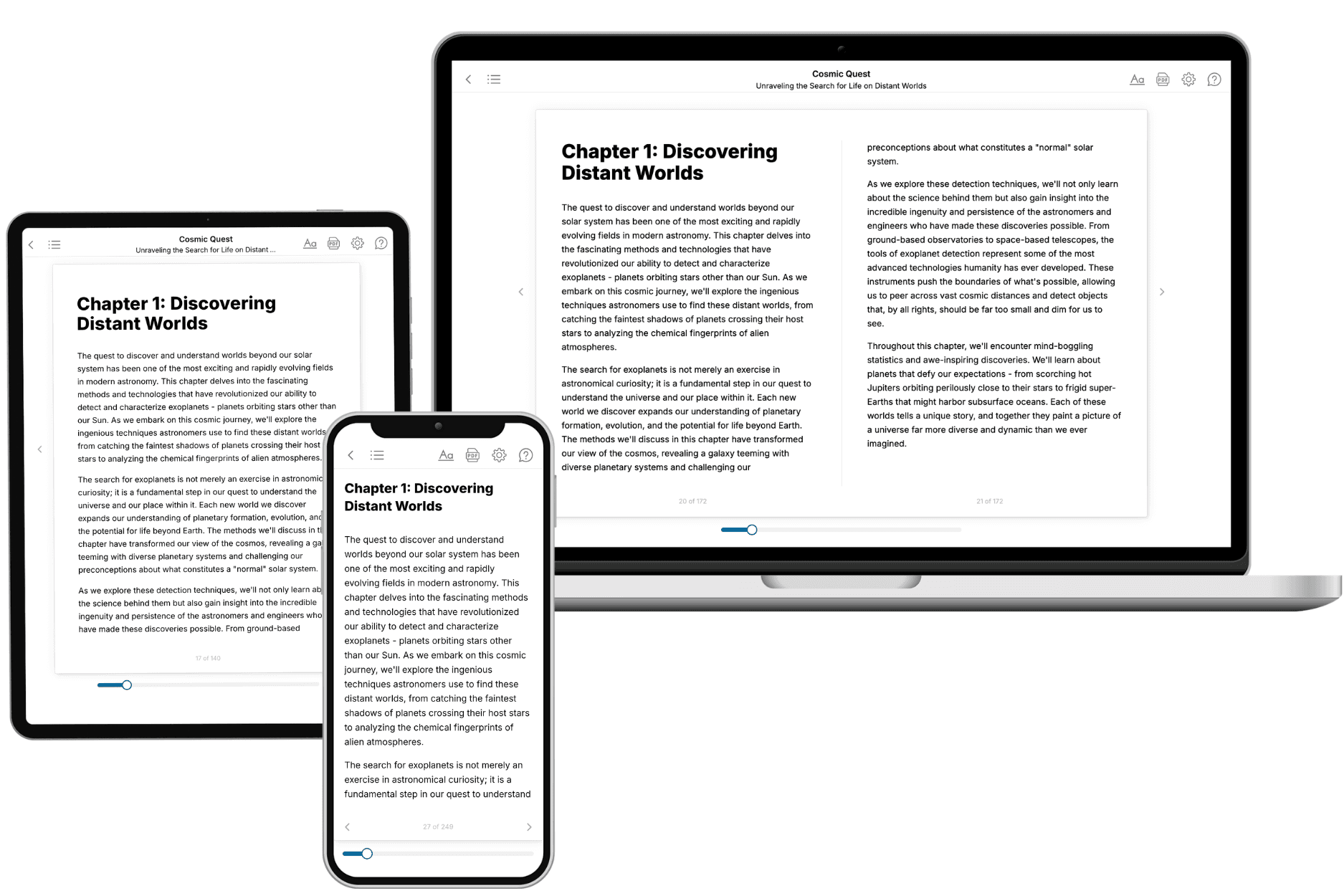
TailoredRead creates complete, full-length nonfiction ebooks, written specifically for you. Tell us what you want to learn and why, and TailoredRead writes you a complete ebook on it, with charts, tables, and diagrams throughout. Read it online, on Kindle, or on any e-reader, or download it as a PDF or EPUB. Every book is written fresh the day you order it.
- How is the book tailored to me?
Before anything is written, you answer a few short questions about your goals, your background, and the topics you care about. Your book is then planned around your answers: written at your level, focused on your goals, and covering the topics you chose, instead of the one-size-fits-all book a store sells everyone.
- Will it read like generic AI content?
No. Your book isn't a chat transcript: it's planned chapter by chapter before a single word is written, told in a clear book voice, and explains ideas visually with charts, tables, and diagrams. After writing, every book goes through an editorial pass that polishes chapters so the book reads consistent from start to finish. Judge for yourself: browse thousands of sample books on our Explore Books page.
- How accurate is the content?
Our AI first checks whether your subject needs live research. Niche and fast-moving subjects are researched before writing, and the book plan and chapters are grounded in what it finds. After writing, every book goes through a quality pass that checks its facts and consistency, and researched books list their sources in a Notes section at the back.
- How long is the book?
You choose the length: Comprehensive (250-300 pages), Detailed (150-200 pages), Essential (70-100 pages), or Short (30-50 pages).
- Does the book include visuals?
Yes. Every book includes charts, tables, and diagrams: timelines, checklists, step-by-step guides, decision trees, comparison tables, matrices, and bar charts. A typical book includes dozens of these visual elements.
- Can I read it on Kindle? What formats can I download?
Yes. Every book can be read in our online reader or downloaded as a PDF or EPUB. The EPUB can be opened with Kindle, Apple Books, Kobo, and any e-reader. The Commercial and Author licenses also include an editable Word (DOCX) and Markdown download.
- How much does it cost?
About the price of a regular ebook. The exact price depends on your book's length and complexity, from $2 for the shortest books to $35 for the most comprehensive, and it's shown when you review your book, before you commit to anything. Each book is a one-time purchase, yours to keep, no subscription. Licenses that let you share, teach, or publish your book range from $35.99 to $49.99.
- Can I preview the book before purchasing?
Before you pay, you'll see what your book will cover: the title, a detailed description, the estimated length, and the complete chapter-by-chapter table of contents, so you know what you're getting before you decide. The full text itself is written after you purchase.
- How long does it take to create a book?
About 10 minutes. You can start reading the opening chapters while the rest is still being written.