Integration Testing Mastery
Build Reliable Systems Through Strategic Testing Across Components
Imagine a development environment where integration issues are caught before they ever reach your users—where your team confidently deploys code knowing that all components work seamlessly together.
191 pages10 chaptersNov 30, 2025Software Testing
About this book
This is the reality when integration testing is done right. This book provides a comprehensive roadmap for mastering integration testing in modern software development. You'll learn how to design integration tests that actually catch real-world defects, set up reliable test environments, and automate your testing without creating maintenance nightmares. Whether you're testing APIs, databases, microservices, or third-party integrations, you'll discover practical techniques that work in real projects. Beyond theory, you'll explore how to build integration tests into your CI/CD pipeline, manage test data effectively, and debug failures systematically. You'll understand when to mock, when to use real services, and how to balance speed with accuracy. This book transforms integration testing from a frustrating afterthought into a strategic advantage that reduces bugs, accelerates releases, and builds team confidence in your software quality.
Table of contents
- IntroductionWhy Integration Testing Matters in Modern Development, Understanding Your Place in the Testing Pyramid, How to Use This BookRead below
- Chapter 1: Foundations of Integration TestingUnit Testing vs. Integration Testing: Key Differences, Defining the Scope of Your Integration Tests, Types of Integration Testing: Big Bang, Incremental, and Hybrid Approaches
- Chapter 2: Designing Your Integration Testing StrategyMapping Components and Dependencies, Identifying Critical Test Scenarios and Workflows, Planning Coverage Without Exhaustion, Risk-Based Testing Prioritization
- Chapter 3: Setting Up Your Integration Test EnvironmentDesigning a Reliable Test Environment Architecture, Isolation and Independence Between Test Runs, Managing Configuration Across Environments
- Chapter 4: Test Data Management for Integration TestingBuilding a Sustainable Test Data Strategy, Setup and Teardown: Creating Consistent Test States, Handling Sensitive Data in Integration Tests, Maintaining Test Data Over Time
- Chapter 5: Mocking and Stubbing External DependenciesWhen to Mock, When to Stub, When to Use Real Services, Popular Mocking Frameworks and Tools, Strategies for Effective Mocking in Integration Tests
- Chapter 6: API Integration TestingFundamentals of API Testing in Integration Scenarios, Testing Request/Response Contracts and Data Formats, Testing Error Handling and Edge Cases in APIs, Tools and Frameworks for API Integration Testing
- Chapter 7: Database Integration TestingWhat to Test in Database Integration, Verifying Data Persistence and Consistency, Testing Transactions and Rollback Scenarios
- Chapter 8: Automating Integration Tests in CI/CD PipelinesIntegrating Tests into Your CI/CD Pipeline, Optimizing Test Execution Speed and Parallelization, Reporting and Feedback Mechanisms, Handling Flaky Tests and Pipeline Failures
- Chapter 9: Debugging and Analyzing Integration Test FailuresSystematic Approaches to Analyzing Test Failures, Debugging Techniques for Integration Issues, Root Cause Analysis and Documentation
- Chapter 10: Maintaining and Evolving Your Integration TestsStrategies for Long-Term Test Maintenance, Refactoring Tests as Your System Evolves, Managing Technical Debt in Your Test Suite
- ConclusionBuilding a Culture of Quality Through Integration Testing
Introduction
Picture this scenario: Your development team has just deployed a new feature to production. Every unit test passed with flying colors. Code reviews were thorough. Static analysis tools gave the green light. Yet within hours of release, users are reporting errors, data inconsistencies, and unexpected behavior. The culprit? Components that worked perfectly in isolation failed when they had to communicate with each other. This is the integration gap—the space between perfectly functioning individual components and a reliably working system—and it's where some of the most costly and embarrassing software failures occur.
Integration testing exists to close this gap. While unit tests verify that individual functions and classes work correctly, and system tests validate end-to-end user workflows, integration testing focuses on the critical middle ground: ensuring that components, services, databases, APIs, and external systems work together as expected. This level of testing catches defects that are invisible to unit tests but would be catastrophic in production. A payment service might process transactions flawlessly on its own, but what happens when it needs to communicate with an inventory system, update a database, and send confirmation emails simultaneously? Integration testing answers these questions before your users discover the problems.
The modern software landscape makes integration testing more critical than ever. Microservices architectures, cloud-native applications, third-party API dependencies, and distributed systems have multiplied the number of integration points in typical applications. Each connection between components represents a potential failure point—a place where data formats might mismatch, timing issues might emerge, or unexpected states might cause cascading failures. Without systematic integration testing, these vulnerabilities remain hidden until they manifest in production environments where the cost of failure is measured not just in debugging time but in lost revenue, damaged reputation, and eroded user trust.
This book provides a comprehensive, practical guide to mastering integration testing in real-world development environments. You'll learn not just the theory behind integration testing, but the specific techniques, tools, and strategies that experienced QA professionals use to build reliable, maintainable integration test suites. Whether you're testing REST APIs, database transactions, message queues, or complex microservices interactions, you'll discover actionable approaches that work in production systems. The goal isn't to make you an expert in testing theory—it's to equip you with skills you can apply immediately to improve the quality and reliability of the systems you test.
Why Integration Testing Matters in Modern Development
Integration defects are fundamentally different from unit-level bugs, and they're often more difficult to diagnose and fix. When a unit test fails, the problem is typically localized to a specific function or class with clear inputs and outputs. When an integration test fails, the issue might involve multiple components, asynchronous communication, timing dependencies, or environmental factors. A study by the National Institute of Standards and Technology found that software bugs cost the U.S. economy approximately $59.5 billion annually, with integration and system-level defects accounting for a disproportionate share of these costs[1]. These defects are expensive because they're discovered late, require extensive debugging across multiple systems, and often necessitate coordinated fixes across several teams.
Consider a real-world example from e-commerce: An online retailer implemented a new checkout flow where the payment processing component was thoroughly unit tested and worked perfectly in isolation. However, integration testing revealed that when payment confirmation was delayed by more than three seconds due to network latency, the order management system would time out and create duplicate orders. This defect only manifested when multiple systems interacted under realistic timing conditions—something unit tests could never catch. Without integration testing, this bug would have resulted in thousands of duplicate orders, inventory discrepancies, and customer service nightmares. The integration test suite caught it before a single customer was affected.
Modern architectural patterns have dramatically increased the importance of integration testing. Microservices architectures, which break applications into dozens or hundreds of independent services, create exponentially more integration points than traditional monolithic applications. Each service boundary represents a potential failure point where contracts might be violated, data formats might mismatch, or version incompatibilities might emerge. A typical microservices application might have:
- Service-to-service communication via REST APIs, gRPC, or message queues
- Database interactions with multiple data stores (SQL, NoSQL, caches)
- Third-party integrations for payments, authentication, analytics, and more
- Event-driven workflows where actions in one service trigger cascading changes
- Shared infrastructure like configuration services, logging systems, and monitoring tools
The shift to continuous delivery and DevOps practices has also elevated integration testing from a pre-release activity to a continuous quality gate. In organizations deploying code multiple times per day, integration tests running in CI/CD pipelines are often the last line of defense before production. They need to be fast enough not to bottleneck deployments, reliable enough not to create false alarms, and comprehensive enough to catch real defects. This balance—speed, reliability, and coverage—is one of the central challenges this book addresses. You'll learn how to design integration test suites that provide meaningful quality signals without becoming a deployment bottleneck.
Integration testing also serves a critical documentation function that's often overlooked. Well-designed integration tests document how components are supposed to interact, what data formats they expect, and what error conditions they should handle. When a new developer joins your team, reading integration tests provides insight into system behavior that's often more accurate and up-to-date than written documentation. When you need to refactor a component, integration tests verify that you haven't broken existing contracts with other parts of the system. This documentation value compounds over time, making integration tests an investment that pays dividends throughout the software lifecycle.
The cost of skipping integration testing becomes apparent when you examine production incident reports. A 2019 analysis of major software outages found that approximately 40% of critical failures involved integration issues between components that had individually passed their unit tests[2]. These failures included database connection pool exhaustion under load, API timeout cascades, message queue backlogs causing memory issues, and data synchronization problems between services. Each of these issues could have been detected with appropriate integration testing, but they slipped through because testing focused primarily on unit-level verification. The organizations affected spent weeks debugging production issues, implementing emergency fixes, and dealing with customer impact—all preventable with a solid integration testing strategy.
Integration testing also addresses the reality that software doesn't run in isolation. Your application depends on databases, external APIs, authentication services, file systems, network infrastructure, and countless other components. Unit tests typically mock these dependencies, which is appropriate for testing business logic in isolation. However, mocks are simplifications that can't capture the full complexity of real systems. Databases have transaction semantics, locking behavior, and performance characteristics that mocks don't replicate. External APIs have rate limits, error conditions, and response variations that simple stubs can't simulate. Integration testing with real or realistic dependencies reveals how your code behaves in the actual environment where it will run, catching issues that mocked unit tests miss entirely.
Understanding Your Place in the Testing Pyramid
The testing pyramid is a conceptual model that helps teams balance different types of testing for optimal quality and efficiency. First popularized by Mike Cohn in his book "Succeeding with Agile," the pyramid places unit tests at the base, integration tests in the middle, and end-to-end tests at the top[3]. The shape of the pyramid reflects both the quantity and speed of tests at each level: you should have many fast unit tests, a moderate number of integration tests, and relatively few slow end-to-end tests. Understanding where integration testing fits in this model helps you design a test strategy that provides comprehensive coverage without creating unsustainable maintenance burdens or slow feedback loops.
At the base of the pyramid, unit tests verify individual functions, methods, and classes in isolation. These tests are fast (milliseconds per test), numerous (thousands in a typical application), and focused on specific logic paths. Unit tests excel at verifying business logic, edge cases, and algorithmic correctness. However, they have a fundamental limitation: they can't verify that components work together correctly. A unit test might verify that a function correctly formats a database query, but it can't confirm that the query actually works against a real database schema. This is where integration testing enters the picture, occupying the middle layer of the pyramid.
Integration tests verify that multiple components work together correctly. They're slower than unit tests (seconds to minutes per test) because they involve real or realistic dependencies like databases, APIs, or message queues. You'll have fewer integration tests than unit tests—perhaps hundreds rather than thousands—because they're more expensive to write, maintain, and execute. The key is focusing integration tests on critical interaction points and realistic workflows rather than trying to test every possible combination of components. A well-designed integration test suite provides confidence that your system's major components communicate correctly without duplicating the exhaustive coverage that unit tests already provide.
At the top of the pyramid sit end-to-end tests (also called system tests or UI tests), which verify complete user workflows through the entire application stack. These tests are the slowest (minutes to hours), most brittle, and most expensive to maintain. They're valuable for validating critical user journeys and ensuring that the entire system works from the user's perspective, but they shouldn't be your primary quality gate. Many teams make the mistake of over-investing in end-to-end tests while neglecting integration testing, resulting in slow, flaky test suites that provide delayed feedback and frustrate developers. The testing pyramid reminds us that integration tests should catch most cross-component issues before they reach the end-to-end testing phase.
Your role as a QA professional specializing in integration testing is to strengthen the middle of the pyramid. This means:
- Identifying critical integration points where components interact and failures would have significant impact
- Designing tests that verify realistic interactions without duplicating unit test coverage
- Balancing test speed with realism by using appropriate mocking and test data strategies
- Maintaining tests that remain valuable as the system evolves and new integration points emerge
- Providing fast feedback to developers about integration issues before they reach end-to-end testing
The testing pyramid isn't a rigid prescription but a guideline that adapts to your system's architecture and risk profile. Microservices architectures might justify a slightly wider middle section because integration points are more numerous and critical. Systems with complex business logic might have a wider base of unit tests. Applications with critical user workflows might invest more in end-to-end testing. The key principle remains constant: each testing level should focus on what it does best, with integration testing specializing in verifying that components communicate correctly under realistic conditions.
Understanding the testing pyramid also helps you communicate with stakeholders about testing strategy and resource allocation. When developers question why integration tests take longer to run than unit tests, you can explain the trade-off between speed and realism. When managers ask why you can't just rely on end-to-end tests, you can demonstrate how integration tests catch issues earlier and more reliably. When product owners want to know where to invest in quality improvements, you can use the pyramid model to identify gaps in your current testing approach. This shared mental model creates alignment around testing priorities and helps teams build balanced, effective test suites.
The evolution of testing practices has also introduced variations on the traditional pyramid. Some teams advocate for a "testing trophy" model that emphasizes integration testing even more, arguing that integration tests provide the best return on investment for modern applications. Others propose a "testing diamond" for microservices, with a bulge in the middle representing extensive integration testing between services. Regardless of the specific model, the underlying principle remains: integration testing occupies a critical middle ground between isolated unit tests and comprehensive end-to-end tests, and mastering this level of testing is essential for delivering reliable software systems.
How to Use This Book
This book is structured as a progressive journey through integration testing mastery, starting with foundational concepts and building toward advanced techniques for automation, debugging, and maintenance. Each chapter focuses on a specific aspect of integration testing with practical examples, actionable techniques, and real-world scenarios. You can read the book sequentially for a comprehensive education, or jump to specific chapters that address your immediate challenges. The content assumes you have basic testing knowledge and some experience with software development or QA, but it doesn't require expertise in any specific programming language or testing framework.
The early chapters establish the conceptual foundation you need to design effective integration tests. Chapter 1 clarifies what integration testing is and isn't, distinguishing it from unit and system testing while exploring different integration testing approaches. Chapter 2 guides you through designing an integration testing strategy, helping you identify what to test, how to prioritize scenarios, and how to plan coverage without attempting to test every possible combination. These chapters answer the "what" and "why" questions that inform all your subsequent testing decisions. If you're new to integration testing or want to strengthen your strategic thinking, start here.
Chapters 3 through 5 address the practical infrastructure challenges that make or break integration testing efforts. You'll learn how to set up reliable test environments that provide consistent, isolated testing conditions. You'll discover strategies for managing test data that balance realism with maintainability. You'll explore when to use mocks and stubs versus real dependencies, and how to implement effective mocking strategies. These chapters are essential for anyone struggling with flaky tests, environment configuration issues, or test data management problems. The techniques you'll learn here form the foundation for reliable, maintainable integration tests.
The middle chapters dive into specific integration testing scenarios that you'll encounter in real projects. Chapter 6 covers API integration testing, including contract testing, error handling, and tools for API verification. Chapter 7 focuses on database integration testing, addressing data persistence, transactions, and consistency verification. These chapters provide concrete techniques for the most common integration testing challenges. If you're working on a specific type of integration—APIs, databases, or external services—you can jump directly to the relevant chapter and immediately apply the techniques to your current project.
Chapters 8 through 10 address the operational aspects of integration testing in production environments. You'll learn how to integrate tests into CI/CD pipelines without creating deployment bottlenecks, how to optimize test execution speed through parallelization, and how to handle flaky tests that undermine confidence in your test suite. You'll discover systematic approaches to debugging integration test failures and performing root cause analysis. Finally, you'll explore strategies for maintaining and evolving your integration tests as your system grows and changes. These chapters are crucial for teams practicing continuous delivery or struggling with test maintenance overhead.
Throughout the book, you'll find several types of practical content designed to accelerate your learning:
- Concrete examples showing specific integration testing scenarios with actual code patterns and test structures
- Step-by-step processes for common tasks like setting up test environments or debugging failures
- Decision frameworks helping you choose between different approaches based on your context
- Common pitfalls highlighting mistakes to avoid based on real-world experience
- Tool recommendations for frameworks, libraries, and platforms that support integration testing
- Case studies illustrating how integration testing principles apply in real projects
The book is language-agnostic and framework-agnostic by design. While examples occasionally reference specific tools or technologies, the principles and techniques apply regardless of whether you're testing Java microservices, Python APIs, .NET applications, or Node.js backends. The focus is on concepts and strategies that transcend specific technology stacks. When you understand why certain approaches work, you can adapt them to whatever tools and languages your team uses. This universality makes the book valuable whether you're working in a startup with a modern tech stack or an enterprise with legacy systems.
To get the most value from this book, consider keeping a notebook or digital document where you track insights and action items relevant to your current projects. After each chapter, ask yourself: What's one technique I can apply this week? What's one problem in my current test suite that this chapter helps me solve? What's one conversation I should have with my team based on what I've learned? This active engagement transforms reading into learning and learning into improved testing practices. Integration testing mastery isn't achieved by reading alone—it comes from applying these principles in real projects, learning from failures, and continuously refining your approach.
The book concludes with a chapter on building a culture of quality through integration testing, recognizing that technical skills alone aren't sufficient. Effective integration testing requires collaboration between developers, QA professionals, and operations teams. It requires organizational support for investing in test infrastructure and maintenance. It requires a shared understanding of quality goals and testing priorities. The final chapter helps you think beyond individual techniques to consider how integration testing fits into your team's broader quality strategy and how you can advocate for the resources and practices that make integration testing successful.
Whether you're a QA professional looking to deepen your integration testing expertise, a developer who wants to write better tests, or a team lead designing a testing strategy, this book provides the knowledge and techniques you need. The goal isn't perfection—it's progress. Every integration test you write based on these principles is a potential production bug prevented, a debugging session avoided, and a step toward more reliable software. Let's begin the journey toward integration testing mastery.
Notes
Introduction
- 1. National Institute of Standards and Technology, The Economic Impacts of Inadequate Infrastructure for Software Testing, RTI Project Number 7007.011, 2002
- 2. M. Grottke and K. S. Trivedi, "Fighting Bugs," IEEE Computer, 2007
- 3. M. Cohn, Succeeding with Agile: Software Development Using Scrum, Addison-Wesley Professional, 2009
This is the end of the free sample. The full book has 10 chapters.
Want this book written for you?
Tell us your goals and background, and get your own version of this book, tailored by AI to you.


Benefits of AI-tailored books
- Read one book, not ten:
- all the Software Testing knowledge you need, gathered into a single book.
- Save days of learning:
- tell us your goals, choose your topics, and the whole book is built around them.
- Learn effortlessly:
- Software Testing book written for your specific background and expertise.
- Understand at a glance:
- includes charts, tables, timelines, checklists, decision trees, and more.
- Stay current:
- written the day you order it, not years ago.
- Trust what you read:
- every book is checked for accuracy, with real research when your subject needs it.
Create your unique book in 3 steps
- 1. Select your focus
Select the focus of your Software Testing book and share your background
- 2. Personalize your book
Specify your goals and choose sub-topics to include
- 3. Get your tailored book
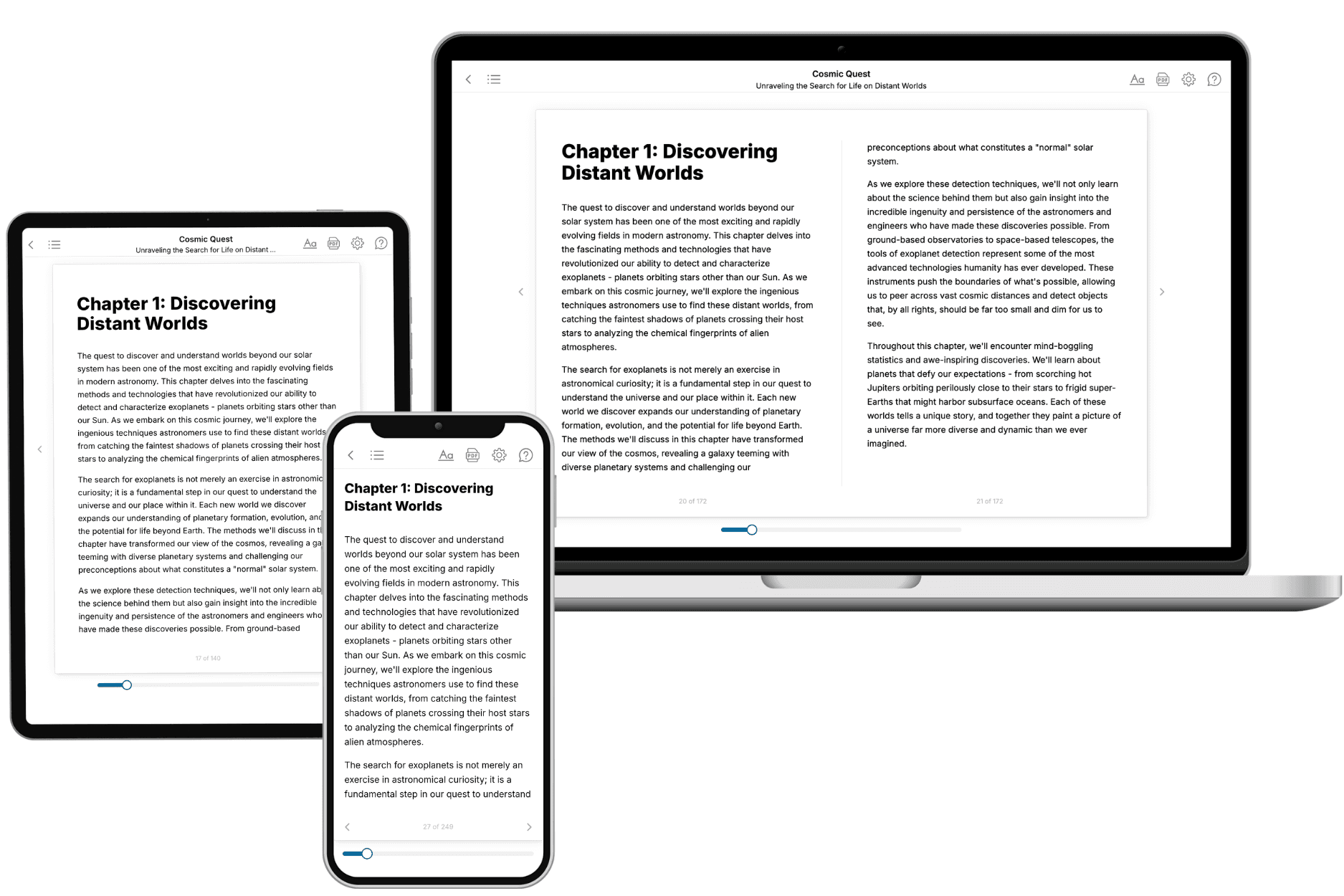
Your book is ready in 10 minutes. Read it online, download as EPUB or PDF, or send to Kindle.

Frequently asked questions
- What is TailoredRead?
TailoredRead creates complete, full-length nonfiction ebooks, written specifically for you. Tell us what you want to learn and why, and TailoredRead writes you a complete ebook on it, with charts, tables, and diagrams throughout. Read it online, on Kindle, or on any e-reader, or download it as a PDF or EPUB. Every book is written fresh the day you order it.
- How is the book tailored to me?
Before anything is written, you answer a few short questions about your goals, your background, and the topics you care about. Your book is then planned around your answers: written at your level, focused on your goals, and covering the topics you chose, instead of the one-size-fits-all book a store sells everyone.
- Will it read like generic AI content?
No. Your book isn't a chat transcript: it's planned chapter by chapter before a single word is written, told in a clear book voice, and explains ideas visually with charts, tables, and diagrams. After writing, every book goes through an editorial pass that polishes chapters so the book reads consistent from start to finish. Judge for yourself: browse thousands of sample books on our Explore Books page.
- How accurate is the content?
Our AI first checks whether your subject needs live research. Niche and fast-moving subjects are researched before writing, and the book plan and chapters are grounded in what it finds. After writing, every book goes through a quality pass that checks its facts and consistency, and researched books list their sources in a Notes section at the back.
- How long is the book?
You choose the length: Comprehensive (250-300 pages), Detailed (150-200 pages), Essential (70-100 pages), or Short (30-50 pages).
- Does the book include visuals?
Yes. Every book includes charts, tables, and diagrams: timelines, checklists, step-by-step guides, decision trees, comparison tables, matrices, and bar charts. A typical book includes dozens of these visual elements.
- Can I read it on Kindle? What formats can I download?
Yes. Every book can be read in our online reader or downloaded as a PDF or EPUB. The EPUB can be opened with Kindle, Apple Books, Kobo, and any e-reader. The Commercial and Author licenses also include an editable Word (DOCX) and Markdown download.
- How much does it cost?
About the price of a regular ebook. The exact price depends on your book's length and complexity, from $2 for the shortest books to $35 for the most comprehensive, and it's shown when you review your book, before you commit to anything. Each book is a one-time purchase, yours to keep, no subscription. Licenses that let you share, teach, or publish your book range from $35.99 to $49.99.
- Can I preview the book before purchasing?
Before you pay, you'll see what your book will cover: the title, a detailed description, the estimated length, and the complete chapter-by-chapter table of contents, so you know what you're getting before you decide. The full text itself is written after you purchase.
- How long does it take to create a book?
About 10 minutes. You can start reading the opening chapters while the rest is still being written.