About this book
This book offers that clarity. It guides you through the central puzzle of modern economic history: how a species whose living standards hovered at subsistence for millennia came to experience sustained, compounding growth. Drawing on the work of economic historians, institutional theorists, and growth economists, it weighs the rival accounts of the Industrial Revolution and its precursors. You will travel from Malthusian constraints to the coal fields of northern England, from the Yangtze Delta to the counting houses of London, and from the workshops of Enlightenment Britain to the debates over geography versus institutions. Along the way, the book connects abstract theory to concrete episodes such as the Glorious Revolution, the rise of the joint-stock company, and the diffusion of the steam engine. Written for a thoughtful reader who values argument as much as evidence, it treats each explanation fairly, exposes its assumptions, and equips you to form your own judgment about how the modern economic world came to be.
Table of contents
- IntroductionThe Long Puzzle of Stagnant Living Standards, Why the Origins of Growth Still Matter, How to Read the Competing ExplanationsRead below
- Chapter 1: Escaping the Malthusian TrapMalthus, Population, and the Limits of Land, Agricultural Revolution and Rising Productivity, When the Trap Finally Loosened
- Chapter 2: What Modern Economic Growth Really MeansThe Great Enrichment and Its Measurement, Real Wage Debates and Competing Measures, Economic Models of Growth Compared
- Chapter 3: Ideas, Knowledge, and the EnlightenmentEnlightenment Ideas and Their Economic Uses, How Scientific Knowledge Compounded Over Time, The Industrial Enlightenment and Practical Networks
- Chapter 4: Property Rights and the Institutional FoundationsThe Origins of Secure Property Rights, Acemoglu's Theory of Inclusive Institutions, The Glorious Revolution and Its Consequences
- Chapter 5: Finance, Banking, and the Joint-Stock EconomyThe Bank of England and Public Credit, Britain's Financial Revolution in Context, The Rise of the Joint-Stock Company
- Chapter 6: Technological Change and the Patent SystemPatent Incentives and the Logic of Invention, Textile Mechanization and Its Wider Impact, Steam Power and the Diffusion of Innovation
- Chapter 7: Coal, Energy, and Britain's AdvantageBritain's Coal Advantage Examined, The Transition to a Fossil Fuel Economy, Geography Versus Institutions in Practice
- Chapter 8: The Great Divergence: Britain and ChinaThe Yangtze Delta and Pre-Modern Prosperity, Silver, Trade, and Global Economic Flows, Pomeranz, Allen, and the Divergence Debate
- Chapter 9: Colonialism, Extraction, and Global TradeThe Economics of Colonial Extraction, Smith's Division of Labor and Global Markets, Diamond and Morris on Long-Run Development
- Chapter 10: Creative Destruction and the Costs of GrowthSchumpeter's Theory of Creative Destruction, Winners, Losers, and the Politics of Change, Judging Competing Explanations of Take-Off
- ConclusionSynthesizing the Major Explanations, Open Questions for Future Inquiry
- Further Reading and Resources
- Glossary
Introduction
A farmer in Flanders in the year 1300 and a farmer in Flanders in the year 1700 would have recognized almost everything about each other's lives. Same crops, same plow, same thatched roof, same fear of a bad harvest turning into a famine. Four centuries passed, dynasties rose and fell, wars reshaped maps, and yet the material texture of an ordinary life barely moved. Then, within the span of a few generations starting in Britain, that pattern broke. Output per person began to climb and kept climbing, decade after decade, in a way no society had ever sustained before. This book is about why that break happened where and when it did.
The break itself has a name among economic historians: the Great Enrichment. Other chapters in this book will define that term carefully and show how economists measure it. The introduction has a narrower job. It needs to make clear why the question of origins is so hard, why serious scholars still disagree about the answer after two centuries of study, and why a careful reader should approach the rival explanations with both curiosity and skepticism. None of the theories on offer, whether they center on institutions, energy, culture, or trade, can claim to have settled the matter on its own.
Part of the difficulty is that the transformation did not announce itself. There was no single invention, treaty, or battle that historians can point to and say, there, that is where stagnation ended.
Instead there was a slow accumulation of smaller shifts in law, finance, knowledge, and machinery, concentrated in one corner of northwestern Europe, that only in retrospect look like a single story. Reconstructing that story means weighing causes that worked over different timescales, from the centuries-long buildup of secure property rights to the sudden political rupture of the Glorious Revolution in 1688. Each later chapter in this book takes one strand of that story and follows it closely.
A second difficulty is that explanations compete for the same evidence. A rise in textile output in Lancashire can be read as proof that patents rewarded inventors, or as proof that cheap coal made steam-powered looms profitable, or as proof that colonial markets created demand no domestic economy could have generated alone. All three readings are defensible, and most economic historians now think all three forces mattered together rather than any one of them acting alone. Holding multiple explanations in mind at once, without rushing to pick a favorite, is the discipline this book asks of its reader.
The three sections that follow lay the groundwork for everything after them. The first names the puzzle precisely: why living standards sat still for so long, and what that stillness implied about the kind of change that eventually broke it. The second explains why getting the origin story right is not merely an antiquarian exercise, since it shapes how people think about growth, inequality, and development today. The third offers a framework for reading the rival accounts in the chapters ahead, so that each theory can be judged on its own terms rather than measured against a straw version of its rivals.
The Long Puzzle of Stagnant Living Standards
Consider a thought experiment that economic historians return to often. Take a skilled craftsman in Rome under Emperor Trajan, around the year 100, and compare his standard of living to a skilled craftsman in London under Charles the First, around 1630. Despite fifteen centuries separating them, the technology each could call on for lighting, heating, transport, and food production was broadly similar. Candles, not electric light. Horses and sailing ships, not engines. Hand tools, not machines. Grain yields that had crept upward only slightly, limited by the same constraints of soil, weather, and seed. The gap between them, if it existed at all, was far smaller than the gap between either of them and a craftsman in London just two centuries later still.
This flatness was not an accident of bad luck or missing genius. It followed from a mechanism that Thomas Malthus described with unusual clarity at the end of the eighteenth century, even as the mechanism he described was about to stop applying to the country he lived in.[1] Population, Malthus argued, tends to grow faster than the food supply that sustains it, because land is fixed while people are not. Any gain in agricultural output, whether from a better plow or a mild run of good weather, tends to get absorbed by population growth rather than converted into higher living standards. More food means more surviving children, and more surviving children means more mouths competing for the same land a generation later.
Economic historians now call this self-correcting mechanism the Malthusian trap, and it functioned through two distinct channels that Malthus himself distinguished. The positive check operated through mortality: when population outran food supply, famine, malnutrition, and disease cut numbers back down. The preventive check operated through fertility: people delayed marriage or had fewer children when resources grew scarce, heading off the worst mortality crises before they struck. Northwestern Europe leaned more heavily on the preventive check than many other regions, which is one reason its pre-modern demographic history looks somewhat less brutal, but the underlying ceiling on living standards held regardless of which check did the work.
The result was what might be called an organic economy ceiling, a term economic historians use for the limit that pre-industrial societies ran into because almost every form of energy they used, whether for heating, cooking, transport, or mechanical work, ultimately traced back to recent plant growth. Firewood, animal fodder, and human muscle all drew on the same finite flow of solar energy captured by land in a given year. Expand population and you expand demand on that flow, but the flow itself cannot expand nearly as fast, since it is capped by how much land exists and how much sunlight it receives. Growth in this kind of economy ran into limits of a basically different character than the limits a modern economy faces.
None of this means pre-modern societies were static in every sense. They built empires, developed sophisticated law and philosophy, and produced extraordinary art and architecture. Population did grow over the long run, slowly, and technology did improve, incrementally. The puzzle is narrower and more specific than why didn't anything change
. It is why gains in productivity, when they occurred, kept translating into more people rather than into higher output per person, generation after generation, across civilizations as different as Han China, Abbasid Baghdad, and medieval France. That translation mechanism is what needed to break for sustained growth to become possible at all.
A useful way to see the scale of what eventually happened is to compare the rate of change across different eras. Across most of recorded history, output per person moved so slowly that centuries could pass without a detectable improvement visible to the people living through them. Starting in Britain in the late eighteenth century, and then spreading outward over the following two centuries, the rate of change in output per person accelerated to a pace unprecedented in the historical record, as the chart below indicates in broad strokes.
| Period | Output per person index | |
|---|---|---|
| Year 1000 | 100 | |
| Year 1500 | 110 | |
| Year 1700 | 120 | |
| Year 1850 | 180 | |
| Year 1950 | 420 | |
| Year 2000 | 950 |
The jump visible in that chart is not a smooth continuation of earlier trends, it is a break in the trend line itself. For centuries, a line plotting output per person would have looked nearly flat, with small bumps for good harvests and dips for plagues and wars, always returning to roughly the same long-run level. After the break, the line bends sharply upward and keeps climbing instead of returning to baseline. Explaining that bend, rather than simply describing the technologies that accompanied it, is the actual target of this book. A list of inventions, however impressive, does not by itself explain why their gains stopped being absorbed by population growth.
One more piece of the puzzle deserves attention before moving on: the trap was not just an economic mechanism, it was also a demographic and even psychological one. People in Malthusian economies were not ignorant of the tradeoffs they faced, they often married later, limited family size, or migrated when local conditions tightened, exactly the preventive check in action. What changed after the escape was not that these choices stopped mattering, but that rising income no longer triggered the same proportional increase in population that would cancel out the gain. Other chapters trace exactly when and how that link between income and population growth weakened in Britain's case.
It is tempting to imagine the escape as a single door that opened once and let everyone through together, but the historical record does not support that image. Parts of Europe experienced partial, temporary loosenings of the Malthusian ceiling well before the eighteenth century, periods of rising real wages following population collapses such as the one after the Black Death, only to see the ceiling reassert itself once population recovered. The genuine escape had to be something durable enough to survive population recovery rather than a temporary slack created by a demographic shock. That durability is exactly what makes the eventual escape historically remarkable rather than merely one fluctuation among many.
Several candidate mechanisms for a durable escape have been proposed over the decades, and part of the value of studying this period is learning to evaluate them side by side rather than picking the first one encountered. Some scholars emphasize agricultural productivity gains freeing up labor for other pursuits. Others emphasize institutional changes that altered incentives to invest and innovate. Still others emphasize a new energy source that broke the organic ceiling directly. The table below previews these broad families of explanation, each of which gets developed in full in a later chapter.
| Explanation family | Core mechanism | Where it is developed |
|---|---|---|
| Agricultural productivity | Freed labor and food surplus loosen the land constraint | Escaping the Malthusian Trap |
| Institutions and property rights | Secure returns to investment change incentives to innovate | Property Rights and the Institutional Foundations |
| Finance and capital markets | Public credit and joint-stock organization mobilize large-scale investment | Finance, Banking, and the Joint-Stock Economy |
| Energy and geography | Coal replaces land as the binding constraint on output | Coal, Energy, and Britain's Advantage |
| Trade and global markets | Colonial demand and resource flows widen the market for industry | Colonialism, Extraction, and Global Trade |
Keeping these families distinct in mind matters because they are frequently blurred together in popular retellings, which tend to compress the whole story into a single cause, usually either genius inventors or lucky geography. The chapters ahead treat each family on its own terms, specify what evidence supports it, and note where that evidence runs thin or contested. None of the families fully explains the escape in isolation, and the strongest accounts in the historical literature tend to be the ones that show how two or more of them reinforced each other over time, an argument this book returns to directly in its final chapters.
What should stick from this opening discussion is a sense of scale and a sense of mechanism together. The scale is the sheer length of the stagnation, measured not in decades but in millennia, and the abruptness of the break relative to that long baseline. The mechanism is the Malthusian link between productivity gains and population growth, a link so persistent across civilizations that its breakdown in one particular place and period demands explanation rather than acceptance as simply what progress looks like. Carrying both of these forward sets up the stakes for the argument that follows.
Why the Origins of Growth Still Matter
It would be easy to treat the question of how growth began as a piece of historical trivia, interesting in the way that any distant puzzle is interesting, but with no bearing on how anyone should think or act today. That view underestimates how much the explanation chosen for the past quietly shapes expectations about the present. If growth is believed to have started because of a lucky coal deposit, the lesson transferred to poorer countries today is that resource endowment is close to destiny, a conclusion with real consequences for how aid and investment get allocated. If growth is believed to have started because of institutional reform, the lesson transferred is that legal and political change can unlock prosperity anywhere, a far more hopeful but also more demanding claim.
This is not an abstract concern. Development economics as a field has swung between these emphases more than once, and policy recommendations have followed each swing. In the mid-twentieth century, large infrastructure investment and capital transfer were often treated as the key missing ingredient for poor countries, an assumption that drew directly on growth models emphasizing capital accumulation. By the 1990s, emphasis had shifted heavily toward governance, property rights, and the rule of law, following the influence of institutional economists who argued that capital without secure institutions tends to be squandered, misallocated, or captured by elites rather than invested productively.
The institutional turn in development economics owes a great deal to the comparative historical work of economists such as Daron Acemoglu and James Robinson, whose research contrasted former colonies that inherited extractive institutions with those that inherited more inclusive institutions, arguing that this difference explains much of the variation in prosperity observed today.[2] Their work draws directly on the historical case of Britain's own institutional development, since Britain's trajectory is treated as a template for what inclusive institutions look like in practice. A later chapter in this book examines their theory in detail, including the objections raised against it, but its influence on current policy debates is itself a reason to take the historical case seriously rather than treating it as settled background.
There is also a quieter but important stake in how the origin story treats the relationship between resources and human choice. An account that leans entirely on geography, such as an emphasis on Britain's coal deposits lying unusually close to its iron and its waterways, can slide into a kind of fatalism about development, implying that societies without comparable resource luck were simply never going to industrialize regardless of what they did. An account that leans entirely on culture or ideas can slide into the opposite error, implying that any society could have industrialized at any time if only it had thought differently, which ignores real material constraints that no amount of cleverness could overcome on its own.
The most careful historical accounts try to avoid both traps by specifying how resources and institutions interacted rather than treating either as sufficient on its own. Coal mattered, but it mattered because British institutions and markets were positioned to exploit it profitably once steam technology made it exploitable. Patents mattered, but they mattered because Britain had courts and enforcement mechanisms capable of making a patent grant worth something in practice, unlike jurisdictions where a legal right existed on paper but could not be defended. This book treats that kind of interaction claim as the frontier of the debate rather than a compromise position reached by splitting the difference.
Beyond policy, there is a more personal stake in getting the history right, one closer to how any thoughtful person reasons about change and progress. Origin stories function as implicit models for what kind of interventions actually work, whether in a national economy, an organization, or even a personal project. Someone convinced that the Industrial Revolution happened because a handful of brilliant inventors simply had better ideas is more likely to overweight individual genius and underweight supporting institutions when thinking about innovation elsewhere. Someone convinced it happened entirely through structural forces beyond anyone's control is more likely to underweight the agency of specific actors, specific laws, and specific decisions that historical research shows did matter.
A further reason the debate matters is that it is still actively unsettled among specialists, not merely among popular writers compressing history for a general audience. The Great Divergence debate, examined closely later in this book, shows just how much hinges on which comparison point gets chosen and which variables get held constant. Economic historian Kenneth Pomeranz argued that the most developed regions of China, particularly the Yangtze Delta, looked remarkably similar to England in measures of wages, consumption, and market sophistication as late as 1750, a claim now known as the Pomeranz thesis.[3] If that similarity is accepted, then explanations resting on supposedly deep and long-standing European institutional superiority become much harder to sustain, and the weight of explanation shifts toward more contingent and recent factors like coal access and colonial trade.
That shift in emphasis is not a minor technical dispute confined to specialist journals, it changes the entire moral and political coloring of the story. A story in which Europe pulled ahead because of institutions built up gradually over centuries can read as a story of earned advantage, however complicated the earning. A story in which Europe pulled ahead largely through a combination of geographic luck and the forcible extraction of resources from colonized regions reads very differently, and carries real implications for how historical responsibility and present-day inequality get discussed. Economic historian Robert Allen contributed a related argument, known as the Allen high-wage hypothesis, proposing that unusually high wages in Britain specifically created the incentive to substitute capital and energy for labor, a dynamic not present in regions where labor stayed cheap.[4]
None of this is raised to suggest that historical inquiry should be steered by its political implications, which would corrupt the inquiry itself. It is raised because pretending the stakes are purely academic misrepresents how these arguments actually function once they leave the seminar room. A reader who understands why economic historians argue so persistently over seemingly narrow questions, such as whether Yangtze Delta wages in 1750 matched English wages, is better positioned to see why the field has not converged on a single textbook answer and is unlikely to converge on one soon. That lack of convergence is not a failure of the field, it reflects a genuinely difficult evidentiary problem spanning centuries and continents.
A further stake worth naming directly concerns the costs of growth, not only its benefits. Explanations of take-off that focus exclusively on aggregate output risk obscuring how unevenly those gains were distributed and how disruptive the transition was for people whose livelihoods depended on the old arrangements. The handloom weavers displaced by mechanized textile production, examined later through the lens of Schumpeterian creative destruction, experienced the Industrial Revolution as loss long before later generations experienced it as enrichment. An origin story that only counts aggregate gains and ignores this distributional history gives an incomplete account even of the economics, let alone the ethics.
Taken together, these considerations argue for treating the question of origins as live and consequential rather than finished and merely interesting. The explanation accepted for how a handful of societies escaped millennia of stagnation shapes, whether explicitly argued or quietly assumed, how people today reason about poverty, policy, resource constraints, and the proper role of institutions in building prosperity elsewhere. That is a substantial weight to place on a historical question, which is exactly why it deserves the careful, comparative treatment the rest of this book attempts to give it.
How to Read the Competing Explanations
Reading economic history responsibly requires a different posture than reading a single connected argument from start to finish, since no single argument in this field has earned the right to be read as simply correct. Each later chapter in this book presents an explanation, backed by real researchers and real evidence, but also carrying specific assumptions and specific limits. The goal in reading them is not to settle on a favorite and discard the rest, it is to notice what each explanation is actually claiming, what evidence would count against it, and what it conveniently leaves out. A short set of questions, applied consistently, makes that kind of reading much easier to sustain across chapters covering very different material.
The first and most important question to ask of any explanation is what counterfactual it relies on. Claiming that coal gave Britain a decisive advantage only means something relative to an implied alternative, such as a Britain without accessible coal, or a France with equally accessible coal, and the strength of the claim depends heavily on how plausible that alternative actually is. Claiming that patents incentivized invention only means something relative to a counterfactual world without patent protection, and economic historians disagree sharply about how inventors would have behaved in that world, since some evidence suggests important inventions occurred without patent protection at all. Asking what is this being compared to
before accepting a causal claim is the single most useful habit a reader can bring to this material.
The second question concerns the direction of causation, since correlation across a handful of historical cases is cheap and causation is expensive to establish. Britain had secure property rights and also experienced an industrial take-off, but did secure property rights cause the take-off, did the take-off create the political conditions for more secure property rights, or did some third factor, such as an unusually commercialized rural economy, produce both outcomes independently? Historical explanations are especially vulnerable to this confusion because the small number of genuine cases, essentially a handful of early industrializers, makes statistical disentangling of cause from correlation far harder than in modern economic research with thousands of observations.
The decision tree below offers one practical way to organize this kind of causal scrutiny while moving through later chapters, applying the same basic checks to whichever explanation is on the page at the time.
A quick check for any proposed cause of take-off
- Does the explanation name a clear counterfactual?
- No Treat the claim as suggestive, not established
- Yes Could the arrow of causation run the other way?
- Yes, plausibly Weigh both directions before accepting the claim
- No, direction is clear Check whether it rests on one case only
- Multiple cases support it Treat the claim as reasonably well supported
- Only Britain fits Look for a second independent case before trusting it
A third question worth asking is what kind of claim is actually being made, since explanations in this field operate at different levels and are easily mistaken for rivals when they are not. An argument about secure property rights making investment rational is a claim about incentives facing individuals and firms. An argument about Britain's coal advantage is a claim about physical resource constraints. An argument about the division of labor expanding with market size, developed by Adam Smith, is a claim about organizational efficiency.[5] These operate at different levels of the system and can all be true simultaneously, since an incentive claim, a resource claim, and an organizational claim describe different parts of the same machine rather than competing for the same explanatory slot.
Placing an explanation on this matrix does not settle whether it is correct, but it clarifies what kind of claim is on the table and what kind of evidence would actually test it.
A fourth habit worth building is attention to the difference between a necessary condition and a sufficient one, a distinction economic historians use carefully but that popular summaries frequently flatten. Secure property rights may well have been necessary for sustained investment in new machinery, in the sense that investment was unlikely without them, without being sufficient on their own to produce an industrial take-off, since many societies with reasonably secure property rights never industrialized at all. Recognizing a factor as necessary rather than sufficient allows multiple explanations to sit together without contradiction, since a full account of take-off likely requires several necessary conditions arriving together rather than any single sufficient cause acting alone.
A fifth and related habit is watching for anachronism, the tendency to read later outcomes back into earlier causes as though observers at the time could see what was coming. Patent law in eighteenth-century Britain was not designed with an industrial revolution in mind, it evolved out of older royal practices for granting monopolies and was reformed piecemeal in response to specific disputes and complaints. Treating it as though it were deliberately engineered to produce mechanized textile production misreads the historical record and makes the eventual outcome look more inevitable than it was. The same caution applies to Enlightenment science, financial innovation, and nearly every other factor examined in this book.
It helps to keep a short checklist close at hand while working through the chapters that follow, not as a rigid test but as a set of prompts that keep the reading active rather than passive. The checklist below compresses the habits described above into a form that can be applied quickly to any specific claim, whether encountered in this book or in other historical reading.
None of these habits are meant to produce suspicion toward every claim encountered, which would make serious engagement with the evidence impossible. They are meant to produce the kind of reading that takes each explanation seriously enough to test it properly, rather than accepting or rejecting it based on how neatly it fits a preferred narrative. Economic historians themselves disagree using exactly these tools, pointing to different counterfactuals, different directions of causation, and different weighting of necessary versus sufficient conditions when they argue with each other in print.
The chapters ahead move roughly from the deepest and slowest-moving factors toward the more contingent and specific ones, starting with the long Malthusian stasis and the agricultural shifts that began loosening it, before turning to institutions, finance, technology, energy, global trade, and finally the uneven human costs of the growth that resulted. Treat that ordering as a path through the argument rather than a ranking of importance, since the book's own position, developed most fully in its concluding chapters, is that the strongest account of take-off is one that shows these factors interacting rather than competing. Carrying the questions from this section forward is what will make that final synthesis legible rather than merely asserted.
Notes
Introduction
- 1. Thomas Malthus, "An Essay on the Principle of Population," J. Johnson, 1798
- 2. Daron Acemoglu and James Robinson, Why Nations Fail, Crown Business, 2012
- 3. Kenneth Pomeranz, The Great Divergence, Princeton University Press, 2000
- 4. Robert Allen, The British Industrial Revolution in Global Perspective, Cambridge University Press, 2009
- 5. Adam Smith, "An Inquiry into the Nature and Causes of the Wealth of Nations," W. Strahan and T. Cadell, 1776
This is the end of the free sample. The full book has 10 chapters.
Want this book written for you?
Tell us your goals and background, and get your own version of this book, tailored by AI to you.


Benefits of AI-tailored books
- Read one book, not ten:
- all the knowledge you need, gathered into a single book.
- Save days of learning:
- tell us your goals, choose your topics, and the whole book is built around them.
- Learn effortlessly:
- a book written for your specific background and expertise.
- Understand at a glance:
- includes charts, tables, timelines, checklists, decision trees, and more.
- Stay current:
- written the day you order it, not years ago.
- Trust what you read:
- every book is checked for accuracy, with real research when your subject needs it.

Create your unique book in 3 steps
- 1. Pick a subject
Select what you want to learn and share your background
- 2. Personalize your book
Specify your goals and choose sub-topics to include
- 3. Get your tailored book
Your book is ready in 10 minutes. Read it online, download as EPUB or PDF, or send to Kindle.


Frequently asked questions
- What is TailoredRead?
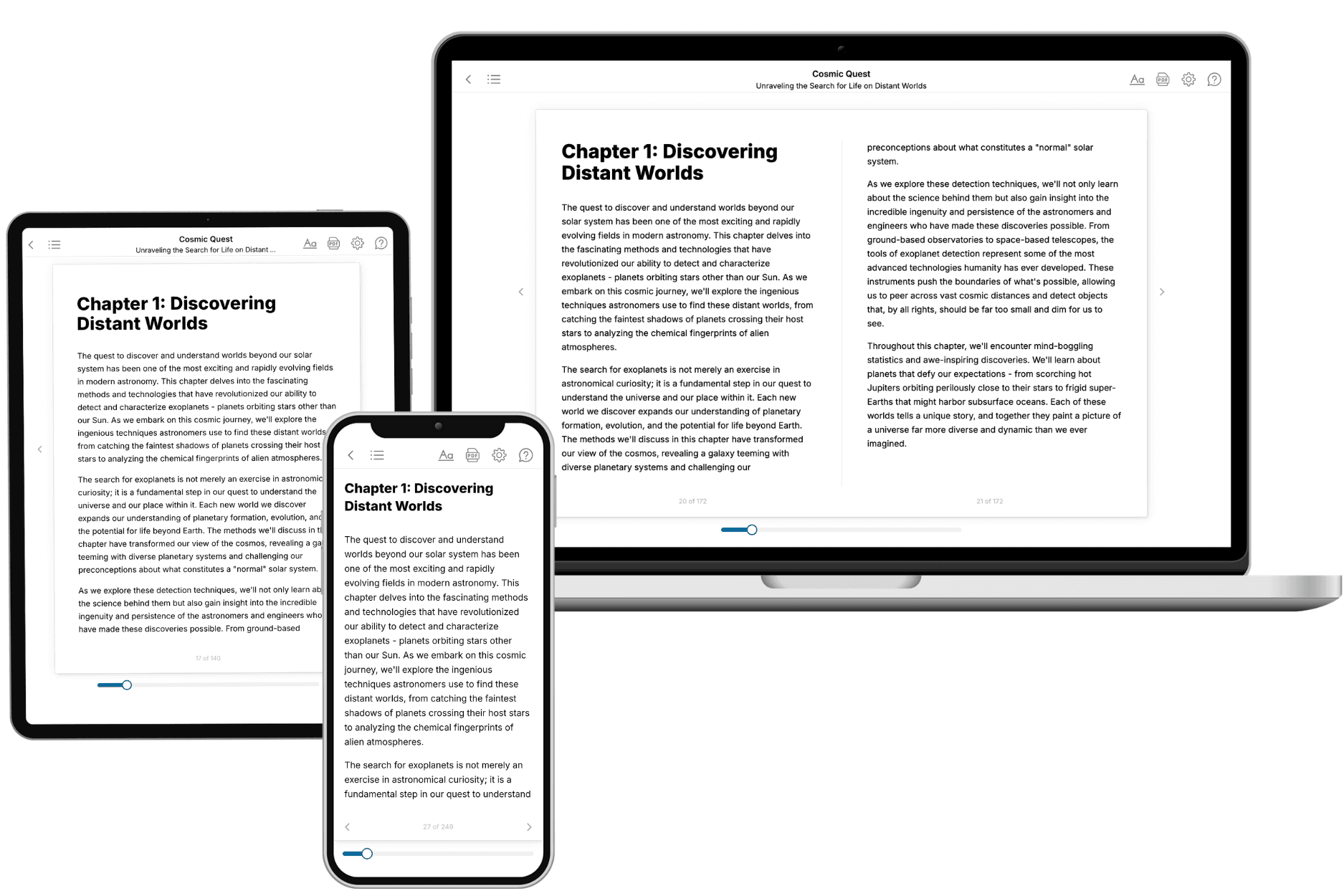
TailoredRead creates complete, full-length nonfiction ebooks, written specifically for you. Tell us what you want to learn and why, and TailoredRead writes you a complete ebook on it, with charts, tables, and diagrams throughout. Read it online, on Kindle, or on any e-reader, or download it as a PDF or EPUB. Every book is written fresh the day you order it.
- How is the book tailored to me?
Before anything is written, you answer a few short questions about your goals, your background, and the topics you care about. Your book is then planned around your answers: written at your level, focused on your goals, and covering the topics you chose, instead of the one-size-fits-all book a store sells everyone.
- Will it read like generic AI content?
No. Your book isn't a chat transcript: it's planned chapter by chapter before a single word is written, told in a clear book voice, and explains ideas visually with charts, tables, and diagrams. After writing, every book goes through an editorial pass that polishes chapters so the book reads consistent from start to finish. Judge for yourself: browse thousands of sample books on our Explore Books page.
- How accurate is the content?
Our AI first checks whether your subject needs live research. Niche and fast-moving subjects are researched before writing, and the book plan and chapters are grounded in what it finds. After writing, every book goes through a quality pass that checks its facts and consistency, and researched books list their sources in a Notes section at the back.
- How long is the book?
You choose the length: Comprehensive (250-300 pages), Detailed (150-200 pages), Essential (70-100 pages), or Short (30-50 pages).
- Does the book include visuals?
Yes. Every book includes charts, tables, and diagrams: timelines, checklists, step-by-step guides, decision trees, comparison tables, matrices, and bar charts. A typical book includes dozens of these visual elements.
- Can I read it on Kindle? What formats can I download?
Yes. Every book can be read in our online reader or downloaded as a PDF or EPUB. The EPUB can be opened with Kindle, Apple Books, Kobo, and any e-reader. The Commercial and Author licenses also include an editable Word (DOCX) and Markdown download.
- How much does it cost?
About the price of a regular ebook. The exact price depends on your book's length and complexity, from $2 for the shortest books to $35 for the most comprehensive, and it's shown when you review your book, before you commit to anything. Each book is a one-time purchase, yours to keep, no subscription. Licenses that let you share, teach, or publish your book range from $35.99 to $49.99.
- Can I preview the book before purchasing?
Before you pay, you'll see what your book will cover: the title, a detailed description, the estimated length, and the complete chapter-by-chapter table of contents, so you know what you're getting before you decide. The full text itself is written after you purchase.
- How long does it take to create a book?
About 10 minutes. You can start reading the opening chapters while the rest is still being written.