Mastering Gaussian Mixture Models
A Complete Guide to Probabilistic Clustering and Data Analysis
Build sophisticated clustering solutions that reveal hidden patterns in your data through the power of probabilistic modeling.
284 pages16 chaptersOct 16, 2025Machine Learning
About this book
This comprehensive guide takes you from the mathematical foundations of Gaussian distributions to advanced implementation techniques for real-world applications. You'll discover how Gaussian Mixture Models outperform traditional clustering methods by handling overlapping clusters, providing probabilistic assignments, and adapting to complex data structures. Through clear explanations and practical examples, you'll learn to implement the Expectation-Maximization algorithm, select optimal model parameters, and avoid common pitfalls that derail clustering projects. The book covers essential topics including initialization strategies, regularization techniques, model selection criteria, and performance optimization. You'll explore advanced applications beyond clustering, including density estimation, anomaly detection, and dimensionality reduction, giving you a complete toolkit for probabilistic data analysis. Whether you're working with customer segmentation, image processing, or scientific data analysis, this guide provides the theoretical understanding and practical skills needed to leverage GMMs effectively in your machine learning pipeline.
Table of contents
- IntroductionThe Modern Clustering Landscape, Why Probabilistic Clustering Matters, Advantages of Gaussian Mixture Models, How This Book Is OrganizedRead below
- Chapter 1: Mathematical FoundationsProbability Theory Essentials, Understanding Gaussian Distributions, Multivariate Gaussian Distributions, Mixture Model Concepts
- Chapter 2: Clustering FundamentalsTypes of Clustering Algorithms, Hard vs Soft Clustering, Clustering Evaluation Metrics, Common Clustering Challenges
- Chapter 3: Gaussian Mixture Model TheoryDefining Gaussian Mixture Models, The Likelihood Function, Latent Variables and Hidden Structure, Parameter Estimation Challenges
- Chapter 4: The Expectation-Maximization AlgorithmEM Algorithm Intuition, The Expectation Step, The Maximization Step, Convergence Properties and Guarantees
- Chapter 5: Basic ImplementationAlgorithm Structure and Flow, Data Preprocessing Requirements, Parameter Initialization Strategies, Convergence and Stopping Criteria
- Chapter 6: Initialization StrategiesRandom Initialization Methods, K-means Based Initialization, Advanced Initialization Techniques, Impact on Convergence and Results
- Chapter 7: Model Selection and ValidationChoosing the Number of Components, Information Criteria (AIC, BIC), Cross-Validation Techniques, Comparing Different Models
- Chapter 8: Covariance Structures and ConstraintsTypes of Covariance Matrices, Spherical and Diagonal Covariances, Full Covariance Matrices, Tied Covariance Structures
- Chapter 9: Regularization and Numerical StabilityCommon Numerical Problems, Regularization Methods, Handling Singular Covariance Matrices, Maintaining Numerical Precision
- Chapter 10: Performance OptimizationComputational Complexity Analysis, Vectorization and Matrix Operations, Memory Optimization Strategies, Parallel Processing Approaches
- Chapter 11: High-Dimensional Data ChallengesThe Curse of Dimensionality, Dimensionality Reduction Preprocessing, Feature Selection for GMMs, Handling Sparse Data
- Chapter 12: Density Estimation ApplicationsEstimating Probability Densities, Generative Modeling with GMMs, Sampling from Mixture Models, Visualizing Density Estimates
- Chapter 13: Anomaly Detection with GMMsOutlier and Anomaly Concepts, Setting Likelihood Thresholds, Anomaly Scoring Methods, Evaluation Metrics for Anomaly Detection
- Chapter 14: Semi-Supervised LearningCombining Labeled and Unlabeled Data, Integrating Prior Knowledge, Active Learning Strategies, Performance Gains from Labels
- Chapter 15: Online and Incremental LearningHandling Streaming Data, Incremental EM Algorithms, Adapting to Concept Drift, Memory Management for Online Learning
- Chapter 16: Practical Applications and Case StudiesImage Segmentation and Computer Vision, Customer Segmentation Analysis, Bioinformatics and Genomics, Speech and Audio Processing
- ConclusionKey Takeaways and Best Practices, Future Directions and Research
Introduction
Data clustering stands as one of the most fundamental challenges in machine learning and data science. Every day, organizations and researchers face the task of making sense of vast, unlabeled datasets—from customer behavior patterns to genetic sequences, from image pixels to sensor readings. The ability to discover hidden structure in data without predefined labels has become increasingly critical as data volumes grow exponentially. Traditional clustering methods have served us well for decades, but they often fall short when dealing with the complexity and ambiguity inherent in real-world data. This is where Gaussian Mixture Models emerge as a powerful alternative, offering a probabilistic framework that captures the nuanced, overlapping nature of natural data distributions.
Gaussian Mixture Models represent a paradigm shift from rigid, boundary-based clustering to flexible, probability-based modeling. Unlike algorithms that force each data point into exactly one cluster, GMMs acknowledge that reality is rarely so clear-cut. A customer might exhibit purchasing behaviors that span multiple segments. An image pixel might belong partially to both foreground and background. A gene expression pattern might reflect multiple biological processes simultaneously. GMMs embrace this ambiguity by modeling data as arising from a mixture of multiple Gaussian distributions, each representing a distinct cluster or component. This probabilistic approach not only provides more realistic representations of complex data but also enables sophisticated applications beyond simple clustering, including density estimation, anomaly detection, and generative modeling.
This book provides a comprehensive journey through the theory, implementation, and application of Gaussian Mixture Models. Whether you're a data scientist seeking to enhance your clustering toolkit, a machine learning engineer building production systems, or a researcher exploring advanced probabilistic methods, you'll find practical guidance grounded in solid mathematical foundations. The content balances theoretical rigor with hands-on implementation details, ensuring you understand not just how GMMs work, but why they work and when to apply them. You'll learn to navigate common pitfalls, optimize performance, and extend GMMs to solve diverse real-world problems. By the end of this book, you'll possess both the conceptual understanding and practical skills needed to leverage GMMs effectively in your own projects.
The Modern Clustering Landscape
The field of clustering has evolved dramatically since its early days, expanding from simple partitioning algorithms to sophisticated probabilistic models. Today's clustering landscape encompasses a diverse array of approaches, each with distinct strengths and limitations. K-means clustering remains ubiquitous due to its simplicity and speed, partitioning data into spherical clusters by minimizing within-cluster variance. Hierarchical clustering builds tree-like structures that reveal nested relationships at multiple scales. Density-based methods like DBSCAN identify clusters of arbitrary shape by examining local density patterns. Spectral clustering leverages graph theory and eigenvalue decomposition to uncover complex cluster structures. Each approach makes implicit assumptions about cluster shape, size, and separation that may or may not align with your data's true structure.
Despite this rich ecosystem of clustering algorithms, many traditional methods share a common limitation: they perform hard clustering, assigning each data point definitively to a single cluster. This binary decision-making process works well when clusters are well-separated and clearly defined, but real-world data rarely cooperates so neatly. Consider a dataset of customer transactions where some customers exhibit hybrid behaviors—they might purchase both budget and premium products, or shop across multiple product categories with similar frequency. Hard clustering forces an artificial choice, assigning such customers to one segment while ignoring their affinity to others. This loss of information can lead to oversimplified models that miss important nuances in the data structure.
The limitations of hard clustering become particularly apparent in several common scenarios that data scientists encounter regularly:
- Overlapping clusters: When natural groupings in data share significant overlap, hard boundaries create artificial separations that don't reflect the underlying distribution
- Uncertainty quantification: Business decisions often require understanding confidence levels, but hard clustering provides no measure of assignment certainty
- Outlier handling: Points that lie between clusters or far from any cluster center must still be assigned somewhere, potentially distorting cluster statistics
- Variable cluster shapes: Real clusters may be elliptical, elongated, or have different sizes and orientations that spherical assumptions cannot capture
Modern machine learning applications demand more sophisticated approaches that can handle these complexities. In customer analytics, marketers need to understand the degree to which customers belong to multiple segments to create nuanced targeting strategies. In image processing, pixels often represent transitions between regions rather than belonging purely to one segment. In bioinformatics, gene expression patterns frequently reflect multiple overlapping biological processes. These applications require clustering methods that provide probabilistic assignments, capturing the inherent uncertainty and overlap in the data. This need has driven increased adoption of probabilistic clustering approaches, with Gaussian Mixture Models standing out as one of the most theoretically sound and practically effective solutions.
The rise of big data and complex machine learning pipelines has further elevated the importance of probabilistic clustering. Modern data science workflows often chain multiple models together, where the output of one model feeds into another. Hard cluster assignments create information bottlenecks in these pipelines, discarding uncertainty that downstream models might leverage. Probabilistic assignments, by contrast, propagate uncertainty through the pipeline, allowing subsequent models to make more informed decisions. Additionally, as organizations increasingly deploy machine learning in high-stakes domains—healthcare diagnostics, autonomous systems, fraud detection—the ability to quantify uncertainty becomes not just desirable but essential for responsible AI deployment.
GMMs have emerged as a cornerstone of probabilistic clustering precisely because they address these modern requirements while maintaining computational tractability. Unlike some probabilistic methods that require complex inference procedures or make restrictive assumptions, GMMs strike a balance between flexibility and practicality. They can model clusters of different shapes, sizes, and orientations through their covariance structures. They provide interpretable probability distributions that quantify assignment uncertainty. They connect naturally to fundamental statistical concepts, making them accessible to practitioners with traditional statistics backgrounds. Most importantly, they come with well-established algorithms—particularly the Expectation-Maximization algorithm—that reliably converge to good solutions in practice.
Understanding where GMMs fit in the broader clustering landscape helps you make informed decisions about when to apply them. GMMs excel when your data exhibits characteristics like overlapping clusters, elliptical cluster shapes, or when you need probabilistic assignments for downstream tasks. They work particularly well with continuous numerical data that approximately follows Gaussian distributions within clusters. However, they may not be the best choice for every scenario. When clusters have highly irregular shapes or varying densities, density-based methods might perform better. When you need strict hierarchical relationships, hierarchical clustering provides more appropriate structure. When computational resources are severely constrained and data is high-dimensional, simpler methods like k-means might be more practical. The key is recognizing that GMMs are a powerful tool in your clustering toolkit, not a universal solution to all clustering problems.
Why Probabilistic Clustering Matters
Probabilistic clustering fundamentally changes how we think about grouping data by replacing definitive assignments with probability distributions. Instead of declaring that a data point belongs to cluster A, probabilistic methods state that the point has, say, a 70% probability of belonging to cluster A, 25% to cluster B, and 5% to cluster C. This seemingly simple shift has profound implications for how we model, interpret, and apply clustering results. The probabilistic framework acknowledges that cluster boundaries are inherently fuzzy in most real-world datasets, and that forcing hard decisions often discards valuable information. By maintaining uncertainty throughout the analysis, probabilistic clustering enables more nuanced insights and more robust downstream applications.
The advantages of probabilistic clustering become immediately apparent when working with ambiguous data points. Consider a concrete example from customer segmentation: imagine analyzing purchasing behavior to identify customer types. Customer Alice purchases primarily electronics but occasionally buys home goods. Customer Bob splits purchases evenly between electronics and home goods. Customer Carol buys mostly home goods with rare electronics purchases. A hard clustering algorithm might assign all three to different clusters based on which category dominates their purchases, treating Bob's balanced behavior as equivalent to either Alice or Carol. A probabilistic approach, however, captures the gradation: Alice might be 90% electronics-focused, Bob 50-50, and Carol 90% home-goods-focused. This richer representation preserves information that could be crucial for targeted marketing campaigns or inventory planning.
Probabilistic assignments enable sophisticated applications that hard clustering cannot support. One powerful application is soft decision-making, where downstream systems can weight their actions by cluster membership probabilities. For instance, a recommendation system might blend recommendations from multiple customer segments proportionally to a user's membership probabilities in each segment, creating more personalized suggestions than treating the user as belonging to a single segment. Similarly, in image segmentation, probabilistic assignments allow smooth transitions between regions rather than harsh boundaries, producing more natural-looking results. In anomaly detection, examining the probability distribution across clusters helps identify not just outliers but also points that don't fit well into any cluster—a more nuanced form of anomaly than simple distance-based methods provide.
The probabilistic framework also provides natural mechanisms for quantifying and communicating uncertainty, which is increasingly important in responsible machine learning deployment. When a clustering model assigns a data point with high confidence (e.g., 95% probability to one cluster), you can trust that assignment for critical decisions. When assignments are uncertain (e.g., 40% to one cluster, 35% to another, 25% to a third), this signals that the point lies in an ambiguous region where additional scrutiny or alternative approaches might be warranted. This uncertainty quantification proves invaluable in several contexts:
- Quality control: Flagging uncertain assignments for manual review in high-stakes applications
- Active learning: Identifying ambiguous points where obtaining labels would most improve model performance
- Model validation: Assessing whether cluster boundaries are well-defined or if the data structure is genuinely ambiguous
- Risk management: Understanding confidence levels when clustering informs business decisions or automated actions
Probabilistic clustering also facilitates more principled model selection and evaluation. With hard clustering, comparing models with different numbers of clusters often relies on heuristic metrics or visual inspection. Probabilistic models, by contrast, provide likelihood-based measures that quantify how well the model explains the observed data. Information criteria like the Bayesian Information Criterion (BIC) and Akaike Information Criterion (AIC) balance model fit against complexity, providing objective guidance for selecting the number of clusters. These criteria have solid theoretical foundations in statistics and information theory, making model selection less arbitrary and more defensible. Additionally, the probabilistic framework enables Bayesian approaches that incorporate prior knowledge and provide posterior distributions over model parameters, further enriching the analysis.
From a theoretical perspective, probabilistic clustering connects naturally to fundamental concepts in statistics and machine learning. Viewing clustering as density estimation—modeling the probability distribution that generated the observed data—provides a unified framework that encompasses clustering, generative modeling, and anomaly detection. This perspective reveals that clustering is not just about grouping similar points, but about understanding the underlying data-generating process. GMMs, in particular, model data as arising from a mixture of Gaussian distributions, each representing a distinct mode in the probability density. This generative view enables applications beyond clustering: you can sample new data points from the learned distribution, estimate probabilities for unseen points, or use the model as a component in larger probabilistic graphical models.
The shift to probabilistic thinking also changes how we approach common clustering challenges. Consider the problem of determining the optimal number of clusters. With hard clustering, this often involves running the algorithm multiple times with different cluster counts and comparing results using metrics like silhouette scores or elbow plots—methods that can be subjective and inconsistent. Probabilistic models frame this as a model selection problem with well-established statistical solutions. The likelihood of the data under different models provides a principled comparison metric, and information criteria automatically penalize overly complex models that might overfit. This statistical rigor makes the clustering process more reproducible and the results more trustworthy, particularly important when clustering informs consequential decisions.
Perhaps most importantly, probabilistic clustering aligns better with how humans naturally think about categories and groupings. In reality, categories are rarely absolute—they exist on spectrums with fuzzy boundaries. A person might be somewhat introverted and somewhat extroverted depending on context. A document might partially belong to multiple topics. A biological sample might exhibit characteristics of multiple disease states. Probabilistic clustering captures this natural ambiguity in a mathematically rigorous way, producing results that feel more intuitive and actionable than forced binary assignments. This alignment between the mathematical framework and human intuition makes probabilistic clustering results easier to interpret, communicate, and apply in practice.
Advantages of Gaussian Mixture Models
Gaussian Mixture Models stand out among probabilistic clustering methods due to their unique combination of flexibility, interpretability, and computational tractability. At their core, GMMs model data as arising from a mixture of multiple Gaussian (normal) distributions, each representing a cluster component. This seemingly simple formulation provides remarkable expressive power: by combining multiple Gaussians with different means, covariances, and mixing weights, GMMs can approximate a wide variety of complex probability distributions. The Gaussian distribution's mathematical properties—particularly its behavior under linear transformations and its maximum entropy property—make GMMs both theoretically elegant and practically effective. Unlike some probabilistic models that require complex inference procedures, GMMs can be efficiently trained using the Expectation-Maximization algorithm, which reliably converges to local optima.
One of GMMs' most significant advantages is their ability to model clusters with different shapes, sizes, and orientations through their covariance structures. Each Gaussian component has a covariance matrix that determines the cluster's shape and orientation in the feature space. A full covariance matrix allows elliptical clusters that can be stretched and rotated in any direction, capturing elongated or tilted cluster structures that spherical methods like k-means cannot represent. A diagonal covariance matrix produces axis-aligned elliptical clusters, reducing parameters while still allowing different spreads along different dimensions. A spherical covariance matrix creates circular clusters similar to k-means but within a probabilistic framework. This flexibility in covariance structures lets you match the model complexity to your data characteristics and computational constraints.
GMMs provide interpretable parameters that directly correspond to intuitive cluster properties, making results easier to understand and communicate to stakeholders. Each mixture component has three types of parameters:
- Mean vector (μ): The center or typical value of the cluster, directly interpretable in the original feature space
- Covariance matrix (Σ): The spread and shape of the cluster, showing which features vary together and how dispersed the cluster is
- Mixing weight (π): The proportion of data points belonging to this cluster, indicating relative cluster sizes
The probabilistic nature of GMMs enables soft clustering assignments that capture uncertainty and overlap between clusters. For each data point, GMMs compute the posterior probability of belonging to each component—the probability that the point was generated by that particular Gaussian distribution given the observed data. These probabilities sum to one across all components, providing a complete probabilistic description of cluster membership. This soft assignment proves invaluable in numerous scenarios: identifying boundary points that lie between clusters, detecting outliers that don't fit well into any cluster, and propagating uncertainty to downstream models. The posterior probabilities also enable weighted analyses where you can compute cluster statistics that account for partial memberships rather than treating all assignments as equally certain.
GMMs excel at handling overlapping clusters, a common characteristic of real-world data that causes problems for many clustering algorithms. When clusters overlap, hard clustering methods must draw arbitrary boundaries that may not reflect the true data structure. GMMs, by contrast, naturally model overlap through their mixture formulation. Points in overlapping regions receive significant posterior probabilities for multiple components, accurately representing their ambiguous status. This capability makes GMMs particularly effective for applications where overlap is inherent to the problem domain. For example, in image segmentation, pixels at object boundaries naturally belong partially to multiple regions. In document clustering, articles covering multiple topics should be associated with multiple clusters. GMMs handle these situations gracefully without requiring special preprocessing or post-processing steps.
The connection between GMMs and maximum likelihood estimation provides a principled framework for parameter learning and model selection. Training a GMM involves finding parameters that maximize the likelihood of the observed data—the probability of generating the observed points from the mixture model. This maximum likelihood principle has deep roots in statistical theory and provides desirable properties like consistency and efficiency under appropriate conditions. The Expectation-Maximization algorithm, which iteratively refines parameter estimates to increase likelihood, comes with convergence guarantees and well-understood behavior. This theoretical foundation makes GMM training more reliable and predictable than heuristic optimization procedures, and enables sophisticated extensions like Bayesian GMMs that incorporate prior knowledge through Bayesian inference.
GMMs serve as versatile building blocks that extend beyond simple clustering to support diverse machine learning tasks. As density estimators, GMMs model the probability distribution of your data, enabling you to compute probabilities for new points, generate synthetic samples, or identify regions of high and low density. For anomaly detection, points with low probability under the learned GMM can be flagged as outliers or anomalies. In dimensionality reduction, GMMs can be combined with techniques like factor analysis to learn low-dimensional representations. For semi-supervised learning, GMMs naturally incorporate labeled data by constraining certain points to specific components. This versatility means that investing time in understanding GMMs pays dividends across multiple application areas, not just clustering.
The computational efficiency of GMMs makes them practical for real-world applications with moderate to large datasets. While GMMs are more computationally intensive than simple methods like k-means, they remain tractable for many practical scenarios. The EM algorithm's computational complexity scales linearly with the number of data points and quadratically with dimensionality (for full covariance matrices), making it feasible for datasets with thousands to millions of points and dozens to hundreds of features. Modern implementations leverage vectorized operations and efficient linear algebra libraries to achieve good performance. Additionally, various approximations and constraints on covariance structures can reduce computational costs when necessary. For instance, using diagonal covariances reduces complexity from quadratic to linear in dimensionality, enabling application to higher-dimensional data while retaining more flexibility than spherical assumptions.
Finally, GMMs benefit from extensive theoretical analysis, mature implementations, and a large body of research literature. The mathematical properties of Gaussian distributions and mixture models have been studied for decades, providing deep understanding of their behavior, limitations, and extensions. This mature theoretical foundation means you can find answers to questions about convergence, identifiability, asymptotic properties, and optimal usage. Practical implementations are available in virtually every major machine learning library and programming language, often with optimized code and extensive documentation. The research literature contains numerous extensions and variations—robust GMMs, infinite mixture models, constrained GMMs, and more—that address specific challenges or application domains. This rich ecosystem makes GMMs a safe, well-supported choice for production systems and research projects alike.
How This Book Is Organized
This book follows a carefully structured progression from mathematical foundations through practical implementation to advanced applications, ensuring you build a complete understanding of Gaussian Mixture Models. The early chapters establish the theoretical groundwork necessary for understanding how and why GMMs work, covering probability theory, Gaussian distributions, and clustering fundamentals. The middle chapters dive deep into GMM theory and the Expectation-Maximization algorithm, providing both intuitive explanations and mathematical rigor. Later chapters focus on practical implementation concerns, optimization techniques, and real-world applications. This structure allows you to either read sequentially for comprehensive coverage or jump to specific chapters based on your needs and background. Each chapter builds on previous material while remaining as self-contained as possible, with cross-references to related sections when deeper understanding requires connecting multiple concepts.
The book is organized into four main parts, though these divisions are conceptual rather than explicitly marked. Part One (Chapters 1-2) covers foundational material that underpins everything that follows. Chapter 1 reviews essential probability theory and introduces univariate and multivariate Gaussian distributions, ensuring you understand the building blocks of GMMs. Chapter 2 surveys the clustering landscape, comparing different clustering paradigms and establishing evaluation metrics. If you have a strong background in probability and statistics, you might skim these chapters, but they contain important notation and concepts referenced throughout the book. Even experienced practitioners often find value in the unified treatment of Gaussian distributions and mixture concepts.
The second conceptual part, Chapters 3-5, forms the theoretical and algorithmic core of the book. Chapter 3 formally defines Gaussian Mixture Models, derives the likelihood function, and explains the role of latent variables in representing cluster assignments. Chapter 4 provides a comprehensive treatment of the Expectation-Maximization algorithm, the workhorse method for training GMMs. You'll understand not just the mechanical steps of EM but the intuition behind why it works and its convergence properties. Chapter 5 bridges theory and practice by walking through basic implementation, covering data preprocessing, parameter initialization, and convergence criteria. These chapters are essential reading for anyone seeking to truly understand GMMs rather than just applying them as black boxes. The mathematical content is presented with both formal notation and intuitive explanations, making it accessible to readers with varying mathematical backgrounds.
The third part, Chapters 6-11, addresses practical implementation concerns that determine whether GMMs succeed or fail in real applications. These chapters cover topics that are often overlooked in theoretical treatments but prove critical in practice:
- Chapter 6: Initialization strategies that dramatically impact convergence and final results
- Chapter 7: Model selection techniques for choosing the number of components and comparing models
- Chapter 8: Covariance structures and constraints that balance flexibility with computational efficiency
- Chapter 9: Regularization and numerical stability techniques that prevent common failure modes
- Chapter 10: Performance optimization strategies for handling large datasets efficiently
- Chapter 11: Special considerations for high-dimensional data where standard approaches break down
The final part, Chapters 12-16, explores advanced applications and extensions that leverage GMMs beyond basic clustering. Chapter 12 covers density estimation, showing how GMMs model probability distributions and enable generative modeling. Chapter 13 focuses on anomaly detection, using GMMs to identify outliers and unusual patterns. Chapter 14 introduces semi-supervised learning with GMMs, incorporating labeled data and prior knowledge. Chapter 15 addresses online and incremental learning for streaming data scenarios. Chapter 16 presents detailed case studies across diverse domains—image processing, customer analytics, bioinformatics, and speech processing—demonstrating how GMMs solve real-world problems. These chapters showcase GMMs' versatility and provide templates for applying them in your own domain.
Throughout the book, you'll find several recurring elements designed to enhance understanding and practical application. Mathematical derivations are presented with step-by-step explanations, showing not just the final result but the reasoning behind each step. Concrete examples illustrate abstract concepts with specific scenarios and numerical values. Implementation notes provide practical guidance on translating theory into code, including common pitfalls and debugging strategies. Comparative analyses help you understand when GMMs are appropriate versus when alternative methods might be better. Visual illustrations are described in detail to help you visualize concepts even without seeing actual figures. This multi-faceted approach ensures that different learning styles are accommodated and that you develop both conceptual understanding and practical skills.
The book assumes you have intermediate-level knowledge of machine learning, linear algebra, and probability theory. You should be comfortable with concepts like vectors, matrices, matrix multiplication, probability distributions, and basic calculus. Familiarity with Python or another programming language for data science is helpful but not strictly required, as the focus is on concepts and algorithms rather than specific code implementations. If you find certain mathematical sections challenging, don't let that stop you from continuing—the practical chapters provide value even if you skip some derivations. Conversely, if you want deeper mathematical treatment, the footnotes and references point to additional resources for further study.
To get the most from this book, consider your learning goals and adjust your reading approach accordingly. If you're primarily interested in applying GMMs to solve practical problems, you might focus on Chapters 3-7 for core concepts, then jump to the application chapters (12-16) most relevant to your domain, referring back to implementation chapters (8-11) as needed. If you're building GMM implementations from scratch or contributing to machine learning libraries, you'll want to read sequentially through all chapters, paying special attention to the algorithmic details and optimization techniques. If you're conducting research or need deep theoretical understanding, focus on the mathematical derivations and theoretical properties, supplementing with the cited research literature. Regardless of your path through the book, the comprehensive index and cross-references will help you navigate to relevant material when questions arise.
By the end of this book, you will have developed a complete understanding of Gaussian Mixture Models from multiple perspectives. You'll understand the mathematical foundations that make GMMs work, the algorithmic techniques that make them practical, and the application strategies that make them valuable. You'll be able to implement GMMs from scratch, use existing libraries effectively, debug problems when they arise, and make informed decisions about when GMMs are appropriate for your problems. Most importantly, you'll have developed intuition about probabilistic clustering that extends beyond GMMs to inform your broader machine learning practice. The journey from basic probability theory to advanced applications is substantial, but each step builds naturally on the previous ones, creating a coherent narrative that transforms GMMs from mysterious black boxes into well-understood, powerful tools in your machine learning toolkit.
This is the end of the free sample. The full book has 16 chapters.
Want this book written for you?
Tell us your goals and background, and get your own version of this book, tailored by AI to you.


Benefits of AI-tailored books
- Read one book, not ten:
- all the Machine Learning knowledge you need, gathered into a single book.
- Save days of learning:
- tell us your goals, choose your topics, and the whole book is built around them.
- Learn effortlessly:
- Machine Learning book written for your specific background and expertise.
- Understand at a glance:
- includes charts, tables, timelines, checklists, decision trees, and more.
- Stay current:
- written the day you order it, not years ago.
- Trust what you read:
- every book is checked for accuracy, with real research when your subject needs it.
Create your unique book in 3 steps
- 1. Select your focus
Select the focus of your Machine Learning book and share your background
- 2. Personalize your book
Specify your goals and choose sub-topics to include
- 3. Get your tailored book
Your book is ready in 10 minutes. Read it online, download as EPUB or PDF, or send to Kindle.


Frequently asked questions
- What is TailoredRead?
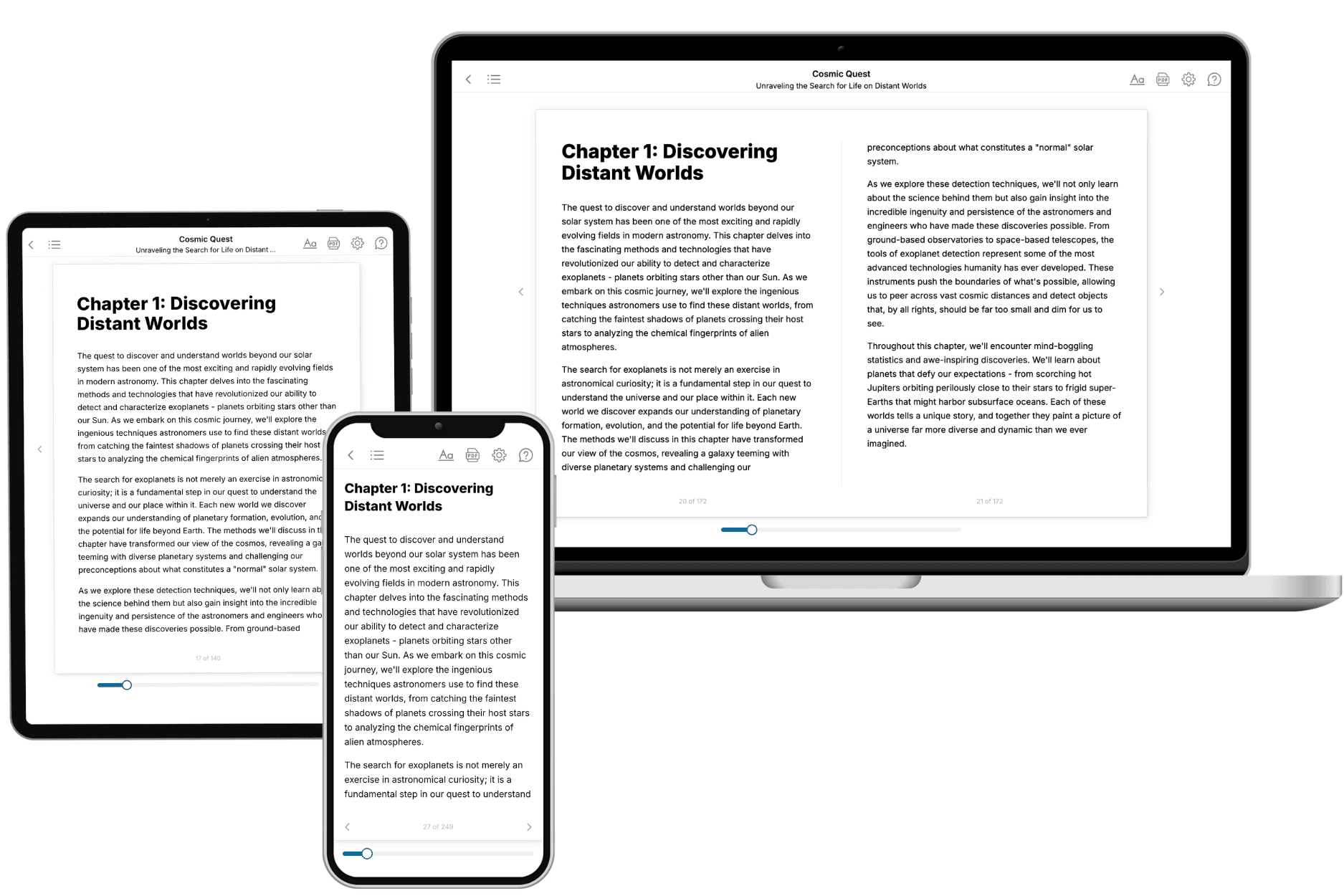
TailoredRead creates complete, full-length nonfiction ebooks, written specifically for you. Tell us what you want to learn and why, and TailoredRead writes you a complete ebook on it, with charts, tables, and diagrams throughout. Read it online, on Kindle, or on any e-reader, or download it as a PDF or EPUB. Every book is written fresh the day you order it.
- How is the book tailored to me?
Before anything is written, you answer a few short questions about your goals, your background, and the topics you care about. Your book is then planned around your answers: written at your level, focused on your goals, and covering the topics you chose, instead of the one-size-fits-all book a store sells everyone.
- Will it read like generic AI content?
No. Your book isn't a chat transcript: it's planned chapter by chapter before a single word is written, told in a clear book voice, and explains ideas visually with charts, tables, and diagrams. After writing, every book goes through an editorial pass that polishes chapters so the book reads consistent from start to finish. Judge for yourself: browse thousands of sample books on our Explore Books page.
- How accurate is the content?
Our AI first checks whether your subject needs live research. Niche and fast-moving subjects are researched before writing, and the book plan and chapters are grounded in what it finds. After writing, every book goes through a quality pass that checks its facts and consistency, and researched books list their sources in a Notes section at the back.
- How long is the book?
You choose the length: Comprehensive (250-300 pages), Detailed (150-200 pages), Essential (70-100 pages), or Short (30-50 pages).
- Does the book include visuals?
Yes. Every book includes charts, tables, and diagrams: timelines, checklists, step-by-step guides, decision trees, comparison tables, matrices, and bar charts. A typical book includes dozens of these visual elements.
- Can I read it on Kindle? What formats can I download?
Yes. Every book can be read in our online reader or downloaded as a PDF or EPUB. The EPUB can be opened with Kindle, Apple Books, Kobo, and any e-reader. The Commercial and Author licenses also include an editable Word (DOCX) and Markdown download.
- How much does it cost?
About the price of a regular ebook. The exact price depends on your book's length and complexity, from $2 for the shortest books to $35 for the most comprehensive, and it's shown when you review your book, before you commit to anything. Each book is a one-time purchase, yours to keep, no subscription. Licenses that let you share, teach, or publish your book range from $35.99 to $49.99.
- Can I preview the book before purchasing?
Before you pay, you'll see what your book will cover: the title, a detailed description, the estimated length, and the complete chapter-by-chapter table of contents, so you know what you're getting before you decide. The full text itself is written after you purchase.
- How long does it take to create a book?
About 10 minutes. You can start reading the opening chapters while the rest is still being written.