MCP Server Mastery
A Comprehensive Guide to Deploying and Optimizing on AWS SageMaker
Think setting up an MCP server on AWS SageMaker is just about clicking a few buttons?
284 pages14 chaptersMay 10, 2025DevopsCreated by Chris
About this book
Think again. The complexities of containerization, DevOps integration, and performance optimization can quickly turn your dream setup into a nightmare. MCP Server Mastery is your ultimate companion in navigating the intricate world of MCP server deployment on AWS SageMaker. This book goes beyond basic setup, diving deep into advanced topics like GPU optimization, auto-scaling strategies, and ML pipeline integration. You'll learn how to design fault-tolerant architectures, implement robust security measures, and create efficient CI/CD pipelines. From containerizing MCP components to fine-tuning SageMaker deployments, this guide covers it all. You'll discover practical techniques for resource monitoring, cost optimization, and team training. With hands-on examples and real-world scenarios, you'll be equipped to tackle any challenge in your MCP server journey. Whether you're looking to enhance scalability, streamline workflows, or boost overall efficiency, MCP Server Mastery provides the insights and strategies you need. Get ready to take your MCP server skills to the next level and become the go-to expert in your organization.
Table of contents
- IntroductionUnderstanding MCP and Its Importance, Introduction to AWS SageMaker, How to Use This Book, Prerequisites and SetupRead below
- Chapter 1: Containerizing MCP ComponentsDocker Fundamentals for MCP, Creating an MCP Dockerfile, Optimizing MCP Containers, Multi-Container MCP Setups
- Chapter 2: Deploying MCP on AWS SageMakerSetting Up SageMaker for MCP, MCP Deployment Options in SageMaker, Managing MCP Configurations, Automating MCP Deployment
- Chapter 3: MCP Architecture DesignDesigning for Scalability, Implementing Fault Tolerance, Ensuring High Availability, Network Architecture for MCP
- Chapter 4: Optimizing MCP PerformanceKey Performance Metrics for MCP, GPU Optimization Techniques, Maximizing Resource Utilization, Network Performance Tuning
- Chapter 5: Scaling MCP InfrastructureImplementing Auto-scaling, Load Balancing Strategies, Horizontal vs. Vertical Scaling, Best Practices for Scaling MCP
- Chapter 6: Securing MCP DeploymentsImplementing Access Control, Network Security for MCP, Data Encryption Strategies, Security Monitoring and Auditing
- Chapter 7: Monitoring and LoggingChoosing Monitoring Tools, Effective Log Management, Setting Up Alerting Systems, Creating Performance Dashboards
- Chapter 8: Integrating MCP with DevOpsBuilding CI/CD Pipelines for MCP, Infrastructure as Code for MCP, Version Control Strategies, Automated Testing for MCP
- Chapter 9: Integrating MCP with ML PipelinesUnderstanding ML Workflows, Data Preprocessing in MCP, Model Training Integration, Optimizing Inference in MCP
- Chapter 10: Cost Optimization StrategiesEffective Resource Planning, Leveraging Spot Instances, Rightsizing MCP Deployments, Monitoring and Reducing Costs
- Chapter 11: Troubleshooting MCP IssuesCommon MCP Problems and Solutions, Advanced Debugging Techniques, Identifying Performance Bottlenecks, Implementing Robust Error Handling
- Chapter 12: MCP Best PracticesConfiguration Management Best Practices, Backup and Recovery Strategies, Creating Comprehensive Documentation, Training Your Team on MCP
- Chapter 13: Advanced MCP TopicsDeveloping Custom MCP Extensions, Designing Robust APIs for MCP, Integrating MCP with Big Data Systems, Optimizing UI/UX for MCP Applications
- Chapter 14: Future Trends in MCP and AWS SageMakerEmerging Technologies in ML and Cloud, The Evolution of MCP, AWS SageMaker Innovations, Preparing for the Future of MCP
- Conclusion
- Glossary
- Appendix
Introduction
Welcome to the world of MCP Server Mastery on AWS SageMaker. This comprehensive guide is designed to equip you with the knowledge and skills necessary to deploy, optimize, and manage MCP servers effectively in the cloud. As a highly skilled Machine Learning Engineer with an MSc in Computer Science, you're about to embark on a journey that will elevate your expertise in containerization, DevOps integration, and performance optimization specifically tailored for MCP servers on AWS SageMaker.
In today's rapidly evolving technological landscape, the ability to harness the power of Machine Learning and cloud computing is paramount. MCP (Machine Learning Control Plane) servers play a crucial role in this ecosystem, providing a robust platform for managing and orchestrating machine learning workflows. By mastering the intricacies of setting up and running an MCP Server using AWS SageMaker, you'll position yourself at the forefront of this exciting field, ready to tackle complex challenges and drive innovation in your organization.
Throughout this book, we'll delve deep into the core concepts, best practices, and advanced techniques that will transform you into an MCP server expert. From containerization strategies to DevOps integration, from performance optimization to security implementation, every aspect of MCP server deployment and management on AWS SageMaker will be thoroughly explored. By the end of this journey, you'll have the confidence and skills to design, deploy, and maintain highly efficient, scalable, and secure MCP server infrastructures that can handle the most demanding machine learning workloads.
Let's begin by laying the foundation for your MCP server mastery, starting with an overview of MCP and its significance in the machine learning landscape, followed by an introduction to AWS SageMaker and its powerful capabilities. We'll then outline how to make the most of this book and ensure you have all the necessary prerequisites in place to start your hands-on learning experience.
Understanding MCP and Its Importance
Machine Learning Control Plane (MCP) is a critical component in the modern machine learning infrastructure, serving as the central nervous system for managing and orchestrating machine learning workflows. At its core, MCP is designed to streamline the process of developing, deploying, and maintaining machine learning models at scale. It provides a unified interface for data scientists, machine learning engineers, and DevOps teams to collaborate effectively, ensuring that machine learning projects move seamlessly from experimentation to production.
The importance of MCP in today's data-driven world cannot be overstated. As organizations increasingly rely on machine learning to gain insights, make predictions, and automate decision-making processes, the need for a robust and efficient system to manage these workflows becomes paramount. MCP addresses this need by offering a comprehensive set of tools and services that handle various aspects of the machine learning lifecycle, including data preparation, model training, deployment, monitoring, and continuous improvement.
One of the key advantages of MCP is its ability to abstract away much of the complexity involved in managing machine learning infrastructure. This abstraction allows data scientists and machine learning engineers to focus on what they do best – developing and refining models – while the MCP takes care of the underlying infrastructure concerns. By providing a standardized platform for machine learning operations, MCP significantly reduces the time-to-market for ML-powered applications and services, giving organizations a competitive edge in their respective industries.
Moreover, MCP plays a crucial role in ensuring the scalability and reliability of machine learning systems. As the volume of data and the complexity of models continue to grow, MCP provides the necessary tools to handle increased workloads efficiently. It enables automatic scaling of resources based on demand, ensures high availability of services, and facilitates seamless updates and rollbacks of models in production environments. This level of automation and control is essential for organizations looking to leverage machine learning at an enterprise scale.
Another significant aspect of MCP is its contribution to the reproducibility and governance of machine learning projects. By providing a centralized platform for managing experiments, tracking model versions, and monitoring performance metrics, MCP enables teams to maintain a clear audit trail of their work. This is particularly important in regulated industries where the ability to explain and justify model decisions is crucial. MCP's governance features help organizations maintain compliance with data protection regulations and industry standards, fostering trust in the machine learning systems they deploy.
Furthermore, MCP serves as a bridge between the worlds of data science and IT operations. It embodies the principles of MLOps (Machine Learning Operations), a set of practices that combines machine learning, DevOps, and data engineering to deploy and maintain machine learning models in production reliably and efficiently. By integrating with existing DevOps tools and processes, MCP enables organizations to treat machine learning models as first-class citizens in their software development lifecycle, ensuring that they are developed, tested, and deployed with the same rigor as traditional software applications.
As we delve deeper into the world of MCP servers on AWS SageMaker, it's important to keep in mind the transformative potential of this technology. By mastering MCP, you'll be equipped to drive innovation in your organization, accelerate the deployment of machine learning solutions, and unlock new possibilities in data-driven decision making. The skills you'll acquire throughout this book will not only make you a valuable asset to your current team but will also open up new career opportunities in the rapidly growing field of machine learning engineering and MLOps.
In the following sections, we'll explore how AWS SageMaker provides a powerful platform for deploying and managing MCP servers, and how you can leverage its features to build robust, scalable, and efficient machine learning infrastructures. Let's embark on this exciting journey of MCP Server Mastery, where you'll learn to harness the full potential of machine learning in the cloud.
Introduction to AWS SageMaker
AWS SageMaker is a fully managed machine learning platform that provides developers and data scientists with the tools to build, train, and deploy machine learning models quickly and easily. Launched by Amazon Web Services in 2017, SageMaker has rapidly become a cornerstone of cloud-based machine learning infrastructure, offering a comprehensive suite of services that cover the entire machine learning workflow. Its integration with the broader AWS ecosystem makes it an ideal platform for deploying and managing MCP servers, providing a robust foundation for scalable and efficient machine learning operations.
At its core, AWS SageMaker is designed to simplify the machine learning process, removing many of the barriers that traditionally made ML projects complex and time-consuming. It achieves this by providing a set of integrated tools that work seamlessly together, from data labeling and preparation to model training and deployment. One of SageMaker's key strengths is its ability to abstract away much of the underlying infrastructure management, allowing you to focus on the machine learning aspects of your projects rather than worrying about server provisioning, scaling, and maintenance.
SageMaker's architecture is built around several key components, each addressing a specific aspect of the machine learning lifecycle. These include SageMaker Studio, an integrated development environment (IDE) for machine learning; SageMaker Notebooks, for interactive data exploration and model development; SageMaker Training, for distributed model training; and SageMaker Inference, for model deployment and serving. Together, these components create a cohesive environment that supports the end-to-end machine learning workflow, making it an ideal platform for hosting MCP servers.
One of the most powerful features of AWS SageMaker is its built-in algorithms and frameworks. SageMaker provides a wide range of pre-built algorithms for common machine learning tasks such as classification, regression, and clustering. These algorithms are optimized for performance and scalability on AWS infrastructure, allowing you to get started quickly without having to implement algorithms from scratch. Additionally, SageMaker supports popular open-source frameworks like TensorFlow, PyTorch, and Scikit-learn, giving you the flexibility to use familiar tools and libraries in your ML projects.
When it comes to model training, SageMaker offers several innovative features that make it stand out. Its distributed training capabilities allow you to scale your training jobs across multiple instances, significantly reducing training time for large models. SageMaker also provides managed spot training, which can help reduce costs by leveraging AWS EC2 Spot Instances for training jobs. Furthermore, SageMaker's hyperparameter tuning feature automates the process of finding the best hyperparameters for your models, saving time and improving model performance.
For model deployment and inference, SageMaker provides a range of options to suit different use cases. You can deploy models for real-time inference, where predictions are generated on-demand with low latency, or batch inference for processing large volumes of data asynchronously. SageMaker's elastic inference feature allows you to add GPU-powered inference acceleration to your endpoints at a fraction of the cost of using a full GPU instance, optimizing both performance and cost.
Security and compliance are paramount in machine learning projects, especially when dealing with sensitive data. AWS SageMaker addresses these concerns by integrating with AWS's robust security features. This includes encryption at rest and in transit, integration with AWS Identity and Access Management (IAM) for fine-grained access control, and VPC support for network isolation. These security features make SageMaker a suitable platform for deploying MCP servers in environments with strict compliance requirements.
Another significant advantage of AWS SageMaker is its integration with other AWS services. This allows you to build comprehensive machine learning pipelines that leverage the full power of the AWS ecosystem. For example, you can use Amazon S3 for data storage, AWS Glue for data preparation, Amazon CloudWatch for monitoring and logging, and AWS Lambda for serverless compute. This tight integration enables you to create end-to-end ML workflows that are both powerful and cost-effective.
As we progress through this book, you'll learn how to leverage these features of AWS SageMaker to deploy, manage, and optimize MCP servers. You'll discover how to use SageMaker's containerization capabilities to package your MCP components, how to design scalable architectures using SageMaker's distributed training and inference features, and how to implement robust security measures using SageMaker's built-in security controls. By mastering these aspects of SageMaker, you'll be well-equipped to build and maintain high-performance MCP server infrastructures that can handle the most demanding machine learning workloads.
In the next section, we'll outline how to make the most of this book, ensuring that you're well-prepared to dive into the practical aspects of MCP server deployment on AWS SageMaker. Let's continue our journey towards becoming an MCP server expert, armed with the power and flexibility of AWS SageMaker.
How to Use This Book
To maximize your learning experience and ensure you get the most out of "MCP Server Mastery: A Comprehensive Guide to Deploying and Optimizing on AWS SageMaker," it's important to understand the structure of this book and how to approach its content effectively. This guide is designed to take you on a journey from understanding the basics of MCP and AWS SageMaker to mastering advanced techniques for deploying, optimizing, and managing MCP servers in a cloud environment. Here's how you can make the most of this comprehensive resource.
First and foremost, it's crucial to approach this book with a hands-on mindset. While the theoretical knowledge provided is essential, the real learning happens when you apply these concepts in practice. Each chapter is structured to provide a balance of conceptual understanding and practical application. As you progress through the book, you'll find numerous code examples, configuration snippets, and step-by-step guides. It's highly recommended that you follow along with these examples in your own AWS environment. This hands-on approach will help solidify your understanding and give you valuable experience in working with MCP servers on AWS SageMaker.
The book is organized in a logical progression, starting with foundational concepts and gradually moving towards more advanced topics. However, depending on your existing knowledge and specific learning goals, you may choose to navigate the chapters in a non-linear fashion. Each chapter is designed to be relatively self-contained, with cross-references to related topics in other sections. This structure allows you to focus on the areas most relevant to your current projects or interests while still having the option to explore other topics as needed.
Throughout the book, you'll encounter various callouts and special sections designed to enhance your learning experience:
- Key Concepts: These highlight the most important ideas in each section, helping you focus on the core principles.
- Best Practices: These provide industry-tested recommendations for optimal performance, security, and efficiency.
- Common Pitfalls: These sections alert you to potential issues and how to avoid them, saving you time and frustration in your projects.
- Deep Dives: For those interested in exploring certain topics in more depth, these sections offer additional technical details and advanced concepts.
- Case Studies: Real-world examples that illustrate how the concepts are applied in practical scenarios.
As you work through the book, it's important to actively engage with the material. Take notes, highlight key points, and most importantly, try to relate the concepts to your own projects or experiences. The field of machine learning and cloud computing is vast and constantly evolving, so developing a habit of critical thinking and problem-solving will serve you well beyond the scope of this book.
Each chapter concludes with a summary of key takeaways and a set of review questions. These are not just for testing your memory, but are designed to encourage deeper reflection on the material and how it might apply to different scenarios. Take the time to think through these questions and discuss them with colleagues if possible. This reflection process will help reinforce your learning and uncover areas where you might need additional study or practice.
The code examples provided in the book are available in a companion GitHub repository. It's highly recommended that you clone this repository and use it as a reference as you work through the chapters. Feel free to experiment with the code, modify it to suit your specific needs, and use it as a starting point for your own projects. Remember, the best way to learn is by doing, so don't hesitate to get your hands dirty with code.
As you progress through the book, you'll notice that many concepts build upon each other. For example, the containerization techniques discussed in early chapters will be crucial when you're setting up CI/CD pipelines later on. Similarly, the performance optimization strategies you learn will inform your approach to scaling and cost management. Keep these connections in mind as you read, and don't be afraid to revisit earlier chapters if you need to refresh your understanding of foundational concepts.
Finally, remember that this book is not just a one-time read, but a reference that you can return to as you work on MCP server projects. The detailed table of contents and index are designed to help you quickly locate specific information when you need it. As you gain more experience with MCP servers on AWS SageMaker, you may find yourself revisiting certain chapters with a new perspective, discovering nuances that you might have missed on your first read-through.
By approaching this book with an active, hands-on mindset and leveraging all the resources provided, you'll be well on your way to mastering the art and science of deploying and optimizing MCP servers on AWS SageMaker. Let's embark on this learning journey together, and unlock the full potential of machine learning in the cloud.
Prerequisites and Setup
Before diving into the intricacies of MCP server deployment and optimization on AWS SageMaker, it's essential to ensure that you have the necessary prerequisites in place. This section will guide you through the foundational knowledge, tools, and account setup required to make the most of this book and to follow along with the practical examples and exercises.
First and foremost, this book assumes a solid foundation in computer science and machine learning concepts. As a highly skilled Machine Learning Engineer with an MSc in Computer Science, you likely already possess much of this knowledge. However, it's worth reviewing the following areas to ensure you're fully prepared:
- Strong understanding of machine learning algorithms and workflows
- Proficiency in Python programming, including experience with popular ML libraries such as TensorFlow, PyTorch, or Scikit-learn
- Familiarity with cloud computing concepts and basic AWS services
- Understanding of containerization technologies, particularly Docker
- Basic knowledge of DevOps practices and CI/CD pipelines
- Familiarity with Linux command-line operations
In terms of hardware and software requirements, you'll need:
- A computer with a modern web browser and internet connection
- Python 3.7 or later installed on your local machine
- Docker installed locally for testing and development
- A code editor or IDE of your choice (e.g., Visual Studio Code, PyCharm, or Jupyter Notebook)
- Git for version control and accessing the book's companion repository
One of the most critical prerequisites is having an active AWS account. If you don't already have one, you can sign up at aws.amazon.com. Be aware that while AWS offers a free tier for many services, some of the exercises in this book may incur charges. It's recommended to set up billing alerts to monitor your usage and avoid unexpected costs. Additionally, familiarize yourself with the AWS Management Console, as you'll be using it extensively throughout the book.
Once you have your AWS account set up, you'll need to configure your environment for working with AWS services. This includes:
- Installing the AWS Command Line Interface (CLI) on your local machine
- Setting up your AWS credentials and configuring the CLI with your access key and secret key
- Creating an IAM user with appropriate permissions for working with SageMaker and related services
- Optionally, setting up AWS SDK for Python (Boto3) for programmatic access to AWS services
For working with AWS SageMaker specifically, you'll want to familiarize yourself with the SageMaker console and ensure that you have the necessary permissions to create and manage SageMaker resources. It's also recommended to review the SageMaker documentation to get an overview of its capabilities and terminology.
To follow along with the code examples in this book, you'll need to clone the companion GitHub repository. The repository contains all the code samples, Jupyter notebooks, and configuration files referenced throughout the book. You can clone it using the following command:
git clone https://github.com/mcp-server-mastery/companion-repo.gitIn terms of dataset preparation, many of the examples in this book will use publicly available datasets or synthetic data generated for demonstration purposes. However, for some advanced exercises, you may want to have your own dataset ready. If you're planning to use your own data, ensure that it's properly formatted and cleaned, and consider uploading it to an S3 bucket in advance.
Lastly, it's worth setting up a dedicated development environment for your MCP server projects. This could be a separate directory on your local machine or a dedicated EC2 instance on AWS. Having a clean, isolated environment will help you avoid conflicts with other projects and make it easier to manage dependencies.
By ensuring you have all these prerequisites in place, you'll be well-prepared to dive into the world of MCP server deployment and optimization on AWS SageMaker. Remember, the key to success is not just in reading the material, but in actively engaging with it through hands-on practice. So, take the time to set up your environment properly, and get ready for an exciting journey into the cutting edge of machine learning infrastructure.
This is the end of the free sample. The full book has 14 chapters.
Want this book written for you?
Tell us your goals and background, and get your own version of this book, tailored by AI to you.


Benefits of AI-tailored books
- Read one book, not ten:
- all the Devops knowledge you need, gathered into a single book.
- Save days of learning:
- tell us your goals, choose your topics, and the whole book is built around them.
- Learn effortlessly:
- Devops book written for your specific background and expertise.
- Understand at a glance:
- includes charts, tables, timelines, checklists, decision trees, and more.
- Stay current:
- written the day you order it, not years ago.
- Trust what you read:
- every book is checked for accuracy, with real research when your subject needs it.
Create your unique book in 3 steps
- 1. Select your focus
Select the focus of your Devops book and share your background
- 2. Personalize your book
Specify your goals and choose sub-topics to include
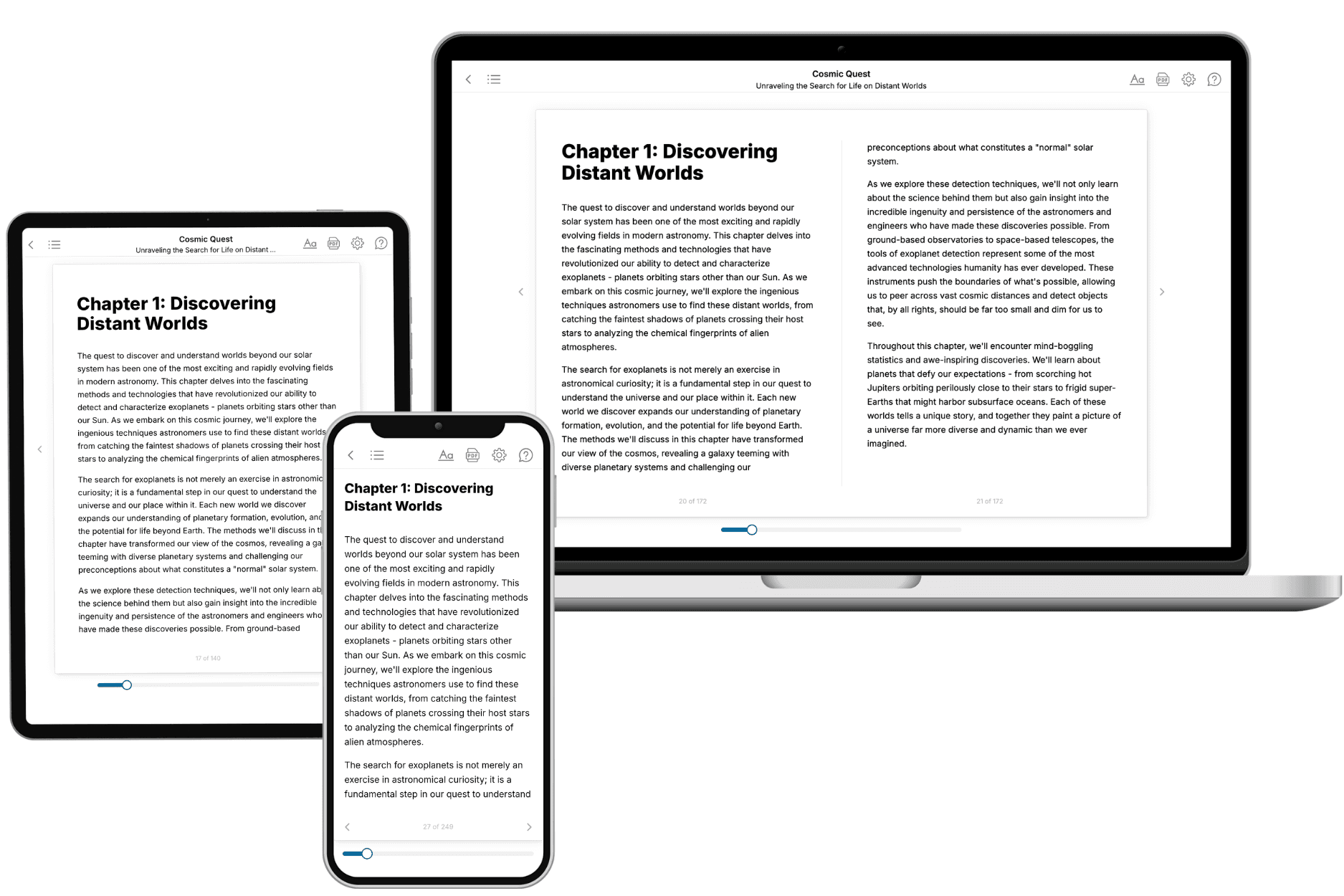
- 3. Get your tailored book
Your book is ready in 10 minutes. Read it online, download as EPUB or PDF, or send to Kindle.
Frequently asked questions
- What is TailoredRead?
TailoredRead creates complete, full-length nonfiction ebooks, written specifically for you. Tell us what you want to learn and why, and TailoredRead writes you a complete ebook on it, with charts, tables, and diagrams throughout. Read it online, on Kindle, or on any e-reader, or download it as a PDF or EPUB. Every book is written fresh the day you order it.
- How is the book tailored to me?
Before anything is written, you answer a few short questions about your goals, your background, and the topics you care about. Your book is then planned around your answers: written at your level, focused on your goals, and covering the topics you chose, instead of the one-size-fits-all book a store sells everyone.
- Will it read like generic AI content?
No. Your book isn't a chat transcript: it's planned chapter by chapter before a single word is written, told in a clear book voice, and explains ideas visually with charts, tables, and diagrams. After writing, every book goes through an editorial pass that polishes chapters so the book reads consistent from start to finish. Judge for yourself: browse thousands of sample books on our Explore Books page.
- How accurate is the content?
Our AI first checks whether your subject needs live research. Niche and fast-moving subjects are researched before writing, and the book plan and chapters are grounded in what it finds. After writing, every book goes through a quality pass that checks its facts and consistency, and researched books list their sources in a Notes section at the back.
- How long is the book?
You choose the length: Comprehensive (250-300 pages), Detailed (150-200 pages), Essential (70-100 pages), or Short (30-50 pages).
- Does the book include visuals?
Yes. Every book includes visual elements such as timelines, checklists, step-by-step guides, decision trees, comparison tables, and matrices, and many include bar charts. A typical book includes dozens of these visual elements.
- Can I read it on Kindle? What formats can I download?
Yes. Every book can be read in our online reader or downloaded as a PDF or EPUB. The EPUB can be opened with Kindle, Apple Books, Kobo, and any e-reader. The Commercial and Author licenses also include an editable Word (DOCX) and Markdown download.
- How much does it cost?
About the price of a regular ebook. The exact price depends on your book's length and complexity, from $2 for the shortest books to $35 for the most comprehensive, and it's shown when you review your book, before you commit to anything. Each book is a one-time purchase, yours to keep, no subscription. Licenses that let you share, teach, or publish your book range from $35.99 to $49.99.
- Can I preview the book before purchasing?
Before you pay, you'll see what your book will cover: the title, a detailed description, the estimated length, and the complete chapter-by-chapter table of contents, so you know what you're getting before you decide. The full text itself is written after you purchase.
- How long does it take to create a book?
About 10 minutes. You can start reading the opening chapters while the rest is still being written.