Multi-Agent Systems in Machine Learning
Building Intelligent Collaborative Networks with Semi-Supervised Learning
Building intelligent systems that work together is one of the most challenging frontiers in AI.
222 pages10 chaptersJul 28, 2026Multi-Agent Systems
About this book
Multi-agent systems promise to solve complex problems through collaboration, but coordinating multiple learning agents—especially when data is limited—presents significant technical hurdles. This book bridges the gap between theoretical concepts and practical implementation, showing you how to design agents that learn from both labeled and unlabeled data while effectively communicating and coordinating with peers. You'll discover how semi-supervised learning techniques enable agents to maximize learning from sparse labeled datasets, explore proven coordination mechanisms that drive emergent intelligence, and learn strategies for scaling systems from small teams to large networks. Through real-world examples and actionable frameworks, you'll gain the knowledge to build multi-agent systems that are more efficient, adaptive, and capable than traditional single-agent approaches.
Table of contents
- IntroductionWhy Multi-Agent Systems Matter, The Role of Semi-Supervised Learning, What You'll Learn in This BookRead below
- Chapter 1: Foundations of Multi-Agent SystemsUnderstanding Agents and Their Properties, From Single Agents to Multi-Agent Paradigms, Designing Multi-Agent System Architecture
- Chapter 2: Semi-Supervised Learning FundamentalsCore Concepts of Semi-Supervised Learning, Key Semi-Supervised Techniques and Algorithms, Challenges and Limitations in Semi-Supervised Settings
- Chapter 3: Individual Agent Learning in Multi-Agent ContextsLocal Learning Strategies for Individual Agents, Feature Extraction and Representation Learning, Uncertainty Estimation and Confidence Scoring
- Chapter 4: Communication and Information SharingDesigning Effective Communication Protocols, Message Passing and Information Exchange, Managing Communication Overhead and Bandwidth
- Chapter 5: Coordination and Consensus MechanismsConsensus Algorithms and Distributed Agreement, Negotiation and Conflict Resolution, Designing Reward Structures for Cooperation
- Chapter 6: Collaborative Learning ApproachesFederated Learning and Decentralized Training, Peer-to-Peer Learning and Knowledge Transfer, Ensemble Methods for Multi-Agent Systems
- Chapter 7: Scalability and Performance OptimizationChallenges in Scaling Multi-Agent Systems, Distributed Computing Frameworks and Tools, Measuring and Optimizing System Performance
- Chapter 8: Real-World Applications and Case StudiesRobotics and Swarm Intelligence, Financial Markets and Trading Systems, Resource Management and Optimization
- Chapter 9: Practical Implementation GuideTools, Frameworks, and Libraries, Building Your First Multi-Agent System, Debugging, Testing, and Validation
- Chapter 10: Advanced Topics and Future DirectionsEmergent Behavior and Self-Organization, Robustness, Reliability, and Fault Tolerance, Emerging Research Directions and Opportunities
- ConclusionKey Takeaways and Lessons Learned, Your Next Steps Forward
- Glossary of Terms
- Further Reading and Resources
Introduction
A single expert working alone can solve many problems, but some problems are simply too large, too distributed, or too data-hungry for one mind to handle. The same logic applies to machine learning systems. When a hospital network wants to train a diagnostic model across dozens of facilities without centralizing patient records, or when a fleet of autonomous vehicles needs to share road observations in real time, a single model running on a single machine hits a wall fast. The answer, increasingly, is to distribute the intelligence across multiple collaborating agents, each learning from its own slice of the world and sharing what it knows.
That shift from single-agent to multi-agent thinking is not just an engineering convenience. It changes what problems become tractable. A Multi-Agent System (MAS) can explore a solution space in parallel, cross-check its own conclusions against peers, and keep learning even when parts of the network go offline. These properties matter enormously in real deployments, where data is messy, labels are expensive, and the environment keeps changing. The combination of MAS architecture with Semi-Supervised Learning amplifies both advantages: agents can squeeze learning signal from vast pools of unlabeled data while still anchoring their models to the small amounts of labeled ground truth that exist.
This book is built for practitioners who already understand the basics of machine learning and want to move into the more demanding territory of collaborative, distributed intelligence. The concepts here are grounded in real system design, not just theory. Each chapter connects a core idea to a concrete implementation challenge, so you leave with frameworks you can actually use. Before diving into the technical depth, this introduction sets the stage: why multi-agent approaches matter, what Semi-Supervised Learning contributes to the picture, and how the chapters ahead build on each other.
Why Multi-Agent Systems Matter
The dominant paradigm in machine learning for most of its history has been centralized: one dataset, one model, one training loop. That paradigm works well when data can be pooled freely and compute is concentrated in one place. But the real world rarely cooperates. Data is generated at the edge, in hospitals, factories, smartphones, and sensors, and moving all of it to a central server is slow, expensive, and often legally prohibited. A Multi-Agent System sidesteps this constraint by letting learning happen where the data lives.
Beyond data locality, there is a deeper reason to care about MAS: some tasks are structurally distributed. Consider a network of environmental monitoring stations tracking air quality across a city. No single station sees the full picture, but together they can build a model that accounts for wind patterns, traffic cycles, and industrial emissions. Each station is an Agent, a computational entity with its own sensors, its own local model, and the ability to communicate with neighbors. The collective behavior that emerges from their interactions can be far richer than anything a single centralized model could produce.
The concept of Autonomy is central here. Each agent in a well-designed MAS makes its own decisions based on local observations, without waiting for instructions from a central controller. This autonomy makes the system resilient. If one agent fails, the others continue operating. If the network is partitioned, agents on each side keep learning independently and reconcile their knowledge when connectivity is restored. This property, known as Graceful Degradation, is one of the most practically valuable features of MAS architecture.
Reactivity is the other side of the coin. Agents do not just act on pre-programmed rules; they respond to changes in their environment and to signals from other agents. In a dynamic setting like financial trading or real-time traffic management, this responsiveness is not optional. A system that cannot adapt to new information within seconds is not useful. MAS architecture, when designed well, enables both the stability of learned models and the agility of reactive decision-making.
The practical evidence for MAS is growing. Research in Swarm Intelligence has shown that large groups of simple agents, each following local rules, can solve optimization problems that defeat conventional algorithms.[1] In robotics, teams of autonomous agents have demonstrated coordinated search-and-rescue behaviors that no single robot could replicate. In distributed machine learning, approaches like Federated Learning have proven that models trained across thousands of devices can match the accuracy of centrally trained models while preserving data privacy.[2]
None of this comes for free. Coordinating multiple agents introduces challenges that simply do not exist in single-agent systems. Agents may hold conflicting beliefs about the world. Communication channels can fail or become congested. Agents may behave in ways that are locally rational but globally harmful. Designing systems that handle these failure modes gracefully is a significant engineering challenge, and it is one that this book addresses directly. Understanding why MAS matters is the first step; understanding how to build them well is the rest of the journey.
A concrete example: A network of ten medical imaging agents, each trained on data from a different hospital, can collectively label ambiguous X-ray cases by voting. No single agent has enough data to be confident alone, but their combined judgment, weighted by each agent's Confidence Scoring on that specific image type, produces a reliable consensus. This is MAS in action: distributed data, distributed learning, and a collective output that beats any individual.
The shift to multi-agent thinking also changes how you frame problems. Instead of asking "how do I build a better model?", you start asking "how do I design agents that make each other better?" That reframing opens up a much larger design space, and it is the mindset that runs through every chapter of this book.
The Role of Semi-Supervised Learning
Labeled data is the bottleneck of modern machine learning. Getting a human expert to annotate a medical image, transcribe a speech recording, or classify a legal document takes time and money. In many domains, the cost of labeling is so high that organizations end up training models on datasets that are far smaller than the raw data they actually have. Semi-Supervised Learning (SSL) is the family of techniques designed to close that gap, using the structure of unlabeled data to improve models trained on a small labeled set.
The core intuition behind SSL rests on a few key assumptions about data. The Manifold Assumption holds that high-dimensional data, like images or text, actually lives on a lower-dimensional surface, and that points close together on that surface are likely to share the same label. The Consistency Regularization principle says that a good model should produce similar predictions for similar inputs, even when those inputs are unlabeled. Together, these assumptions let a model use the geometry of unlabeled data to sharpen its decision boundaries.
Several concrete techniques implement these ideas. Self-Training is the simplest: a model trained on labeled data makes predictions on unlabeled examples, and the high-confidence predictions are added back to the training set as Pseudo-Labels. The model then retrains on this expanded set and repeats the process. Co-Training extends this idea to two models that view the data from different angles, each labeling examples for the other. Label Propagation works on a graph where labeled and unlabeled points are connected by similarity edges, spreading label information through the graph to unlabeled nodes.
What makes SSL especially powerful in a multi-agent context is that each agent naturally sees a different view of the data. One agent might observe sensor readings from a factory floor; another might observe maintenance logs from the same factory. Neither view alone is sufficient, but together they provide the complementary perspectives that Co-Training requires. The MAS architecture does not just enable SSL; it creates the conditions under which SSL works best.
SSL is not without its risks. The biggest danger is confirmation bias in the pseudo-labeling process: if a model's initial predictions are wrong, adding those wrong labels to the training set can reinforce the errors rather than correct them. In a single-agent system, this error can spiral unchecked. In a multi-agent system, peer agents can catch and correct each other's mistakes, provided the communication and coordination mechanisms are designed to support that kind of cross-checking. This is one of the most important synergies between MAS and SSL, and it is a theme that runs through the chapters on coordination and collaborative learning.
The practical impact of SSL on labeling costs is substantial. Studies in natural language processing have shown that SSL techniques can achieve competitive performance with as little as one percent of the labeled data that a fully supervised approach would require.[3] In medical imaging, SSL has enabled models to reach near-expert accuracy on tasks where labeled examples number in the hundreds rather than the tens of thousands. These are not marginal gains; they represent a fundamental shift in what is feasible for organizations that cannot afford large annotation budgets.
Understanding SSL at a conceptual level is necessary before you can design agents that use it well. The chapter on Semi-Supervised Learning Fundamentals covers the core algorithms in depth. The chapters that follow build on that foundation to show how agents can apply SSL locally, share the results of their learning with peers, and collectively arrive at better models than any single agent could produce alone.
Why this combination works: Semi-Supervised Learning needs diverse views of data to avoid confirmation bias. Multi-Agent Systems naturally provide those diverse views. MAS needs a way to learn from limited labeled data at each node. Semi-Supervised Learning provides exactly that mechanism. The two approaches are not just compatible; they are mutually reinforcing.
One more point deserves emphasis. SSL in a multi-agent context is not just about saving annotation costs. It is about enabling learning in environments where labeling is structurally impossible. A swarm of drones mapping a disaster zone cannot pause to ask a human to label each image. A network of fraud detection agents cannot wait for a human to confirm each suspicious transaction. SSL gives agents the ability to keep learning from the stream of unlabeled observations they encounter in the real world, which is the only kind of learning that works at operational speed.
What You'll Learn in This Book
The chapters ahead are organized as a progressive build. Each one introduces concepts that the next one depends on, so reading in order gives you the clearest path from foundations to advanced implementation. That said, if you already have strong background in a particular area, each chapter is written to be self-contained enough to serve as a reference when you need it.
The first major block covers foundations. The chapter on Foundations of Multi-Agent Systems establishes what an Agent actually is in a technical sense, what properties like Autonomy and Reactivity mean in practice, and how MAS Architecture differs from single-agent design. This is not a review of things you already know; it is a precise framing of the concepts that every later chapter builds on. The chapter on Semi-Supervised Learning Fundamentals then covers the core SSL algorithms, their assumptions, and their failure modes, giving you the technical vocabulary to understand how agents learn from unlabeled data.
The second block goes inside the individual agent. The chapter on Individual Agent Learning in Multi-Agent Contexts covers Local Learning Strategies, Representation Learning, and the critical topic of Uncertainty Estimation. An agent that cannot quantify its own uncertainty cannot communicate reliably with peers, because it has no way to signal how much weight its messages should carry. Epistemic Uncertainty and Aleatoric Uncertainty are treated as first-class design concerns, not afterthoughts.
The third block addresses the space between agents. Two chapters cover the mechanics of how agents talk to each other and how they reach agreement:
- Communication and Information Sharing covers Communication Protocols, Message Passing, Communication Topology, and the challenge of managing Communication Overhead without starving agents of the information they need.
- Coordination and Consensus Mechanisms covers Consensus Algorithms, Byzantine Fault Tolerance, negotiation strategies, and Reward Structures that align individual agent incentives with collective goals.
The fourth block covers collaborative learning at the system level. The chapter on Collaborative Learning Approaches examines Federated Learning and the FedAvg algorithm, Peer-to-Peer Learning, Knowledge Distillation, and Ensemble Methods that combine agent predictions into outputs more reliable than any single agent's. These are the techniques that turn a collection of individual learners into a genuinely collaborative system.
Scalability gets its own dedicated treatment because it is where many real-world MAS deployments fail. The chapter on Scalability and Performance Optimization covers the specific challenges that emerge as agent count grows, including Bottleneck Analysis, Load Balancing, Throughput, and Latency management. The goal is not just to understand these problems theoretically but to have concrete strategies for diagnosing and fixing them in running systems.
Real-world grounding comes through the chapter on Real-World Applications and Case Studies, which examines three domains in depth:
- Robotics and Swarm Intelligence, where Robotic Swarm systems have demonstrated coordinated behavior at scales that centralized control cannot match.
- Financial Markets and Trading Systems, where multi-agent approaches model the emergent dynamics of markets and enable distributed risk management.
- Distributed Resource Allocation, where MAS has been applied to problems ranging from power grid management to cloud computing scheduling.
The practical implementation chapter is designed to get you from concept to running code. It covers the major MAS Frameworks and Simulation Environments available today, walks through the process of building a working multi-agent semi-supervised system from scratch, and addresses the debugging and testing challenges that are specific to distributed learning systems. This is where the conceptual knowledge from earlier chapters gets translated into engineering decisions.
The final chapter on Advanced Topics and Future Directions covers the frontier: Emergent Behavior and Self-Organization, Fault Tolerance and Graceful Degradation, and the open research questions that are shaping the next generation of multi-agent systems. This is not a speculative chapter; it is grounded in current research directions and the specific technical problems that the field is actively working to solve.
A few practical notes on how to use this book effectively:
- The Glossary at the back defines every canonical term used in the book. If a term appears in bold and you are not sure of its precise meaning, the glossary is the fastest reference.
- Code examples throughout the implementation chapter use Python and standard ML libraries. The examples are designed to be runnable with minimal setup, so you can experiment as you read.
- Each chapter ends at a natural boundary, not a summary. The goal is to leave you thinking about the next problem, not reviewing what you just read.
The field of multi-agent machine learning is moving fast. New coordination algorithms, new SSL techniques, and new hardware architectures are changing what is possible every year. What this book gives you is not a snapshot of the current state of the art, which will be outdated before long, but a set of durable frameworks for thinking about distributed learning problems. Those frameworks will remain useful even as the specific tools and benchmarks evolve. The goal is to make you the kind of practitioner who can evaluate a new technique, understand where it fits in the larger picture, and decide whether it solves the problem you actually have.
Notes
Introduction
- 1. Marco Dorigo and Thomas Stutzle, Ant Colony Optimization, MIT Press, 2004
- 2. Brendan McMahan and others, "Communication-Efficient Learning of Deep Networks from Decentralized Data," Proceedings of the 20th International Conference on Artificial Intelligence and Statistics, 2017
- 3. Zhenzhong Lan and others, "ALBERT: A Lite BERT for Self-supervised Learning of Language Representations," International Conference on Learning Representations, 2020
This is the end of the free sample. The full book has 10 chapters.
Want this book written for you?
Tell us your goals and background, and get your own version of this book, tailored by AI to you.


Benefits of AI-tailored books
- Read one book, not ten:
- all the Multi-Agent Systems knowledge you need, gathered into a single book.
- Save days of learning:
- tell us your goals, choose your topics, and the whole book is built around them.
- Learn effortlessly:
- Multi-Agent Systems book written for your specific background and expertise.
- Understand at a glance:
- includes charts, tables, timelines, checklists, decision trees, and more.
- Stay current:
- written the day you order it, not years ago.
- Trust what you read:
- every book is checked for accuracy, with real research when your subject needs it.
Create your unique book in 3 steps
- 1. Select your focus
Select the focus of your Multi-Agent Systems book and share your background
- 2. Personalize your book
Specify your goals and choose sub-topics to include
- 3. Get your tailored book
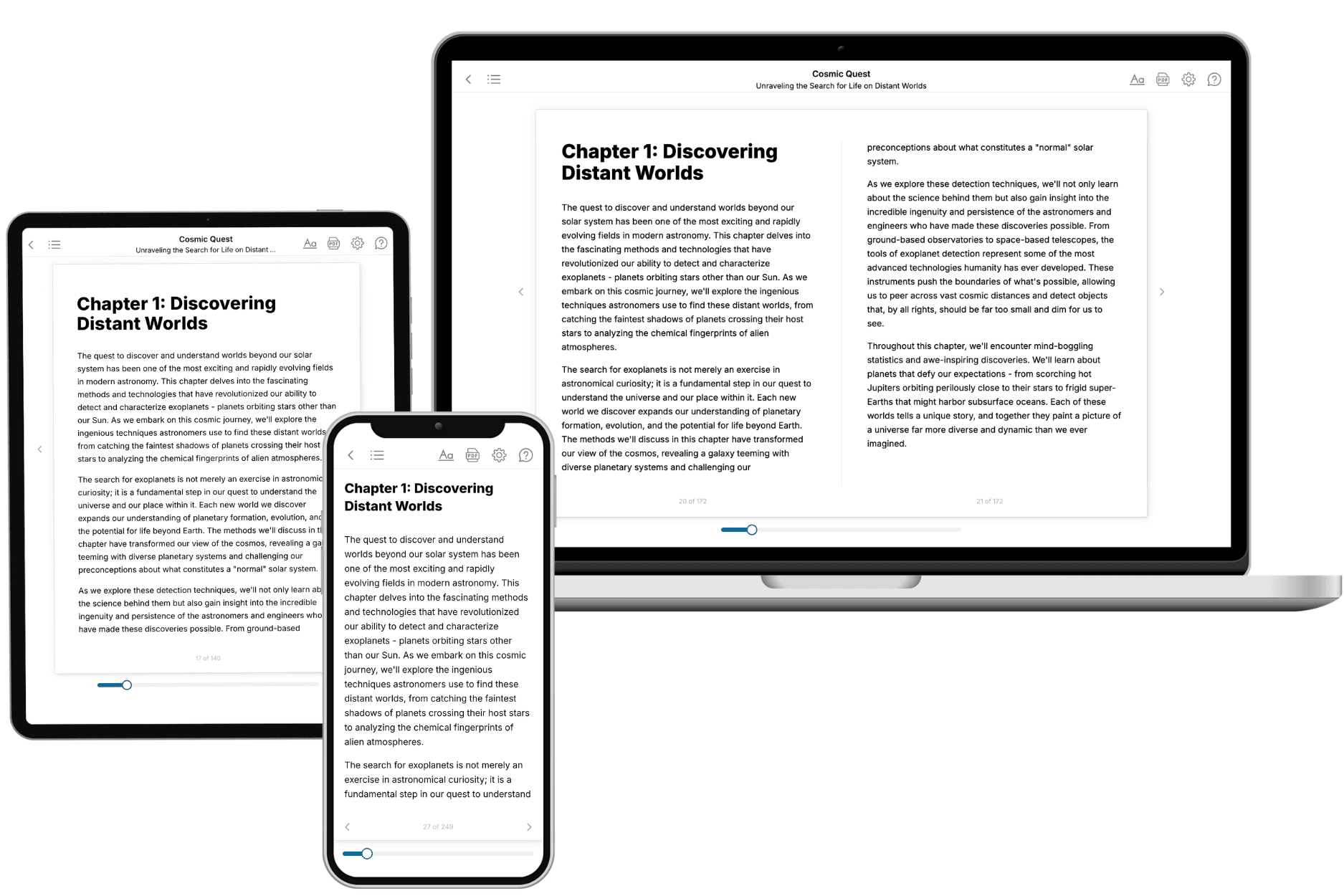
Your book is ready in 10 minutes. Read it online, download as EPUB or PDF, or send to Kindle.
Frequently asked questions
- What is TailoredRead?
TailoredRead creates complete, full-length nonfiction ebooks, written specifically for you. Tell us what you want to learn and why, and TailoredRead writes you a complete ebook on it, with charts, tables, and diagrams throughout. Read it online, on Kindle, or on any e-reader, or download it as a PDF or EPUB. Every book is written fresh the day you order it.
- How is the book tailored to me?
Before anything is written, you answer a few short questions about your goals, your background, and the topics you care about. Your book is then planned around your answers: written at your level, focused on your goals, and covering the topics you chose, instead of the one-size-fits-all book a store sells everyone.
- Will it read like generic AI content?
No. Your book isn't a chat transcript: it's planned chapter by chapter before a single word is written, told in a clear book voice, and explains ideas visually with charts, tables, and diagrams. After writing, every book goes through an editorial pass that polishes chapters so the book reads consistent from start to finish. Judge for yourself: browse thousands of sample books on our Explore Books page.
- How accurate is the content?
Our AI first checks whether your subject needs live research. Niche and fast-moving subjects are researched before writing, and the book plan and chapters are grounded in what it finds. After writing, every book goes through a quality pass that checks its facts and consistency, and researched books list their sources in a Notes section at the back.
- How long is the book?
You choose the length: Comprehensive (250-300 pages), Detailed (150-200 pages), Essential (70-100 pages), or Short (30-50 pages).
- Does the book include visuals?
Yes. Every book includes charts, tables, and diagrams: timelines, checklists, step-by-step guides, decision trees, comparison tables, matrices, and bar charts. A typical book includes dozens of these visual elements.
- Can I read it on Kindle? What formats can I download?
Yes. Every book can be read in our online reader or downloaded as a PDF or EPUB. The EPUB can be opened with Kindle, Apple Books, Kobo, and any e-reader. The Commercial and Author licenses also include an editable Word (DOCX) and Markdown download.
- How much does it cost?
About the price of a regular ebook. The exact price depends on your book's length and complexity, from $2 for the shortest books to $35 for the most comprehensive, and it's shown when you review your book, before you commit to anything. Each book is a one-time purchase, yours to keep, no subscription. Licenses that let you share, teach, or publish your book range from $35.99 to $49.99.
- Can I preview the book before purchasing?
Before you pay, you'll see what your book will cover: the title, a detailed description, the estimated length, and the complete chapter-by-chapter table of contents, so you know what you're getting before you decide. The full text itself is written after you purchase.
- How long does it take to create a book?
About 10 minutes. You can start reading the opening chapters while the rest is still being written.