Network Topologies Decoded
A Journey Through Computer Science History, Design Principles, and Algorithmic Foundations
Dive deep into the fascinating world of computer network topologies and discover how these fundamental structures have shaped the digital landscape we know today.
331 pages18 chaptersOct 15, 2025Computer Networks
About this book
From the earliest mainframe connections to today's complex cloud infrastructures, you'll explore the evolution of network design through the lens of computer science history and algorithmic innovation. This comprehensive guide takes you through the mathematical foundations of graph theory that underpin all network designs, revealing how abstract concepts translate into real-world computing solutions. You'll examine classic topologies like bus, ring, and star configurations alongside modern mesh networks and software-defined architectures, understanding not just how they work, but why they emerged when they did. Through detailed analysis of algorithmic approaches to topology optimization, you'll gain insights into the decision-making processes that drive network design choices. Each topology's strengths, limitations, and ideal use cases are explored with practical examples that bridge theoretical knowledge with contemporary applications. Whether you're designing distributed systems, optimizing existing networks, or simply seeking to understand the architectural foundations of modern computing, this book provides the historical context, theoretical framework, and practical knowledge needed to master network topology concepts and apply them effectively in your work.
Table of contents
- IntroductionWhy Network Topology Matters, Historical Context and Evolution, How This Book Is Organized, Getting the Most from Your ReadingRead below
- Chapter 1: Foundations of Network TopologyDefining Network Topology, Graph Theory Fundamentals, Classification Systems, Key Performance Metrics
- Chapter 2: Early Computing and Network OriginsThe Mainframe Era, Terminal Connection Patterns, First Computer Networks, Centralized Computing Models
- Chapter 3: Bus Topology: The Linear FoundationBus Topology Principles, Ethernet and Bus Networks, Collision Detection Algorithms, Scalability and Performance Limits
- Chapter 4: Ring Topology: Circular Data FlowRing Network Fundamentals, Token Passing Protocols, FDDI and High-Speed Rings, Fault Tolerance Mechanisms
- Chapter 5: Star Topology: Centralized ControlStar Network Architecture, From Hubs to Switches, Centralized Management Benefits, Addressing Single Points of Failure
- Chapter 6: Tree Topology: Hierarchical NetworksHierarchical Network Design, Spanning Tree Algorithms, Campus Network Applications, Tree Structure Optimization
- Chapter 7: Mesh Topology: Full ConnectivityMesh Network Principles, Full vs Partial Mesh Designs, Routing Algorithm Complexity, Scalability Considerations
- Chapter 8: Hybrid Topologies: Combining ApproachesHybrid Design Principles, Star-Bus Combinations, Tree-Mesh Hybrid Networks, Optimization Strategies
- Chapter 9: The Internet's Emergence and ImpactARPANET Topology Design, Packet Switching Revolution, Internet Backbone Evolution, Distributed Architecture Principles
- Chapter 10: Graph Theory in Network DesignGraph Representations, Connectivity Analysis, Shortest Path Algorithms, Network Flow Theory
- Chapter 11: Algorithmic Approaches to Topology OptimizationOptimization Objectives, Genetic Algorithm Applications, Simulated Annealing Techniques, Machine Learning Approaches
- Chapter 12: Fault Tolerance and RedundancyCommon Failure Modes, Redundancy Strategies, Recovery Algorithms, Measuring Network Resilience
- Chapter 13: Wireless Network TopologiesUnique Wireless Challenges, Ad Hoc Network Topologies, Wireless Mesh Networks, Mobile Topology Adaptation
- Chapter 14: Data Center Network TopologiesData Center Requirements, Fat Tree Network Design, Clos Network Architecture, Spine-Leaf Topology
- Chapter 15: Software-Defined Network TopologiesSDN Topology Principles, Virtual Topology Creation, Dynamic Topology Reconfiguration, Controller Placement Strategies
- Chapter 16: Cloud Computing Network ArchitecturesCloud Topology Models, Multi-Tenant Network Design, Edge Computing Topologies, Hybrid Cloud Connectivity
- Chapter 17: Performance Analysis and ModelingNetwork Performance Modeling, Simulation Techniques, Topology Benchmarking, Capacity Planning Algorithms
- Chapter 18: Future Trends and Emerging TopologiesQuantum Network Topologies, Neuromorphic Network Architectures, Internet of Things Topologies, Next-Generation Design Principles
- Conclusion
- Glossary
Introduction
Network topology represents one of the most fundamental yet often overlooked aspects of computer science and information technology. Every time you send an email, stream a video, or access a cloud application, your data travels through carefully designed network structures that have evolved over decades of technological advancement. These underlying architectural patterns determine not just how fast your connection works, but also how reliable, scalable, and secure your digital interactions can be. Understanding network topologies means understanding the very foundation upon which our modern digital world operates.
The journey of network topology design mirrors the broader evolution of computing itself, from the centralized mainframe systems of the 1960s to today's distributed cloud architectures and edge computing networks. Each major shift in computing paradigms has brought with it new challenges and opportunities in network design, leading to innovative topological solutions that balance competing demands for performance, cost, reliability, and scalability. What makes this field particularly fascinating is how mathematical principles from graph theory provide the theoretical foundation for solving real-world engineering problems, creating a bridge between abstract mathematical concepts and practical technological solutions.
This book takes you on a comprehensive exploration of network topologies, combining historical perspective with technical depth and practical application. You'll discover how the choices made by early computer scientists continue to influence modern system designs, and how algorithmic approaches to topology optimization are shaping the future of network architecture. Whether you're designing distributed systems, optimizing existing networks, or seeking to understand the architectural foundations that enable our connected world, this journey through network topology evolution will provide you with both the theoretical framework and practical insights needed to master these essential concepts.
Why Network Topology Matters
Network topology choices fundamentally shape every aspect of system performance, from the latency experienced by end users to the overall resilience of critical infrastructure. When Netflix streams content to millions of viewers simultaneously, or when financial trading systems execute thousands of transactions per second, the underlying network topology determines whether these operations succeed or fail. The topology defines the pathways that data can take, the bottlenecks that might occur, and the alternative routes available when primary connections fail. Understanding these relationships is crucial for anyone involved in designing, managing, or optimizing computer networks.
Consider the difference between a traditional star topology, where all communication flows through a central hub, and a mesh topology, where multiple pathways exist between any two points. In a star configuration, the failure of the central node brings down the entire network, but the design is simple to manage and cost-effective to implement. A mesh topology offers multiple redundant paths and excellent fault tolerance, but at the cost of increased complexity and higher infrastructure requirements. These trade-offs illustrate why topology selection requires careful analysis of specific requirements and constraints:
- Performance requirements: Latency sensitivity, throughput demands, and quality of service needs
- Reliability expectations: Acceptable downtime, fault tolerance requirements, and disaster recovery capabilities
- Scalability projections: Expected growth patterns, capacity planning, and future expansion needs
- Cost constraints: Infrastructure budgets, operational expenses, and maintenance costs
- Management complexity: Administrative overhead, monitoring requirements, and troubleshooting capabilities
The impact of topology decisions extends far beyond technical performance metrics. In enterprise environments, network topology choices affect business continuity, competitive advantage, and operational efficiency. A well-designed topology can enable new business models and services, while a poorly chosen one can become a limiting factor that constrains organizational growth. For example, the rise of cloud computing has been enabled partly by sophisticated data center topologies that can efficiently handle the massive scale and dynamic workload patterns characteristic of modern applications.
Modern applications place increasingly demanding requirements on network infrastructure, requiring topologies that can adapt to changing conditions and optimize themselves automatically. Machine learning applications need high-bandwidth, low-latency connections between compute nodes. Internet of Things deployments require topologies that can handle millions of small, intermittent data flows. Real-time collaboration tools demand consistent performance and seamless failover capabilities. Each of these use cases benefits from different topological approaches, and understanding these relationships is essential for making informed design decisions.
The mathematical foundations underlying network topology design provide powerful tools for analyzing and optimizing network performance. Graph theory concepts such as connectivity, diameter, and centrality measures offer quantitative methods for comparing different topological options. Algorithmic approaches to problems like shortest path routing, maximum flow optimization, and minimum spanning tree construction translate directly into practical network design and management tools. These mathematical insights help transform topology design from an art based on intuition into a science grounded in rigorous analysis.
Security considerations add another critical dimension to topology importance. Different topological patterns create different attack surfaces and vulnerability profiles. A highly centralized topology might be easier to secure at key control points but creates attractive targets for attackers. A distributed topology might be more resilient to targeted attacks but requires more comprehensive security measures across a larger number of nodes. Understanding these security implications is increasingly important as cyber threats become more sophisticated and network-dependent systems become more critical to organizational operations.
The emergence of software-defined networking has fundamentally changed how we think about topology design and management. Traditional physical topologies are now complemented by virtual topologies that can be created, modified, and optimized dynamically through software control. This flexibility enables new approaches to network optimization, allowing administrators to adapt topology characteristics to changing requirements without physical infrastructure changes. However, it also introduces new complexity in understanding the relationship between physical and logical network structures.
Environmental and sustainability concerns are becoming increasingly important factors in topology design decisions. Different topological approaches have varying power consumption profiles, cooling requirements, and physical footprint characteristics. As organizations seek to reduce their environmental impact and operating costs, these factors are becoming significant considerations in topology selection. Energy-efficient topologies that minimize power consumption while maintaining performance requirements represent an important area of ongoing research and development.
Historical Context and Evolution
The history of network topology design is intrinsically linked to the broader evolution of computing technology and the changing needs of users and organizations. In the early days of computing, during the 1950s and 1960s, networks were simple point-to-point connections between mainframe computers and remote terminals. These early topologies were primarily star-based, with a powerful central computer serving multiple "dumb" terminals that had no processing capability of their own. This centralized model reflected both the technological limitations of the era and the economic realities of expensive computing resources that needed to be shared among many users.
The development of ARPANET in the late 1960s marked a revolutionary shift in network topology thinking. Unlike previous centralized approaches, ARPANET was designed as a distributed network that could continue functioning even if individual nodes were destroyed or disconnected. This resilience requirement, driven by Cold War concerns about nuclear attack survivability, led to the development of packet-switching technology and mesh-like topologies that provided multiple pathways between any two points. The ARPANET design principles established many of the foundational concepts that continue to influence network topology design today:
- Distributed control: No single point of failure or central authority
- Packet switching: Data broken into small packets that can take different routes
- Dynamic routing: Automatic adaptation to network changes and failures
- End-to-end principle: Intelligence at the network edges rather than in the core
The 1970s and 1980s saw the emergence of local area networks (LANs) that brought networking capabilities to smaller organizations and individual departments. This period witnessed intense competition between different topological approaches, each with distinct advantages and limitations. Ethernet's bus topology offered simplicity and cost-effectiveness, making it accessible to smaller organizations. Token Ring's circular topology provided deterministic performance characteristics that appealed to enterprises with predictable traffic patterns. These competing approaches reflected different philosophical views about network design and different priorities in balancing performance, cost, and complexity.
The standardization efforts of the 1980s, particularly the development of the OSI model and IEEE 802 standards, helped establish common frameworks for understanding and comparing different topological approaches. This standardization was crucial for enabling interoperability between equipment from different vendors and for creating the economies of scale that made networking technology more affordable and accessible. The layered approach embodied in these standards also helped separate topology concerns from other networking issues, enabling more focused development and optimization of topological solutions.
The explosive growth of the Internet during the 1990s created new challenges and opportunities for network topology design. The hierarchical structure of the Internet, with its backbone networks, regional networks, and local access networks, demonstrated how different topological approaches could be combined effectively at different scales. The development of the World Wide Web created new traffic patterns that favored topologies optimized for client-server communication rather than the peer-to-peer patterns that had dominated earlier network designs.
The dot-com boom and the subsequent focus on web-based applications drove significant innovations in data center topology design. Traditional hierarchical approaches gave way to more sophisticated designs that could handle the massive scale and unpredictable traffic patterns characteristic of web applications. The development of content delivery networks (CDNs) represented a new approach to topology design that optimized for geographic distribution and edge caching rather than centralized processing.
The emergence of cloud computing in the 2000s created entirely new requirements for network topology design. Cloud providers needed topologies that could support multi-tenant environments, provide consistent performance across diverse workloads, and scale to unprecedented levels. This led to innovations such as fat-tree topologies, spine-leaf architectures, and software-defined networking approaches that separated the control plane from the data plane. These developments represented a fundamental shift from static, hardware-defined topologies to dynamic, software-controlled network architectures.
The mobile revolution and the Internet of Things have created new challenges for topology design, requiring networks that can handle massive numbers of small, intermittent connections from devices with limited power and processing capabilities. Edge computing represents the latest evolution in this ongoing story, bringing computation closer to data sources and users to reduce latency and bandwidth requirements. This trend is driving the development of new topological approaches that can efficiently connect edge nodes with centralized cloud resources.
Throughout this historical evolution, certain patterns and principles have remained constant while others have been transformed by technological advances. The fundamental trade-offs between centralization and distribution, between simplicity and redundancy, and between cost and performance continue to shape topology design decisions. However, the specific ways these trade-offs are resolved have evolved dramatically as technology capabilities have advanced and user requirements have changed. Understanding this historical context provides essential perspective for evaluating current topology options and anticipating future developments.
How This Book Is Organized
This book is structured to provide both comprehensive coverage of network topology concepts and practical guidance for applying these concepts in real-world situations. The organization follows a logical progression from fundamental principles through historical development to advanced applications and future trends. Each chapter builds upon previous material while also standing alone as a reference for specific topics. This approach allows you to read the book sequentially for a complete education in network topology, or to focus on specific chapters that address your immediate interests and needs.
The early chapters establish the theoretical and historical foundations necessary for understanding more advanced topics. Chapter 1 introduces the fundamental concepts of network topology and the mathematical principles from graph theory that underlie all network design. This mathematical foundation is essential because it provides the analytical tools needed to compare different topological approaches objectively and to understand the performance implications of design choices. The chapter also introduces the classification systems and performance metrics that are used throughout the rest of the book to evaluate and compare different topological approaches.
Chapters 2 through 8 provide detailed coverage of the major topological patterns that have shaped network design throughout computing history. Each chapter follows a consistent structure that includes:
- Historical context: When and why each topology emerged
- Technical principles: How each topology works and its key characteristics
- Algorithmic foundations: The mathematical and computational principles underlying each approach
- Performance analysis: Strengths, limitations, and optimal use cases
- Real-world examples: Specific implementations and case studies
- Evolution and variants: How each topology has been adapted and improved over time
The middle section of the book, chapters 9 through 12, focuses on the algorithmic and analytical aspects of network topology design. These chapters explore how mathematical principles and computational techniques can be applied to optimize network performance, ensure fault tolerance, and adapt to changing requirements. Chapter 10 provides an in-depth exploration of graph theory applications, showing how abstract mathematical concepts translate into practical network design tools. Chapter 11 covers algorithmic optimization techniques, including genetic algorithms, simulated annealing, and machine learning approaches that are increasingly important for managing complex network environments.
Chapters 13 through 16 examine specialized applications and emerging trends in network topology design. These chapters address the unique challenges and opportunities presented by wireless networks, data centers, software-defined networks, and cloud computing environments. Each of these domains has specific requirements and constraints that have driven the development of specialized topological approaches. Understanding these specialized applications is crucial for anyone working in modern IT environments where these technologies play increasingly important roles.
The final chapters, 17 and 18, focus on performance analysis techniques and future trends in network topology design. Chapter 17 provides comprehensive coverage of methods for modeling, simulating, and benchmarking network performance, giving you the tools needed to evaluate topology options quantitatively. Chapter 18 explores emerging technologies and trends that are likely to shape the future of network design, including quantum networks, neuromorphic computing architectures, and Internet of Things topologies.
Throughout the book, special attention is paid to the relationship between theoretical principles and practical applications. Each major concept is illustrated with concrete examples that show how abstract ideas translate into real-world solutions. Case studies drawn from actual network deployments demonstrate both successful applications and lessons learned from failures. These practical elements are designed to help you develop not just theoretical understanding but also the practical judgment needed to make effective topology design decisions.
The book also includes extensive cross-references and connections between chapters, helping you understand how different concepts relate to each other and how insights from one area can be applied to others. For example, the fault tolerance principles discussed in the context of ring topologies are also relevant to mesh networks and cloud architectures. The algorithmic optimization techniques introduced for traditional topologies can be adapted for software-defined networks and edge computing environments.
Appendices and supplementary materials provide additional resources for readers who want to delve deeper into specific topics. The glossary defines technical terms and concepts used throughout the book, while the bibliography provides references for further reading and research. Online resources, including simulation tools and code examples, complement the printed material and provide hands-on opportunities to explore the concepts presented in the book.
Getting the Most from Your Reading
To maximize the value you derive from this book, it's important to approach the material with both theoretical curiosity and practical focus. Network topology is a field where abstract mathematical concepts have direct practical applications, so the most effective learning approach combines conceptual understanding with hands-on exploration. As you read each chapter, try to connect the theoretical principles with network systems you've encountered in your professional or academic experience. This connection between theory and practice will help solidify your understanding and make the concepts more memorable and applicable.
The mathematical content in this book is designed to be accessible to readers with intermediate technical backgrounds, but don't skip over the mathematical sections even if they seem challenging at first. The graph theory concepts and algorithmic principles provide essential tools for understanding why certain topological approaches work well in specific situations and poorly in others. If you encounter mathematical concepts that are unfamiliar, take the time to work through the examples and exercises provided. Many readers find it helpful to supplement the book's mathematical content with additional resources on graph theory and network analysis.
Active engagement with the material will significantly enhance your learning experience. Consider implementing some of the simpler algorithms and examples in your preferred programming language. Many of the concepts become much clearer when you can see them working in practice. Network simulation tools such as ns-3, OMNET++, or even simple graph visualization libraries can help you explore the behavior of different topological approaches under various conditions. Creating your own implementations, even simple ones, will deepen your understanding of the underlying principles.
The historical perspective provided throughout the book is not just background information but an essential part of understanding current and future developments in network topology. Many seemingly modern concepts have roots in earlier work, and understanding this historical context can provide insights into why certain approaches succeeded while others failed. Pay attention to the recurring themes and patterns that appear across different eras and technologies. These patterns often reflect fundamental principles that transcend specific technological implementations.
When reading about specific topological approaches, try to think beyond the immediate technical details to consider the broader design philosophy and trade-offs involved. Ask yourself questions such as:
- What problem was this topology designed to solve?
- What assumptions about usage patterns and requirements does it make?
- How would this topology perform under different conditions than those it was designed for?
- What aspects of this approach might be applicable to current challenges?
- How might this topology need to be modified for emerging applications?
The case studies and examples throughout the book are carefully chosen to illustrate both successful applications and instructive failures. Pay particular attention to the failure cases, as they often provide more insight into the limitations and constraints of different approaches than success stories do. Understanding why certain topological choices failed in specific situations will help you avoid similar mistakes in your own work and develop better judgment about when different approaches are appropriate.
Consider forming or joining a study group with colleagues or classmates who are also interested in network topology and design. Discussing the concepts and working through problems together can provide valuable different perspectives and help clarify difficult concepts. Many of the trade-offs and design decisions discussed in the book benefit from multiple viewpoints and collaborative analysis. Online forums and professional communities focused on network design can also provide valuable opportunities for discussion and learning.
Keep a notebook or digital document where you record key insights, interesting examples, and questions that arise as you read. Network topology design often involves complex interactions between multiple factors, and having a place to record and organize your thoughts can help you develop a more comprehensive understanding. Review your notes periodically to reinforce important concepts and to see how your understanding evolves as you progress through the material.
Finally, remember that network topology is a rapidly evolving field where new challenges and solutions emerge regularly. The principles and concepts presented in this book provide a solid foundation, but staying current with developments in areas such as software-defined networking, edge computing, and emerging applications will be essential for applying these concepts effectively in your professional work. Use this book as a launching point for ongoing learning and exploration rather than as a final destination in your understanding of network topology design.
This is the end of the free sample. The full book has 18 chapters.
Want this book written for you?
Tell us your goals and background, and get your own version of this book, tailored by AI to you.


Benefits of AI-tailored books
- Read one book, not ten:
- all the Computer Networks knowledge you need, gathered into a single book.
- Save days of learning:
- tell us your goals, choose your topics, and the whole book is built around them.
- Learn effortlessly:
- Computer Networks book written for your specific background and expertise.
- Understand at a glance:
- includes charts, tables, timelines, checklists, decision trees, and more.
- Stay current:
- written the day you order it, not years ago.
- Trust what you read:
- every book is checked for accuracy, with real research when your subject needs it.
Create your unique book in 3 steps
- 1. Select your focus
Select the focus of your Computer Networks book and share your background
- 2. Personalize your book
Specify your goals and choose sub-topics to include
- 3. Get your tailored book
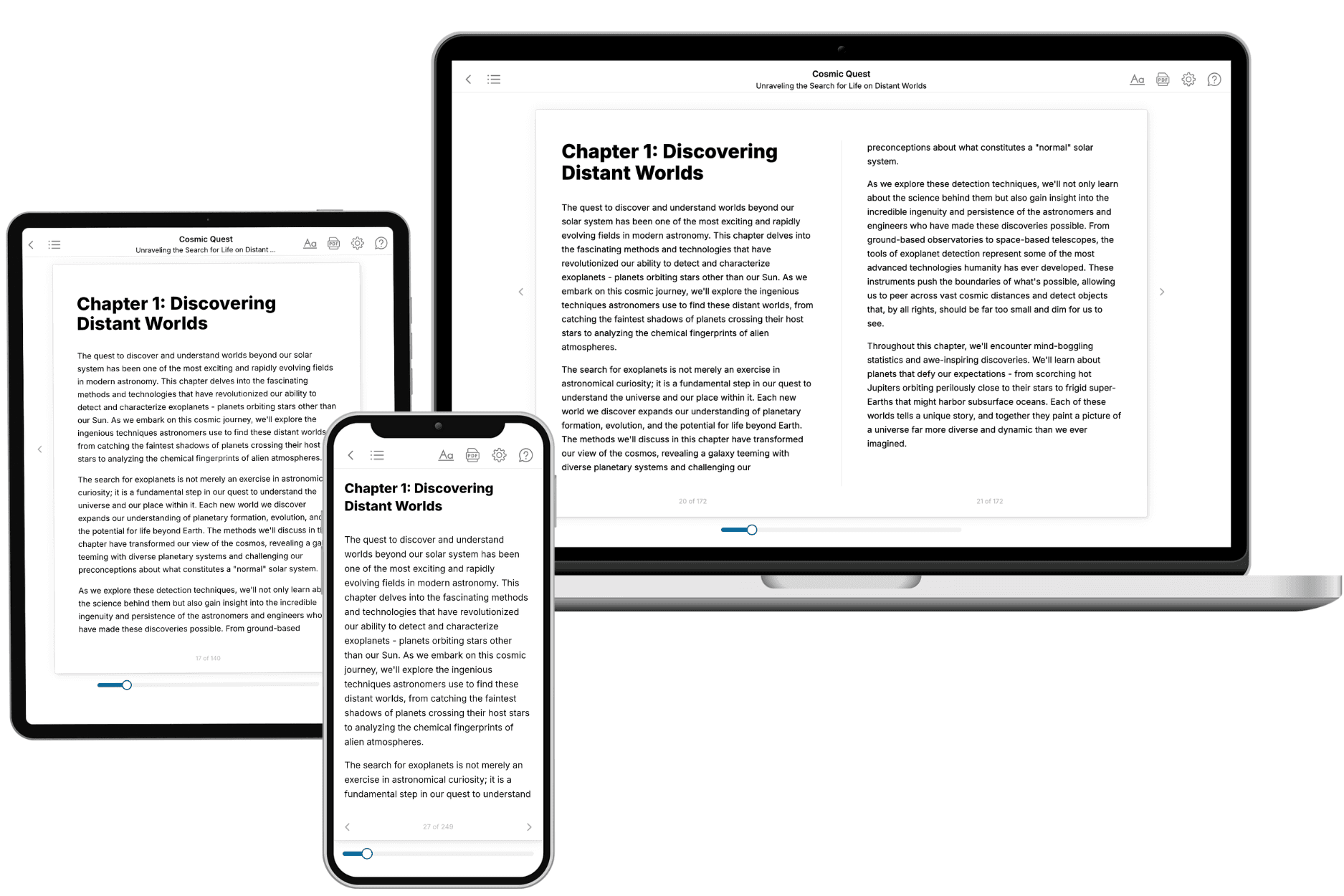
Your book is ready in 10 minutes. Read it online, download as EPUB or PDF, or send to Kindle.

Frequently asked questions
- What is TailoredRead?
TailoredRead creates complete, full-length nonfiction ebooks, written specifically for you. Tell us what you want to learn and why, and TailoredRead writes you a complete ebook on it, with charts, tables, and diagrams throughout. Read it online, on Kindle, or on any e-reader, or download it as a PDF or EPUB. Every book is written fresh the day you order it.
- How is the book tailored to me?
Before anything is written, you answer a few short questions about your goals, your background, and the topics you care about. Your book is then planned around your answers: written at your level, focused on your goals, and covering the topics you chose, instead of the one-size-fits-all book a store sells everyone.
- Will it read like generic AI content?
No. Your book isn't a chat transcript: it's planned chapter by chapter before a single word is written, told in a clear book voice, and explains ideas visually with charts, tables, and diagrams. After writing, every book goes through an editorial pass that polishes chapters so the book reads consistent from start to finish. Judge for yourself: browse thousands of sample books on our Explore Books page.
- How accurate is the content?
Our AI first checks whether your subject needs live research. Niche and fast-moving subjects are researched before writing, and the book plan and chapters are grounded in what it finds. After writing, every book goes through a quality pass that checks its facts and consistency, and researched books list their sources in a Notes section at the back.
- How long is the book?
You choose the length: Comprehensive (250-300 pages), Detailed (150-200 pages), Essential (70-100 pages), or Short (30-50 pages).
- Does the book include visuals?
Yes. Every book includes charts, tables, and diagrams: timelines, checklists, step-by-step guides, decision trees, comparison tables, matrices, and bar charts. A typical book includes dozens of these visual elements.
- Can I read it on Kindle? What formats can I download?
Yes. Every book can be read in our online reader or downloaded as a PDF or EPUB. The EPUB can be opened with Kindle, Apple Books, Kobo, and any e-reader. The Commercial and Author licenses also include an editable Word (DOCX) and Markdown download.
- How much does it cost?
About the price of a regular ebook. The exact price depends on your book's length and complexity, from $2 for the shortest books to $35 for the most comprehensive, and it's shown when you review your book, before you commit to anything. Each book is a one-time purchase, yours to keep, no subscription. Licenses that let you share, teach, or publish your book range from $35.99 to $49.99.
- Can I preview the book before purchasing?
Before you pay, you'll see what your book will cover: the title, a detailed description, the estimated length, and the complete chapter-by-chapter table of contents, so you know what you're getting before you decide. The full text itself is written after you purchase.
- How long does it take to create a book?
About 10 minutes. You can start reading the opening chapters while the rest is still being written.