Object-Oriented Design in .NET Framework 1.0
Master the Fundamentals of OOP Architecture and Build Scalable Applications
Many developers struggle with object-oriented design, treating it as a collection of abstract concepts rather than practical tools for solving real problems.
191 pages9 chaptersJun 20, 2026Object Oriented Design
About this book
This book bridges that gap by grounding OOP principles in the concrete reality of .NET Framework 1.0 development. You'll move beyond memorizing definitions to understanding why encapsulation matters, how inheritance can both help and harm your code, and when to apply specific design patterns. Through clear explanations, practical examples, and real-world scenarios, you'll learn to design systems that are easier to maintain, test, and extend. Whether you're building enterprise applications or working on smaller projects, mastering these fundamentals will significantly improve your ability to write professional-grade code that stands the test of time.
Table of contents
- IntroductionWhy Object-Oriented Design Matters, Object-Oriented Design in the .NET Framework 1.0 Context, How to Use This BookRead below
- Chapter 1: Core Object-Oriented PrinciplesUnderstanding Encapsulation, Inheritance and Class Hierarchies, Polymorphism and Method Overriding
- Chapter 2: Abstraction and InterfacesAbstract Classes and Their Role, Designing Effective Interfaces, Abstraction Patterns in Practice
- Chapter 3: SOLID Principles for Better DesignSingle Responsibility Principle, Open/Closed Principle, Liskov Substitution Principle, Interface Segregation Principle
- Chapter 4: Dependency Inversion and Loose CouplingThe Problems with Tight Coupling, Dependency Inversion Principle, Dependency Injection Techniques
- Chapter 5: Composition vs. InheritanceUnderstanding Inheritance Limitations, The Power of Composition, Choosing the Right Approach
- Chapter 6: Essential Design PatternsCreational Patterns: Factory and Singleton, Structural Patterns: Adapter and Decorator, Behavioral Patterns: Observer and Strategy
- Chapter 7: Object-Oriented Design in .NET Framework 1.0The Common Language Runtime and Type System, Organizing Code with Namespaces, Best Practices for .NET Framework 1.0
- Chapter 8: Designing Real-World ApplicationsBuilding Layered Architectures, Domain Modeling and Business Logic, Designing for Testability
- Chapter 9: Refactoring for Better DesignIdentifying Design Problems, Common Refactoring Techniques, Incremental Design Improvement
- ConclusionKey Takeaways, Your Path Forward
- Glossary of Terms
Introduction
Most developers learn object-oriented programming the same way: they memorize the definitions of encapsulation, inheritance, and polymorphism, write a few classes, and move on. The concepts feel clear enough on paper. Then they sit down to build a real application, and something goes wrong. The code works, but it becomes harder to change with every passing week. Adding a new feature breaks something unrelated. A simple bug fix requires touching a dozen files. The codebase that started clean slowly turns into something nobody wants to touch. This is not a failure of effort. It is a failure of design.
Object-oriented design is not just a set of vocabulary words. It is a way of thinking about software structure that, when applied well, makes systems dramatically easier to build, maintain, and extend. The gap between knowing the terms and applying the principles effectively is where most developers get stuck. Bridging that gap requires more than reading definitions. It requires seeing the principles in action, understanding the reasoning behind them, and practicing their application in realistic scenarios. That is exactly what this book is built to do.
The focus here is specifically on the .NET Framework 1.0 environment. This was a foundational platform that introduced millions of developers to managed code, the Common Language Runtime, and a rich class library built from the ground up with object-oriented principles in mind. Understanding OOP within this specific context is valuable not only for working with legacy systems but also because the design principles established in .NET 1.0 remain the bedrock of every version of .NET that followed. The fundamentals do not expire. Learning them deeply here gives you a foundation that transfers forward across the entire .NET ecosystem.
This book is written for intermediate developers who already know how to write code but want to write better code. You understand variables, loops, and methods. You have probably written classes before. What you are looking for is a clearer mental model of how to structure those classes, how to make decisions about design, and how to recognize when a design is working against you. Each chapter builds on the last, moving from core principles to advanced patterns to real-world application. By the end, you will have both the conceptual framework and the practical tools to design software that holds up over time.
Why Object-Oriented Design Matters
Software development has a complexity problem. As applications grow, the number of moving parts multiplies. Data flows between components, logic gets duplicated, and the relationships between different pieces of code become harder to track. Without a disciplined approach to structure, even a moderately sized application can become nearly impossible to reason about. Object-oriented design exists to manage that complexity by organizing code around meaningful, self-contained units that mirror the way humans naturally think about problems.
Consider a simple example. Imagine you are building an order management system for a retail business. Without OOP, you might write a series of functions that operate on raw data structures: arrays of order records, customer IDs, product lists. Every function needs to know the exact shape of that data. When the data structure changes, every function that touches it needs to change too. Now imagine instead that you have an Order class that knows its own data and exposes clear methods like AddItem(), CalculateTotal(), and Submit(). The rest of the system talks to the Order through those methods. When the internal structure of an order changes, only the Order class needs to be updated. Everything else stays the same.
This is the core promise of object-oriented design: isolate change. When a requirement changes (and it always does), a well-designed system limits the blast radius of that change. You modify one class, one module, one layer, rather than hunting through the entire codebase. This is not just a theoretical benefit. Studies of software maintenance consistently show that the majority of development time is spent modifying existing code rather than writing new code.[1] Good design directly reduces that cost.
Beyond maintenance, object-oriented design improves communication. When a codebase is organized around meaningful domain concepts, it becomes easier for developers to understand what the code does without reading every line. A class named CustomerAccount with methods named Deposit() and Withdraw() communicates intent clearly. New team members can orient themselves faster. Code reviews become more productive. The code itself becomes a form of documentation. This is sometimes called expressive code, and it is one of the most underrated benefits of disciplined OOP.
Object-oriented design also enables reuse in a meaningful way. Not the copy-paste reuse that creates maintenance nightmares, but structural reuse through inheritance, composition, and interfaces. When you design a well-defined base class or interface, you create a contract that other parts of the system can depend on without knowing the implementation details. This makes it possible to swap out implementations, extend behavior, and build new features on top of existing foundations without rewriting what already works.
It is worth being honest about the limits too. Object-oriented design is not a silver bullet. Applied poorly, it can produce code that is over-engineered, unnecessarily abstract, and harder to understand than a simpler procedural approach would have been. The goal is not to use OOP for its own sake. The goal is to use it where it genuinely helps: where complexity needs to be managed, where change is expected, and where multiple developers need to collaborate on a shared codebase. Learning to recognize those situations is part of what this book will help you develop.
The developers who get the most out of object-oriented design are not the ones who apply every pattern they know to every problem. They are the ones who understand the principles deeply enough to know when to apply them and when to keep things simple. That kind of judgment comes from understanding the why behind the principles, not just the what. Every chapter in this book is written with that goal in mind.
Object-Oriented Design in the .NET Framework 1.0 Context
When Microsoft released .NET Framework 1.0 in February 2002, it represented a significant shift in how Windows developers built software.[2] The platform was designed from the ground up around object-oriented principles. The Common Language Runtime (CLR) managed memory, enforced type safety, and provided a unified execution environment for multiple languages. The Base Class Library (BCL) offered thousands of pre-built classes organized into logical namespaces. Everything in .NET 1.0 was an object, rooted in a single base class: System.Object. This was not just a technical decision. It was a philosophical commitment to OOP as the primary model for software construction on the platform.
Understanding the .NET 1.0 type system is essential for applying OOP effectively within it. The CLR distinguishes between value types and reference types, a distinction that has direct implications for how you design classes and pass data between them. Value types (like int, struct, and enum) are stored on the stack and copied when assigned. Reference types (like classes and interfaces) are stored on the heap and passed by reference. Getting this wrong can lead to subtle bugs, unexpected behavior, and performance problems that are difficult to diagnose.
The .NET 1.0 framework also introduced several features that directly support OOP design patterns. Interfaces are first-class citizens in the type system, making it straightforward to define contracts between components. Abstract classes allow you to share implementation across a hierarchy while still enforcing a common interface. The virtual and override keywords give you precise control over polymorphic behavior. Delegates and events provide a built-in mechanism for the Observer pattern. These are not just language features. They are tools that, when understood in the context of design principles, become powerful building blocks for well-structured systems.
One of the most important things to understand about .NET 1.0 specifically is what it did not have. Generics were not introduced until .NET 2.0. This means that collection classes in .NET 1.0, like ArrayList and Hashtable, work with System.Object references and require casting. This limitation has real design implications. It pushes you toward wrapper classes, strongly-typed collections, and careful interface design to maintain type safety. Working within these constraints is not a disadvantage. It is an opportunity to understand why generics were eventually introduced and to appreciate the design problems they solved.
The namespace system in .NET 1.0 provides a model for organizing code that maps directly to OOP principles. Namespaces like System.IO, System.Collections, and System.Net group related classes by responsibility. This mirrors the Single Responsibility Principle at the organizational level. When you design your own applications, following this same pattern of logical grouping makes your codebase easier to navigate and your dependencies easier to manage. The framework itself is a teaching tool, if you know how to read it.
It is also worth noting that many of the design patterns covered in this book were formalized in the landmark work by the Gang of Four in 1994, just a few years before .NET was developed.[3] The .NET Framework 1.0 class library itself implements many of these patterns. The Stream class hierarchy is a textbook example of the Template Method pattern. The IEnumerator and IEnumerable interfaces implement the Iterator pattern. Studying the framework with this lens reveals a wealth of practical examples that reinforce the patterns you will learn throughout this book.
Working with .NET 1.0 today might seem like a niche concern, but the principles it embodies are anything but niche. Every version of .NET that followed, including .NET 2.0 through .NET 8 and beyond, is built on the same foundational type system and the same OOP principles. Developers who understand these fundamentals in their original context have a much clearer mental model of why the platform evolved the way it did. That understanding pays dividends across every project, regardless of which version of .NET you are working with.
The examples throughout this book are written in C#, the primary language of the .NET ecosystem. C# was designed specifically to be a clean, modern, object-oriented language, and its syntax maps closely to the OOP concepts being discussed. Even if you primarily work in Visual Basic .NET, the concepts translate directly. The language is the vehicle. The design principles are the destination.
How to Use This Book
This book is structured as a progressive journey from foundational concepts to advanced application. Each chapter builds on what came before, so reading in order is strongly recommended, especially if you are newer to formal OOP design. That said, the chapters are also written to stand on their own as reference material. If you are an experienced developer who wants to revisit a specific topic, like the Liskov Substitution Principle or the Decorator pattern, you can jump directly to that chapter without losing the thread.
Here is a quick map of what each part of the book covers:
- Chapters 1 through 2 cover the core OOP principles and abstraction mechanisms. This is the foundation everything else rests on. Even if you feel confident here, a careful read will likely surface nuances you have not considered before.
- Chapters 3 through 4 introduce the SOLID principles and dependency inversion. These chapters are where many developers experience the biggest shift in how they think about design.
- Chapter 5 tackles the composition versus inheritance debate, one of the most practically important decisions you make when designing class hierarchies.
- Chapter 6 covers essential design patterns, including Factory, Singleton, Adapter, Decorator, Observer, and Strategy. Each pattern is explained with a concrete .NET 1.0 example.
- Chapter 7 dives into .NET Framework 1.0 specifics, including the CLR, the type system, and best practices unique to the platform.
- Chapters 8 through 9 focus on real-world application: building layered architectures, modeling domains, designing for testability, and refactoring existing code toward better design.
Each chapter includes code examples written in C# that you can run against a .NET Framework 1.0 environment. The examples are intentionally practical. They are not toy problems invented to illustrate a point in isolation. They are drawn from the kinds of scenarios you actually encounter when building business applications: order processing, user authentication, data access, event handling, and configuration management. Seeing the principles applied to familiar problems makes them much easier to internalize.
To get the most out of this book, do not just read the code examples. Type them out. Modify them. Break them intentionally and see what happens. Try applying the principle being discussed to a project you are currently working on or have worked on recently. The gap between understanding a concept and being able to apply it reliably is closed through practice, not through reading alone. Every chapter ends with a set of key points that summarize the most important ideas, which you can use as a quick review or a checklist when applying the concepts in your own work.
Pay particular attention to the sections that discuss what not to do. Anti-patterns and common mistakes are just as instructive as correct examples. Understanding why a particular approach fails helps you recognize the same failure mode in your own code before it becomes a problem. Many of the most valuable lessons in software design come from examining code that seemed reasonable at the time but turned out to be fragile, rigid, or impossible to extend.
A note on the code style used throughout the book: the examples follow the naming conventions and coding standards recommended by Microsoft for .NET development, including PascalCase for class and method names, camelCase for local variables, and meaningful names that reflect the domain being modeled. These conventions are not arbitrary. They are part of writing code that communicates clearly to other developers. Consistency in naming is a small but meaningful part of good design.
Good design is not about writing clever code. It is about writing code that the next developer (including your future self) can understand, modify, and extend with confidence. Every principle and pattern in this book serves that goal.
If you encounter a concept that does not click immediately, keep reading. Sometimes a later example or a different angle of explanation will make an earlier idea suddenly clear. Software design concepts have a way of reinforcing each other. Encapsulation makes more sense after you understand the Single Responsibility Principle. The value of interfaces becomes clearer after you have seen the problems that tight coupling creates. The book is designed with these connections in mind, and returning to earlier chapters after finishing later ones is often a rewarding experience.
Finally, approach this material with patience and a willingness to question your existing habits. Some of the principles here will challenge patterns you have been using for years. That discomfort is a good sign. It means you are encountering a genuinely new way of thinking, not just confirming what you already know. The developers who improve the most are the ones who stay curious, stay critical, and never stop asking whether there is a better way to structure the code in front of them. That mindset is the most important tool you can bring to this book.
Notes
Introduction
- 1. B. P. Lientz and E. B. Swanson, Software Maintenance Management, Addison-Wesley. Research indicating that software maintenance accounts for 60-80% of total software lifecycle costs, 1980
- 2. Microsoft Corporation, .NET Framework 1.0 Release, Microsoft Developer Network (MSDN) documentation archive, 2002
- 3. E. Gamma and others, Design Patterns: Elements of Reusable Object-Oriented Software, Addison-Wesley, 1994
This is the end of the free sample. The full book has 9 chapters.
Want this book written for you?
Tell us your goals and background, and get your own version of this book, tailored by AI to you.


Benefits of AI-tailored books
- Read one book, not ten:
- all the Object Oriented Design knowledge you need, gathered into a single book.
- Save days of learning:
- tell us your goals, choose your topics, and the whole book is built around them.
- Learn effortlessly:
- Object Oriented Design book written for your specific background and expertise.
- Understand at a glance:
- includes charts, tables, timelines, checklists, decision trees, and more.
- Stay current:
- written the day you order it, not years ago.
- Trust what you read:
- every book is checked for accuracy, with real research when your subject needs it.
Create your unique book in 3 steps
- 1. Select your focus
Select the focus of your Object Oriented Design book and share your background
- 2. Personalize your book
Specify your goals and choose sub-topics to include
- 3. Get your tailored book
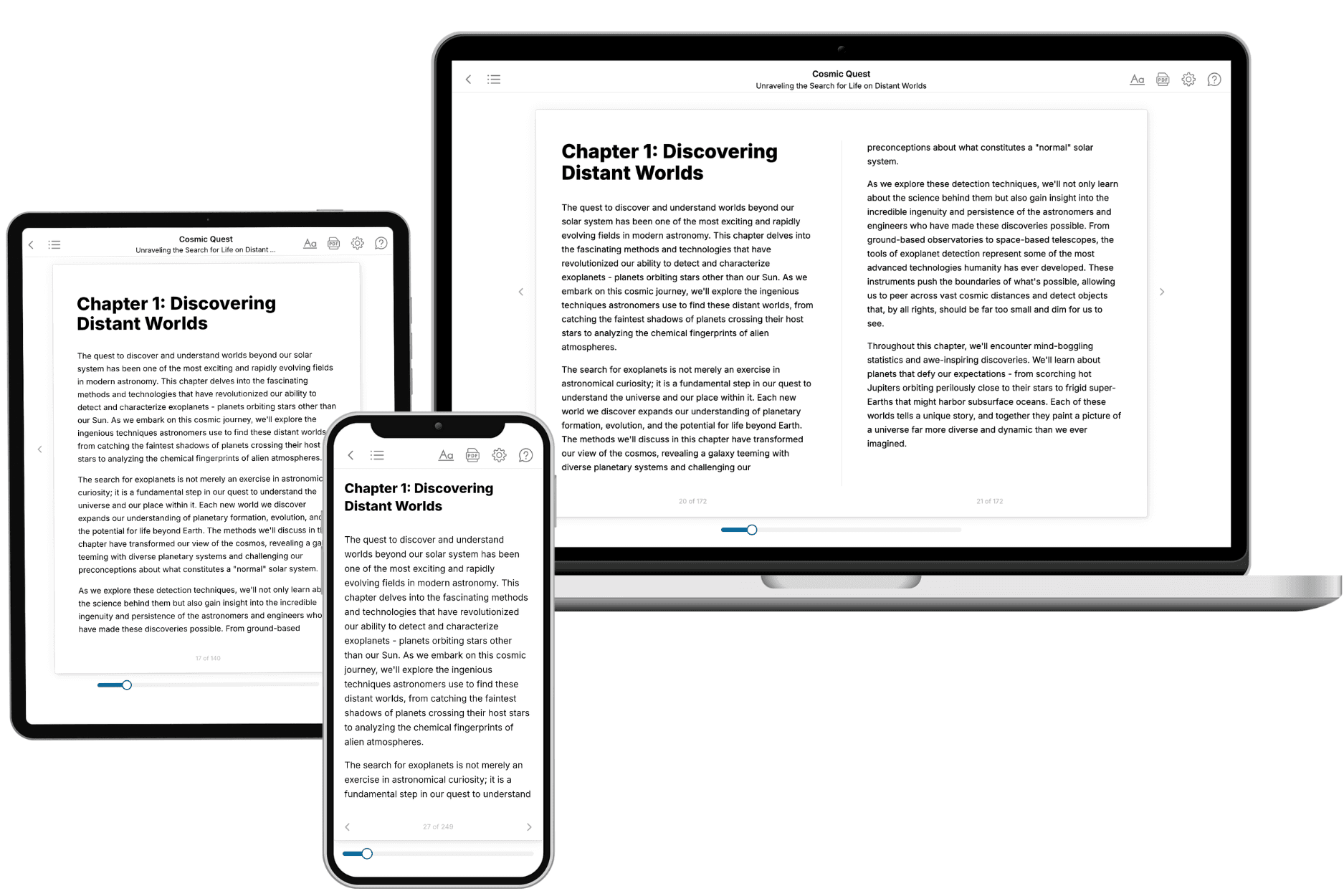
Your book is ready in 10 minutes. Read it online, download as EPUB or PDF, or send to Kindle.

Frequently asked questions
- What is TailoredRead?
TailoredRead creates complete, full-length nonfiction ebooks, written specifically for you. Tell us what you want to learn and why, and TailoredRead writes you a complete ebook on it, with charts, tables, and diagrams throughout. Read it online, on Kindle, or on any e-reader, or download it as a PDF or EPUB. Every book is written fresh the day you order it.
- How is the book tailored to me?
Before anything is written, you answer a few short questions about your goals, your background, and the topics you care about. Your book is then planned around your answers: written at your level, focused on your goals, and covering the topics you chose, instead of the one-size-fits-all book a store sells everyone.
- Will it read like generic AI content?
No. Your book isn't a chat transcript: it's planned chapter by chapter before a single word is written, told in a clear book voice, and explains ideas visually with charts, tables, and diagrams. After writing, every book goes through an editorial pass that polishes chapters so the book reads consistent from start to finish. Judge for yourself: browse thousands of sample books on our Explore Books page.
- How accurate is the content?
Our AI first checks whether your subject needs live research. Niche and fast-moving subjects are researched before writing, and the book plan and chapters are grounded in what it finds. After writing, every book goes through a quality pass that checks its facts and consistency, and researched books list their sources in a Notes section at the back.
- How long is the book?
You choose the length: Comprehensive (250-300 pages), Detailed (150-200 pages), Essential (70-100 pages), or Short (30-50 pages).
- Does the book include visuals?
Yes. Every book includes charts, tables, and diagrams: timelines, checklists, step-by-step guides, decision trees, comparison tables, matrices, and bar charts. A typical book includes dozens of these visual elements.
- Can I read it on Kindle? What formats can I download?
Yes. Every book can be read in our online reader or downloaded as a PDF or EPUB. The EPUB can be opened with Kindle, Apple Books, Kobo, and any e-reader. The Commercial and Author licenses also include an editable Word (DOCX) and Markdown download.
- How much does it cost?
About the price of a regular ebook. The exact price depends on your book's length and complexity, from $2 for the shortest books to $35 for the most comprehensive, and it's shown when you review your book, before you commit to anything. Each book is a one-time purchase, yours to keep, no subscription. Licenses that let you share, teach, or publish your book range from $35.99 to $49.99.
- Can I preview the book before purchasing?
Before you pay, you'll see what your book will cover: the title, a detailed description, the estimated length, and the complete chapter-by-chapter table of contents, so you know what you're getting before you decide. The full text itself is written after you purchase.
- How long does it take to create a book?
About 10 minutes. You can start reading the opening chapters while the rest is still being written.