Okinawa: The Final Battle
How the Last Major Campaign of World War II Changed Warfare Forever
Discover the full story of the Battle of Okinawa, the bloodiest battle of the Pacific War and a turning point that reshaped military strategy and world history.
176 pages8 chaptersDec 18, 2025World War II
About this book
From April to June 1945, American and Japanese forces clashed on this small island in a brutal campaign that cost over 200,000 lives and fundamentally changed how nations wage war. This book takes you through the strategic decisions that led to the battle, the intense fighting across Okinawa's terrain, the devastating human cost to soldiers and civilians alike, and the profound consequences that rippled through the end of World War II and beyond. You'll understand why military historians consider Okinawa a watershed moment—where new tactics were forged, where the atomic bomb's use became more likely, and where the modern rules of warfare were tested. Whether you're a history student, military enthusiast, or simply seeking to understand this pivotal moment, this comprehensive account reveals how one island battle influenced the course of the twentieth century.
Table of contents
- IntroductionWhy Okinawa Matters Today, The Scope and Scale of the Battle, How to Read This BookRead below
- Chapter 1: The Road to OkinawaAmerican Strategy in the Pacific, Japan's Deteriorating Position, Why Okinawa Was Chosen
- Chapter 2: Preparing for BattleAmerican Military Preparations, Japanese Defensive Strategy, The Okinawan Civilian Population
- Chapter 3: The Opening AssaultThe Naval Bombardment Campaign, The Amphibious Landing, The First Days of Combat
- Chapter 4: The Grinding CampaignThe Battle for the Shuri Line, American Tactical Innovations, Japanese Resistance and Counterattacks
- Chapter 5: The Human CostThe Soldier's Experience, The Civilian Tragedy, Medical Care and Trauma
- Chapter 6: The Final PhaseThe Japanese Collapse, Final Pockets of Resistance, The Battle's Conclusion
- Chapter 7: Strategic ConsequencesInfluence on the Atomic Bomb Decision, Impact on Military Doctrine, Path to Japan's Surrender
- Chapter 8: Legacy and LessonsHistorical Significance, Lessons for Modern Warfare, Okinawa's Place in History Today
- ConclusionThe Enduring Significance of Okinawa
- Further Reading and Resources
Introduction
On April 1, 1945, Easter Sunday, the largest amphibious assault of the Pacific War began on the shores of Okinawa, a small island just 340 miles from mainland Japan. What followed was eighty-two days of the most brutal, costly, and consequential fighting in the Pacific theater. The Battle of Okinawa claimed over 200,000 lives—American, Japanese, and Okinawan civilian—and fundamentally altered the trajectory of World War II. The ferocity of the resistance American forces encountered on this island directly influenced President Truman's decision to use atomic weapons against Hiroshima and Nagasaki, making Okinawa not just a battle but a pivot point in human history.
The battle represented a collision of two fundamentally different military philosophies and national wills. American forces brought overwhelming material superiority, innovative combined arms tactics, and a determination to end the war as quickly as possible. Japanese defenders, knowing they faced certain defeat, chose to exact the highest possible price for every yard of ground, hoping that American casualties would force a negotiated peace rather than unconditional surrender. Between these two forces stood the Okinawan civilian population, caught in a catastrophe not of their making, suffering losses proportionally greater than either combatant nation. The result was a campaign that shocked even battle-hardened veterans and military planners alike.
Understanding Okinawa requires looking beyond the tactical details of individual engagements to grasp its broader significance. This battle was where modern amphibious warfare reached its apex, where the limits of Japanese defensive strategy became tragically clear, and where the ethical questions surrounding civilian casualties in total war became impossible to ignore. The lessons learned on Okinawa's ridges and in its caves shaped American military doctrine for decades, influenced Cold War strategy, and established patterns of military presence in the Pacific that persist into the twenty-first century. This introduction will guide you through why this battle matters, what made it so devastating, and how to approach the complex story that follows.
Why Okinawa Matters Today
The Battle of Okinawa stands as a watershed moment in military history because it fundamentally changed how nations think about warfare, civilian protection, and the use of overwhelming force. When military historians and strategists study modern conflicts, they consistently return to Okinawa as a case study in the costs of total war and the challenges of fighting an enemy committed to resistance at any price. The battle demonstrated that technological and material superiority alone cannot guarantee quick victory when facing determined defenders willing to sacrifice everything. This lesson has echoed through conflicts from Vietnam to Iraq, where superior firepower met asymmetric resistance and the results defied simple predictions.
The battle's influence on the decision to use atomic weapons cannot be overstated. American military planners, extrapolating from Okinawa's casualty rates, estimated that invading mainland Japan would cost between 500,000 and one million American casualties, with Japanese military and civilian deaths potentially reaching into the millions[1]. These projections, based directly on Okinawa's experience, created the strategic context in which Truman authorized the use of nuclear weapons. Whether you view that decision as justified or tragic, understanding Okinawa is essential to understanding why it was made. The battle thus serves as a crucial link between conventional warfare and the nuclear age.
Beyond its immediate impact on World War II's conclusion, Okinawa established patterns that define contemporary military operations. The integration of naval gunfire support, close air support, and ground forces that American commanders perfected during the battle became the foundation for modern combined arms doctrine. The logistical systems developed to sustain over 180,000 troops on a small island while simultaneously supporting naval operations demonstrated capabilities that shaped post-war American military power projection. Today's military operations, from amphibious assaults to expeditionary warfare, trace their doctrinal lineage directly to innovations tested and refined on Okinawa's battlefields.
The battle also raised enduring questions about the protection of civilians in warfare that remain unresolved today. Okinawan civilians suffered catastrophically, with estimates suggesting that one-quarter of the island's population perished during the battle[2]. Some died in crossfire, others in mass suicides encouraged by Japanese military propaganda, and still others were killed by Japanese soldiers who viewed them as potential collaborators or liabilities. This civilian tragedy forced military planners and international law experts to grapple with questions that remain relevant: What obligations do military forces have to protect civilian populations? How do you conduct operations when the enemy deliberately positions forces among civilians? These questions, first confronted in their modern form at Okinawa, continue to challenge military ethicists and international humanitarian law.
The battle's legacy extends into contemporary geopolitics through the continued American military presence on Okinawa. The island became a cornerstone of American Pacific strategy after the war, hosting major military installations that remain operational today. This presence has generated ongoing tensions between Okinawan residents, the Japanese government, and American military planners—tensions rooted in the battle's history and its aftermath. Understanding why Okinawa became so strategically important requires understanding the battle that demonstrated its value as a forward operating base. The political debates about base relocations and military burden-sharing that continue today are direct descendants of decisions made in 1945.
For students of military history, Okinawa offers a comprehensive case study in nearly every aspect of warfare. The battle featured:
- Strategic planning: The decision-making process that led to targeting Okinawa rather than other potential objectives
- Operational art: The coordination of massive naval, air, and ground forces across an extended campaign
- Tactical innovation: New methods for reducing fortified positions and overcoming determined defenders
- Logistics: The challenge of sustaining large forces across vast ocean distances
- Intelligence: The successes and failures in understanding enemy capabilities and intentions
- Leadership: How commanders at all levels adapted to unexpected challenges
The battle also matters because it represents a moment when the nature of warfare itself was changing. Okinawa was among the last major conventional battles of World War II, fought with tactics and weapons that would have been recognizable to soldiers from earlier in the war. Yet it occurred in the shadow of the atomic age, and its outcome directly influenced humanity's entry into nuclear warfare. This transitional quality makes Okinawa a bridge between the industrial warfare of the early twentieth century and the nuclear-shadowed conflicts that followed. Understanding this transition helps explain how warfare evolved and why certain strategic assumptions that seemed reasonable in 1945 became obsolete within months of the battle's conclusion.
The Scope and Scale of the Battle
The Battle of Okinawa was unprecedented in its scale and intensity, dwarfing previous Pacific campaigns in nearly every measurable dimension. The American invasion force, designated the Tenth Army, comprised over 180,000 combat troops from both Army and Marine Corps units, supported by the largest naval armada ever assembled in the Pacific—more than 1,300 ships[3]. This naval force included battleships, aircraft carriers, cruisers, destroyers, and hundreds of support vessels, creating a floating city larger than many nations' entire military establishments. The logistical challenge of moving, supplying, and coordinating this massive force across thousands of miles of ocean represented a triumph of American industrial and organizational capability.
Japanese forces defending Okinawa numbered approximately 110,000 troops, including the 32nd Army under Lieutenant General Mitsuru Ushijima, supplemented by local Okinawan conscripts and militia. Unlike previous island battles where Japanese forces had been isolated and undersupplied, Okinawa's defenders had months to prepare elaborate defensive positions. They constructed a network of caves, tunnels, and fortified positions that took advantage of the island's rugged terrain, particularly in the southern region where limestone ridges and escarpments created natural fortresses. This defensive network, centered on the Shuri Line, represented the most sophisticated Japanese defensive system encountered in the Pacific War.
The battle's duration—eighty-two days of continuous combat—far exceeded the typical Pacific island campaign. Previous battles like Tarawa (three days), Saipan (twenty-four days), and Iwo Jima (thirty-six days) had been intense but relatively brief. Okinawa's extended timeline reflected both the island's size—approximately sixty miles long and between two and eighteen miles wide—and the effectiveness of Japanese defensive tactics. The prolonged fighting meant that troops experienced sustained combat stress unprecedented in the Pacific theater, with some units spending weeks in continuous contact with the enemy under constant artillery and mortar fire.
Casualty figures from Okinawa reveal the battle's devastating human cost across all participants:
- American casualties: Approximately 12,500 killed and 38,000 wounded among ground forces
- Naval casualties: Nearly 5,000 killed and 4,600 wounded, primarily from kamikaze attacks
- Japanese military deaths: Over 110,000 killed, with only 7,400 taken prisoner
- Okinawan civilian deaths: Estimates range from 40,000 to 150,000, with most historians settling on approximately 100,000
The naval dimension of Okinawa was equally staggering and often overshadowed by the ground campaign. The battle witnessed the most intense kamikaze campaign of the war, with Japanese forces launching ten major kikusui (floating chrysanthemum) attacks involving over 1,900 kamikaze sorties. These suicide attacks sank thirty-six American ships and damaged 368 others, making the naval battle around Okinawa the costliest in American naval history[4]. The psychological impact of kamikaze attacks on American sailors was profound, creating stress casualties that rivaled those experienced by ground troops. Destroyers on radar picket duty, positioned to provide early warning of air attacks, suffered particularly heavy losses.
The material expenditure during the battle reflected its intensity and scale. American forces fired over 2.5 million artillery shells during the campaign, more than in the entire North African campaign. Naval gunfire support ships expended thousands of tons of shells, with some battleships firing more ammunition at Okinawa than in all their previous engagements combined. The air campaign involved over 40,000 sorties by American aircraft, dropping thousands of tons of bombs and napalm. This concentration of firepower in such a confined area created a level of destruction that shocked observers and raised questions about the limits of conventional warfare.
The battle's geographic scope extended far beyond Okinawa itself. Japanese kamikaze attacks originated from airfields throughout Kyushu and Taiwan, requiring American forces to conduct air operations across hundreds of miles. Submarine warfare continued throughout the campaign, with American submarines interdicting Japanese supply lines while Japanese submarines attempted to attack the invasion fleet. The British Pacific Fleet, operating as Task Force 57, conducted operations against Japanese airfields in the Sakishima Islands to prevent reinforcement of kamikaze forces. This multi-dimensional battlefield, spanning air, sea, and land across a vast geographic area, demonstrated the complexity of modern combined arms warfare.
Understanding the battle's scope requires recognizing that Okinawa was not an isolated engagement but part of a broader strategic campaign. While the main battle raged on Okinawa, American forces conducted subsidiary operations to secure smaller islands in the Ryukyu chain, established air bases to support the main effort, and prepared for the anticipated invasion of mainland Japan. The battle occurred simultaneously with the final collapse of Nazi Germany in Europe, creating competing demands for resources and attention. This broader context shaped decisions made during the campaign and influenced how commanders balanced immediate tactical needs against longer-term strategic objectives.
How to Read This Book
This book is structured to provide both a chronological narrative of the battle and thematic analysis of its most important aspects. You can read it straight through for a comprehensive understanding of how the campaign unfolded, or you can focus on specific chapters that address particular interests. Each chapter is designed to stand alone while contributing to the overall narrative, allowing you to engage with the material in whatever way best suits your learning style and objectives. Whether you're a student researching a specific aspect of the battle, a military professional studying operational art, or a history enthusiast seeking to understand this pivotal moment, the structure accommodates different approaches.
The early chapters establish the strategic context that made Okinawa necessary and inevitable. Understanding why American planners chose Okinawa, what they hoped to achieve, and how Japanese forces prepared their defense provides essential background for comprehending the battle itself. These chapters explain the decision-making processes on both sides, the intelligence assessments that shaped planning, and the preparations that determined how the battle would unfold. If you're primarily interested in strategic and operational-level decision-making, these chapters offer detailed analysis of how military leaders translate strategic objectives into operational plans.
The middle chapters provide a detailed chronological account of the battle's progression, from the initial amphibious assault through the grinding campaign against Japanese defensive positions to the final collapse of organized resistance. These chapters focus on tactical operations, describing how American forces adapted their methods to overcome Japanese defenses and how Japanese commanders employed their limited resources to maximum effect. The narrative includes specific examples of key engagements, such as the battles for Kakazu Ridge, the Shuri Line, and Sugar Loaf Hill, which illustrate broader tactical patterns. If you're interested in how battles are actually fought at the tactical level, these chapters provide concrete examples of combat operations.
Throughout the book, special attention is given to the human dimension of warfare. The Battle of Okinawa was not merely a clash of military forces but a human tragedy that affected soldiers, sailors, and civilians in profound ways. Chapters addressing the soldier's experience, the civilian tragedy, and medical challenges explore how individuals experienced and coped with the battle's intensity. These sections include firsthand accounts, descriptions of daily life under combat conditions, and analysis of the psychological toll that sustained combat exacted. Understanding warfare requires understanding not just what happened but what it felt like to those who lived through it.
The later chapters shift focus to consequences and legacy, examining how Okinawa influenced the war's conclusion and shaped post-war military doctrine. These chapters address questions that extend beyond the battle itself: How did Okinawa influence the decision to use atomic weapons? What lessons did military planners draw from the campaign? How did the battle shape American strategy in the Pacific and beyond? These analytical chapters connect the specific events of 1945 to broader patterns in military history and contemporary strategic thinking. If you're interested in how historical events influence present-day military and political decisions, these chapters demonstrate those connections.
As you read, you'll encounter several recurring themes that tie the narrative together:
- The tension between firepower and maneuver: How American forces balanced the use of overwhelming firepower with the need for tactical maneuver
- The limits of defensive warfare: Why Japanese defensive tactics, though effective at inflicting casualties, could not prevent ultimate defeat
- The civilian dimension: How the presence of a large civilian population complicated military operations and created ethical dilemmas
- Innovation under pressure: How both sides adapted their tactics in response to battlefield realities
- The strategic context: How the battle fit into broader war aims and influenced subsequent decisions
The book includes footnotes and references to primary and secondary sources throughout. These citations serve multiple purposes: they allow you to verify claims and explore topics in greater depth, they acknowledge the scholarship on which this work builds, and they demonstrate the evidence base for interpretations and conclusions. If you're conducting research or writing about Okinawa, these references provide starting points for deeper investigation. The "Further Reading and Resources" section at the end offers guidance on the most valuable sources for different aspects of the battle.
Maps, statistics, and specific examples are integrated throughout to make abstract concepts concrete. When discussing tactical operations, the text describes specific terrain features, unit movements, and combat actions rather than speaking in generalities. When addressing casualty figures or material expenditures, specific numbers are provided with their sources. This approach reflects a commitment to precision and evidence-based analysis rather than impressionistic history. However, it's important to recognize that historical sources sometimes conflict, particularly regarding casualty figures and the details of specific engagements. Where significant disagreements exist among historians, the text acknowledges these disputes and explains the reasoning behind the interpretations presented.
Finally, approach this book with an awareness that the Battle of Okinawa remains a sensitive subject for many people. For Okinawans, the battle represents a catastrophic trauma that destroyed their society and killed a substantial portion of their population. For Japanese, it symbolizes the final desperate resistance before surrender and raises difficult questions about military leadership and national sacrifice. For Americans, it represents both a hard-won victory and a sobering reminder of warfare's costs. For all parties, the battle raises ethical questions about civilian protection, the use of overwhelming force, and the morality of total war that remain unresolved. This book strives to present the battle's history accurately and fairly while respecting the experiences of all who suffered through it. Understanding history requires empathy as well as analysis, and the story of Okinawa demands both.
Notes
Introduction
- 1. Richard B. Frank, Downfall: The End of the Imperial Japanese Empire, Random House, 1999
- 2. George Feifer, The Battle of Okinawa, Lyons Press, 2001
- 3. Roy E. Appleman and others, Okinawa: The Last Battle, Center of Military History, United States Army, 1948
- 4. Samuel Eliot Morison, Victory in the Pacific, 1945, Little, Brown and Company, 1960
This is the end of the free sample. The full book has 8 chapters.
Want this book written for you?
Tell us your goals and background, and get your own version of this book, tailored by AI to you.


Benefits of AI-tailored books
- Read one book, not ten:
- all the World War II knowledge you need, gathered into a single book.
- Save days of learning:
- tell us your goals, choose your topics, and the whole book is built around them.
- Learn effortlessly:
- World War II book written for your specific background and expertise.
- Understand at a glance:
- includes charts, tables, timelines, checklists, decision trees, and more.
- Stay current:
- written the day you order it, not years ago.
- Trust what you read:
- every book is checked for accuracy, with real research when your subject needs it.
Create your unique book in 3 steps
- 1. Select your focus
Select the focus of your World War II book and share your background
- 2. Personalize your book
Specify your goals and choose sub-topics to include
- 3. Get your tailored book
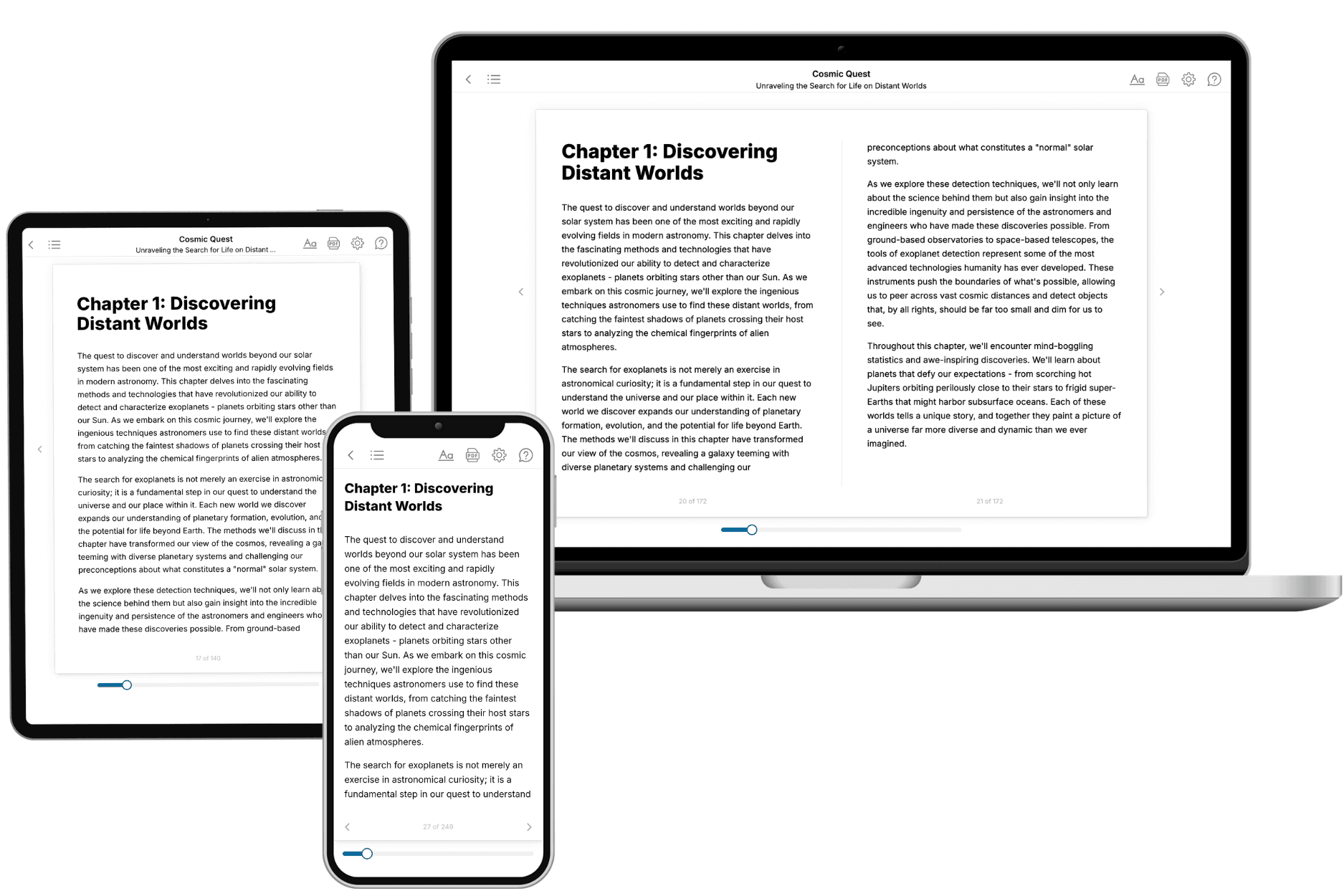
Your book is ready in 10 minutes. Read it online, download as EPUB or PDF, or send to Kindle.

Frequently asked questions
- What is TailoredRead?
TailoredRead creates complete, full-length nonfiction ebooks, written specifically for you. Tell us what you want to learn and why, and TailoredRead writes you a complete ebook on it, with charts, tables, and diagrams throughout. Read it online, on Kindle, or on any e-reader, or download it as a PDF or EPUB. Every book is written fresh the day you order it.
- How is the book tailored to me?
Before anything is written, you answer a few short questions about your goals, your background, and the topics you care about. Your book is then planned around your answers: written at your level, focused on your goals, and covering the topics you chose, instead of the one-size-fits-all book a store sells everyone.
- Will it read like generic AI content?
No. Your book isn't a chat transcript: it's planned chapter by chapter before a single word is written, told in a clear book voice, and explains ideas visually with charts, tables, and diagrams. After writing, every book goes through an editorial pass that polishes chapters so the book reads consistent from start to finish. Judge for yourself: browse thousands of sample books on our Explore Books page.
- How accurate is the content?
Our AI first checks whether your subject needs live research. Niche and fast-moving subjects are researched before writing, and the book plan and chapters are grounded in what it finds. After writing, every book goes through a quality pass that checks its facts and consistency, and researched books list their sources in a Notes section at the back.
- How long is the book?
You choose the length: Comprehensive (250-300 pages), Detailed (150-200 pages), Essential (70-100 pages), or Short (30-50 pages).
- Does the book include visuals?
Yes. Every book includes charts, tables, and diagrams: timelines, checklists, step-by-step guides, decision trees, comparison tables, matrices, and bar charts. A typical book includes dozens of these visual elements.
- Can I read it on Kindle? What formats can I download?
Yes. Every book can be read in our online reader or downloaded as a PDF or EPUB. The EPUB can be opened with Kindle, Apple Books, Kobo, and any e-reader. The Commercial and Author licenses also include an editable Word (DOCX) and Markdown download.
- How much does it cost?
About the price of a regular ebook. The exact price depends on your book's length and complexity, from $2 for the shortest books to $35 for the most comprehensive, and it's shown when you review your book, before you commit to anything. Each book is a one-time purchase, yours to keep, no subscription. Licenses that let you share, teach, or publish your book range from $35.99 to $49.99.
- Can I preview the book before purchasing?
Before you pay, you'll see what your book will cover: the title, a detailed description, the estimated length, and the complete chapter-by-chapter table of contents, so you know what you're getting before you decide. The full text itself is written after you purchase.
- How long does it take to create a book?
About 10 minutes. You can start reading the opening chapters while the rest is still being written.