The Plow to the Tractor
How Machines Transformed Farming and Shaped the Modern World
You'll trace the remarkable transformation of agriculture from labor-intensive hand cultivation to machine-driven industrial farming.
207 pages10 chaptersFeb 18, 2026Agriculture
About this book
This journey reveals how the steam engine, the mechanical reaper, and the tractor didn't simply make farming easier—they rewrote the rules of human civilization. Discover how mechanization triggered the greatest migration in human history, emptied countryside villages, and powered the rise of industrial cities. Explore how different nations adapted these technologies to their own circumstances, creating vastly different agricultural systems. Examine the environmental consequences of mechanized farming, from soil depletion to chemical pollution, and understand how these challenges shape our food systems today. You'll see how mechanization deepened global inequalities, concentrating wealth in the hands of large landowners while devastating traditional farming communities. By the end, you'll understand that agricultural mechanization wasn't simply progress—it was a complex transformation with winners and losers, benefits and costs, that continues to reshape our world.
Table of contents
- IntroductionWhy Agriculture Matters to History, What Is Agricultural Mechanization?, What This Book CoversRead below
- Chapter 1: The Agricultural World Before MachinesFarming for Millennia: The Hand Tool Era, Labor-Intensive Systems and Social Structures, The Limits of Pre-Industrial Agriculture
- Chapter 2: The First Wave: Early Mechanization and Steam PowerSteam Engines Enter the Farm, The Mechanical Reaper and Grain Harvesting, Threshing Machines and Processing Innovation, Early Adoption: Who Mechanized First and Why
- Chapter 3: The Tractor Revolution: Replacing Animal PowerThe Rise of Internal Combustion Engines, From Experimental Machines to Practical Tractors, The Global Spread of Tractors: Timeline and Patterns
- Chapter 4: Labor Displacement and Rural ExodusHow Many Workers Were Replaced?, The Great Rural-to-Urban Migration, Social and Cultural Consequences of Displacement, Resistance and Adaptation: How Communities Responded
- Chapter 5: Mechanization and Industrial GrowthThe Freed Labor Force and Factory Growth, Agricultural Surplus and Urban Feeding, Capital Accumulation and Industrial Investment
- Chapter 6: Regional Variations: Different Paths to MechanizationNorth America: Rapid Adoption and Large-Scale Farming, Europe: Varied Adoption Across Different Nations, Colonial and Postcolonial Regions: Imposed Mechanization, Asia: Late Adoption and Unique Adaptations
- Chapter 7: Environmental Consequences of Mechanized FarmingSoil Degradation and Erosion, Chemical Inputs and Pollution, Monoculture and Biodiversity Loss, Water Depletion and Contamination
- Chapter 8: Mechanization and Agricultural InequalityLand Consolidation and the Rise of Large Farms, The Decline of Small Farmers and Peasants, Wealth Concentration in Agricultural Systems, Mechanization and Global Agricultural Inequality
- Chapter 9: Mechanization, Colonialism, and Global TradeColonial Powers and Agricultural Mechanization, Mechanized Plantations and Resource Extraction, Global Trade Networks and Agricultural Specialization
- Chapter 10: The Modern Era: Automation and Precision AgricultureComputerization and Digital Farming, Precision Agriculture and Data-Driven Decisions, Automation and the Future of Farm Labor
- ConclusionThe Legacy of Agricultural Mechanization, Future Challenges and Opportunities
- Further Reading and Resources
Introduction
Somewhere in rural England in the summer of 1830, a group of farm laborers smashed a threshing machine with hammers and crowbars. They weren't vandals. They were desperate men who understood, with painful clarity, that the machine in front of them was about to take their livelihoods. These workers were part of what became known as the Captain Swing Riots, a wave of agricultural unrest that swept across southern England as mechanization began creeping into the countryside.[1] Their rage was not simply about one machine. It was about a world changing faster than they could adapt to it.
That moment captures something essential about the story this book tells. Agricultural mechanization was never just a technical story about better tools and higher yields. It was a human story, full of conflict, ambition, suffering, and transformation. When machines replaced human hands in the fields, they didn't simply make farming more efficient. They reshuffled entire societies, redirected rivers of human migration, and laid the foundations for the industrial world we still live in today. The plow gave way to the tractor, and in that transition, the modern world was born.
This book traces that transformation from its earliest roots to its most recent expressions. It asks not just how mechanization happened, but why it happened when and where it did, who benefited from it, and who paid the price. These are not simple questions, and the answers are rarely comfortable. Agricultural mechanization produced extraordinary abundance and devastating displacement in equal measure. Understanding both sides of that ledger is essential to understanding how the world came to be the way it is today.
The story spans roughly three centuries, from the early experiments with steam-powered farm equipment in the 1700s to the GPS-guided autonomous tractors and drone-monitored fields of the present day. Along the way, it crosses continents, touching the wheat fields of the American Midwest, the rice paddies of Southeast Asia, the colonial plantations of Africa and Latin America, and the smallholder farms of Europe. Each of these places experienced mechanization differently, shaped by their own histories, geographies, and power structures. Together, they form a global picture of one of the most consequential transformations in human history.
Why Agriculture Matters to History
It is easy to take food for granted. In wealthy countries today, most people spend less than 10 percent of their income on food, and the average supermarket stocks tens of thousands of products year-round.[2] This abundance is so normal that it feels like a natural condition of human life. But for most of human history, feeding people was the central challenge of every society, and the way a society organized that challenge determined almost everything else about how it functioned.
Agriculture is the foundation on which all complex civilizations have been built. When humans first began cultivating crops and domesticating animals around 10,000 BCE, they set in motion a chain of consequences that eventually produced cities, writing, governments, armies, and trade networks.[3] The ability to produce a food surplus, even a modest one, freed some people from farming and allowed them to become craftspeople, priests, soldiers, and administrators. Civilization, in a very real sense, is what happens when not everyone has to grow their own food.
This means that any major change in how agriculture works ripples outward through every other part of society. When farming becomes more productive, more people can live in cities. When farming requires less labor, workers flow into factories and workshops. When farming generates large surpluses, trade networks expand and capital accumulates. The history of agriculture is not a separate story from the history of politics, economics, and culture. It is the same story, told from the ground up.
Consider a concrete example. In 1800, roughly 90 percent of the American workforce was employed in agriculture.[4] By 2000, that figure had fallen to less than 2 percent. Yet the country was feeding far more people, and exporting food to much of the world. That shift, from 90 percent to 2 percent, represents one of the most dramatic reallocations of human labor in history. It powered the growth of American industry, shaped the demographics of American cities, and transformed the country's political landscape. And it was driven, more than anything else, by mechanization.
Agriculture also matters because it connects human societies to the natural world in the most direct possible way. Farming shapes landscapes, redirects water, depletes soils, and alters ecosystems. When the tools and methods of farming change dramatically, the environmental consequences are equally dramatic. The mechanization of agriculture enabled humans to farm at scales and intensities that were previously impossible, with consequences for soil, water, and biodiversity that are still unfolding today. Understanding those consequences requires understanding how mechanization worked and why it spread so rapidly.
Finally, agriculture matters because it has always been a site of profound social inequality. Who owns the land, who works it, and who captures the profits from it are questions that have driven revolutions, wars, and social movements throughout history. Mechanization did not resolve those questions. In many cases, it intensified them, concentrating land and wealth in fewer hands while displacing the workers who had depended on farming for their survival. That dimension of the story is just as important as the technological achievements, and this book gives it the attention it deserves.
Agriculture is not simply an economic sector. It is the material foundation of human civilization, and changes in how it works have always reverberated through every layer of society, from the family farm to the global economy.
Keeping this broader context in mind helps explain why the mechanization of agriculture deserves serious historical attention. It was not simply a story of clever inventors and better machines. It was a story about power, survival, and the reshaping of human life on a planetary scale.
What Is Agricultural Mechanization?
Before going further, it helps to be precise about what the term agricultural mechanization actually means. In the broadest sense, mechanization refers to the replacement of human or animal muscle power with machines powered by external energy sources. But that definition covers a wide range of technologies and processes, and it is worth unpacking what that looks like in practice across different stages of farming.
Farming involves a series of distinct tasks, each of which can be mechanized separately and at different times. Those tasks include:
- Land preparation: plowing, tilling, and breaking up soil to prepare it for planting
- Planting: sowing seeds at the right depth and spacing across large areas
- Cultivation: managing weeds and aerating soil during the growing season
- Harvesting: cutting, gathering, and collecting mature crops
- Processing: threshing grain, husking corn, ginning cotton, and separating usable product from waste
- Transport: moving crops from fields to storage, markets, or processing facilities
Each of these tasks was historically performed by human hands, often assisted by draft animals like oxen and horses. Mechanization entered each stage at different points in history, and the impact of mechanizing each stage was different. Mechanizing harvesting, for example, had an enormous effect on labor demand because harvest was the most labor-intensive moment in the farming calendar. Mechanizing transport had different effects, primarily on the economics of moving goods to market.
It is also important to distinguish between different types of mechanization. The earliest mechanical innovations in agriculture, such as improved plows and seed drills, were still powered by animals. They made farming more efficient without eliminating animal or human labor entirely. True mechanization, in the sense most historians use the term, refers to the introduction of machines powered by steam engines, internal combustion engines, or electricity. These machines could do work that no number of horses or humans could match in terms of speed and scale.
A useful way to think about this is through the concept of energy substitution. Pre-industrial farming ran almost entirely on biological energy: the calories burned by human workers and draft animals. Mechanized farming substituted fossil fuel energy for biological energy, dramatically expanding the amount of work that could be done per unit of time. A single modern combine harvester can harvest as much grain in one hour as a team of 150 workers could harvest by hand in the same period.[5] That ratio captures the scale of the transformation.
Mechanization also needs to be understood as a process, not a single event. It unfolded over roughly two centuries, with different technologies arriving at different times and spreading at different rates across different regions. The mechanical reaper appeared in the 1830s. Practical steam-powered tractors became available in the 1870s and 1880s. Gasoline-powered tractors became widely affordable in the 1920s and 1930s. Computerized precision farming tools arrived in the 1990s and 2000s. Each wave of innovation built on the previous one, and each created new possibilities and new disruptions.
Understanding mechanization as a layered, uneven process is important because it explains why different regions and different types of farming were affected at different times and in different ways. A cotton plantation in the American South mechanized differently from a wheat farm in the Canadian prairies, which mechanized differently from a rice farm in Japan. The technology was often similar, but the social, economic, and geographic contexts shaped how and when it was adopted, and what consequences it produced.
One more distinction is worth making here. Mechanization is related to, but not the same as, industrialization of agriculture. Industrialization refers to the broader transformation of farming into a large-scale, capital-intensive, market-oriented enterprise. Mechanization was a key driver of that transformation, but industrialization also involved changes in land ownership, crop specialization, chemical inputs, and global trade. This book focuses primarily on mechanization as the technological engine of that broader transformation, while keeping the wider industrial context clearly in view.
What This Book Covers
This book is organized to take you through the story of agricultural mechanization in a logical sequence, moving from the pre-mechanical world through successive waves of technological change and their consequences. Each chapter focuses on a distinct aspect of the story, but the chapters are designed to build on each other, so that by the end you have a coherent picture of how all the pieces fit together.
The journey begins in Chapter 1 with a close look at the agricultural world before machines arrived. Understanding what pre-industrial farming actually looked like, how it was organized, and what its limits were is essential context for understanding why mechanization happened and what it changed. This chapter examines the hand-tool era, the social structures that labor-intensive farming created, and the pressures that were building toward change by the 18th century.
Chapters 2 and 3 cover the first two major waves of mechanization. Chapter 2 examines the introduction of steam power and the first mechanical harvesting and processing machines in the 19th century. Chapter 3 focuses on the tractor revolution of the early 20th century, when internal combustion engines replaced both steam power and draft animals, fundamentally changing the economics and scale of farming. Together, these chapters trace the technological arc from the first experiments to the point where mechanized farming became the dominant model in the industrialized world.
Chapters 4 and 5 shift focus from technology to consequences. Chapter 4 examines the displacement of agricultural workers and the massive rural-to-urban migration that mechanization triggered. This is one of the most important and least discussed aspects of the story, involving tens of millions of people whose lives were upended by the arrival of machines in the fields. Chapter 5 then examines the other side of that migration: how the labor freed from farming powered the growth of industrial cities and manufacturing economies.
Chapter 6 takes a global perspective, examining how different regions adopted mechanization in different ways and at different rates. The contrast between North America's rapid, large-scale adoption and the slower, more varied patterns in Europe, Asia, and the colonial world reveals how much context shapes technological change. This chapter is particularly important for understanding why mechanization did not produce the same outcomes everywhere it arrived.
Chapters 7 and 8 address two of the most significant long-term consequences of mechanized agriculture. Chapter 7 examines the environmental impact, from soil erosion and chemical pollution to monoculture farming and water depletion. Chapter 8 examines the social and economic inequality that mechanization generated, including the concentration of land ownership, the decline of small farmers, and the widening gap between large agricultural enterprises and subsistence farmers around the world.
Chapter 9 explores the relationship between mechanization, colonialism, and global trade. This chapter argues that the spread of mechanized agriculture cannot be understood without understanding the colonial systems that shaped it. Mechanized plantations in colonized regions were not simply examples of technological progress. They were instruments of resource extraction that served the interests of colonial powers at the expense of local populations and environments.
Chapter 10 brings the story into the present, examining the latest wave of agricultural technology: computerization, precision farming, and automation. GPS-guided tractors, drone surveillance, soil sensors, and machine learning algorithms are transforming farming once again, raising new questions about labor, sustainability, and who controls the food system. This chapter connects the historical patterns explored throughout the book to the challenges and choices facing agriculture today.
The conclusion draws the threads together, reflecting on the legacy of agricultural mechanization and the questions it leaves unresolved. It does not offer simple answers, because the history does not support them. Instead, it offers a framework for thinking clearly about the trade-offs involved in technological change in food systems, and about what a more equitable and sustainable agricultural future might look like.
A few notes on scope and approach are worth mentioning here. This book is written for readers who are curious about history and want to understand how the world came to be the way it is, but who are not necessarily specialists in agricultural history or economics. Technical concepts are explained clearly when they appear, and the focus throughout is on the human story behind the machines. The book draws on a wide range of historical scholarship, and key sources are cited throughout for readers who want to explore specific topics in greater depth.
The geographic scope is genuinely global, though the coverage is not perfectly even. The United States and Western Europe receive substantial attention because they were early leaders in mechanization and because the historical record is richest there. But the book makes a deliberate effort to include the experiences of Asia, Africa, Latin America, and the colonial world, because leaving those regions out would produce a distorted and incomplete picture. Mechanization was a global phenomenon with global consequences, and the full story requires a global lens.
The goal of this book is not to celebrate mechanization as inevitable progress, nor to condemn it as pure destruction. It is to understand it honestly, in all its complexity, so that the choices being made about agricultural technology today can be informed by a clear-eyed view of what has happened before.
One of the most important things this book tries to do is resist the temptation of technological determinism, the idea that once a technology exists, its adoption and consequences are inevitable. Agricultural mechanization was shaped at every stage by human choices: choices made by inventors, investors, governments, landowners, and farmers. Different choices could have produced different outcomes. Understanding that contingency is not just historically accurate. It is also practically important, because it means that the choices being made today about agricultural technology are genuinely consequential, and that the future is not already written.
By the time you finish this book, the story of the plow giving way to the tractor should feel like much more than a tale of technological progress. It should feel like a window into the forces that shaped the modern world: the drive for efficiency, the displacement of workers, the concentration of power, the transformation of landscapes, and the ongoing struggle over who controls the most fundamental resource of all, the ability to feed people. That story is still unfolding, and understanding where it came from is the first step toward understanding where it might go.
Notes
Introduction
- 1. E. J. Hobsbawm and George Rudé, Captain Swing, Lawrence and Wishart, London, 1969
- 2. USDA Economic Research Service, Food Expenditure Series, United States Department of Agriculture, 2022
- 3. Jared Diamond, Guns, Germs, and Steel, W.W. Norton & Company, 1997
- 4. Carolyn Dimitri and others, The 20th Century Transformation of U.S. Agriculture and Farm Policy, USDA Economic Research Service, 2005
- 5. Alan L. Olmstead and Paul W. Rhode, "Reshaping the Landscape," Journal of Economic History, 2001
This is the end of the free sample. The full book has 10 chapters.
Want this book written for you?
Tell us your goals and background, and get your own version of this book, tailored by AI to you.


Benefits of AI-tailored books
- Read one book, not ten:
- all the Agriculture knowledge you need, gathered into a single book.
- Save days of learning:
- tell us your goals, choose your topics, and the whole book is built around them.
- Learn effortlessly:
- Agriculture book written for your specific background and expertise.
- Understand at a glance:
- includes charts, tables, timelines, checklists, decision trees, and more.
- Stay current:
- written the day you order it, not years ago.
- Trust what you read:
- every book is checked for accuracy, with real research when your subject needs it.
Create your unique book in 3 steps
- 1. Select your focus
Select the focus of your Agriculture book and share your background
- 2. Personalize your book
Specify your goals and choose sub-topics to include
- 3. Get your tailored book
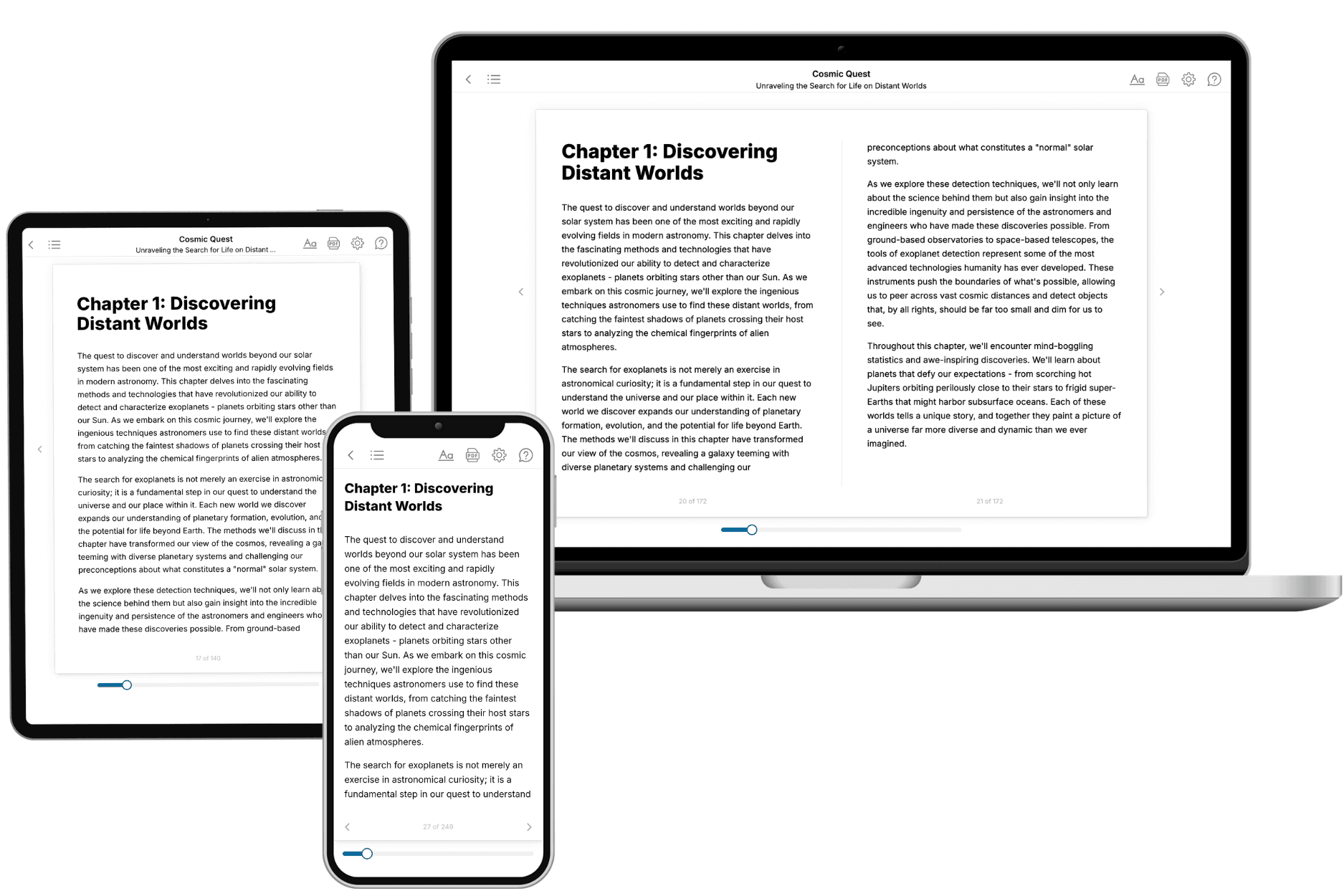
Your book is ready in 10 minutes. Read it online, download as EPUB or PDF, or send to Kindle.

Frequently asked questions
- What is TailoredRead?
TailoredRead creates complete, full-length nonfiction ebooks, written specifically for you. Tell us what you want to learn and why, and TailoredRead writes you a complete ebook on it, with charts, tables, and diagrams throughout. Read it online, on Kindle, or on any e-reader, or download it as a PDF or EPUB. Every book is written fresh the day you order it.
- How is the book tailored to me?
Before anything is written, you answer a few short questions about your goals, your background, and the topics you care about. Your book is then planned around your answers: written at your level, focused on your goals, and covering the topics you chose, instead of the one-size-fits-all book a store sells everyone.
- Will it read like generic AI content?
No. Your book isn't a chat transcript: it's planned chapter by chapter before a single word is written, told in a clear book voice, and explains ideas visually with charts, tables, and diagrams. After writing, every book goes through an editorial pass that polishes chapters so the book reads consistent from start to finish. Judge for yourself: browse thousands of sample books on our Explore Books page.
- How accurate is the content?
Our AI first checks whether your subject needs live research. Niche and fast-moving subjects are researched before writing, and the book plan and chapters are grounded in what it finds. After writing, every book goes through a quality pass that checks its facts and consistency, and researched books list their sources in a Notes section at the back.
- How long is the book?
You choose the length: Comprehensive (250-300 pages), Detailed (150-200 pages), Essential (70-100 pages), or Short (30-50 pages).
- Does the book include visuals?
Yes. Every book includes charts, tables, and diagrams: timelines, checklists, step-by-step guides, decision trees, comparison tables, matrices, and bar charts. A typical book includes dozens of these visual elements.
- Can I read it on Kindle? What formats can I download?
Yes. Every book can be read in our online reader or downloaded as a PDF or EPUB. The EPUB can be opened with Kindle, Apple Books, Kobo, and any e-reader. The Commercial and Author licenses also include an editable Word (DOCX) and Markdown download.
- How much does it cost?
About the price of a regular ebook. The exact price depends on your book's length and complexity, from $2 for the shortest books to $35 for the most comprehensive, and it's shown when you review your book, before you commit to anything. Each book is a one-time purchase, yours to keep, no subscription. Licenses that let you share, teach, or publish your book range from $35.99 to $49.99.
- Can I preview the book before purchasing?
Before you pay, you'll see what your book will cover: the title, a detailed description, the estimated length, and the complete chapter-by-chapter table of contents, so you know what you're getting before you decide. The full text itself is written after you purchase.
- How long does it take to create a book?
About 10 minutes. You can start reading the opening chapters while the rest is still being written.