Ray on Kubernetes
Architecting Scalable Machine Learning Systems
Many organizations struggle to scale their machine learning operations, often hitting roadblocks when moving from prototype to production.
269 pages13 chaptersAug 6, 2025Software ArchitectureCreated by Jyoti
About this book
Traditional approaches fall short when dealing with the complexities of distributed computing and resource management. Ray on Kubernetes: Architecting Scalable Machine Learning Systems offers a powerful solution to this challenge. This book provides a deep dive into the integration of Ray, a distributed computing framework, with Kubernetes, the leading container orchestration platform. You'll discover how to design, deploy, and manage large-scale machine learning systems that can handle complex workloads with ease. From setting up your first Ray cluster on Kubernetes to optimizing performance for production environments, this guide covers it all. Packed with practical examples and best practices, you'll learn how to leverage the full potential of distributed computing for your machine learning projects. Whether you're dealing with massive datasets, computationally intensive algorithms, or need to serve models at scale, this book will equip you with the tools and knowledge to build robust, efficient, and scalable machine learning architectures.
Table of contents
- IntroductionChallenges in Distributed Machine Learning, Overview of Ray, Kubernetes Fundamentals, Book Structure and How to Use ItRead below
- Chapter 1: Foundations of Ray and KubernetesRay Architecture Deep Dive, Kubernetes Components and Concepts, Principles of Distributed Computing, Characteristics of ML Workloads
- Chapter 2: Setting Up Your Ray on Kubernetes EnvironmentCreating a Kubernetes Cluster, Installing Ray on Kubernetes, Configuring Ray Cluster on Kubernetes, Validating Your Setup
- Chapter 3: Ray Basics for Machine LearningRay Core Concepts, Distributed Computing with Ray, Ray Tasks and Actors, Ray Object Store and Memory Management
- Chapter 4: Kubernetes for Machine Learning WorkloadsResource Management in Kubernetes, Pod Scheduling Strategies, Storage Options for ML Data, Networking for Distributed Training
- Chapter 5: Integrating Ray with KubernetesRay Operator for Kubernetes, Custom Resource Definitions, Autoscaling Ray Clusters, Resource Allocation and Limits
- Chapter 6: Distributed Training with Ray on KubernetesData Parallelism Strategies, Model Parallelism Techniques, Distributed Hyperparameter Tuning, Fault Tolerance in Training
- Chapter 7: Serving Machine Learning Models at ScaleRay Serve for Model Serving, Load Balancing and Traffic Management, Model Versioning and Rollouts, Serving Patterns and Best Practices
- Chapter 8: Large-Scale Data ProcessingWorking with Ray Datasets, Building ETL Pipelines, Real-time Data Streaming, Distributed Data Preprocessing
- Chapter 9: Performance Optimization TechniquesProfiling Ray Applications, Memory Usage Optimization, Network Communication Optimization, GPU Utilization Strategies
- Chapter 10: Monitoring and ObservabilityMetrics Collection and Dashboards, Centralized Logging, Distributed Tracing, Alerting and Incident Response
- Chapter 11: Security ConsiderationsAuthentication and Authorization, Network Policies and Isolation, Secrets Management, Compliance and Auditing
- Chapter 12: Building End-to-End ML WorkflowsMLOps Best Practices, CI/CD for ML Systems, Experiment Tracking and Versioning, Workflow Orchestration with Ray
- Chapter 13: Advanced Topics and Future DirectionsFederated Learning with Ray, Distributed Reinforcement Learning, Edge Computing and IoT Integration, Future Trends in Distributed ML
- ConclusionKey Takeaways, Next Steps in Your Distributed ML Journey
- AppendixTroubleshooting Common Issues, Resource Allocation Cheat Sheet
- Glossary
Introduction
In the rapidly evolving landscape of machine learning and artificial intelligence, the ability to scale computations and manage complex workflows has become paramount. As datasets grow larger and models become more sophisticated, the limitations of traditional computing approaches have become increasingly apparent. This book, "Ray on Kubernetes: Architecting Scalable Machine Learning Systems," addresses these challenges head-on by exploring the powerful combination of Ray, a distributed computing framework, and Kubernetes, the leading container orchestration platform.
The integration of Ray and Kubernetes offers a robust solution for building and managing large-scale machine learning systems. This synergy allows organizations to harness the full potential of distributed computing, enabling them to tackle complex ML workloads with unprecedented efficiency and scalability. Whether you're dealing with massive datasets, computationally intensive algorithms, or need to serve models at scale, the techniques and strategies outlined in this book will equip you with the tools and knowledge to build robust, efficient, and scalable machine learning architectures.
As an experienced engineering manager at Google with a strong technical background from IIT Mandi, you are likely familiar with the challenges of scaling machine learning operations. This book aims to expand your knowledge in distributed machine learning and Kubernetes, providing you with practical insights and actionable strategies to elevate your ML infrastructure to the next level. Throughout this introduction, we will explore the key challenges in distributed machine learning, provide an overview of Ray and its capabilities, delve into the fundamentals of Kubernetes, and outline the structure of this book to help you navigate its contents effectively.
Challenges in Distributed Machine Learning
Distributed machine learning presents a unique set of challenges that go beyond those encountered in traditional software development. As ML models grow in complexity and datasets expand exponentially, the need for distributed computing becomes increasingly critical. However, this shift introduces several hurdles that must be overcome to build effective and efficient ML systems at scale.
One of the primary challenges in distributed ML is data parallelism. As datasets grow beyond the capacity of a single machine, it becomes necessary to distribute the data across multiple nodes. This distribution introduces complexities in data management, synchronization, and consistency. Ensuring that all nodes have access to the required data while maintaining data integrity and avoiding bottlenecks is a non-trivial task. Moreover, the overhead of data transfer between nodes can significantly impact the overall performance of the system if not managed properly.
Another significant challenge is model parallelism. As ML models become more complex, with billions of parameters, they may no longer fit into the memory of a single machine. Distributing the model across multiple nodes introduces challenges in coordination, synchronization, and communication between different parts of the model. Ensuring that gradients are properly aggregated and that the model remains consistent across all nodes is crucial for the convergence of the training process.
Resource management and scheduling present another layer of complexity in distributed ML systems. Efficiently allocating computational resources such as CPUs, GPUs, and memory across a cluster of machines is critical for maximizing utilization and minimizing training time. This allocation must be dynamic, adapting to changing workloads and priorities. Furthermore, scheduling tasks across the cluster in a way that minimizes communication overhead and maximizes parallelism requires sophisticated algorithms and careful system design.
Fault tolerance and high availability are paramount in distributed systems, and ML workloads are no exception. In a large-scale distributed environment, hardware failures, network issues, and other unforeseen problems are inevitable. Designing systems that can gracefully handle these failures, recover from errors, and continue processing without significant disruption or data loss is essential. This requirement adds another layer of complexity to the already challenging task of distributed ML.
Monitoring and observability pose unique challenges in distributed ML systems. With computations spread across multiple nodes, gaining insight into the overall system performance, identifying bottlenecks, and debugging issues become significantly more complex. Collecting and aggregating metrics, logs, and traces from across the cluster in a meaningful way is crucial for maintaining and optimizing the system.
Scalability is a fundamental challenge that underlies all aspects of distributed ML. As the size of datasets and models continues to grow, systems must be designed to scale horizontally, adding more nodes to the cluster to handle increased load. This scalability must be achieved while maintaining performance, reliability, and ease of management. Designing architectures that can seamlessly scale from a few nodes to hundreds or thousands without requiring significant redesign is a complex engineering challenge.
Lastly, the integration of distributed ML systems with existing infrastructure and workflows presents its own set of challenges. Many organizations have established data pipelines, model development processes, and deployment strategies. Incorporating distributed ML capabilities into these existing systems without disrupting current operations requires careful planning and execution.
These challenges highlight the complexity of building and managing distributed ML systems. They underscore the need for robust frameworks and platforms that can abstract away much of this complexity, allowing data scientists and ML engineers to focus on model development and experimentation rather than infrastructure management. This is where the combination of Ray and Kubernetes comes into play, offering a powerful solution to many of these challenges.
Overview of Ray
Ray is an open-source distributed computing framework designed to address the unique challenges of scaling machine learning and AI applications. Developed at the University of California, Berkeley, Ray provides a unified interface for distributed computing that simplifies the process of building and running distributed applications. Its architecture is specifically tailored to meet the demands of modern ML workloads, offering a flexible and efficient platform for scaling from a single machine to large clusters.
At its core, Ray is built on a distributed object store and task execution system. This foundation allows Ray to efficiently manage and distribute data and computations across a cluster of machines. The object store provides a shared memory abstraction that enables fast data sharing between tasks and actors, minimizing data movement and reducing overhead. The task execution system allows for fine-grained parallelism, enabling developers to express complex computational graphs and dependencies with ease.
One of Ray's key strengths is its ability to seamlessly scale from a single machine to a large cluster without requiring changes to the application code. This feature is particularly valuable in ML workflows, where development often starts on a local machine before moving to larger-scale distributed environments. Ray achieves this scalability through its dynamic resource management system, which automatically adapts to the available resources in the cluster.
Ray introduces several core abstractions that simplify distributed computing:
- Tasks: Stateless functions that can be executed in parallel across the cluster. Tasks are ideal for embarrassingly parallel workloads and can be used to implement data-parallel algorithms efficiently.
- Actors: Stateful compute units that maintain their state across method invocations. Actors are particularly useful for implementing stateful services, managing shared resources, and implementing model-parallel algorithms.
- Object Store: A distributed shared memory system that allows for efficient data sharing between tasks and actors across the cluster.
- Placement Groups: A mechanism for co-locating related tasks and actors to optimize communication and resource utilization.
These abstractions provide a powerful toolkit for building distributed ML applications. For example, data-parallel training can be implemented using tasks to distribute computations across multiple workers, while model-parallel training can leverage actors to manage different parts of a large model. The object store facilitates efficient data sharing, crucial for both training and serving ML models at scale.
Ray also offers a rich ecosystem of libraries and tools built on top of its core framework:
- Ray Tune: A scalable hyperparameter tuning library that supports a wide range of optimization algorithms and integrates with popular ML frameworks.
- Ray Serve: A scalable model serving library that simplifies the deployment and management of ML models in production environments.
- Ray RLlib: A scalable reinforcement learning library that provides a collection of RL algorithms and environments.
- Ray Datasets: A library for distributed data processing that enables efficient handling of large-scale datasets.
These libraries leverage Ray's distributed computing capabilities to provide high-performance, scalable solutions for common ML tasks. They integrate seamlessly with the Ray ecosystem, allowing developers to build end-to-end ML pipelines that can scale effortlessly.
Ray's architecture is designed with fault tolerance in mind. It employs a distributed scheduler and fault-tolerant storage system to ensure that applications can continue running even in the face of node failures. This resilience is crucial for long-running ML workloads, where hardware failures in a large cluster are not uncommon.
Another significant advantage of Ray is its interoperability with existing ML frameworks and tools. Ray integrates well with popular libraries such as TensorFlow, PyTorch, and scikit-learn, allowing developers to leverage their existing knowledge and codebases while benefiting from Ray's distributed computing capabilities.
Ray's flexibility and power make it an excellent choice for a wide range of ML workloads, from distributed training and hyperparameter tuning to model serving and reinforcement learning. Its ability to abstract away much of the complexity of distributed computing while providing fine-grained control when needed makes it an invaluable tool for scaling ML operations.
As we delve deeper into this book, you'll discover how Ray's capabilities can be leveraged in conjunction with Kubernetes to build robust, scalable ML systems. The combination of Ray's distributed computing prowess and Kubernetes' container orchestration capabilities provides a powerful platform for tackling the most demanding ML workloads at scale.
Kubernetes Fundamentals
Kubernetes, often abbreviated as K8s, is an open-source container orchestration platform that has become the de facto standard for deploying, scaling, and managing containerized applications. Originally developed by Google and now maintained by the Cloud Native Computing Foundation (CNCF), Kubernetes provides a robust set of features for automating the deployment, scaling, and operations of application containers across clusters of hosts.
At its core, Kubernetes is designed to abstract away the complexity of managing a distributed system. It provides a declarative approach to defining and managing applications, allowing developers and operators to describe the desired state of their system rather than the specific steps to achieve that state. Kubernetes then works to ensure that the actual state of the system matches the desired state, automatically making adjustments as needed.
The fundamental unit of deployment in Kubernetes is the Pod. A Pod represents one or more containers that are deployed together on the same host and share the same network namespace. Pods are ephemeral by design, meaning they can be created, destroyed, and rescheduled as needed to maintain the desired state of the system. This design aligns well with the principles of immutable infrastructure and facilitates easy scaling and updates of applications.
Kubernetes introduces several key abstractions that are crucial for understanding its architecture and capabilities:
- Nodes: The physical or virtual machines that make up the Kubernetes cluster. Each node runs a container runtime (such as Docker) and the necessary Kubernetes components to communicate with the master and manage Pods.
- Control Plane: The set of components that manage the overall state of the cluster. This includes the API server, scheduler, and controller manager.
- Deployments: A higher-level abstraction that manages ReplicaSets and provides declarative updates to Pods.
- Services: An abstraction that defines a logical set of Pods and a policy by which to access them. Services enable loose coupling between dependent Pods.
- ConfigMaps and Secrets: Resources for managing configuration data and sensitive information, respectively.
- Persistent Volumes: An abstraction for managing durable storage in a cluster.
One of Kubernetes' key strengths is its extensibility. The platform provides several extension points that allow for customization and enhancement of its core functionality:
- Custom Resources: Allow for the definition of new resource types that can be managed by Kubernetes.
- Operators: Custom controllers that extend Kubernetes to manage complex, stateful applications.
- Admission Controllers: Plugins that intercept requests to the Kubernetes API server before object persistence.
- Container Network Interface (CNI): A specification and libraries for configuring network interfaces in Linux containers.
- Container Storage Interface (CSI): A standard for exposing arbitrary block and file storage systems to containerized workloads.
These extension mechanisms make Kubernetes highly adaptable to a wide range of use cases and environments, including the specific requirements of distributed machine learning workloads.
Kubernetes excels in several areas that are particularly relevant to ML operations:
- Scalability: Kubernetes can easily scale applications up or down based on demand or custom metrics.
- High Availability: The platform is designed to be resilient to failures, with features like self-healing and automatic load balancing.
- Resource Management: Kubernetes provides sophisticated mechanisms for allocating and managing compute resources across the cluster.
- Rolling Updates and Rollbacks: Applications can be updated or rolled back with minimal downtime.
- Service Discovery and Load Balancing: Kubernetes automatically handles service discovery and distributes traffic across healthy instances of an application.
- Secret and Configuration Management: Sensitive data and configuration can be managed and updated independently of application code.
These capabilities make Kubernetes an excellent platform for managing the complex infrastructure requirements of distributed ML systems. When combined with Ray, Kubernetes provides a powerful foundation for building scalable, resilient, and efficient ML pipelines.
However, it's important to note that while Kubernetes offers tremendous power and flexibility, it also introduces significant complexity. Managing a Kubernetes cluster requires a deep understanding of its architecture and components. This complexity is one of the reasons why the integration of Ray with Kubernetes is so valuable – it allows ML practitioners to leverage the power of Kubernetes without necessarily having to become experts in its intricacies.
As we progress through this book, you'll see how Kubernetes concepts and features can be applied specifically to ML workloads. You'll learn how to deploy Ray clusters on Kubernetes, manage resources effectively, handle storage for large datasets, and implement best practices for security and monitoring in a Kubernetes environment. This knowledge will empower you to build ML systems that can scale seamlessly from development to production, leveraging the best of both Ray and Kubernetes.
Book Structure and How to Use It
"Ray on Kubernetes: Architecting Scalable Machine Learning Systems" is designed to provide a comprehensive guide to leveraging Ray with Kubernetes for building and managing large-scale machine learning systems. The book is structured to take you on a journey from the foundational concepts to advanced topics, with each chapter building upon the knowledge gained in the previous ones. This section will outline the structure of the book and provide guidance on how to make the most of its contents.
The book is divided into 13 main chapters, followed by a conclusion, appendix, and glossary. Here's an overview of what you can expect from each section:
- Foundations of Ray and Kubernetes: This chapter provides a deep dive into the architectures of Ray and Kubernetes, exploring the principles of distributed computing and the characteristics of ML workloads.
- Setting Up Your Ray on Kubernetes Environment: Here, you'll learn how to create a Kubernetes cluster, install Ray, and configure your environment for distributed ML workloads.
- Ray Basics for Machine Learning: This chapter covers the core concepts of Ray, including tasks, actors, and the object store, with a focus on their application to ML workflows.
- Kubernetes for Machine Learning Workloads: You'll explore how Kubernetes can be leveraged specifically for ML, covering topics like resource management, pod scheduling, and storage options for ML data.
- Integrating Ray with Kubernetes: This crucial chapter details how Ray and Kubernetes work together, including the use of the Ray Operator and custom resource definitions.
- Distributed Training with Ray on Kubernetes: Here, you'll learn strategies for implementing distributed training, including data and model parallelism techniques.
- Serving Machine Learning Models at Scale: This chapter covers model serving at scale using Ray Serve and Kubernetes, including load balancing and versioning strategies.
- Large-Scale Data Processing: You'll explore techniques for handling massive datasets using Ray Datasets and building efficient ETL pipelines.
- Performance Optimization Techniques: This chapter provides strategies for optimizing the performance of your distributed ML systems, including profiling and resource utilization techniques.
- Monitoring and Observability: Here, you'll learn how to implement comprehensive monitoring and observability for your Ray on Kubernetes deployments.
- Security Considerations: This chapter covers essential security practices for distributed ML systems, including authentication, network policies, and secrets management.
- Building End-to-End ML Workflows: You'll learn how to implement MLOps best practices and build complete ML pipelines using Ray and Kubernetes.
- Advanced Topics and Future Directions: The final chapter explores cutting-edge topics like federated learning and distributed reinforcement learning, as well as future trends in the field.
To make the most of this book, it's recommended to follow the chapters in order, as each builds upon the concepts introduced in the previous ones. However, if you're already familiar with certain topics, you can also use the book as a reference guide, jumping to specific chapters or sections as needed.
Throughout the book, you'll find practical examples, code snippets, and best practices that you can apply directly to your own projects. It's highly recommended to follow along with these examples in your own environment, experimenting and adapting them to your specific use cases.
The book is designed to be both a learning tool and a reference guide. As you progress through the chapters, you'll gain a deep understanding of how to architect scalable ML systems using Ray and Kubernetes. At the same time, you can refer back to specific sections when you need guidance on particular topics or techniques in your day-to-day work.
Each chapter concludes with a summary of key points and, where applicable, suggestions for further reading or exploration. These resources can be valuable for deepening your understanding of specific topics or staying up-to-date with the latest developments in the field.
The appendix provides additional resources, including troubleshooting guides and cheat sheets, which can be invaluable when working with Ray and Kubernetes in practice. The glossary offers quick references to key terms and concepts used throughout the book.
As you work through the book, it's important to keep in mind that the field of distributed ML is rapidly evolving. While the fundamental concepts and techniques covered in this book will remain relevant, specific tools and best practices may evolve over time. It's always a good idea to refer to the official documentation of Ray and Kubernetes for the most up-to-date information on specific features or APIs.
Finally, remember that building scalable ML systems is as much an art as it is a science. While this book provides a solid foundation and numerous best practices, there's no one-size-fits-all solution. As you gain experience, you'll develop intuition about how to best architect and optimize your systems for your specific use cases. Don't be afraid to experiment, iterate, and adapt the concepts learned here to your unique requirements.
By the end of this book, you'll have a comprehensive understanding of how to leverage Ray and Kubernetes to build scalable, efficient, and robust machine learning systems. Whether you're looking to optimize existing ML workflows or architect entirely new systems, the knowledge gained from this book will be invaluable in your journey towards mastering distributed machine learning.
This is the end of the free sample. The full book has 13 chapters.
Want this book written for you?
Tell us your goals and background, and get your own version of this book, tailored by AI to you.


Benefits of AI-tailored books
- Read one book, not ten:
- all the Software Architecture knowledge you need, gathered into a single book.
- Save days of learning:
- tell us your goals, choose your topics, and the whole book is built around them.
- Learn effortlessly:
- Software Architecture book written for your specific background and expertise.
- Understand at a glance:
- includes charts, tables, timelines, checklists, decision trees, and more.
- Stay current:
- written the day you order it, not years ago.
- Trust what you read:
- every book is checked for accuracy, with real research when your subject needs it.
Create your unique book in 3 steps
- 1. Select your focus
Select the focus of your Software Architecture book and share your background
- 2. Personalize your book
Specify your goals and choose sub-topics to include
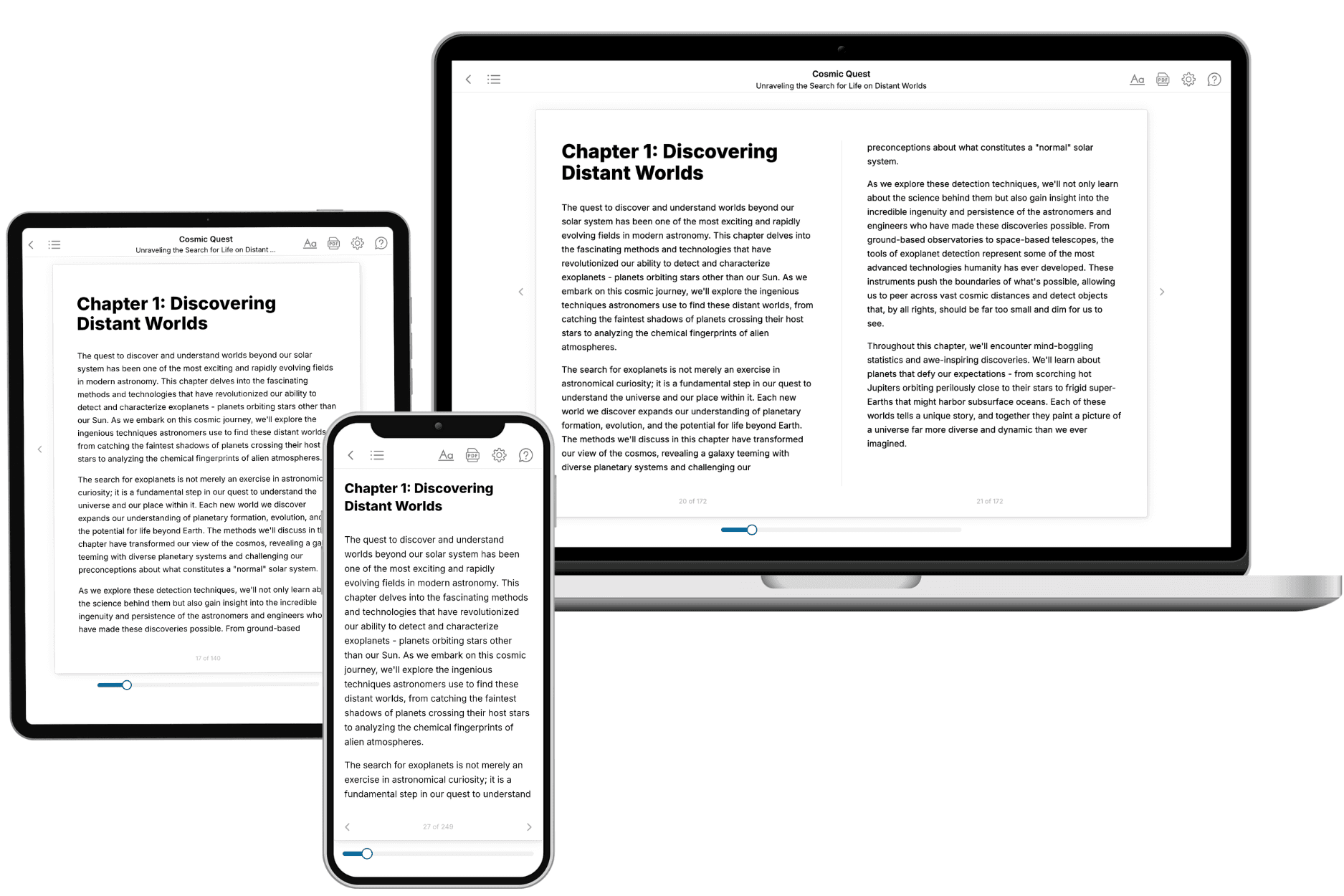
- 3. Get your tailored book
Your book is ready in 10 minutes. Read it online, download as EPUB or PDF, or send to Kindle.
Frequently asked questions
- What is TailoredRead?
TailoredRead creates complete, full-length nonfiction ebooks, written specifically for you. Tell us what you want to learn and why, and TailoredRead writes you a complete ebook on it, with charts, tables, and diagrams throughout. Read it online, on Kindle, or on any e-reader, or download it as a PDF or EPUB. Every book is written fresh the day you order it.
- How is the book tailored to me?
Before anything is written, you answer a few short questions about your goals, your background, and the topics you care about. Your book is then planned around your answers: written at your level, focused on your goals, and covering the topics you chose, instead of the one-size-fits-all book a store sells everyone.
- Will it read like generic AI content?
No. Your book isn't a chat transcript: it's planned chapter by chapter before a single word is written, told in a clear book voice, and explains ideas visually with charts, tables, and diagrams. After writing, every book goes through an editorial pass that polishes chapters so the book reads consistent from start to finish. Judge for yourself: browse thousands of sample books on our Explore Books page.
- How accurate is the content?
Our AI first checks whether your subject needs live research. Niche and fast-moving subjects are researched before writing, and the book plan and chapters are grounded in what it finds. After writing, every book goes through a quality pass that checks its facts and consistency, and researched books list their sources in a Notes section at the back.
- How long is the book?
You choose the length: Comprehensive (250-300 pages), Detailed (150-200 pages), Essential (70-100 pages), or Short (30-50 pages).
- Does the book include visuals?
Yes. Every book includes charts, tables, and diagrams: timelines, checklists, step-by-step guides, decision trees, comparison tables, matrices, and bar charts. A typical book includes dozens of these visual elements.
- Can I read it on Kindle? What formats can I download?
Yes. Every book can be read in our online reader or downloaded as a PDF or EPUB. The EPUB can be opened with Kindle, Apple Books, Kobo, and any e-reader. The Commercial and Author licenses also include an editable Word (DOCX) and Markdown download.
- How much does it cost?
About the price of a regular ebook. The exact price depends on your book's length and complexity, from $2 for the shortest books to $35 for the most comprehensive, and it's shown when you review your book, before you commit to anything. Each book is a one-time purchase, yours to keep, no subscription. Licenses that let you share, teach, or publish your book range from $35.99 to $49.99.
- Can I preview the book before purchasing?
Before you pay, you'll see what your book will cover: the title, a detailed description, the estimated length, and the complete chapter-by-chapter table of contents, so you know what you're getting before you decide. The full text itself is written after you purchase.
- How long does it take to create a book?
About 10 minutes. You can start reading the opening chapters while the rest is still being written.