Revolution in Budapest
The Hungarian Uprising of 1956 and Its Impact on European History
The streets of Budapest erupt in chaos as ordinary citizens rise against an oppressive regime.
269 pages12 chaptersDec 25, 2024European History
About this book
The year is 1956, and Hungary is about to change the course of European history. But what led to this moment of defiance, and how did it shape the future of a nation and a continent? In "Revolution in Budapest," you'll be transported to the heart of Cold War Europe, where tensions between East and West reached a boiling point. This book offers a vivid account of the Hungarian Uprising, from its roots in post-World War II politics to its dramatic unfolding and lasting consequences. You'll gain insights into the key players, the international response, and the human stories that defined this pivotal moment. Through meticulous research and compelling narratives, you'll discover how the Hungarian people's brave stand against Soviet dominance resonated far beyond their borders. This book not only chronicles the events of 1956 but also explores their significance in the broader tapestry of European history, offering a fresh perspective on the Cold War era and its impact on modern geopolitics.
Table of contents
- IntroductionThe Significance of the Hungarian Uprising, Overview of the Book's Structure, Setting the Historical ContextRead below
- Chapter 1: Prelude to RevolutionHungary in the Aftermath of World War II, Establishment of Soviet Control, The Stalinist Era in Hungary, Growing Social and Political Tensions
- Chapter 2: The Spark of RevolutionStudent Protests and Demands, Workers' Strikes and Factory Occupations, Initial Demonstrations in Budapest, Government Response and Escalation
- Chapter 3: The Uprising UnfoldsOctober 23: The Day of Revolution, The Battle for the Radio Building, Toppling of the Stalin Statue, Spread of the Revolution Across Hungary
- Chapter 4: Key Figures of the RevolutionImre Nagy: The Reformist Prime Minister, Pál Maléter: The Military Leader, József Mindszenty: The Cardinal's Role, Other Revolutionary Leaders and Organizers
- Chapter 5: The Soviet ResponseInitial Soviet Withdrawal, The Decision to Intervene, Operation Whirlwind: The Soviet Offensive, Hungarian Resistance Against Soviet Forces
- Chapter 6: International Reaction and InactionWestern Powers' Response, United Nations Debates and Resolutions, The Suez Crisis: A Distracting Factor, Cold War Dynamics and Limitations
- Chapter 7: Suppression and AftermathSoviet Victory and Consolidation of Power, Reprisals and Executions, The Hungarian Refugee Crisis, Establishment of the Kádár Regime
- Chapter 8: The Human Cost of RevolutionCasualties and Injuries, Imprisonment and Deportations, Families Torn Apart, Personal Stories of Survivors and Exiles
- Chapter 9: Cultural Impact of the UprisingLiterature and Poetry of the Revolution, Art and Music Inspired by 1956, Film and Media Representations, Memorials and Commemorations
- Chapter 10: Long-Term Effects on HungaryPolitical Changes and 'Goulash Communism', Economic Reforms and Development, Social Transformation and Dissent, Impact on Hungarian National Identity
- Chapter 11: Impact on European HistoryShifting Cold War Dynamics, Cracks in the Eastern Bloc, Impact on Western European Communism, Inspiration for Future Resistance Movements
- Chapter 12: The Legacy of 1956Role in the Fall of Communism in 1989, 1956 in Modern Hungarian Politics, The Uprising in European Historical Memory, Lessons Learned from the Hungarian Revolution
- ConclusionHistorical Significance of the Hungarian Uprising, Reflections on Revolution and Resistance, Avenues for Future Research and Understanding
- AppendixTimeline of Key Events, Biographies of Key Figures, Important Documents and Declarations
- Glossary
- Further Reading
Introduction
The Hungarian Uprising of 1956 stands as a defining moment in the tapestry of 20th-century European history. It was a brief but intense period of hope, courage, and ultimately, tragedy that reverberated far beyond the borders of Hungary. This pivotal event not only challenged the iron grip of Soviet control over Eastern Europe but also exposed the deep-seated tensions within the communist bloc and the complex dynamics of the Cold War. As you embark on this exploration of the Hungarian Uprising, you will uncover a story of ordinary people who dared to dream of freedom and were willing to risk everything in pursuit of that dream.
The events that unfolded in Budapest and across Hungary in the autumn of 1956 were not merely a localized rebellion against an unpopular regime. They represented a fundamental challenge to the post-World War II order in Europe and a moment of reckoning for both East and West. The uprising forced the world to confront the realities of Soviet domination in Eastern Europe and the limitations of Western support for those seeking liberation from communist rule. It was a time when the ideological battle lines of the Cold War were starkly drawn, yet also a moment when those lines were blurred by the complexities of international politics and the human desire for self-determination.
As you delve into the pages of this book, you will be transported to a Hungary struggling to emerge from the shadows of World War II and grappling with the imposition of a Soviet-style communist system. You will witness the buildup of tensions, the spark that ignited the revolution, and the dramatic days of hope and resistance that followed. Through detailed accounts and analysis, you will gain insight into the key figures who shaped the uprising, from student protesters and workers to political leaders and military commanders. You will also explore the international context of the revolution, examining how global powers responded to the crisis and why their actions (or inactions) had such profound consequences.
The Hungarian Uprising of 1956 was more than just a failed revolution; it was a watershed moment that left an indelible mark on the conscience of Europe and the world. Its legacy continues to influence political discourse, national identity, and collective memory to this day. By understanding the events of 1956, you will gain valuable insights into the forces that shaped the latter half of the 20th century and continue to resonate in contemporary European politics and society.
This introduction sets the stage for a comprehensive exploration of the Hungarian Uprising, its causes, its course, and its consequences. As you proceed through the chapters that follow, you will uncover the layers of this complex historical event, gaining a deeper appreciation for its significance and the enduring lessons it offers for our understanding of freedom, resistance, and the human spirit in the face of oppression.
The Significance of the Hungarian Uprising
The Hungarian Uprising of 1956 holds a unique place in the annals of Cold War history, representing a moment when the façade of Soviet control over Eastern Europe cracked, revealing the deep-seated discontent that lay beneath. This event was not merely a localized disturbance but a seismic shift that sent shockwaves through the entire communist bloc and beyond. To fully grasp its significance, it is essential to consider the uprising within the broader context of post-World War II Europe and the global struggle between capitalism and communism.
At its core, the Hungarian Uprising was a powerful assertion of national sovereignty and a rejection of foreign domination. It demonstrated that despite years of repression and indoctrination, the desire for freedom and self-determination remained strong among the Hungarian people. This challenge to Soviet authority was unprecedented in its scale and intensity, marking the first time that a Warsaw Pact country had attempted to break free from Moscow's orbit. The bravery displayed by ordinary Hungarians in the face of overwhelming odds captured the world's imagination and exposed the fragility of Soviet control over its satellite states[1].
The uprising also played a crucial role in shaping Cold War dynamics and international relations. It forced both Eastern and Western powers to reassess their strategies and assumptions about the stability of the post-war order. For the Soviet Union, the events in Hungary revealed the limits of its ability to maintain control through force alone and highlighted the need for more nuanced approaches to managing its sphere of influence. The brutal suppression of the uprising, while successful in the short term, ultimately undermined the legitimacy of Soviet rule and sowed the seeds of future resistance movements across Eastern Europe.
For Western powers, particularly the United States, the Hungarian Uprising presented a moral and strategic dilemma. While publicly supporting the cause of freedom and democracy, the West's inability or unwillingness to intervene directly exposed the limitations of its containment policy and the rhetoric of liberation. This failure to act had profound implications for future Cold War strategies and highlighted the complexities of balancing ideological commitments with geopolitical realities[2].
The significance of the Hungarian Uprising extends beyond its immediate political and strategic implications. It had a profound impact on intellectual and cultural life both within Hungary and across Europe. The events of 1956 inspired a generation of writers, artists, and thinkers to grapple with questions of freedom, resistance, and the human cost of totalitarianism. Works of literature, film, and art that emerged in the aftermath of the uprising continue to shape our understanding of this period and its legacy.
Moreover, the Hungarian Uprising played a crucial role in the evolution of communist ideology and practice. It exposed the contradictions inherent in the Soviet system and forced a reevaluation of the relationship between Moscow and its satellite states. In Hungary itself, the uprising led to the development of "goulash communism" under János Kádár, a more liberal form of socialism that sought to balance ideological orthodoxy with limited economic and cultural freedoms. This model would later influence reform movements in other Eastern Bloc countries.
The legacy of 1956 continues to resonate in contemporary Hungarian politics and national identity. The uprising has become a powerful symbol of Hungarian resilience and the nation's commitment to freedom and independence. It serves as a touchstone for discussions about Hungary's place in Europe and its relationship with both East and West. The commemoration of the uprising remains an important part of Hungary's political calendar, with each anniversary providing an opportunity for reflection on the country's past and its aspirations for the future.
In the broader context of European history, the Hungarian Uprising stands as a pivotal moment in the long process of communist collapse and the eventual end of the Cold War. While it did not immediately lead to the fall of the Iron Curtain, it exposed the fundamental weaknesses of the Soviet system and inspired future generations of dissidents and reformers. The courage displayed by Hungarian revolutionaries in 1956 set a precedent for later movements in Czechoslovakia, Poland, and ultimately, the peaceful revolutions of 1989 that brought down the Berlin Wall and led to the dissolution of the Soviet Union.
As you delve deeper into the story of the Hungarian Uprising, you will discover that its significance lies not only in the dramatic events of those few weeks in 1956 but in the long-lasting impact it had on the course of European history. It serves as a powerful reminder of the enduring human desire for freedom and the complex interplay of forces that shape historical change. By understanding the Hungarian Uprising, you gain insight into the forces that transformed Europe in the latter half of the 20th century and continue to influence the continent's political landscape today.
The significance of the Hungarian Uprising of 1956 cannot be overstated. It was a moment when the aspirations of a nation collided with the realities of Cold War politics, producing consequences that would reverberate for decades. As you proceed through this book, you will explore in detail the various facets of this pivotal event, from its origins in the post-war period to its long-term effects on Hungary, Europe, and the world. By doing so, you will gain a deeper appreciation for the complexities of history and the enduring power of the human spirit in the face of oppression.
Overview of the Book's Structure
This book is designed to provide you with a comprehensive and nuanced understanding of the Hungarian Uprising of 1956. It is structured to guide you through the complex web of historical events, personalities, and consequences that define this pivotal moment in European history. As you progress through the chapters, you will find a carefully crafted narrative that balances chronological progression with thematic exploration, allowing for a deep and multifaceted analysis of the uprising and its impact.
The journey begins with a thorough examination of the historical context that set the stage for the events of 1956. Chapter 1, "Prelude to Revolution," delves into Hungary's position in the aftermath of World War II, the establishment of Soviet control, and the Stalinist era that followed. This chapter is crucial for understanding the deep-rooted grievances and tensions that ultimately led to the uprising. You will explore the social, economic, and political conditions that prevailed in Hungary during the early 1950s, providing essential background for the dramatic events that were to unfold.
Moving forward, Chapter 2, "The Spark of Revolution," focuses on the immediate triggers that ignited the uprising. Here, you will learn about the student protests, workers' strikes, and initial demonstrations that marked the beginning of the revolution. This chapter provides a detailed account of how discontent transformed into open rebellion, examining the key demands of the protesters and the government's initial response. By understanding these critical early moments, you will gain insight into the rapid escalation of events that followed.
Chapter 3, "The Uprising Unfolds," takes you into the heart of the revolution. This chapter provides a day-by-day account of the key events, from the toppling of Stalin's statue to the spread of the uprising across Hungary. You will witness the dramatic confrontations between revolutionaries and authorities, the formation of revolutionary committees, and the initial successes of the uprising. This chapter brings to life the intensity and chaos of those pivotal days in October 1956.
To provide a deeper understanding of the individuals who shaped the course of events, Chapter 4, "Key Figures of the Revolution," offers detailed profiles of the main protagonists. From Imre Nagy, the reformist prime minister, to Cardinal József Mindszenty and military leaders like Pál Maléter, you will gain insight into the motivations, actions, and fates of those who played crucial roles in the uprising. This chapter humanizes the historical narrative, allowing you to connect with the personal stories behind the larger events.
The international dimension of the uprising is explored in depth in Chapters 5 and 6. "The Soviet Response" examines the decision-making process in Moscow, the initial withdrawal of Soviet forces, and the subsequent military intervention. "International Reaction and Inaction" broadens the scope to analyze the responses of Western powers, the United Nations debates, and the impact of concurrent events like the Suez Crisis. These chapters provide crucial context for understanding the global dynamics that influenced the outcome of the uprising.
The tragic conclusion of the revolution is covered in Chapter 7, "Suppression and Aftermath," which details the Soviet military victory, the reprisals against revolutionaries, and the establishment of the Kádár regime. This chapter also examines the refugee crisis that followed the uprising, providing insight into the long-term demographic and social impacts of the events of 1956.
To fully appreciate the human dimension of the uprising, Chapter 8, "The Human Cost of Revolution," focuses on the personal stories of those affected. Through accounts of casualties, imprisonments, and families torn apart, you will gain a poignant understanding of the profound impact the uprising had on individual lives. This chapter serves as a powerful reminder of the real human consequences of historical events.
The cultural legacy of the uprising is explored in Chapter 9, "Cultural Impact of the Uprising." Here, you will discover how the events of 1956 influenced literature, art, music, and film, both in Hungary and internationally. This chapter demonstrates the enduring power of the uprising in shaping cultural memory and artistic expression.
Chapters 10 and 11 examine the long-term effects of the uprising on Hungary and Europe, respectively. "Long-Term Effects on Hungary" explores the political, economic, and social transformations that occurred in the decades following 1956, including the development of "goulash communism" and changes in national identity. "Impact on European History" broadens the perspective to analyze how the uprising influenced Cold War dynamics, Western European communism, and future resistance movements across the Eastern Bloc.
The book concludes with Chapter 12, "The Legacy of 1956," which brings the narrative up to the present day. This chapter examines the role of the uprising in the fall of communism in 1989, its place in modern Hungarian politics, and its significance in European historical memory. It also reflects on the lessons that can be drawn from the Hungarian Revolution and its relevance to contemporary issues of democracy, nationalism, and resistance.
Throughout the book, you will find that each chapter is enriched with primary source materials, including eyewitness accounts, official documents, and contemporary media reports. These sources provide a direct connection to the events and personalities being discussed, allowing you to engage with the historical material in a more immediate and personal way. Additionally, maps, photographs, and other visual aids are incorporated to enhance your understanding of the geographical and physical context of the uprising.
The book also includes several special features designed to deepen your engagement with the material. Sidebars throughout the text provide additional context on specific topics, such as the role of Radio Free Europe, the impact of de-Stalinization, and the experiences of Hungarian refugees. Timeline summaries at the end of key chapters help you keep track of the rapid sequence of events, while "Spotlight" sections focus on particular individuals, places, or incidents that merit closer examination.
To facilitate further exploration of the topics covered, each chapter concludes with a list of recommended readings and resources. These carefully selected materials provide avenues for more in-depth study of specific aspects of the uprising and its historical context. The book's appendices offer additional valuable resources, including a comprehensive timeline of events, biographies of key figures, and important documents related to the uprising.
By structuring the book in this way, the aim is to provide you with a rich, multifaceted understanding of the Hungarian Uprising of 1956. As you progress through the chapters, you will not only gain knowledge of the events themselves but also develop a deeper appreciation for their significance within the broader context of European and Cold War history. This comprehensive approach allows you to engage with the material on multiple levels, from the grand sweep of geopolitical forces to the intimate stories of individual participants and survivors.
Setting the Historical Context
To fully grasp the significance and dynamics of the Hungarian Uprising of 1956, it is crucial to understand the historical context in which it occurred. The events that unfolded in Budapest and across Hungary in the autumn of 1956 were the culmination of long-standing tensions and the product of complex historical forces that had been shaping Central and Eastern Europe for decades. This section aims to provide you with a comprehensive overview of the key historical developments that set the stage for the uprising, allowing you to appreciate the depth and complexity of the factors that led to this pivotal moment in European history.
The roots of the Hungarian Uprising can be traced back to the aftermath of World War I and the Treaty of Trianon in 1920. This treaty, which formally ended Hungary's involvement in the war, resulted in the loss of two-thirds of Hungary's territory and left millions of ethnic Hungarians living outside the country's new borders. The trauma of this territorial dismemberment had a profound impact on Hungarian national identity and politics in the interwar period, fueling irredentist sentiments and contributing to Hungary's alignment with Nazi Germany in the lead-up to World War II[3].
World War II itself brought further devastation to Hungary. The country's alliance with Nazi Germany led to its occupation by German forces in 1944, followed by a brutal siege of Budapest by the advancing Soviet Red Army. The war resulted in significant loss of life, destruction of infrastructure, and profound social and economic disruption. As the conflict drew to a close, Hungary found itself firmly within the Soviet sphere of influence, setting the stage for the imposition of communist rule.
The immediate post-war period in Hungary was characterized by a brief but significant experiment with democracy. Multi-party elections held in 1945 resulted in a victory for the Smallholders' Party, which formed a coalition government. However, this democratic interlude was short-lived. Through a combination of political maneuvering, intimidation, and outright fraud – a strategy known as "salami tactics" – the Hungarian Communist Party, backed by Soviet authorities, gradually consolidated its power. By 1949, Hungary had become a one-party state under the leadership of Mátyás Rákosi, a hardline Stalinist[4].
The Rákosi era, which lasted from 1949 to 1956, was characterized by the wholesale imposition of the Soviet model on Hungarian society. This period saw the nationalization of industry, the collectivization of agriculture, and the implementation of centralized economic planning. The regime also embarked on a campaign of political repression, targeting not only perceived opponents of communism but also potential rivals within the party itself. Thousands of Hungarians were imprisoned, executed, or sent to labor camps during this time. The secret police, known as the ÁVH, became a feared instrument of state control, creating an atmosphere of pervasive terror and suspicion.
Economically, the Stalinist policies implemented under Rákosi proved disastrous for Hungary. The focus on heavy industry at the expense of consumer goods led to shortages and a decline in living standards. Forced collectivization disrupted agricultural production, leading to food shortages. Workers faced increasingly demanding production quotas while their real wages declined. These economic hardships contributed significantly to growing discontent among the Hungarian population.
The death of Joseph Stalin in 1953 marked a turning point in the Soviet bloc, including Hungary. The new Soviet leadership, under Nikita Khrushchev, began to promote a policy of de-Stalinization, encouraging some degree of reform in the satellite states. In Hungary, this led to the appointment of Imre Nagy as Prime Minister in 1953. Nagy's "New Course" policies, which included relaxing collectivization, allowing some private enterprise, and releasing political prisoners, offered a brief respite from the harshest aspects of Stalinist rule. However, Nagy's reforms were met with resistance from hardliners within the Hungarian Communist Party, leading to his removal from office in 1955.
The period between Nagy's dismissal and the outbreak of the uprising in October 1956 was marked by increasing tension and uncertainty. Khrushchev's "Secret Speech" in February 1956, in which he denounced Stalin's crimes and cult of personality, sent shockwaves through the communist world. In Hungary, this emboldened reformist elements within the party and society at large. Intellectual and cultural life began to show signs of greater openness, with writers and artists pushing the boundaries of what was permissible under communist rule.
International events also played a role in setting the stage for the Hungarian Uprising. The Poznań protests in Poland in June 1956, which were met with a relatively conciliatory response from the Polish communist leadership, demonstrated that change was possible within the Soviet bloc. The Suez Crisis, which began to unfold in late October 1956, diverted international attention and complicated the geopolitical landscape just as tensions in Hungary were reaching a boiling point.
It is within this complex historical context that the events of October and November 1956 unfolded. The Hungarian Uprising was not merely a spontaneous outburst of discontent but the result of long-simmering grievances, economic hardships, and political repression. It was fueled by hopes for reform inspired by de-Stalinization and emboldened by signs of change elsewhere in the Eastern Bloc. At the same time, it was constrained by the realities of Cold War geopolitics and the limits of Soviet tolerance for dissent within its sphere of influence.
As you proceed through the subsequent chapters of this book, this historical background will provide you with a crucial framework for understanding the motivations of the various actors involved in the uprising, the rapid escalation of events, and the ultimate tragic outcome. The Hungarian Uprising of 1956 was a pivotal moment that both reflected the tensions inherent in the post-war order and foreshadowed the eventual unraveling of Soviet control in Eastern Europe. By appreciating the deep historical roots of this event, you will be better equipped to grasp its profound significance and lasting impact on European history.
In the chapters that follow, you will explore in detail how these historical forces manifested in the specific events of the uprising, from the initial student protests to the formation of workers' councils, from the brief triumph of the revolutionaries to the brutal Soviet suppression. Throughout this journey, it is important to keep in mind the complex interplay of national aspirations, ideological conflicts, and geopolitical realities that shaped the course of events in Hungary in 1956 and continue to resonate in European politics and society to this day.
Notes
Introduction
- 1. Charles Gati, Failed Illusions, Stanford University Press, 2006
- 2. László Borhi, Hungary in the Cold War, 1945-1956, Central European University Press, 2004
- 3. Ignác Romsics, Hungary in the Twentieth Century, Corvina Books, 1999
- 4. Peter Kenez, Hungary from the Nazis to the Soviets, Cambridge University Press, 2006
This is the end of the free sample. The full book has 12 chapters.
Want this book written for you?
Tell us your goals and background, and get your own version of this book, tailored by AI to you.


Benefits of AI-tailored books
- Read one book, not ten:
- all the European History knowledge you need, gathered into a single book.
- Save days of learning:
- tell us your goals, choose your topics, and the whole book is built around them.
- Learn effortlessly:
- European History book written for your specific background and expertise.
- Understand at a glance:
- includes charts, tables, timelines, checklists, decision trees, and more.
- Stay current:
- written the day you order it, not years ago.
- Trust what you read:
- every book is checked for accuracy, with real research when your subject needs it.
Create your unique book in 3 steps
- 1. Select your focus
Select the focus of your European History book and share your background
- 2. Personalize your book
Specify your goals and choose sub-topics to include
- 3. Get your tailored book
Your book is ready in 10 minutes. Read it online, download as EPUB or PDF, or send to Kindle.


Frequently asked questions
- What is TailoredRead?
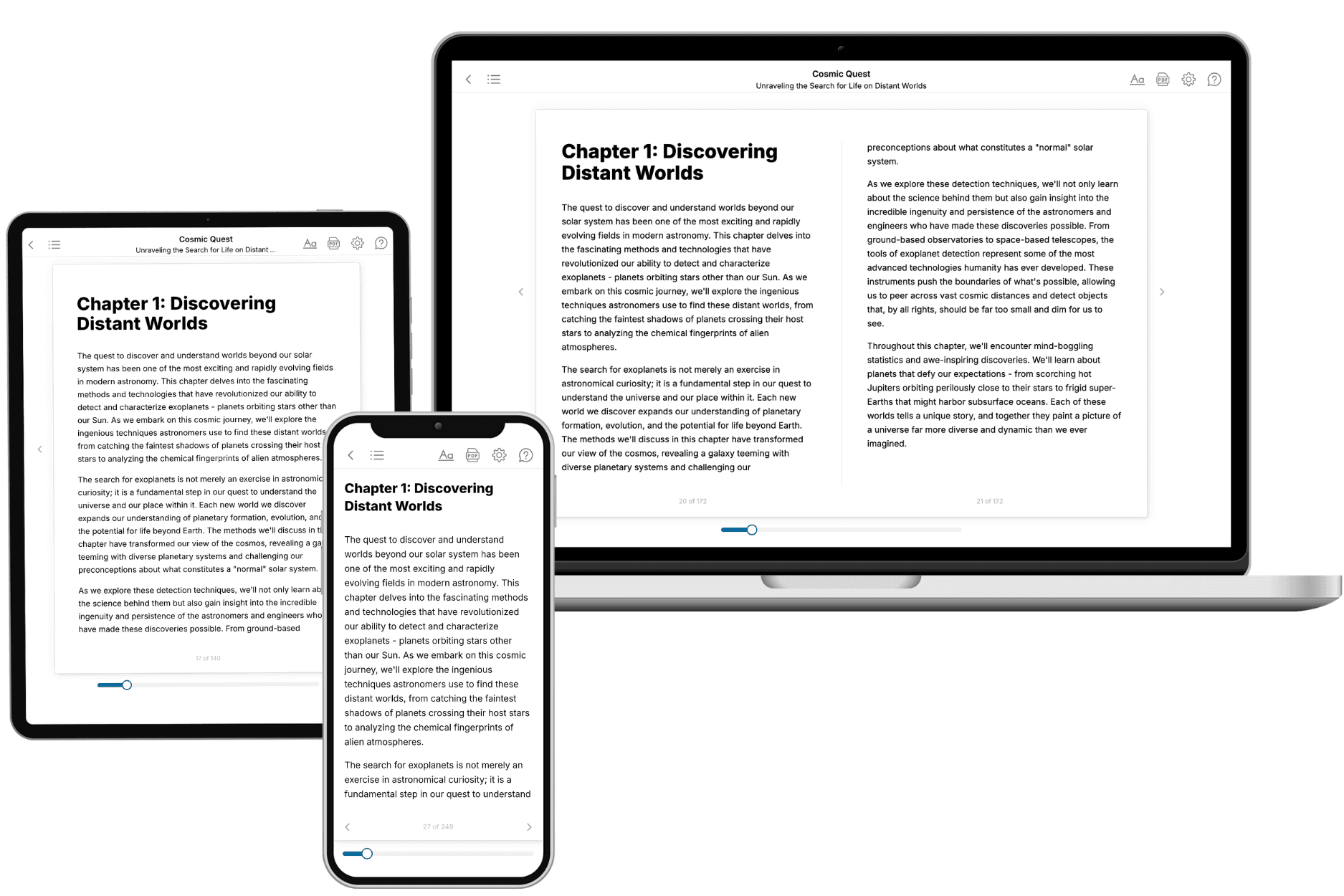
TailoredRead creates complete, full-length nonfiction ebooks, written specifically for you. Tell us what you want to learn and why, and TailoredRead writes you a complete ebook on it, with charts, tables, and diagrams throughout. Read it online, on Kindle, or on any e-reader, or download it as a PDF or EPUB. Every book is written fresh the day you order it.
- How is the book tailored to me?
Before anything is written, you answer a few short questions about your goals, your background, and the topics you care about. Your book is then planned around your answers: written at your level, focused on your goals, and covering the topics you chose, instead of the one-size-fits-all book a store sells everyone.
- Will it read like generic AI content?
No. Your book isn't a chat transcript: it's planned chapter by chapter before a single word is written, told in a clear book voice, and explains ideas visually with charts, tables, and diagrams. After writing, every book goes through an editorial pass that polishes chapters so the book reads consistent from start to finish. Judge for yourself: browse thousands of sample books on our Explore Books page.
- How accurate is the content?
Our AI first checks whether your subject needs live research. Niche and fast-moving subjects are researched before writing, and the book plan and chapters are grounded in what it finds. After writing, every book goes through a quality pass that checks its facts and consistency, and researched books list their sources in a Notes section at the back.
- How long is the book?
You choose the length: Comprehensive (250-300 pages), Detailed (150-200 pages), Essential (70-100 pages), or Short (30-50 pages).
- Does the book include visuals?
Yes. Every book includes charts, tables, and diagrams: timelines, checklists, step-by-step guides, decision trees, comparison tables, matrices, and bar charts. A typical book includes dozens of these visual elements.
- Can I read it on Kindle? What formats can I download?
Yes. Every book can be read in our online reader or downloaded as a PDF or EPUB. The EPUB can be opened with Kindle, Apple Books, Kobo, and any e-reader. The Commercial and Author licenses also include an editable Word (DOCX) and Markdown download.
- How much does it cost?
About the price of a regular ebook. The exact price depends on your book's length and complexity, from $2 for the shortest books to $35 for the most comprehensive, and it's shown when you review your book, before you commit to anything. Each book is a one-time purchase, yours to keep, no subscription. Licenses that let you share, teach, or publish your book range from $35.99 to $49.99.
- Can I preview the book before purchasing?
Before you pay, you'll see what your book will cover: the title, a detailed description, the estimated length, and the complete chapter-by-chapter table of contents, so you know what you're getting before you decide. The full text itself is written after you purchase.
- How long does it take to create a book?
About 10 minutes. You can start reading the opening chapters while the rest is still being written.