Sacagawea: The Woman Who Shaped American Exploration
Her Remarkable Life, Crucial Role, and Lasting Legacy on the Lewis and Clark Expedition
What if the most crucial member of America's most famous expedition has been largely misunderstood?
191 pages9 chaptersAug 18, 2026Biography
About this book
Sacagawea's story is far more complex and consequential than the simplified narratives found in textbooks. This book moves beyond the myths to reveal how a Shoshone woman, captured as a child and enslaved, became indispensable to one of history's greatest journeys. Discover how her linguistic abilities, cultural knowledge, and diplomatic skills opened doors that would have remained closed to Lewis and Clark. Explore the fragmented historical record that obscures her true contributions and the challenges of separating fact from legend. From her early life on the Great Plains to her mysterious final years, this biography examines Sacagawea as a fully realized person—not merely a supporting character in someone else's story. You'll gain insight into Shoshone culture, the fur trade economy, and how indigenous women shaped American exploration in ways that history has only recently begun to acknowledge.
Table of contents
- IntroductionWhy Sacagawea Matters Today, Separating Myth from Reality, How to Read This BookRead below
- Chapter 1: The Shoshone World: Before CaptivityShoshone Culture and Society, Childhood on the Great Plains, The Raid That Changed Everything
- Chapter 2: Captivity and Survival: The Hidatsa YearsEnslaved Among the Hidatsa, Learning Languages and Survival Skills, Meeting Toussaint Charbonneau
- Chapter 3: The Expedition Begins: Joining Lewis and ClarkThe Corps of Discovery Forms, Sacagawea Hired as Interpreter, Departure from Fort Mandan
- Chapter 4: The Indispensable Guide: Sacagawea's Crucial ContributionsLinguistic Bridge Between Worlds, Geographical Knowledge and Navigation, Gathering Food and Resources, Diplomatic Presence and Legitimacy
- Chapter 5: Motherhood on the Trail: Jean Baptiste and SurvivalPregnancy and Birth During Expedition, Caring for Jean Baptiste, Balancing Motherhood and Expedition Duties
- Chapter 6: Key Moments: Encounters That Changed the JourneyReunion with the Shoshone, Acquiring Horses for Mountain Crossing, Reaching the Pacific Ocean
- Chapter 7: After the Expedition: The Lost YearsReturn to Fort Mandan, Separation from Jean Baptiste, Conflicting Accounts of Her Final Years
- Chapter 8: Interpreting the Evidence: What Historians Know and DebatePrimary Sources and Their Limitations, Competing Historical Narratives, The Challenge of Indigenous Women in Archives
- Chapter 9: Legacy and Symbolism: Sacagawea in American CultureMonuments and Memorials, Sacagawea in Popular Imagination, Reclaiming Her Story: Indigenous Perspectives
- ConclusionSacagawea Beyond the Expedition, Lessons for Understanding History
- Further Reading and Resources
Introduction
A single coin, minted in golden brass and placed into circulation in the year 2000, carries the face of a woman whose actual appearance no one alive has ever confirmed. The Sacagawea dollar coin shows a young mother with an infant strapped to her back, an image drawn largely from imagination rather than any surviving portrait or detailed physical description[1]. Millions of Americans have held that coin without knowing that the woman it depicts left behind fewer than a handful of confirmed facts about her life. This gap between fame and factual knowledge sits at the center of everything this book sets out to examine.
Sacagawea's name appears in nearly every American history textbook that covers westward expansion, yet the space given to her is often thin. She is frequently reduced to a single sentence: the Native woman who guided Lewis and Clark to the Pacific. That sentence is not accurate, and it flattens a life that involved captivity, forced marriage, multilingual interpretation, childbirth on the move, and survival across thousands of miles of unfamiliar and often dangerous terrain. The purpose of this introduction is to explain why a fuller, more careful account matters, how popular stories about her diverge from the documented record, and how the chapters ahead are organized to help sort one from the other.
This book does not claim to solve every mystery surrounding her life. The historical record, as later chapters will show in detail, is fragmentary, filtered through the journals of men who did not always think her actions worth recording, and shaped by later writers who filled gaps with invention. What this book offers instead is a disciplined attempt to separate what expedition journals and other primary sources actually say from what has been added by novelists, filmmakers, and civic mythmakers over two centuries. That distinction, simple to state, turns out to be difficult to maintain, and much of the value of this book lies in showing exactly where the line falls.
Readers who come to this subject already familiar with the broad outline of the Corps of Discovery expedition will find here a deeper look at the specific mechanisms of her contribution: how her presence functioned as a diplomatic signal to tribes along the route, how her knowledge of edible plants supplemented a diet that repeatedly threatened to fail, and how her fluency across multiple languages made her one link in a chain of interpretation that stretched across cultural boundaries most expedition members could never have crossed alone. These are not romantic flourishes. They are documented functions that had measurable effects on whether the expedition survived contact with the peoples whose land it crossed.
Why Sacagawea Matters Today
The standard account of the Lewis and Clark expedition tends to present it as an achievement of two white American officers, supported by a crew of enlisted men, that opened the western half of the continent to American settlement. That framing is not wrong so much as incomplete. It leaves out the fact that the expedition's survival depended repeatedly on cooperation from Native nations who had no obligation to help a group of armed strangers moving through their territory. Sacagawea's presence changed how those encounters unfolded, and understanding her role means understanding the expedition as a negotiated passage rather than a solitary conquest.
Consider the specific mechanics of how a war party was traditionally read on the northern plains and Rocky Mountain frontier in the early 1800s. An armed group of men traveling without women or children signaled potential hostility to tribes who had every reason to be wary of outsiders. Clark himself recorded this dynamic directly in the expedition journals, noting that the presence of a woman with an infant served as a sign of peaceful intent[2]. This single documented observation carries enormous weight. It means that Sacagawea's body, quite apart from any skill or action she performed, functioned as a kind of passport that no map or compass could replace.
Beyond the specific historical case, Sacagawea matters because her story forces a reconsideration of who counts as a historical actor. Traditional narratives of exploration center commanding officers and named male scouts, while women, especially Native women, are treated as background figures who accompanied the "real" participants. Reassessing her role is part of a broader shift in historical practice toward recovering the contributions of people who were present, consequential, and yet marginal in the written record because of who controlled the pen. This shift is not a matter of rewriting history to fit modern values. It is a matter of reading existing sources more carefully and asking what they actually document.
Her relevance also extends into contemporary conversations about indigenous representation in American public memory. More statues have been erected in her honor than for almost any other woman in American history, and her image has been used on currency, postage, and place names across the country[3]. Yet many of these tributes were designed and funded by non-Native institutions with little input from Shoshone or other indigenous communities. Examining that gap between commemoration and consultation is part of what makes her story relevant to debates happening today about who gets to shape public memory and how.
Finally, her life offers a case study in resilience under circumstances almost no reader today will ever face directly: forced removal from her family as a child, servitude in a foreign community, a marriage arranged without her consent, and a multi-thousand-mile journey undertaken while caring for an infant. None of this is presented in this book as inspirational packaging. It is presented because these were the actual conditions of her life, and any honest account of her contributions to American exploration has to hold those conditions in view rather than smoothing them into an uplifting footnote.
Approaching her life this way changes the questions worth asking. Instead of asking only "what did she do for Lewis and Clark," this book also asks what the expedition demanded of her, what she lost in the process, and what choices, if any, were actually available to her at each stage. Those questions do not have comfortable answers. They are, however, the questions that a serious biography of a captured, enslaved, then employed Shoshone woman must confront if it intends to treat her as a full person rather than a supporting character in someone else's adventure story.
Separating Myth from Reality
Popular imagination has attached several claims to Sacagawea that do not hold up against the documentary record. One of the most persistent is the idea that she served as the expedition's primary navigator, guiding Lewis and Clark along a route she already knew from memory. In reality, the expedition relied on maps, astronomical observation, and information gathered from various tribes along the way, and Sacagawea's direct geographic knowledge applied mainly to the region near her Lemhi Shoshone homeland, particularly around the Bitterroot Mountains and the areas where she had lived before her capture. Outside that specific stretch, she was traveling through unfamiliar territory just as the rest of the party was.
This distinction matters because it does not diminish her contribution so much as correct its shape. Her value in unfamiliar territory came less from route-finding and more from her ability to recognize edible plants, read certain landscape signs common across the plains and mountain West, and maintain composure during moments of crisis, such as when a boat capsized and she recovered scientific instruments and records from the water[4]. That is a documented act of quick thinking under pressure, not an invented legend, and it deserves more attention than the guiding myth that has overshadowed it for generations.
A second myth concerns the nature of her relationship with the expedition itself. Popular retellings sometimes imply she joined as an eager volunteer swept up in the excitement of discovery. The documented reality is considerably more constrained. She was married to Toussaint Charbonneau, a French-Canadian fur trader hired by the expedition, and she was brought along largely because Charbonneau's employment came bundled with her presence and her linguistic usefulness. She had no independent contract, no wage of her own, and no formal say in whether the journey happened. Recognizing this does not erase her agency within the journey, but it corrects a common distortion that frames her involvement as a simple choice freely made.
A third area of confusion involves her name itself. Sources spell it multiple ways, including Sacajawea and Sakakawea, and disagreements persist among historians and linguists about its correct pronunciation and even its language of origin, with some arguing for a Hidatsa derivation meaning "bird woman" and others favoring a Shoshone origin[5]. This is not a trivial detail. The uncertainty over her name reflects a larger pattern in which even the most basic facts about her were recorded inconsistently by men who did not always prioritize accuracy when it came to a woman they viewed primarily as useful rather than notable.
Perhaps the most consequential myth involves her death. Popular tradition in some Shoshone oral accounts holds that she lived a long life and died in 1884 on the Wind River Reservation in Wyoming, while the documentary record kept by fur traders points to a woman matching her description dying of illness in 1812 at Fort Manuel in present-day South Dakota[6]. Both claims cannot be simultaneously true, and this book will not pretend otherwise. Instead, it treats this disagreement as a genuine historical problem worth examining rather than a detail to be resolved by picking whichever version feels more satisfying.
The pattern across all these corrections is consistent. Myths about Sacagawea tend to either inflate her role into something more singular and heroic than the record supports, or they simplify her circumstances into something more comfortable and less coercive than what actually happened. Both distortions do her a disservice, because both replace a complicated, constrained, and genuinely remarkable life with a flatter story that is easier to tell but less true. The chapters ahead will return repeatedly to this tension between the documented and the imagined, because that tension is not a side issue. It is the central challenge of writing about her at all.
None of this means treating every popular account as worthless. Some elements of the popular image, such as her resourcefulness during moments of crisis and her presence as a stabilizing figure among strangers, are well supported by primary sources. The goal is not cynicism toward every story told about her, but discernment about which stories can be traced to documented evidence and which have been added later to serve other purposes, whether nation-building, commercial marketing, or feminist reclamation. Each of those purposes has its place, but none of them should be mistaken for history itself.
How to Read This Book
This book proceeds mostly in chronological order, beginning with the Shoshone world into which Sacagawea was born and moving through her capture, her years among the Hidatsa at the Knife River Villages, her recruitment into the Corps of Discovery, the expedition itself, and the largely undocumented decades that followed. This structure is meant to help build an understanding of cause and effect: the skills she brought to the expedition were not innate talents but the direct product of a childhood in one culture and a captivity in another, and later chapters will make little sense without that earlier grounding firmly in mind.
Two chapters near the end of the book depart from strict chronology to address method directly. One examines the primary sources available to historians, mainly the expedition journals kept by Lewis, Clark, and other members of the party, and explains what these documents can and cannot tell us given who wrote them and why. The other looks at how her image has been used, reshaped, and contested in American culture since her death, from statues and coinage to contemporary indigenous reclamation efforts. These chapters function as a toolkit, giving a framework for evaluating any claim about Sacagawea encountered outside this book, whether in a museum placard, a documentary, or a casual conversation.
Readers looking for a quick answer to "what did Sacagawea actually do" may be tempted to skip ahead to the chapter cataloging her documented contributions to the expedition. That chapter is useful and worth reading closely, but it will mean more after working through the earlier material on her upbringing and captivity, because her specific skills, from plant knowledge to language fluency, trace directly back to those experiences. Skipping the foundation makes her contributions look like isolated talents rather than the product of a specific, traceable life history, which undercuts one of the central arguments of this book.
Throughout the book, direct quotations from expedition journals are presented alongside careful notes about their limitations. Clark, in particular, spelled her name and Charbonneau's inconsistently across different entries, and both he and Lewis frequently described her actions without recording her own words or reported feelings. When a journal entry is quoted, take note of whose voice is actually speaking. It is almost never Sacagawea's own, and that absence is itself a finding worth sitting with rather than glossing over.
Footnotes throughout the book point toward primary sources and standard scholarly works for readers who want to go deeper into a particular claim or period. These are not decorative. Given how contested and thin the record on Sacagawea can be, tracing a claim back to its source is often the only way to judge whether it deserves confidence or skepticism. Readers with a research interest in this period are encouraged to treat the footnotes as a starting map for further investigation rather than a formality to skip past.
Finally, approach the uncertainties in this story as part of its substance rather than as gaps to be impatiently endured before reaching firmer ground. Much of what makes Sacagawea's life difficult to write about honestly, the missing birth records, the disputed death accounts, the near total absence of her own recorded voice, is itself a reflection of how indigenous women's lives were documented, or rather not documented, in this period of American history. Sitting with that absence, rather than rushing to fill it with invented certainty, is part of what this book asks of anyone reading it seriously.
Notes
Introduction
- 1. United States Mint, Annual Report, 2000
- 2. Bernard DeVoto, "The Journals of Lewis and Clark," Houghton Mifflin, 1953
- 3. Ella E. Clark and Margot Edmonds, Sacagawea of the Lewis and Clark Expedition, University of California Press, 1979
- 4. Gary E. Moulton, The Journals of the Lewis and Clark Expedition, University of Nebraska Press, 1986
- 5. Irving W. Anderson, "Probing the Riddle of the Bird Woman," Montana The Magazine of Western History, 1973
- 6. John C. Luttig, "Journal of a Fur-Trading Expedition on the Upper Missouri," State Historical Society of North Dakota, 1920
This is the end of the free sample. The full book has 9 chapters.
Want this book written for you?
Tell us your goals and background, and get your own version of this book, tailored by AI to you.


Benefits of AI-tailored books
- Read one book, not ten:
- all the Biography knowledge you need, gathered into a single book.
- Save days of learning:
- tell us your goals, choose your topics, and the whole book is built around them.
- Learn effortlessly:
- Biography book written for your specific background and expertise.
- Understand at a glance:
- includes charts, tables, timelines, checklists, decision trees, and more.
- Stay current:
- written the day you order it, not years ago.
- Trust what you read:
- every book is checked for accuracy, with real research when your subject needs it.
Create your unique book in 3 steps
- 1. Select your focus
Select the focus of your Biography book and share your background
- 2. Personalize your book
Specify your goals and choose sub-topics to include
- 3. Get your tailored book
Your book is ready in 10 minutes. Read it online, download as EPUB or PDF, or send to Kindle.


Frequently asked questions
- What is TailoredRead?
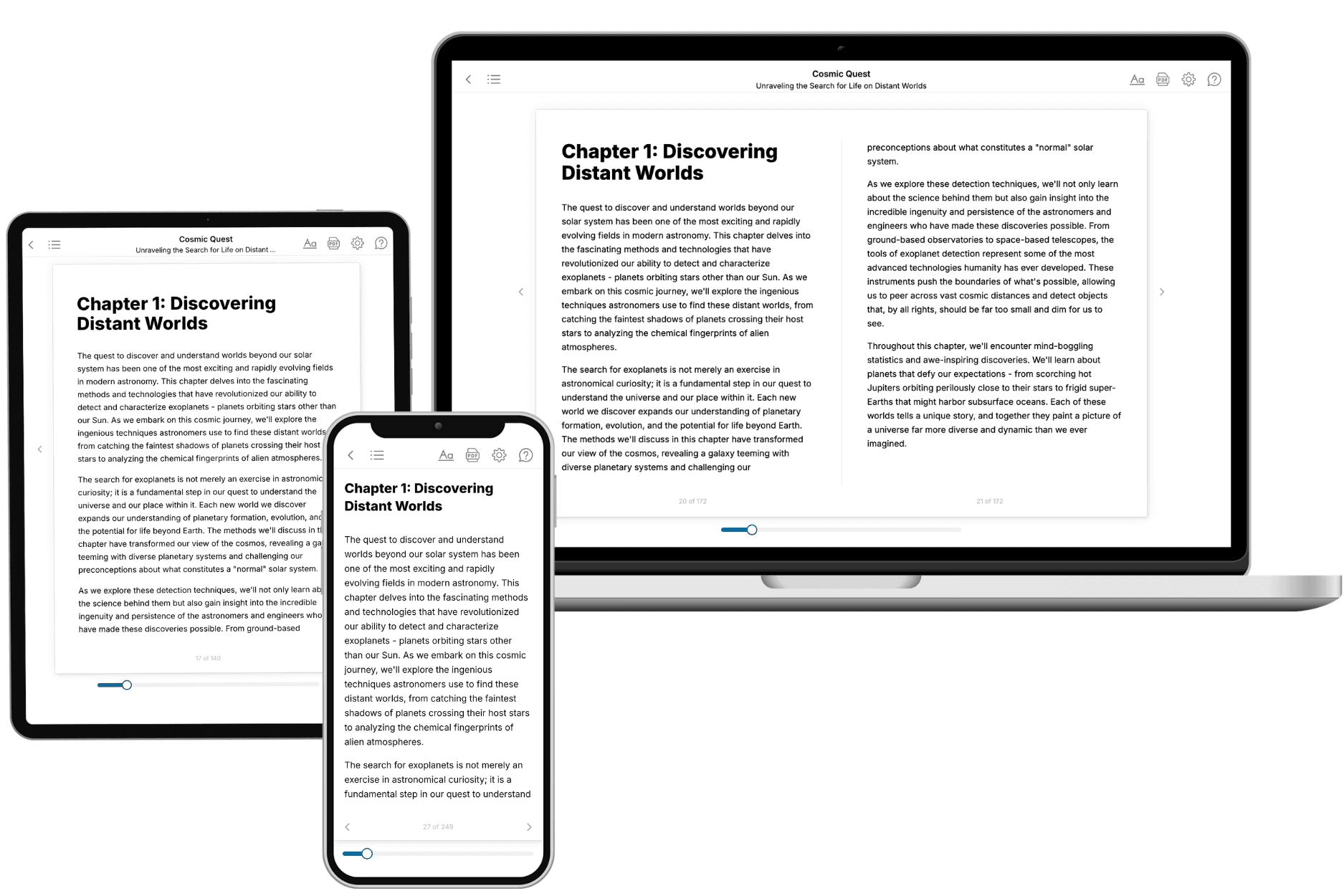
TailoredRead creates complete, full-length nonfiction ebooks, written specifically for you. Tell us what you want to learn and why, and TailoredRead writes you a complete ebook on it, with charts, tables, and diagrams throughout. Read it online, on Kindle, or on any e-reader, or download it as a PDF or EPUB. Every book is written fresh the day you order it.
- How is the book tailored to me?
Before anything is written, you answer a few short questions about your goals, your background, and the topics you care about. Your book is then planned around your answers: written at your level, focused on your goals, and covering the topics you chose, instead of the one-size-fits-all book a store sells everyone.
- Will it read like generic AI content?
No. Your book isn't a chat transcript: it's planned chapter by chapter before a single word is written, told in a clear book voice, and explains ideas visually with charts, tables, and diagrams. After writing, every book goes through an editorial pass that polishes chapters so the book reads consistent from start to finish. Judge for yourself: browse thousands of sample books on our Explore Books page.
- How accurate is the content?
Our AI first checks whether your subject needs live research. Niche and fast-moving subjects are researched before writing, and the book plan and chapters are grounded in what it finds. After writing, every book goes through a quality pass that checks its facts and consistency, and researched books list their sources in a Notes section at the back.
- How long is the book?
You choose the length: Comprehensive (250-300 pages), Detailed (150-200 pages), Essential (70-100 pages), or Short (30-50 pages).
- Does the book include visuals?
Yes. Every book includes charts, tables, and diagrams: timelines, checklists, step-by-step guides, decision trees, comparison tables, matrices, and bar charts. A typical book includes dozens of these visual elements.
- Can I read it on Kindle? What formats can I download?
Yes. Every book can be read in our online reader or downloaded as a PDF or EPUB. The EPUB can be opened with Kindle, Apple Books, Kobo, and any e-reader. The Commercial and Author licenses also include an editable Word (DOCX) and Markdown download.
- How much does it cost?
About the price of a regular ebook. The exact price depends on your book's length and complexity, from $2 for the shortest books to $35 for the most comprehensive, and it's shown when you review your book, before you commit to anything. Each book is a one-time purchase, yours to keep, no subscription. Licenses that let you share, teach, or publish your book range from $35.99 to $49.99.
- Can I preview the book before purchasing?
Before you pay, you'll see what your book will cover: the title, a detailed description, the estimated length, and the complete chapter-by-chapter table of contents, so you know what you're getting before you decide. The full text itself is written after you purchase.
- How long does it take to create a book?
About 10 minutes. You can start reading the opening chapters while the rest is still being written.