Shiloh: The Battle That Changed America
How Two Days in April 1862 Revealed the True Cost of Civil War
Many believe the Civil War was decided by grand strategy and famous generals, but the truth is far more complex.
191 pages9 chaptersDec 23, 2025American Civil War
About this book
The Battle of Shiloh, fought April 6-7, 1862, in southwestern Tennessee, shattered every assumption Americans held about their conflict. In just two days, over 23,000 soldiers fell—more casualties than in all previous American wars combined. This battle transformed the Civil War from a romantic notion of heroic combat into a grim reality of industrial-scale slaughter. Through detailed accounts of the fighting, personal narratives of soldiers and commanders, and analysis of tactical decisions, this book reveals how Shiloh changed everything. You'll discover why both armies were unprepared for what they faced, how weather and terrain shaped the outcome, and why this "victory" for the Union actually proved inconclusive. More importantly, you'll understand how Shiloh forced military leaders, politicians, and citizens to confront the war's true nature—a prolonged struggle that would demand total commitment and exact an unprecedented human cost.
Table of contents
- IntroductionWhy Shiloh Matters Today, What You Will Learn in This Book, How to Use This BookRead below
- Chapter 1: The Road to ShilohEarly War Expectations and Misconceptions, The Western Theater Strategy, Grant and Sherman's Rise to Command
- Chapter 2: The Armies AssembleThe Union Forces: Composition and Readiness, The Confederate Forces: Composition and Readiness, Commanders and Their Plans
- Chapter 3: April 6: The Surprise AttackThe Dawn Assault and Initial Chaos, Union Disorganization and Desperate Defense, The Hornet's Nest and the Sunken Road
- Chapter 4: The Brutal First DayMidday Fighting and Shifting Lines, General Johnston's Death and Its Impact, Union Retreat to Pittsburg Landing
- Chapter 5: April 7: The CounterattackGrant's Reinforcements Arrive, The Union Offensive on the Second Day, Confederate Withdrawal and Retreat
- Chapter 6: The Human CostCasualty Statistics and Their Meaning, Soldier Experiences and Testimonies, The Medical Crisis and Aftermath
- Chapter 7: Tactical Analysis and Military LessonsHow Terrain and Weather Shaped the Battle, Artillery, Infantry Tactics, and Modern Warfare, Command Decisions and Critical Errors
- Chapter 8: The Battle's Aftermath and ConsequencesImmediate Strategic Impact on the War, Public Reaction in the North and South, Military Reorganization and Lessons Learned
- Chapter 9: Shiloh's Legacy in American HistoryChanging Perceptions of the War, Influence on Future Battles and Strategy, Shiloh in Cultural Memory and Commemoration
- ConclusionShiloh as a Turning Point, Lessons for Understanding Conflict and History
- Further Reading and Resources
Introduction
On the morning of April 6, 1862, thousands of Union soldiers awoke in their camps near a small log church called Shiloh, located in southwestern Tennessee. Most were inexperienced volunteers who had enlisted months earlier with visions of glory and quick victory. They cooked breakfast, cleaned their rifles, and went about routine camp duties with little sense of urgency. No one had ordered entrenchments dug. Pickets stood at relaxed intervals. Commanders assured their men that the Confederates were miles away in Corinth, Mississippi, with no intention of attacking. Within hours, these assumptions would prove catastrophically wrong. A massive Confederate army burst from the woods in a surprise assault that sent Union forces reeling backward in chaos and terror.
The Battle of Shiloh transformed the American Civil War in ways that few other engagements would match. Before Shiloh, many Americans on both sides believed the conflict would be brief—a matter of one or two decisive battles followed by negotiated peace. The battle's staggering casualty count shattered this illusion completely. Over 23,000 men were killed, wounded, or went missing in just two days of fighting. This exceeded the combined casualties of the Revolutionary War, the War of 1812, and the Mexican-American War. Newspapers across the nation published lists of the dead that stretched for pages. Families who had sent their sons off with patriotic fervor now confronted the grim reality that this war would consume a generation.
What makes Shiloh particularly significant is not just the scale of bloodshed, but what the battle revealed about the nature of the conflict itself. Both armies demonstrated remarkable courage and determination, yet both also displayed shocking unpreparedness and tactical confusion. Commanders on both sides made critical errors in judgment. Supply lines collapsed under the strain of supporting tens of thousands of men in remote terrain. Medical services proved woefully inadequate to handle the flood of wounded soldiers. The battle exposed fundamental problems in military organization, training, and logistics that would plague both the Union and Confederacy throughout the war. More importantly, Shiloh demonstrated that neither side possessed the capability to deliver a knockout blow—the war would be long, brutal, and decided by attrition rather than brilliant maneuvers.
This book examines the Battle of Shiloh from multiple perspectives to help you understand its full significance. You'll explore the strategic context that brought two massive armies to this remote corner of Tennessee. You'll follow the battle's progression hour by hour, understanding how terrain, weather, and command decisions shaped the outcome. You'll encounter the experiences of ordinary soldiers who fought in the chaos of close-quarters combat. Most importantly, you'll discover how Shiloh changed everything—military tactics, public opinion, political calculations, and the very character of the war itself. The battle serves as a lens through which we can understand the Civil War's transformation from a limited conflict into total war.
Why Shiloh Matters Today
Understanding Shiloh remains essential for anyone seeking to comprehend the Civil War and its impact on American history. The battle represents a pivotal moment when the romantic notions of warfare collided with industrial-age reality. Before Shiloh, military leaders on both sides still thought in terms of Napoleonic tactics—massed infantry charges, cavalry sweeps, and decisive battlefield victories that would break the enemy's will. Shiloh demonstrated that rifled muskets, improved artillery, and the sheer scale of armies had fundamentally changed warfare. Soldiers could now kill each other with unprecedented efficiency from greater distances. Defensive positions became nearly impregnable to frontal assault. The result was carnage on a scale that shocked even hardened veterans.
The battle also matters because it reveals the human dimension of historical events. When you read about 23,000 casualties, it's easy for the number to become abstract. But each casualty represented an individual person—a farmer from Ohio, a clerk from Alabama, a teacher from Illinois. These men experienced terror, pain, courage, and despair in ways that transcended their political allegiances. Their letters and diaries, many written in the days before the battle, provide haunting insights into how ordinary people confronted extraordinary circumstances. One soldier wrote to his wife that he expected to be home by summer. He died on the first day of fighting. These personal stories remind us that history consists of human choices and human suffering, not just strategic abstractions.
Shiloh also offers crucial lessons about leadership under pressure and the consequences of underestimating opponents. General Ulysses S. Grant, who would later become the Union's supreme commander, nearly saw his career destroyed at Shiloh. His failure to entrench his army or adequately prepare for attack drew fierce criticism. Yet Grant's determination to counterattack on the second day, reinforced by fresh troops, ultimately saved the Union position. On the Confederate side, General Albert Sidney Johnston's death during the battle's first day removed one of the South's most capable commanders and may have cost the Confederates their best chance for victory. These leadership dynamics—the interplay of preparation, decision-making under uncertainty, and the role of chance—remain relevant for understanding military history and organizational behavior today.
The battle's strategic implications extended far beyond the immediate tactical outcome. Shiloh secured Union control of the Tennessee River, a vital transportation corridor that split the Confederacy's western territories. This control enabled subsequent Union campaigns deeper into Confederate territory, including the eventual capture of Vicksburg and the splitting of the Confederacy along the Mississippi River. Without the Union's costly victory at Shiloh, the entire trajectory of the Western Theater might have unfolded differently. The battle demonstrated that control of rivers and railroads would determine the war's outcome as much as battlefield victories. This recognition shaped Union strategy for the remainder of the conflict.
Perhaps most importantly, Shiloh matters because it forced both sides to confront the war's true nature and cost. After the battle, no serious person could maintain the illusion of a quick, painless resolution. President Abraham Lincoln faced intense political pressure to remove Grant from command, but he recognized that the general's aggressive determination was exactly what the Union needed. Confederate President Jefferson Davis had to acknowledge that his armies could not simply defeat Union forces in open battle and force a negotiated peace. Both governments began mobilizing their societies for total war—implementing conscription, expanding industrial production, and preparing their populations for years of sacrifice. Shiloh was the wake-up call that transformed the Civil War from a limited conflict into a struggle for national survival.
For modern readers, Shiloh offers insights into how societies respond to unexpected crises and escalating conflicts. The battle illustrates how initial assumptions can prove dangerously wrong, how organizations struggle to adapt to rapidly changing circumstances, and how the human cost of decisions becomes visible only in retrospect. These patterns appear throughout history and remain relevant today. By studying Shiloh in detail, you gain not just historical knowledge but also frameworks for understanding how conflicts escalate, how leadership matters in crisis situations, and how societies process traumatic events. The battle serves as a case study in the gap between expectations and reality—a gap that has shaped countless historical outcomes.
The battle's legacy also extends to how Americans remember and commemorate their history. Shiloh National Military Park, established in 1894, was one of the first such parks created to preserve Civil War battlefields. The park's creation reflected a desire to honor the sacrifice of soldiers from both sides while promoting national reconciliation. Yet the interpretation of Shiloh has evolved over time, reflecting changing perspectives on the Civil War itself. Early commemorations emphasized valor and sacrifice while downplaying the war's causes in slavery and sectional conflict. Modern interpretations take a more comprehensive view, acknowledging both the soldiers' courage and the political and moral issues at stake. Understanding how Shiloh has been remembered helps us think critically about historical memory and how societies construct narratives about their past.
What You Will Learn in This Book
This book provides a comprehensive examination of the Battle of Shiloh organized to build your understanding progressively. You'll begin by exploring the strategic context that made the battle inevitable. The opening chapters examine the war's first year, the competing strategies in the Western Theater, and the movements that brought Union and Confederate armies to southwestern Tennessee. You'll understand why both sides considered this region crucial and how earlier Union victories at Forts Henry and Donelson set the stage for the confrontation at Shiloh. This context is essential because the battle didn't occur in isolation—it was the culmination of months of maneuvering and strategic calculation by both sides.
The book then provides detailed accounts of the battle itself, organized chronologically to help you follow the action as it unfolded. You'll experience the Confederate surprise attack on the morning of April 6, understanding how Union forces were caught unprepared and driven back in confusion. The narrative follows the desperate Union defense, including the famous stand at the Hornet's Nest where thousands of soldiers held their position for hours against repeated Confederate assaults. You'll learn about the death of Confederate General Albert Sidney Johnston and how this loss affected Confederate command and morale. The second day's fighting receives equal attention, showing how Grant's reinforcements enabled a Union counterattack that eventually forced Confederate withdrawal. These detailed accounts include specific times, locations, and unit movements to give you a clear picture of the battle's progression.
Beyond the tactical narrative, you'll gain insights into the human experience of combat at Shiloh. The book incorporates firsthand accounts from soldiers and officers on both sides, revealing what it felt like to participate in one of the war's bloodiest battles. These testimonies describe the terror of facing artillery fire, the confusion of fighting in dense woods where visibility was limited, and the physical exhaustion of sustained combat. You'll read about soldiers who displayed remarkable courage, others who fled in panic, and many who simply tried to survive. These personal perspectives transform the battle from an abstract historical event into a visceral human experience. They also reveal the psychological impact of combat on men who had never experienced anything comparable in their civilian lives.
The book dedicates substantial attention to analyzing the battle's tactical and strategic dimensions. You'll examine how terrain and weather influenced the fighting, understanding why certain positions became crucial and how environmental factors affected both armies' capabilities. The analysis covers artillery deployment, infantry tactics, cavalry operations, and the coordination (or lack thereof) between different units and commanders. You'll learn about the weapons and equipment soldiers used, how these technologies shaped combat effectiveness, and why traditional tactics were becoming obsolete. This tactical analysis helps you understand not just what happened at Shiloh, but why it happened the way it did and what military lessons emerged from the experience.
Leadership decisions receive thorough examination throughout the book. You'll evaluate the choices made by key commanders including Grant, Sherman, Beauregard, and Johnston. The analysis considers what information these leaders possessed, what alternatives they faced, and how their decisions affected the battle's outcome. You'll discover that some decisions that appear obvious in hindsight were far from clear at the time. The book also examines leadership failures—instances where commanders failed to communicate effectively, misunderstood the situation, or simply made poor choices under pressure. These leadership case studies offer valuable insights into decision-making under uncertainty and the qualities that distinguish effective from ineffective commanders.
The book's later chapters explore Shiloh's aftermath and consequences in detail. You'll learn about the immediate strategic impact, including how the battle affected subsequent operations in the Western Theater. The analysis covers public reaction in both the North and South, showing how newspapers, politicians, and ordinary citizens processed the shocking casualty figures. You'll understand the political pressures that Grant faced and how he survived calls for his removal. The book examines how both armies reorganized after Shiloh, implementing new training procedures, improving logistics, and adapting their tactics based on lessons learned. These consequences extended far beyond the battlefield itself, shaping the war's trajectory for years to come.
Finally, you'll explore Shiloh's long-term legacy in American history and memory. The book traces how the battle influenced subsequent Civil War engagements, particularly in demonstrating that the conflict would require total commitment and massive resources. You'll examine how Shiloh has been commemorated, interpreted, and remembered over the past 160 years. The analysis considers how different generations have understood the battle's significance and how these interpretations reflect broader changes in how Americans view the Civil War. By the book's conclusion, you'll possess a comprehensive understanding of Shiloh that encompasses military history, human experience, strategic analysis, and cultural memory. This multifaceted approach ensures you grasp not just the facts of the battle, but its deeper significance for American history.
How to Use This Book
This book is designed to be read sequentially from beginning to end, as each chapter builds on information and context established in previous sections. The chronological organization helps you understand how events unfolded and how earlier developments shaped later outcomes. However, the book's structure also allows for selective reading if you have specific interests. Each chapter functions as a relatively self-contained unit with its own focus and conclusions. If you're particularly interested in the tactical details of the fighting, you can focus on Chapters 3 through 5. If leadership and decision-making interest you most, Chapters 2, 7, and 8 provide concentrated analysis of these themes. The table of contents and chapter introductions will help you navigate to sections most relevant to your interests.
As you read, pay attention to the maps, diagrams, and illustrations that accompany the text. Understanding Shiloh requires spatial awareness—knowing where units were positioned, how terrain features affected movement, and how the battle lines shifted over two days of fighting. The maps show troop positions at different times during the battle, helping you visualize the action described in the text. When the narrative mentions specific locations like the Hornet's Nest, Pittsburg Landing, or the Sunken Road, refer to the maps to understand their geographic relationships. This visual component is essential for grasping the tactical situation and understanding why commanders made certain decisions. Don't skip over these visual aids—they're integral to comprehending the battle's complexity.
The book includes numerous quotations from primary sources—letters, diaries, official reports, and memoirs written by participants. These firsthand accounts provide authenticity and human perspective that secondary analysis cannot match. When you encounter these quotations, consider the source's perspective and potential biases. A Union general's official report might emphasize different aspects than a Confederate private's letter home. A memoir written decades after the battle might reflect later knowledge and interpretations rather than the author's actual thoughts at the time. Evaluating these sources critically enhances your understanding of how historical knowledge is constructed and how different perspectives shape our understanding of events. The footnotes provide source information for readers who want to explore these primary documents further.
Take time to reflect on the broader themes and questions the book raises. Shiloh wasn't just a military engagement—it was a human tragedy, a strategic turning point, and a moment when Americans confronted uncomfortable truths about their conflict. As you read about the battle's casualties, consider what these numbers meant for families and communities. When you learn about tactical decisions, think about the pressures commanders faced and how you might have responded in similar circumstances. When you explore the battle's aftermath, reflect on how societies process traumatic events and adapt to new realities. These reflective questions will deepen your engagement with the material and help you connect Shiloh's specific details to broader patterns in history and human behavior.
The book's conclusion and further reading section provide guidance for continuing your exploration of Shiloh and the Civil War. If this book sparks your interest in particular aspects of the battle, the recommended sources will help you pursue deeper study. Some readers might want to explore other Western Theater battles like Vicksburg or Chattanooga. Others might be interested in biographical studies of Grant, Sherman, or other commanders. Still others might want to read more soldiers' accounts to understand the common soldier's experience. The further reading section organizes recommendations by topic to help you identify resources aligned with your interests. Consider visiting Shiloh National Military Park if possible—walking the actual battlefield provides insights that no book can fully convey.
Finally, approach this book as an invitation to think critically about history and how we understand the past. The Battle of Shiloh has been studied extensively for over 160 years, yet historians continue to debate its significance and interpretation. This book presents one comprehensive account based on extensive research and analysis, but it's not the final word on the subject. As you read, you may find yourself questioning certain interpretations or wanting more information about specific aspects. This critical engagement is exactly what historical study should inspire. Use this book as a foundation for your understanding of Shiloh, but remain open to other perspectives and new evidence. History is not a fixed set of facts but an ongoing conversation about the past—and this book invites you to join that conversation with knowledge, context, and critical thinking skills.
Throughout your reading, remember that the Battle of Shiloh was fought by real people who faced genuine fear, pain, and moral complexity. The strategic analysis and tactical details are important, but they should never obscure the human reality of what occurred in those Tennessee woods in April 1862. Thousands of men died or suffered terrible wounds. Families were shattered. Communities lost their young men. The battle's significance extends beyond military history to encompass questions about courage, sacrifice, leadership, and the costs of conflict. By keeping this human dimension in mind as you explore the battle's details, you'll gain not just historical knowledge but also deeper insight into the human experience of war and its consequences. This understanding is perhaps the most valuable lesson Shiloh can teach us today.
This is the end of the free sample. The full book has 9 chapters.
Want this book written for you?
Tell us your goals and background, and get your own version of this book, tailored by AI to you.


Benefits of AI-tailored books
- Read one book, not ten:
- all the American Civil War knowledge you need, gathered into a single book.
- Save days of learning:
- tell us your goals, choose your topics, and the whole book is built around them.
- Learn effortlessly:
- American Civil War book written for your specific background and expertise.
- Understand at a glance:
- includes charts, tables, timelines, checklists, decision trees, and more.
- Stay current:
- written the day you order it, not years ago.
- Trust what you read:
- every book is checked for accuracy, with real research when your subject needs it.
Create your unique book in 3 steps
- 1. Select your focus
Select the focus of your American Civil War book and share your background
- 2. Personalize your book
Specify your goals and choose sub-topics to include
- 3. Get your tailored book
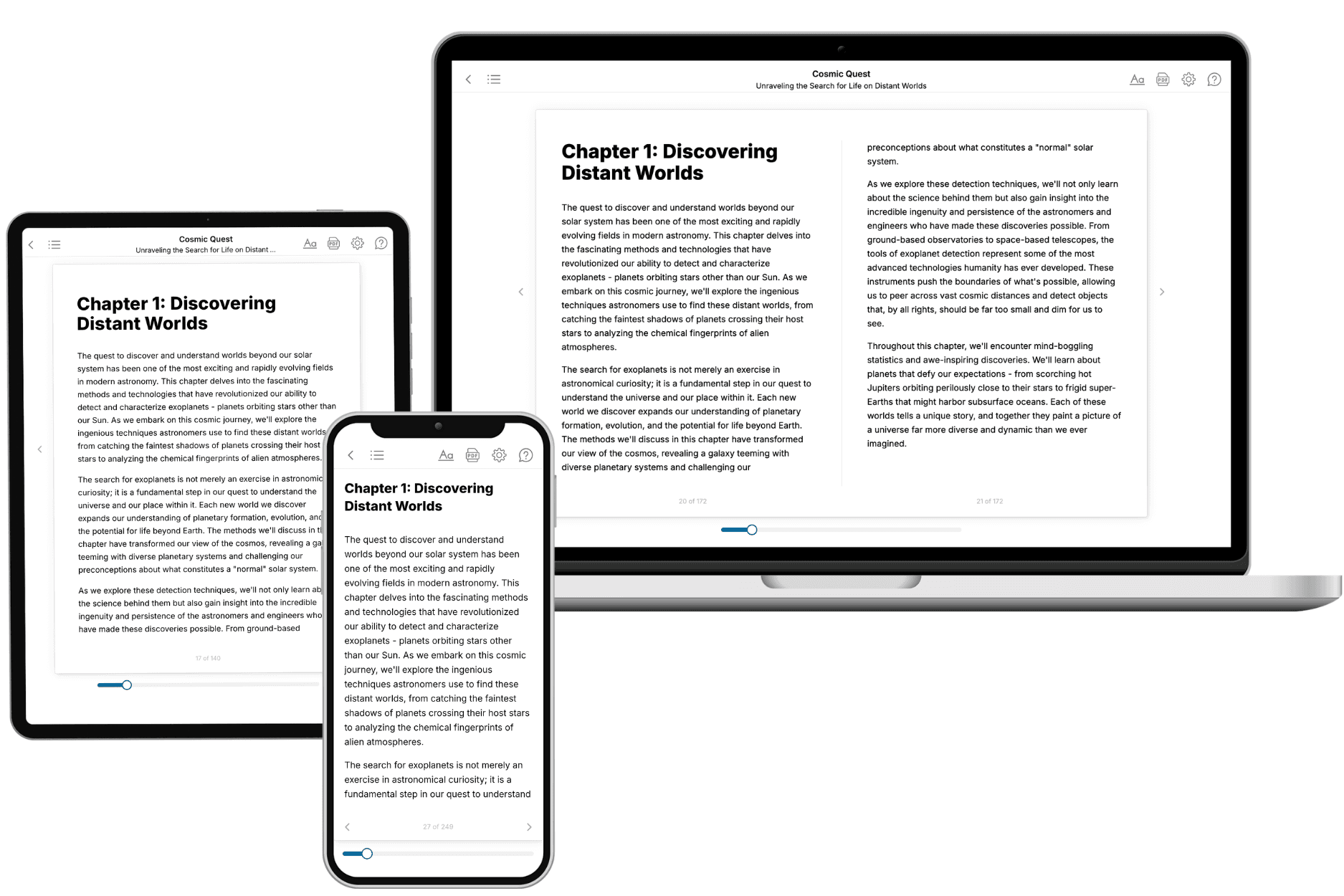
Your book is ready in 10 minutes. Read it online, download as EPUB or PDF, or send to Kindle.

Frequently asked questions
- What is TailoredRead?
TailoredRead creates complete, full-length nonfiction ebooks, written specifically for you. Tell us what you want to learn and why, and TailoredRead writes you a complete ebook on it, with charts, tables, and diagrams throughout. Read it online, on Kindle, or on any e-reader, or download it as a PDF or EPUB. Every book is written fresh the day you order it.
- How is the book tailored to me?
Before anything is written, you answer a few short questions about your goals, your background, and the topics you care about. Your book is then planned around your answers: written at your level, focused on your goals, and covering the topics you chose, instead of the one-size-fits-all book a store sells everyone.
- Will it read like generic AI content?
No. Your book isn't a chat transcript: it's planned chapter by chapter before a single word is written, told in a clear book voice, and explains ideas visually with charts, tables, and diagrams. After writing, every book goes through an editorial pass that polishes chapters so the book reads consistent from start to finish. Judge for yourself: browse thousands of sample books on our Explore Books page.
- How accurate is the content?
Our AI first checks whether your subject needs live research. Niche and fast-moving subjects are researched before writing, and the book plan and chapters are grounded in what it finds. After writing, every book goes through a quality pass that checks its facts and consistency, and researched books list their sources in a Notes section at the back.
- How long is the book?
You choose the length: Comprehensive (250-300 pages), Detailed (150-200 pages), Essential (70-100 pages), or Short (30-50 pages).
- Does the book include visuals?
Yes. Every book includes charts, tables, and diagrams: timelines, checklists, step-by-step guides, decision trees, comparison tables, matrices, and bar charts. A typical book includes dozens of these visual elements.
- Can I read it on Kindle? What formats can I download?
Yes. Every book can be read in our online reader or downloaded as a PDF or EPUB. The EPUB can be opened with Kindle, Apple Books, Kobo, and any e-reader. The Commercial and Author licenses also include an editable Word (DOCX) and Markdown download.
- How much does it cost?
About the price of a regular ebook. The exact price depends on your book's length and complexity, from $2 for the shortest books to $35 for the most comprehensive, and it's shown when you review your book, before you commit to anything. Each book is a one-time purchase, yours to keep, no subscription. Licenses that let you share, teach, or publish your book range from $35.99 to $49.99.
- Can I preview the book before purchasing?
Before you pay, you'll see what your book will cover: the title, a detailed description, the estimated length, and the complete chapter-by-chapter table of contents, so you know what you're getting before you decide. The full text itself is written after you purchase.
- How long does it take to create a book?
About 10 minutes. You can start reading the opening chapters while the rest is still being written.