The Small Business Owner's Guide to Federal Contracting
Master FAR, Set-Asides, and Compliance to Win Government Contracts
Are you leaving millions in government contract opportunities on the table because federal procurement regulations feel like a foreign language?
207 pages9 chaptersOct 4, 2026Small BusinessCreated by Janet
About this book
Federal government contracting represents one of the largest untapped markets for small businesses, yet most entrepreneurs avoid it entirely due to perceived complexity. This practical guide demystifies the Federal Acquisition Regulation (FAR), set-aside programs, compliance requirements, and contract management strategies that government contractors must master. You'll learn how to navigate small business set-asides, understand the Rule of Two, research FAR clauses, handle bid protests, manage contract compliance audits, and differentiate between claims and equitable adjustments. Whether you're pursuing your first government contract or scaling an existing federal business, this book provides the regulatory knowledge and strategic insights you need to compete confidently, avoid costly compliance mistakes, and build a sustainable government contracting practice.
Table of contents
- IntroductionWhy Government Contracting Matters for Small Businesses, What You'll Learn in This Book, How to Use This GuideRead below
- Chapter 1: Federal Acquisition FundamentalsUnderstanding the Federal Acquisition Regulation (FAR), Key Players in Government Contracting, The Government Procurement Process Overview
- Chapter 2: Small Business Set-Asides and EligibilityWhat Are Set-Asides and Why They Matter, The Rule of Two: When Set-Asides Are Mandatory, Understanding Size Standards and NAICS Codes, SBA Certification Programs: 8(a), HUBZone, and WOSB
- Chapter 3: FAR Clauses and Contract RequirementsHow to Research and Understand FAR Clauses, Flow-Down Clauses: Your Obligations to Subcontractors, Essential FAR Clauses Every Contractor Must Know
- Chapter 4: Compliance Standards and AuditsCost Accounting Standards (CAS) Explained, OFCCP Compliance: Recruiting, Compensation, and Affirmative Action, Preparing for and Managing Contract Compliance Audits
- Chapter 5: DFARS and Defense Contracting SpecificsDFARS: How Defense Contracting Differs from Civilian Agencies, Security Clearances, Facility Requirements, and Personnel Vetting, DLA Contracting: Specialized Procedures and Opportunities
- Chapter 6: Multiple Award Contracts and Advanced Procurement MethodsUnderstanding Multiple Award Contracts (MACs), Competing Under MAC Structures and Task Order Processes, Simplified Acquisitions and Micro-Purchase Thresholds
- Chapter 7: Bid Protests and Dispute ResolutionBid Protest Fundamentals and Your Rights, Filing a Bid Protest with the Government Accountability Office (GAO), Agency-Level Protests and Alternative Dispute Resolution
- Chapter 8: Contract Management and ClaimsUnderstanding Terminations: For Convenience vs. For Default, Requests for Equitable Adjustment (REA) and Contract Claims, Dispute Resolution Pathways and Remedies
- Chapter 9: Building Your Government Contracting StrategyIdentifying Opportunities and Assessing Your Readiness, Building Internal Compliance Systems and Documentation, Scaling Your Government Contracting Business
- ConclusionKey Takeaways for Your Government Contracting Journey, Your Next Steps
- Glossary of Federal Contracting Terms
- Additional Resources and References
Introduction
A nurse who spent a decade managing patient schedules, supply inventories, and staffing compliance at a regional clinic has more relevant experience for federal contracting than most new entrants realize. Reading a contract line item, tracking a credentialing deadline, documenting a corrective action, these are the same muscles the federal marketplace demands. The gap is not aptitude. The gap is familiarity with a specific, rule-bound system that rewards preparation and punishes guesswork. That system has a name, an entry point, and a learning curve that can be climbed in months rather than years.
This book exists because that climb is steeper than it needs to be. Most small business owners who look into government contracting quit before they submit a single proposal, not because the work is beyond them, but because the vocabulary alone feels like a locked door. Terms like set-aside, flow-down clause, and equitable adjustment get used as if everyone already knows what they mean. They do not have to stay locked. Each one has a precise definition, a practical function, and a reason it exists, and once those are visible the whole system stops looking like a wall and starts looking like a map.
The opportunity on the other side of that door is real and substantial. Federal agencies buy everything from medical staffing and janitorial services to software and construction, and a meaningful share of that spending is reserved specifically for small businesses. That reservation is not charity. It reflects a policy judgment that small firms bring innovation, competitive pricing, and community investment that large contractors cannot always match. The mechanisms that make those reservations work, and the eligibility rules that determine who qualifies, are covered in detail later in this book rather than summarized here.
What follows in this introduction sets expectations rather than teaching procurement rules directly. It explains why this market deserves serious consideration even for a business with no government experience, previews the structure of the chapters ahead, and offers a practical approach to reading and using this book so the information translates into action rather than sitting as background knowledge. None of the three sections below assume anything beyond ordinary business ownership experience.
Think of this introduction as orientation before a hike rather than the hike itself. It will not explain how to calculate a size standard or file a bid protest. It will explain why those topics matter enough to learn, in what order they build on each other, and how to move through the material without getting lost or overwhelmed by jargon that later chapters will unpack piece by piece.
Why Government Contracting Matters for Small Businesses
Every federal agency, from a regional Veterans Affairs hospital to the Defense Logistics Agency, needs vendors to supply goods and services it cannot produce internally. That need does not fluctuate the way private sector demand does during a recession or a slow sales quarter. Agencies have budgets that get appropriated annually and spent according to mission requirements, which means contracting opportunities continue even when commercial markets contract. For a small business owner used to the unpredictability of private clients, that stability alone is a compelling reason to pay attention.
The scale of the federal marketplace also means that even a small slice of it can transform a business. A single multi-year contract for medical transcription services, facility maintenance, or IT support can provide more predictable revenue than years of chasing private contracts one at a time. Government buyers tend to sign longer agreements with built-in renewal options, called option years, which gives a contractor a planning horizon that few commercial clients offer. That horizon makes it easier to hire, invest in equipment, and build the kind of operational stability that attracts even more business.
Small business owners often assume that federal contracts go exclusively to giant corporations with decades of experience and dedicated compliance departments. That assumption misreads how the system is actually built. Policy sets aside substantial portions of federal spending specifically so smaller firms can compete without facing off against corporations with thousands of employees. The specific programs that create this protected space, how they are structured, and who qualifies, are explored fully in later chapters, but the underlying principle matters here: the government actively wants small businesses in its supplier base, not as an afterthought but as a stated policy goal.
Consider a small janitorial services company that has spent years cleaning office buildings for private landlords, with contracts renewed annually and renegotiated under constant price pressure. That same company, once registered correctly and positioned within the right certification category, can compete for facility maintenance contracts at federal buildings where contract terms run longer and pricing is negotiated against a defined scope of work rather than squeezed every renewal cycle. The work itself does not change much. The buyer, the contract structure, and the competitive rules do.
There is also a reputational dimension that compounds over time. Winning and successfully performing a federal contract becomes a credential in itself. Past performance, a term covered in depth later in this book, functions almost like a credit score for future bids. Agencies evaluating new proposals look at how a company performed on prior government work, and a strong track record with one agency can open doors with others. A business that delivers reliably on a Department of Veterans Affairs contract builds evidence that helps it compete for work with the Department of Defense or the General Services Administration down the line.
None of this means the market is easy to enter. The same rules that create reserved space for small businesses also create procedural requirements that have no equivalent in private sector sales. A commercial client might award work based on a phone call and a handshake. A federal contracting officer, the government official with legal authority to bind the agency to a contract, operates under regulations that dictate how solicitations are written, how proposals are evaluated, and how awards are justified. That structure protects taxpayer dollars and ensures fair competition, but it also means a business cannot simply show up and start selling the way it might in the private market.
That structure is precisely why preparation pays off disproportionately in this market compared to commercial sales. A private sector competitor might out-charm a buyer in a sales meeting. A federal competitor generally cannot out-charm a contracting officer, because the evaluation process is designed to be documented, objective, and defensible against challenge. What wins instead is a proposal that demonstrates understanding of the solicitation requirements, a competitive and well-supported price, and evidence of the capacity to perform. Businesses that learn the rules of this specific game tend to outperform businesses with more experience but less procedural fluency.
There is also a defensive reason to understand this market even for a business that is not actively pursuing federal work yet. Many private sector prime contractors with federal contracts are themselves required to subcontract a portion of that work to small businesses, and they actively search for qualified subcontractors to meet those obligations. A small business that understands how federal contract flow-down requirements work, a concept detailed in the chapter on FAR clauses, is better positioned to become an attractive subcontracting partner even before pursuing a prime contract of its own.
The healthcare and staffing sectors in particular carry substantial federal demand that is easy to overlook. Military treatment facilities, VA medical centers, and various federal health programs regularly contract for clinical staffing, medical supplies, administrative support, and related services. A business owner with a nursing background already understands the operational realities those contracts are trying to solve, including staffing ratios, licensing requirements, and the documentation discipline that healthcare work demands. That background is a genuine competitive advantage once paired with procurement knowledge, not a disadvantage to overcome.
Entering this market also forces a business to professionalize in ways that tend to pay dividends even outside government work. The documentation discipline required to track certifications, the cost accounting rigor expected under certain contract types, and the compliance infrastructure needed to pass an audit all strengthen internal operations generally. A business that builds the systems to satisfy a federal contracting officer often finds those same systems make it more attractive to private sector clients, lenders, and eventually buyers if an owner decides to sell the business.
The counterargument deserves honest treatment rather than dismissal. Government contracting involves real administrative burden, slower payment cycles than some private clients, and compliance obligations that carry financial consequences if ignored. A business entering this market without preparation can underprice a contract, miscalculate its compliance obligations, or misunderstand a solicitation requirement in ways that cost real money. This book exists specifically to prevent those mistakes, but it will not pretend the learning curve is trivial or that every small business is automatically suited for government work on day one.
The right framing is not that government contracting is easy, but that it is learnable, and that the difficulty is concentrated in understanding a specific rulebook rather than in any shortage of capability on the business owner's part. A business that can staff a clinic, manage inventory, or run a construction crew already has the operational competence federal buyers are paying for. What is missing, for most new entrants, is fluency in how that competence gets translated into a compliant proposal and a well-managed contract.
That fluency is buildable in a defined sequence, and building it in the right order matters more than most new entrants expect. A business that tries to learn bid protest procedure before understanding basic set-aside eligibility will waste time on a topic it is not yet positioned to use. A business that studies DFARS security requirements before confirming it even has a viable NAICS code and size standard is solving a problem it does not yet have. The chapters in this book are sequenced deliberately so that each concept builds on something already covered rather than assuming prior knowledge.
The remainder of this introduction lays out that sequence directly, chapter by chapter, so the shape of the learning path is visible before the detailed material begins. Understanding where the book is headed makes it easier to place each new term and concept into context as it appears, rather than absorbing isolated facts without a sense of how they connect to the larger system of federal acquisition.
What You'll Learn in This Book
The book opens with the foundational rulebook that governs the entire system, the Federal Acquisition Regulation. Every subsequent topic in this book, from set-asides to bid protests to contract claims, operates as an extension or application of rules established in the FAR. The chapter covering this foundation explains how the regulation is organized, who the key players are in a typical procurement, from the contracting officer to the agency's small business specialist, and how a solicitation moves from initial need to final award. Understanding this structure first prevents the confusion that comes from encountering later terms without knowing where they sit in the overall framework.
From there, the book moves into the territory most small business owners are specifically hoping to understand: set-asides and eligibility. This section explains why certain contracts are reserved exclusively for small businesses, how the Rule of Two determines when an agency must set aside a procurement, and how size standards and NAICS codes work together to define whether a given business actually qualifies as small for a particular contract. It also covers the major SBA certification programs, including the 8(a) Business Development Program, HUBZone, Women-Owned Small Business, Economically Disadvantaged Women-Owned Small Business, and Service-Disabled Veteran-Owned Small Business certifications, each of which opens access to a different slice of reserved federal spending.
The next major block of material addresses FAR clauses in practical detail, moving beyond the regulation's overall structure into the specific contractual language that governs day-to-day performance. This includes how to research and interpret individual clauses, which matters because a solicitation can incorporate dozens of them by reference without printing their full text. It also covers flow-down clauses, the mechanism by which obligations a prime contractor accepts from the government get pushed down to subcontractors, creating a compliance chain that a small business must manage carefully whether it sits at the top of that chain or partway down it.
Compliance receives its own dedicated treatment because the financial and reputational stakes of getting it wrong are high. This section covers Cost Accounting Standards, the rules that govern how contractors measure, assign, and allocate costs on certain contract types, and OFCCP compliance, which addresses nondiscrimination and affirmative action obligations tied to recruiting and compensation practices. It also walks through what audit readiness actually looks like in practice, including the kind of documentation a contractor should maintain continuously rather than scrambling to assemble when an audit notice arrives.
For businesses interested in defense work specifically, the book includes a dedicated section on how DFARS modifies and extends the baseline FAR framework for Department of Defense procurements. This includes the added layer of cybersecurity and personnel vetting requirements that come with defense contracts, the facility security considerations that apply to certain classified or sensitive work, and the specific procedures used by the Defense Logistics Agency, which handles a substantial share of defense supply contracting and operates with its own procurement culture distinct from civilian agencies.
Beyond traditional single-award contracts, the book covers Multiple Award Contracts and related advanced procurement vehicles, which represent an increasingly common way agencies buy goods and services. This section explains how MACs work, how task order competition differs from competing for a standalone contract, and how simplified acquisition procedures and the micro-purchase threshold create a lower-barrier entry point for very small purchases that can serve as a first foothold in federal work before a business is ready to compete for larger awards.
Because competition does not always resolve cleanly, the book devotes a full section to bid protests and dispute resolution. This covers the basic rights a disappointed bidder has when a contract award seems improperly decided, the formal process for filing a protest with the Government Accountability Office, including the procedural mechanism known as the automatic stay that can pause contract performance while a protest is pending, and the alternative path of an agency-level protest, which operates under different rules and timelines than a GAO protest.
Performance problems after award receive equally careful treatment, because a contract that goes wrong mid-performance creates risks that are different in kind from a lost bid. This section distinguishes between a termination for convenience, where the government ends a contract for its own reasons unrelated to contractor fault, and a termination for default, where the government alleges the contractor failed to perform. It also explains the Request for Equitable Adjustment process, a formal mechanism for seeking additional compensation when government actions increase contract costs, and how that process differs from filing a formal contract claim.
The final substantive chapter turns from regulatory knowledge toward business strategy, addressing how to actually build a sustainable government contracting practice rather than winning a single contract and stalling out. This includes how to identify genuine opportunities that match a business's actual capabilities, how to build the internal compliance infrastructure that supports sustained participation in this market, and how to plan deliberate growth rather than treating each contract win as an isolated event disconnected from a longer-term strategy.
Each of these chapters is designed to stand on its own as a reference, meaning a business owner who already has a specific question about bid protests, for instance, does not need to reread the entire book to find a useful answer. At the same time, the chapters build on each other in a deliberate sequence, and concepts introduced early, such as NAICS codes and size standards, get referenced again later without being fully re-explained. Reading in order the first time through is strongly recommended even for an experienced reader.
A recurring thread across nearly every chapter is the distinction between general principle and specific application. The FAR establishes a principle, a certification program creates a specific eligibility pathway, a clause creates a specific contractual obligation. Learning to separate the general rule from its specific application is one of the most transferable skills this book aims to build, because federal contracting regulations change over time in their specifics even when the underlying principles remain stable.
Another consistent thread is the idea that documentation is not bureaucratic overhead but a competitive asset. A capability statement, the one-page summary of a business's qualifications used throughout federal marketing, works better when it is backed by genuine, documented past performance. A compliance file survives an audit better when it has been maintained continuously rather than reconstructed under deadline pressure. Nearly every chapter returns to this theme in its own context, because it is one of the clearest differences between businesses that thrive in this market and businesses that struggle.
The book also addresses the registration and infrastructure steps that sit underneath all of the substantive regulatory content, including the role of SAM.gov as the system of record for federal vendor registration, the function of a capability statement as a marketing tool, and the value of teaming agreements for businesses that want to partner with other firms to pursue contracts beyond their individual capacity. These practical mechanics appear throughout the book wherever they are relevant to the surrounding topic rather than being isolated into a single checklist.
By the final chapter, the goal is for a business owner to be able to read an actual federal solicitation, recognize the clauses it incorporates, assess whether the business qualifies to bid, understand what compliance obligations an award would create, and know what options exist if something goes wrong either during competition or during performance. That is a substantial amount of fluency to build, which is exactly why the material is organized the way it is rather than compressed into a single overview chapter.
The emphasis throughout stays on practical application rather than abstract legal theory, consistent with the needs of a working business owner rather than a procurement attorney. Legal nuance exists in this field and sometimes requires professional counsel, a point the book will flag honestly where it applies, but the baseline goal is equipping a business owner to understand the landscape well enough to operate confidently, ask informed questions, and recognize when a situation calls for specialized legal or accounting help.
How to Use This Guide
Treat the first few chapters as mandatory groundwork rather than optional background, even if a specific later topic feels more urgent. The chapter on the Federal Acquisition Regulation and the chapter on set-asides and eligibility establish vocabulary and concepts that nearly every later chapter assumes. Skipping ahead to bid protests or DFARS security requirements without that foundation tends to create more confusion than it saves time, because those later chapters use terms like size standard and contracting officer without redefining them each time.
After the first two chapters, reading order becomes more flexible based on actual business priorities. A business owner focused exclusively on civilian agency work has less immediate need for the DFARS and defense contracting chapter, though skimming it still builds useful general awareness of how defense procurement differs. A business not yet performing on any federal contract has less immediate use for the chapter on terminations and claims, though understanding those risks in advance shapes smarter decisions about contract terms accepted at the proposal stage.
Keep a running list of terms that feel unfamiliar on first encounter, because the glossary at the end of the book is built specifically to support that kind of lookup. Federal contracting vocabulary is dense enough that even an attentive reader will hit terms that need a second or third encounter before they stick. Rather than rereading an entire section to recover a definition, the glossary allows a quick check that keeps momentum through the main chapters.
Consider working through this book alongside an actual, current solicitation pulled from SAM.gov, even one the business has no intention of bidding on. Reading a real solicitation while learning about FAR clauses, set-aside designations, and evaluation criteria turns abstract concepts into concrete, visible examples. A solicitation will typically show its NAICS code and size standard directly, display whether it carries a set-aside designation, and list incorporated clauses by number, all of which connect directly to material covered in the early chapters.
Resist the temptation to treat this book as something to read once and shelve. Federal contracting knowledge works best as a reference consulted repeatedly across the life of a business, revisited before each major decision point: before registering in SAM.gov, before submitting a first proposal, before accepting subcontract terms from a prime contractor, before responding to an audit notice. Each of those moments benefits from rereading the relevant chapter with that specific, concrete situation in mind rather than relying on memory from a single earlier read-through.
Where a chapter references professional help, whether an accountant familiar with Cost Accounting Standards or an attorney experienced in bid protest practice, treat that as a genuine recommendation rather than a formality. This book builds broad, practical fluency across a wide regulatory landscape, but some situations, particularly ones involving significant money, formal disputes, or security clearance matters, benefit from specialized expertise that goes beyond what any general guide can responsibly provide. Knowing when to bring in that expertise is itself a skill this book tries to build.
Approach the compliance-related chapters, particularly those covering Cost Accounting Standards and OFCCP requirements, with extra attention even if they feel less immediately exciting than winning a contract. These topics tend to get deprioritized by new entrants focused on securing their first award, but the financial and legal exposure from compliance failures can be severe enough to threaten the survival of a business that otherwise performed well. Reading these sections early, before pressure to bid forces a rushed decision, allows for calmer and more thorough preparation.
Use the structured elements throughout the book, including checklists, decision frameworks, and comparison tables, as working tools rather than material to skim past. These elements are built to be referenced directly during real decision-making, such as determining whether a particular contract situation calls for a Request for Equitable Adjustment versus a formal claim, or weighing whether a given solicitation is a good fit for the business's current certifications and capacity.
Pay attention to the distinction the book draws consistently between what a regulation requires and what represents a strategic choice within that requirement. The FAR might require a certain clause to appear in a contract, but how a business structures its internal processes to satisfy that clause involves judgment calls specific to its own operations. Confusing a mandatory requirement with an optional best practice, or the reverse, is a common source of either wasted effort or genuine compliance risk.
For a business with a background outside traditional business administration, such as a clinical background in nursing, map each new procurement concept back to an equivalent already-understood professional concept wherever possible. A FAR clause functions much like a clinical protocol: a standardized requirement designed to ensure consistent, safe, and accountable practice regardless of who is performing the work. An audit functions much like a regulatory inspection in a healthcare setting: a structured check against documented standards rather than an arbitrary or hostile process. These analogies, drawn consistently throughout the book, are meant to make unfamiliar material land faster.
Expect some chapters to feel denser than others, and plan reading pace accordingly rather than assuming uniform difficulty throughout. The chapters on FAR clauses and Cost Accounting Standards tend to require slower, more careful reading because the material is technical and the stakes of misunderstanding it are higher. The chapters on strategy and growth planning read more quickly because they draw more directly on general business judgment the reader likely already has.
Take the self-check quizzes and exercises embedded throughout the book seriously, even though they may feel like an unnecessary pause in the reading flow. Federal contracting terminology is easy to recognize passively while reading but harder to recall accurately under the pressure of an actual proposal deadline or compliance question. A quick self-check after a dense section is a low-cost way to confirm the material actually transferred rather than just scrolled past.
Finally, treat the conclusion and the resources section at the end of the book as a launching point rather than a formality to skip. The conclusion distills the key takeaways across all nine substantive chapters into a more condensed form useful for quick review, and the resources section points toward where to continue building knowledge once this book's scope has been covered, since federal contracting regulations and procedures continue to evolve after any single book goes to print.
Government contracting rewards patience and procedural discipline more than charisma or speed, which makes it a genuinely different competitive arena than most small business owners have operated in before. The chapters ahead are built to meet that reality directly, starting with the regulatory foundation every other topic in this book rests on.
This is the end of the free sample. The full book has 9 chapters.
Want this book written for you?
Tell us your goals and background, and get your own version of this book, tailored by AI to you.


Benefits of AI-tailored books
- Read one book, not ten:
- all the Small Business knowledge you need, gathered into a single book.
- Save days of learning:
- tell us your goals, choose your topics, and the whole book is built around them.
- Learn effortlessly:
- Small Business book written for your specific background and expertise.
- Understand at a glance:
- includes charts, tables, timelines, checklists, decision trees, and more.
- Stay current:
- written the day you order it, not years ago.
- Trust what you read:
- every book is checked for accuracy, with real research when your subject needs it.
Create your unique book in 3 steps
- 1. Select your focus
Select the focus of your Small Business book and share your background
- 2. Personalize your book
Specify your goals and choose sub-topics to include
- 3. Get your tailored book
Your book is ready in 10 minutes. Read it online, download as EPUB or PDF, or send to Kindle.


Frequently asked questions
- What is TailoredRead?
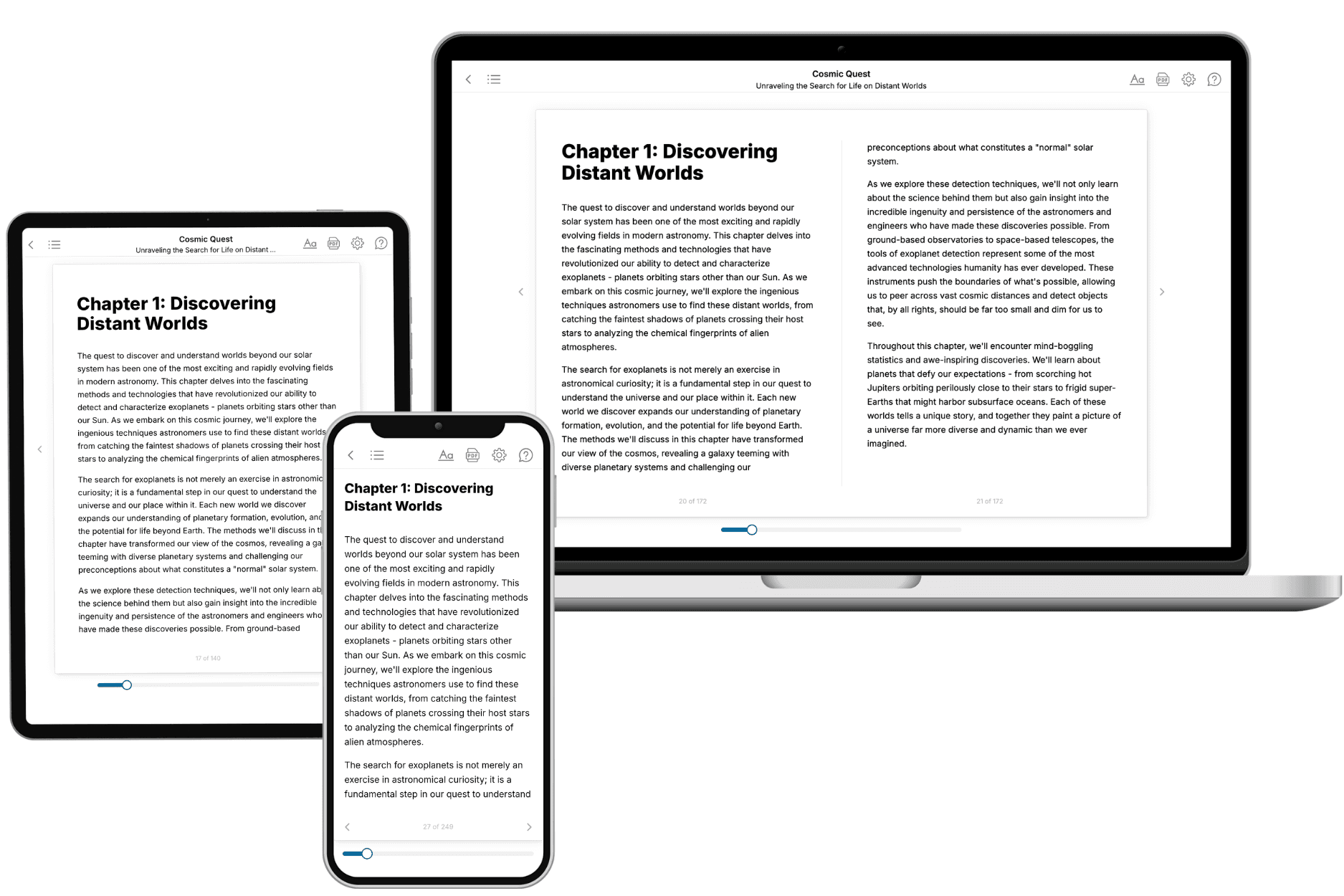
TailoredRead creates complete, full-length nonfiction ebooks, written specifically for you. Tell us what you want to learn and why, and TailoredRead writes you a complete ebook on it, with charts, tables, and diagrams throughout. Read it online, on Kindle, or on any e-reader, or download it as a PDF or EPUB. Every book is written fresh the day you order it.
- How is the book tailored to me?
Before anything is written, you answer a few short questions about your goals, your background, and the topics you care about. Your book is then planned around your answers: written at your level, focused on your goals, and covering the topics you chose, instead of the one-size-fits-all book a store sells everyone.
- Will it read like generic AI content?
No. Your book isn't a chat transcript: it's planned chapter by chapter before a single word is written, told in a clear book voice, and explains ideas visually with charts, tables, and diagrams. After writing, every book goes through an editorial pass that polishes chapters so the book reads consistent from start to finish. Judge for yourself: browse thousands of sample books on our Explore Books page.
- How accurate is the content?
Our AI first checks whether your subject needs live research. Niche and fast-moving subjects are researched before writing, and the book plan and chapters are grounded in what it finds. After writing, every book goes through a quality pass that checks its facts and consistency, and researched books list their sources in a Notes section at the back.
- How long is the book?
You choose the length: Comprehensive (250-300 pages), Detailed (150-200 pages), Essential (70-100 pages), or Short (30-50 pages).
- Does the book include visuals?
Yes. Every book includes visual elements such as timelines, checklists, step-by-step guides, decision trees, comparison tables, and matrices, and many include bar charts. A typical book includes dozens of these visual elements.
- Can I read it on Kindle? What formats can I download?
Yes. Every book can be read in our online reader or downloaded as a PDF or EPUB. The EPUB can be opened with Kindle, Apple Books, Kobo, and any e-reader. The Commercial and Author licenses also include an editable Word (DOCX) and Markdown download.
- How much does it cost?
About the price of a regular ebook. The exact price depends on your book's length and complexity, from $2 for the shortest books to $35 for the most comprehensive, and it's shown when you review your book, before you commit to anything. Each book is a one-time purchase, yours to keep, no subscription. Licenses that let you share, teach, or publish your book range from $35.99 to $49.99.
- Can I preview the book before purchasing?
Before you pay, you'll see what your book will cover: the title, a detailed description, the estimated length, and the complete chapter-by-chapter table of contents, so you know what you're getting before you decide. The full text itself is written after you purchase.
- How long does it take to create a book?
About 10 minutes. You can start reading the opening chapters while the rest is still being written.