Temporary Foreign Workers in America
A Historical and Contemporary Guide to Understanding Guest Worker Programs and Their Impact on the United States
Many Americans believe temporary foreign worker programs are a recent invention designed to replace domestic workers.
191 pages8 chaptersJul 6, 2026Immigration
About this book
In reality, these programs have shaped American labor markets for over a century, evolving through wars, economic booms, and recessions. This book cuts through the misconceptions to reveal the true history and current reality of guest worker programs in the United States. You'll discover how these programs originated, why they persist despite ongoing controversy, and how they affect workers, employers, and communities across America. From agricultural workers to tech professionals, temporary foreign worker programs touch nearly every sector of the economy. This comprehensive guide examines the major programs operating today, their economic impacts, the challenges faced by foreign workers, and the legitimate concerns raised by labor advocates. Whether you're interested in immigration policy, labor economics, or American history, this book provides the context and evidence you need to understand one of the most debated aspects of U.S. immigration policy.
Table of contents
- IntroductionWhy This Topic Matters Today, What You'll Learn in This Book, How to Use This GuideRead below
- Chapter 1: The Origins of Temporary Foreign Worker ProgramsEarly American Labor Needs and Solutions, The Bracero Program: America's First Major Guest Worker Initiative, The Post-Bracero Era and Program Evolution
- Chapter 2: Understanding the Major Programs TodayThe H-1B Program: Specialty Occupations and Tech Workers, The H-2A Program: Seasonal Agricultural Workers, The H-2B Program: Non-Agricultural Temporary Workers, Other Visa Categories and Emerging Programs
- Chapter 3: How Temporary Foreign Worker Programs OperateThe Recruitment and Hiring Process, Visa Sponsorship and Legal Requirements, Compliance, Enforcement, and Penalties
- Chapter 4: Economic Impacts and Labor Market EffectsFilling Labor Gaps and Addressing Shortages, Effects on Wages and Employment for Domestic Workers, Business Competitiveness and Economic Growth
- Chapter 5: The Vulnerabilities and Challenges Faced by Foreign WorkersVisa Sponsorship Dependency and Limited Mobility, Exploitation, Wage Theft, and Working Conditions, Limited Legal Protections and Access to Justice
- Chapter 6: The Broader Debate: Competing Interests and ValuesThe Business Case for Temporary Foreign Workers, Labor Advocates' Concerns and Criticisms, Balancing Economic Needs with Worker Protection
- Chapter 7: Regional and Sectoral VariationsAgriculture: The Largest User of Temporary Foreign Workers, Technology and Professional Services: The H-1B Debate, Hospitality, Construction, and Other Industries
- Chapter 8: Policy Debates and Reform ProposalsCurrent Criticisms and Identified Problems, Proposed Reforms and Policy Solutions, How Other Countries Approach Guest Worker Programs
- ConclusionKey Takeaways and Moving Forward, Becoming an Informed Participant in the Debate
- Glossary of Key Terms
- Further Reading and Resources
Introduction
Every year, hundreds of thousands of workers arrive in the United States on temporary visas, ready to pick crops in California's Central Valley, write code in Silicon Valley, staff resorts in Florida, and fill dozens of other roles across the economy. They come legally, through formal programs that the U.S. government has operated in various forms for more than a century. Yet despite their scale and their long history, these programs remain poorly understood by most Americans, including many people who hold strong opinions about them. The gap between public perception and documented reality is wide, and it has real consequences for policy, for workers, and for communities.
The phrase "temporary foreign worker" tends to trigger strong reactions. Some people hear it and think of desperate exploitation, of workers trapped in unfair conditions with no way out. Others hear it and think of companies gaming the system to avoid hiring Americans. Still others see it as a straightforward solution to genuine labor shortages that domestic workers simply cannot fill. All three of these reactions contain some truth. None of them captures the full picture. The reality of temporary foreign worker programs is layered, historically rooted, and shaped by competing interests that rarely get examined together in the same place.
This book is built on a simple premise: that understanding these programs clearly, with accurate historical context and honest economic analysis, is more useful than approaching them through any single political lens. The programs covered here, including the H-1B for specialty occupations, the H-2A for agricultural workers, and the H-2B for non-agricultural seasonal work, are not abstract policy constructs. They affect real people: the farmworker sleeping in employer-provided housing in North Carolina, the software engineer waiting years for a green card in Texas, the landscaping company owner in Ohio who cannot find enough local workers to fulfill contracts. Getting the facts right matters for all of them.
The chapters ahead move through the subject systematically, from historical origins to current operations to economic effects to the ongoing policy debate. Along the way, you will encounter data, case studies, and perspectives from multiple sides of the argument. The goal is not to tell you what to think about temporary foreign worker programs. The goal is to give you the foundation you need to think about them clearly, on your own terms, with a solid grasp of what these programs actually are and how they actually work.
Why This Topic Matters Today
Temporary foreign worker programs are not a niche immigration issue. They sit at the intersection of labor economics, immigration law, national security debates, and questions about what kind of economy the United States wants to build. In fiscal year 2023, U.S. Citizenship and Immigration Services approved more than 386,000 H-2A positions for agricultural workers alone, a number that has more than tripled over the past decade.[1] The H-1B program, which covers specialty occupations in fields like technology, engineering, and medicine, receives hundreds of thousands of applications every year for a capped number of slots, creating a lottery system that affects major corporations and small businesses alike.
These numbers reflect something important: the U.S. economy has developed a significant structural reliance on temporary foreign labor across multiple sectors. That reliance did not happen by accident. It developed over decades, shaped by deliberate policy choices, industry lobbying, demographic shifts, and the practical realities of labor markets that do not always produce the workers that employers need, where they need them, when they need them. Understanding how that reliance developed is essential to evaluating whether current programs are working well, working poorly, or working for some people at the expense of others.
The political stakes are also unusually high right now. Immigration policy, including the rules governing temporary workers, has become one of the most contested areas of American public life. Debates that once took place primarily among policy specialists and industry groups now play out in presidential campaigns, congressional hearings, and social media arguments. The quality of those debates depends heavily on whether participants have access to accurate information. When the conversation is driven by myths, the resulting policies tend to serve no one well.
Consider a few of the most common misconceptions that shape public debate. Many people believe that temporary foreign worker programs are primarily used to replace American workers with cheaper foreign labor. While this does happen in some documented cases, it is not the defining feature of these programs across the board. Many employers use them because they genuinely cannot recruit domestic workers for specific roles, particularly in agriculture and seasonal industries. At the same time, the concern about wage suppression is not unfounded. Research shows that in certain sectors, the availability of temporary foreign workers does affect wage levels for domestic workers, though the magnitude and direction of that effect varies significantly by industry and region.[2]
Another common misconception is that temporary foreign workers are largely undocumented or operating outside the law. In fact, the programs described in this book are formal legal channels with detailed regulatory requirements, employer obligations, and government oversight. That oversight is imperfect, and violations do occur, but these are not shadow programs. They are codified in federal law, administered by multiple government agencies, and subject to ongoing legal and political scrutiny. Conflating legal temporary worker programs with unauthorized immigration creates confusion that makes it harder to address the real problems in either system.
The topic also matters because it touches on fundamental questions about fairness and human dignity. Temporary foreign workers are not just economic units. They are people who leave their families, take on debt to pay recruitment fees, and navigate an unfamiliar legal system in a country where they often have limited rights and limited recourse when things go wrong. The structural vulnerabilities built into these programs, particularly the way visa status is tied to a single employer, create conditions that can be exploited. Recognizing those vulnerabilities is not an argument for or against the programs. It is a prerequisite for designing them better.
Finally, this topic matters because it is not going away. Demographic trends in the United States, including an aging workforce and declining birth rates in many regions, suggest that labor shortages in specific sectors will persist or intensify in coming decades. How the country chooses to respond to those shortages, through expanded temporary worker programs, immigration reform, workforce development, automation, or some combination of all of these, will shape the economy and the social fabric for generations. That is a decision that deserves to be made with clear eyes and accurate information.
The debate over temporary foreign workers is ultimately a debate about what kind of labor market America wants, and who gets to benefit from it. That debate is too important to be left to myths and talking points.
What You'll Learn in This Book
This book is organized to take you from historical foundations to current realities to future possibilities. Each chapter builds on the ones before it, so by the time you reach the policy debate chapters near the end, you will have the context needed to evaluate competing arguments on their merits rather than on the basis of political affiliation or gut instinct. Here is a brief map of what each section covers and why it is included.
Chapter 1 covers the historical origins of temporary foreign worker programs in the United States. This history is longer and more complex than most people realize. It includes the Chinese Exclusion Act era, the recruitment of Mexican workers during World War I, and most significantly, the Bracero Program that ran from 1942 to 1964 and brought millions of Mexican agricultural workers to the United States under formal government agreements. Understanding this history is not just an academic exercise. The structural features of today's programs, including their strengths and their flaws, were largely inherited from these earlier arrangements.
Chapter 2 provides a detailed breakdown of the major programs operating today. This includes the H-1B, H-2A, and H-2B visas, as well as other categories like the J-1 exchange visitor program, the TN visa for Canadian and Mexican professionals under trade agreements, and the O and P visas for workers with extraordinary abilities. Each program has its own eligibility rules, application process, numerical limits, and compliance requirements. This chapter gives you a clear, practical understanding of how each one works and who uses it.
Chapter 3 goes inside the operational mechanics of these programs, covering how recruitment works, what employers must do to sponsor a visa, and how the government enforces compliance. This is where you will learn about the Labor Condition Application process for H-1B workers, the housing and transportation requirements for H-2A agricultural workers, and the role of the Department of Labor in investigating violations. Understanding the mechanics helps you evaluate both the protections that exist on paper and the gaps that exist in practice.
Chapter 4 examines the economic evidence on what these programs actually do to wages, employment, and business competitiveness. This is one of the most contested areas in the entire debate, and the research is genuinely mixed. You will encounter studies that find minimal negative effects on domestic workers alongside studies that document wage suppression in specific sectors. The goal is not to declare a winner in that academic debate but to help you understand what the evidence shows, where it is strong, and where it is limited.
The remaining chapters cover the vulnerabilities faced by foreign workers themselves, the competing interests of businesses and labor advocates, the significant variation in how these programs play out across different industries and regions, and the landscape of proposed reforms. A concluding section on international comparisons looks at how other countries, including Canada, Germany, and Australia, have structured their guest worker programs, offering useful benchmarks for evaluating U.S. policy choices.
Throughout the book, you will find specific examples drawn from documented cases, government data, academic research, and news reporting. These examples are chosen not to make a political argument but to illustrate how abstract policy rules translate into concrete human experiences. A farmworker in Georgia who cannot leave an abusive employer without losing his visa status is not a statistic. He is a person navigating a system that was designed with certain priorities in mind, and understanding those priorities helps explain why the system works the way it does.
By the end of this book, you should be able to do several things that most people engaged in this debate cannot currently do. You should be able to distinguish between the different programs and explain how they differ. You should be able to evaluate claims about economic impacts with an understanding of what the research actually shows. You should be able to identify the structural features of these programs that create vulnerability for workers, and you should be able to assess proposed reforms against a realistic understanding of what problems they are trying to solve. That combination of knowledge and analytical skill is the practical payoff of working through this material.
How to Use This Guide
This book is designed to work for readers with different goals and different starting points. If you are coming to this topic with a moderate background in immigration history and want a comprehensive overview, reading from beginning to end will give you the most complete picture. The chapters are sequenced to build understanding progressively, and later chapters assume familiarity with concepts introduced earlier. That said, each chapter is also written to stand on its own, so if you have a specific interest, you can go directly to the relevant section without feeling lost.
Here are some suggested reading paths based on different goals:
- If you want historical context first: Start with Chapter 1 on origins, then move to Chapter 2 for the current program landscape. This sequence gives you the "how did we get here" foundation before diving into present-day mechanics.
- If you are primarily interested in economics: Chapter 4 on labor market effects is the core chapter for you, but it will be more useful after reading Chapter 2 so you understand which programs are being discussed.
- If you are focused on worker rights and vulnerabilities: Chapter 5 is the central chapter, but Chapter 3 on program mechanics provides essential context for understanding why those vulnerabilities exist structurally.
- If you are interested in policy reform: Chapter 8 is your destination, but it will be most useful after reading Chapters 4, 5, and 6, which lay out the problems that reform proposals are trying to address.
- If you are a student or researcher: The footnotes throughout the book point to primary sources, academic studies, and government data that can serve as starting points for deeper research. The Further Reading section at the back provides additional resources organized by topic.
A few notes on how sources are used in this book. Where statistics are cited, the source is identified in a footnote so you can verify the data and explore the original context. Where research findings are described, the book tries to be honest about the degree of certainty those findings carry. Immigration economics is a field where researchers sometimes reach different conclusions from similar data, and that genuine uncertainty is acknowledged rather than papered over. The goal is to give you an accurate picture of what is known, what is contested, and what remains genuinely unclear.
The book also tries to be consistent about distinguishing between different types of claims. Factual claims about how programs work, what the law requires, and what data shows are treated differently from normative claims about what policy should be. You will encounter both types throughout the book, but they are kept as separate as possible. When a normative judgment appears, it is labeled as such. The aim is to give you the factual foundation to form your own normative judgments, not to substitute the book's conclusions for your own thinking.
One practical suggestion: the Glossary of Key Terms at the back of the book is worth consulting early. Temporary foreign worker policy involves a significant amount of specialized vocabulary, including visa categories, legal terms, and agency acronyms that can be confusing if you encounter them without context. Terms like prevailing wage, labor condition application, cap-exempt employer, and portability have specific technical meanings in this context that differ from their everyday usage. The glossary defines these terms clearly and concisely, and referring to it when you encounter an unfamiliar term will make the rest of the reading smoother.
It is also worth noting what this book does not cover. It focuses specifically on legal temporary worker programs administered by the U.S. federal government. It does not provide a comprehensive treatment of unauthorized immigration, though it does note where the two issues intersect in important ways. It does not cover permanent immigration pathways in depth, though it does discuss the relationship between temporary and permanent status where that relationship is directly relevant to understanding how temporary programs work. And it does not offer legal advice. If you are an employer, a worker, or an attorney dealing with a specific visa situation, the information here provides useful background, but it is not a substitute for professional legal guidance.
Finally, a word about tone. This is a topic that generates strong feelings, and those feelings are often rooted in legitimate concerns. Business owners who cannot staff their operations have real problems. Workers who are exploited by employers who know they cannot complain without losing their visa status face real harm. Domestic workers who see their wages undercut by a system that gives employers access to cheaper labor have real grievances. This book tries to take all of those concerns seriously without dismissing any of them. The goal is not to be neutral in the sense of pretending that all positions are equally well-supported by evidence. It is to be fair in the sense of engaging honestly with the strongest version of each argument and letting the evidence speak for itself.
Understanding temporary foreign worker programs clearly is not just an academic exercise. It is a form of civic preparation for one of the most consequential and ongoing debates in American public life.
The chapters ahead cover a lot of ground, but the core questions running through all of them are relatively simple. Who benefits from these programs? Who bears the costs? Are the rules designed to protect the people who need protection? And are those rules actually enforced? Those questions do not have easy answers, but they are the right questions to ask. This book is designed to help you ask them well.
Notes
Introduction
This is the end of the free sample. The full book has 8 chapters.
Want this book written for you?
Tell us your goals and background, and get your own version of this book, tailored by AI to you.


Benefits of AI-tailored books
- Read one book, not ten:
- all the Immigration knowledge you need, gathered into a single book.
- Save days of learning:
- tell us your goals, choose your topics, and the whole book is built around them.
- Learn effortlessly:
- Immigration book written for your specific background and expertise.
- Understand at a glance:
- includes charts, tables, timelines, checklists, decision trees, and more.
- Stay current:
- written the day you order it, not years ago.
- Trust what you read:
- every book is checked for accuracy, with real research when your subject needs it.
Create your unique book in 3 steps
- 1. Select your focus
Select the focus of your Immigration book and share your background
- 2. Personalize your book
Specify your goals and choose sub-topics to include
- 3. Get your tailored book
Your book is ready in 10 minutes. Read it online, download as EPUB or PDF, or send to Kindle.

Frequently asked questions
- What is TailoredRead?
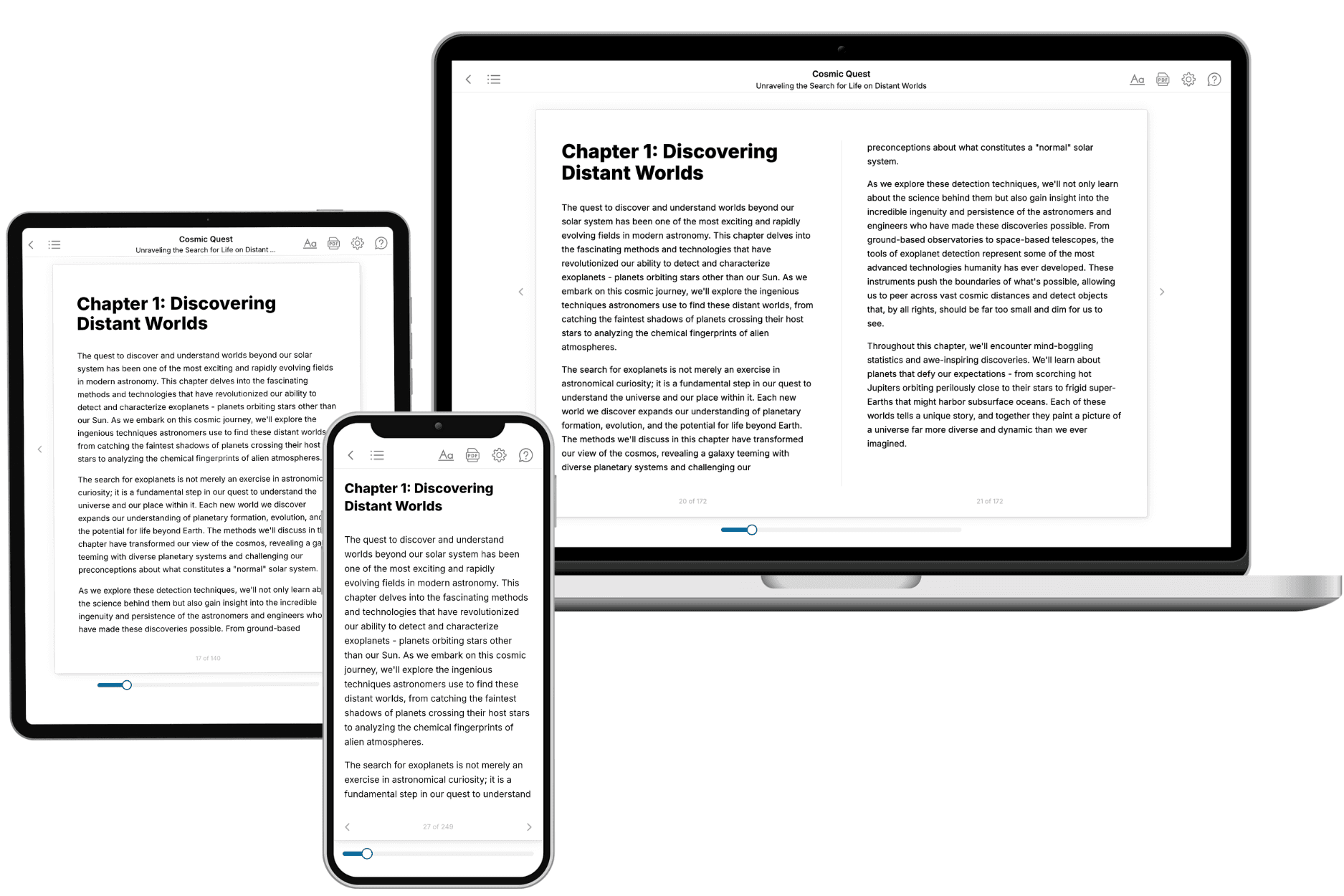
TailoredRead creates complete, full-length nonfiction ebooks, written specifically for you. Tell us what you want to learn and why, and TailoredRead writes you a complete ebook on it, with charts, tables, and diagrams throughout. Read it online, on Kindle, or on any e-reader, or download it as a PDF or EPUB. Every book is written fresh the day you order it.
- How is the book tailored to me?
Before anything is written, you answer a few short questions about your goals, your background, and the topics you care about. Your book is then planned around your answers: written at your level, focused on your goals, and covering the topics you chose, instead of the one-size-fits-all book a store sells everyone.
- Will it read like generic AI content?
No. Your book isn't a chat transcript: it's planned chapter by chapter before a single word is written, told in a clear book voice, and explains ideas visually with charts, tables, and diagrams. After writing, every book goes through an editorial pass that polishes chapters so the book reads consistent from start to finish. Judge for yourself: browse thousands of sample books on our Explore Books page.
- How accurate is the content?
Our AI first checks whether your subject needs live research. Niche and fast-moving subjects are researched before writing, and the book plan and chapters are grounded in what it finds. After writing, every book goes through a quality pass that checks its facts and consistency, and researched books list their sources in a Notes section at the back.
- How long is the book?
You choose the length: Comprehensive (250-300 pages), Detailed (150-200 pages), Essential (70-100 pages), or Short (30-50 pages).
- Does the book include visuals?
Yes. Every book includes charts, tables, and diagrams: timelines, checklists, step-by-step guides, decision trees, comparison tables, matrices, and bar charts. A typical book includes dozens of these visual elements.
- Can I read it on Kindle? What formats can I download?
Yes. Every book can be read in our online reader or downloaded as a PDF or EPUB. The EPUB can be opened with Kindle, Apple Books, Kobo, and any e-reader. The Commercial and Author licenses also include an editable Word (DOCX) and Markdown download.
- How much does it cost?
About the price of a regular ebook. The exact price depends on your book's length and complexity, from $2 for the shortest books to $35 for the most comprehensive, and it's shown when you review your book, before you commit to anything. Each book is a one-time purchase, yours to keep, no subscription. Licenses that let you share, teach, or publish your book range from $35.99 to $49.99.
- Can I preview the book before purchasing?
Before you pay, you'll see what your book will cover: the title, a detailed description, the estimated length, and the complete chapter-by-chapter table of contents, so you know what you're getting before you decide. The full text itself is written after you purchase.
- How long does it take to create a book?
About 10 minutes. You can start reading the opening chapters while the rest is still being written.