The Transcendentalist Revolution
How American Thinkers Challenged Convention and Shaped a Nation
What if the greatest truths about human existence couldn't be found in institutions or traditions, but within yourself and the natural world around you?
222 pages11 chaptersAug 15, 2026Philosophy
About this book
This is the radical question that transcendentalism posed to 19th-century America. This book explores how a group of visionary thinkers challenged the intellectual and spiritual foundations of their society, arguing that intuition and nature held more wisdom than established religion or rigid rationalism. You'll discover how figures like Emerson and Thoreau developed philosophies that celebrated human potential, questioned authority, and inspired movements for social justice. From their critique of conformity to their revolutionary ideas about civil disobedience, transcendentalists shaped American thought in ways that continue to influence how we think about individualism, environmentalism, and social change. Whether you're interested in American history, philosophy, or the roots of modern activism, this book reveals how a small group of New England intellectuals sparked a movement that transformed a nation.
Table of contents
- IntroductionWhat Is Transcendentalism?, Why It Matters Today, How to Use This BookRead below
- Chapter 1: The Intellectual FoundationsEnlightenment Rationalism and Its Limits, The Romantic Philosophy Movement, Adapting European Ideas to America
- Chapter 2: The Birth of a MovementNew England's Intellectual Climate, Breaking Away from Unitarianism, The Transcendental Club and Early Gatherings
- Chapter 3: Ralph Waldo Emerson: The Movement's PhilosopherFrom Minister to Philosopher, Self-Reliance and Individual Genius, Nature and the Over-Soul
- Chapter 4: Henry David Thoreau: Philosophy in ActionA Life of Principle and Experiment, Walden Pond and Simple Living, Civil Disobedience and Moral Resistance
- Chapter 5: Margaret Fuller and Women's VoicesMargaret Fuller's Intellectual Journey, Women's Rights and Gender Equality, Fuller's Influence on Feminism
- Chapter 6: Core Philosophical PrinciplesIntuition as a Path to Truth, Nature as Divine Expression, The Perfectibility of Human Nature
- Chapter 7: Transcendentalism and Social ReformThe Abolitionist Movement, Reimagining Education and Learning, Utopian Communities and Brook Farm
- Chapter 8: Nature, Environment, and ConservationA Transcendental View of Ecology, Wilderness Preservation and National Parks, Environmental Activism Today
- Chapter 9: Literature and the ArtsTranscendentalist Writers and Poets, Art as Spiritual Expression, Influence on American Literary Tradition
- Chapter 10: Challenges and CriticismsContemporary Critiques and Opposition, Idealism Versus Practical Reality, The Decline of the Movement
- Chapter 11: The Lasting LegacyShaping American Identity and Values, Influence on Modern Social Movements, Transcendentalism in the 21st Century
- ConclusionThe Enduring Questions Transcendentalists Posed, Moving Forward with Transcendental Wisdom
- Further Reading and Resources
Introduction
In the spring of 1838, a thirty-four-year-old former minister stood before the graduating class of Harvard Divinity School and told them, in plain terms, that the church had lost its way. Ralph Waldo Emerson argued that organized religion had substituted ritual and doctrine for genuine spiritual experience, and that every human being carried within themselves a direct line to the divine. The faculty was scandalized. Harvard would not invite him back to speak for nearly three decades. But the students who heard that address carried its ideas outward into a country that was, in many ways, ready to receive them.
That moment captures something essential about transcendentalism as a movement. It was not a quiet academic debate. It was a direct challenge to the most powerful institutions of its time: the church, the university, the state, and the social conventions that kept people in their assigned places. The thinkers who gathered around these ideas in 1830s and 1840s New England were not simply philosophers writing for other philosophers. They were trying to change how ordinary people understood themselves, their relationship to nature, and their obligations to one another.
The word "transcendentalism" can sound abstract, even intimidating. But the questions it raised are anything but remote. Can you trust your own conscience more than the authority of an institution? Does the natural world carry a kind of wisdom that modern civilization tends to drown out? What do you owe to a government whose laws you believe are unjust? These are not historical curiosities. They are live questions, and the transcendentalists developed some of the most compelling answers the American tradition has ever produced.
This book traces the full arc of that tradition: where it came from, who built it, what it argued, and why it still matters. Along the way, you will encounter a cast of thinkers who were, by any measure, remarkable people. Emerson, who rebuilt his intellectual life from scratch after losing his first wife and resigning his ministry. Thoreau, who turned a two-year experiment in deliberate simplicity into one of the most influential books in American literature. Margaret Fuller, who used the movement's ideas to construct a systematic argument for women's intellectual equality at a time when that argument was considered radical to the point of absurdity. These were not armchair philosophers. They tested their ideas against real life, and the results were often surprising, sometimes contradictory, and always worth examining closely.
What Is Transcendentalism?
At its simplest, transcendentalism is the belief that human beings have access to truths that go beyond what the senses can observe or what formal logic can prove. The word "transcend" means to go beyond, and that is precisely what these thinkers argued the human mind could do. They believed that intuition, direct experience, and a deep engagement with the natural world could reveal truths that neither science nor scripture alone could deliver. This was a bold claim in an era when both religious orthodoxy and Enlightenment Rationalism were competing to define what counted as legitimate knowledge.
The movement drew from several intellectual traditions at once. From German Idealism, particularly the work of Immanuel Kant, the transcendentalists borrowed the idea that the mind is not a passive receiver of information but an active participant in shaping reality. From British Romanticism, especially the poetry of Wordsworth and Coleridge, they inherited a reverence for nature as something spiritually alive rather than merely a collection of physical resources. These European influences were then filtered through a distinctly American sensibility: optimistic, democratic, and deeply suspicious of inherited authority. The chapter on intellectual foundations explores these borrowings in detail.
What made transcendentalism distinctly American was its insistence on the individual. European Romanticism often celebrated the nation, the folk tradition, or the organic community. The transcendentalists celebrated the self. Emerson's concept of Self-Reliance was not a call for selfishness; it was a call for intellectual and moral independence. He argued that conformity to social expectations was a form of spiritual cowardice, and that genuine virtue required the courage to trust your own deepest convictions even when the crowd disagreed. This was a genuinely radical position in a society that placed enormous pressure on people to conform to religious, social, and political norms.
The movement also had a strong ethical dimension. Transcendentalists did not simply retreat into private contemplation. They believed that a person who had genuinely awakened to their own moral nature would be compelled to act in the world. This is why transcendentalism and abolitionism became so closely linked. If every human being possessed an innate moral sense and an inherent dignity, then slavery was not merely economically inefficient or politically inconvenient. It was a fundamental violation of human nature itself. The same logic extended to women's rights, educational reform, and the critique of industrial capitalism.
Three philosophical pillars held the whole structure together. First, intuition as epistemology: the idea that direct inner experience is a valid and even superior source of knowledge compared to external authority. Second, nature as divine expression: the conviction that the natural world is not separate from the spiritual but is, in fact, its most visible manifestation. Third, human perfectibility: the belief that human beings are not fixed in their moral condition but are capable of genuine growth and transformation. These three ideas reinforced each other and gave the movement its characteristic combination of spiritual depth and social ambition.
Transcendentalism was never a tightly organized school of thought with a fixed doctrine. It was more like a shared orientation, a set of questions and commitments that different thinkers developed in different directions. Emerson was the movement's philosopher and its most eloquent voice. Thoreau was its most rigorous practitioner. Fuller was its most politically daring interpreter. Others, like Bronson Alcott and George Ripley, pushed the ideas into education and communal living. The diversity within the movement was one of its strengths, even as it sometimes made the transcendentalists difficult to pin down.
Transcendentalism was not a creed to be memorized but a practice to be lived. Its thinkers disagreed with each other constantly, and they would have considered that a sign of intellectual health rather than a problem to be solved.
One useful way to understand the movement is to contrast it with what it was reacting against. The dominant intellectual tradition in early nineteenth-century America was a form of empiricism derived from the Scottish Common Sense philosophers, which held that knowledge comes primarily through sensory experience and that moral truths can be derived through careful observation and reason. The transcendentalists found this approach too cold, too mechanical, and ultimately too limiting. They wanted a philosophy that could account for the full range of human experience, including beauty, love, moral conviction, and the sense of awe that a person feels standing at the edge of a forest or looking at a night sky.
The movement also had a specific historical location. It emerged in New England in the 1830s, at a moment when Unitarian dissent had already loosened the grip of Calvinist orthodoxy, when Harvard-educated ministers and intellectuals were reading German philosophy and British poetry, and when the young American republic was still working out what kind of civilization it wanted to be. The Transcendental Club, which began meeting informally in 1836, was the organizational center of this ferment. The chapter on the birth of the movement examines these conditions in depth. For now, the key point is that transcendentalism was not an accident. It grew from a specific soil, and understanding that soil helps explain both its strengths and its limitations.
Why It Matters Today
It would be easy to treat transcendentalism as a historical curiosity, a nineteenth-century intellectual fashion that has since been superseded by more rigorous philosophies and more sophisticated social theories. That would be a mistake. The movement's core questions have not been answered, and in some respects they have become more urgent. How do you maintain a sense of individual conscience in a society that generates enormous pressure to conform? How do you relate to the natural world in an age of ecological crisis? What do you owe to laws and institutions that you believe are unjust? These are not abstract puzzles. They are practical challenges that millions of people navigate every day.
The King-Thoreau connection is one of the clearest examples of transcendentalism's living influence. Martin Luther King Jr. read Thoreau's essay on Civil Disobedience as a student and later described it as one of the intellectual foundations of the Montgomery Bus Boycott and the broader civil rights movement.[1] Thoreau's argument that a person has not only the right but the moral obligation to refuse compliance with unjust laws became a practical tool for one of the most consequential social movements in American history. That is not a minor footnote. That is a direct line from a 1849 essay to the transformation of American society a century later.
The environmental connection is equally significant. The transcendentalist reverence for nature as something sacred rather than merely useful laid the philosophical groundwork for the wilderness preservation movement that would eventually produce the national parks system. John Muir, who founded the Sierra Club and campaigned for the preservation of Yosemite, was deeply influenced by Emerson and Thoreau. The idea that wild places have intrinsic value, not just instrumental value, is a transcendentalist idea. In an era of accelerating climate change and biodiversity loss, that idea carries more weight than ever.
Transcendentalism also speaks directly to questions about authenticity and meaning that feel particularly acute in contemporary life. The movement's critique of conformity was aimed at the social pressures of 1840s New England, but it translates with uncomfortable precision to the dynamics of social media, consumer culture, and institutional groupthink. Emerson's warning that society everywhere is in conspiracy against the manhood of every one of its members
was written in 1841, but it describes something that many people recognize in their own experience today.[2]
The movement's emphasis on human perfectibility also remains relevant, though it requires careful handling. The transcendentalists believed that human beings are capable of genuine moral growth, that the current state of any person or society is not its final state. This is an optimistic and, in many ways, a generous view of human nature. It underlies the American tradition of reform movements, the belief that things can be made better through sustained effort and moral commitment. At the same time, as the chapter on challenges and criticisms explores, this optimism had real blind spots, particularly around race and class, that the movement's own members sometimes failed to confront honestly.
Understanding transcendentalism also helps make sense of some of the deepest tensions in American culture. The conflict between individual freedom and collective responsibility, between reverence for nature and the drive to develop it, between moral idealism and political pragmatism: these tensions did not originate with the transcendentalists, but they gave them some of their most articulate and enduring formulations. When you understand what Emerson meant by Self-Reliance or what Thoreau meant by Civil Disobedience, you understand something important about the intellectual DNA of American public life.
There is also a more personal dimension to why this movement matters. The transcendentalists were, at bottom, asking how a person should live. Not in the abstract, but concretely: what to read, how to spend time, what to refuse, what to pursue. Thoreau's Walden experiment was not a philosophical treatise in the conventional sense. It was a record of someone trying to figure out, through direct experience, what a genuinely examined life looks like. That project has not gone out of date. If anything, the noise and speed of contemporary life make the question more pressing, not less.
The transcendentalists did not offer a self-help program or a set of life hacks. They offered something harder and more valuable: a set of principles rigorous enough to actually guide a life, tested against real conditions, and honest about the costs involved.
The movement's influence on American literature is another reason to take it seriously. The writers who came out of or were shaped by transcendentalism, including Walt Whitman, Emily Dickinson, and later figures like Robert Frost and Annie Dillard, produced some of the most distinctive and enduring work in the American literary tradition. The American Renaissance of the mid-nineteenth century, which also included Hawthorne and Melville (who had complicated relationships with transcendentalist ideas), was in large part a response to the intellectual energy the movement generated. Understanding transcendentalism gives you a richer reading of that literature and a clearer sense of what it was trying to do.
How to Use This Book
This book is organized to take you through transcendentalism in a logical sequence, but it is also designed so that each chapter can stand on its own if you come to it with a specific interest. The early chapters establish context: the European philosophical inheritance that supplied the raw material, the specific conditions in New England that turned a set of ideas into a self-aware movement, and the institutional setting of Unitarian dissent and Harvard networks that shaped the movement's early character. If you already have a solid grounding in this background, you can move more quickly through these sections and spend more time with the chapters on individual thinkers and core principles.
The chapters on Emerson, Thoreau, and Fuller are the heart of the book. Each one focuses on a distinct figure who developed transcendentalist ideas in a different direction. Emerson built the philosophical architecture: Self-Reliance, the Over-Soul, and Emersonian Nature as a framework for understanding the relationship between the individual and the universe. Thoreau translated those ideas into practice through the Walden experiment and the theory of Civil Disobedience. Fuller extended the movement's logic into a systematic argument for gender equality, producing in Women in the Nineteenth Century one of the most important feminist texts of the nineteenth century. Reading these three chapters together gives you a sense of both the movement's coherence and its internal diversity.
The chapters on core philosophical principles, social reform, and environmental thought are where the book moves from biography to analysis. These chapters examine the three pillars of transcendentalist thought (intuition as epistemology, nature as divine expression, and human perfectibility) as a connected system, then trace how those principles translated into concrete action. The connections between transcendentalism and abolitionism, between the movement's nature philosophy and the wilderness preservation movement, and between its educational ideas and the reform of American schooling are all explored with specific examples and historical detail.
To get the most from this book, consider keeping a few guiding questions in mind as you read:
- Where do you see transcendentalist ideas showing up in contemporary debates about individual rights, environmental policy, or social justice?
- Which of the three core pillars (intuition, nature, perfectibility) do you find most compelling, and which do you find most problematic?
- How do the different figures in the movement (Emerson, Thoreau, Fuller) agree and disagree with each other, and what do those disagreements reveal about the movement's strengths and limits?
- Where do you think the transcendentalists got things right, and where do you think their critics had a point?
These questions do not have single correct answers. The transcendentalists themselves disagreed about them, sometimes sharply. But holding them in mind as you read will help you engage with the material actively rather than passively, which is, appropriately enough, exactly what the transcendentalists would have wanted.
The chapter on challenges and criticisms is particularly important and should not be skipped. The transcendentalists had real blind spots. Their celebration of individual self-reliance sometimes sat uneasily with the collective action required to address systemic injustice. Their movement was predominantly white and educated, and its relationship to the experiences of enslaved people and working-class Americans was complicated and sometimes contradictory. The pragmatist critique, which argued that transcendentalism was too vague and too disconnected from practical consequences to be genuinely useful, also deserves serious consideration. Engaging with these criticisms honestly makes the movement's genuine achievements more meaningful, not less.
The final chapters on legacy and contemporary relevance bring the story forward into the present. The King-Thoreau connection, the influence of transcendentalist nature philosophy on modern environmentalism, and the movement's fingerprints on American identity and public culture are all examined with specific examples. The goal is not to argue that transcendentalism solved everything or that its ideas should be adopted wholesale. The goal is to show that these ideas have been genuinely productive, that they have generated real insights and real change, and that they continue to offer resources for thinking about problems that have not gone away.
A note on primary sources: wherever possible, this book quotes directly from the transcendentalists' own writings. Emerson's essays, Thoreau's journals and books, Fuller's criticism and her landmark text Women in the Nineteenth Century, and the pages of The Dial magazine are all rich sources that reward direct engagement. The further reading section at the end of the book provides a guide to the most accessible and rewarding primary and secondary texts for readers who want to go deeper. The transcendentalists were, above all, writers, and reading them directly is one of the best ways to understand what made their ideas so compelling and so durable.
One final thought before the main chapters begin. The transcendentalists were not saints, and this book does not treat them as such. They were complicated people who held contradictory views, made significant mistakes, and sometimes failed to live up to their own ideals. Emerson owned stock in a railroad while writing about the corrupting influence of commerce. Thoreau accepted his mother's cooking during his time at Walden Pond. Fuller's feminism, radical for its time, still operated within assumptions that later generations would challenge. These contradictions are not reasons to dismiss the movement. They are reasons to engage with it honestly, as a human project rather than a monument, and to ask what it can still teach us when we see it clearly.
This is the end of the free sample. The full book has 11 chapters.
Want this book written for you?
Tell us your goals and background, and get your own version of this book, tailored by AI to you.


Benefits of AI-tailored books
- Read one book, not ten:
- all the Philosophy knowledge you need, gathered into a single book.
- Save days of learning:
- tell us your goals, choose your topics, and the whole book is built around them.
- Learn effortlessly:
- Philosophy book written for your specific background and expertise.
- Understand at a glance:
- includes charts, tables, timelines, checklists, decision trees, and more.
- Stay current:
- written the day you order it, not years ago.
- Trust what you read:
- every book is checked for accuracy, with real research when your subject needs it.
Create your unique book in 3 steps
- 1. Select your focus
Select the focus of your Philosophy book and share your background
- 2. Personalize your book
Specify your goals and choose sub-topics to include
- 3. Get your tailored book
Your book is ready in 10 minutes. Read it online, download as EPUB or PDF, or send to Kindle.


Frequently asked questions
- What is TailoredRead?
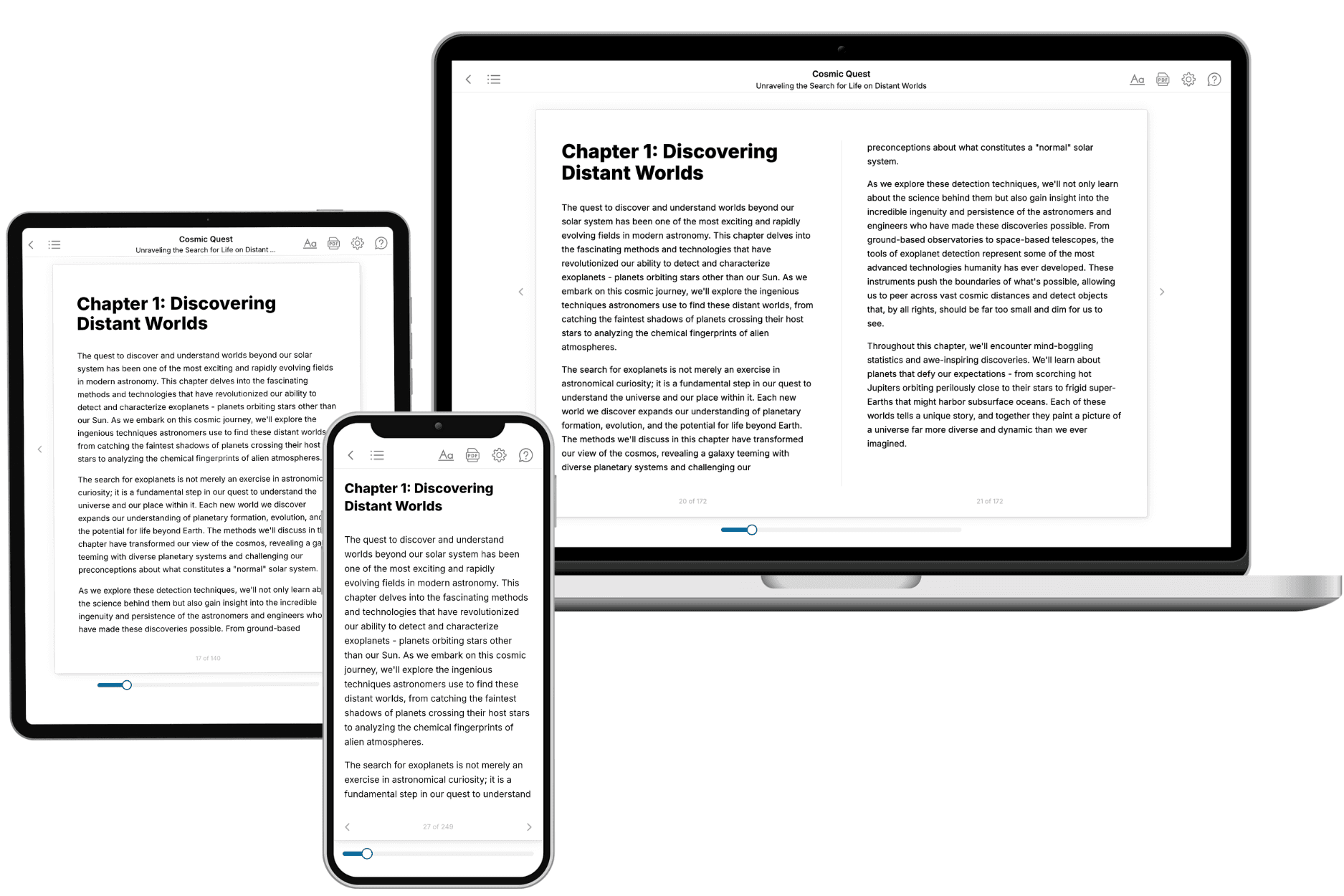
TailoredRead creates complete, full-length nonfiction ebooks, written specifically for you. Tell us what you want to learn and why, and TailoredRead writes you a complete ebook on it, with charts, tables, and diagrams throughout. Read it online, on Kindle, or on any e-reader, or download it as a PDF or EPUB. Every book is written fresh the day you order it.
- How is the book tailored to me?
Before anything is written, you answer a few short questions about your goals, your background, and the topics you care about. Your book is then planned around your answers: written at your level, focused on your goals, and covering the topics you chose, instead of the one-size-fits-all book a store sells everyone.
- Will it read like generic AI content?
No. Your book isn't a chat transcript: it's planned chapter by chapter before a single word is written, told in a clear book voice, and explains ideas visually with charts, tables, and diagrams. After writing, every book goes through an editorial pass that polishes chapters so the book reads consistent from start to finish. Judge for yourself: browse thousands of sample books on our Explore Books page.
- How accurate is the content?
Our AI first checks whether your subject needs live research. Niche and fast-moving subjects are researched before writing, and the book plan and chapters are grounded in what it finds. After writing, every book goes through a quality pass that checks its facts and consistency, and researched books list their sources in a Notes section at the back.
- How long is the book?
You choose the length: Comprehensive (250-300 pages), Detailed (150-200 pages), Essential (70-100 pages), or Short (30-50 pages).
- Does the book include visuals?
Yes. Every book includes charts, tables, and diagrams: timelines, checklists, step-by-step guides, decision trees, comparison tables, matrices, and bar charts. A typical book includes dozens of these visual elements.
- Can I read it on Kindle? What formats can I download?
Yes. Every book can be read in our online reader or downloaded as a PDF or EPUB. The EPUB can be opened with Kindle, Apple Books, Kobo, and any e-reader. The Commercial and Author licenses also include an editable Word (DOCX) and Markdown download.
- How much does it cost?
About the price of a regular ebook. The exact price depends on your book's length and complexity, from $2 for the shortest books to $35 for the most comprehensive, and it's shown when you review your book, before you commit to anything. Each book is a one-time purchase, yours to keep, no subscription. Licenses that let you share, teach, or publish your book range from $35.99 to $49.99.
- Can I preview the book before purchasing?
Before you pay, you'll see what your book will cover: the title, a detailed description, the estimated length, and the complete chapter-by-chapter table of contents, so you know what you're getting before you decide. The full text itself is written after you purchase.
- How long does it take to create a book?
About 10 minutes. You can start reading the opening chapters while the rest is still being written.