The Unraveling
How the Soviet Union Collapsed and Reshaped the Modern World
The Soviet Union's dissolution in 1991 stands as one of the most consequential events of the twentieth century, yet its causes and implications remain widely misunderstood.
238 pages12 chaptersOct 23, 2025Russian History
About this book
This book takes you through the intricate web of economic failures, political miscalculations, and social upheavals that brought down a superpower without a single shot fired in its defense. You'll discover how decades of systemic problems converged in the late 1980s, how Gorbachev's well-intentioned reforms backfired spectacularly, and why nationalist movements proved impossible to contain once unleashed. Through careful analysis of key events, decisions, and turning points, you'll gain insight into the human drama behind the headlines—from Kremlin power struggles to independence movements in the Baltic states. More than a historical account, this book illuminates how the Soviet collapse continues to reverberate through contemporary politics, shaping everything from European security to Russia's current trajectory. Whether you're seeking to understand the past or make sense of today's geopolitical landscape, you'll find the context and clarity you need.
Table of contents
- IntroductionDecember 1991: The End of an Empire, Why the Soviet Collapse Still Matters, Approach and Structure of This BookRead below
- Chapter 1: The Soviet System and Its ContradictionsLenin's Revolutionary State, Stalin's Totalitarian Consolidation, The Command Economy Model, The Nationalities Question
- Chapter 2: From Khrushchev to Brezhnev: Seeds of DeclineKhrushchev's Thaw and Failed Reforms, The Brezhnev Era of Stagnation, Economic Slowdown and Technological Lag, The Gerontocracy and Leadership Crisis
- Chapter 3: Economic Foundations of CollapseCentral Planning's Fatal Flaws, The Military-Industrial Burden, Oil Dependency and Falling Prices, Consumer Goods Crisis and Daily Life
- Chapter 4: Gorbachev and the Reform AgendaA New Generation Takes Power, Glasnost: Opening the Floodgates, Perestroika: Restructuring the Economy, Unintended Consequences of Reform
- Chapter 5: Political Liberalization and Its LimitsChallenging the Party Monopoly, The 1989 Elections and New Politics, Conservative Resistance Within the System
- Chapter 6: The Nationalist AwakeningThe Baltic States Lead the Way, Conflict in the Caucasus, Ukraine and the Question of Sovereignty, Central Asia's Reluctant Independence
- Chapter 7: The Collapse of the Eastern BlocPoland and the Solidarity Movement, The Fall of the Berlin Wall, Velvet Revolutions Across Eastern Europe, Moscow's Non-Response and the Sinatra Doctrine
- Chapter 8: 1991: The Year of CrisisEconomic Freefall and Social Unrest, The New Union Treaty Negotiations, The August Coup Attempt, Yeltsin's Rise and Russia's Assertion
- Chapter 9: The Final DissolutionThe Belavezha Accords, Gorbachev's Resignation, December 25, 1991: The Flag Comes Down
- Chapter 10: Immediate Aftermath and TransitionFifteen New Independent States, Economic Shock Therapy and Its Consequences, The Nuclear Arsenal Question, Russia's Identity Crisis
- Chapter 11: Impact on Europe and the WorldNATO Expansion and European Security, European Union Enlargement, The Unipolar Moment and American Hegemony
- Chapter 12: The Enduring LegacyFrozen Conflicts and Territorial Disputes, Putin's Russia and Nostalgia for Empire, Democracy, Authoritarianism, and Transition Lessons, Historical Memory and Competing Narratives
- ConclusionUnderstanding the Collapse: Key Takeaways, Why This History Matters Today
- Further Reading
Introduction
On December 25, 1991, the red hammer-and-sickle flag was lowered from the Kremlin for the last time. The Soviet Union, a superpower that had shaped global politics for seven decades, ceased to exist. This moment marked not just the end of a state but the conclusion of an ideological experiment that had promised to reshape human society itself. The collapse came swiftly in its final months, yet its roots stretched back through decades of accumulated problems, missed opportunities, and systemic contradictions that no amount of reform could ultimately resolve.
Understanding how and why the Soviet Union fell apart remains one of the most important questions in modern history. This was not a collapse caused by military defeat or foreign invasion. No external enemy breached Soviet borders or forced capitulation. Instead, the system unraveled from within, pulled apart by economic dysfunction, political paralysis, nationalist aspirations, and the unintended consequences of reform efforts. The speed and manner of the collapse surprised nearly everyone, including Western intelligence agencies, Soviet leaders themselves, and the millions of ordinary citizens whose lives were transformed overnight.
The story of the Soviet collapse is fundamentally human. It involves leaders who made fateful decisions with incomplete information, reformers whose good intentions produced catastrophic results, and ordinary people who navigated extraordinary circumstances. It encompasses the courage of dissidents who challenged totalitarian power, the desperation of consumers waiting in endless queues for basic goods, and the confusion of citizens who watched their country disappear. This book examines these human dimensions alongside the structural forces, economic realities, and political dynamics that made collapse possible. You'll discover not just what happened, but why it happened, and why those events continue to shape our world today.
December 1991: The End of an Empire
The final weeks of the Soviet Union unfolded with remarkable speed. On December 8, 1991, the leaders of Russia, Ukraine, and Belarus met secretly in a hunting lodge in the Belavezha Forest. There, Boris Yeltsin of Russia, Leonid Kravchuk of Ukraine, and Stanislav Shushkevich of Belarus signed an agreement declaring that the USSR as a subject of international law and geopolitical reality is ceasing its existence.
This meeting, conducted without the knowledge or consent of Soviet President Mikhail Gorbachev, effectively dissolved the union that had existed since 1922. The three leaders represented the Slavic core of the Soviet state, and their decision made continuation of the union impossible.
Gorbachev learned of the Belavezha Accords through news reports and phone calls, discovering that his position as Soviet president had become meaningless. He initially resisted, calling the agreement illegal and unconstitutional. Yet he possessed no mechanism to enforce his authority. The Soviet military, which might have intervened, remained in its barracks. The Communist Party, once the glue holding the system together, had been effectively banned in Russia following the failed August coup attempt just months earlier. Gorbachev found himself president of a country that no longer existed in any practical sense.
On December 21, eleven former Soviet republics met in Alma-Ata (now Almaty), Kazakhstan, to formalize the creation of the Commonwealth of Independent States. This gathering confirmed what the Belavezha Accords had initiated. The Baltic states—Estonia, Latvia, and Lithuania—had already declared independence and were not present. Georgia, embroiled in civil conflict, also did not participate. The remaining republics agreed to coordinate certain policies but made clear they were now sovereign nations. The meeting represented not a negotiation but a funeral, with participants dividing the inheritance of a deceased empire.
Four days later, on December 25, Gorbachev delivered his resignation speech on television. He defended his reform efforts while acknowledging their failure to save the system he had tried to transform. The old system fell apart even before the new system began to work,
he observed, capturing the essential tragedy of perestroika. That evening, at 7:32 PM Moscow time, the Soviet flag was lowered from the Kremlin flagpole. In its place rose the white, blue, and red tricolor of Russia. The ceremony was brief and witnessed by few people. There were no celebrations, no crowds, no sense of triumph—only a quiet acknowledgment that an era had ended.
The practical implications of dissolution became immediately apparent. Soviet embassies around the world suddenly represented a non-existent country. The massive Soviet military, with troops stationed from Germany to Mongolia, required division among successor states. Nuclear weapons, once controlled by a single authority, now sat on the territory of four independent nations. Economic relationships that had functioned within a single system needed complete restructuring. Citizens went to sleep as Soviets and woke up as Russians, Ukrainians, Kazakhs, or members of other newly independent nations, often without clear understanding of what this transformation meant for their daily lives.
The international community scrambled to respond to this unprecedented situation. The United States and other Western nations quickly recognized the new states, eager to establish relationships and ensure stability, particularly regarding nuclear weapons. The United Nations transferred the Soviet Union's permanent Security Council seat to Russia, along with its veto power. International organizations faced the complex task of replacing one member state with fifteen. The speed of these changes left little time for careful consideration of long-term implications, creating ambiguities and tensions that would persist for decades.
December 1991 represented the culmination of processes that had been building for years, even decades. The final collapse came quickly, but it was not sudden in any meaningful sense. Economic problems had accumulated throughout the 1970s and 1980s. Nationalist movements had been gathering strength since glasnost allowed open discussion. Political legitimacy had eroded as the Communist Party's monopoly on truth crumbled under scrutiny. The August 1991 coup attempt had fatally weakened central authority. By December, the question was not whether the Soviet Union would survive but how its dissolution would be managed and what would replace it.
The manner of the Soviet collapse—peaceful, negotiated, and relatively orderly—was not inevitable. History offers many examples of empires that fought desperately to preserve themselves, often at tremendous human cost. The Soviet military possessed overwhelming force and could theoretically have attempted to hold the union together through violence. That this did not happen reflects specific choices made by individuals, particularly military leaders who declined to intervene. It also reflects the complete exhaustion of the system's ideological legitimacy. When the moment came, there was simply nothing left worth fighting for, no compelling vision that could motivate people to preserve the union through bloodshed.
Why the Soviet Collapse Still Matters
More than three decades after the Soviet flag came down, the collapse continues to shape global politics in profound ways. Understanding this event is not merely an exercise in historical curiosity but essential for making sense of contemporary international relations. The post-Soviet space remains a region of ongoing conflict, competing visions, and unresolved tensions. From Ukraine to the Caucasus to Central Asia, the borders, institutions, and relationships established during the collapse continue to generate friction and occasionally violence. You cannot understand current events in this vast region without grasping how and why the Soviet Union fell apart.
Russia's relationship with the West remains fundamentally shaped by the collapse and its aftermath. Many Russians, including current leaders, view the 1990s as a period of national humiliation when a weakened Russia was taken advantage of by Western powers. This perception influences Russian foreign policy, military doctrine, and domestic politics. The expansion of NATO into former Soviet territories, the color revolutions in post-Soviet states, and conflicts in Georgia and Ukraine all connect directly to unresolved issues from the collapse. Without understanding the Soviet Union's end, these contemporary tensions appear arbitrary rather than rooted in specific historical grievances and competing narratives.
The collapse also offers crucial lessons about how political and economic systems fail. The Soviet experience demonstrates that:
- Centrally planned economies cannot match the innovation and efficiency of market systems over the long term
- Political systems that suppress dissent and prevent feedback mechanisms become brittle and vulnerable to sudden collapse
- Multinational states held together by force rather than consent face existential challenges when central authority weakens
- Reform efforts can accelerate collapse rather than prevent it if they expose fundamental contradictions without providing viable alternatives
- Economic problems, if severe and prolonged enough, can delegitimize even the most powerful political systems
These lessons remain relevant for understanding other authoritarian systems and centrally planned economies today. China's leaders studied the Soviet collapse intensively, drawing conclusions that shaped their approach to economic reform and political control. They determined that Gorbachev's mistake was loosening political control before establishing economic stability, and they pursued the opposite path—economic liberalization while maintaining Communist Party monopoly on power. Whether this alternative approach can succeed long-term remains an open question, but it demonstrates how the Soviet collapse continues to influence policy decisions in major powers.
The collapse also transformed European security architecture in ways that continue to generate controversy. The question of whether Western leaders made promises about NATO expansion that were later broken remains disputed, with different participants remembering conversations differently. The integration of former Soviet satellites and even former Soviet republics into Western institutions created a new Europe, but one where Russia feels increasingly encircled and threatened. Understanding what was said, promised, and understood during the collapse helps clarify whether current tensions represent broken agreements or different interpretations of ambiguous understandings reached during chaotic times.
For the fifteen successor states, the collapse created divergent paths that illuminate broader questions about political and economic development. The Baltic states joined the European Union and NATO, achieving prosperity and stability. Ukraine has struggled with corruption, oligarchic control, and territorial conflict. Belarus remained under authoritarian rule. Central Asian states developed various forms of personalized authoritarianism. Russia itself experienced economic collapse, oligarchic capitalism, and eventual reconsolidation under Putin. These different trajectories, all starting from the same Soviet system, offer natural experiments in how institutions, leadership, geography, and historical memory shape national development.
The human dimension of the collapse also deserves attention. Millions of people experienced the dissolution as personal catastrophe. Life savings evaporated through hyperinflation. Social safety nets disappeared. Ethnic conflicts erupted, displacing populations. The certainties of Soviet life—guaranteed employment, subsidized housing, predictable if modest living standards—vanished. For many, particularly older citizens, the collapse meant poverty, confusion, and loss of identity. Understanding this human cost provides necessary context for why nostalgia for the Soviet period persists in many former Soviet republics, even among people who were not Communist Party members or regime beneficiaries.
Finally, the Soviet collapse represents one of the few cases where a superpower dissolved without major war. This relatively peaceful transition was not inevitable and required specific choices by key individuals at critical moments. Studying how this happened offers insights into how other potentially catastrophic transitions might be managed. It also raises questions about whether the transition could have been handled better, whether different policies might have produced more stable and prosperous successor states, and whether opportunities for building a more cooperative post-Cold War order were missed. These counterfactual questions remain relevant as we consider how to manage other major geopolitical transitions.
Approach and Structure of This Book
This book takes a comprehensive approach to understanding the Soviet collapse, examining multiple dimensions rather than attributing the event to any single cause. You'll find that the collapse resulted from the convergence of economic, political, social, and international factors that reinforced each other in a cascading failure. Economic problems undermined political legitimacy. Political reforms unleashed nationalist movements. Nationalist movements accelerated economic disintegration. International developments, particularly in Eastern Europe, demonstrated that Soviet-style systems were failing everywhere. No single factor alone would have brought down the Soviet Union, but together they created an unstoppable momentum toward dissolution.
The book is organized chronologically and thematically to help you understand both the sequence of events and the underlying structural problems. Early chapters establish the foundations of the Soviet system and the contradictions built into it from the beginning. You'll see how Lenin's revolutionary state was constructed, how Stalin consolidated totalitarian control, and how the command economy functioned. Understanding these foundations is essential because the collapse was not simply a failure of leadership in the 1980s but the culmination of problems inherent in the system's design. The seeds of collapse were planted decades before Gorbachev came to power.
Middle chapters trace the accumulation of problems from the 1950s through the early 1980s. You'll examine:
- Khrushchev's reform attempts and why they failed to address fundamental issues
- The Brezhnev era's economic stagnation and growing technological gap with the West
- The burden of military spending and competition with the United States
- The crisis of leadership as aging Soviet leaders proved incapable of addressing mounting challenges
- The growing gap between official propaganda and lived reality that eroded system legitimacy
The book then focuses intensively on the Gorbachev era, examining his reform program in detail. You'll understand what glasnost and perestroika were intended to accomplish, why Gorbachev believed reform was necessary, and how these policies produced consequences he neither intended nor anticipated. This section pays particular attention to the dilemma Gorbachev faced: the system needed fundamental reform to survive, but fundamental reform exposed contradictions that made survival impossible. His tragedy was that he understood the need for change but could not control the forces that change unleashed.
Separate chapters address the nationalist dimension of the collapse, examining how different Soviet republics experienced and contributed to the union's disintegration. The Baltic states, with their history of independent statehood and forced incorporation, led the independence movement. The Caucasus experienced violent ethnic conflicts that demonstrated Moscow's inability to maintain order. Ukraine's decision to pursue independence made the union's continuation impossible. Central Asian republics, by contrast, were reluctant participants in independence, preferring continued association with Russia. These different trajectories reveal how diverse the Soviet Union actually was and why holding it together required constant coercion.
The book also examines the international dimension, particularly the collapse of communist regimes throughout Eastern Europe in 1989. These events demonstrated that Soviet-style systems were failing everywhere, not just in the USSR itself. They also revealed that Gorbachev would not use force to preserve communist rule, fundamentally changing the calculations of both reformers and hardliners within the Soviet Union. The fall of the Berlin Wall, the Velvet Revolution in Czechoslovakia, and the violent overthrow of Ceaușescu in Romania all influenced Soviet domestic politics and accelerated the union's disintegration.
Later chapters focus on the critical year of 1991, when the Soviet Union moved from crisis to collapse. You'll follow the failed August coup attempt, which fatally weakened Gorbachev and central authority while strengthening Yeltsin and the Russian republic. You'll examine the final negotiations over a new union treaty and why they ultimately failed. The book provides detailed coverage of the final months, including the Belavezha Accords, Gorbachev's resignation, and the practical challenges of dividing Soviet assets and institutions among fifteen successor states.
The final chapters examine the immediate aftermath and lasting legacy of the collapse. You'll explore how different successor states navigated the transition, why some succeeded while others struggled, and how the collapse continues to shape contemporary politics. Special attention is paid to Russia's evolution under Yeltsin and Putin, the expansion of NATO and the European Union, and the frozen conflicts that remain unresolved decades later. The book concludes by drawing lessons from the collapse that remain relevant for understanding political and economic systems today.
Throughout the book, you'll encounter specific examples, case studies, and personal stories that illustrate broader trends. Rather than presenting only high-level analysis, the book grounds abstract concepts in concrete details. You'll read about specific factories that couldn't meet production quotas, particular nationalist demonstrations that challenged Soviet authority, and individual leaders whose decisions shaped events. These details help make the collapse comprehensible as a human event, not just an abstract historical process. They also reveal the contingency of history—how different choices at key moments might have produced different outcomes.
The book draws on a wide range of sources, including:
- Memoirs and accounts from Soviet leaders, including Gorbachev, Yeltsin, and other key figures
- Declassified documents from Soviet archives that became available after the collapse
- Economic data and analysis from both Soviet and Western sources
- Journalistic accounts and contemporary reporting from the period
- Academic research and historical analysis from the past three decades
- Interviews and oral histories from participants at various levels
This multi-source approach provides a more complete picture than relying on any single perspective. Soviet official sources often obscured problems and presented misleading data. Western analyses sometimes misunderstood Soviet realities or projected their own assumptions. Memoirs by participants can be self-serving and selective. By triangulating among different sources, the book aims to present a balanced account that acknowledges complexity and avoids oversimplification. Where sources conflict or evidence is ambiguous, the book acknowledges these uncertainties rather than presenting contested interpretations as established fact.
The book assumes you have basic familiarity with Cold War history but does not require specialized knowledge. Key concepts, institutions, and individuals are explained when first introduced. Russian and other non-English terms are translated and contextualized. The goal is accessibility without sacrificing depth or nuance. You should finish the book with not just a narrative understanding of what happened but analytical tools for understanding why it happened and what it means. The collapse was complex, but it is comprehensible if examined systematically and thoroughly, which is precisely what this book aims to provide.
This is the end of the free sample. The full book has 12 chapters.
Want this book written for you?
Tell us your goals and background, and get your own version of this book, tailored by AI to you.


Benefits of AI-tailored books
- Read one book, not ten:
- all the Russian History knowledge you need, gathered into a single book.
- Save days of learning:
- tell us your goals, choose your topics, and the whole book is built around them.
- Learn effortlessly:
- Russian History book written for your specific background and expertise.
- Understand at a glance:
- includes charts, tables, timelines, checklists, decision trees, and more.
- Stay current:
- written the day you order it, not years ago.
- Trust what you read:
- every book is checked for accuracy, with real research when your subject needs it.
Create your unique book in 3 steps
- 1. Select your focus
Select the focus of your Russian History book and share your background
- 2. Personalize your book
Specify your goals and choose sub-topics to include
- 3. Get your tailored book
Your book is ready in 10 minutes. Read it online, download as EPUB or PDF, or send to Kindle.


Frequently asked questions
- What is TailoredRead?
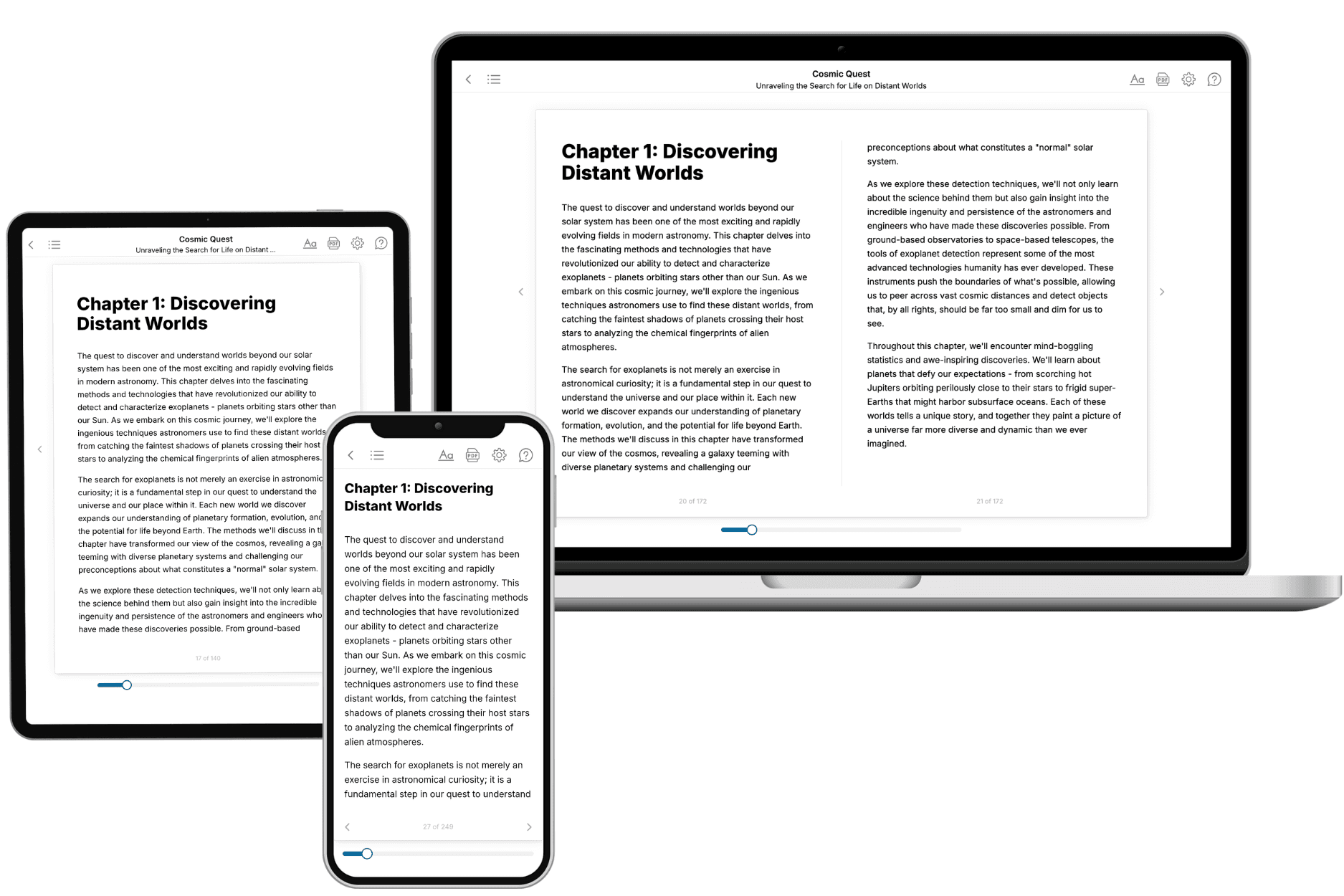
TailoredRead creates complete, full-length nonfiction ebooks, written specifically for you. Tell us what you want to learn and why, and TailoredRead writes you a complete ebook on it, with charts, tables, and diagrams throughout. Read it online, on Kindle, or on any e-reader, or download it as a PDF or EPUB. Every book is written fresh the day you order it.
- How is the book tailored to me?
Before anything is written, you answer a few short questions about your goals, your background, and the topics you care about. Your book is then planned around your answers: written at your level, focused on your goals, and covering the topics you chose, instead of the one-size-fits-all book a store sells everyone.
- Will it read like generic AI content?
No. Your book isn't a chat transcript: it's planned chapter by chapter before a single word is written, told in a clear book voice, and explains ideas visually with charts, tables, and diagrams. After writing, every book goes through an editorial pass that polishes chapters so the book reads consistent from start to finish. Judge for yourself: browse thousands of sample books on our Explore Books page.
- How accurate is the content?
Our AI first checks whether your subject needs live research. Niche and fast-moving subjects are researched before writing, and the book plan and chapters are grounded in what it finds. After writing, every book goes through a quality pass that checks its facts and consistency, and researched books list their sources in a Notes section at the back.
- How long is the book?
You choose the length: Comprehensive (250-300 pages), Detailed (150-200 pages), Essential (70-100 pages), or Short (30-50 pages).
- Does the book include visuals?
Yes. Every book includes visual elements such as timelines, checklists, step-by-step guides, decision trees, comparison tables, and matrices, and many include bar charts. A typical book includes dozens of these visual elements.
- Can I read it on Kindle? What formats can I download?
Yes. Every book can be read in our online reader or downloaded as a PDF or EPUB. The EPUB can be opened with Kindle, Apple Books, Kobo, and any e-reader. The Commercial and Author licenses also include an editable Word (DOCX) and Markdown download.
- How much does it cost?
About the price of a regular ebook. The exact price depends on your book's length and complexity, from $2 for the shortest books to $35 for the most comprehensive, and it's shown when you review your book, before you commit to anything. Each book is a one-time purchase, yours to keep, no subscription. Licenses that let you share, teach, or publish your book range from $35.99 to $49.99.
- Can I preview the book before purchasing?
Before you pay, you'll see what your book will cover: the title, a detailed description, the estimated length, and the complete chapter-by-chapter table of contents, so you know what you're getting before you decide. The full text itself is written after you purchase.
- How long does it take to create a book?
About 10 minutes. You can start reading the opening chapters while the rest is still being written.