Unveiling the Iron Curtain
The Transformative Era of Glasnost and Perestroika in Soviet History
Discover the pivotal era that reshaped the Soviet Union and changed the course of European history.
284 pages14 chaptersDec 30, 2024Soviet History
About this book
"Unveiling the Iron Curtain" takes you on an illuminating journey through the transformative policies of Glasnost and Perestroika. You'll gain a deep understanding of the social, political, and economic forces that led to these reforms and their far-reaching consequences. Delve into the intricacies of Mikhail Gorbachev's leadership and the bold steps taken to reform a stagnating system. You'll explore how these policies of openness and restructuring challenged decades of Soviet ideology and practice, ultimately leading to unexpected outcomes that reshaped the global political landscape. Through engaging narratives and insightful analysis, you'll witness the unraveling of censorship, the emergence of new freedoms, and the complex challenges faced during this period of rapid change. This book offers a nuanced perspective on a crucial chapter of 20th-century history, providing you with the context to understand its lasting impact on contemporary Europe and beyond.
Table of contents
- IntroductionThe Importance of Glasnost and Perestroika, Historical Context of the Soviet Union, Overview of the Book's StructureRead below
- Chapter 1: The Soviet Union Before ReformsThe Legacy of Stalin, The Brezhnev Era and Stagnation, Economic Challenges in the 1980s, Social and Cultural Issues
- Chapter 2: The Rise of Mikhail GorbachevGorbachev's Background and Early Career, Political Ascent to Leadership, Initial Reform Attempts, The Concept of 'New Thinking'
- Chapter 3: Introducing Glasnost: The Policy of OpennessDefining Glasnost, Goals and Objectives of Glasnost, Media Freedom and Censorship Reduction, Encouraging Public Discourse
- Chapter 4: Understanding Perestroika: Economic RestructuringDefining Perestroika, Economic Goals of Perestroika, Introduction of Market Reforms, Increasing Enterprise Autonomy
- Chapter 5: Political Reforms and DemocratizationIntroduction of Multicandidate Elections, The Congress of People's Deputies, Emergence of Political Pluralism, Shifting Power Dynamics
- Chapter 6: Social and Cultural ChangesArtistic and Cultural Freedom, Religious Revival, Education System Reforms, Emergence of Social Movements
- Chapter 7: The Media RevolutionFreedom of the Press, Rise of Investigative Journalism, Transformation of Television, Access to International Media
- Chapter 8: Economic Consequences of PerestroikaThe Cooperative Movement, Opening to Foreign Investment, Challenges and Shortcomings, Impact on Consumer Goods and Services
- Chapter 9: Nationalism and Ethnic TensionsBaltic States' Push for Independence, Conflicts in the Caucasus, Unrest in Central Asia, The Rise of Russian Nationalism
- Chapter 10: Changes in Soviet Foreign Policy'New Thinking' in Foreign Policy, Arms Reduction and Disarmament, Withdrawal from Afghanistan, Changing Relations with Eastern Europe
- Chapter 11: The Impact on Eastern EuropeSolidarity in Poland, The Velvet Revolution in Czechoslovakia, The Fall of the Berlin Wall, The Romanian Revolution
- Chapter 12: The August Coup AttemptCauses and Motivations, The Events of August 19-21, 1991, Public Resistance and Yeltsin's Role, Aftermath and Consequences
- Chapter 13: The Dissolution of the Soviet UnionThe Belavezha Accords, Gorbachev's Resignation, Formation of the Commonwealth of Independent States, Global Reactions to the Soviet Collapse
- Chapter 14: Assessing the Legacy of Glasnost and PerestroikaSuccesses and Failures, Impact on Post-Soviet States, Reshaping the Global Order, Historical Debates and Interpretations
- ConclusionKey Takeaways, Future Implications
- Glossary
- Further Reading
Introduction
The late 20th century witnessed a series of transformative events that reshaped the global political landscape, none more significant than the reforms known as Glasnost and Perestroika in the Soviet Union. These policies, introduced by Soviet leader Mikhail Gorbachev in the mid-1980s, marked a dramatic departure from decades of rigid communist rule and set in motion a chain of events that would ultimately lead to the dissolution of the Soviet Union and the end of the Cold War. As you embark on this journey through one of the most pivotal periods in modern history, you will gain a comprehensive understanding of the forces that drove these changes, their implementation, and their far-reaching consequences that continue to shape our world today.
The story of Glasnost and Perestroika is not merely a tale of political and economic reform; it is a narrative of human aspirations, societal transformation, and the complex interplay between ideology and reality. Through these pages, you will explore how these policies emerged from a recognition of the deep-seated problems within the Soviet system, and how they aimed to revitalize a stagnating superpower. You will witness the unfolding of events that saw increased openness, political pluralism, and economic restructuring challenge the very foundations of the Soviet state, leading to outcomes that few could have predicted at the outset.
As we delve into this era of profound change, we will examine the historical context that gave rise to these reforms, the key figures who shaped their implementation, and the myriad ways in which they affected every aspect of Soviet life - from politics and economics to culture and international relations. By understanding the complexities of Glasnost and Perestroika, you will gain valuable insights into the nature of political and social change, the challenges of reforming entrenched systems, and the often unpredictable consequences of well-intentioned policies.
The Importance of Glasnost and Perestroika
Glasnost and Perestroika stand as watershed moments in 20th-century history, their significance extending far beyond the borders of the Soviet Union. These policies represented a bold attempt to address the systemic issues plaguing the Soviet system, which had become increasingly apparent in the years leading up to their implementation. The importance of these reforms cannot be overstated, as they not only transformed the Soviet Union but also reshaped the global geopolitical landscape, ending the Cold War and ushering in a new era of international relations.
At its core, Glasnost, which translates to "openness" or "transparency," was a policy aimed at increasing government accountability and reducing censorship. This marked a radical departure from the secretive and tightly controlled information flow that had characterized the Soviet regime for decades. The importance of Glasnost lies in its role in fostering a more open society, where citizens could engage in public discourse, criticize government policies, and access previously restricted information. This newfound freedom of expression led to a flourishing of cultural and intellectual life, as well as a reevaluation of historical narratives that had long been suppressed or distorted by official propaganda[1].
Perestroika, meaning "restructuring," was equally revolutionary in its scope and ambition. This economic reform program sought to address the inefficiencies and stagnation that had come to characterize the Soviet command economy. By introducing elements of market economics, decentralizing decision-making, and encouraging individual initiative, Perestroika aimed to revitalize the Soviet economy and improve living standards for its citizens. The importance of these economic reforms lies not only in their attempt to modernize the Soviet economy but also in their implicit acknowledgment that the existing system was fundamentally flawed and in need of radical change.
Together, Glasnost and Perestroika represented a comprehensive attempt to reform and reinvigorate the Soviet system from within. Their importance lies in their role as catalysts for change, setting in motion a series of events that would ultimately lead to the collapse of the Soviet Union and the end of communist rule in Eastern Europe. These policies challenged the very foundations of the Soviet state, undermining the authority of the Communist Party and exposing the contradictions inherent in the system. As such, they played a crucial role in the peaceful revolutions that swept across Eastern Europe in 1989 and the eventual dissolution of the Soviet Union in 1991.
The impact of Glasnost and Perestroika extended far beyond the borders of the Soviet Union and its satellite states. These reforms fundamentally altered the global balance of power, ending the decades-long Cold War and the threat of nuclear confrontation between East and West. The dissolution of the Soviet Union led to the emergence of new nation-states, redrawing the map of Europe and Central Asia. Moreover, the end of the bipolar world order ushered in a period of American hegemony and reshaped international relations in ways that continue to influence global politics today.
From a broader historical perspective, the importance of Glasnost and Perestroika lies in their demonstration of the potential for peaceful, top-down reform to bring about radical change in authoritarian systems. While the ultimate outcome may not have been what Gorbachev and his allies initially envisioned, these policies showed that even deeply entrenched political and economic systems can be transformed through reform rather than revolution. This lesson has had profound implications for other authoritarian regimes and continues to inform debates about political change and democratization around the world.
Furthermore, the era of Glasnost and Perestroika provides valuable insights into the challenges and complexities of implementing large-scale reforms. The unintended consequences of these policies, including the rise of nationalism and the economic difficulties that accompanied the transition, offer important lessons about the potential pitfalls of rapid change and the need for careful planning and implementation in reform processes. These experiences continue to inform discussions about economic and political transitions in other parts of the world.
In the realm of international relations, the importance of Glasnost and Perestroika is evident in their role in ending the Cold War and fostering a new era of cooperation between East and West. Gorbachev's "new thinking" in foreign policy, which emphasized common human interests over ideological differences, led to significant arms reduction agreements and a thawing of relations between the superpowers. This shift in approach to international affairs has had lasting effects on global diplomacy and conflict resolution strategies.
Lastly, the importance of Glasnost and Perestroika extends to their impact on individual lives and societal norms. These policies unleashed forces of change that transformed the daily experiences of millions of people, from increased access to information and cultural exchange to new economic opportunities and political freedoms. The legacy of this period continues to shape the identities and aspirations of people across the former Soviet space and beyond, influencing everything from artistic expression to political activism.
As you delve deeper into the chapters that follow, you will gain a nuanced understanding of the multifaceted importance of Glasnost and Perestroika. These reforms represent a crucial chapter in world history, one that continues to resonate in contemporary politics, economics, and culture. By examining this period in detail, you will not only enhance your knowledge of Soviet and European history but also gain valuable insights into the nature of political and social change that remain relevant in today's rapidly evolving global landscape.
Historical Context of the Soviet Union
To fully appreciate the significance of Glasnost and Perestroika, it is essential to understand the historical context in which these reforms emerged. The Soviet Union, established in the aftermath of the 1917 Russian Revolution, was founded on Marxist-Leninist principles that envisioned a socialist utopia governed by the working class. However, the reality of Soviet rule often diverged significantly from these ideals, shaped by the personalities of its leaders, the challenges of rapid industrialization, and the geopolitical pressures of the 20th century.
The early years of the Soviet Union were marked by the leadership of Vladimir Lenin, who implemented the New Economic Policy (NEP) as a temporary measure to revive the economy after the devastation of World War I and the Russian Civil War. This period of limited market reforms and ideological flexibility would later serve as a point of reference for Gorbachev's reformers. However, Lenin's death in 1924 and the subsequent rise of Joseph Stalin led to a dramatic shift in the Soviet approach to governance and economic management[2].
Stalin's era, lasting from the late 1920s until his death in 1953, was characterized by rapid industrialization, collectivization of agriculture, and the establishment of a centrally planned economy. While these policies transformed the Soviet Union from a largely agrarian society into an industrial superpower, they came at an enormous human cost. The Great Purges of the 1930s, the creation of the Gulag system of forced labor camps, and the deliberate famines that resulted from collectivization led to millions of deaths and established a legacy of state terror that would cast a long shadow over Soviet society.
The post-Stalin era saw a period of relative liberalization under Nikita Khrushchev, known as the "Thaw." Khrushchev's denunciation of Stalin's cult of personality and his attempts at reform, including decentralization of economic decision-making and a relaxation of censorship, represented an early attempt to address some of the systemic issues within the Soviet system. However, Khrushchev's erratic leadership style and the perceived threat to party elites led to his ouster in 1964.
The period from 1964 to 1982, known as the Era of Stagnation under Leonid Brezhnev, was characterized by economic decline, technological lag, and a return to more conservative policies. While this era saw a degree of stability and improved living standards for many Soviet citizens, it also witnessed a calcification of the bureaucratic system, increased corruption, and a widening gap between official ideology and everyday reality. The Soviet invasion of Afghanistan in 1979 further strained the country's resources and international standing.
By the time Mikhail Gorbachev came to power in 1985, the Soviet Union was facing a multitude of challenges. Economically, the centrally planned system was struggling to meet the needs of a modern, technologically advanced society. The arms race with the United States was placing an unsustainable burden on the Soviet economy, while the rigid ideological control was stifling innovation and productivity. Socially, there was growing discontent among the population, particularly the younger generation, who were increasingly aware of the disparities between Soviet life and the outside world.
Internationally, the Soviet Union found itself increasingly isolated. The arms race and interventions in places like Afghanistan had strained relations with the West, while the country's ability to support its Eastern European satellites was diminishing. The rise of reform movements in countries like Poland, with the emergence of the Solidarity trade union, signaled growing challenges to Soviet dominance in its sphere of influence.
It was in this context of mounting internal and external pressures that Gorbachev and his allies recognized the need for fundamental reforms. The policies of Glasnost and Perestroika were conceived as a means to reinvigorate the Soviet system, addressing its economic inefficiencies, political rigidities, and social discontents. However, the legacy of seven decades of communist rule, including the centralization of power, the suppression of dissent, and the ingrained habits of a command economy, presented significant obstacles to reform.
The historical context of the Soviet Union also includes the complex tapestry of nationalities and ethnic groups that made up the vast country. While official Soviet ideology emphasized the unity of Soviet peoples, underlying tensions and aspirations for greater autonomy or independence among various republics had been suppressed for decades. The policies of Glasnost and Perestroika would inadvertently provide an outlet for these long-simmering nationalist sentiments, contributing to the eventual breakup of the Soviet Union.
Furthermore, the Soviet Union's role as a superpower and leader of the communist world added another layer of complexity to any reform efforts. Changes in Soviet policies had far-reaching implications not only for its own citizens but also for its allies and client states around the world. The delicate balance of power that had characterized the Cold War era meant that any significant shifts in Soviet policy could have global repercussions.
As you proceed through the subsequent chapters, keep in mind this rich historical context. The policies of Glasnost and Perestroika did not emerge in a vacuum but were shaped by the cumulative experiences of Soviet history. Understanding this background will help you appreciate the magnitude of the challenges faced by reformers, the resistance they encountered, and the ultimate consequences of their efforts. The legacy of the past, both in terms of the aspirations of the early revolutionary period and the traumas of Stalinism, played a crucial role in shaping the course of these reforms and their reception by Soviet society.
This historical context also underscores the significance of Glasnost and Perestroika as attempts to address long-standing issues within the Soviet system. By examining these reforms against the backdrop of Soviet history, you will gain insights into the cyclical nature of reform efforts in authoritarian systems, the challenges of overcoming entrenched ideologies and practices, and the complex interplay between continuity and change in political and social transformations.
Overview of the Book's Structure
This book is structured to provide you with a comprehensive and nuanced understanding of the Glasnost and Perestroika era, its antecedents, and its lasting impact on the Soviet Union and the world. The chapters are organized thematically and chronologically, allowing you to follow the development of these reforms from their inception to their ultimate consequences. This structure will enable you to grasp both the broad sweep of historical change and the specific details of policy implementation and societal transformation.
The book begins by setting the stage with an examination of the Soviet Union before the reforms. Chapter 1, "The Soviet Union Before Reforms," provides a detailed look at the legacy of Stalinism, the Brezhnev era of stagnation, and the economic and social challenges that the country faced in the early 1980s. This background is crucial for understanding the context in which Glasnost and Perestroika emerged and the problems they sought to address.
Chapter 2, "The Rise of Mikhail Gorbachev," introduces the key figure behind these reforms. You will learn about Gorbachev's background, his ascent to power, and the development of his reform-minded worldview. This chapter sets the stage for understanding the personal and political factors that shaped the policies of Glasnost and Perestroika.
The next two chapters delve into the core policies themselves. Chapter 3, "Introducing Glasnost: The Policy of Openness," explores the concept of transparency and its implementation in Soviet society. You will examine how Glasnost affected media freedom, public discourse, and the re-examination of historical narratives. Chapter 4, "Understanding Perestroika: Economic Restructuring," focuses on the economic reforms, detailing the attempts to introduce market mechanisms, increase enterprise autonomy, and modernize the Soviet economy.
The subsequent chapters examine the various dimensions of change brought about by these policies. Chapter 5 discusses the political reforms and democratization efforts, including the introduction of competitive elections and the emergence of political pluralism. Chapter 6 explores the social and cultural changes, from increased artistic freedom to religious revival and the emergence of new social movements.
Chapter 7 is dedicated to the media revolution that accompanied Glasnost, examining how increased press freedom and the rise of investigative journalism transformed the flow of information in Soviet society. Chapter 8 delves deeper into the economic consequences of Perestroika, including the challenges and shortcomings of the reform efforts.
The book then turns to the broader implications of these reforms. Chapter 9 examines the rise of nationalism and ethnic tensions that emerged as a consequence of increased openness. Chapter 10 explores the changes in Soviet foreign policy, including arms reduction efforts and the withdrawal from Afghanistan. Chapter 11 looks at the impact of these reforms on Eastern Europe, detailing the revolutions of 1989 and the fall of communist regimes across the region.
The final chapters of the book focus on the dramatic events that led to the dissolution of the Soviet Union. Chapter 12 examines the August 1991 coup attempt, a pivotal moment that accelerated the country's disintegration. Chapter 13 details the process of the Soviet Union's dissolution, from the Belavezha Accords to the formation of the Commonwealth of Independent States.
The book concludes with Chapter 14, which provides a comprehensive assessment of the legacy of Glasnost and Perestroika. This chapter examines the successes and failures of these policies, their impact on post-Soviet states, and their role in reshaping the global order. It also explores ongoing historical debates and interpretations of this crucial period.
Throughout the book, you will find detailed analyses of key events, policies, and figures. Each chapter includes a mix of narrative history, policy analysis, and examination of social and cultural trends. The text is enriched with quotes from primary sources, including speeches, memoirs, and contemporary accounts, providing you with a vivid sense of the period. Additionally, the book includes case studies and specific examples that illustrate the broader themes and bring the era to life.
Sidebars and text boxes throughout the chapters offer deeper dives into specific topics, biographical sketches of key figures, and explanations of important concepts. These features provide additional context and help to break down complex ideas, making the material more accessible and engaging.
At the end of each chapter, you will find a summary of key points and a set of discussion questions. These are designed to help you review and reflect on the material, encouraging critical thinking about the issues presented. The book also includes a comprehensive glossary of terms, a chronology of key events, and suggestions for further reading, allowing you to explore topics of particular interest in greater depth.
By following this structure, you will gain a thorough understanding of the Glasnost and Perestroika era, its historical significance, and its lasting impact. The book aims to provide you with not just facts and dates, but a nuanced appreciation of the complexities of this period of rapid change and its relevance to contemporary global affairs. Whether you are a student of history, a policy analyst, or simply someone interested in understanding this pivotal moment in 20th-century history, this book will serve as a comprehensive guide to the transformative era of Glasnost and Perestroika.
This is the end of the free sample. The full book has 14 chapters.
Want this book written for you?
Tell us your goals and background, and get your own version of this book, tailored by AI to you.


Benefits of AI-tailored books
- Read one book, not ten:
- all the Soviet History knowledge you need, gathered into a single book.
- Save days of learning:
- tell us your goals, choose your topics, and the whole book is built around them.
- Learn effortlessly:
- Soviet History book written for your specific background and expertise.
- Understand at a glance:
- includes charts, tables, timelines, checklists, decision trees, and more.
- Stay current:
- written the day you order it, not years ago.
- Trust what you read:
- every book is checked for accuracy, with real research when your subject needs it.
Create your unique book in 3 steps
- 1. Select your focus
Select the focus of your Soviet History book and share your background
- 2. Personalize your book
Specify your goals and choose sub-topics to include
- 3. Get your tailored book
Your book is ready in 10 minutes. Read it online, download as EPUB or PDF, or send to Kindle.


Frequently asked questions
- What is TailoredRead?
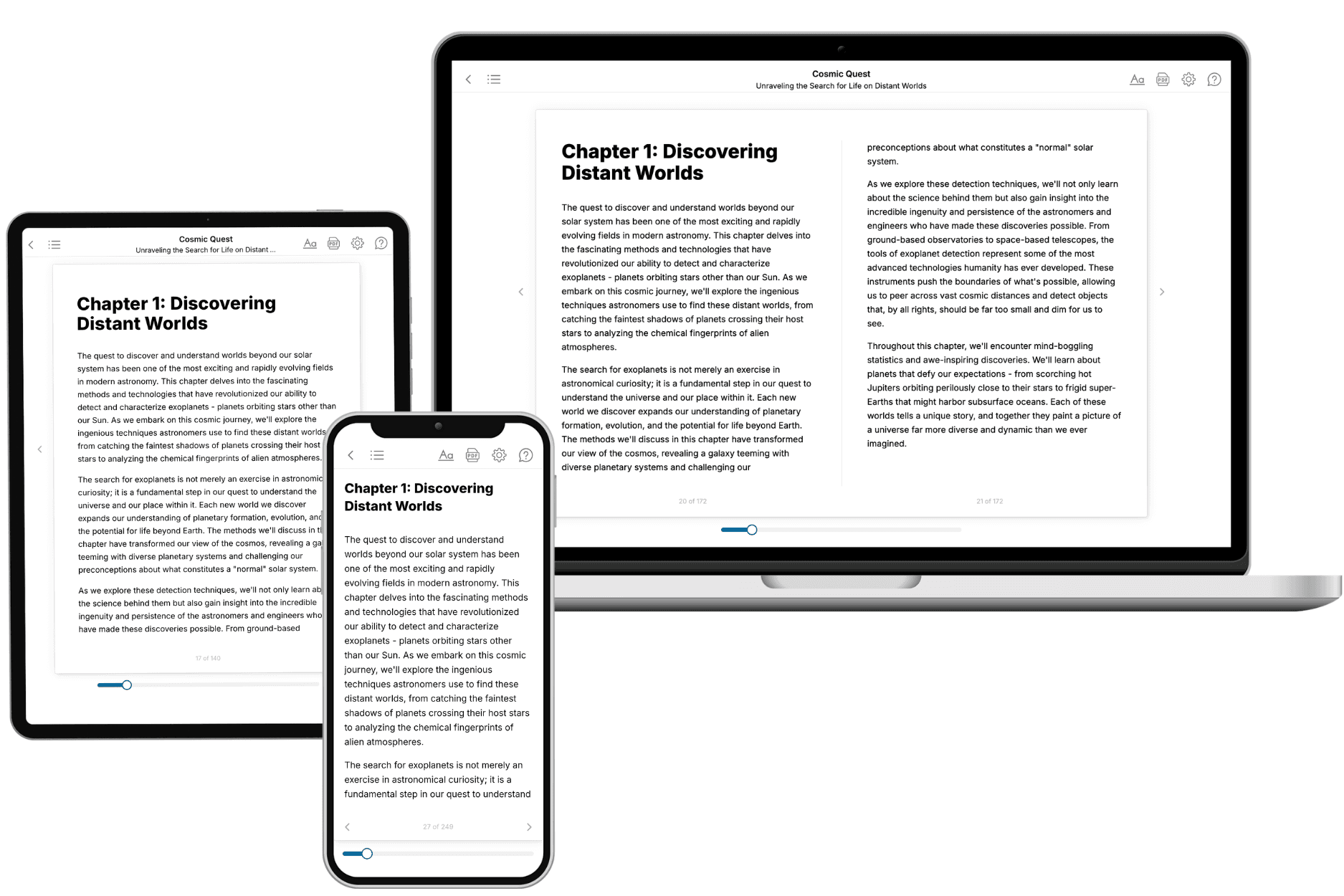
TailoredRead creates complete, full-length nonfiction ebooks, written specifically for you. Tell us what you want to learn and why, and TailoredRead writes you a complete ebook on it, with charts, tables, and diagrams throughout. Read it online, on Kindle, or on any e-reader, or download it as a PDF or EPUB. Every book is written fresh the day you order it.
- How is the book tailored to me?
Before anything is written, you answer a few short questions about your goals, your background, and the topics you care about. Your book is then planned around your answers: written at your level, focused on your goals, and covering the topics you chose, instead of the one-size-fits-all book a store sells everyone.
- Will it read like generic AI content?
No. Your book isn't a chat transcript: it's planned chapter by chapter before a single word is written, told in a clear book voice, and explains ideas visually with charts, tables, and diagrams. After writing, every book goes through an editorial pass that polishes chapters so the book reads consistent from start to finish. Judge for yourself: browse thousands of sample books on our Explore Books page.
- How accurate is the content?
Our AI first checks whether your subject needs live research. Niche and fast-moving subjects are researched before writing, and the book plan and chapters are grounded in what it finds. After writing, every book goes through a quality pass that checks its facts and consistency, and researched books list their sources in a Notes section at the back.
- How long is the book?
You choose the length: Comprehensive (250-300 pages), Detailed (150-200 pages), Essential (70-100 pages), or Short (30-50 pages).
- Does the book include visuals?
Yes. Every book includes visual elements such as timelines, checklists, step-by-step guides, decision trees, comparison tables, and matrices, and many include bar charts. A typical book includes dozens of these visual elements.
- Can I read it on Kindle? What formats can I download?
Yes. Every book can be read in our online reader or downloaded as a PDF or EPUB. The EPUB can be opened with Kindle, Apple Books, Kobo, and any e-reader. The Commercial and Author licenses also include an editable Word (DOCX) and Markdown download.
- How much does it cost?
About the price of a regular ebook. The exact price depends on your book's length and complexity, from $2 for the shortest books to $35 for the most comprehensive, and it's shown when you review your book, before you commit to anything. Each book is a one-time purchase, yours to keep, no subscription. Licenses that let you share, teach, or publish your book range from $35.99 to $49.99.
- Can I preview the book before purchasing?
Before you pay, you'll see what your book will cover: the title, a detailed description, the estimated length, and the complete chapter-by-chapter table of contents, so you know what you're getting before you decide. The full text itself is written after you purchase.
- How long does it take to create a book?
About 10 minutes. You can start reading the opening chapters while the rest is still being written.