The Velvet Revolution
How Czechoslovakia Peacefully Overthrew Communism and Changed Europe
Discover how a nation of 15 million people peacefully dismantled communist rule in just 10 days without firing a shot.
176 pages8 chaptersDec 20, 2025European History
About this book
The Velvet Revolution stands as one of history's most remarkable examples of nonviolent resistance, proving that moral courage and strategic organizing can topple even the most entrenched authoritarian systems. This book traces the revolution's roots in decades of cultural suppression and economic decline, introduces the visionary leaders who guided the movement, and reveals the specific tactics and conditions that made peaceful transformation possible. You'll explore how intellectuals, artists, and ordinary citizens built networks of resistance, how international events created a critical window of opportunity, and how the revolution's success reshaped not just Czechoslovakia but the entire political landscape of Europe. Whether you're studying revolutionary movements, seeking inspiration from historical examples of nonviolent change, or simply curious about one of the 20th century's most pivotal moments, this book provides essential context and compelling insights into how ordinary people can achieve extraordinary political transformation.
Table of contents
- IntroductionWhy the Velvet Revolution Matters Today, What You'll Learn in This Book, How to Use This BookRead below
- Chapter 1: Czechoslovakia Under Communist RuleThe Soviet Takeover and Early Communist Years, The Prague Spring and Soviet Invasion of 1968, Normalization: Two Decades of Stagnation
- Chapter 2: Seeds of ResistanceCharter 77 and the Birth of Organized Dissent, Underground Culture and Intellectual Resistance, Building Civil Society Networks
- Chapter 3: The Visionary LeadersVáclav Havel: Playwright, Dissident, Moral Authority, Other Key Figures and Coalition Builders, The Philosophy of Nonviolent Leadership
- Chapter 4: International Context and OpportunityGorbachev's Reforms and Soviet Weakness, The Fall of the Berlin Wall and Regional Momentum, How Global Events Created a Window of Opportunity
- Chapter 5: The Ten Days That Changed EverythingNovember 17: The Spark, Mass Mobilization and the Candle Demonstrations, The Final Days: From Protest to Power Transfer
- Chapter 6: Strategies of Nonviolent ResistanceCore Tactics: Strikes, Demonstrations, and Symbolic Action, Communication and Information Networks, Building Broad Coalitions Across Social Groups
- Chapter 7: The Role of Culture and IntellectualsArtists and Musicians as Agents of Change, Theater and Literature as Political Resistance, Why Cultural Resistance Proved Decisive
- Chapter 8: From Revolution to Democratic TransitionBuilding Democratic Institutions, Lustration and Dealing with the Communist Past, Challenges in the Transition Period
- ConclusionLessons from the Velvet Revolution, The Revolution's Legacy and Ongoing Impact
- Further Reading and Resources
Introduction
On November 17, 1989, a peaceful student demonstration in Prague was brutally suppressed by riot police. Within ten days, the communist government that had ruled Czechoslovakia for over four decades collapsed without firing a single shot in return. This extraordinary sequence of events became known as the Velvet Revolution, named for its remarkably smooth and nonviolent character. What made this transformation possible? How did a nation living under authoritarian rule for two generations suddenly find the courage and coordination to demand freedom? These questions matter not just for understanding history, but for grasping how political change happens in our own time.
The Velvet Revolution stands as one of the most compelling examples of successful nonviolent resistance in modern history. Unlike many revolutions that descend into violence, chaos, or simply replace one authoritarian system with another, Czechoslovakia's transition demonstrated that peaceful mass mobilization could achieve genuine democratic transformation. The revolution succeeded because it combined moral clarity with strategic thinking, united diverse social groups around shared values, and seized a critical moment when international conditions aligned with domestic readiness. Understanding these elements provides insights that extend far beyond one country's experience in 1989.
This book examines the Velvet Revolution not as an isolated miracle, but as the culmination of decades of cultural resistance, intellectual courage, and careful organizing. You'll discover how dissidents built networks of opposition under constant surveillance, how artists and writers challenged communist ideology through their work, and how ordinary citizens found ways to maintain dignity and truth in a system built on lies. The revolution's success depended on groundwork laid years before the dramatic events of November 1989, and understanding this longer arc reveals patterns applicable to other contexts where people seek to challenge entrenched power.
The story of the Velvet Revolution also illuminates the crucial role of international context in enabling domestic change. Mikhail Gorbachev's reforms in the Soviet Union, the fall of the Berlin Wall, and the broader collapse of communist regimes across Eastern Europe created a window of opportunity that Czech and Slovak activists recognized and exploited. Yet international conditions alone cannot explain the revolution's success. Other countries in the region experienced violent transitions or incomplete democratization. Czechoslovakia's particular path depended on specific leaders, strategies, and social conditions that this book will explore in detail.
Why the Velvet Revolution Matters Today
The Velvet Revolution offers lessons that remain urgently relevant more than three decades after the events themselves. In an era when authoritarian governments have gained strength in many parts of the world, understanding how nonviolent resistance can succeed against entrenched power provides both practical guidance and moral inspiration. The revolution demonstrated that even seemingly invincible regimes contain vulnerabilities, that civil society can gradually erode authoritarian control, and that strategic nonviolence can prove more effective than armed rebellion. These insights apply not just to overthrowing dictatorships, but to any situation where citizens seek to challenge unjust systems.
The revolution's emphasis on moral leadership and truth-telling speaks directly to contemporary debates about politics and public discourse. Václav Havel, the playwright and dissident who became Czechoslovakia's first democratic president, articulated a vision of politics grounded in human dignity, personal responsibility, and what he called living in truth.
This approach rejected both the cynicism of communist ideology and the empty pragmatism that often characterizes democratic politics. Havel's insistence that moral clarity and political effectiveness need not conflict offers a powerful alternative to the false choice between idealism and realism that dominates much contemporary political thinking.
The Velvet Revolution also provides a case study in successful coalition-building across diverse social groups. The revolution united students and workers, Catholics and secular intellectuals, Czechs and Slovaks, urban professionals and rural communities around shared democratic values rather than narrow interests. This broad-based mobilization proved essential to the revolution's success and its peaceful character. In contemporary societies increasingly fragmented by identity politics and polarization, the revolution's example of finding common ground without erasing differences offers valuable lessons for building effective movements for change.
Understanding the revolution's institutional legacy matters for anyone interested in democratic transitions and consolidation. The choices Czechoslovakia made in the immediate aftermath of the revolution shaped its democratic trajectory for decades to come. Questions about how to deal with former communist officials, how to design new democratic institutions, and how to balance justice with reconciliation remain relevant wherever societies attempt to move from authoritarian to democratic governance. The Czech and Slovak experience provides both successes to emulate and mistakes to avoid.
The revolution's cultural dimension offers insights often overlooked in conventional political analysis. Artists, musicians, and writers played crucial roles in challenging communist ideology and creating spaces for independent thought. Underground concerts, samizdat literature, and experimental theater provided not just entertainment but alternative visions of society and human possibility. This cultural resistance gradually eroded the regime's legitimacy and created networks that proved essential when the moment for political action arrived. Recognizing culture's political power remains important in any context where dominant narratives need challenging.
The Velvet Revolution matters today because it demonstrates that history remains open, that ordinary people can shape political outcomes, and that nonviolent resistance can achieve what violence cannot. In a time when many feel powerless before large-scale political and economic forces, the revolution reminds us that determined citizens acting collectively can transform seemingly immovable systems. This lesson applies whether you're concerned about democratic backsliding in established democracies, authoritarian consolidation in other contexts, or simply seeking to understand how social change happens. The revolution proves that peaceful transformation remains possible even under difficult circumstances.
Finally, the Velvet Revolution matters because it changed not just Czechoslovakia but the entire political landscape of Europe. The revolution contributed to the broader collapse of communist regimes across Eastern Europe, accelerated European integration, and reshaped the continent's political geography. Understanding this single country's experience illuminates larger patterns of political change and international transformation. The revolution's ripple effects continue to shape European politics today, making it essential background for understanding contemporary debates about democracy, nationalism, and European identity.
What You'll Learn in This Book
This book provides a comprehensive examination of the Velvet Revolution, from its deep historical roots through its immediate aftermath and lasting legacy. You'll gain understanding of the specific conditions that made the revolution possible, the strategies that made it successful, and the challenges that emerged during the transition to democracy. The book combines historical narrative with analytical frameworks, offering both a compelling story and practical insights applicable beyond this particular case. Each chapter builds on previous ones to create a complete picture of how peaceful revolutionary change occurs.
The opening chapters establish essential historical context by examining Czechoslovakia under communist rule. You'll learn about the Soviet takeover after World War II, the brief flowering of reform during the Prague Spring of 1968, and the subsequent period of normalization
that brought two decades of stagnation and repression. Understanding this background proves crucial because the revolution didn't emerge from nowhere but represented the culmination of long-term processes. You'll see how the regime's own contradictions and failures created conditions for eventual collapse, even as it maintained apparent stability through most of the 1970s and 1980s.
The book then explores the seeds of resistance that grew during the normalization period. You'll discover how Charter 77, a human rights manifesto signed by intellectuals and activists in 1977, created a focal point for organized dissent despite severe repression. You'll learn about underground cultural movements that maintained spaces for independent thought and expression, and about the gradual building of civil society networks that would prove essential when the moment for mass mobilization arrived. These chapters reveal how resistance develops under authoritarian conditions and how seemingly small acts of defiance accumulate into transformative potential.
A substantial section examines the revolution's key leaders, particularly Václav Havel, whose moral authority and philosophical vision shaped the movement's character. You'll understand Havel's concept of living in truth
and how it provided both a critique of communist ideology and a positive vision for democratic society. The book also introduces other crucial figures who built coalitions, organized protests, and negotiated the transition to democracy. You'll see how effective leadership in nonviolent movements differs from traditional political leadership, emphasizing moral clarity and personal example over conventional power.
The book analyzes the international context that created a window of opportunity for the revolution. You'll learn how Gorbachev's reforms in the Soviet Union undermined the ideological and military foundations of communist rule in Eastern Europe, how the fall of the Berlin Wall created momentum for change across the region, and how global conditions aligned with domestic readiness in Czechoslovakia. These chapters demonstrate that successful revolutions require both internal preparation and external opportunity, and that recognizing and seizing favorable moments proves as important as long-term organizing.
The heart of the book provides a detailed account of the ten days in November 1989 when the revolution unfolded. You'll follow events day by day, from the initial student demonstration through mass mobilizations involving hundreds of thousands of people, to the final negotiations that transferred power from the communist government to democratic leaders. This narrative reveals the revolution's dramatic arc while highlighting the strategic decisions, tactical innovations, and moments of uncertainty that shaped outcomes. You'll see how peaceful mass mobilization can overwhelm authoritarian control when conditions align properly.
Subsequent chapters examine the specific strategies and tactics that made the revolution successful. You'll learn about the role of strikes, demonstrations, and symbolic actions in building momentum and maintaining nonviolent discipline. You'll discover how activists used communication networks to coordinate action and spread information despite government control of official media. You'll understand how coalition-building across different social groups created the broad base necessary for success. These chapters provide practical insights into how nonviolent resistance works, applicable to other contexts where people seek to challenge entrenched power.
The book explores the crucial role of culture and intellectuals in the revolution's success. You'll see how artists, musicians, and writers challenged communist ideology and created alternative visions of society through their work. You'll learn about specific cultural events and movements that contributed to the regime's erosion, from underground rock concerts to experimental theater to samizdat literature. These chapters demonstrate that political change requires not just organizational capacity but also imaginative vision and cultural transformation that make new possibilities conceivable.
The final chapters examine the transition from revolution to democratic governance. You'll learn about the challenges of building democratic institutions, the debates over how to deal with former communist officials through lustration processes, and the difficulties of economic transformation from central planning to market economy. You'll understand both the successes and failures of the transition period, including the eventual peaceful separation of Czechoslovakia into the Czech Republic and Slovakia in 1993. These chapters provide essential context for understanding the revolution's long-term impact and the complexities of democratic consolidation.
Throughout the book, you'll encounter specific examples, case studies, and analytical frameworks that illuminate broader patterns of political change. The book draws on historical research, participant accounts, and scholarly analysis to provide a comprehensive understanding of the revolution. You'll gain not just knowledge of this particular historical event, but insights applicable to understanding how social movements develop, how nonviolent resistance succeeds, and how democratic transitions unfold. The book aims to make you a more informed observer of political change wherever it occurs.
How to Use This Book
This book is designed to be read in sequence, with each chapter building on previous ones to create a comprehensive understanding of the Velvet Revolution. However, the structure also allows you to focus on particular aspects that interest you most. If you're primarily interested in the revolution's strategic and tactical dimensions, you might concentrate on the chapters examining nonviolent resistance methods and coalition-building. If you're more drawn to the cultural and intellectual dimensions, the chapters on underground culture and the role of artists and writers will prove especially valuable. The book's organization allows both linear reading and selective focus depending on your interests and needs.
Each chapter begins with clear context and ends with connections to broader themes, making it possible to understand individual chapters even if you haven't read everything that came before. However, the book's full value emerges from seeing how different elements connect. The revolution's success depended on the interaction of long-term cultural resistance, strategic leadership, favorable international conditions, and effective tactical choices. Understanding these connections requires engaging with the complete narrative rather than isolated pieces. Consider reading the book through once for overall understanding, then returning to specific chapters for deeper engagement with particular topics.
The book includes numerous specific examples, case studies, and historical details that bring abstract concepts to life. Pay attention to these concrete instances, as they often reveal patterns and principles applicable beyond the specific context. When you encounter an example of how dissidents communicated under surveillance, or how activists maintained nonviolent discipline during confrontations with police, consider how similar challenges might be addressed in other contexts. The book aims to provide not just historical knowledge but practical wisdom applicable to contemporary situations.
As you read, consider keeping notes on themes and patterns that emerge across different chapters. You might track how particular strategies evolved over time, how different social groups contributed to the revolution's success, or how leaders balanced competing demands and constituencies. Creating your own analytical framework as you read will deepen understanding and help you apply insights to other contexts. The book provides interpretation and analysis, but your own engagement with the material will determine how much you ultimately gain from it.
The book assumes you have intermediate knowledge of modern history and political movements, but it doesn't require specialized expertise. Key terms and concepts are explained when introduced, and the narrative provides sufficient context to understand events even if you're not familiar with detailed Czechoslovak history. If you encounter unfamiliar references or want deeper background on particular topics, the further reading section at the book's end provides resources for additional exploration. The book aims to be accessible while maintaining analytical rigor and historical accuracy.
Consider reading this book in dialogue with current events and contemporary political challenges. The Velvet Revolution's lessons remain relevant precisely because the fundamental dynamics of political power, resistance, and change persist across different contexts and time periods. As you read about how Czech and Slovak activists built coalitions, communicated under repression, or maintained moral clarity amid political complexity, think about how similar challenges manifest today. The book's value lies not just in understanding the past but in illuminating the present and informing future action.
Finally, approach this book with both critical engagement and openness to inspiration. The Velvet Revolution succeeded remarkably, but it wasn't perfect, and the transition to democracy faced significant challenges and setbacks. The book presents both successes and failures, both inspiring moments and difficult compromises. Learning from history requires honest assessment of what worked and what didn't, what proved replicable and what depended on unique circumstances. At the same time, the revolution's core achievement—peaceful democratic transformation against long odds—deserves recognition and can provide genuine inspiration for those working toward justice and freedom in their own contexts.
This is the end of the free sample. The full book has 8 chapters.
Want this book written for you?
Tell us your goals and background, and get your own version of this book, tailored by AI to you.


Benefits of AI-tailored books
- Read one book, not ten:
- all the European History knowledge you need, gathered into a single book.
- Save days of learning:
- tell us your goals, choose your topics, and the whole book is built around them.
- Learn effortlessly:
- European History book written for your specific background and expertise.
- Understand at a glance:
- includes charts, tables, timelines, checklists, decision trees, and more.
- Stay current:
- written the day you order it, not years ago.
- Trust what you read:
- every book is checked for accuracy, with real research when your subject needs it.
Create your unique book in 3 steps
- 1. Select your focus
Select the focus of your European History book and share your background
- 2. Personalize your book
Specify your goals and choose sub-topics to include
- 3. Get your tailored book
Your book is ready in 10 minutes. Read it online, download as EPUB or PDF, or send to Kindle.


Frequently asked questions
- What is TailoredRead?
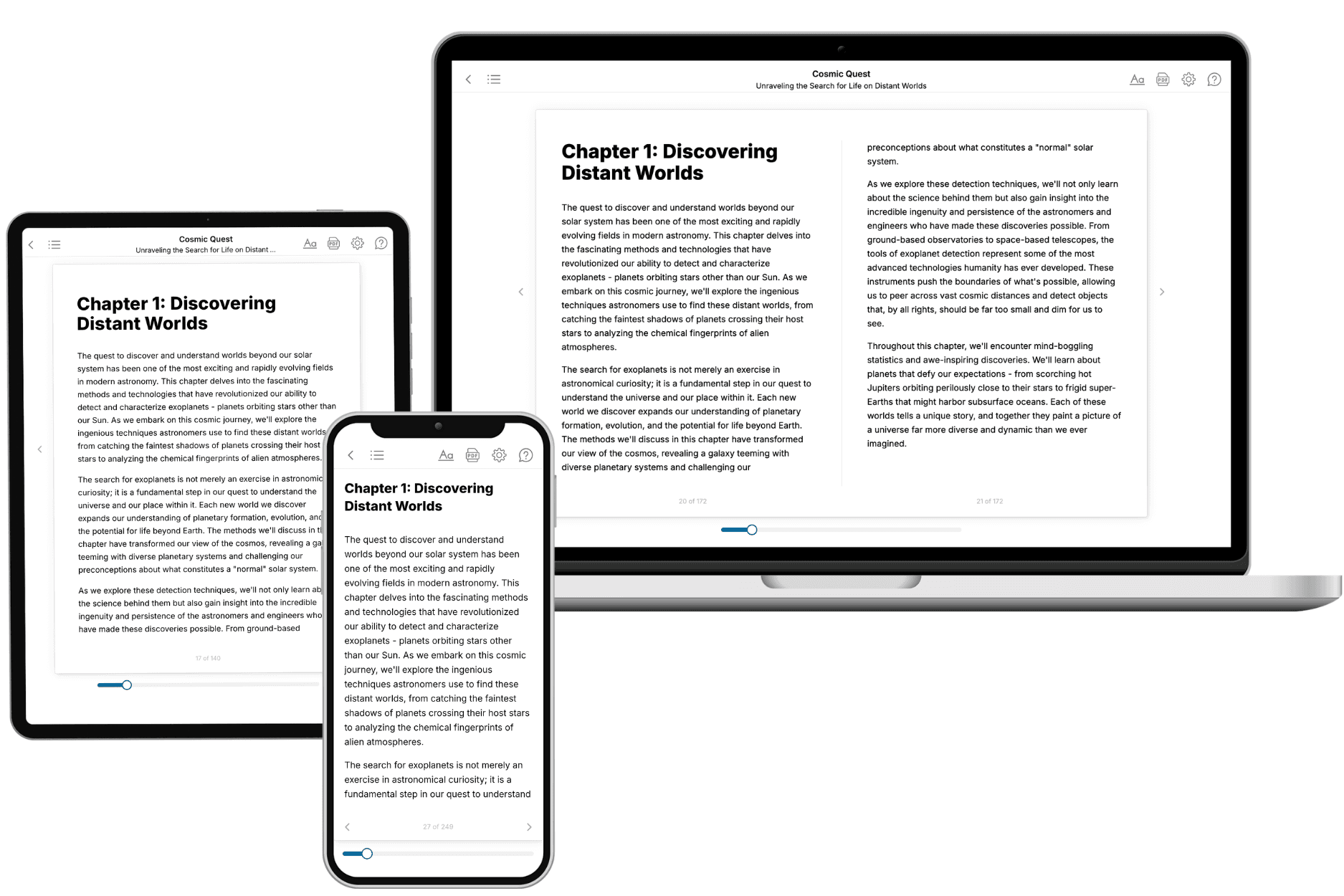
TailoredRead creates complete, full-length nonfiction ebooks, written specifically for you. Tell us what you want to learn and why, and TailoredRead writes you a complete ebook on it, with charts, tables, and diagrams throughout. Read it online, on Kindle, or on any e-reader, or download it as a PDF or EPUB. Every book is written fresh the day you order it.
- How is the book tailored to me?
Before anything is written, you answer a few short questions about your goals, your background, and the topics you care about. Your book is then planned around your answers: written at your level, focused on your goals, and covering the topics you chose, instead of the one-size-fits-all book a store sells everyone.
- Will it read like generic AI content?
No. Your book isn't a chat transcript: it's planned chapter by chapter before a single word is written, told in a clear book voice, and explains ideas visually with charts, tables, and diagrams. After writing, every book goes through an editorial pass that polishes chapters so the book reads consistent from start to finish. Judge for yourself: browse thousands of sample books on our Explore Books page.
- How accurate is the content?
Our AI first checks whether your subject needs live research. Niche and fast-moving subjects are researched before writing, and the book plan and chapters are grounded in what it finds. After writing, every book goes through a quality pass that checks its facts and consistency, and researched books list their sources in a Notes section at the back.
- How long is the book?
You choose the length: Comprehensive (250-300 pages), Detailed (150-200 pages), Essential (70-100 pages), or Short (30-50 pages).
- Does the book include visuals?
Yes. Every book includes charts, tables, and diagrams: timelines, checklists, step-by-step guides, decision trees, comparison tables, matrices, and bar charts. A typical book includes dozens of these visual elements.
- Can I read it on Kindle? What formats can I download?
Yes. Every book can be read in our online reader or downloaded as a PDF or EPUB. The EPUB can be opened with Kindle, Apple Books, Kobo, and any e-reader. The Commercial and Author licenses also include an editable Word (DOCX) and Markdown download.
- How much does it cost?
About the price of a regular ebook. The exact price depends on your book's length and complexity, from $2 for the shortest books to $35 for the most comprehensive, and it's shown when you review your book, before you commit to anything. Each book is a one-time purchase, yours to keep, no subscription. Licenses that let you share, teach, or publish your book range from $35.99 to $49.99.
- Can I preview the book before purchasing?
Before you pay, you'll see what your book will cover: the title, a detailed description, the estimated length, and the complete chapter-by-chapter table of contents, so you know what you're getting before you decide. The full text itself is written after you purchase.
- How long does it take to create a book?
About 10 minutes. You can start reading the opening chapters while the rest is still being written.