The Art of Understanding
A Practical Guide to Philosophy of Art and Aesthetic Experience
Deepen your appreciation and understanding of art by exploring the philosophical questions that have shaped how we think about creativity, beauty, and meaning.
207 pages10 chaptersAug 19, 2026Philosophy of Art
About this book
This guide takes you beyond surface-level appreciation to examine why art matters, how it communicates, and what makes something worthy of aesthetic consideration. You'll discover how philosophers from Plato to contemporary thinkers have grappled with defining art, evaluating aesthetic experience, and understanding the relationship between artist, artwork, and audience. Through clear explanations and practical examples, you'll learn to think critically about art's role in society, develop your own aesthetic framework, and engage more meaningfully with creative works. Whether you're exploring philosophy for the first time or expanding your existing knowledge, this book provides the conceptual tools needed to navigate art's philosophical landscape with confidence and insight.
Table of contents
- IntroductionWhy Philosophy of Art Matters, What You'll Learn in This Book, How to Use This GuideRead below
- Chapter 1: Foundations of AestheticsDefining Aesthetics and Aesthetic Experience, The Concept of Beauty Through History, Aesthetic Judgment and Personal Taste
- Chapter 2: What Is Art?The Problem of Defining Art, Classical Theories: Imitation and Form, Modern Approaches to Art Definition, Institutional Theory and the Art World
- Chapter 3: Ancient and Medieval PerspectivesPlato's Theory of Forms and Art as Imitation, Aristotle's Poetics and the Concept of Catharsis, Medieval Aesthetics and Divine Beauty
- Chapter 4: Enlightenment and Modern AestheticsKant's Revolutionary Theory of Aesthetic Judgment, Hegel's Philosophy of Art and Historical Development, Nineteenth-Century Aesthetics and Artistic Movements
- Chapter 5: Expression and Emotion in ArtExpressionism: Art as Emotional Communication, How Emotion Creates Meaning in Artworks, The Role of Artist Intention and Expression
- Chapter 6: Form and FormalismThe Formalist Approach to Art Analysis, Understanding Aesthetic Properties and Qualities, The Relationship Between Form and Content
- Chapter 7: Representation and MeaningHow Art Represents Reality and Ideas, Symbolism, Metaphor, and Interpretation, The Role of Context in Creating Meaning
- Chapter 8: Contemporary Perspectives on ArtPostmodern Challenges to Traditional Aesthetics, Identity, Politics, and Artistic Representation, Digital Art and New Media Aesthetics
- Chapter 9: The Nature of Aesthetic ExperienceWhat Makes an Experience Aesthetic?, Contemplation, Engagement, and Appreciation, Universal Standards Versus Subjective Response
- Chapter 10: Art as a Form of KnowledgeCan Art Convey Truth and Knowledge?, Aesthetic Understanding and Cognitive Value, The Ethical Dimensions of Artistic Knowledge
- ConclusionIntegrating Philosophical Perspectives, Developing Your Own Aesthetic Practice
- Further Reading and Resources
Introduction
A museum guard once watched a visitor stand in front of a canvas of solid red for nearly twenty minutes, arms crossed, clearly working through something. Nearby, another visitor glanced at the same painting for three seconds and walked away shaking her head. Neither reaction was wrong. What separated them was not taste alone but a set of assumptions, mostly unexamined, about what a painting is supposed to do. That gap between the two visitors is the starting point for this book. It is not primarily about paintings, or music, or novels, though all three appear throughout. It is about the questions underneath the experience of encountering them.
Philosophy of art asks what happens in that twenty-minute standoff between a person and a red canvas. Is the viewer projecting meaning onto an empty object, or discovering something the artist placed there deliberately? Does the answer depend on the artist's intention, on the formal properties of the paint and canvas, or on the institutions that decided the work belonged in a museum in the first place? These are not idle puzzles for specialists. They shape how entire cultures fund museums, teach children to draw, judge what counts as vandalism versus street art, and decide which stories get told in film and literature.
This book treats those questions as answerable, at least partially, through careful argument rather than mere personal preference. Philosophers have spent over two thousand years building frameworks for thinking about art, from Plato's suspicion of poetry to Kant's account of judgment to contemporary debates about digital media. Each framework captures something real about how art works, while missing or distorting other parts of the picture. Rather than asking you to pick a winner, this guide walks through the major traditions so you can see what each one notices and what each one overlooks.
The payoff is practical as much as intellectual. Understanding these frameworks changes how you look at a film, read a poem, or stand in front of a sculpture. It gives you vocabulary for disagreements that would otherwise dead-end in I just don't like it.
It also gives you tools to notice when claims about art (that something is objectively
beautiful, or that anything can be art
) are doing more philosophical work than they first appear to. The following three sections explain why this matters, what specifically the book covers, and how to get the most out of reading it.
Why Philosophy of Art Matters
Art shapes decisions long before anyone consciously thinks about aesthetics. A city council deciding whether graffiti counts as art or vandalism is making a philosophical judgment, whether it recognizes that or not. A streaming platform deciding which films to promote is implicitly endorsing a theory of what makes a work worth watching. A school curriculum that includes some novels and excludes others is taking a position on what art is for. These decisions happen constantly, and they rest on assumptions that philosophy of art makes explicit and open to scrutiny.
Consider a concrete case. In 1917, an artist submitted a porcelain urinal, titled Fountain and signed with a pseudonym, to an exhibition that claimed to accept any work from any artist who paid the fee. The submission was rejected, then became one of the most discussed objects in the history of Western art. The controversy was never about craftsmanship. Nobody argued the urinal was well-carved. The dispute was entirely philosophical: does selecting and presenting an object transform it into art, or does art require the artist to make something by hand[1]? Without philosophy of art, that dispute has no vocabulary. With it, the dispute becomes a productive argument about the nature of artistic authorship.
The same stakes appear outside galleries. Advertising borrows techniques from fine art to shape emotional response, and understanding how form generates feeling helps you recognize when you are being moved for commercial rather than expressive reasons. Political movements have long used art, from murals to protest songs, to build solidarity or spread propaganda, and knowing how symbolism and context generate meaning helps you evaluate what a piece of political art is actually claiming rather than just how it makes you feel. None of this requires becoming a professional critic. It requires the same kind of clear thinking this book aims to build.
There is also a personal dimension that matters beyond public debates. Most people carry aesthetic reactions they have never examined: a preference for representational painting over abstraction, a suspicion of contemporary art, a conviction that classical music is superior to popular music. These reactions often trace back to childhood exposure, social class, or educational background rather than reasoned conviction. Philosophy of art does not tell you which reactions to keep. It gives you a way to ask where they came from and whether they still hold up once examined, which is a more honest relationship to your own taste than simply defending it.
Finally, art remains one of the few domains where humans routinely attempt to communicate things that resist plain language: grief that has no adequate sentence, joy too large for a single word, the texture of a historical moment as it was lived. A philosophy that takes art seriously as a vehicle for this kind of meaning treats creative work as intellectually significant rather than as decoration or entertainment. That reframing, from art as a luxury to art as a distinctive form of human meaning-making, runs through every chapter that follows and gives the more abstract arguments a reason to matter beyond the seminar room.
What You'll Learn in This Book
The book moves roughly in two directions at once: historically, from ancient thinkers to contemporary debates, and thematically, from the question of what art is to the question of what experiencing art does to a person. The historical arc begins with the origins of systematic thinking about art in ancient Greece and moves through medieval, Enlightenment, and modern frameworks before arriving at postmodern and digital-age debates. This arc matters because later philosophers rarely start from nothing. They are almost always responding to, correcting, or rejecting an earlier position, so understanding the sequence makes each later theory sharper and less arbitrary.
Several chapters focus on definitional theories of art, tracing how thinkers have tried to answer what might seem like a simple question: what makes something art rather than a mere object? Some theories look at imitation, some at form, some at the surrounding institutions that confer art status on an object. You will see why no single theory has settled the matter permanently, and why that lack of settlement is itself philosophically interesting rather than a failure of the field. A definition that fits Renaissance portraiture may fail completely when applied to a Duchamp readymade or a piece of generative digital art, which is exactly the kind of tension the book works through.
Other chapters take up the classical roots of the discipline in more depth, examining how Plato's suspicion of artistic imitation and Aristotle's defense of tragedy set up a disagreement that echoes through every later debate about whether art should be trusted or regulated. From there the book turns to the Enlightenment, where a shift occurred from asking what art imitates to asking what happens inside a person's mind when judging something beautiful. This shift, associated above all with a rethinking of aesthetic judgment as a distinct mental faculty, changed the entire vocabulary available for discussing art and continues to shape contemporary debates about taste and objectivity.
A separate cluster of chapters addresses how meaning gets into artworks in the first place, covering expressive theories that treat art as emotional communication, formalist theories that locate value in internal structure, and representational theories that examine how symbols and context generate significance. These are not simply competing schools to memorize. They are different lenses that can be applied to the same object with different results. Looking at a single painting through an expressive lens versus a formalist lens will often produce genuinely different, sometimes contradictory, accounts of why the work succeeds or fails, and learning to switch between lenses deliberately is one of the practical skills this book aims to build.
The later chapters turn toward contemporary territory: how postmodern thought destabilized older certainties about beauty and definition, how identity and politics have reshaped what gets exhibited and celebrated, and how digital tools have created entirely new categories of artistic object that older theories were never built to handle. The book closes by asking whether art constitutes genuine knowledge, distinct from but comparable to scientific or historical knowledge, and what ethical weight that knowledge might carry. By the final chapter, the aim is not to hand you a single settled theory but a working set of tools flexible enough to handle a Baroque altarpiece, a punk album, and a generative AI image with equal seriousness.
How to Use This Guide
The chapters are ordered to build on each other, so reading them in sequence the first time through will make the later material easier to follow. The definitional debates in the early chapters set up vocabulary, such as the tension between essentialist and institutional accounts of art, that reappears without re-explanation in later discussions of postmodernism and digital media. Someone who skips ahead to the chapter on contemporary perspectives without reading the earlier material on classical theories may find references to imitation or form that feel unanchored. A first pass in order is the more efficient route, even for readers already familiar with some of the history.
That said, the book is also built to function as a reference after that first read. Each chapter is reasonably self-contained around its own cluster of ideas, so returning to the chapter on formalism before visiting a gallery, or rereading the material on artist intention before a book club discussion, works perfectly well without rereading everything from the start. Treat the table of contents as a map you can return to rather than a sequence you owe loyalty to on every subsequent visit. The goal is a durable set of concepts you can pull from years later, not a single linear reading experience meant to be finished once and shelved.
Approach the historical figures in this book, particularly the ancient and Enlightenment thinkers, as conversation partners rather than authorities to be accepted wholesale. Plato's arguments about the dangers of poetic imitation were shaped by concerns specific to Athenian democracy and education, and applying them uncritically to twenty-first century film or video games requires real translation work. Part of what philosophy of art teaches is how to extract the durable structure of an old argument from its historically specific packaging. When a chapter presents a historical theory, ask what problem it was solving in its own moment, then ask separately whether that same problem, or a version of it, still exists today.
Try applying each theory to a specific artwork you already know well as you read, rather than only following the abstract version of the argument. If a chapter introduces formalist analysis, pause and apply it to a song, film, or painting sitting in your own memory: what happens when you focus only on its structure, its rhythm, its composition, and set aside what it is supposedly about? If a later chapter introduces expressive theory, return to that same work and ask what changes when you instead focus on the feeling the artist seems to be communicating. This kind of repeated testing against real examples is what turns abstract philosophy into a working skill rather than a set of facts to recall.
Expect genuine disagreement among the philosophers covered here, and resist the urge to resolve every tension into a tidy synthesis before you are ready. Kant and Hegel, both central to modern aesthetics, disagreed sharply about whether beauty is timeless or historically developing, and that disagreement is not a flaw in the material but a real fault line in the discipline that remains active today. The concluding chapters return to the question of how to hold competing frameworks together without forcing false agreement between them. Until then, sit with the tension each theory creates rather than reaching for premature closure, since that discomfort is often where the clearest thinking about art actually begins.
Notes
Introduction
- 1. Marcel Duchamp, "The Richard Mutt Case," The Blind Man, 1917
This is the end of the free sample. The full book has 10 chapters.
Want this book written for you?
Tell us your goals and background, and get your own version of this book, tailored by AI to you.


Benefits of AI-tailored books
- Read one book, not ten:
- all the Philosophy of Art knowledge you need, gathered into a single book.
- Save days of learning:
- tell us your goals, choose your topics, and the whole book is built around them.
- Learn effortlessly:
- Philosophy of Art book written for your specific background and expertise.
- Understand at a glance:
- includes charts, tables, timelines, checklists, decision trees, and more.
- Stay current:
- written the day you order it, not years ago.
- Trust what you read:
- every book is checked for accuracy, with real research when your subject needs it.
Create your unique book in 3 steps
- 1. Select your focus
Select the focus of your Philosophy of Art book and share your background
- 2. Personalize your book
Specify your goals and choose sub-topics to include
- 3. Get your tailored book
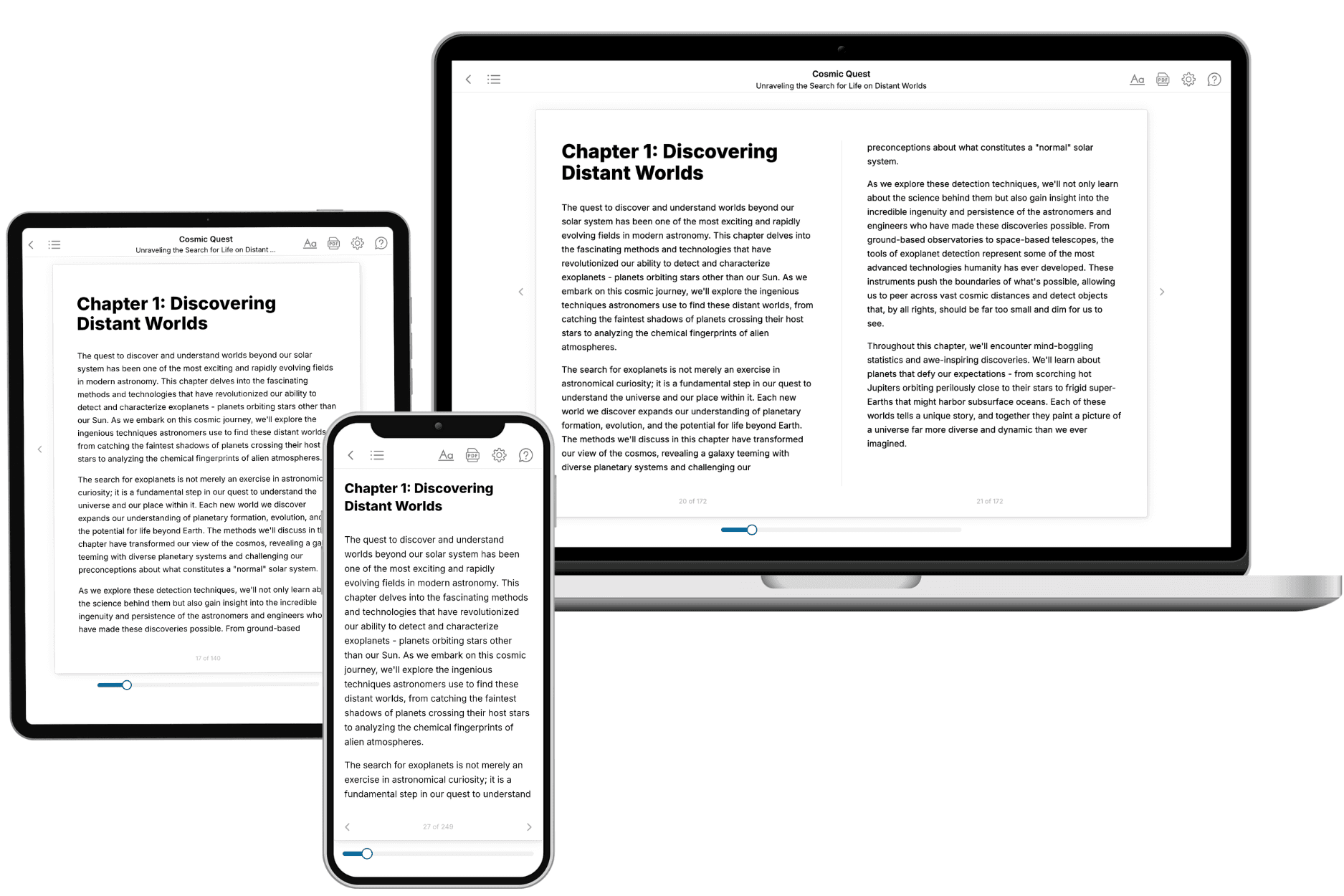
Your book is ready in 10 minutes. Read it online, download as EPUB or PDF, or send to Kindle.
Frequently asked questions
- What is TailoredRead?
TailoredRead creates complete, full-length nonfiction ebooks, written specifically for you. Tell us what you want to learn and why, and TailoredRead writes you a complete ebook on it, with charts, tables, and diagrams throughout. Read it online, on Kindle, or on any e-reader, or download it as a PDF or EPUB. Every book is written fresh the day you order it.
- How is the book tailored to me?
Before anything is written, you answer a few short questions about your goals, your background, and the topics you care about. Your book is then planned around your answers: written at your level, focused on your goals, and covering the topics you chose, instead of the one-size-fits-all book a store sells everyone.
- Will it read like generic AI content?
No. Your book isn't a chat transcript: it's planned chapter by chapter before a single word is written, told in a clear book voice, and explains ideas visually with charts, tables, and diagrams. After writing, every book goes through an editorial pass that polishes chapters so the book reads consistent from start to finish. Judge for yourself: browse thousands of sample books on our Explore Books page.
- How accurate is the content?
Our AI first checks whether your subject needs live research. Niche and fast-moving subjects are researched before writing, and the book plan and chapters are grounded in what it finds. After writing, every book goes through a quality pass that checks its facts and consistency, and researched books list their sources in a Notes section at the back.
- How long is the book?
You choose the length: Comprehensive (250-300 pages), Detailed (150-200 pages), Essential (70-100 pages), or Short (30-50 pages).
- Does the book include visuals?
Yes. Every book includes charts, tables, and diagrams: timelines, checklists, step-by-step guides, decision trees, comparison tables, matrices, and bar charts. A typical book includes dozens of these visual elements.
- Can I read it on Kindle? What formats can I download?
Yes. Every book can be read in our online reader or downloaded as a PDF or EPUB. The EPUB can be opened with Kindle, Apple Books, Kobo, and any e-reader. The Commercial and Author licenses also include an editable Word (DOCX) and Markdown download.
- How much does it cost?
About the price of a regular ebook. The exact price depends on your book's length and complexity, from $2 for the shortest books to $35 for the most comprehensive, and it's shown when you review your book, before you commit to anything. Each book is a one-time purchase, yours to keep, no subscription. Licenses that let you share, teach, or publish your book range from $35.99 to $49.99.
- Can I preview the book before purchasing?
Before you pay, you'll see what your book will cover: the title, a detailed description, the estimated length, and the complete chapter-by-chapter table of contents, so you know what you're getting before you decide. The full text itself is written after you purchase.
- How long does it take to create a book?
About 10 minutes. You can start reading the opening chapters while the rest is still being written.