Behavior Driven Development with Cucumber
Master Test-Driven Development Through Executable Specifications
Imagine your test suite becoming a bridge between your development team and business stakeholders—where everyone speaks the same language about what your software should do.
191 pages9 chaptersJul 15, 2026Test-Driven Development
About this book
With Behavior Driven Development and Cucumber, this becomes reality. This book guides you through implementing BDD practices that transform how you write, maintain, and communicate about tests. You'll learn to craft executable specifications in Gherkin that read like plain English, design step definitions that remain flexible and reusable, and integrate BDD into your existing TDD workflows. Whether you're struggling with brittle tests, communication gaps between teams, or unclear requirements, this practical guide provides concrete strategies and real-world examples. Discover how to leverage Cucumber's power to create tests that serve as living documentation, reduce maintenance costs, and ensure your software truly meets business needs. By the end, you'll have the skills to implement BDD confidently and lead your team toward more collaborative, sustainable testing practices.
Table of contents
- IntroductionWhy BDD Matters in Modern Development, What You'll Learn in This Book, How to Use This Book, Prerequisites and AssumptionsRead below
- Chapter 1: Understanding Behavior Driven DevelopmentThe Core Principles of BDD, How BDD Complements Test-Driven Development, The Business and Technical Benefits of BDD, Adopting the BDD Mindset
- Chapter 2: Introduction to Cucumber and GherkinWhat is Cucumber and Why Use It, Gherkin Syntax and Structure, Setting Up Cucumber in Your Project, Writing Your First Scenario
- Chapter 3: Mastering Gherkin: Writing Effective ScenariosThe Given-When-Then Framework, Designing Clear and Maintainable Scenarios, Using Scenario Outlines and Examples, Avoiding Common Gherkin Mistakes
- Chapter 4: Step Definitions: Bridging Scenarios and CodeUnderstanding Step Definition Fundamentals, Writing Reusable and Maintainable Step Definitions, Regular Expressions and Pattern Matching, Organizing Step Definitions for Scalability
- Chapter 5: Integrating BDD with Test-Driven DevelopmentCombining BDD and TDD in Your Development Cycle, Balancing Unit Tests with BDD Scenarios, Building an Effective Test Pyramid, Running Cucumber Tests in CI/CD Pipelines
- Chapter 6: Advanced Cucumber Features and TechniquesUsing Hooks and Tags for Test Control, Working with Data Tables and Complex Inputs, Reducing Duplication with Background Steps, Advanced Patterns and Best Practices
- Chapter 7: Collaboration and Communication Through BDDEngaging Non-Technical Stakeholders, Using Scenarios as Living Documentation, Establishing Team Practices and Standards, Tools and Techniques for Better Communication
- Chapter 8: Practical Implementation: Real-World ScenariosTesting Web Applications with Cucumber, API Testing with BDD Principles, Handling Database and State Management, Case Studies and Real-World Examples
- Chapter 9: Maintaining and Scaling Your Test SuiteStrategies for Long-Term Test Maintenance, Identifying and Fixing Brittle Tests, Optimizing Test Performance and Execution Speed, Scaling BDD Practices Across Large Teams
- ConclusionKey Takeaways and Next Steps, Your Journey to BDD Mastery
- Appendix: Quick Reference GuideGherkin Syntax Quick Reference, Common Cucumber Commands and Options, Additional Resources and Further Learning
Introduction
Picture this: your product manager walks into a sprint planning meeting with a stack of requirements written in dense business language. Your developers translate those requirements into code. Your QA team writes tests based on their own interpretation of what the software should do. Three months later, a critical bug slips through because everyone had a slightly different understanding of what "a successful checkout" actually means. This scenario plays out in software teams every single day, and it costs companies enormous amounts of time, money, and trust. Behavior Driven Development, or BDD, was created specifically to break this cycle.
BDD is not just another testing methodology. It is a collaborative approach to software development that forces teams to agree on what the software should do before anyone writes a single line of code. At its core, BDD asks a deceptively simple question: what behavior should this system exhibit? By anchoring development around that question, teams produce software that genuinely meets business needs rather than software that technically passes a set of unit tests while missing the point entirely. The difference sounds subtle, but in practice it changes everything about how a team works.
Cucumber is the tool that makes BDD practical and scalable. It provides a structured way to write specifications in plain English using a syntax called Gherkin, and then connects those specifications directly to executable test code. When a Cucumber scenario passes, you know the software behaves exactly as the business described. When it fails, you know precisely which behavior broke. This tight feedback loop between human-readable requirements and running code is what makes Cucumber so powerful, and it is what this book will teach you to harness effectively.
This book is written for developers and QA engineers who already understand the basics of software testing but want to level up their practice. You will not find lengthy explanations of what a unit test is or why testing matters in general. Instead, you will find concrete guidance on how to implement BDD with Cucumber in real projects, how to write Gherkin scenarios that actually communicate clearly, and how to build a test suite that serves as living documentation for your entire team. Every chapter is grounded in practical examples drawn from realistic software development situations.
Why BDD Matters in Modern Development
Modern software development moves fast. Agile teams ship code in two-week sprints, microservices multiply across infrastructure, and product requirements shift with market conditions. In this environment, the traditional gap between business stakeholders and technical teams becomes a serious liability. When a product owner describes a feature and a developer implements something subtly different, the cost of that misalignment compounds with every sprint. BDD directly addresses this problem by creating a shared language that both sides can use to describe and verify system behavior.[1]
The numbers behind this problem are striking. Research from the Project Management Institute found that poor communication is the primary cause of project failure in roughly one-third of all cases.[2] In software specifically, requirements defects introduced early in a project can cost up to 100 times more to fix after deployment than they would have cost to address during the requirements phase. BDD attacks this problem at the source by making requirements explicit, testable, and agreed upon before development begins.
Consider a concrete example. A team building an e-commerce platform needs to implement a discount system. Without BDD, a developer might write code that applies a 10% discount to all orders over $50, while the product manager assumed the discount would only apply to registered users. Both interpretations are reasonable readings of a vague requirement. With BDD, the team would write a Gherkin scenario before coding begins:
That scenario forces the conversation about registered users to happen upfront, not after the code is already written and deployed.Given a registered user has items worth $60 in their cart
When they proceed to checkout
Then a 10% discount should be applied to their order total
BDD also changes the relationship between tests and documentation. In most projects, documentation drifts out of sync with the actual codebase within weeks of being written. Developers update the code but forget to update the wiki. Product managers write requirements that never get revised after implementation. BDD scenarios, by contrast, are executable. If the scenario no longer matches the code, the test fails. This means your Gherkin files are always an accurate description of what the system actually does, making them genuinely useful as documentation rather than aspirational artifacts that gather dust.
The rise of cross-functional teams in modern development makes BDD even more relevant. When designers, developers, QA engineers, and product managers all work together on the same feature, they need a common vocabulary. Gherkin's plain-language syntax is readable by anyone on the team, regardless of technical background. A product manager can read a feature file and immediately understand what the system is supposed to do. A designer can verify that the user flows described in scenarios match their wireframes. This shared understanding reduces friction and speeds up delivery.
BDD also has a measurable impact on test quality. Because scenarios are written from the perspective of observable system behavior rather than internal implementation details, they tend to be far more stable than traditional unit tests. When you refactor internal code without changing external behavior, your BDD scenarios should still pass. This stability reduces the maintenance burden that plagues large test suites and makes developers more confident about making changes. Teams that adopt BDD consistently report fewer brittle tests and lower overall maintenance costs over time.[3]
Finally, BDD matters because it shifts the culture of a development team. When everyone participates in writing specifications, ownership of quality becomes shared. Developers stop thinking of testing as something QA does after the fact. Product managers stop thinking of requirements as documents they hand off and forget. Instead, the whole team takes responsibility for defining and verifying behavior together. This cultural shift is arguably the most valuable outcome of adopting BDD, and it is one that pays dividends far beyond any individual project.
What You'll Learn in This Book
This book covers BDD and Cucumber comprehensively, moving from foundational concepts through advanced techniques and real-world application. The goal is not just to teach you the syntax of Gherkin or the mechanics of Cucumber. The goal is to give you a complete mental model for thinking about software behavior, and the practical skills to implement that model in your daily work. Here is a clear picture of what each part of the book delivers.
The first two chapters build your conceptual foundation. Chapter 1 explains what BDD actually is, where it came from, and how it differs from traditional testing approaches. You will understand the relationship between BDD and Test-Driven Development, and why the two practices complement rather than compete with each other. Chapter 2 introduces Cucumber and Gherkin specifically, walking you through the tool's architecture and getting your first scenario running. By the end of Chapter 2, you will have a working Cucumber setup and a clear understanding of how the pieces fit together.
Chapters 3 and 4 go deep on the two core skills of BDD practice: writing effective Gherkin scenarios and implementing step definitions. You will learn:
- How to use the Given-When-Then structure to describe behavior precisely
- How to design scenarios that are readable, maintainable, and focused
- How to use Scenario Outlines to test multiple data variations without duplication
- How to write step definitions that are reusable across many scenarios
- How to use regular expressions and Cucumber expressions for flexible pattern matching
- How to organize step definitions so your codebase stays clean as it grows
Chapter 5 addresses one of the most common questions teams have when adopting BDD: how does it fit with the TDD workflow they already use? You will get a clear framework for combining BDD scenarios with unit tests, understanding which level of the test pyramid each type of test belongs to, and integrating everything into a CI/CD pipeline that gives fast, reliable feedback.
Chapter 6 covers advanced Cucumber features that become essential as your test suite grows. Hooks, tags, data tables, and background steps are all covered with practical examples. You will also learn advanced patterns for handling complex testing scenarios, including stateful workflows and multi-step user journeys. These techniques are what separate a basic Cucumber implementation from a professional-grade test suite.
Chapters 7 and 8 shift focus to the human and practical dimensions of BDD. Chapter 7 covers collaboration: how to run effective specification workshops, how to engage non-technical stakeholders in writing scenarios, and how to establish team standards that keep your Gherkin files consistent and useful. Chapter 8 gets into real-world implementation, with detailed examples of testing web applications, REST APIs, and database-driven features using Cucumber.
Chapter 9 tackles the long-term challenge of maintaining a growing test suite. You will learn how to identify and fix brittle tests, how to optimize test execution speed, and how to scale BDD practices across large teams with multiple feature areas. The strategies in this chapter are drawn from the hard-won experience of teams that have run Cucumber at scale, and they will save you from the most common pitfalls that cause BDD adoptions to stall or fail.
Throughout the book, every concept is illustrated with concrete code examples and realistic scenarios. You will not find abstract theory without practical application. Each chapter builds on the previous one, so by the time you finish, you will have a complete, coherent understanding of BDD with Cucumber that you can apply immediately in your own projects.
How to Use This Book
This book is designed to be read sequentially from start to finish, especially if you are new to BDD. Each chapter builds on concepts introduced in earlier chapters, and the examples in later chapters reference patterns established earlier. If you skip ahead to Chapter 6 without reading Chapters 3 and 4, you may find the advanced techniques harder to follow because the foundational vocabulary has not been established yet. The sequential path is the recommended one for most readers.
That said, if you already have some BDD experience and are coming to this book with specific questions, the chapter structure makes it easy to navigate directly to what you need. Here is a quick guide to finding what you are looking for:
- Struggling with brittle tests? Start with Chapter 3 on scenario design and Chapter 9 on test maintenance.
- Need to get stakeholders involved? Chapter 7 on collaboration is your starting point.
- Setting up Cucumber for the first time? Chapter 2 walks you through the complete setup process.
- Trying to integrate BDD with your existing TDD workflow? Chapter 5 addresses this directly.
- Working on a specific type of application? Chapter 8 covers web apps, APIs, and database testing with concrete examples.
The code examples in this book are written primarily in Java with Cucumber-JVM, which is the most widely used Cucumber implementation in enterprise environments. However, the concepts and patterns apply equally to Cucumber implementations in Ruby, JavaScript (Cucumber.js), Python (Behave), and other languages. Where language-specific details matter, they are called out explicitly. The Gherkin syntax itself is identical across all implementations, so the scenario-writing skills you develop here transfer directly regardless of your technology stack.
Each chapter ends with a summary of key points and a set of practical exercises. Do not skip the exercises. Reading about BDD is useful, but the real learning happens when you write your own scenarios and step definitions, run them against actual code, and see the feedback loop in action. The exercises are designed to take 30 to 60 minutes each and are calibrated to reinforce the most important concepts from each chapter. Working through them will accelerate your learning significantly compared to reading alone.
You will also find callout boxes throughout the book highlighting three types of content:
- Pro Tips offer shortcuts and best practices from experienced BDD practitioners.
- Common Mistakes flag the errors that teams most frequently make when implementing BDD, so you can avoid them proactively.
- Real-World Notes provide context from actual projects where the techniques described have been applied, including what worked and what did not.
Finally, treat this book as a starting point rather than a complete reference. BDD is a living practice that evolves as your team learns and as your software grows. The Appendix includes a curated list of additional resources, including the official Cucumber documentation, community forums, and recommended further reading. As you gain experience, those resources will help you continue developing your skills beyond what any single book can cover.
The companion code repository for this book contains all the example projects referenced in the chapters. You can clone the repository and run the examples locally as you read. Seeing the tests execute in your own environment, watching them fail and then pass as you implement the step definitions, is a fundamentally different experience from reading code on a page. The repository URL and setup instructions are provided at the beginning of Chapter 2.
Prerequisites and Assumptions
This book assumes you are an intermediate software developer or QA engineer with real-world experience writing and running tests. You do not need to be an expert in testing theory, but you should be comfortable with the basic concepts: what a test is, why tests matter, and how to run a test suite in your language of choice. If you have never written a unit test before, it would be worth spending a few hours with a basic testing tutorial before diving into this book.
On the programming side, the examples use Java, so familiarity with Java syntax will help you follow the code. You should be comfortable with:
- Basic Java syntax including classes, methods, and annotations
- Working with a build tool such as Maven or Gradle
- Running tests from the command line or from an IDE like IntelliJ IDEA or Eclipse
- Basic understanding of object-oriented programming concepts
You should also have a basic understanding of what Test-Driven Development is, even if you do not practice it regularly. Chapter 1 explains the relationship between BDD and TDD in detail, but it assumes you already know what the TDD red-green-refactor cycle looks like. If TDD is completely new to you, a brief introduction to the concept will make Chapter 1 much easier to follow. A quick read of Kent Beck's original description of TDD or any introductory article on the subject will give you enough context.[4]
No prior experience with Cucumber or Gherkin is required. Chapter 2 starts from scratch with Cucumber, assuming you have never used it before. If you have used Cucumber in a previous project, you will move through the early sections of Chapter 2 quickly, but you will likely still find value in the discussion of setup best practices and project structure. Even experienced Cucumber users often discover that their initial setup choices create problems later, and Chapter 2 addresses those pitfalls explicitly.
On the tooling side, you will need the following to work through the examples:
- Java Development Kit (JDK) version 11 or higher
- Maven 3.6 or higher, or Gradle 7 or higher
- An IDE with Java support (IntelliJ IDEA Community Edition is free and works well)
- Git, for cloning the companion code repository
- A terminal or command prompt for running Cucumber from the command line
One important assumption this book makes is that you are working in, or planning to work in, a team environment. BDD is fundamentally a collaborative practice, and many of its benefits only fully materialize when multiple people are involved in writing and reviewing scenarios. If you are a solo developer, you can still benefit enormously from BDD's structured approach to thinking about behavior, but some of the collaboration-focused content in Chapter 7 will be most relevant when you have teammates to work with. The technical skills transfer regardless of team size; the collaborative practices scale with the team.
Finally, this book assumes you are approaching BDD with an open mind about changing how you work. BDD is not just a new tool to add to your existing workflow. It is a different way of thinking about software development that requires some adjustment, especially if you are accustomed to writing tests after the fact or treating testing as a separate phase from development. The mindset shift is not difficult, but it is real. The teams that get the most out of BDD are the ones that embrace the collaborative, behavior-first approach rather than trying to retrofit it onto their existing habits. Come ready to think differently, and this book will give you everything you need to make that shift successfully.
Notes
Introduction
- 1. Dan North, "Introducing BDD," Better Software Magazine. The original article that coined the term Behavior Driven Development, 2006
- 2. Project Management Institute, "Pulse of the Profession: The High Cost of Low Performance," PMI, 2013
- 3. Matt Wynne and Aslak Hellesøy, "The Cucumber Book: Behaviour-Driven Development for Testers and Developers," Pragmatic Bookshelf, 2012
- 4. Kent Beck, "Test Driven Development: By Example," Addison-Wesley Professional, 2002
This is the end of the free sample. The full book has 9 chapters.
Want this book written for you?
Tell us your goals and background, and get your own version of this book, tailored by AI to you.


Benefits of AI-tailored books
- Read one book, not ten:
- all the Test-Driven Development knowledge you need, gathered into a single book.
- Save days of learning:
- tell us your goals, choose your topics, and the whole book is built around them.
- Learn effortlessly:
- Test-Driven Development book written for your specific background and expertise.
- Understand at a glance:
- includes charts, tables, timelines, checklists, decision trees, and more.
- Stay current:
- written the day you order it, not years ago.
- Trust what you read:
- every book is checked for accuracy, with real research when your subject needs it.
Create your unique book in 3 steps
- 1. Select your focus
Select the focus of your Test-Driven Development book and share your background
- 2. Personalize your book
Specify your goals and choose sub-topics to include
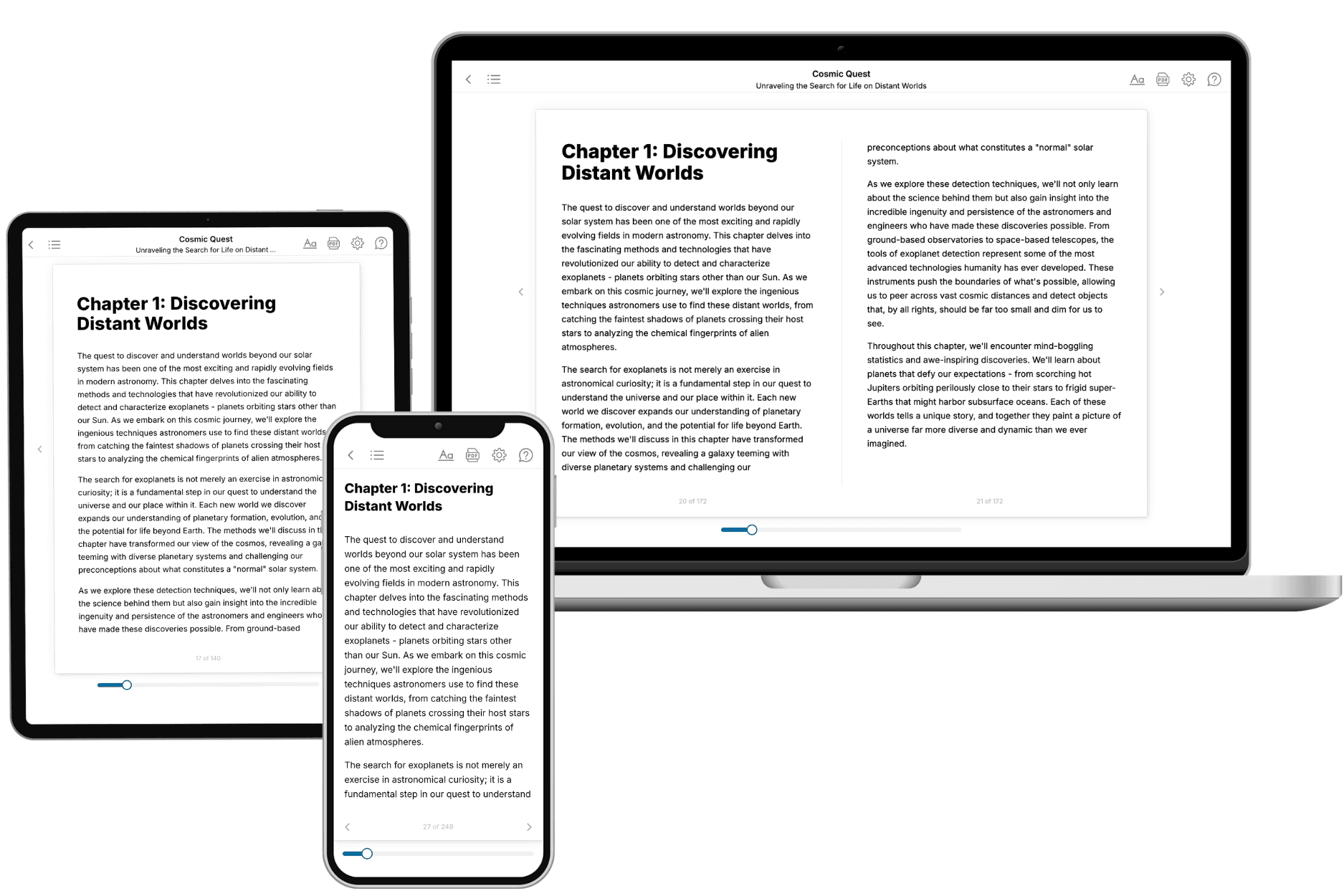
- 3. Get your tailored book
Your book is ready in 10 minutes. Read it online, download as EPUB or PDF, or send to Kindle.
Frequently asked questions
- What is TailoredRead?
TailoredRead creates complete, full-length nonfiction ebooks, written specifically for you. Tell us what you want to learn and why, and TailoredRead writes you a complete ebook on it, with charts, tables, and diagrams throughout. Read it online, on Kindle, or on any e-reader, or download it as a PDF or EPUB. Every book is written fresh the day you order it.
- How is the book tailored to me?
Before anything is written, you answer a few short questions about your goals, your background, and the topics you care about. Your book is then planned around your answers: written at your level, focused on your goals, and covering the topics you chose, instead of the one-size-fits-all book a store sells everyone.
- Will it read like generic AI content?
No. Your book isn't a chat transcript: it's planned chapter by chapter before a single word is written, told in a clear book voice, and explains ideas visually with charts, tables, and diagrams. After writing, every book goes through an editorial pass that polishes chapters so the book reads consistent from start to finish. Judge for yourself: browse thousands of sample books on our Explore Books page.
- How accurate is the content?
Our AI first checks whether your subject needs live research. Niche and fast-moving subjects are researched before writing, and the book plan and chapters are grounded in what it finds. After writing, every book goes through a quality pass that checks its facts and consistency, and researched books list their sources in a Notes section at the back.
- How long is the book?
You choose the length: Comprehensive (250-300 pages), Detailed (150-200 pages), Essential (70-100 pages), or Short (30-50 pages).
- Does the book include visuals?
Yes. Every book includes visual elements such as timelines, checklists, step-by-step guides, decision trees, comparison tables, and matrices, and many include bar charts. A typical book includes dozens of these visual elements.
- Can I read it on Kindle? What formats can I download?
Yes. Every book can be read in our online reader or downloaded as a PDF or EPUB. The EPUB can be opened with Kindle, Apple Books, Kobo, and any e-reader. The Commercial and Author licenses also include an editable Word (DOCX) and Markdown download.
- How much does it cost?
About the price of a regular ebook. The exact price depends on your book's length and complexity, from $2 for the shortest books to $35 for the most comprehensive, and it's shown when you review your book, before you commit to anything. Each book is a one-time purchase, yours to keep, no subscription. Licenses that let you share, teach, or publish your book range from $35.99 to $49.99.
- Can I preview the book before purchasing?
Before you pay, you'll see what your book will cover: the title, a detailed description, the estimated length, and the complete chapter-by-chapter table of contents, so you know what you're getting before you decide. The full text itself is written after you purchase.
- How long does it take to create a book?
About 10 minutes. You can start reading the opening chapters while the rest is still being written.