Colonialism Mastery
A Customized Guide to Colonial History, Theory, and Global Legacies
You'll navigate the complex architecture of colonialism—from its emergence in 15th-century Europe through its transformation into contemporary neocolonial systems.
191 pages8 chaptersDec 3, 2025World HistoryCreated by Livingstone
About this book
This guide systematically deconstructs how imperial powers consolidated control through administrative hierarchies, economic monopolies, and ideological frameworks that justified domination. You'll examine the sophisticated mechanisms of extraction—mercantilism, plantation economies, and resource capitalism—that generated wealth for empires while impoverishing colonized regions. Critically, you'll explore how indigenous peoples resisted through cultural preservation, political organization, and armed struggle, ultimately forcing decolonization. The book connects historical analysis to present-day realities: global inequality structures, institutional legacies, and ongoing sovereignty struggles. You'll engage with postcolonial theory frameworks that explain how colonial power persists through economic dependency and cultural narratives. By centering indigenous perspectives and subaltern voices, you'll develop a comprehensive understanding of how colonialism shaped—and continues to shape—global systems of power, knowledge production, and resource distribution.
Table of contents
- IntroductionWhy Colonialism Matters Today, Scope and Approach of This Guide, How to Use This BookRead below
- Chapter 1: Origins and Emergence of ColonialismThe Pre-Colonial World: Trade, Technology, and Power, European Conditions: Economic Pressures and Ideological Shifts, First Colonial Ventures: Portugal, Spain, and Early Expansion, Colonialism as Choice, Not Inevitability
- Chapter 2: Imperial Power Structures and AdministrationBuilding Administrative Hierarchies, Racial Hierarchies and Justification Systems, Institutional Control and Colonial Governance, Imperial Power Consolidation Strategies
- Chapter 3: Economic Exploitation SystemsMercantilism and Trade Monopolies, Plantation Economy Systems and Labor Extraction, Resource Extraction and Capitalist Accumulation, Creating Structural Economic Dependency
- Chapter 4: Indigenous Resistance and Cultural SurvivalSubaltern Resistance Tactics and Strategies, Cultural Resistance and Knowledge Preservation, Indigenous Sovereignty Movements and Self-Determination, Indigenous Knowledge Systems and Epistemologies
- Chapter 5: Decolonization Movements and StrategiesAnti-Colonial Political Thought and Ideology, Decolonization Movement Strategies and Tactics, Independence Struggles Across Regions, Self-Determination Frameworks and Rights
- Chapter 6: Postcolonial Theory and AnalysisPostcolonial Theory Frameworks and Concepts, Decolonial Epistemology and Knowledge Production, Colonial Narrative Deconstruction and Subaltern Voices, Power Dynamics in Imperial and Postcolonial Systems
- Chapter 7: Contemporary Colonial LegaciesColonial Institutional Legacies in Modern States, Global Inequality Structures and Resource Distribution, Neocolonialism and Economic Dependency Today, Extractive Industry Impacts and Contemporary Exploitation
- Chapter 8: Indigenous Futures and Decolonial MovementsIndigenous Land Rights and Territorial Sovereignty, Indigenous Autonomy Struggles and Self-Governance, Contemporary Decolonial Projects and Resistance, Reimagining Futures Beyond Colonial Structures
- ConclusionSynthesizing Colonial History and Theory, Developing Critical Perspectives on Global Power, Moving Forward: Engaging with Decolonial Futures
- Glossary of Key Terms
- Further Reading and Resources
Introduction
Colonialism is not a relic confined to history textbooks. It is a living force that continues to shape global power dynamics, economic structures, and social hierarchies in the twenty-first century. The systems established during centuries of imperial expansion—from the fifteenth century through the mid-twentieth century—created patterns of wealth extraction, political control, and cultural domination that persist today in modified forms. Understanding colonialism is essential for anyone seeking to comprehend contemporary global inequality, geopolitical conflicts, resource distribution patterns, and the ongoing struggles for indigenous sovereignty and self-determination. This guide provides you with the analytical tools to recognize how colonial legacies operate in modern institutions, economic relationships, and knowledge production systems.
Your background in security, history, and business positions you uniquely to grasp the multidimensional nature of colonial power. Security systems often reflect colonial-era hierarchies of control and surveillance. Historical patterns reveal how empires consolidated territorial dominance through administrative innovation and military force. Financial structures trace their origins to mercantilist policies and extractive economic models developed to enrich imperial centers at the expense of colonized peripheries. By examining colonialism through these intersecting lenses, you will develop a comprehensive understanding of how power operates across political, economic, and cultural domains. This knowledge enables critical analysis of contemporary systems that reproduce colonial patterns under different names—structural adjustment programs, resource extraction agreements, and development frameworks that perpetuate dependency.
This introduction establishes the foundation for your journey through colonial history, theory, and contemporary legacies. You will encounter challenging questions about how knowledge itself has been shaped by colonial power—whose voices have been centered, whose perspectives have been marginalized, and how dominant narratives have obscured the agency and resistance of colonized peoples. The guide does not offer simple answers or moral certainties. Instead, it provides rigorous analytical frameworks drawn from postcolonial theory, decolonial epistemology, and indigenous scholarship. You will learn to recognize the sophisticated mechanisms through which colonial power operated and continues to operate, while also discovering the equally sophisticated strategies of resistance, survival, and transformation developed by those who refused to accept domination as inevitable.
Why Colonialism Matters Today
The global distribution of wealth and poverty directly reflects colonial-era patterns of extraction and accumulation. Former colonial powers in Western Europe and North America control disproportionate shares of global capital, technological infrastructure, and institutional power. Meanwhile, regions subjected to centuries of colonial exploitation—sub-Saharan Africa, South Asia, Latin America, and the Caribbean—face persistent challenges including debt burdens, resource dependency, and limited industrial capacity. These disparities are not accidents of geography or culture. They are the predictable outcomes of systems designed to transfer wealth from colonized territories to imperial centers. Understanding this historical causation is essential for analyzing contemporary development challenges, trade relationships, and financial flows that continue to disadvantage formerly colonized nations.
Contemporary conflicts over resources, borders, and sovereignty trace their origins to colonial-era decisions made without regard for indigenous populations or existing political systems. European powers divided Africa at the Berlin Conference of 1884-1885, drawing borders that split ethnic groups, combined rival communities, and created artificial states designed for administrative convenience rather than local realities[1]. Similar processes occurred across Asia, the Middle East, and the Pacific. These imposed boundaries became the basis for modern nation-states, generating ongoing territorial disputes, ethnic tensions, and governance challenges. When you examine conflicts in Kashmir, the Democratic Republic of Congo, or Palestine, you are witnessing the direct consequences of colonial territorial engineering that prioritized imperial interests over local self-determination.
Economic structures established during colonialism continue to shape global trade patterns and development trajectories. Many formerly colonized nations remain locked into roles as primary commodity exporters—extracting raw materials for processing and consumption elsewhere—while importing manufactured goods at higher prices. This pattern, established through mercantilist policies and plantation economies, creates structural disadvantages that persist despite formal independence. Consider how Ghana exports cocoa beans but imports chocolate products, or how oil-rich Nigeria imports refined petroleum. These arrangements reflect colonial-era economic relationships designed to prevent industrialization in colonized territories while ensuring cheap raw material supplies for imperial economies. Breaking these patterns requires understanding their historical origins and the mechanisms that perpetuate them.
Cultural and epistemological legacies of colonialism shape how knowledge is produced, validated, and disseminated globally. Western universities, research institutions, and publishing houses dominate academic discourse, often marginalizing indigenous knowledge systems, non-Western philosophical traditions, and subaltern perspectives. This intellectual colonialism affects everything from medical research priorities to environmental management approaches to historical narratives. When indigenous communities assert traditional land management practices or alternative development models, they often face dismissal from institutions that privilege Western scientific frameworks. Recognizing these epistemological hierarchies is crucial for developing more inclusive and effective approaches to global challenges. Decolonizing knowledge production means questioning whose expertise counts, whose voices are heard, and whose ways of knowing are considered legitimate.
Indigenous peoples worldwide continue to struggle for rights, recognition, and sovereignty against state systems and economic forces rooted in colonial dispossession. From the Amazon to the Arctic, indigenous communities face ongoing threats to their territories, resources, and cultural survival. These struggles are not separate from colonial history—they are its continuation. The same logics that justified European conquest—terra nullius (empty land), civilizing missions, resource development imperatives—now appear in contemporary forms through mining concessions, conservation projects that exclude indigenous inhabitants, and development schemes that prioritize extraction over local livelihoods. Understanding colonialism provides the analytical framework to recognize these patterns and support indigenous self-determination movements that challenge neocolonial structures.
Global institutions established in the colonial and immediate post-colonial periods reflect power imbalances that favor former imperial powers. The United Nations Security Council grants permanent seats and veto power to five nations—the United States, United Kingdom, France, Russia, and China—while excluding representation for Africa, Latin America, and much of Asia. The International Monetary Fund and World Bank, created in 1944, maintain voting structures weighted toward wealthy nations, enabling them to impose economic policies on debtor countries. These institutional arrangements are not neutral or natural. They embody colonial-era hierarchies that positioned European and North American powers as global decision-makers while relegating formerly colonized nations to subordinate roles. Reforming these institutions requires confronting their colonial origins and the interests they were designed to serve.
Environmental crises, including climate change and biodiversity loss, are deeply connected to colonial patterns of resource extraction and land use transformation. Colonial powers converted diverse ecosystems into monoculture plantations, extracted minerals without regard for environmental consequences, and displaced indigenous peoples who had maintained sustainable relationships with their territories for millennia. These practices established extractive models that continue today through industrial agriculture, mining operations, and fossil fuel development. Significantly, the nations that contributed least to historical emissions—largely formerly colonized countries—face the most severe climate impacts, while those that industrialized through colonial extraction bear the greatest responsibility. Climate justice frameworks recognize these historical inequities and demand that solutions address colonial legacies rather than reproduce them through new forms of green colonialism.
Scope and Approach of This Guide
This guide examines colonialism as a global system spanning five centuries, from the Portuguese and Spanish ventures of the fifteenth century through formal decolonization in the mid-twentieth century and into contemporary neocolonial arrangements. The scope encompasses European colonialism in Africa, Asia, the Americas, and the Pacific, while acknowledging other imperial projects including Ottoman, Russian, and Japanese expansions. The focus remains on European colonialism because of its global reach, its role in creating modern capitalism, and its lasting impacts on contemporary international systems. You will encounter specific case studies from diverse regions—the Belgian Congo, British India, French Algeria, Spanish Americas—that illustrate broader patterns while respecting regional particularities. This approach balances breadth and depth, providing comprehensive coverage while examining specific mechanisms in detail.
The analytical framework draws from multiple disciplines to provide a rigorous, multidimensional understanding of colonial systems. Historical analysis traces the emergence, consolidation, and transformation of colonial power structures. Economic examination reveals the material foundations of empire—mercantilism, plantation systems, resource extraction—and their lasting effects on global inequality. Political analysis explores administrative hierarchies, legal frameworks, and governance systems that enabled imperial control. Cultural and epistemological investigation examines how colonial powers justified domination through racial ideologies, civilizing missions, and knowledge production systems that marginalized indigenous perspectives. This interdisciplinary approach reflects the reality that colonialism operated simultaneously across economic, political, cultural, and ideological domains. Understanding any single dimension requires grasping how it interconnected with others in a comprehensive system of domination.
Postcolonial theory and decolonial epistemology provide critical lenses for analyzing how colonial power persists beyond formal independence. Postcolonial theorists including Edward Said, Gayatri Spivak, and Homi Bhabha developed frameworks for understanding how colonial discourse, representation, and knowledge production continue to shape global relationships[2]. Decolonial thinkers from Latin America, Africa, and indigenous communities worldwide challenge Western epistemological dominance and assert alternative ways of knowing and being. These theoretical frameworks are not abstract academic exercises. They provide practical tools for recognizing neocolonial patterns in contemporary institutions, economic relationships, and cultural productions. You will learn to apply concepts like epistemic violence, subaltern agency, and coloniality of power to analyze real-world situations and identify opportunities for decolonial transformation.
Indigenous perspectives and voices are centered throughout this guide, challenging the colonial tendency to treat indigenous peoples as passive victims or historical footnotes. Indigenous scholars, activists, and communities have developed sophisticated analyses of colonialism and powerful visions for decolonial futures. Their perspectives reveal dimensions of colonial violence and resistance that Eurocentric accounts often obscure. You will encounter indigenous frameworks for understanding land relationships, sovereignty, and knowledge systems that fundamentally challenge colonial logics. This centering of indigenous voices is not tokenistic inclusion. It reflects the epistemological principle that those who experienced colonialism most directly possess crucial insights that external observers cannot access. Decolonizing knowledge production requires listening to and learning from those whose ancestors resisted conquest and whose communities continue to assert self-determination.
The guide maintains analytical rigor while acknowledging the ethical and political dimensions of studying colonialism. Historical analysis cannot be separated from questions of justice, responsibility, and ongoing harm. At the same time, effective analysis requires moving beyond simple moral condemnation to understand the complex mechanisms through which colonial systems operated and continue to operate. You will encounter uncomfortable realities about how ordinary people participated in and benefited from colonial exploitation, how resistance movements sometimes reproduced hierarchies, and how decolonization created new challenges alongside liberation. This complexity does not diminish colonial violence or excuse imperial powers. Rather, it provides the nuanced understanding necessary for effective contemporary action. Simplistic narratives—whether celebratory accounts of imperial progress or one-dimensional stories of victimization—obscure the sophisticated power dynamics that must be understood to challenge neocolonial structures.
Primary sources and historical evidence ground the analysis throughout, ensuring claims are supported by documentary records, statistical data, and firsthand accounts. You will encounter colonial administrative documents that reveal the calculated nature of imperial exploitation, economic data showing wealth transfers from colonies to metropoles, and testimonies from colonized peoples describing their experiences and resistance strategies. This evidence-based approach serves multiple purposes:
- Countering denial: Documentary evidence makes it impossible to dismiss colonial violence as exaggeration or anti-Western bias
- Revealing mechanisms: Administrative records show exactly how colonial systems operated, enabling precise analysis of power structures
- Centering voices: Testimonies and writings from colonized peoples challenge narratives that erase their agency and perspectives
- Supporting analysis: Quantitative data on trade flows, population changes, and resource extraction provides empirical foundation for theoretical claims
Contemporary applications and ongoing struggles receive sustained attention, connecting historical analysis to present-day realities. Each chapter examines how colonial-era patterns manifest in current institutions, economic relationships, and political conflicts. You will explore how international financial institutions perpetuate dependency, how extractive industries reproduce colonial exploitation, how indigenous communities assert land rights against state and corporate power, and how social movements challenge neocolonial structures. This contemporary focus serves your practical needs as someone working in security and business contexts where understanding power dynamics, institutional legacies, and resistance strategies provides strategic advantages. More fundamentally, it reflects the reality that colonialism is not finished history but an ongoing process requiring active engagement and transformation.
How to Use This Book
The guide follows a logical progression from historical origins through theoretical frameworks to contemporary applications, but you can adapt your reading path to your specific interests and needs. If you are primarily interested in economic dimensions, you might focus on Chapter 3 (Economic Exploitation Systems) and Chapter 7 (Contemporary Colonial Legacies) before exploring other chapters. If indigenous sovereignty and resistance strategies are your priority, Chapters 4 (Indigenous Resistance) and 8 (Indigenous Futures) provide concentrated analysis. For theoretical frameworks, Chapter 6 (Postcolonial Theory) offers comprehensive coverage of analytical tools applicable throughout the guide. However, the chapters build on each other conceptually, so reading sequentially provides the most coherent understanding. Each chapter can stand alone while contributing to the comprehensive analysis that emerges from engaging with the complete work.
Active engagement with the material will deepen your understanding and analytical capabilities. As you read, consider these approaches:
- Question assumptions: When you encounter claims about historical inevitability, natural development, or cultural superiority, ask who benefits from these narratives and what alternatives they obscure
- Trace connections: Link historical patterns to contemporary situations you observe in your professional or personal contexts
- Seek multiple perspectives: Compare how different actors—colonial administrators, indigenous resisters, metropolitan populations, settler communities—understood the same events
- Examine evidence: Evaluate the sources supporting claims and consider what perspectives might be missing from available archives
- Apply frameworks: Use theoretical concepts from postcolonial and decolonial theory to analyze current events, institutional structures, and power relationships
The guide includes specific features designed to support your learning and application of concepts. Key terms appear in bold when first introduced, with definitions provided in context and compiled in the glossary for quick reference. Conceptual frameworks receive emphasis to highlight analytical tools you can apply beyond specific historical examples. Footnotes provide citations for claims requiring documentation and point you toward additional sources for deeper exploration. Blockquotes present extended examples, case studies, or particularly significant statements that warrant careful attention. These formatting choices are not decorative—they serve as navigational aids helping you identify different types of information and their relationships within the broader argument.
Case studies throughout the guide illustrate abstract concepts through concrete historical situations. These examples serve multiple purposes: demonstrating how theoretical frameworks apply to real events, revealing the diversity of colonial experiences across regions and time periods, and providing specific details that make general patterns tangible. When you encounter a case study, consider both its particular features and what it reveals about broader colonial dynamics. For instance, the Belgian Congo case study in Chapter 3 shows extreme extractive violence, but it also illustrates general principles about how colonial economies prioritized metropolitan profit over colonized welfare. Ask yourself how the specific example relates to patterns you observe in other contexts, and what unique features might limit its generalizability.
Connecting the guide's content to your professional contexts in security and business will enhance both your understanding of colonialism and your effectiveness in those domains. Security systems often reflect colonial-era approaches to surveillance, control, and threat assessment that may reproduce problematic assumptions about who poses risks and whose security matters. Business relationships frequently operate within structures established during colonialism—supply chains that extract raw materials from formerly colonized regions, financial systems that concentrate capital in former imperial centers, and development frameworks that prioritize foreign investment over local needs. As you read, consider these questions:
- How do security protocols in your organization reflect or challenge colonial hierarchies of control and surveillance?
- What colonial-era patterns appear in your industry's supply chains, labor practices, or market relationships?
- How might indigenous perspectives on land, resources, or governance challenge conventional business or security approaches?
- What opportunities exist to support decolonial alternatives within your professional sphere?
The Further Reading section provides curated resources for deepening your engagement with specific topics, theoretical frameworks, and regional histories. These recommendations include foundational texts in postcolonial theory, historical monographs examining particular colonial contexts, indigenous scholarship offering alternative epistemologies, and contemporary analyses of neocolonialism and decolonial movements. You need not read everything listed—the annotations help you identify resources most relevant to your interests and needs. Prioritize works by scholars from formerly colonized regions and indigenous authors, whose perspectives often differ significantly from Eurocentric accounts. Building a diverse reading practice challenges the epistemological colonialism that privileges Western knowledge production and opens access to analytical frameworks developed from different standpoints and experiences.
Engaging with this material may provoke strong emotional and intellectual responses, particularly if you identify with communities that benefited from colonialism or those that suffered under it. These responses are natural and valuable if approached thoughtfully. If you are descended from colonizing populations or currently benefit from colonial legacies, you may experience discomfort, defensiveness, or guilt. These feelings need not paralyze you—they can motivate critical examination of how you participate in and might challenge ongoing colonial patterns. If you are descended from colonized peoples or indigenous communities, you may experience anger, grief, or recognition of ongoing harms. These responses validate the severity of colonial violence and can fuel commitment to decolonial transformation. Regardless of your positionality, the goal is not to feel good or bad about history, but to understand it clearly enough to act effectively in the present. Critical analysis requires emotional honesty combined with intellectual rigor—acknowledging how colonialism affects you personally while maintaining analytical distance necessary for comprehensive understanding.
Finally, recognize that this guide is itself a product of particular perspectives and limitations. Despite efforts to center indigenous voices and challenge Eurocentric narratives, the very form of a comprehensive analytical text reflects Western academic traditions. The selection of topics, theoretical frameworks, and examples inevitably reflects choices that privilege certain perspectives while marginalizing others. No single work can capture the full complexity of five centuries of global colonial history and its contemporary legacies. Approach this guide as one resource among many, valuable for its systematic analysis and interdisciplinary scope, but necessarily incomplete. Supplement it with works by indigenous scholars, regional histories that provide depth beyond what a survey can offer, and contemporary analyses from decolonial movements actively transforming colonial legacies. Your understanding of colonialism should be dynamic and evolving, continuously refined through engagement with diverse sources and ongoing attention to how colonial patterns manifest in the world around you.
This is the end of the free sample. The full book has 8 chapters.
Want this book written for you?
Tell us your goals and background, and get your own version of this book, tailored by AI to you.


Benefits of AI-tailored books
- Read one book, not ten:
- all the World History knowledge you need, gathered into a single book.
- Save days of learning:
- tell us your goals, choose your topics, and the whole book is built around them.
- Learn effortlessly:
- World History book written for your specific background and expertise.
- Understand at a glance:
- includes charts, tables, timelines, checklists, decision trees, and more.
- Stay current:
- written the day you order it, not years ago.
- Trust what you read:
- every book is checked for accuracy, with real research when your subject needs it.
Create your unique book in 3 steps
- 1. Select your focus
Select the focus of your World History book and share your background
- 2. Personalize your book
Specify your goals and choose sub-topics to include
- 3. Get your tailored book
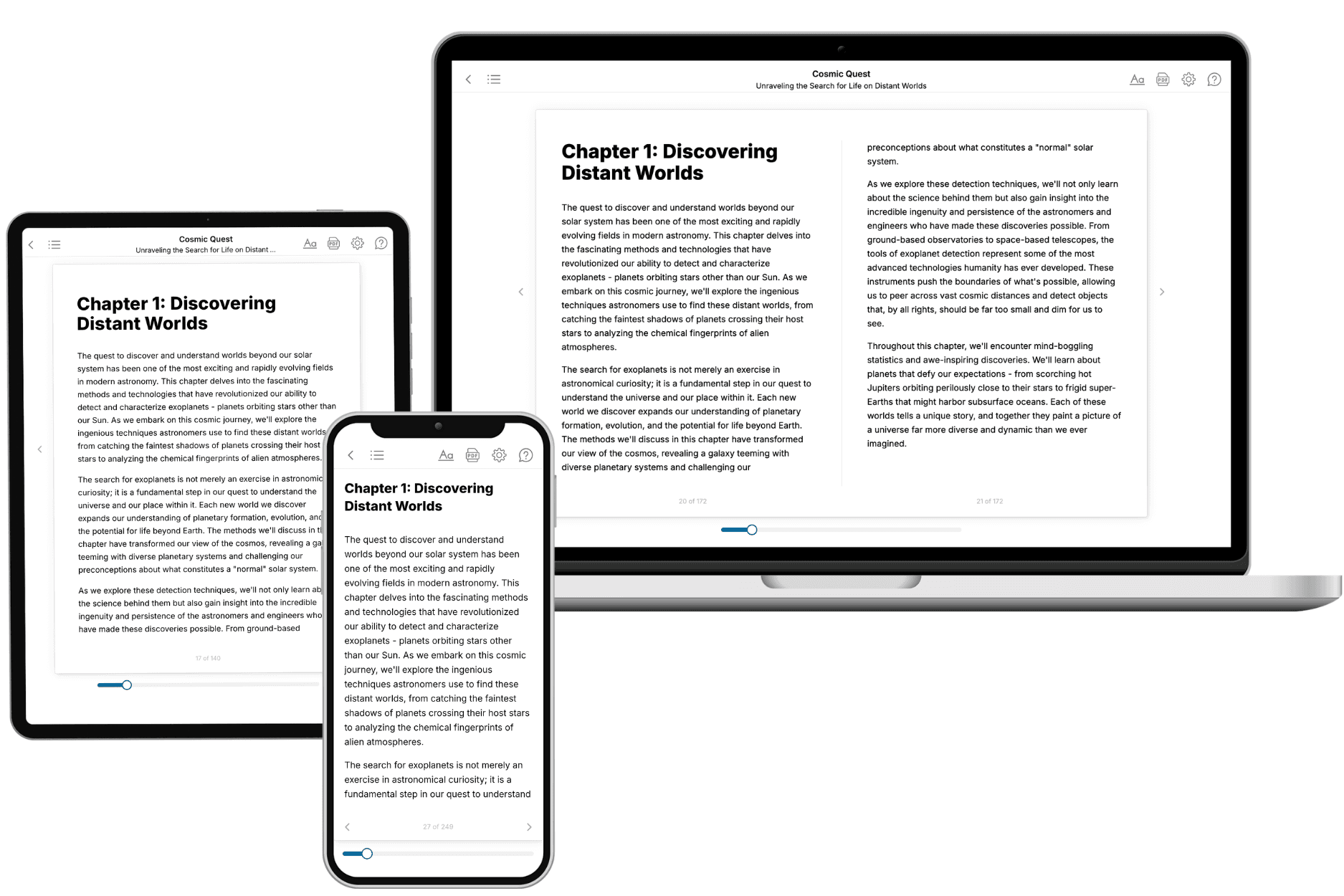
Your book is ready in 10 minutes. Read it online, download as EPUB or PDF, or send to Kindle.

Frequently asked questions
- What is TailoredRead?
TailoredRead creates complete, full-length nonfiction ebooks, written specifically for you. Tell us what you want to learn and why, and TailoredRead writes you a complete ebook on it, with charts, tables, and diagrams throughout. Read it online, on Kindle, or on any e-reader, or download it as a PDF or EPUB. Every book is written fresh the day you order it.
- How is the book tailored to me?
Before anything is written, you answer a few short questions about your goals, your background, and the topics you care about. Your book is then planned around your answers: written at your level, focused on your goals, and covering the topics you chose, instead of the one-size-fits-all book a store sells everyone.
- Will it read like generic AI content?
No. Your book isn't a chat transcript: it's planned chapter by chapter before a single word is written, told in a clear book voice, and explains ideas visually with charts, tables, and diagrams. After writing, every book goes through an editorial pass that polishes chapters so the book reads consistent from start to finish. Judge for yourself: browse thousands of sample books on our Explore Books page.
- How accurate is the content?
Our AI first checks whether your subject needs live research. Niche and fast-moving subjects are researched before writing, and the book plan and chapters are grounded in what it finds. After writing, every book goes through a quality pass that checks its facts and consistency, and researched books list their sources in a Notes section at the back.
- How long is the book?
You choose the length: Comprehensive (250-300 pages), Detailed (150-200 pages), Essential (70-100 pages), or Short (30-50 pages).
- Does the book include visuals?
Yes. Every book includes charts, tables, and diagrams: timelines, checklists, step-by-step guides, decision trees, comparison tables, matrices, and bar charts. A typical book includes dozens of these visual elements.
- Can I read it on Kindle? What formats can I download?
Yes. Every book can be read in our online reader or downloaded as a PDF or EPUB. The EPUB can be opened with Kindle, Apple Books, Kobo, and any e-reader. The Commercial and Author licenses also include an editable Word (DOCX) and Markdown download.
- How much does it cost?
About the price of a regular ebook. The exact price depends on your book's length and complexity, from $2 for the shortest books to $35 for the most comprehensive, and it's shown when you review your book, before you commit to anything. Each book is a one-time purchase, yours to keep, no subscription. Licenses that let you share, teach, or publish your book range from $35.99 to $49.99.
- Can I preview the book before purchasing?
Before you pay, you'll see what your book will cover: the title, a detailed description, the estimated length, and the complete chapter-by-chapter table of contents, so you know what you're getting before you decide. The full text itself is written after you purchase.
- How long does it take to create a book?
About 10 minutes. You can start reading the opening chapters while the rest is still being written.