Imperialism Books
Explore tailored Imperialism books created by our AI
Books readers created
40 Imperialism books, each written for the reader who ordered it. Read its introduction, then personalize it to get a book of your own.
Colonialism Mastery
A Customized Guide to Colonial History, Theory, and Global Legacies
You'll navigate the complex architecture of colonialism—from its emergence in 15th-century Europe through its transformation into contemporary neocolonial systems. This guide systematically deconstructs how imperial powers consolidated control through administrative hierarchies, economic monopolies, and ideological frameworks that justified domination. You'll examine the sophisticated mechanisms of extraction—mercantilism, plantation economies, and resource capitalism—that generated wealth for empires while impoverishing colonized regions. Critically, you'll explore how indigenous peoples resisted through cultural preservation, political organization, and armed struggle, ultimately forcing decolonization. The book connects historical analysis to present-day realities: global inequality structures, institutional legacies, and ongoing sovereignty struggles. You'll engage with postcolonial theory frameworks that explain how colonial power persists through economic dependency and cultural narratives. By centering indigenous perspectives and subaltern voices, you'll develop a comprehensive understanding of how colonialism shaped—and continues to shape—global systems of power, knowledge production, and resource distribution.
The End of Empire
How Britain Lost Its Colonies and Reshaped the Modern World
Discover how the world's most powerful empire systematically dismantled itself over just two decades. This book traces the dramatic collapse of British imperial rule from the end of World War II through the 1970s, revealing the political calculations, nationalist uprisings, and global power shifts that transformed the map of the world. You'll explore how Britain navigated the loss of India, Africa, and the Caribbean, examining the perspectives of both colonial administrators grappling with inevitable change and independence leaders fighting for their nations' futures. Through compelling historical narratives and clear analysis, you'll understand why decolonization happened when it did, how it unfolded across different regions, and what consequences still reverberate today. This is not a story of inevitable progress or simple good versus evil—it's a nuanced examination of how empires end and how that ending continues to shape our modern world.
The Scramble for Africa
How European Powers Carved Up a Continent and Shaped the Modern World
Within just three decades, from the 1880s to 1914, European powers transformed Africa from a continent of independent kingdoms, empires, and societies into a patchwork of colonial territories. This dramatic partition—the Scramble for Africa—represents one of history's most consequential geopolitical transformations, yet its complexities often remain obscured by simplified narratives. You'll explore the multifaceted forces that drove European expansion: industrial capitalism's hunger for raw materials and markets, nationalist rivalries among competing powers, technological innovations that shifted military balance, and the ideological frameworks that justified conquest. Moving beyond European perspectives, you'll examine how African leaders and communities responded—through armed resistance, diplomatic negotiation, strategic alliances, and adaptation. The book traces the scramble's execution across different regions, from the Berlin Conference's diplomatic maneuvering to the violent realities of conquest and resistance. You'll understand how arbitrary colonial borders were drawn, how diverse governance systems were imposed, and how economic structures were fundamentally reordered. Finally, you'll connect historical events to contemporary Africa, recognizing how colonial legacies continue shaping political boundaries, economic systems, ethnic relations, and development challenges across the continent.
Imagine understanding one of history's most consequential periods—not through oversimplified narratives, but through a clear-eyed examination of how power, economics, and human ambition reshaped an entire civilization. The British Raj stands as one of history's most transformative colonial enterprises, fundamentally altering India's trajectory while leaving imprints that persist today. This book cuts through mythology to reveal how a trading company became an empire, how colonial administrators justified their rule, and how Indians resisted, adapted, and ultimately reclaimed their nation. You'll discover the economic mechanisms that extracted wealth, the administrative innovations that governed hundreds of millions, and the intellectual currents that both sustained and eventually undermined colonial authority. By examining primary sources, competing perspectives, and historical evidence, you'll gain the analytical tools to understand not just what happened, but why it matters for understanding modern India, British identity, and global power dynamics. This is history that illuminates the present.
Discover how a small island nation became the world's most powerful empire, controlling a quarter of the globe at its peak. This book traces the British Empire's remarkable journey from its medieval origins through its twentieth-century collapse, revealing the forces that propelled Britain to global dominance and the consequences that still shape our world today. You'll explore the economic ambitions that drove expansion, the naval innovations that secured British supremacy, and the political strategies that allowed a relatively small population to rule hundreds of millions. Beyond the triumphalist narratives, you'll examine the complex realities: how imperial rule transformed colonized societies, the resistance movements that challenged British authority, and why the empire ultimately proved unsustainable. This comprehensive account balances historical achievement with honest assessment of imperial exploitation, offering essential context for understanding modern international relations, global inequality, and the ongoing debates about colonialism's legacy. Whether you're studying history, seeking to understand current global dynamics, or simply curious about one of history's most consequential empires, this book provides the clarity and depth you need.
Drawn in Ink, Lived in Blood
How Colonial Borders Shaped Modern Conflicts and Identities
Discover why the world's most intractable conflicts, from the Middle East to sub-Saharan Africa, trace their roots to lines drawn on maps by colonial administrators who never set foot in the territories they divided. This book reveals how European powers carved up continents to serve their economic interests, creating borders that ignored centuries of cultural, ethnic, and religious geography. You'll understand why these arbitrary lines persist today despite their destructive consequences, how they fuel modern wars and humanitarian crises, and what this means for resolving contemporary geopolitical tensions. Through case studies spanning multiple continents and centuries, you'll see the direct connections between colonial boundary-drawing and today's refugee crises, resource conflicts, and identity struggles. Whether you're studying international relations, working in policy, or simply seeking to understand why the world is shaped as it is, this book provides the historical foundation necessary to comprehend modern global challenges.
The Age of Encounter
How European Colonization Reshaped the Americas in the 17th Century
Discover how the 17th century became the pivotal moment when European powers fundamentally transformed the Americas. This comprehensive exploration takes you through the motivations that drove colonization—from the pursuit of wealth and religious conversion to geopolitical competition among European nations. You'll examine how different colonial powers established distinct systems in North America, Central America, and South America, each shaped by local geography and resources. The book reveals the complex experiences of indigenous populations who faced unprecedented challenges while developing strategies of resistance and adaptation. Through detailed analysis of key events, figures, and systems, you'll understand how colonization created lasting demographic, economic, and social changes. This is not a simple story of conquest, but rather a nuanced examination of how two worlds collided, adapted, and ultimately created entirely new societies that blended European and indigenous elements in ways that continue to influence the Americas today.
The Spanish Explorers
How Spain Shaped the Modern World Through Discovery and Conquest
Discover how a small Iberian kingdom became a global superpower that reshaped the entire world. This book traces Spain's remarkable journey from medieval Christian kingdoms fighting the Reconquista to the master of vast overseas empires spanning continents. You'll explore the bold explorers who sailed into unknown waters, the political intrigue that funded their voyages, and the technological innovations that made exploration possible. More importantly, you'll understand the profound and lasting consequences of Spanish expansion—from the transformation of indigenous societies to the creation of new trade networks that connected Europe, Africa, Asia, and the Americas. This is not simply a story of heroic discovery, but a nuanced examination of ambition, faith, commerce, and cultural collision that fundamentally altered human civilization and continues to shape our world today.
The Boer Wars
Britain's Imperial Ambition and the Struggle for South African Independence
Many assume the Boer Wars were simply a straightforward British military victory over Dutch settlers in South Africa. In reality, these conflicts represent one of the most complex and consequential struggles of the 19th century—a clash that exposed the vulnerabilities of imperial power and introduced modern warfare tactics that would influence military strategy for decades. This book examines the origins of the Boer Wars, tracing how the discovery of precious minerals transformed peaceful coexistence into bitter conflict. You'll explore the military campaigns, the innovative guerrilla tactics employed by Boer forces, and the humanitarian crisis that shocked the world. Beyond the battlefields, you'll understand how these wars reshaped British imperial policy, influenced international law, and set the stage for South Africa's complex future. Whether you're studying 19th-century history, imperial politics, or the evolution of modern warfare, this comprehensive account reveals why the Boer Wars remain essential to understanding our world.
Shadows of Empire
Filipino Lives During the American Colonial Period
Imagine understanding the Philippines not as a footnote in American history, but as a nation of individuals whose choices, struggles, and aspirations shaped their own colonial experience. This book brings the American colonial period to life through the stories of Filipinos who lived through it—from political leaders and intellectuals to farmers, teachers, and families navigating unprecedented change. You'll discover how ordinary Filipinos resisted, adapted, and thrived during a transformative era that fundamentally altered their society. Through carefully researched biographical narratives and historical analysis, you'll see how the colonial period created lasting impacts on Filipino culture, education, economy, and identity. This is not a story told from the perspective of colonizers, but rather an exploration of how Filipinos themselves experienced, interpreted, and responded to American rule. Whether you're studying this period for academic purposes or seeking to understand the roots of modern Filipino society, this book provides essential context for comprehending how the past continues to shape the Philippines today.
What if everything you learned about Columbus in school was incomplete? The story of Christopher Columbus has been told and retold so many times that myth has overshadowed history. This book cuts through the romanticized narratives and popular misconceptions to reveal the real Columbus—a complex figure whose ambitions, calculations, and decisions set in motion events that fundamentally altered human civilization. You'll discover how Columbus's four voyages were shaped by the technology, politics, and knowledge of his era, why his treatment of indigenous peoples reflected the colonial mindset of the time, and how his legacy continues to spark debate among historians. By examining primary sources, archaeological evidence, and competing historical interpretations, you'll gain a deeper understanding of how one man's expeditions became a turning point in world history—for better and worse. This is history as it actually happened, not as legend has painted it.
The Last Gasp of Empire
How the Suez Crisis Reshaped Britain, Europe, and the Modern World
Understanding why Britain made one of its greatest strategic blunders requires grappling with the complex intersection of imperial decline, Cold War tensions, and nationalist movements that defined the 1950s. The Suez Crisis of 1956 wasn't just a failed military operation—it was the moment when Britain's pretensions to global power collapsed under the weight of new geopolitical realities. This book takes you through the crisis from multiple perspectives: the British cabinet rooms where Eden's government plotted intervention, the Egyptian streets where Nasser rallied nationalist sentiment, the secret meetings where Britain and France coordinated with Israel, and the international forums where American pressure forced humiliating withdrawal. You'll discover how imperial nostalgia, personal rivalries, and fundamental misunderstandings of the post-war order led to decisions that permanently diminished British influence. Beyond the immediate drama, you'll explore how this single event accelerated decolonization, reshaped European politics, transformed the Middle East, and established patterns in international relations that continue to influence global affairs. The Suez Crisis offers essential lessons about power, decline, and the dangers of leaders who refuse to accept changed circumstances.
Imagine understanding the hidden architecture of global power—how one European nation built an empire spanning continents, shaped international relations for centuries, and left imprints that still influence our world today. French colonialism was far more than a historical footnote; it was a transformative force that reshaped economies, cultures, and political boundaries across Africa, Asia, the Caribbean, and beyond. This book traces France's colonial journey from its earliest ventures through its complex decolonization, revealing the economic motivations, ideological justifications, and human consequences that defined this era. You'll discover how colonial systems worked, why they persisted despite resistance, and how their effects ripple through contemporary international relations. Whether you're studying history, seeking to understand current geopolitical tensions, or simply curious about how empires function, this comprehensive exploration provides the context and analysis needed to grasp one of history's most consequential chapters. Gain the knowledge to see beyond simplified narratives and appreciate the full complexity of colonialism's past and present.
Many believe the Boxer Rebellion was simply a chaotic peasant uprising easily suppressed by Western forces. In reality, it was a complex nationalist response to decades of foreign domination that fundamentally reshaped American foreign policy and global power dynamics. This book examines how Western imperialism, particularly American commercial expansion, created the conditions for the rebellion while simultaneously using it to justify deeper military involvement in Asia. You'll discover how the United States' response to the crisis established patterns of intervention that would define American foreign policy throughout the 20th century. By exploring the rebellion through multiple perspectives—Chinese resistance fighters, American diplomats, and international powers—you'll gain insight into how imperial powers maintained control over colonized regions and how nationalist movements emerged in response. This historical moment reveals the roots of modern tensions between Western powers and Asia, making it essential for understanding contemporary international relations and American global influence.
Voyages of Discovery
Understanding the 16th Century Age of Exploration and Its Global Impact
Many assume the Age of Exploration was simply about brave adventurers seeking new lands. In reality, it was a calculated convergence of economic desperation, technological innovation, religious fervor, and geopolitical competition that transformed the entire world. This book examines the 16th century's greatest voyages and explorers—from Columbus to Magellan—revealing the complex motivations behind their journeys and the far-reaching consequences that followed. You'll discover how advances in navigation technology made oceanic exploration possible, why European powers competed so fiercely for trade routes, and how these voyages created the interconnected global system we inhabit today. More importantly, you'll understand the human cost of exploration: the devastating impact on indigenous populations, the establishment of colonial systems, and the long-term power imbalances that still shape our world. This is not a romanticized tale of discovery, but a nuanced historical account that helps you grasp how the 16th century fundamentally altered human civilization.
This book takes you through a critical examination of settler colonialism—one of the most consequential yet often misunderstood political systems shaping our world. You'll discover how settler colonialism differs fundamentally from other forms of colonialism, and why this distinction matters for understanding everything from contemporary land disputes to indigenous rights movements. Through concrete historical examples and contemporary case studies, you'll see how settler colonial logic operates: the systematic replacement of indigenous populations, the legal frameworks that legitimize dispossession, and the cultural narratives that normalize these processes. You'll explore how settler colonialism persists in modern nation-states long after formal independence, embedded in property laws, educational systems, and political institutions. By examining specific regions—from North America to Australia to the Middle East—you'll recognize patterns while appreciating how settler colonialism manifests uniquely in different contexts. This book equips you with analytical tools to understand ongoing conflicts over land, sovereignty, and justice, while introducing you to indigenous perspectives and resistance movements that challenge settler colonial authority. Whether you're studying politics, engaged in activism, or simply seeking to understand the world's most pressing conflicts, this book provides essential context for making sense of our settler colonial present.
Many people think African history begins with European colonization, but this misconception erases thousands of years of sophisticated civilizations, powerful empires, and remarkable achievements. Africa's pre-colonial past includes thriving kingdoms like Mali and Great Zimbabwe, complex trade networks spanning continents, and cultural innovations that influenced the world. This book takes you on a chronological journey through African history, starting with ancient civilizations and progressing through the colonial period and its lasting impact. You'll discover the political systems, economic structures, and cultural achievements of major African empires, meet the historical figures who shaped nations, and understand how colonialism disrupted societies in ways still felt today. Whether you're a student seeking deeper knowledge or an adult learner exploring your heritage, this guide provides the context needed to understand Africa's central role in human history and its profound connection to African-American identity and culture.
The Battle of Algiers
Urban Warfare, Colonial Conflict, and the Fight for Independence
The Battle of Algiers stands as one of history's most consequential urban conflicts, yet many struggle to understand its significance beyond the famous film. This book cuts through the complexity to reveal how a year-long struggle in Algeria's capital reshaped colonial warfare, international relations, and the future of North Africa. You'll discover how the FLN's shift to urban guerrilla tactics forced the French military to confront an enemy that couldn't be defeated through conventional means. The book examines the brutal counterinsurgency measures, the civilian toll, and the strategic miscalculations that transformed a tactical French victory into a strategic defeat. By exploring the political, military, and human dimensions of this conflict, you'll gain insight into how nationalist movements challenge imperial power and why military superiority alone cannot guarantee political victory. This is essential reading for understanding modern insurgency, colonial collapse, and the enduring consequences of the Algerian War.
Imagine writing Caribbean fiction that resonates with historical authenticity—where your characters inhabit a world you truly understand, where the landscape carries the weight of real history, and where cultural details ring true to readers who know this region intimately. This book provides the historical foundation you need. You'll explore the Caribbean from the sophisticated agricultural systems of the Taíno peoples through the brutal machinery of colonialism, the explosive energy of revolutionary movements, and the complex negotiations of postcolonial nations. You'll discover how oral traditions preserved history when written records were controlled by colonizers, how religious syncretism became an act of cultural resistance, and how trade networks made the Caribbean central—not peripheral—to global history. Each chapter connects historical events and themes directly to the creative challenges fiction writers face: developing authentic characters, building believable settings, understanding cultural context, and avoiding stereotypes. Whether you're crafting a novel set in 1492, during the Haitian Revolution, or in contemporary Caribbean society, this book equips you with the knowledge to write with confidence and integrity.
The Opium Wars
How British Imperial Ambition Reshaped China and the Global Order
Gain a deep understanding of one of history's most consequential conflicts that forever changed the relationship between East and West. The Opium Wars weren't just about drugs—they were pivotal moments that established the framework for modern global trade, diplomacy, and imperial power. You'll discover how British commercial interests collided with Chinese sovereignty, creating conflicts that would reshape two civilizations and establish patterns of international relations that persist today. Through detailed analysis of key battles, diplomatic negotiations, and cultural clashes, you'll understand why these wars became turning points in both British imperial expansion and Chinese modernization. This comprehensive examination reveals the complex motivations driving both sides, from British merchants seeking new markets to Chinese officials defending their nation's autonomy. You'll explore how technological advantages, cultural misunderstandings, and competing worldviews escalated trade disputes into full-scale wars that redefined the balance of global power. By understanding these conflicts within the broader context of 19th-century European imperialism, you'll gain valuable insights into how economic interests, national pride, and imperial ambitions combined to create lasting changes that influenced international relations for generations to come.
What made the Persian Empires so powerful that they dominated three continents for over a thousand years? This book reveals how ancient Persia created the world's first truly cosmopolitan civilization, establishing administrative systems, trade networks, and cultural practices that shaped human history. You'll discover how Persian kings managed vast, diverse populations through innovative governance, how Zoroastrian beliefs influenced major world religions, and why Persian military tactics remained unmatched for centuries. From the legendary Cyrus the Great to the sophisticated Sassanid court, explore the emperors, generals, and thinkers who built empires that rivaled Rome. This accessible yet authoritative guide separates myth from history, showing you the real achievements and challenges of ancient Persia—and why understanding these empires is essential to understanding our world today.
The Spanish-American War
America's First Modern Conflict and the Birth of a Global Power
Discover how a brief ten-week conflict transformed America from a continental power into a global superpower. The Spanish-American War stands as one of the most consequential yet often misunderstood events in U.S. history. This book takes you beyond the headlines to explore the complex political, economic, and social forces that propelled the nation into its first overseas war. You'll understand how yellow journalism inflamed public sentiment, why American military leaders embraced new technologies and tactics, and how victory in Cuba and the Pacific fundamentally altered America's role on the world stage. Through detailed accounts of key battles, profiles of influential leaders, and analysis of the war's immediate and long-term consequences, you'll gain insight into how this conflict set the trajectory for American foreign policy throughout the 20th century. Whether you're studying American history or seeking to understand the roots of modern U.S. global engagement, this comprehensive examination provides the context and clarity needed to grasp this pivotal moment.
Discover how a single letter from a British Foreign Secretary fundamentally altered the course of Middle Eastern history. This book provides you with a clear, evidence-based understanding of the Balfour Declaration—one of history's most consequential yet misunderstood documents. You'll learn the political calculations that led Britain to issue this promise, the competing interests it attempted to balance, and why its ambiguous language created conflicts that persist over a century later. Through careful examination of primary sources, historical context, and multiple perspectives, you'll gain the analytical tools to understand how imperial decisions shape modern geopolitics. Whether you're studying history, seeking to understand contemporary Middle Eastern politics, or simply curious about how historical documents influence nations, this book equips you with the knowledge to engage thoughtfully with one of the world's most debated declarations.
Discover how Spain's colonial conquest of Mexico created legal, social, and cultural systems that fundamentally shaped a nation. This exploration examines Mexico's first century of colonialism through the lens of law, power, and resistance—revealing how indigenous peoples, women, and mestizos navigated and challenged colonial structures. You'll trace the evolution of the caste system that legally classified people by race and ethnicity, explore how indigenous communities maintained agency through legal petitions and spiritual resistance, and understand how women leveraged convents as centers of intellectual and economic power. The book examines the Inquisition's dual role as religious enforcer and political tool, analyzes how religious syncretism preserved indigenous cosmologies within Catholic frameworks, and investigates the viceregal court's complex patronage networks. With focus on Durango's frontier dynamics and the first transformative hundred years of Spanish rule, this work connects colonial foundations to contemporary Mexican identity, legal traditions, and ongoing struggles for indigenous rights and social justice.
The Soul of Puerto Rico
A Historical Journey Through the Island That Shaped the Caribbean
Most travelers arrive in Puerto Rico with guidebooks full of beach recommendations and restaurant reviews, but without understanding the historical forces that created the vibrant culture they're experiencing. You walk through Old San Juan's colorful streets or hear bomba drums without grasping the centuries of struggle, creativity, and resilience these represent. This gap between observation and understanding leaves your travel experience incomplete. This book bridges that divide by weaving Puerto Rico's complex history into a narrative that directly enhances your travel experience. You'll discover how Taíno, Spanish, African, and American influences collided and merged to create contemporary Puerto Rican identity. From pre-Columbian societies through Spanish colonization, the sugar economy's brutal realities, American territorial status, and modern challenges, you'll gain the context that transforms tourist sites into meaningful encounters. Each chapter connects historical events to places you can visit, foods you can taste, and traditions you can witness. You'll understand why El Morro fortress dominates San Juan's skyline, what bomba rhythms reveal about African resistance, and how Hurricane Maria exposed deeper truths about Puerto Rico's political status. This knowledge doesn't just inform your trip—it fundamentally changes how you experience the island.
Many people view World War II as a distant European conflict, overlooking the devastating impact it had on Asia and the Pacific. The Japanese occupation of the Philippines from 1941 to 1945 was one of the most transformative and traumatic periods in Philippine history, yet it remains underexplored in mainstream historical narratives. This book provides a comprehensive examination of this critical era, exploring how a nation of over 16 million people endured three years of military rule, economic collapse, and social upheaval. You'll discover the strategic decisions that led to the occupation, the remarkable resistance movements that emerged, the everyday struggles of ordinary Filipinos, and how this period fundamentally reshaped the nation's future. Through detailed accounts of military campaigns, personal stories, and historical analysis, this book illuminates a pivotal chapter that shaped modern Asia and demonstrates the resilience of the Filipino people during their darkest hours.
You'll gain a comprehensive understanding of how the Arab-Israeli conflict evolved from competing imperial ambitions and nationalist movements into one of the world's most intractable disputes. This book traces the historical trajectory from the Balfour Declaration through the British Mandate, the 1948 war, and contemporary peace efforts, examining how imperialism, nationalism, and religious identity intersected to shape the region. You'll explore the origins of the Zionist movement, Palestinian nationalism, and Arab League responses while analyzing concrete disputes over water rights, land partition, and settlement expansion. By examining key events, political causes, and social impacts through a balanced historical lens, you'll develop the contextual knowledge needed to assess current proposals like the two-state solution and understand why previous frameworks like the Oslo Accords achieved limited success. This analysis equips you with the historical foundation to engage thoughtfully with Middle Eastern affairs.
The Meiji Restoration
How Japan Transformed from Feudal Empire to Modern Nation in 50 Years
Imagine a nation that, in just fifty years, transformed itself from a feudal society ruled by competing warlords into a modern industrial power that rivaled Western nations. This is the story of Japan's Meiji Restoration—one of history's most remarkable transformations. You'll discover how a group of visionary leaders, responding to the threat of Western colonization, dismantled centuries of tradition and rebuilt their entire society from the ground up. Through careful study of Western institutions, strategic adoption of foreign technology, and deliberate preservation of Japanese culture, these reformers created a blueprint for modernization that other nations would attempt to replicate. This book takes you through the political upheaval, social revolution, and economic transformation that reshaped Japan. You'll understand the key figures who drove change, the obstacles they overcame, and the lasting impact of their decisions on Japan and the world. Whether you're a history student, a curious learner, or someone interested in how societies successfully navigate radical change, this exploration of the Meiji era offers invaluable insights into modernization, leadership, and cultural resilience.
The Great Divide
Understanding the Partition of India and Its Place in World History
Many people believe the Partition of India was simply an inevitable religious conflict that naturally divided Hindus and Muslims. This oversimplified view misses the complex web of political maneuvering, colonial policies, and strategic decisions that actually shaped one of history's most consequential events. The Great Divide takes you beyond surface-level explanations to explore how the partition of British India in 1947 fundamentally altered not just South Asia, but the entire trajectory of world history. You'll discover how colonial administrative choices, key personality conflicts, and international pressures converged to create a perfect storm that displaced over 14 million people and established patterns of conflict that continue today. Through careful analysis of primary sources and historical evidence, you'll gain insight into the roles played by Gandhi, Nehru, Jinnah, and Mountbatten, while understanding how their decisions reverberated across continents. You'll explore how Partition influenced decolonization movements worldwide, shaped Cold War dynamics, and created lasting impacts on global migration patterns. By the end of this comprehensive examination, you'll possess a nuanced understanding of how local events can reshape world history, and why the lessons of Partition remain critically relevant for understanding contemporary geopolitics, religious nationalism, and the ongoing challenges of nation-building in our interconnected world.
The Roman Conquest of Greece
How Rome Transformed the Ancient World and Built an Empire
Many assume Rome simply overpowered Greece through brute military force, but the reality is far more complex and fascinating. The Roman conquest of Greece was a gradual process spanning over a century, driven by political instability in the Greek world, Rome's strategic ambitions, and the clash between two fundamentally different military systems. This book traces how Rome's disciplined legions defeated the legendary Greek hoplites, how political divisions among Greek city-states sealed their fate, and how this conquest paradoxically led to Greek culture dominating Roman civilization. You'll discover the key battles, the ambitious commanders who shaped history, and the political maneuvering that transformed the Mediterranean world. More importantly, you'll understand how this conquest created the Greco-Roman synthesis that became the bedrock of Western civilization, proving that military victory doesn't always mean cultural defeat.
The Golden Decade
Understanding Britain's Edwardian Era and Its Lasting Legacy
What if the most pivotal decade in British history has been hiding in plain sight, overshadowed by the drama of Victorian grandeur and the tragedy of World War I? The Edwardian Era—those remarkable ten years from 1901 to 1910—represents far more than a brief interlude between two defining periods. This was Britain's golden decade, a time when the nation stood at the crossroads of tradition and modernity, empire and democracy, privilege and progress. You'll discover how King Edward VII's reign ushered in an age of unprecedented social change, technological innovation, and cultural flowering. From the grand country houses where the elite entertained to the bustling streets where working-class movements gained momentum, this era witnessed the birth of modern Britain. The period's seemingly carefree lifestyle of garden parties and grand tours masked profound transformations in women's rights, political representation, and social mobility. Through detailed exploration of daily life, political developments, and cultural achievements, you'll understand how the Edwardian period's unique blend of optimism and underlying tension created the conditions for both remarkable progress and eventual conflict. The era's innovations in transportation, communication, and industry didn't just change how people lived—they fundamentally altered how society functioned and how Britain related to the world. This comprehensive examination reveals how the Edwardian Era's legacy continues to influence contemporary Britain, from democratic institutions to social attitudes, architectural styles to cultural values. You'll gain insight into why this golden decade remains essential for understanding not just British history, but the broader trajectory of Western civilization in the twentieth century.
The Trail of Tears
Understanding America's Forced Removal of Native Nations
Gain a deeper understanding of one of America's most consequential and tragic historical events. This comprehensive examination of the Trail of Tears moves beyond surface-level narratives to explore the complex political, legal, and social forces that drove the forced removal of Native American nations from their ancestral lands. You'll discover how federal policy, westward expansion, and the ideology of Manifest Destiny converged to displace thousands of Native Americans in the 1830s and beyond. Through detailed accounts of the Cherokee, Creek, Chickasaw, Choctaw, and Seminole experiences, you'll understand the human cost of removal—the deaths, suffering, and cultural disruption—alongside stories of resistance and resilience. This book contextualizes the Trail of Tears within broader American history, examining the legal mechanisms that enabled removal, the diverse responses of Native nations, and the lasting legacy that continues to shape Native American communities today. Whether you're a student, educator, or history enthusiast, this accessible yet authoritative account provides the knowledge needed to understand this pivotal moment and its enduring significance.
Stones of Empire
Spanish Colonial Architecture and the Making of the Caribbean
Discover how Spanish colonial architecture shaped the Caribbean's identity and continues to influence the region today. This exploration takes you through centuries of stone, design, and power—from the first European settlements to the enduring structures that define Dominican and Caribbean cities. You'll examine how Spanish colonizers used architecture as a tool of control, establishing fortresses, churches, and urban layouts that reflected imperial hierarchy. Along the way, you'll uncover how local populations, enslaved workers, and indigenous peoples adapted these European designs, creating a distinctive architectural language that blended Spanish, African, and Caribbean influences. Through detailed analysis of iconic structures—from Santo Domingo's Alcázar fortress to colonial convents and merchant houses—you'll understand how buildings tell stories of power, resistance, adaptation, and cultural synthesis. This book reveals why these centuries-old structures matter today, how they're being preserved, and what they teach us about colonialism's lasting impact on Caribbean society and culture.
Discover how Spain's greatest monarchs transformed a fragmented medieval kingdom into a global superpower that shaped the modern world. From the visionary leadership of Ferdinand and Isabella who unified Spain and sponsored Columbus's voyage, to the Habsburg emperors who ruled vast territories across Europe and the Americas, this book reveals the personal ambitions, strategic brilliance, and human flaws of history's most influential Spanish rulers. You'll explore the political intrigue, military campaigns, cultural achievements, and succession struggles that defined each reign. Understand how these monarchs navigated religious conflict, managed colonial empires, and left indelible marks on European civilization. Whether you're fascinated by royal history, European politics, or the forces that shaped our modern world, this comprehensive guide brings Spain's monarchs to life with engaging narratives and historical insight that illuminate why their legacies still matter today.
The Suez Crisis
How a Canal Dispute Reshaped the Modern Middle East and European Power
The Suez Canal Crisis of 1956 stands as one of history's most pivotal moments, yet many struggle to understand its complex causes and far-reaching consequences. This book cuts through the confusion by providing a clear, comprehensive account of how a dispute over a waterway became the event that fundamentally reshaped global power dynamics. You'll discover how Egyptian President Nasser's bold nationalization of the canal challenged Western dominance, why Britain and France's military intervention ultimately failed, and how this crisis marked the definitive end of European colonialism. Through detailed analysis of the key players—from Nasser and Eisenhower to Eden and Mollet—you'll understand the political calculations, military strategies, and diplomatic maneuvering that defined this critical moment. This book reveals how the Suez Crisis accelerated decolonization worldwide, elevated Soviet influence in the Middle East, and established new rules for international conflict. Whether you're studying history, interested in geopolitics, or seeking to understand the roots of modern Middle Eastern tensions, this account provides the context and clarity you need to grasp why 1956 matters today.
The Dutch East India Company
How a Trading Enterprise Shaped the Modern World
Imagine understanding how a single trading company reshaped global commerce, politics, and culture for over two centuries. The Dutch East India Company stands as one of history's most influential yet often overlooked institutions. This book reveals how a group of Dutch merchants created the world's first multinational corporation, wielding military power, governing territories, and accumulating wealth that rivaled nations. You'll discover how the VOC pioneered modern business practices—from stock markets to corporate governance—while simultaneously establishing the colonial systems that defined the modern world. Through vivid accounts of merchants, sailors, and administrators, you'll trace the company's rise from Amsterdam's harbor to dominance across Asia, and understand why its eventual decline mattered as much as its success. This is the story of how commerce, innovation, and ambition created the blueprint for the global economy we inhabit today.
Discover how a single piece of legislation fundamentally altered the course of American history and the lives of thousands of Native Americans. This book traces the origins, implementation, and devastating consequences of the Indian Removal Act of 1830—a federal policy that forcibly displaced Native nations from their ancestral homelands. You'll explore the political motivations behind the act, the harrowing experiences of those forced westward on the Trail of Tears, and the profound ways this policy violated treaties and constitutional principles. Through careful examination of primary sources, historical accounts, and contemporary perspectives, you'll understand how this act represents a critical chapter in American civil rights history. You'll also discover how Native nations resisted removal, adapted to new territories, and continue to fight for justice and sovereignty today. This comprehensive exploration reveals the human cost of westward expansion and provides essential context for understanding ongoing Native American struggles and the importance of honoring indigenous rights and self-determination.
The Dissolution of the Monasteries stands as one of history's most consequential yet often misunderstood events. You face the challenge of grasping how a single monarch's personal crisis—Henry VIII's desire for an annulment—cascaded into the wholesale destruction of institutions that had shaped English civilization for nearly a thousand years. This book cuts through the complexity to reveal the true story: a masterfully executed political strategy that was simultaneously a religious revolution, an economic restructuring, and a social catastrophe. Discover how the seizure of monastic lands financed a nation's rise to global power, how it created a new aristocracy bound to Protestant rule, and how it left millions vulnerable and displaced. Through vivid narratives, primary sources, and clear analysis, you'll understand not just what happened, but why it mattered—and how its effects continue to shape Britain and Europe today.
The Sino-Japanese Wars
Conflict, Culture, and the Shaping of Modern Asia
Many assume the tensions between China and Japan are recent phenomena, but their roots run deep into the late 19th and 20th centuries. The Sino-Japanese Wars represent pivotal moments when two ancient civilizations collided in the modern era, reshaping not just their own futures but the entire trajectory of Asia. This book traces the origins, progression, and lasting consequences of these transformative conflicts. You'll discover how Japan's rapid modernization challenged China's traditional power structure, how military innovations changed warfare forever, and how decisions made during these wars continue to influence international relations today. Through detailed analysis of key battles, political decisions, and cultural factors, this book illuminates why these conflicts matter—not as distant historical events, but as foundational moments that explain contemporary Asia. Whether you're a history student, policy analyst, or simply curious about how nations shape their destinies, this comprehensive examination provides the context needed to understand modern East Asia.
Britain Between the Wars
The Interwar Years That Shaped Modern Europe
What if the decisions made in the 1920s and 1930s could have prevented the catastrophe of World War II? The interwar period in Britain was far more than a quiet interval between conflicts—it was a crucible of economic crisis, political upheaval, and cultural renaissance that fundamentally reshaped the modern world. This book explores how Britain navigated the treacherous waters of post-war recovery, economic collapse, and the rise of totalitarianism across Europe. You'll discover how the Treaty of Versailles sowed the seeds of future conflict, why the gold standard became an economic straitjacket, and how British appeasement policies inadvertently enabled fascism's rise. Through vivid accounts of political leaders, social movements, and everyday struggles, you'll understand how this turbulent era transformed Britain from imperial superpower to a nation grappling with its diminished role. Essential reading for anyone seeking to understand how the past shapes our present.
Related books you may like:
Embark on a captivating journey through one of the most pivotal moments in British history with "1066: The Year That Changed England." This meticulously researched account of the Battle of Hastings offers you a front-row seat to the events that reshaped the course of European history. Delve into the complex web of political intrigue, military strategy, and cultural shifts that led to this momentous clash. You'll gain a deep understanding of the key players - William the Conqueror, Harold Godwinson, and Harald Hardrada - and the high-stakes game of thrones they played. Through vivid storytelling and expert analysis, you'll experience the tension of the battlefield, the clash of Anglo-Saxon and Norman cultures, and the far-reaching consequences of William's victory. Discover how this single event transformed England's language, laws, and social structure, leaving an indelible mark on the nation's identity. Whether you're a history buff or simply curious about this transformative period, this book offers fresh insights and a comprehensive overview that will enrich your understanding of medieval Europe and the foundations of modern Britain.
Many assume the French Revolution ended in 1799 with Napoleon's rise to power. In reality, the struggle for democracy and social justice continued to convulse France throughout the nineteenth century. The 1848 Revolution represents a pivotal moment when ordinary people—workers, students, intellectuals, and the poor—rose up against an entrenched monarchy and demanded fundamental change. This book explores the dramatic events of that revolutionary year, from the February uprising that toppled King Louis-Philippe to the violent June Days that exposed the revolution's internal contradictions. You'll discover how economic crisis, industrial transformation, and competing political ideologies collided to reshape not just France, but the entire European continent. Through vivid narratives and careful analysis, this account reveals why 1848 mattered then and why its lessons remain relevant today for understanding how societies change, how revolutions succeed and fail, and how the pursuit of liberty continues to define our world.
Discover how a single year transformed global history and set the stage for the modern world. The Russian Revolutions of 1917 were pivotal moments that toppled an empire, established the first communist state, and triggered consequences that rippled across the entire 20th century. This book walks you through the complex web of causes—from centuries of imperial rule and industrialization to the devastating impact of World War I—that made revolution possible. You'll explore the dramatic events of both the February and October revolutions, meet the key figures who shaped these upheavals, and understand how ordinary Russians experienced these extraordinary times. Beyond the headlines and heroic narratives, you'll examine the real economic hardships, military failures, and social tensions that drove millions to support radical change. This comprehensive account reveals why 1917 matters today, how it reshaped global politics and ideology, and what it teaches us about revolution, power, and historical change. Whether you're a history student, curious learner, or someone seeking to understand the roots of modern geopolitics, this book provides the context and clarity needed to grasp one of history's most consequential moments.
Discover the pivotal events and complex forces that shaped one of the 20th century's most consequential moments. This comprehensive examination takes you through the centuries of Jewish diaspora, the rise of Zionism, and the dramatic final years leading to Israel's establishment in 1948. You'll understand how the Holocaust transformed international politics, why the British Mandate created irreconcilable tensions, and how the UN Partition Plan became a flashpoint for conflict. Through careful analysis of key figures, military campaigns, and political negotiations, you'll gain insight into how a new nation emerged from centuries of displacement and persecution—while grappling with the displacement of another people. This book presents the historical evidence, competing narratives, and lasting consequences of 1948, enabling you to understand not just what happened, but why it matters for the modern Middle East and global politics today.
Most people think the Norman Conquest was simply a military victory that happened in a single day. In reality, 1066 marked the beginning of a decades-long transformation that would fundamentally reshape English society, language, and identity. This book reveals how William the Conqueror's invasion wasn't inevitable—it emerged from a disputed succession, political intrigue, and the ambitions of ambitious leaders. Beyond the famous Battle of Hastings, you'll discover how Norman rulers consolidated power through feudalism, how the French language permanently altered English, and how a new ruling class gradually integrated with the existing population. Through vivid storytelling and careful analysis, you'll understand how this single conquest rippled across centuries, influencing everything from English law and governance to the very words we speak today. Whether you're exploring medieval history for the first time or deepening your existing knowledge, this book illuminates why 1066 remains one of history's most consequential moments—and how its effects continue to shape our world.
Create an Imperialism Book Tailored to You
Create an AI-crafted book tailored to your goals, interests, and background






Benefits of AI-tailored books
- Read one book, not ten:
- all the Imperialism knowledge you need, gathered into a single book.
- Save days of learning:
- tell us your goals, choose your topics, and the whole book is built around them.
- Learn effortlessly:
- Imperialism book written for your specific background and expertise.
- Understand at a glance:
- includes charts, tables, timelines, checklists, decision trees, and more.
- Stay current:
- written the day you order it, not years ago.
- Trust what you read:
- every book is checked for accuracy, with real research when your subject needs it.
Create your unique book in 3 steps
- 1. Select your focus
Select the focus of your Imperialism book and share your background
- 2. Personalize your book
Specify your goals and choose sub-topics to include
- 3. Get your tailored book
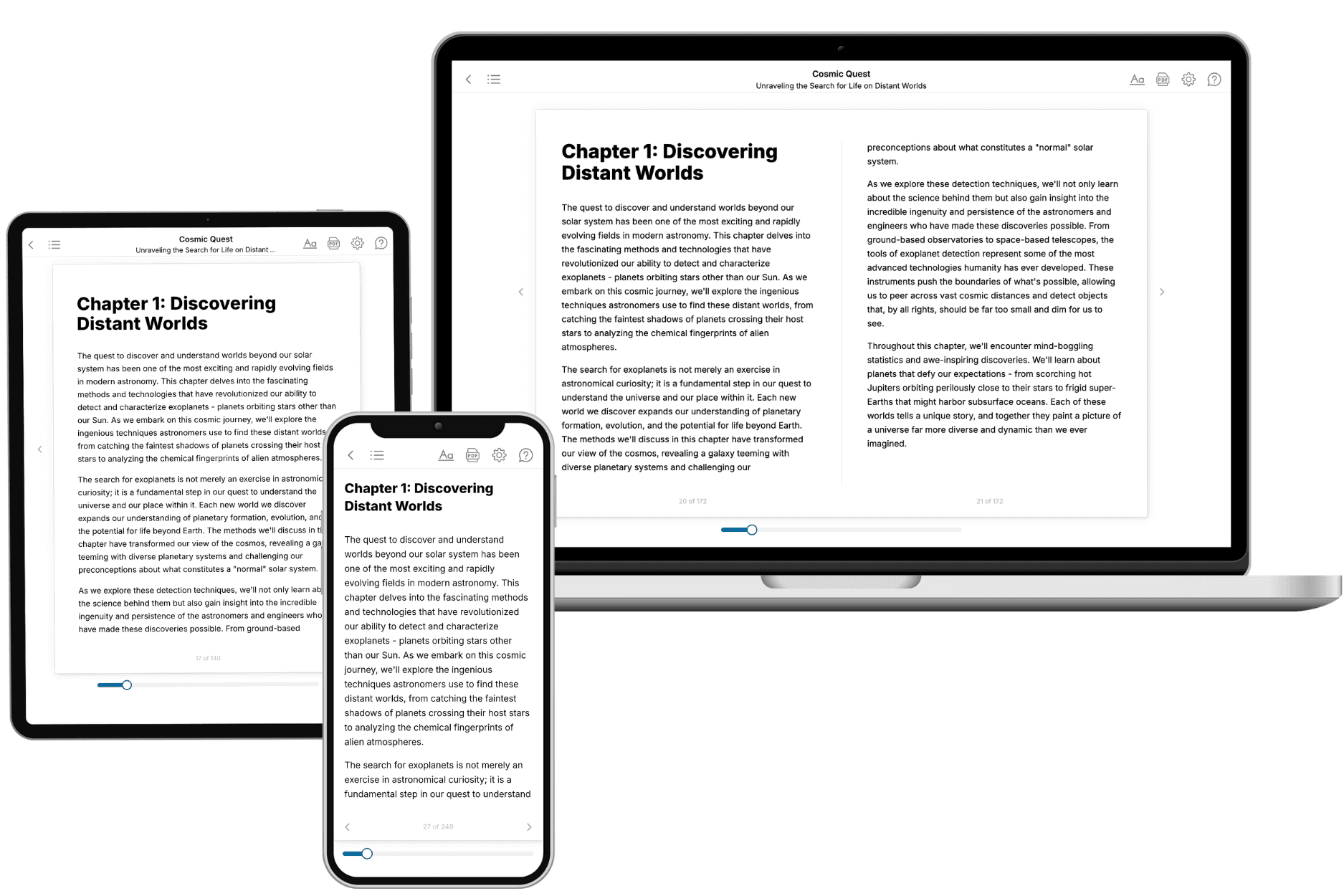
Your book is ready in 10 minutes. Read it online, download as EPUB or PDF, or send to Kindle.

Frequently asked questions
- What is TailoredRead?
TailoredRead creates complete, full-length nonfiction ebooks, written specifically for you. Tell us what you want to learn and why, and TailoredRead writes you a complete ebook on it, with charts, tables, and diagrams throughout. Read it online, on Kindle, or on any e-reader, or download it as a PDF or EPUB. Every book is written fresh the day you order it.
- How is the book tailored to me?
Before anything is written, you answer a few short questions about your goals, your background, and the topics you care about. Your book is then planned around your answers: written at your level, focused on your goals, and covering the topics you chose, instead of the one-size-fits-all book a store sells everyone.
- Will it read like generic AI content?
No. Your book isn't a chat transcript: it's planned chapter by chapter before a single word is written, told in a clear book voice, and explains ideas visually with charts, tables, and diagrams. After writing, every book goes through an editorial pass that polishes chapters so the book reads consistent from start to finish. Judge for yourself: browse thousands of sample books on our Explore Books page.
- How accurate is the content?
Our AI first checks whether your subject needs live research. Niche and fast-moving subjects are researched before writing, and the book plan and chapters are grounded in what it finds. After writing, every book goes through a quality pass that checks its facts and consistency, and researched books list their sources in a Notes section at the back.
- How long is the book?
You choose the length: Comprehensive (250-300 pages), Detailed (150-200 pages), Essential (70-100 pages), or Short (30-50 pages).
- Does the book include visuals?
Yes. Every book includes charts, tables, and diagrams: timelines, checklists, step-by-step guides, decision trees, comparison tables, matrices, and bar charts. A typical book includes dozens of these visual elements.
- Can I read it on Kindle? What formats can I download?
Yes. Every book can be read in our online reader or downloaded as a PDF or EPUB. The EPUB can be opened with Kindle, Apple Books, Kobo, and any e-reader. The Commercial and Author licenses also include an editable Word (DOCX) and Markdown download.
- How much does it cost?
About the price of a regular ebook. The exact price depends on your book's length and complexity, from $2 for the shortest books to $35 for the most comprehensive, and it's shown when you review your book, before you commit to anything. Each book is a one-time purchase, yours to keep, no subscription. Licenses that let you share, teach, or publish your book range from $35.99 to $49.99.
- Can I preview the book before purchasing?
Before you pay, you'll see what your book will cover: the title, a detailed description, the estimated length, and the complete chapter-by-chapter table of contents, so you know what you're getting before you decide. The full text itself is written after you purchase.
- How long does it take to create a book?
About 10 minutes. You can start reading the opening chapters while the rest is still being written.