The End of Empire
How Britain Lost Its Colonies and Reshaped the Modern World
Discover how the world's most powerful empire systematically dismantled itself over just two decades.
207 pages10 chaptersNov 4, 2025British History
About this book
This book traces the dramatic collapse of British imperial rule from the end of World War II through the 1970s, revealing the political calculations, nationalist uprisings, and global power shifts that transformed the map of the world. You'll explore how Britain navigated the loss of India, Africa, and the Caribbean, examining the perspectives of both colonial administrators grappling with inevitable change and independence leaders fighting for their nations' futures. Through compelling historical narratives and clear analysis, you'll understand why decolonization happened when it did, how it unfolded across different regions, and what consequences still reverberate today. This is not a story of inevitable progress or simple good versus evil—it's a nuanced examination of how empires end and how that ending continues to shape our modern world.
Table of contents
- IntroductionThe Empire at Its Peak, Why Empires End, What This Book Covers, How to Read This BookRead below
- Chapter 1: The Cracks Begin to Show: Britain After World War IIThe Economic and Military Toll of War, American Pressure Against Colonialism, Rising Expectations in the Colonies
- Chapter 2: India: The Jewel Slips AwayDecades of Resistance and Negotiation, Partition and Its Tragic Consequences, Independence and Britain's Retreat
- Chapter 3: The Middle East: Oil, Strategy, and WithdrawalThe Suez Crisis: A Turning Point, Retreat from the Persian Gulf, Redefining Britain's Role in the Region
- Chapter 4: Africa: The Scramble ReversedThe Rise of African Nationalism, East Africa: Kenya, Uganda, and Tanganyika, West Africa: Ghana and Nigeria Lead the Way, Southern Africa: Rhodesia and the Difficult Cases
- Chapter 5: The Caribbean and Pacific: Distant ColoniesCaribbean Independence and Continued Ties, Pacific Island Territories and Gradual Transitions, Economic Dependencies After Independence
- Chapter 6: The Cold War Factor: Superpowers and DecolonizationSoviet Support for Independence Movements, American Strategic Interests, The Non-Aligned Movement and Third World Politics
- Chapter 7: Armed Struggle: When Negotiation FailedThe Malayan Emergency and Counterinsurgency, Kenya's Mau Mau Uprising, Other Armed Conflicts and Their Outcomes
- Chapter 8: The Commonwealth: Empire ReimaginedFrom Empire to Commonwealth, How the Commonwealth Functioned, The Limits of Commonwealth Influence
- Chapter 9: Legacies and Consequences: The World After EmpireInherited Borders and Ongoing Conflicts, Economic Relationships and Neo-Colonialism, Language, Culture, and Colonial Legacies, Political Systems and Governance Challenges
- Chapter 10: Britain's New Identity: From Empire to Middle PowerBritain's Search for a New Role, Turning Toward Europe, The Special Relationship with America
- ConclusionWhat Decolonization Teaches Us, Questions That Remain
- Further Reading
Introduction
In 1945, the British Empire stretched across nearly a quarter of the world's land surface and governed roughly 700 million people. British administrators in London made decisions that affected lives from Singapore to Jamaica, from Cairo to Cape Town. The Union Jack flew over territories on every continent, and British naval power still dominated crucial sea routes. Yet within just three decades, this vast imperial structure had almost entirely disappeared. By 1975, Britain controlled only a handful of small territories, and dozens of new nations had emerged from what had been the world's largest empire. This transformation represents one of the most dramatic geopolitical shifts in modern history, reshaping international relations, redrawing maps, and creating new nations that would define the second half of the twentieth century.
The story of how Britain lost its empire is not simply a tale of decline or defeat. It involves complex negotiations between British officials and independence leaders, violent uprisings and peaceful transitions, strategic calculations and moral reckonings. Different colonies followed vastly different paths to independence. India achieved freedom through decades of organized resistance and negotiation. Kenya's path involved armed conflict and brutal counterinsurgency. Ghana's independence came relatively smoothly, while Rhodesia's white minority clung to power for years after Britain withdrew. Understanding these varied experiences reveals how decolonization was shaped by local conditions, international pressures, and the specific relationships between colonizers and colonized in each territory.
This book examines why the British Empire ended when it did, how the process unfolded across different regions, and what consequences continue to shape our world today. You'll discover the economic pressures that made empire unsustainable, the nationalist movements that challenged British rule, and the Cold War dynamics that influenced independence timelines. You'll explore the perspectives of both British officials managing imperial retreat and independence leaders fighting for their nations' futures. Most importantly, you'll understand that decolonization was not inevitable or predetermined—it resulted from specific historical forces, human decisions, and political struggles that could have unfolded differently. The choices made during this period created borders, institutions, and relationships that still affect international politics, economic development, and regional conflicts decades later.
The end of the British Empire matters because it fundamentally changed how we organize our world. The international system we inhabit today—with its emphasis on national sovereignty, its network of international organizations, and its ongoing debates about intervention and self-determination—emerged directly from the decolonization era. Former colonies now make up the majority of United Nations members. The economic relationships established during and after independence continue to shape global trade patterns and development challenges. Border disputes created by hasty imperial withdrawals still generate conflicts. Understanding how this transformation happened provides essential context for comprehending contemporary global politics, North-South economic relations, and the lasting impacts of colonialism on both former colonies and former colonial powers.
The Empire at Its Peak
The British Empire reached its maximum territorial extent in the years immediately following World War I. The Treaty of Versailles and the League of Nations mandate system added former German and Ottoman territories to British control, including Tanganyika, parts of Cameroon and Togo in Africa, and Palestine, Transjordan, and Iraq in the Middle East. By the early 1920s, Britain governed approximately 458 million people across territories totaling about 13.7 million square miles[1]. This vast domain included formal colonies with direct British administration, protectorates where local rulers governed under British supervision, dominions with substantial self-government, and mandated territories held in trust. The empire's reach was genuinely global, with possessions in every time zone and on every inhabited continent.
The empire's structure reflected different types of colonial relationships developed over centuries of expansion. The white dominions—Canada, Australia, New Zealand, and South Africa—enjoyed substantial autonomy and self-government, with populations primarily of European descent. These territories had achieved responsible government during the nineteenth century and were moving toward full independence in foreign policy by the 1920s and 1930s. The crown colonies like Jamaica, Kenya, and Hong Kong experienced direct rule from London through appointed governors. Protectorates such as Uganda and the Malay states maintained indigenous rulers who governed under British supervision and protection. India occupied a unique position as the empire's most valuable possession, with a complex administrative system combining direct British rule over some provinces and indirect rule through hundreds of princely states.
Britain's imperial power rested on several interconnected foundations that made this global system possible:
- Naval supremacy: The Royal Navy controlled crucial sea routes and could project power globally, protecting trade and communications
- Economic integration: Colonial economies were structured to supply raw materials to Britain and purchase British manufactured goods
- Administrative systems: A relatively small number of British officials governed vast territories through local intermediaries and indigenous administrative structures
- Military garrisons: Strategic bases and colonial armies maintained order and defended against external threats
- Cultural influence: English language, British education systems, and cultural institutions spread British values and created local elites educated in British traditions
- Financial networks: London served as the financial center for imperial trade, with the pound sterling functioning as the empire's common currency
The economic benefits of empire to Britain were substantial but unevenly distributed. Colonial territories provided raw materials—rubber from Malaya, cotton from India and Egypt, cocoa from the Gold Coast, tea from Ceylon—that fed British industries and generated export earnings. Colonial markets absorbed British manufactured goods, though this became less important as Britain's industrial dominance declined in the early twentieth century. India alone contributed significantly to British finances, with Indian revenues funding the Indian Army that Britain deployed throughout Asia and the Middle East. The City of London profited enormously from financing imperial trade and investment. However, the costs of defending and administering this vast empire were also substantial, requiring military expenditure, administrative personnel, and infrastructure investment that would become increasingly burdensome.
Despite its apparent strength in the 1920s, the empire already contained seeds of its eventual dissolution. Nationalist movements had emerged in India, Egypt, and Ireland, challenging the legitimacy of British rule. The dominions were asserting greater independence in foreign policy, formalized in the 1931 Statute of Westminster that recognized their autonomy. The League of Nations mandate system, while expanding British territorial control, also introduced the principle that colonial rule should prepare territories for eventual self-government—a concept that contradicted traditional imperial assumptions. Economic competition from the United States and Japan was eroding Britain's industrial advantages. Most fundamentally, the democratic principles that Britain claimed to represent at home sat uneasily with authoritarian rule over hundreds of millions of people abroad, a contradiction that would become increasingly difficult to sustain.
The interwar period saw Britain attempting to adapt its imperial system to changing circumstances while maintaining control. Constitutional reforms in India, beginning with the 1919 Government of India Act and continuing with the 1935 Government of India Act, introduced limited self-government at provincial levels while keeping ultimate power in British hands. In Africa, the doctrine of indirect rule formalized the practice of governing through traditional authorities, supposedly preserving indigenous institutions while maintaining British oversight. In the Middle East, Britain granted nominal independence to Iraq and Egypt while retaining military bases and control over foreign policy. These adaptations represented attempts to make empire more sustainable and less costly, but they also created expectations for further political advancement that would prove difficult to contain. The empire at its peak was already beginning the long process of transformation that would accelerate dramatically after 1945.
Understanding the empire at its height is essential for comprehending what was lost and what changed during decolonization. For Britain, the empire represented global power, economic advantage, and national prestige. For colonial subjects, it meant varying degrees of political subordination, economic exploitation, and cultural domination, but also access to British markets, investment, and institutions. The relationships established during the imperial period—economic dependencies, administrative systems, educational networks, and personal connections—would shape how decolonization unfolded and what kind of post-colonial relationships emerged. The empire's diversity meant that no single decolonization model could apply everywhere; each territory's unique history, economy, and social structure would influence its path to independence.
Why Empires End
Empires throughout history have eventually dissolved, but the reasons and mechanisms vary considerably. Some empires collapse suddenly through military defeat, as happened to the German, Austro-Hungarian, and Ottoman empires after World War I. Others fragment gradually as central authority weakens and peripheral territories break away, like the decline of the Roman Empire. Still others transform into different political structures, as the Russian Empire became the Soviet Union. The British Empire's end followed yet another pattern: a relatively rapid but largely managed withdrawal from formal political control, driven by a combination of economic pressures, nationalist resistance, and changing international norms. Understanding why empires end in general helps explain the specific factors that made the British Empire unsustainable after 1945.
The fundamental challenge facing any empire is the cost-benefit calculation of maintaining control over distant territories. Empires persist when the benefits—economic resources, strategic advantages, prestige, or security—outweigh the costs of administration, defense, and suppression of resistance. This calculation changes over time as circumstances evolve. Military technology can make territories easier or harder to defend. Economic development can make colonies more or less valuable. Resistance movements can raise the costs of control. International pressure can make empire politically expensive. For Britain after World War II, multiple factors simultaneously shifted this calculation against empire. The economic benefits of colonial control diminished as Britain's economy weakened and alternative trade relationships became available. The costs of maintaining control increased as nationalist movements gained strength and required military suppression. International opinion, particularly from the United States and Soviet Union, turned decisively against colonialism.
Nationalist resistance represents another crucial factor in imperial decline. Empires can govern effectively only when subject populations accept or acquiesce to foreign rule. When significant portions of the population actively resist, the costs of maintaining control escalate dramatically. The British Empire faced increasingly sophisticated nationalist movements that employed various strategies:
- Mass mobilization: Organizations like the Indian National Congress built broad-based movements that made colonies difficult to govern
- International advocacy: Independence leaders appealed to international opinion and organizations like the United Nations
- Armed resistance: Guerrilla campaigns in Malaya, Kenya, and Cyprus raised the military costs of colonial control
- Economic disruption: Strikes, boycotts, and non-cooperation campaigns undermined colonial economic systems
- Ideological challenge: Nationalist leaders articulated visions of self-determination that contradicted imperial justifications
The legitimacy crisis of empire proved equally important. Empires require some ideological justification—a reason why foreign rule is acceptable or beneficial. The British Empire had long justified itself through claims of bringing civilization, development, and good government to supposedly backward peoples. This civilizing mission
narrative became increasingly untenable in the twentieth century. World War II, fought explicitly against fascist ideologies of racial superiority, made it difficult to maintain that some peoples were unfit for self-government. The Atlantic Charter of 1941, signed by Britain and the United States, proclaimed the right of all peoples to choose their own government, though Britain initially tried to limit this principle to European nations under Nazi occupation. The United Nations Charter of 1945 enshrined self-determination as a fundamental principle. Britain found itself defending an imperial system that contradicted the democratic values it claimed to represent.
Economic transformations also undermined the imperial system. The nineteenth-century empire had been built on Britain's industrial supremacy and its need for raw materials and markets. By the mid-twentieth century, this economic logic had weakened considerably. Britain's share of global manufacturing had declined as other nations industrialized. Colonial markets became less important as Britain developed trade relationships with other industrial nations. The costs of colonial administration and defense increasingly outweighed the economic benefits, especially as colonies demanded more investment in infrastructure, education, and social services. The sterling area—the system of currency controls that channeled colonial trade through London—became more of a burden than an advantage as Britain struggled with balance of payments problems. Decolonization often made economic sense because it allowed Britain to shed expensive administrative and military commitments while maintaining profitable trade and investment relationships.
The international context after 1945 created unprecedented pressure for decolonization. Both superpowers opposed European colonialism, though for different reasons. The Soviet Union supported anti-colonial movements as part of its broader challenge to Western capitalism and its appeal to the developing world. The United States, despite its own history of territorial expansion, generally opposed European colonialism as economically inefficient and strategically dangerous, fearing that colonial oppression would drive nationalist movements toward communism. The United Nations provided a forum where newly independent nations could advocate for decolonization and condemn remaining colonial powers. The Bandung Conference of 1955 and the subsequent Non-Aligned Movement created solidarity among Asian and African nations demanding independence. Britain found itself increasingly isolated in defending colonialism against this international consensus.
Finally, domestic politics within Britain itself shifted toward accepting decolonization. The Labour Party, which governed from 1945 to 1951 and again from 1964 to 1970, was generally more sympathetic to colonial nationalism than the Conservative Party, though both parties ultimately presided over decolonization. The British public, exhausted by war and focused on domestic reconstruction, showed little enthusiasm for expensive military campaigns to maintain colonial control. The Suez Crisis of 1956 demonstrated the limits of British power and the costs of acting without American support, fundamentally changing British calculations about empire. By the 1960s, even Conservative politicians accepted that decolonization was inevitable and focused on managing the process to protect British interests rather than preventing independence. The empire ended not just because colonies demanded independence, but because Britain decided that maintaining formal political control was no longer worth the costs.
What This Book Covers
This book focuses on the period from 1945 to the mid-1970s, when the vast majority of British decolonization occurred. While the process began earlier—Ireland achieved independence in 1922, and Egypt gained nominal independence in 1922—the systematic dismantling of the empire happened primarily in the three decades after World War II. The book examines this transformation chronologically and geographically, tracing how decolonization unfolded in different regions and understanding why timing and processes varied so dramatically. You'll discover that decolonization was not a single event but rather dozens of separate independence processes, each shaped by unique local circumstances, British strategic considerations, and international pressures.
The book is organized to help you understand both the overall pattern of decolonization and the specific experiences of different regions. After this introduction, the narrative begins with Britain's situation after World War II, examining the economic, military, and political factors that made empire increasingly unsustainable. Subsequent chapters explore decolonization in specific regions:
- India and South Asia: The partition of India and Pakistan in 1947, which set important precedents for later decolonization
- The Middle East: Britain's retreat from Palestine, Egypt, and the Persian Gulf, including the pivotal Suez Crisis
- Africa: The rapid decolonization of British Africa from the late 1950s through the 1960s, covering West, East, and Southern Africa
- The Caribbean and Pacific: The independence of smaller territories and the creation of new micro-states
Beyond the regional chapters, the book examines several cross-cutting themes that affected decolonization throughout the empire. A dedicated chapter explores how the Cold War influenced independence movements and British decisions, with both superpowers competing for influence in newly independent nations. Another chapter examines cases where negotiation failed and armed conflict resulted, comparing British counterinsurgency campaigns in Malaya, Kenya, and Cyprus. The transformation of empire into Commonwealth receives detailed attention, analyzing Britain's attempt to maintain influence through voluntary association after formal political control ended. These thematic chapters help you understand the broader forces shaping decolonization beyond specific territorial cases.
The book pays particular attention to the consequences and legacies of decolonization, which continue to affect international relations today. You'll explore how hastily drawn borders created ongoing conflicts, how economic relationships established during colonialism persisted after independence, and how political institutions inherited from Britain functioned in post-colonial contexts. The book examines both the perspectives of former colonies dealing with independence's challenges and Britain's own transformation from global empire to European middle power. Understanding these legacies is crucial because decolonization's effects didn't end with independence ceremonies and flag changes—they shaped development trajectories, political systems, and international relationships for decades afterward.
Throughout the book, you'll encounter multiple perspectives on decolonization. British officials saw the process through the lens of managing decline, protecting strategic interests, and maintaining influence after formal control ended. Their decisions reflected calculations about costs and benefits, concerns about Cold War competition, and domestic political pressures. Independence leaders viewed decolonization as the culmination of long struggles for self-determination, though they disagreed about strategies and post-independence visions. Some advocated negotiation and gradual transition; others insisted on immediate independence or armed struggle. Ordinary people in colonies experienced decolonization in varied ways—as liberation, as disruption, as opportunity, or as the replacement of one form of domination with another. The book presents these multiple perspectives to provide a nuanced understanding of this complex historical process.
The book also addresses several important questions that historians continue to debate:
- Was decolonization inevitable, or could the empire have been sustained longer under different circumstances?
- Did Britain voluntarily grant independence, or was it forced to withdraw by nationalist resistance?
- How much did economic factors versus political and moral considerations drive British decisions?
- Could decolonization have been managed better to avoid some of the conflicts and problems that followed?
- Did independence benefit former colonies economically and politically, or did neo-colonial relationships perpetuate dependency?
- How does British decolonization compare to the end of other European empires?
What this book does not attempt to cover comprehensively is the entire history of British colonialism or detailed histories of every territory. The focus remains on the decolonization process itself—how and why it happened—rather than the centuries of colonial rule that preceded it or the complete post-independence histories of former colonies. Some territories receive more attention than others based on their significance to the overall decolonization story. India's independence gets substantial coverage because it was the empire's most valuable possession and set important precedents. The Suez Crisis receives detailed examination because it fundamentally changed British calculations about empire. Smaller territories receive less individual attention but are discussed in the context of broader regional patterns. This selective approach allows the book to maintain focus on understanding decolonization as a historical process while remaining accessible and manageable in length.
How to Read This Book
This book is designed to be read in multiple ways depending on your interests and existing knowledge. If you're new to the topic of British decolonization, reading straight through from beginning to end will provide a comprehensive understanding of the process. The chapters build on each other, with earlier chapters establishing context and patterns that later chapters develop and complicate. The chronological and geographical organization helps you see how decolonization unfolded over time and how experiences in one region influenced British approaches elsewhere. For example, understanding India's partition in 1947 provides essential context for later African decolonization, as British officials tried to avoid similar violence and chaos.
If you already have some familiarity with decolonization or have particular regional interests, you can approach the book more selectively. Each regional chapter is relatively self-contained, with sufficient context to be understood independently. You might choose to read the chapters on Africa if that's your primary interest, or focus on the Middle East chapters if you're trying to understand the origins of contemporary conflicts in that region. However, even selective readers should begin with the introduction and the first chapter on Britain after World War II, as these establish the fundamental economic, political, and international pressures that drove decolonization throughout the empire. The thematic chapters on the Cold War, armed struggles, and the Commonwealth can be read in any order based on your interests.
As you read, pay attention to several recurring themes that appear across different chapters and regions:
- Timing: Why did some territories achieve independence early while others remained colonies longer?
- Methods: What determined whether independence came through negotiation or armed conflict?
- Preparation: How much did Britain invest in preparing colonies for self-government, and how did this affect post-independence outcomes?
- Borders: How were boundaries determined, and what conflicts resulted from these decisions?
- Continuity: What colonial structures, relationships, and dependencies persisted after independence?
- Agency: How much did local actors versus British decisions determine decolonization outcomes?
The book includes specific examples, case studies, and historical details to illustrate broader arguments and patterns. These concrete details serve several purposes: they make abstract concepts tangible, they provide evidence for historical claims, and they reveal the human dimensions of decolonization. When you encounter a detailed example—such as the negotiations leading to Ghana's independence or the violence of Kenya's Mau Mau uprising—consider both what it reveals about that specific case and what broader patterns it illustrates. Ask yourself how this example compares to others you've read about. What's similar and what's different? What explains these similarities and differences? This comparative approach will deepen your understanding of decolonization as a complex historical process.
Throughout the book, you'll encounter historical debates and different interpretations of events. Historians disagree about many aspects of decolonization: whether economic or political factors were more important, whether Britain voluntarily granted independence or was forced to withdraw, whether decolonization was managed well or poorly, and whether independence benefited former colonies. These disagreements reflect both different evidence and different analytical frameworks. Rather than presenting a single authoritative interpretation, the book introduces you to these debates and provides evidence for different perspectives. This approach reflects how historical understanding actually develops—through ongoing discussion and reinterpretation of evidence—and encourages you to think critically about the past rather than simply accepting one narrative.
The book uses several conventions to help you navigate the material effectively. Key terms and concepts appear in bold when first introduced, signaling that these are important ideas worth remembering. Italics indicate emphasis or the introduction of specific historical terms and phrases. Footnotes provide sources for specific claims and direct you to additional reading if you want to explore particular topics in greater depth. Blockquotes highlight particularly important statements, examples, or contemporary observations that illuminate the historical period. These formatting choices are designed to make the text more readable and to help you identify the most important information.
As you read about decolonization, try to avoid two common pitfalls. First, resist the temptation to view the process as inevitable or predetermined. While we know how the story ended—with the empire's dissolution—people living through these events didn't know the outcome. British officials debated whether and how to maintain empire. Independence leaders disagreed about strategies and timing. Outcomes that seem obvious in retrospect were uncertain at the time. Maintaining this sense of contingency—that things could have turned out differently—helps you understand the actual choices and constraints people faced. Second, avoid simplistic moral judgments that divide historical actors into heroes and villains. Decolonization involved complex motivations, difficult choices, and unintended consequences. Understanding this complexity produces richer historical insight than simple condemnation or celebration.
Finally, consider how the history of British decolonization connects to contemporary issues you care about. Many current international conflicts have roots in decolonization: Kashmir, Palestine, Cyprus, and Zimbabwe all involve disputes originating in the imperial period and its ending. Economic relationships between developed and developing nations often reflect patterns established during colonialism and decolonization. Debates about immigration, multiculturalism, and national identity in Britain itself connect to the imperial past and its legacy. International institutions like the Commonwealth and the United Nations were shaped by decolonization. Understanding this history doesn't provide simple answers to contemporary problems, but it does provide essential context for thinking about them more deeply. As you read, consider what connections you see between the past and present, and how historical understanding might inform contemporary debates.
Notes
Introduction
- 1. Niall Ferguson, Empire: The Rise and Demise of the British World Order, Basic Books, 2004
This is the end of the free sample. The full book has 10 chapters.
Want this book written for you?
Tell us your goals and background, and get your own version of this book, tailored by AI to you.


Benefits of AI-tailored books
- Read one book, not ten:
- all the British History knowledge you need, gathered into a single book.
- Save days of learning:
- tell us your goals, choose your topics, and the whole book is built around them.
- Learn effortlessly:
- British History book written for your specific background and expertise.
- Understand at a glance:
- includes charts, tables, timelines, checklists, decision trees, and more.
- Stay current:
- written the day you order it, not years ago.
- Trust what you read:
- every book is checked for accuracy, with real research when your subject needs it.
Create your unique book in 3 steps
- 1. Select your focus
Select the focus of your British History book and share your background
- 2. Personalize your book
Specify your goals and choose sub-topics to include
- 3. Get your tailored book
Your book is ready in 10 minutes. Read it online, download as EPUB or PDF, or send to Kindle.


Frequently asked questions
- What is TailoredRead?
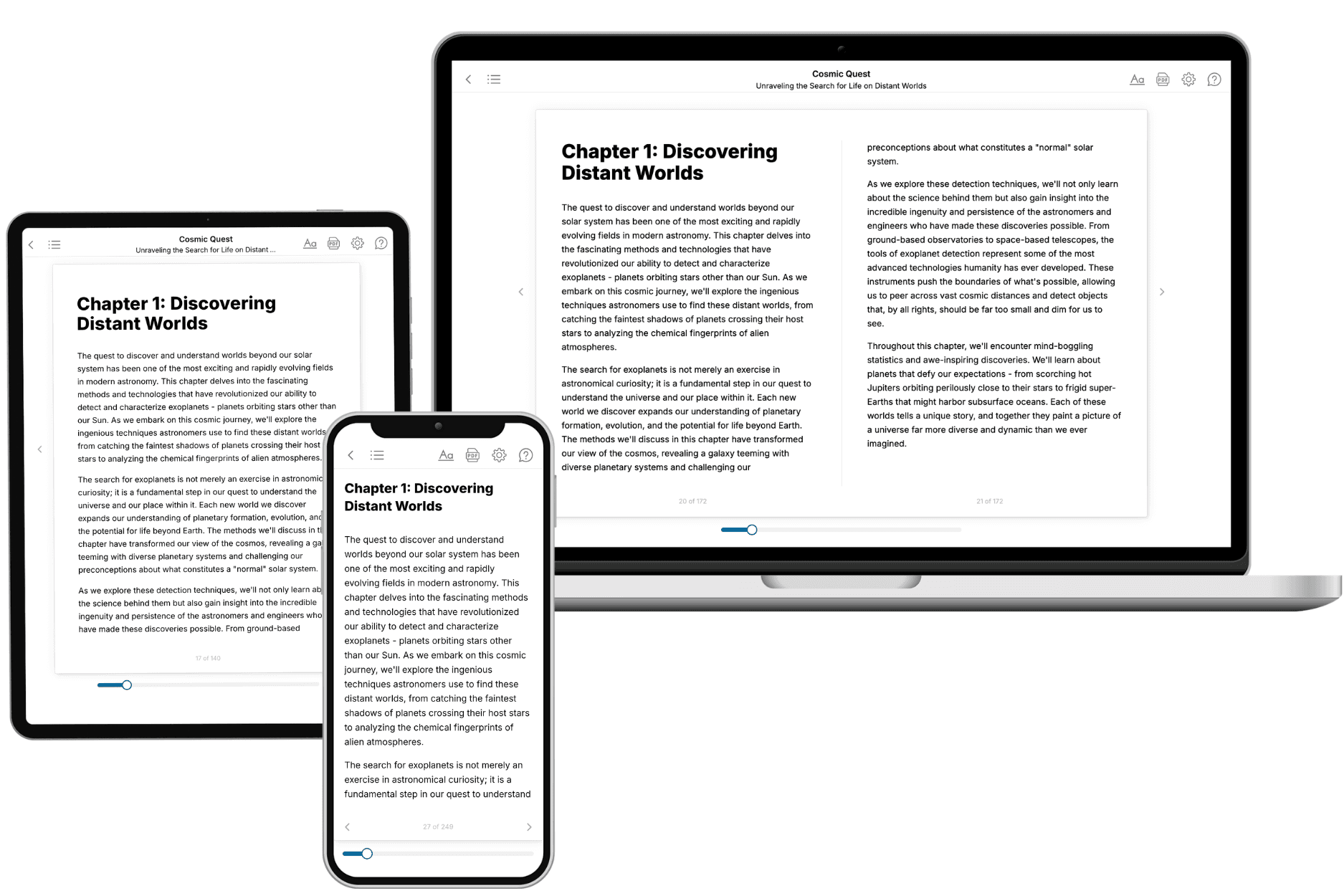
TailoredRead creates complete, full-length nonfiction ebooks, written specifically for you. Tell us what you want to learn and why, and TailoredRead writes you a complete ebook on it, with charts, tables, and diagrams throughout. Read it online, on Kindle, or on any e-reader, or download it as a PDF or EPUB. Every book is written fresh the day you order it.
- How is the book tailored to me?
Before anything is written, you answer a few short questions about your goals, your background, and the topics you care about. Your book is then planned around your answers: written at your level, focused on your goals, and covering the topics you chose, instead of the one-size-fits-all book a store sells everyone.
- Will it read like generic AI content?
No. Your book isn't a chat transcript: it's planned chapter by chapter before a single word is written, told in a clear book voice, and explains ideas visually with charts, tables, and diagrams. After writing, every book goes through an editorial pass that polishes chapters so the book reads consistent from start to finish. Judge for yourself: browse thousands of sample books on our Explore Books page.
- How accurate is the content?
Our AI first checks whether your subject needs live research. Niche and fast-moving subjects are researched before writing, and the book plan and chapters are grounded in what it finds. After writing, every book goes through a quality pass that checks its facts and consistency, and researched books list their sources in a Notes section at the back.
- How long is the book?
You choose the length: Comprehensive (250-300 pages), Detailed (150-200 pages), Essential (70-100 pages), or Short (30-50 pages).
- Does the book include visuals?
Yes. Every book includes charts, tables, and diagrams: timelines, checklists, step-by-step guides, decision trees, comparison tables, matrices, and bar charts. A typical book includes dozens of these visual elements.
- Can I read it on Kindle? What formats can I download?
Yes. Every book can be read in our online reader or downloaded as a PDF or EPUB. The EPUB can be opened with Kindle, Apple Books, Kobo, and any e-reader. The Commercial and Author licenses also include an editable Word (DOCX) and Markdown download.
- How much does it cost?
About the price of a regular ebook. The exact price depends on your book's length and complexity, from $2 for the shortest books to $35 for the most comprehensive, and it's shown when you review your book, before you commit to anything. Each book is a one-time purchase, yours to keep, no subscription. Licenses that let you share, teach, or publish your book range from $35.99 to $49.99.
- Can I preview the book before purchasing?
Before you pay, you'll see what your book will cover: the title, a detailed description, the estimated length, and the complete chapter-by-chapter table of contents, so you know what you're getting before you decide. The full text itself is written after you purchase.
- How long does it take to create a book?
About 10 minutes. You can start reading the opening chapters while the rest is still being written.