Crossing the Isthmus
Teaching Afro-Caribbean Migration Through Panama's Railroad and Canal
Many teachers want to cover Panama's railroad and canal history, but the Afro-Caribbean workers who built and sustained these projects often receive only a sentence or two in textbooks.
191 pages10 chaptersOct 30, 2026
About this book
Gaps in sources, competing population estimates, and sensitive material on racism and citizenship can make the topic feel difficult to teach with confidence. This book was written to close that gap. It walks through the migration routes that brought West Indian workers to Panama from the 1850s through the 1940s, explains how the Panama Railroad, the French and American canal efforts, and the Canal Zone shaped labor and daily life, and examines the Silver Roll divide, Jim Crow practices, and the long fight over citizenship. Along the way, it offers practical guidance on integrating Afro-Caribbean perspectives, using primary sources, connecting lessons to local family histories, and designing classroom activities that build historical thinking. A curated reading list gives teachers a path to deeper study. Whether you teach a single unit or a full course, this book gives you the context and tools to present Afro-Panamanian history clearly, accurately, and with respect for the people at its center.
Table of contents
- IntroductionWhy This Story Matters in Classrooms, How to Use This Guide, Key Terms and Source CaveatsRead below
- Chapter 1: The Panama Railroad and Early West Indian LaborBuilding the Railroad Across the Isthmus, Recruitment and Conditions for Early Workers, Colón as a Port of Arrival
- Chapter 2: Migration Routes and Caribbean OriginsWhere Migrants Came From in the Caribbean, Sea Routes and Steamship Traffic, Why Migration Estimates Differ
- Chapter 3: The French Canal Project and Its WorkersWho Worked on the French Canal, Disease, Mortality, and Labor Conditions, What the French Years Left Behind
- Chapter 4: U.S. Canal Construction and Labor HierarchiesAssembling the American Construction Workforce, The Silver Roll and the Gold Roll, Sanitation Campaigns and Who Benefited
- Chapter 5: Segregation and Jim Crow in the Canal ZoneHousing, Towns, and Spatial Separation, Canal Zone Schools and Unequal Education, Everyday Discrimination and Social Life
- Chapter 6: Citizenship, Law, and the 1941 ConstitutionPanamanian Nationality Before 1941, How the 1941 Constitution Affected Afro-Caribbean Families
- Chapter 7: Community Formation and Afro-Antillean IdentityChurches, Societies, and Mutual Aid, Language, Religion, and Cultural Continuity, Postcolonial Caribbean Identity in Panama
- Chapter 8: Afro-Caribbean Panamanian ActivismEarly Organizing and Civic Associations, Claims for Rights and Recognition
- Chapter 9: Teaching With Sources and Designing LessonsPrimary Source Activities for Students, Connecting Lessons to Local Family Histories, Countering Stereotypes in History Lessons
- Chapter 10: Panama's Curriculum Reform and Next StepsRecent Curriculum Changes and Their Goals, Building a Reading List for Teachers, Putting the Guide Into Practice
- ConclusionCarrying the Story Into Your Classroom
Introduction
A ninth-grade teacher in Colón once asked her students to name the languages their grandparents spoke at home. More than half raised their hands for English, patois, or a Caribbean-inflected Spanish that mixed all three. None of their textbooks explained why. The students could recite the opening year of canal construction and the name of the chief engineer, but they had no language for their own family's presence in that story. That gap between a well-known national narrative and the lived history sitting in the classroom is the starting point for this guide.
Afro-Caribbean and West Indian migration to Panama is not a side note to the railroad and canal story. It is one of the central threads that made both projects possible, and it continues to shape Panamanian society, politics, and culture today. Yet many curricula compress this history into a single sentence about imported labor, stripped of names, conditions, or consequences. Teachers who want to do better often find themselves short on reliable, classroom-ready material, caught between dense academic monographs on one side and thin textbook summaries on the other.
This book exists to fill that middle space. It draws on archival records, academic scholarship, and educational resources to build a narrative teachers can adapt for middle school, high school, or college classrooms. It does not assume specialist knowledge of Caribbean or Panamanian history, but it does assume a teacher's instinct for finding the human stakes in a historical process. Each chapter pairs historical content with practical classroom tools, so the material can move from the page into a lesson plan without a long detour through additional research.
The chapters ahead follow a roughly chronological arc, beginning with the Panama Railroad and early West Indian labor recruitment, moving through the Compagnie Universelle du Canal Interocéanique's French canal effort, the U.S. canal project and its Silver Roll and Gold Roll system, the segregation of the Canal Zone, the citizenship crisis tied to Panama's 1941 Constitution, and the community institutions and activism that sustained Afro-Antillean identity across generations. A later section turns fully to pedagogy, with guidance on primary sources, family history projects, and countering stereotypes, and a final section surveys Panama's current curriculum reform efforts.
Before any of that, this introduction sets the terms of engagement. It explains why this history deserves more than a passing mention, offers a practical map for using the book depending on your grade level and available time, and clarifies the vocabulary and source caveats that will recur throughout. Treat this introduction as the orientation session before a longer expedition, the part where you check your equipment and agree on the route before setting out.
Why This Story Matters in Classrooms
History curricula tend to organize themselves around nations and their founding achievements, which is one reason the Panama Canal often appears as an engineering triumph attached to a single country's ambition. That framing leaves little room for the tens of thousands of workers whose labor, families, and losses made the achievement possible. When a curriculum skips from "the canal was built" to "the canal opened," it erases an entire population's experience in the space of a sentence. Restoring that population to the story is not an act of correction for its own sake. It is a matter of basic historical accuracy, since the canal cannot be explained without the people who dug it.
There is also a present-day stake in this material. Afro-Panamanian communities descended from West Indian migrants are still visible in Panama today, concentrated in places like Colón and parts of Panama City, carrying surnames, religious traditions, and language patterns that trace directly back to Caribbean islands. Students with this heritage often encounter their own family history nowhere in the official curriculum, which can send an unintended message that their background is marginal to the national story. Teaching this history well tells those students the opposite: that their ancestors were not incidental laborers but central actors whose choices and endurance shaped a hemisphere-altering project.
For students without this heritage, the material offers something different but equally valuable. It is a case study in how large infrastructure projects depend on recruiting, managing, and often exploiting workers from outside the host country, a pattern that repeats across the history of canals, railroads, mines, and plantations worldwide. Studying the Panama case in detail, with its distinct waves of migration and labor each shaped by different companies and different eras, gives students a concrete model for thinking about labor migration more broadly rather than leaving it as an abstract concept.
The subject also provides an unusually clear entry point into questions of race, law, and citizenship that can otherwise feel abstract in a classroom setting. The Silver Roll and Gold Roll system (covered in detail in the chapter on U.S. canal construction and labor hierarchies) shows students exactly how a bureaucratic payroll category could become a tool of racial segregation, with consequences for wages, housing, and daily dignity. Few other examples make the mechanics of institutionalized discrimination so visible in official paperwork, which makes it a strong teaching tool for students who are encountering this kind of analysis for the first time.
Citizenship law offers a parallel lesson. The chapter on Panamanian nationality and the 1941 Constitution traces how legal text, seemingly neutral on its face, could strip or threaten the citizenship of people who had lived in Panama for decades, simply because of their ethnic or linguistic background. This is a case study in how law operates as a lived force rather than an abstract text, and it connects directly to ongoing global debates about birthright citizenship, statelessness, and belonging. Students who grasp this case will be better equipped to recognize similar patterns elsewhere.
Finally, this history resists a single, simple narrative of victimhood, which makes it richer material for building historical thinking skills. Afro-Caribbean migrants to Panama organized mutual aid societies, built churches and schools, and engaged in sustained activism to defend their rights, all of which is detailed in the chapters on community formation and activism. Teaching only the hardship, without the organizing and resilience that followed it, flattens the story and denies students the chance to study agency alongside oppression. A full account gives students both halves: the structures that constrained people's lives and the choices people made within and against those structures.
A history that only documents suffering teaches students to see a population as passive. A history that also documents organizing teaches them to see a population as historical actors in their own right.
There is a practical reason to care about this material as well, apart from its intrinsic importance. State and national standards in many places increasingly call for curricula that reflect diverse perspectives and that move beyond single-story narratives of national achievement. Afro-Caribbean migration to Panama is a ready-made case study for meeting those standards without resorting to generic or token inclusion. It has enough depth, enough primary source material, and enough connection to broader themes (labor, race, law, migration, identity) to support a full unit rather than a single supplementary reading.
Consider also the comparative value of this material for a broader Latin American or U.S. history course. The Panama story sits at an intersection: it involves European colonial legacies in the Caribbean, American imperial ambitions on the isthmus, and Panamanian nation-building, all converging on one narrow strip of land. A teacher who wants students to understand how global forces intersect in local places has few better examples available, since the layers of empire, labor, and nationality are compressed into a small and well-documented geography.
The subject additionally opens a path to interdisciplinary teaching. A unit on this material can connect naturally to geography (the sea routes and island origins covered in the migration routes chapter), to civics (citizenship law and constitutional change), to language arts (oral history and family narrative projects), and to public health (the disease and sanitation history tied to both canal projects). Teachers working in team structures or project-based programs can use this flexibility to build cross-curricular units rather than confining the material to a single history class period.
None of this means the material is easy to teach. It involves racial violence, legal exclusion, and significant loss of life, all of which require care in how they are presented to younger students. The chapter on teaching with sources addresses this directly, with guidance on primary source activities and age-appropriate framing. The difficulty of the material is a reason for better preparation, not a reason for avoidance, and that preparation is exactly what this book is built to provide.
It also matters that this is not a finished or settled history. The 2026 Harvard dissertation on Afro-Caribbean Panamanian memory, diaspora, and kinship is one example of ongoing scholarship that continues to refine how historians understand this community's experience and self-understanding[1]. Framing the subject as an active area of research, rather than a closed chapter, gives students an honest picture of how historical knowledge develops and invites them to see themselves as potential contributors to that ongoing work rather than passive recipients of a fixed account.
Taken together, these reasons point to a simple conclusion: this is not peripheral content to be added if time allows. It belongs in the core sequence of any course that touches Panama, the Caribbean, labor history, or the history of U.S. expansion abroad. The chapters that follow are built to support that placement, with enough historical depth to stand on their own and enough classroom tools to make the transition from reading to teaching as direct as possible.
How to Use This Guide
This book is organized to let you move in more than one direction, depending on your course structure and the time available. Read straight through if you are building a dedicated unit on Afro-Caribbean migration and want the full chronological arc, from the railroad era through contemporary curriculum reform. Read selectively if you are weaving shorter segments into an existing U.S. history, Latin American history, or Caribbean studies course, pulling specific chapters that match the moment in your syllabus where this material fits best.
For a middle school classroom, focus on the narrative chapters with strong human stories and visual or concrete detail: the railroad construction chapter, the chapter on migration routes and Caribbean origins, and the chapter on community formation and Afro-Antillean identity. These sections lend themselves to storytelling, map work, and simple primary source excerpts without requiring extended analysis of legal or statistical material. Pair them with the family history project ideas described in the chapter on teaching with sources, since younger students often respond strongly to assignments that connect classroom content to their own households.
For a high school classroom, the full sequence becomes workable, particularly the chapters on the Silver Roll and Gold Roll system, Canal Zone segregation, and the 1941 Constitution's effect on citizenship. These chapters introduce analytical skills, such as evaluating conflicting population estimates or interpreting legal text for its practical effects, that align well with high school historical thinking standards. Consider building a short unit of four to six class periods using chapters four through six as the spine, supplemented by one or two primary source activities per week.
For a college course, the book works best as a starting framework rather than a complete syllabus. Use it to establish the narrative scaffolding and chronology, then supplement each chapter with the academic sources it points toward for deeper study. The chapter on building a reading list, found in the section on curriculum reform and next steps, is designed specifically to support this kind of extension, offering a structured path from this introductory material into more specialized scholarship.
Each content chapter follows a consistent internal structure to make navigation predictable. It opens by establishing a specific historical period or mechanism, develops that content across two or three focused subsections, and includes practical classroom elements such as checklists, timelines, or discussion prompts embedded directly in the text. This structure means you can extract a single subsection for a single class period without needing to read the entire chapter first, though the fuller chapter will always provide more context for your own preparation.
A note on sequencing: while the chapters are numbered to follow historical chronology, several of the thematic chapters, particularly those on community formation, activism, and citizenship, can be taught in a different order without losing coherence. If your course emphasizes legal history, consider teaching the citizenship chapter immediately after the Canal Zone segregation chapter, since the two mechanisms (bureaucratic racial classification and formal legal exclusion) reinforce each other well when studied back to back.
The checklist below offers a quick way to match this book's content to the planning stage you are currently in, whether you are building a new unit from scratch or refreshing an existing lesson.
Matching This Guide to Your Planning Stage
- Building a new unit: read the full chronological sequence from the railroad chapter through curriculum reform
- Supplementing an existing U.S. history course: pull the chapters on the Silver Roll, Gold Roll, and Canal Zone segregation
- Supplementing a Caribbean studies course: pull the chapters on migration routes, community formation, and activism
- Planning a single class period: extract one subsection and pair it with a primary source activity from the teaching chapter
- Designing a student project: use the family history project guidance alongside the community formation chapter
- Preparing for difficult content: review the countering stereotypes subsection before teaching segregation or citizenship material
Each chapter also includes definitions of key terms as they are introduced, rather than isolating all vocabulary in a single glossary at the back of the book. This choice reflects a simple teaching principle: vocabulary sticks better when it is introduced at the moment it becomes necessary to understand the surrounding content, rather than memorized in a list disconnected from context. If a term reappears in a later chapter, it will be used consistently with its original definition, which is why the next subchapter establishes a small set of canonical terms up front.
Where the book includes numerical claims, such as population estimates or counts, treat those numbers with appropriate caution rather than as settled facts to memorize. The chapter on migration routes addresses this directly, since historical estimates of how many West Indian migrants came to Panama differ significantly depending on the source, the period covered, and the counting method used. Rather than asking students to recall a single figure, use these discrepancies as a teaching opportunity about how historians work with incomplete records.
Consider pairing each major unit from this book with at least one local or family-based research component, even if your students have no direct connection to Panama. The exercise of researching one's own family migration history, or researching a local immigrant community's history, builds the same historical thinking skills that the book's Panama-specific content is meant to develop. The chapter on connecting lessons to local family histories offers a template for this kind of assignment that can be adapted to almost any classroom context.
If you are new to teaching about race and segregation in a historical context, review the countering stereotypes subsection in the teaching chapter before you begin the unit, not after. That subsection addresses common misconceptions, including the tendency to conflate all people of African descent in Panama into a single undifferentiated group, when in fact the history involves distinct populations with different origins and different relationships to Panamanian national identity. Preparing for this distinction in advance will help you avoid reinforcing the very stereotypes the book is designed to counter.
Use the citations throughout the book as a starting point for your own further reading, not as a complete bibliography. Each footnote points to a specific source behind a specific claim, which means you can trace any individual fact back to its origin if a student or colleague asks a follow-up question you cannot immediately answer. This transparency is intentional: teaching contested or sensitive history works best when you can show your sourcing rather than asking students to take claims on faith.
Finally, treat this book as a living resource rather than a finished product to be taught exactly as written. Panama's own curriculum reform efforts, discussed in the closing content chapter, are ongoing, and new scholarship continues to refine understanding of this history. Build in room to update your lessons as new sources become available, and consider connecting with colleagues who teach Caribbean, Latin American, or U.S. history to compare notes on how this material lands with different student populations.
Key Terms and Source Caveats
A small set of terms will recur throughout this book, and establishing their meaning now will save confusion later. West Indian refers broadly to people from the English-speaking Caribbean islands, the primary source of the migrant labor force discussed across most chapters. Afro-Antillean is the term often used specifically for the descendants of these migrants within Panama, marking a distinct ethnic and cultural identity that formed on Panamanian soil rather than simply transplanting an island identity unchanged. Using these terms precisely, rather than interchangeably, helps students understand that identity formation in Panama was its own historical process, not a static import.
The terms Silver Roll and Gold Roll refer to the payroll classification system used during the U.S. canal project, where workers were sorted into these categories in a way that closely tracked race, with significant consequences for pay, housing, and access to facilities. This system is explained in full detail in the chapter on U.S. canal construction and labor hierarchies, but it is worth flagging early because it recurs as a reference point across several later chapters, including those on segregation and on citizenship.
The Canal Zone refers to the territory under U.S. administration surrounding the canal, a distinct governmental and social space from the rest of the Republic of Panama. Understanding this distinction matters because many of the discriminatory practices discussed in this book were specific to Canal Zone administration and did not necessarily apply, or applied differently, outside its boundaries. Students sometimes assume all of Panama operated under Canal Zone rules, which is a misconception worth addressing directly in class.
The Compagnie Universelle du Canal Interocéanique was the French company behind the earlier, ultimately unsuccessful canal effort that preceded the U.S. project, and its labor practices and catastrophic health outcomes are treated as a distinct episode in the chapter on the French canal project. Keeping the French and American canal eras analytically separate, rather than merging them into one generic "canal construction" story, is essential, since the companies, labor conditions, and historical consequences differed substantially between them.
The 1941 Constitution refers to a specific moment of Panamanian constitutional change with direct consequences for the citizenship status of Afro-Caribbean residents and their descendants, covered in the chapter on citizenship, law, and that constitution. A mutual aid society refers to the community organizations that West Indian and Afro-Antillean residents formed to provide support, insurance, and social connection in the absence of adequate state provision, a theme developed fully in the chapter on community formation and identity.
Beyond vocabulary, this book asks you to hold a few caveats about its sources in mind throughout. No single publication exists under the exact title sometimes associated with this subject as a definitive teacher's resource, and the current state of scholarship is distributed across archival records, academic studies, and educational materials rather than consolidated into one authoritative text. This book draws on that distributed body of work rather than any single source, which means its claims should be treated as a synthesis rather than a transcription of one existing document.
Population figures for West Indian and Afro-Caribbean migration to Panama vary considerably across different studies, and no single total should be treated as definitive. These differences arise from several factors: some sources count only workers directly employed by canal or railroad companies, while others attempt to capture broader migration including family members and independent arrivals. Some figures cover a single construction period, while others attempt to aggregate across the full span from the 1850s through the 1940s. The migration routes chapter addresses this issue directly and offers guidance on teaching students to evaluate competing estimates rather than memorizing one number as fact.
It is also essential to keep distinct the history of Afro-Caribbean labor migration covered in this book from the earlier, separate history of the forced migration of enslaved Africans to the Isthmus of Panama during the Spanish colonial period. These are two different historical processes, separated by centuries, different mechanisms of movement, and different legal and social contexts. Conflating them risks collapsing distinct chapters of Panama's African diaspora history into an undifferentiated narrative, which undermines the accuracy this book is trying to build.
The table below summarizes a few of these key distinctions as a quick reference you can return to while planning lessons or responding to student questions that blur these categories together.
| Historical Process | Time Period | Nature of Movement |
|---|---|---|
| Colonial-era enslaved African migration | Spanish colonial period | Forced transport through the transatlantic slave trade |
| West Indian railroad and canal labor migration | 1850s through 1940s | Primarily labor recruitment and voluntary migration, under coercive wage conditions |
| Formation of Afro-Antillean identity in Panama | Ongoing from migration era to present | Cultural and social process within Panama, not a migration event itself |
When using primary sources with students, recognize that most surviving records from the canal era were produced by the companies and governments running the projects, not by the workers themselves. This means the archive is skewed toward administrative, managerial, and engineering perspectives, with worker voices appearing less often and usually filtered through official channels. The chapter on teaching with sources addresses strategies for working around this imbalance, including the use of oral history collections and family narratives to supplement the official record.
Academic terminology in this field is also still evolving, and you may encounter alternate terms in other sources that differ from the ones used consistently in this book. Where that happens, treat the variation as a feature of an active scholarly conversation rather than a sign that one term is simply correct and another wrong. Explaining this variation to students, rather than presenting a single fixed vocabulary as timeless, models good historical practice and prepares them to read outside sources critically.
Throughout the book, footnotes point to the specific claim they support rather than attaching generally to a whole paragraph. This means you can distinguish between statements drawn from documented research and statements offered as general historical framing or interpretation. When adapting material for your own lessons, preserve this distinction for your students as well, since it models the difference between a verified fact and a reasonable historical inference, a distinction at the heart of historical thinking as a discipline.
With these terms and caveats established, the chapters ahead can move directly into the substance of the story, beginning with the Panama Railroad and the earliest wave of West Indian labor recruitment that set the pattern for everything that followed.
Notes
Introduction
- 1. Current scholarly research, cited in book background materials, 2026
This is the end of the free sample. The full book has 10 chapters.
Want this book written for you?
Tell us your goals and background, and get your own version of this book, tailored by AI to you.


Benefits of AI-tailored books
- Read one book, not ten:
- all the knowledge you need, gathered into a single book.
- Save days of learning:
- tell us your goals, choose your topics, and the whole book is built around them.
- Learn effortlessly:
- a book written for your specific background and expertise.
- Understand at a glance:
- includes charts, tables, timelines, checklists, decision trees, and more.
- Stay current:
- written the day you order it, not years ago.
- Trust what you read:
- every book is checked for accuracy, with real research when your subject needs it.

Create your unique book in 3 steps
- 1. Pick a subject
Select what you want to learn and share your background
- 2. Personalize your book
Specify your goals and choose sub-topics to include
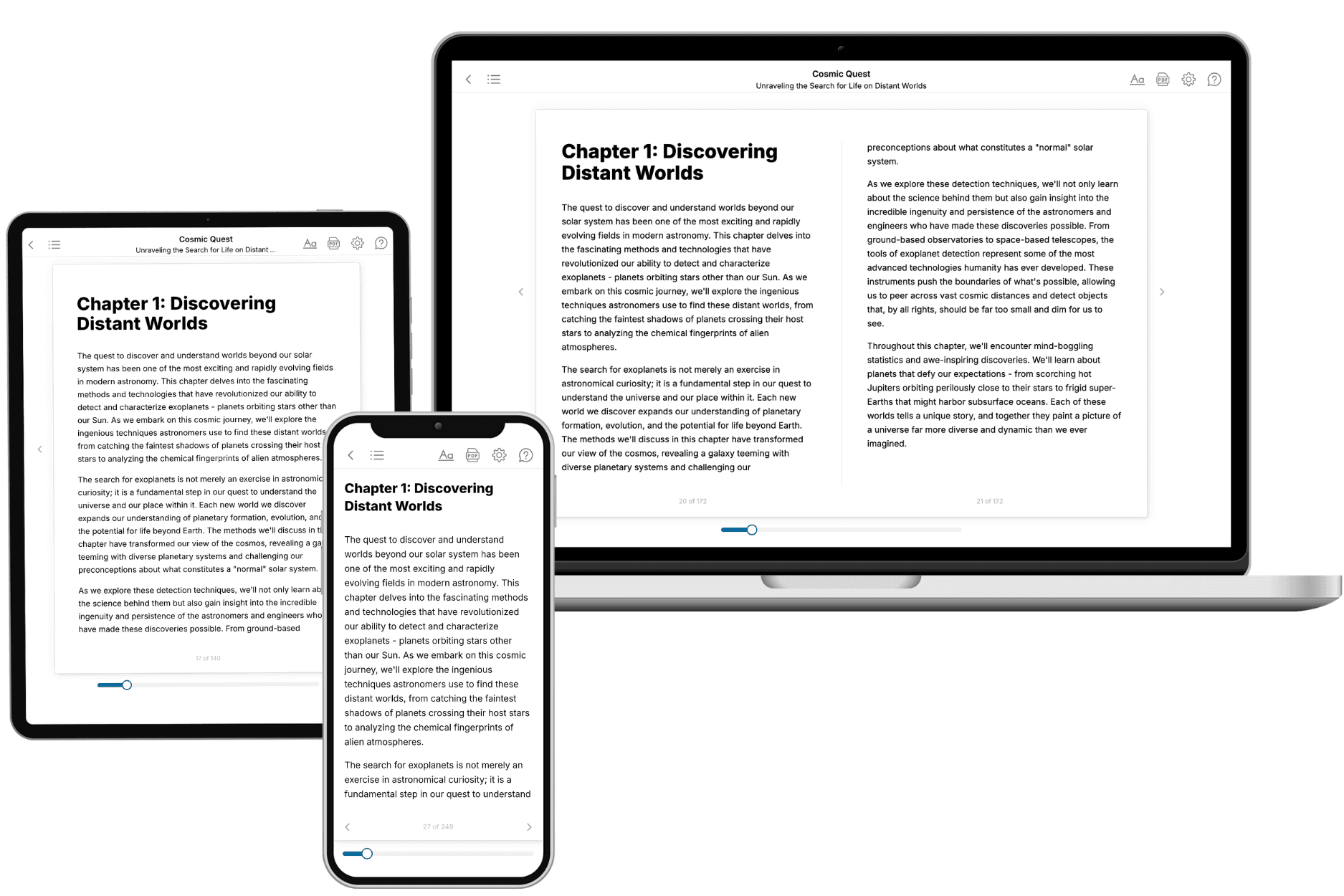
- 3. Get your tailored book
Your book is ready in 10 minutes. Read it online, download as EPUB or PDF, or send to Kindle.
Frequently asked questions
- What is TailoredRead?
TailoredRead creates complete, full-length nonfiction ebooks, written specifically for you. Tell us what you want to learn and why, and TailoredRead writes you a complete ebook on it, with charts, tables, and diagrams throughout. Read it online, on Kindle, or on any e-reader, or download it as a PDF or EPUB. Every book is written fresh the day you order it.
- How is the book tailored to me?
Before anything is written, you answer a few short questions about your goals, your background, and the topics you care about. Your book is then planned around your answers: written at your level, focused on your goals, and covering the topics you chose, instead of the one-size-fits-all book a store sells everyone.
- Will it read like generic AI content?
No. Your book isn't a chat transcript: it's planned chapter by chapter before a single word is written, told in a clear book voice, and explains ideas visually with charts, tables, and diagrams. After writing, every book goes through an editorial pass that polishes chapters so the book reads consistent from start to finish. Judge for yourself: browse thousands of sample books on our Explore Books page.
- How accurate is the content?
Our AI first checks whether your subject needs live research. Niche and fast-moving subjects are researched before writing, and the book plan and chapters are grounded in what it finds. After writing, every book goes through a quality pass that checks its facts and consistency, and researched books list their sources in a Notes section at the back.
- How long is the book?
You choose the length: Comprehensive (250-300 pages), Detailed (150-200 pages), Essential (70-100 pages), or Short (30-50 pages).
- Does the book include visuals?
Yes. Every book includes charts, tables, and diagrams: timelines, checklists, step-by-step guides, decision trees, comparison tables, matrices, and bar charts. A typical book includes dozens of these visual elements.
- Can I read it on Kindle? What formats can I download?
Yes. Every book can be read in our online reader or downloaded as a PDF or EPUB. The EPUB can be opened with Kindle, Apple Books, Kobo, and any e-reader. The Commercial and Author licenses also include an editable Word (DOCX) and Markdown download.
- How much does it cost?
About the price of a regular ebook. The exact price depends on your book's length and complexity, from $2 for the shortest books to $35 for the most comprehensive, and it's shown when you review your book, before you commit to anything. Each book is a one-time purchase, yours to keep, no subscription. Licenses that let you share, teach, or publish your book range from $35.99 to $49.99.
- Can I preview the book before purchasing?
Before you pay, you'll see what your book will cover: the title, a detailed description, the estimated length, and the complete chapter-by-chapter table of contents, so you know what you're getting before you decide. The full text itself is written after you purchase.
- How long does it take to create a book?
About 10 minutes. You can start reading the opening chapters while the rest is still being written.