Design for Real People
Master User-Centered Design to Create Products That Actually Solve Problems
You'll move beyond surface-level design trends to master the principles that separate products people love from those they abandon.
191 pages9 chaptersJul 26, 2026User Experience
About this book
This book teaches you how to genuinely understand your users—not through assumptions, but through structured research and empathy. You'll learn the complete user-centered design process: from discovering real problems to testing solutions with actual users. Whether you're designing software, services, or physical products, you'll discover how to balance user needs with business goals, involve stakeholders effectively, and measure what actually matters. Through practical frameworks, real-world examples, and actionable techniques, you'll develop the skills to lead design decisions with confidence. This is the guide for anyone ready to stop guessing what users want and start building solutions that create lasting value.
Table of contents
- IntroductionWhy User-Centered Design Matters Now, What You'll Learn in This Book, How to Use This BookRead below
- Chapter 1: The Foundations of User-Centered DesignCore Principles That Drive Success, From Assumptions to User Reality, Aligning User Needs with Business Goals
- Chapter 2: Understanding Your Users Through ResearchChoosing the Right Research Methods, Conducting Effective User Interviews, Learning from Observation and Behavior, Turning Data into Actionable Insights
- Chapter 3: Building Empathy and User PersonasCreating Empathy Maps That Reveal Motivations, Developing Realistic User Personas, Mapping the Complete User Journey
- Chapter 4: Design Thinking: A Structured Problem-Solving ApproachThe Five Phases of Design Thinking, Generating Ideas That Matter, Running Effective Design Workshops
- Chapter 5: Prototyping and Testing with UsersChoosing Your Prototype Fidelity, Conducting Usability Tests That Reveal Truth, Iterating Based on User Feedback, Testing Methods for Different Project Stages
- Chapter 6: Accessibility and Inclusive DesignUnderstanding Accessibility Standards and Guidelines, Designing for Diverse Abilities and Contexts, Testing and Validating Accessibility
- Chapter 7: Collaboration and Stakeholder ManagementBuilding Effective Cross-Functional Teams, Communicating Design Decisions to Stakeholders, Navigating Disagreements and Design Critiques
- Chapter 8: Measuring Design Impact and SuccessDefining Metrics That Matter, Analyzing Quantitative Data, Capturing Qualitative User Feedback, Demonstrating ROI and Business Value
- Chapter 9: Scaling User-Centered Design Across OrganizationsBuilding Design Systems for Consistency, Creating a User-Centered Culture, Establishing Sustainable Processes and Workflows
- ConclusionYour Next Steps, Continuing Your Design Journey
- Further Reading and Resources
Introduction
Most products fail not because the technology was wrong, but because the people building them never truly understood who they were building for. A 2019 study by Standish Group found that roughly 66% of software projects either fail outright or deliver significantly less value than planned, and poor understanding of user needs ranks consistently among the top causes.[1] That is a staggering amount of wasted effort, budget, and opportunity. The gap between what teams assume users want and what users actually need is where most of that waste lives.
User-Centered Design is the discipline that closes that gap. It is not a design trend, a software feature, or a checkbox on a project plan. It is a way of working that puts real human beings at the center of every decision, from the first question you ask about a problem to the final refinement of a shipped product. When practiced consistently, it changes not just what gets built, but how teams think, how organizations prioritize, and how products perform in the market.
This book exists because the gap between knowing about User-Centered Design and actually practicing it well is wider than most people expect. There is no shortage of articles, talks, or frameworks describing the theory. What is harder to find is a clear, practical guide that walks you through the full process, addresses the real obstacles you will face, and gives you tools you can use on Monday morning. That is what this book aims to be.
The chapters ahead cover the complete arc of User-Centered Design practice: understanding your users through research, building empathy through structured tools, solving problems with Design Thinking, testing ideas with real people, designing inclusively, collaborating across teams, measuring impact, and scaling the practice across an organization. Each chapter is built around concrete methods, real examples, and frameworks you can adapt to your own context. Whether you work on software, services, or physical products, the principles apply.
Why User-Centered Design Matters Now
The market for digital products has never been more crowded or more competitive. Users today have more choices than ever, and their tolerance for confusing, frustrating, or irrelevant experiences is extremely low. Research from Forrester has consistently shown that companies with strong user experience practices outperform their competitors on key business metrics, including customer retention, conversion rates, and revenue growth.[2] The connection between good design and business performance is no longer a hypothesis. It is a documented pattern.
What has changed in recent years is the cost of getting it wrong. When a product launches with fundamental usability problems, users do not write letters of complaint. They leave, they post negative reviews, and they tell their networks. The feedback loop between poor design and business damage has compressed dramatically. A product that would have taken years to lose its audience in the 1990s can lose it in weeks today. That compression makes early, continuous user research not just a good practice but a risk management strategy.
At the same time, the tools and methods available to designers and product teams have improved significantly. Conducting a User Interview no longer requires a dedicated research lab. Running a Usability Testing session can happen remotely with participants from anywhere in the world. Synthesizing research into Actionable Insights is faster with collaborative digital tools. The barriers to practicing User-Centered Design well have dropped, which means the teams that still skip it are making a deliberate choice to work with less information than they could have.
There is also a broader shift happening in how organizations think about design's role. For much of the twentieth century, design was treated as a finishing step, something applied to a product after the real decisions had been made. That model produced a lot of products that were technically functional but genuinely unpleasant to use. The shift toward User-Centered Design represents a recognition that design decisions are business decisions, and that involving users early in the process produces better outcomes than involving them at the end, if at all.
Consider the contrast between two approaches to building a mobile banking app. In the first approach, a team of engineers and product managers defines the feature set based on what competitors offer and what the business wants to promote. Design is brought in to make it look polished. In the second approach, the team starts by interviewing actual bank customers about how they manage money, what frustrates them about existing apps, and what tasks they most need to accomplish quickly. The second team will almost certainly build a different product, and the evidence strongly suggests it will be a more successful one. That difference in starting point is what User-Centered Design is about.
The discipline also matters because it builds organizational empathy at scale. When teams regularly engage with real users, they develop a shared understanding of who they are building for. That shared understanding reduces internal conflict, speeds up decision-making, and creates alignment between design, engineering, product, and business stakeholders. User-Centered Design is not just a method for making better products. It is a way of building teams that make better decisions together.
Finally, User-Centered Design matters because the problems worth solving are genuinely complex. Users do not always know what they want, and they rarely articulate their needs in ways that translate directly into product requirements. Understanding the difference between what someone says they want, what they actually do, and what they truly need requires structured methods, careful observation, and a willingness to be surprised. That is the work this book is designed to help you do.
The goal of User-Centered Design is not to give users exactly what they ask for. It is to understand their real needs well enough to give them something better than they imagined.
What You'll Learn in This Book
This book is organized around the full lifecycle of User-Centered Design practice. Each chapter addresses a distinct phase or skill set, and together they form a complete picture of how to design products that genuinely work for real people. The progression is intentional: earlier chapters build the foundation that later chapters depend on.
The first chapter establishes the UCD Principles that underpin everything else. These are not abstract values but practical commitments that shape how you approach problems, gather evidence, and make decisions. Understanding these principles helps you recognize when a process is truly user-centered and when it is only performing the appearance of it. The chapter also addresses the critical challenge of Business-User Alignment, showing how user needs and business goals are far more compatible than they are often assumed to be.
The second chapter dives into User Research Methods. Research is the engine of User-Centered Design, and this chapter covers how to choose the right method for the right question, how to conduct a User Interview that generates genuine insight rather than confirmation of existing assumptions, and how to use Observational Research to learn from what users do rather than just what they say. The chapter closes with a practical framework for Research Synthesis, turning raw data into Actionable Insights that a team can actually use.
The third chapter covers the tools that translate research into shared understanding: Empathy Maps, User Personas, and User Journey Maps. These are not decorative artifacts. When built from real research, they serve as reference points that keep teams anchored to actual users throughout a project. The chapter explains how to build each one rigorously and how to use them to surface Pain Points that might otherwise stay invisible.
The fourth chapter introduces Design Thinking as a structured problem-solving framework. The Five Phases of Design Thinking provide a repeatable process for moving from a vague problem to a tested solution. The chapter covers practical Ideation techniques, including How Might We Questions, and explains how to run a Design Workshop that generates useful output rather than just filling a calendar slot.
The fifth chapter addresses prototyping and testing. It covers the full range of Prototype Fidelity, from rough paper sketches to interactive High-Fidelity Prototypes, and explains when each level is appropriate. The chapter then walks through how to conduct Usability Testing that reveals genuine problems, and how to structure an Iteration Cycle that turns test findings into design improvements efficiently.
The sixth chapter covers Inclusive Design and Accessibility Standards. This is not a compliance checklist. It is a practical guide to designing for the full spectrum of human ability and context, including Situational Impairment and the role of Assistive Technology. The chapter explains the WCAG Guidelines in plain terms and shows how designing for accessibility consistently improves the experience for everyone.
The seventh chapter addresses the human side of design work: building effective Cross-Functional Teams, communicating Design Rationale to stakeholders who may not share a design background, and navigating Design Critique productively. These skills are often the difference between good design work that gets implemented and good design work that gets shelved.
The eighth chapter focuses on Design Metrics and the ROI of Design. It covers both Quantitative Analysis and Qualitative Feedback, and provides frameworks for demonstrating the business value of design investment in terms that resonate with executives and finance teams.
The ninth and final chapter addresses scale. It covers how to build a Design System that creates consistency across products, how to use Design Tokens and a Component Library effectively, and how to establish the processes and cultural conditions that allow User-Centered Design to thrive across an entire organization. This includes a practical look at DesignOps, the Design Maturity Model, and what it takes to build a genuine UCD Culture.
- Foundations: UCD Principles and Business-User Alignment
- Research: User Research Methods, User Interviews, Observational Research, Research Synthesis
- Empathy tools: Empathy Maps, User Personas, User Journey Maps
- Problem-solving: Design Thinking, Five Phases, Ideation, Design Workshops
- Testing: Prototype Fidelity, Usability Testing, Iteration Cycles
- Inclusion: Accessibility Standards, WCAG Guidelines, Inclusive Design
- Collaboration: Cross-Functional Teams, Stakeholder Communication, Design Critique
- Measurement: Design Metrics, Quantitative Analysis, Qualitative Feedback, ROI of Design
- Scale: Design Systems, DesignOps, UCD Culture, Design Maturity Model
How to Use This Book
This book is designed to be read from front to back on a first pass. The chapters build on each other in a deliberate sequence. The research methods covered early on feed directly into the empathy tools covered in the middle chapters, which in turn inform the prototyping and testing work covered later. Reading in order gives you the full picture of how these practices connect and reinforce each other.
That said, the book is also structured to work as a reference. Once you have read it through, each chapter stands on its own as a guide to a specific phase or skill. If you are about to run your first round of Usability Testing, you can return to that chapter directly. If you are preparing to present a design decision to a skeptical executive, the chapter on Stakeholder Communication will give you what you need without requiring you to re-read everything before it.
Each chapter includes concrete examples drawn from realistic product scenarios. These examples are not hypothetical edge cases. They are the kinds of situations you are likely to encounter in actual design work: a team that skips research because of time pressure, a persona that was built from assumptions rather than data, a usability test that reveals a problem nobody expected. Paying attention to these examples is worth the time, because the patterns they illustrate tend to repeat across different industries and product types.
The frameworks and templates in each chapter are meant to be adapted, not followed rigidly. User-Centered Design is not a recipe. It is a set of principles and methods that need to be applied with judgment. A User Journey Map for a healthcare app will look different from one for a retail checkout flow, even if the underlying structure is the same. Use the frameworks as starting points and adjust them to fit your context, your users, and your constraints.
If you are working on a specific project right now, consider reading with that project in mind. After each chapter, ask yourself how the methods and frameworks described apply to what you are currently building. The most effective way to learn User-Centered Design is to practice it on real problems with real stakes. This book can accelerate that learning, but it cannot replace the experience of actually doing the work.
Some chapters will feel more immediately relevant than others depending on where you are in your career and what kind of work you do. If you are primarily a visual designer, the chapters on research and measurement may feel like new territory. If you are a product manager or strategist, the chapters on prototyping and accessibility may push you into unfamiliar ground. That discomfort is worth leaning into. The most valuable growth in design practice almost always happens at the edges of your current expertise.
A note on terminology: this book uses a consistent set of canonical terms throughout. When a term like Actionable Insights or Prototype Fidelity appears, it refers to a specific concept that is defined and explained in the relevant chapter. Using consistent language matters in design work because it reduces ambiguity and helps teams communicate more precisely. The same discipline applies here.
Finally, this book assumes you already have some experience with design work. It does not start from zero. If you are familiar with basic design tools and have worked on at least one product project, you have enough context to get full value from every chapter. The goal is not to introduce you to design but to deepen your practice and give you a more rigorous, user-grounded foundation for the decisions you make every day.
The best time to start practicing User-Centered Design rigorously was at the beginning of your last project. The second best time is right now, on whatever you are working on today.
The chapters ahead are dense with practical content, but they are written to be readable rather than academic. The goal is clarity, not comprehensiveness. Where a concept deserves deeper exploration than a single book can provide, the Further Reading section at the end points you toward the best sources available. Use those resources. The designers who improve fastest are the ones who treat their own learning as an ongoing practice, not a one-time event. That orientation, more than any single method or framework, is what separates designers who grow from those who plateau.
This is the end of the free sample. The full book has 9 chapters.
Want this book written for you?
Tell us your goals and background, and get your own version of this book, tailored by AI to you.


Benefits of AI-tailored books
- Read one book, not ten:
- all the User Experience knowledge you need, gathered into a single book.
- Save days of learning:
- tell us your goals, choose your topics, and the whole book is built around them.
- Learn effortlessly:
- User Experience book written for your specific background and expertise.
- Understand at a glance:
- includes charts, tables, timelines, checklists, decision trees, and more.
- Stay current:
- written the day you order it, not years ago.
- Trust what you read:
- every book is checked for accuracy, with real research when your subject needs it.
Create your unique book in 3 steps
- 1. Select your focus
Select the focus of your User Experience book and share your background
- 2. Personalize your book
Specify your goals and choose sub-topics to include
- 3. Get your tailored book
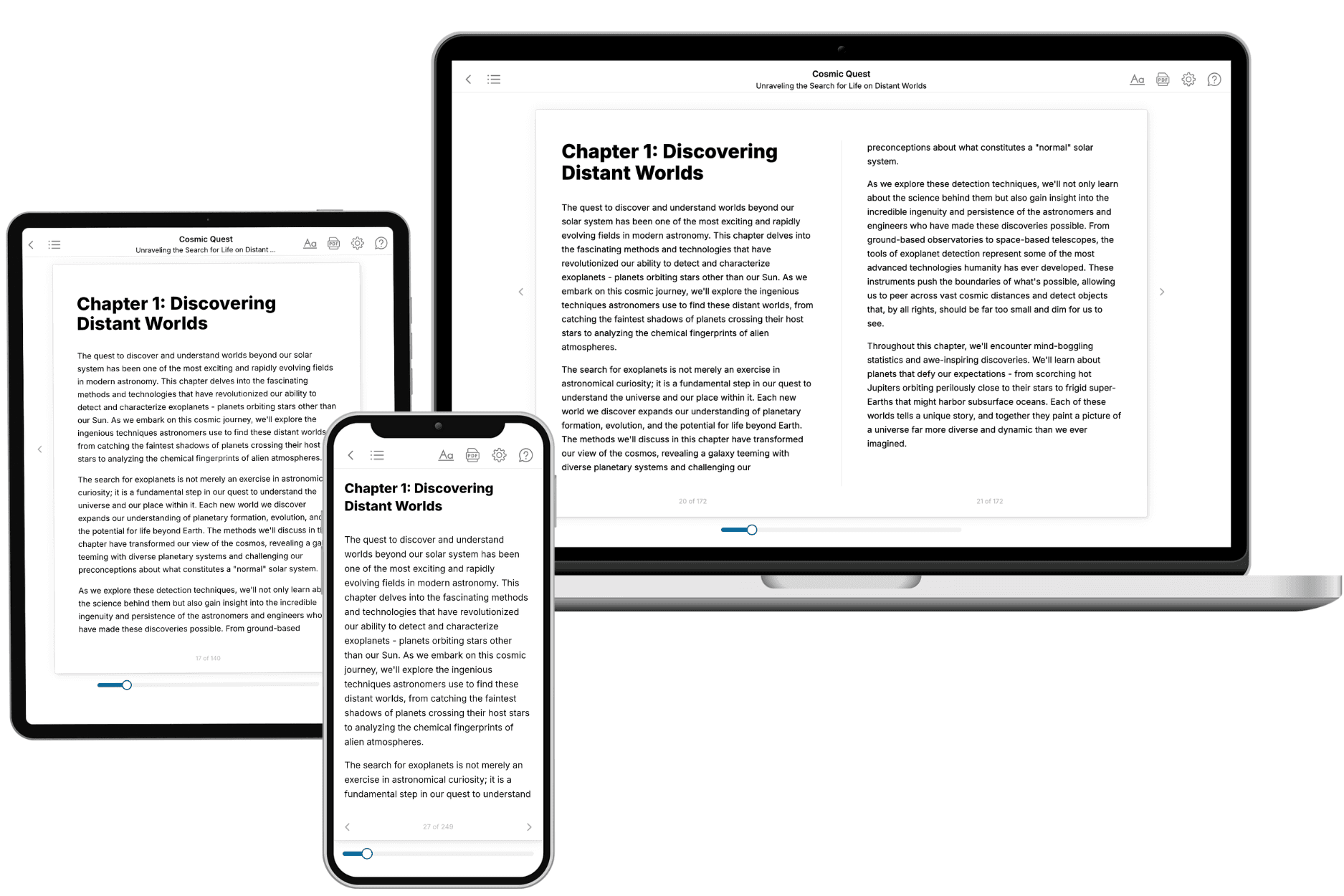
Your book is ready in 10 minutes. Read it online, download as EPUB or PDF, or send to Kindle.
Frequently asked questions
- What is TailoredRead?
TailoredRead creates complete, full-length nonfiction ebooks, written specifically for you. Tell us what you want to learn and why, and TailoredRead writes you a complete ebook on it, with charts, tables, and diagrams throughout. Read it online, on Kindle, or on any e-reader, or download it as a PDF or EPUB. Every book is written fresh the day you order it.
- How is the book tailored to me?
Before anything is written, you answer a few short questions about your goals, your background, and the topics you care about. Your book is then planned around your answers: written at your level, focused on your goals, and covering the topics you chose, instead of the one-size-fits-all book a store sells everyone.
- Will it read like generic AI content?
No. Your book isn't a chat transcript: it's planned chapter by chapter before a single word is written, told in a clear book voice, and explains ideas visually with charts, tables, and diagrams. After writing, every book goes through an editorial pass that polishes chapters so the book reads consistent from start to finish. Judge for yourself: browse thousands of sample books on our Explore Books page.
- How accurate is the content?
Our AI first checks whether your subject needs live research. Niche and fast-moving subjects are researched before writing, and the book plan and chapters are grounded in what it finds. After writing, every book goes through a quality pass that checks its facts and consistency, and researched books list their sources in a Notes section at the back.
- How long is the book?
You choose the length: Comprehensive (250-300 pages), Detailed (150-200 pages), Essential (70-100 pages), or Short (30-50 pages).
- Does the book include visuals?
Yes. Every book includes charts, tables, and diagrams: timelines, checklists, step-by-step guides, decision trees, comparison tables, matrices, and bar charts. A typical book includes dozens of these visual elements.
- Can I read it on Kindle? What formats can I download?
Yes. Every book can be read in our online reader or downloaded as a PDF or EPUB. The EPUB can be opened with Kindle, Apple Books, Kobo, and any e-reader. The Commercial and Author licenses also include an editable Word (DOCX) and Markdown download.
- How much does it cost?
About the price of a regular ebook. The exact price depends on your book's length and complexity, from $2 for the shortest books to $35 for the most comprehensive, and it's shown when you review your book, before you commit to anything. Each book is a one-time purchase, yours to keep, no subscription. Licenses that let you share, teach, or publish your book range from $35.99 to $49.99.
- Can I preview the book before purchasing?
Before you pay, you'll see what your book will cover: the title, a detailed description, the estimated length, and the complete chapter-by-chapter table of contents, so you know what you're getting before you decide. The full text itself is written after you purchase.
- How long does it take to create a book?
About 10 minutes. You can start reading the opening chapters while the rest is still being written.