District Six: A Living Testament
Understanding Cape Town's Most Powerful Historical Site
What does it mean to stand in a place where an entire community was erased?
191 pages8 chaptersApr 16, 2026South Africa History
About this book
District Six Museum in Cape Town is far more than a historical exhibit—it's a profound encounter with one of apartheid's most devastating chapters. This guide takes you beyond the surface, revealing how over 60,000 people were forcibly removed from their homes in 1966 and how their stories continue to shape Cape Town today. You'll discover the museum's innovative approach to preserving memory through personal artifacts, oral histories, and community voices. Whether you're a first-time visitor seeking context or a returning traveler wanting deeper understanding, this book illuminates why District Six remains essential to understanding South Africa's past and present. Explore the neighborhood's vibrant pre-removal history, the trauma of displacement, the museum's powerful exhibits, and the ongoing journey toward healing and justice. This is more than travel information—it's an invitation to witness history through the eyes of those who lived it.
Table of contents
- IntroductionWhy District Six Matters to Cape Town's Story, What You'll Discover in This Guide, How to Use This Book for Maximum ImpactRead below
- Chapter 1: The Vibrant Community Before RemovalA Thriving Neighborhood: Life Before 1966, Cultural Diversity and Community Spirit, Economic Life and Daily Rhythms
- Chapter 2: Apartheid's Machinery: The Forced RemovalThe Legal Framework Behind Removal, The Removal Process: What Happened and When, The Human Impact: Stories of Displacement
- Chapter 3: The Museum's Mission and ApproachFounding Vision and Community Involvement, Innovative Storytelling Methods, How the Museum Has Evolved
- Chapter 4: Navigating the Museum ExhibitsThe Main Exhibition Space: Layout and Flow, Key Artifacts and Their Stories, Interactive Elements and Visitor Engagement
- Chapter 5: Voices from the Past: Oral Histories and TestimoniesSurvivor Stories and Personal Narratives, Recorded Testimonies and Audio Experiences, Ongoing Community Participation and Contribution
- Chapter 6: The Physical Landscape: What RemainsArchitectural Remnants and Urban Traces, Walking the Streets: A Self-Guided Tour, Memorials and Historical Markers
- Chapter 7: District Six in Broader ContextUnderstanding Apartheid's Spatial Policies, How District Six Shaped Modern Cape Town, The Ongoing Legacy and Restitution Efforts
- Chapter 8: Planning Your VisitPractical Information and Logistics, Guided Tours and Educational Programs, Preparing Yourself Emotionally and Intellectually
- ConclusionReflection: What District Six Teaches Us, Moving Forward: Reconciliation and Justice
- Further Reading and Resources
- Glossary of Key Terms
Introduction
There is a particular kind of silence that settles over a place where something irreversible happened. You can feel it in the open lots near the base of Devil's Peak in Cape Town, where streets once hummed with music, argument, laughter, and the smell of food cooking in a dozen different kitchens. District Six is not a ruin in the conventional sense. Most of its buildings are gone. What remains is something harder to name: the weight of an absence, the outline of a community that was deliberately erased, and the stubborn insistence of memory refusing to let that erasure stand unchallenged.
Between 1966 and the early 1980s, the apartheid government forcibly removed more than 60,000 people from this inner-city neighborhood under the Group Areas Act.[1] Homes were bulldozed. Streets were renamed or simply ceased to exist. A community that had taken generations to build was scattered across the Cape Flats, a sprawling, windswept area far from the city center, far from jobs, and far from everything that had made life in District Six feel like home. The land sat largely empty for decades, a deliberate wound in the city's geography, a testament to the cruelty of racial ideology dressed up as urban planning.
The District Six Museum, which opened in 1994 in a former Methodist church on Buitenkant Street, was built in direct response to that erasure. It is not a conventional museum. It does not present history from a safe, clinical distance. Instead, it places the voices, faces, and personal belongings of the people who lived there at the very center of the story. Walking through it, you are not simply learning about what happened. You are being asked to witness it, to sit with its weight, and to carry something of it with you when you leave. This guide exists to help you do exactly that, with the context, preparation, and depth that the experience deserves.
This book is written for travelers and history enthusiasts who want more than a surface-level encounter with one of South Africa's most significant historical sites. Whether you are visiting Cape Town for the first time or returning with fresh questions, the pages ahead will give you the historical grounding, practical guidance, and emotional preparation to make your visit to District Six Museum genuinely meaningful. The story of District Six is not a closed chapter. It continues to shape the city around you, and understanding it changes how you see everything else.
Why District Six Matters to Cape Town's Story
Cape Town is one of the most visually stunning cities on earth. The mountain, the ocean, the vineyards, the architecture: it is a place that can overwhelm the senses with beauty. But beauty and inequality have always coexisted here in uncomfortable proximity. To understand the city honestly, you need to understand how it was shaped, and District Six sits at the very heart of that shaping. What happened there was not an isolated incident. It was a deliberate act of social engineering that restructured the entire city along racial lines, with consequences that are still visible today.
Before the removals, District Six was one of the most densely populated and culturally mixed neighborhoods in South Africa. It was home to freed slaves, immigrants, artisans, musicians, traders, and working-class families of every background. The community was predominantly Coloured, a term used in South Africa to describe people of mixed heritage, but it also included Black African residents, white families, and a significant Muslim population whose mosques still stand in the area today.[2] This diversity was not incidental. It was the defining character of the place, and it was precisely what the apartheid government found threatening.
The Group Areas Act of 1950 gave the government the legal power to designate residential areas by race and to remove anyone who did not fit the designated category. District Six was declared a white group area in 1966, despite the fact that almost none of its residents were white. The logic was not about housing need or urban development. It was about control, about breaking up communities that had learned to live across racial lines, and about reclaiming valuable inner-city land. Understanding this context transforms how you read the city around you, from the townships on the Cape Flats to the gentrified neighborhoods closer to the mountain.
District Six also matters because of what came after the removals. The land was not redeveloped quickly or successfully. Much of it sat empty for years, partly because of the scale of the demolition and partly because of the moral weight that seemed to hang over it. Even developers who had no personal connection to the history found it difficult to build on ground that carried such obvious trauma. That emptiness became its own kind of statement, a visible reminder of what had been done and what had been lost. Today, the slow and contested process of land restitution continues, making District Six an active site of justice and not merely a historical one.
The museum itself has become a model for how communities can reclaim their own histories. Rather than waiting for official institutions to tell their story, former residents and their descendants took the initiative to build a space where memory could be preserved on their own terms. This approach has influenced heritage institutions around the world, and it gives the museum a quality that is rare: genuine authenticity. The people whose lives are documented here were involved in creating the documentation. That matters enormously when you are trying to understand what a place really was.
For visitors from outside South Africa, District Six offers a window into the mechanics of apartheid that goes beyond the abstract. It is one thing to read that apartheid was a system of racial segregation. It is another to stand in a room full of street signs salvaged from demolished roads, to read the handwritten notes that former residents have left on a giant floor map marking where their homes once stood, and to hear recorded voices describing the day the bulldozers arrived. District Six makes history visceral in a way that changes how you understand not just South Africa, but the broader human capacity for both cruelty and resilience.
Finally, District Six matters because it is unfinished. The story does not end with the removals, or with the museum's founding, or even with the democratic transition of 1994. Former residents are still waiting for land restitution. The neighborhood is still being rebuilt, slowly and imperfectly. The conversations about memory, justice, and belonging that District Six provokes are conversations that Cape Town, and South Africa as a whole, is still having. Visiting the museum means stepping into a living debate, not a settled one, and that is part of what makes it so important.
What You'll Discover in This Guide
This guide is organized to take you through the District Six story in layers, starting with the community as it existed before the removals, moving through the mechanics and human impact of the forced displacement, and then exploring the museum itself in detail. From there, the book broadens outward to place District Six in the wider context of apartheid's spatial policies and their legacy in modern Cape Town. The final sections are practical, helping you plan your visit and prepare for what you will encounter.
The first two chapters focus on history. Chapter 1 reconstructs the world of District Six before 1966: the streets, the people, the rhythms of daily life, and the cultural richness that made the neighborhood so distinctive. This is not nostalgia for its own sake. Understanding what existed makes the destruction of it comprehensible in human terms, not just political ones. Chapter 2 then examines the machinery of removal: the laws that enabled it, the timeline of events, and the personal stories of people who were forced to leave. These chapters give you the historical foundation that everything else in the book builds on.
Chapters 3, 4, and 5 focus on the museum itself. You will learn about the founding vision that shaped the institution, the innovative methods it uses to tell its stories, and how it has evolved over the decades since it opened. You will get a detailed guide to the main exhibition space, including the key artifacts and interactive elements that make the museum experience so distinctive. And you will explore the oral histories and recorded testimonies that form the emotional core of the museum's collection. These chapters are designed to be read before your visit, so that you arrive knowing what to look for and why it matters.
Chapter 6 takes you outside the museum walls and into the physical landscape of District Six itself. The neighborhood is not just a historical concept. It is a real place with surviving buildings, memorials, and traces of the community that once lived there. This chapter includes a self-guided walking tour that helps you read the landscape as a historical document. Chapter 7 then zooms out to examine District Six in the broader context of apartheid's spatial policies, the demographics of modern Cape Town, and the ongoing efforts at land restitution and community rebuilding.
Chapter 8 is entirely practical. It covers visiting hours, admission fees, guided tour options, and educational programs. It also addresses something that guidebooks often overlook: how to prepare yourself emotionally and intellectually for a visit to a site of this kind. District Six Museum is not a comfortable experience, and it is not meant to be. Knowing what to expect, and giving yourself permission to be affected by what you encounter, makes the visit more meaningful rather than less.
Throughout the book, you will find specific examples, survivor testimonies, and concrete details that bring the history to life. The goal is not to overwhelm you with information but to give you enough context that every exhibit, every artifact, and every street corner you encounter during your visit carries real meaning. History understood in the abstract is interesting. History understood through specific human lives is transformative.
This guide is not a substitute for the museum itself. It is a companion to it. The most important thing you can do is go, stand in the space, and let the place speak to you directly. Everything in these pages is designed to help you hear it more clearly.
You will also find, woven throughout the book, connections between District Six's history and the Cape Town you will see around you during your visit. The geography of inequality that shapes the city today, from the wealthy Atlantic Seaboard to the densely populated townships of the Cape Flats, did not emerge by accident. It was engineered, and District Six is one of the clearest examples of that engineering. Seeing those connections changes how you experience the city as a whole, and that broader understanding is one of the most valuable things this guide can offer.
How to Use This Book for Maximum Impact
There is no single right way to use this guide, but there are approaches that tend to produce a richer experience. The most straightforward approach is to read the historical chapters (1 and 2) before your visit, use chapters 3 through 5 as preparation for the museum itself, and then read chapters 6 and 7 either just before or just after you walk the neighborhood. Chapter 8 should be consulted early in your planning process, since some guided tours and educational programs require advance booking. The conclusion can be read at any point, but it tends to land most powerfully after you have visited.
If your time is limited and you can only read one section before visiting, make it Chapter 2. Understanding the mechanics and human reality of the forced removal is the single most important piece of context you can bring to the museum. Everything else builds on that foundation. If you have more time, add Chapter 1 to your pre-visit reading. Knowing what District Six was before the removals makes the loss concrete rather than abstract, and that concreteness is what gives the museum its emotional power.
Consider bringing this book with you during your visit. The sections on key artifacts and the self-guided walking tour are designed to be used on-site. You do not need to read them word for word while you are there. A quick review before you enter each space, followed by your own direct engagement with what you see, tends to work better than reading while walking. The goal is to enhance your attention, not to mediate your experience through a screen or a page.
Pay attention to what affects you personally during your visit. District Six Museum is designed to provoke emotional responses, and those responses are data. If a particular photograph stops you, or a recorded voice makes you want to sit down, or a handwritten note on the floor map catches in your throat, that is the museum doing its job. Note those moments. They are often the ones that carry the most meaning, and returning to the relevant sections of this book afterward can help you understand why they hit as hard as they did.
The following practical tips will help you get the most from both this guide and your visit:
- Book a guided tour if possible. The museum's guides are often former residents or their descendants, and their personal knowledge adds a dimension that no written guide can replicate.
- Allow at least two hours for the museum. Rushing through it means missing the details that make the experience meaningful. Three hours is better if you want to engage with the audio testimonies.
- Visit the neighborhood on foot. The walking tour in Chapter 6 is most effective when done at a slow pace, with time to stop and look at what remains.
- Talk to people. Cape Town residents, particularly those from Coloured communities, often have personal or family connections to District Six. Respectful conversation can add layers of understanding that no book can provide.
- Give yourself time to decompress afterward. The museum is emotionally demanding. Building in an hour of quiet time after your visit, whether in a nearby café or simply sitting in the open air, helps you process what you have experienced.
It is also worth being honest with yourself about what you are bringing to this experience. If you are visiting from a country with its own history of racial injustice, you may find unexpected resonances. If you are South African, you may be navigating personal or family history alongside the public record. If you are encountering this history for the first time, you may feel a combination of shock, guilt, and admiration that is difficult to sort through quickly. All of these responses are valid, and the museum is designed to hold them. You do not need to arrive with the right feelings. You just need to arrive open.
One thing this guide will not do is tell you what conclusions to draw. The history of District Six raises profound questions about justice, memory, responsibility, and what it means to rebuild after catastrophic loss. Those questions do not have simple answers, and anyone who tells you otherwise is not engaging with the full complexity of the story. What this book can do is give you the knowledge and context to engage with those questions seriously, and to carry them with you long after you have left Cape Town. That, ultimately, is the purpose of a place like District Six Museum: not to close a chapter, but to keep it open in the most productive and honest way possible.
The story of District Six is, at its core, a story about people. It is about what people build when they are left to live alongside each other, what is lost when that is taken away by force, and what survives even the most determined attempts at erasure. Memory survives. Community survives. The insistence on being seen and heard survives. This guide is an invitation to witness all of that, and to let it matter to you. The pages ahead will give you everything you need to begin.
This is the end of the free sample. The full book has 8 chapters.
Want this book written for you?
Tell us your goals and background, and get your own version of this book, tailored by AI to you.


Benefits of AI-tailored books
- Read one book, not ten:
- all the South Africa History knowledge you need, gathered into a single book.
- Save days of learning:
- tell us your goals, choose your topics, and the whole book is built around them.
- Learn effortlessly:
- South Africa History book written for your specific background and expertise.
- Understand at a glance:
- includes charts, tables, timelines, checklists, decision trees, and more.
- Stay current:
- written the day you order it, not years ago.
- Trust what you read:
- every book is checked for accuracy, with real research when your subject needs it.
Create your unique book in 3 steps
- 1. Select your focus
Select the focus of your South Africa History book and share your background
- 2. Personalize your book
Specify your goals and choose sub-topics to include
- 3. Get your tailored book
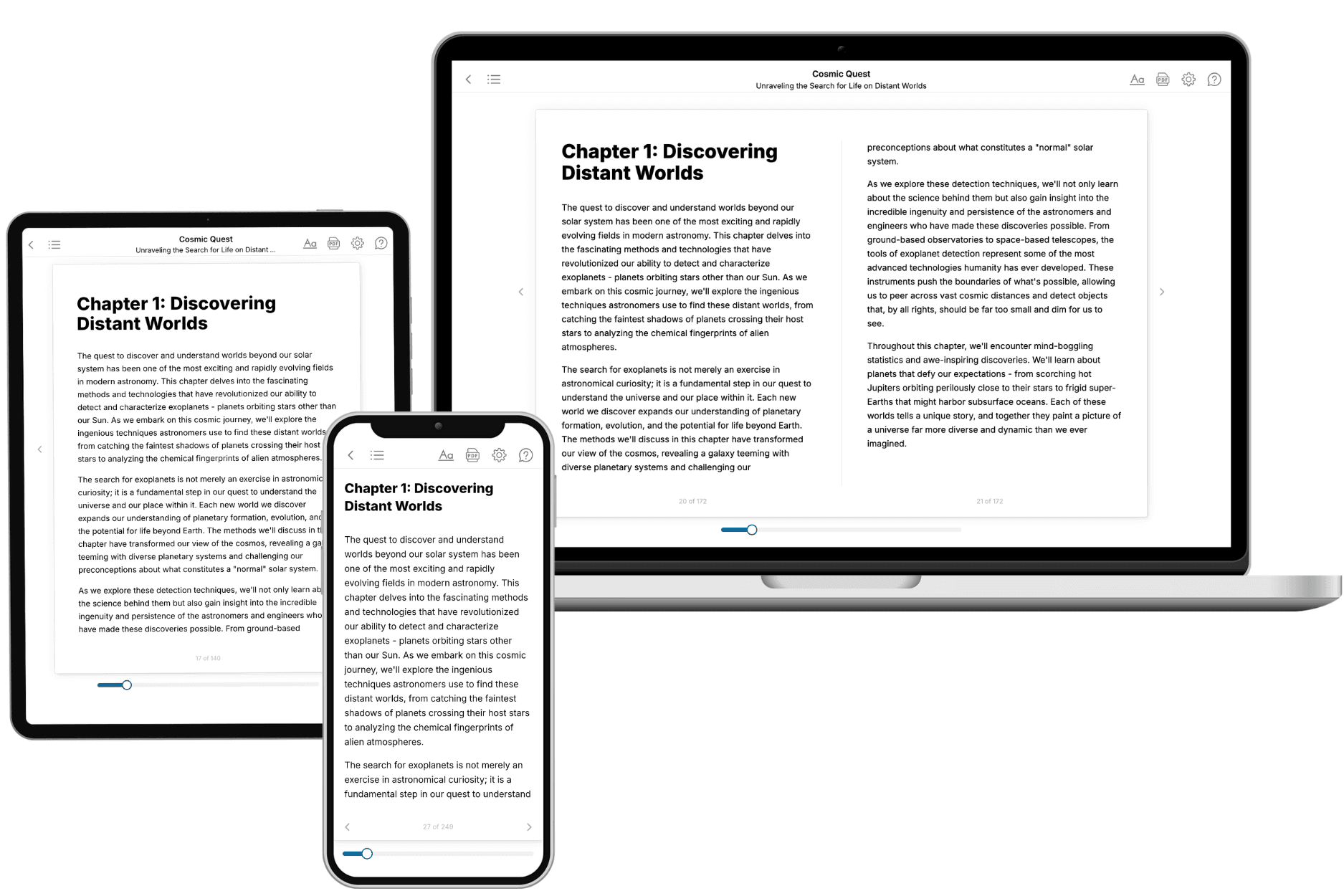
Your book is ready in 10 minutes. Read it online, download as EPUB or PDF, or send to Kindle.
Frequently asked questions
- What is TailoredRead?
TailoredRead creates complete, full-length nonfiction ebooks, written specifically for you. Tell us what you want to learn and why, and TailoredRead writes you a complete ebook on it, with charts, tables, and diagrams throughout. Read it online, on Kindle, or on any e-reader, or download it as a PDF or EPUB. Every book is written fresh the day you order it.
- How is the book tailored to me?
Before anything is written, you answer a few short questions about your goals, your background, and the topics you care about. Your book is then planned around your answers: written at your level, focused on your goals, and covering the topics you chose, instead of the one-size-fits-all book a store sells everyone.
- Will it read like generic AI content?
No. Your book isn't a chat transcript: it's planned chapter by chapter before a single word is written, told in a clear book voice, and explains ideas visually with charts, tables, and diagrams. After writing, every book goes through an editorial pass that polishes chapters so the book reads consistent from start to finish. Judge for yourself: browse thousands of sample books on our Explore Books page.
- How accurate is the content?
Our AI first checks whether your subject needs live research. Niche and fast-moving subjects are researched before writing, and the book plan and chapters are grounded in what it finds. After writing, every book goes through a quality pass that checks its facts and consistency, and researched books list their sources in a Notes section at the back.
- How long is the book?
You choose the length: Comprehensive (250-300 pages), Detailed (150-200 pages), Essential (70-100 pages), or Short (30-50 pages).
- Does the book include visuals?
Yes. Every book includes charts, tables, and diagrams: timelines, checklists, step-by-step guides, decision trees, comparison tables, matrices, and bar charts. A typical book includes dozens of these visual elements.
- Can I read it on Kindle? What formats can I download?
Yes. Every book can be read in our online reader or downloaded as a PDF or EPUB. The EPUB can be opened with Kindle, Apple Books, Kobo, and any e-reader. The Commercial and Author licenses also include an editable Word (DOCX) and Markdown download.
- How much does it cost?
About the price of a regular ebook. The exact price depends on your book's length and complexity, from $2 for the shortest books to $35 for the most comprehensive, and it's shown when you review your book, before you commit to anything. Each book is a one-time purchase, yours to keep, no subscription. Licenses that let you share, teach, or publish your book range from $35.99 to $49.99.
- Can I preview the book before purchasing?
Before you pay, you'll see what your book will cover: the title, a detailed description, the estimated length, and the complete chapter-by-chapter table of contents, so you know what you're getting before you decide. The full text itself is written after you purchase.
- How long does it take to create a book?
About 10 minutes. You can start reading the opening chapters while the rest is still being written.