The Double Crisis
How the 1918 Influenza Pandemic and World War I Reshaped the Modern World
The greatest challenge facing historians studying 1918 is understanding how two catastrophic events—World War I and the deadliest pandemic in human history—collided to create unprecedented global chaos.
300 pages17 chaptersSep 23, 2025World War I
About this book
Most accounts treat these crises separately, missing the crucial ways they amplified each other's devastating effects. This comprehensive examination reveals how the influenza pandemic of 1918 was inextricably linked to the Great War, creating a perfect storm that killed more people than any conflict in human history. You'll discover how military camps became breeding grounds for the deadly virus, how troop movements spread the disease across continents in mere weeks, and how wartime censorship initially concealed the pandemic's true scope from the public. Through detailed analysis of military records, personal accounts, and government documents, you'll understand how flu outbreaks directly influenced major battles, altered military strategies, and ultimately affected the war's outcome. The book explores how this dual crisis overwhelmed governments, collapsed social systems, and accelerated political changes that would define the twentieth century. You'll gain insight into the human cost of these intersecting disasters, from the trenches of France to the home fronts of America, and understand why the lessons of 1918 remain critically relevant for comprehending how global crises can compound and reshape civilization itself.
Table of contents
- IntroductionThe Convergence of Catastrophe, Understanding the Dual Crisis Framework, Historical Significance and Modern Relevance, Sources and MethodologyRead below
- Chapter 1: The Stage is SetGlobal Tensions and Military Buildup, Public Health Infrastructure in 1914, Early Disease Patterns in Military Camps, Communication Networks and Information Flow
- Chapter 2: The Great War EruptsMass Mobilization and Troop Movements, Military Camps as Disease Incubators, Early Disease Outbreaks in Armed Forces, Wartime Censorship and Information Control
- Chapter 3: The First Wave EmergesSpring 1918: The Pandemic's Mysterious Origins, Spread Through Military Networks, Initially Mild Symptoms and False Security, Global Transmission Routes
- Chapter 4: The Spanish Flu MisnomerSpain's Neutral Status and Open Reporting, Allied Powers' Information Suppression, Propaganda Warfare and Public Perception, Long-term Consequences of Mislabeling
- Chapter 5: The Deceptive Summer LullDeclining Case Numbers and False Hope, Continued Military Mobilization, Viral Mutation and Adaptation, The Calm Before the Storm
- Chapter 6: The Deadly Second WaveAutumn 1918: The Explosive Return, Dramatically Increased Virulence, Unprecedented Young Adult Mortality, Rapid Global Spread Through War Networks
- Chapter 7: Chaos on the Western FrontThe German Spring Offensive and Disease, Allied Counterattacks Amid Pandemic, Trench Warfare and Disease Transmission, Forced Changes in Military Strategy
- Chapter 8: American Expeditionary ForcesUS Military Mobilization and Training Camps, Transatlantic Troop Transport Challenges, AEF Flu Outbreaks in France, Impact on American Military Operations
- Chapter 9: The American Home Front CrisisCivilian Population Outbreaks, Public Health Response and Limitations, Social and Economic Disruption, Impact on War Production Efforts
- Chapter 10: European Home Fronts Under SiegeThe British Isles' Dual Struggle, French Civilian Population Crisis, German Home Front Collapse, Eastern European Chaos and Revolution
- Chapter 11: Global Pandemic SpreadImpact on Colonial Territories, Maritime Shipping Routes as Vectors, Devastation of Isolated Communities, Catastrophic Impact on Indigenous Populations
- Chapter 12: Armistice Amid PandemicGerman Surrender and Pandemic Influence, Armistice Negotiations Under Crisis, Victory Celebrations and Continued Contagion, Demobilization Challenges
- Chapter 13: The Third Wave and RecoveryWinter 1918-1919 Resurgence, Gradual Decline and Adaptation, Postwar Reconstruction Efforts, Early Lessons and Adaptations
- Chapter 14: Social and Cultural TransformationDemographic Impact and Population Changes, Transformation of Social Structures, Cultural and Artistic Responses, Changing Gender Roles and Expectations
- Chapter 15: Political RamificationsGovernment Response Variations, Political Instability and Revolution, Impact on International Relations, Erosion and Rebuilding of Public Trust
- Chapter 16: Economic Disruption and RecoveryImpact on Wartime Economies, Labor Shortages and Productivity, Postwar Economic Reconstruction Challenges, Long-term Economic Effects
- Chapter 17: Historical Legacy and Modern LessonsHistorical Memory and Commemoration, Scientific and Public Health Advances, Modern Parallels and Applications, Crisis Preparedness Lessons
- ConclusionUnderstanding the Dual Crisis Model, Historical Significance Revisited
Introduction
The year 1918 stands as one of the most catastrophic in human history, marked not by a single disaster but by the collision of two unprecedented global crises. While the Great War raged across Europe and beyond, claiming millions of lives in trenches and battlefields, a silent killer began its own devastating march across the globe. The influenza pandemic of 1918 would ultimately claim more lives than the war itself, but its story cannot be told in isolation from the conflict that created the perfect conditions for its spread. These twin catastrophes did not merely occur simultaneously—they amplified each other's destructive power in ways that fundamentally altered the course of human history. Understanding this intersection reveals how global crises can compound to create consequences far greater than the sum of their individual impacts.
Most historical accounts treat World War I and the 1918 influenza pandemic as separate events, examining each crisis through its own lens and timeline. This approach, while understandable, misses the crucial interconnections that made 1918 such a pivotal year. The war created the conditions that allowed the pandemic to spread with unprecedented speed and lethality, while the pandemic, in turn, influenced military strategies, battle outcomes, and ultimately the war's conclusion. Military camps became breeding grounds for the virus, troop movements served as transmission networks spanning continents, and wartime censorship initially concealed the pandemic's true scope from both military leaders and civilian populations. The demographic overlap between those fighting the war and those most vulnerable to the flu—healthy young adults—created a perfect storm of mortality that reshaped entire societies.
The conventional narrative of 1918 often focuses on the armistice that ended the Great War, treating it as the year's defining moment. However, this perspective overlooks how the ongoing pandemic continued to kill millions even as the guns fell silent, and how the dual crisis had already set in motion social, political, and economic changes that would define the twentieth century. The intersection of war and pandemic created unique challenges that no government or society had ever faced, forcing rapid adaptations in everything from military tactics to public health policy. These adaptations, born from desperate necessity, would influence how future generations approached both warfare and disease control, making 1918 a crucial turning point in modern history.
The Convergence of Catastrophe
The convergence of World War I and the 1918 influenza pandemic created a unique historical moment where two global catastrophes fed off each other's destructive energy. The war had already mobilized unprecedented numbers of young men, concentrating them in military camps with poor sanitation and overcrowded conditions that became perfect incubators for infectious disease. When the influenza virus emerged in its deadly form, it found a ready-made network for global transmission through military supply lines, troop movements, and naval routes that connected every continent. The timing could not have been more devastating—the pandemic's deadliest phase coincided with the war's final, most intensive year, when both sides were committing their last reserves in desperate attempts to achieve victory.
The scale of this convergence becomes clear when examining specific examples from 1918. At Camp Devens in Massachusetts, one of the largest U.S. military training facilities, the flu outbreak in September 1918 was so severe that bodies were stacked like cordwood outside the morgue[1]. Within days, the camp's hospital capacity was overwhelmed, with over 8,000 soldiers falling ill simultaneously. This pattern repeated across military installations worldwide, from British bases in France to German training camps, creating a global crisis that military planners had never anticipated. The convergence meant that armies were fighting on two fronts simultaneously—against enemy forces and against an invisible biological enemy that recognized no national boundaries or military allegiances.
What made this convergence particularly catastrophic was how each crisis amplified the other's weaknesses. The war had already strained medical resources, with most experienced doctors serving in military hospitals near the front lines, leaving civilian populations with inadequate healthcare infrastructure. When the pandemic struck, this shortage became critical, as communities lacked both the personnel and supplies needed to respond effectively. Simultaneously, wartime censorship meant that accurate information about the pandemic's spread was suppressed in most countries, preventing coordinated public health responses. The result was a feedback loop where military needs took precedence over civilian health, while the pandemic undermined military effectiveness, creating a spiral of escalating crisis that no single institution could address.
The demographic targeting of both crises created an unprecedented assault on the same population group. World War I primarily claimed the lives of men aged 18-35, the same demographic that the 1918 flu killed in disproportionate numbers due to its unusual pattern of cytokine storms in healthy immune systems. This meant that societies faced not just high mortality rates, but the specific loss of their most economically productive and reproductively vital population segment. Countries like France and Germany, already suffering massive military casualties, saw their young adult populations decimated by both bullets and bacteria. The convergence created what demographers would later recognize as one of the most severe population bottlenecks in recorded history, with consequences that would echo through generations.
The geographical scope of this convergence was truly global, extending far beyond the European battlefields where most war narratives focus. Military bases in Africa, Asia, and the Pacific became transmission points for the pandemic, while colonial troops returning from European service carried the virus to previously isolated communities. In India, British colonial records show that the pandemic killed an estimated 12-17 million people, many in regions already destabilized by wartime economic demands and troop recruitment[2]. The convergence thus created a truly global catastrophe that touched every inhabited continent, with the war's infrastructure serving as the pandemic's highway system.
Understanding this convergence requires recognizing that neither crisis would have been as devastating without the other. The 1918 flu might have remained a regional outbreak without the war's global transportation networks and concentrated populations. Conversely, the war might have continued longer and claimed even more lives if the pandemic hadn't weakened all combatant nations simultaneously, contributing to the conditions that made armistice possible. This interdependence makes 1918 a unique case study in how global crises can create emergent properties—outcomes that arise from their interaction rather than from either crisis alone. The convergence of catastrophe in 1918 thus offers crucial insights into how complex systems can fail simultaneously, creating challenges that require entirely new approaches to crisis management and historical understanding.
Understanding the Dual Crisis Framework
The dual crisis framework provides a analytical lens for understanding how simultaneous global catastrophes interact and amplify each other's effects. Rather than treating the war and pandemic as separate events that happened to occur at the same time, this framework examines their dynamic relationship and mutual reinforcement. The framework identifies several key interaction patterns: resource competition, where both crises demand the same limited resources; systemic vulnerability, where one crisis weakens society's ability to respond to the other; and cascade effects, where problems in one domain trigger failures in another. These patterns help explain why 1918 was not simply twice as bad as either crisis alone would have been, but exponentially more devastating due to their synergistic relationship.
Resource competition represents one of the most visible aspects of the dual crisis framework. Both the war effort and pandemic response required massive medical resources, personnel, and government attention, creating impossible choices for leaders worldwide. Military hospitals needed doctors and nurses for wounded soldiers, while civilian populations required the same professionals to treat flu victims. Medical supplies like aspirin, which could help manage flu symptoms, were prioritized for military use, leaving civilian populations with inadequate treatment options. This competition meant that neither crisis received the full response it might have warranted individually, creating a situation where both problems festered and grew worse than they would have in isolation.
Systemic vulnerability illustrates how one crisis can weaken society's resilience against other threats. The war had already strained government budgets, depleted food supplies, and disrupted normal social services when the pandemic arrived. Malnutrition from wartime food shortages made populations more susceptible to infectious disease, while the psychological stress of war reduced immune function and community cohesion. Governments that might have implemented effective quarantine measures during peacetime found themselves unable to restrict movement when military logistics demanded constant troop transportation. The framework reveals how the war created multiple vulnerabilities that the pandemic exploited, turning what might have been manageable health crisis into a civilizational catastrophe.
Cascade effects demonstrate how problems in one domain can trigger failures across seemingly unrelated systems. When flu outbreaks disabled key workers in munitions factories, military supply chains collapsed, affecting battle outcomes and prolonging the war. When military units became non-operational due to illness, strategic plans had to be abandoned, creating opportunities for enemy advances that might not have occurred otherwise. The German Spring Offensive of 1918, for example, was significantly hampered by flu outbreaks among German troops, contributing to its ultimate failure and Germany's subsequent defeat[3]. These cascades created unpredictable chain reactions that made both crises harder to manage and more destructive than anticipated.
The dual crisis framework also reveals how information and communication systems can become overwhelmed when facing multiple simultaneous threats. Wartime censorship, designed to maintain morale and prevent enemy intelligence gathering, inadvertently hampered pandemic response by suppressing accurate reporting about disease outbreaks. Military communication networks, already strained by war coordination needs, couldn't handle the additional burden of public health information sharing. This communication breakdown meant that communities couldn't learn from each other's experiences with the pandemic, preventing the development of effective response strategies. The framework shows how information systems designed for single-crisis scenarios can become counterproductive when multiple crises demand attention simultaneously.
Perhaps most importantly, the dual crisis framework illuminates how recovery and adaptation processes can be fundamentally altered when societies face multiple simultaneous challenges. Normal post-crisis recovery assumes that most social systems remain functional and can support rebuilding efforts. However, when both military and civilian systems are simultaneously damaged, recovery becomes far more complex and prolonged. The framework helps explain why the aftermath of 1918 was so different from previous wars or pandemics—societies had to rebuild multiple systems simultaneously while dealing with unprecedented demographic losses. This understanding provides crucial insights for modern crisis planning, suggesting that preparing for single disasters may be inadequate in an interconnected world where multiple crises can converge.
The practical application of this framework extends beyond historical analysis to contemporary crisis management. Modern societies face similar potential convergences—climate change and economic instability, cyber warfare and pandemic disease, or natural disasters and political upheaval. The 1918 dual crisis framework provides a template for understanding how these modern convergences might unfold and what kinds of adaptive strategies might prove most effective. By studying how societies in 1918 either succeeded or failed in managing dual crises, contemporary planners can develop more robust and flexible response systems that account for the possibility of simultaneous catastrophes rather than assuming crises will occur in isolation.
Historical Significance and Modern Relevance
The historical significance of the 1918 dual crisis extends far beyond its immediate death toll, fundamentally reshaping the trajectory of the twentieth century and establishing patterns that continue to influence global affairs today. The convergence of war and pandemic accelerated social and political changes that might have taken decades to unfold under normal circumstances, compressing transformative processes into a few critical years. Women's suffrage movements, which had been gaining momentum before the war, achieved breakthrough victories partly because the dual crisis demonstrated women's essential roles in both war production and healthcare. Labor movements gained unprecedented power as worker shortages during the crisis gave unions new leverage in negotiations. The dual crisis thus served as a catalyst for social changes that defined the modern era.
The political ramifications of 1918 created the foundation for many of the century's major conflicts and developments. The pandemic's impact on the Paris Peace Conference negotiations, where several key delegates including President Wilson fell ill, may have influenced the harsh terms imposed on Germany, contributing to conditions that enabled the rise of fascism[4]. The collapse of the Russian Empire, accelerated by both war losses and pandemic devastation, created the conditions for the Bolshevik Revolution and the subsequent Cold War. Colonial independence movements gained momentum as the dual crisis exposed the vulnerability of European powers and demonstrated that Western civilization was not invincible. These political shifts, rooted in the 1918 crisis, shaped international relations for generations.
The economic consequences of the dual crisis established new patterns of government intervention and social welfare that became hallmarks of modern states. Governments that had never before taken responsibility for public health were forced to develop rapid response capabilities, creating the foundation for modern public health systems. The crisis demonstrated that laissez-faire economic policies were inadequate for managing complex emergencies, leading to expanded government roles in economic planning and social services. The concept of "total war," where entire societies mobilize for conflict, evolved during this period partly because the pandemic made it impossible to maintain clear distinctions between military and civilian spheres. These changes in government scope and responsibility became permanent features of twentieth-century governance.
The scientific and medical advances spurred by the dual crisis laid the groundwork for modern epidemiology, virology, and public health practice. The 1918 pandemic was the first to be studied using modern scientific methods, with researchers attempting to identify the causative agent and develop prevention strategies. Although they failed to identify the viral cause—viruses wouldn't be discovered until the 1930s—their systematic approach to disease investigation established methodologies still used today. Military medicine advanced rapidly during this period, with innovations in trauma surgery, prosthetics, and psychological treatment that benefited civilian medicine for decades afterward. The crisis thus accelerated medical progress in ways that might not have occurred during peacetime.
The modern relevance of the 1918 dual crisis has become increasingly apparent in recent years as the world faces new convergent threats. The COVID-19 pandemic, occurring alongside climate change, political polarization, and economic instability, demonstrates how multiple crises can still interact and amplify each other's effects. The 1918 experience offers crucial lessons about the importance of maintaining flexible institutions, avoiding information suppression, and preparing for the possibility that crises may not occur in isolation. Modern supply chains, like the military logistics networks of 1918, can become vectors for rapid global transmission of both goods and diseases, making historical lessons about managing dual crises directly applicable to contemporary challenges.
The demographic and social patterns established during the 1918 dual crisis continue to influence contemporary society in subtle but important ways. The generation that survived 1918 developed distinctive attitudes toward government authority, personal responsibility, and community solidarity that they passed on to their children and grandchildren. These attitudes influenced political behavior, social movements, and cultural values throughout the twentieth century. The crisis also established precedents for emergency powers and civil liberties restrictions that governments continue to invoke during modern emergencies. Understanding these historical precedents is crucial for evaluating contemporary crisis responses and maintaining democratic accountability during emergencies.
Perhaps most importantly, the 1918 dual crisis demonstrates the resilience and adaptability of human societies when faced with existential challenges. Despite unprecedented mortality and social disruption, communities found ways to maintain essential services, care for the vulnerable, and eventually rebuild stronger institutions. The crisis sparked innovations in everything from public health surveillance to international cooperation that made subsequent generations better prepared for similar challenges. This historical example provides both sobering warnings about the potential for catastrophic convergences and inspiring evidence of humanity's capacity to survive and learn from even the most devastating circumstances. These lessons remain directly relevant as contemporary societies navigate their own complex and interconnected global challenges.
Sources and Methodology
This examination of the 1918 dual crisis draws upon a diverse array of primary and secondary sources, employing a multidisciplinary methodology that combines traditional historical analysis with insights from epidemiology, military history, and social science. Primary sources include military records from major combatant nations, personal diaries and letters from soldiers and civilians, government documents and policy papers, newspaper accounts from neutral countries where censorship was less restrictive, and medical reports from military and civilian hospitals. These sources provide firsthand accounts of how the dual crisis unfolded and how individuals and institutions responded to unprecedented challenges. The methodology emphasizes cross-referencing multiple source types to build a comprehensive picture that accounts for the biases and limitations inherent in any single type of documentation.
Military archives from the United States, Britain, France, and Germany provide crucial insights into how the pandemic affected military operations and strategic planning. The U.S. National Archives contain extensive records from the American Expeditionary Forces, including detailed reports on flu outbreaks in military camps and their impact on troop readiness. British War Office files document the challenges of maintaining military effectiveness while dealing with massive sick rates among troops. German military records, though less complete due to wartime destruction, still provide valuable perspectives on how the Central Powers experienced the dual crisis. These military sources are particularly valuable because they often contain more accurate casualty figures and timeline information than civilian sources, which were subject to heavier censorship.
Personal accounts from diaries, letters, and memoirs offer irreplaceable insights into the human experience of living through simultaneous catastrophes. Collections such as the Imperial War Museum's extensive archive of personal testimonies provide detailed descriptions of daily life during the crisis, revealing how ordinary people adapted to extraordinary circumstances. Medical personnel's accounts are particularly valuable, as doctors and nurses witnessed both the war's casualties and the pandemic's victims, often in the same facilities. These personal sources help illuminate the emotional and psychological dimensions of the dual crisis that official records often omit, showing how individuals made sense of unprecedented mortality and social disruption.
The methodology employed here recognizes the significant challenges in studying the 1918 dual crisis, particularly the problem of incomplete and biased documentation. Wartime censorship means that many contemporary accounts underreported the pandemic's severity, while post-war memoirs may have been influenced by later knowledge and changing political circumstances. To address these limitations, the analysis triangulates between different types of sources, using military records to verify civilian accounts, comparing reports from different countries to identify common patterns, and employing demographic data to check the plausibility of reported casualty figures. This approach helps distinguish between reliable historical facts and the myths and misconceptions that have grown up around the 1918 events.
Secondary sources play a crucial role in providing analytical frameworks and comparative perspectives that help make sense of the vast primary source material. Recent scholarship in medical history, military history, and social history has developed new methodologies for understanding complex historical events that involve multiple interacting systems. Works by historians like John Barry, Alfred Crosby, and Laura Spinney have established new standards for pandemic history, while military historians like Hew Strachan and David Stevenson have provided frameworks for understanding how non-military factors influenced the Great War's conduct and outcome. This secondary literature provides essential context and analytical tools for interpreting primary sources and understanding their broader significance.
The interdisciplinary methodology employed here draws insights from epidemiology to understand disease transmission patterns, from sociology to analyze social responses to crisis, and from economics to evaluate the dual crisis's impact on production and distribution systems. Modern epidemiological models help explain how the pandemic spread so rapidly through military networks, while sociological theories about social cohesion and breakdown illuminate how communities responded to unprecedented stress. Economic analysis reveals how the dual crisis disrupted normal market mechanisms and forced the development of new forms of government intervention. This interdisciplinary approach is essential for understanding an event as complex and multifaceted as the 1918 dual crisis.
The analysis also employs comparative methodology, examining how different countries, regions, and communities experienced the dual crisis to identify common patterns and unique variations. This comparative approach reveals which response strategies were most effective and which factors made some societies more resilient than others. For example, comparing the experiences of neutral countries like Switzerland and Sweden with combatant nations helps isolate the specific effects of wartime conditions on pandemic response. Similarly, comparing urban and rural experiences, or the experiences of different social classes, reveals how the dual crisis affected different groups in different ways. This comparative methodology provides crucial insights for understanding both the historical significance of 1918 and its relevance for contemporary crisis planning and response.
Notes
Introduction
- 1. John M. Barry, The Great Influenza, Penguin Books, 2004
- 2. Ian D. Mills, "The 1918-1919 influenza pandemic-the Indian experience," Indian Economic & Social History Review, 1986
- 3. Alfred W. Crosby, America's Forgotten Pandemic, Cambridge University Press, 2003
- 4. Laura Spinney, Pale Rider: The Spanish Flu of 1918 and How It Changed the World, PublicAffairs, 2017
This is the end of the free sample. The full book has 17 chapters.
Want this book written for you?
Tell us your goals and background, and get your own version of this book, tailored by AI to you.


Benefits of AI-tailored books
- Read one book, not ten:
- all the World War I knowledge you need, gathered into a single book.
- Save days of learning:
- tell us your goals, choose your topics, and the whole book is built around them.
- Learn effortlessly:
- World War I book written for your specific background and expertise.
- Understand at a glance:
- includes charts, tables, timelines, checklists, decision trees, and more.
- Stay current:
- written the day you order it, not years ago.
- Trust what you read:
- every book is checked for accuracy, with real research when your subject needs it.
Create your unique book in 3 steps
- 1. Select your focus
Select the focus of your World War I book and share your background
- 2. Personalize your book
Specify your goals and choose sub-topics to include
- 3. Get your tailored book
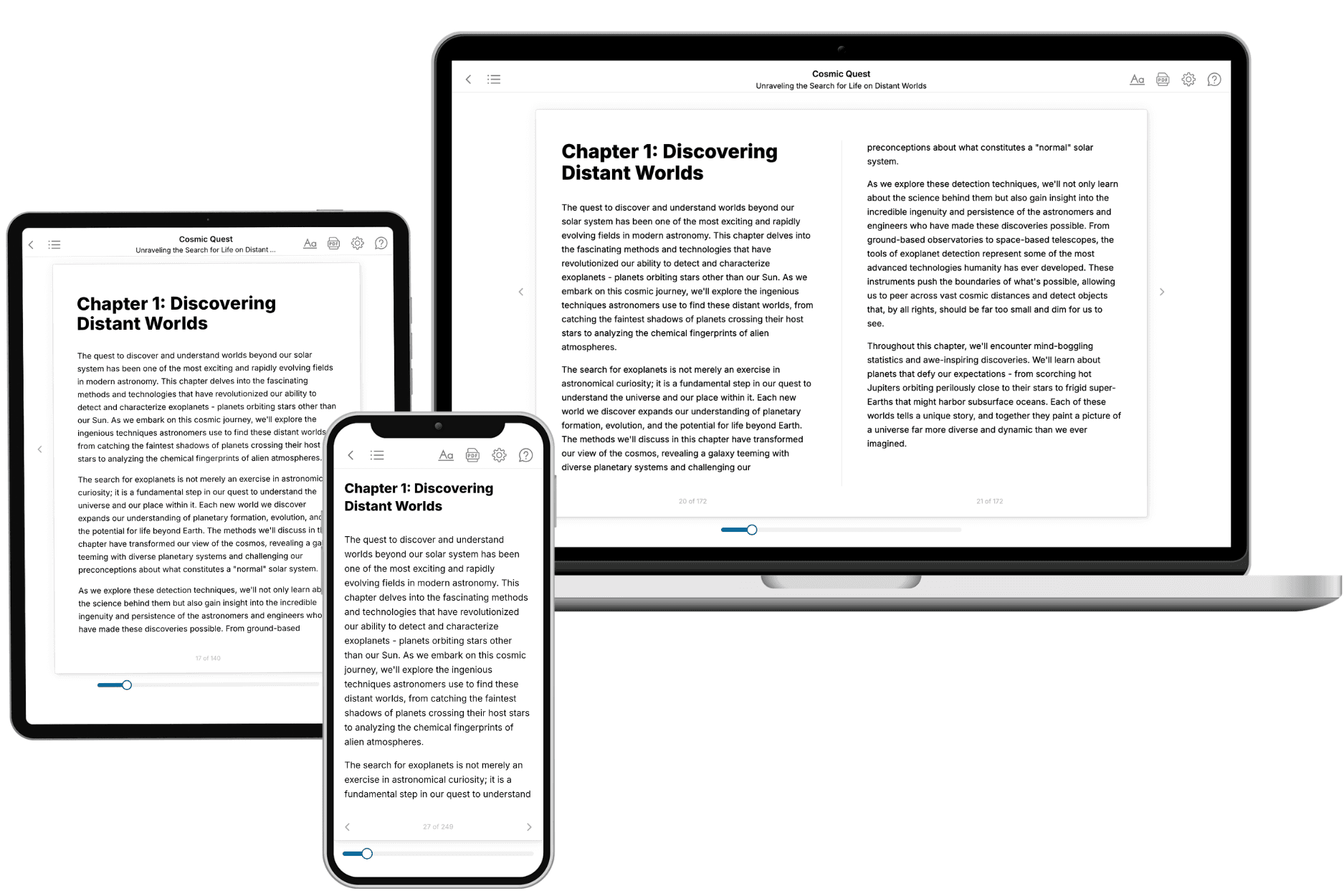
Your book is ready in 10 minutes. Read it online, download as EPUB or PDF, or send to Kindle.

Frequently asked questions
- What is TailoredRead?
TailoredRead creates complete, full-length nonfiction ebooks, written specifically for you. Tell us what you want to learn and why, and TailoredRead writes you a complete ebook on it, with charts, tables, and diagrams throughout. Read it online, on Kindle, or on any e-reader, or download it as a PDF or EPUB. Every book is written fresh the day you order it.
- How is the book tailored to me?
Before anything is written, you answer a few short questions about your goals, your background, and the topics you care about. Your book is then planned around your answers: written at your level, focused on your goals, and covering the topics you chose, instead of the one-size-fits-all book a store sells everyone.
- Will it read like generic AI content?
No. Your book isn't a chat transcript: it's planned chapter by chapter before a single word is written, told in a clear book voice, and explains ideas visually with charts, tables, and diagrams. After writing, every book goes through an editorial pass that polishes chapters so the book reads consistent from start to finish. Judge for yourself: browse thousands of sample books on our Explore Books page.
- How accurate is the content?
Our AI first checks whether your subject needs live research. Niche and fast-moving subjects are researched before writing, and the book plan and chapters are grounded in what it finds. After writing, every book goes through a quality pass that checks its facts and consistency, and researched books list their sources in a Notes section at the back.
- How long is the book?
You choose the length: Comprehensive (250-300 pages), Detailed (150-200 pages), Essential (70-100 pages), or Short (30-50 pages).
- Does the book include visuals?
Yes. Every book includes charts, tables, and diagrams: timelines, checklists, step-by-step guides, decision trees, comparison tables, matrices, and bar charts. A typical book includes dozens of these visual elements.
- Can I read it on Kindle? What formats can I download?
Yes. Every book can be read in our online reader or downloaded as a PDF or EPUB. The EPUB can be opened with Kindle, Apple Books, Kobo, and any e-reader. The Commercial and Author licenses also include an editable Word (DOCX) and Markdown download.
- How much does it cost?
About the price of a regular ebook. The exact price depends on your book's length and complexity, from $2 for the shortest books to $35 for the most comprehensive, and it's shown when you review your book, before you commit to anything. Each book is a one-time purchase, yours to keep, no subscription. Licenses that let you share, teach, or publish your book range from $35.99 to $49.99.
- Can I preview the book before purchasing?
Before you pay, you'll see what your book will cover: the title, a detailed description, the estimated length, and the complete chapter-by-chapter table of contents, so you know what you're getting before you decide. The full text itself is written after you purchase.
- How long does it take to create a book?
About 10 minutes. You can start reading the opening chapters while the rest is still being written.