About this book
Many answers point to money, markets, or natural resources, yet a careful reading of economic history suggests something less tangible and more consequential: the accumulation and spread of useful knowledge. This book follows the argument of economic historian Joel Mokyr, who shows how ideas about how nature works, and about how to make things work, became the engine of sustained growth. Moving from the Republic of Letters and the Scientific Revolution to the British Industrial Enlightenment, it asks why Europe pulled ahead, how a culture of growth took hold, and how institutions and technology interacted along the way. Along the path, it weighs the fiercest objections, from institutional economists to scholars of the Great Divergence, so that you can judge the thesis for yourself. Written for thoughtful readers who want more than a summary, this book offers a clear map of one of the most ambitious explanations of how prosperity came to be.
Table of contents
- IntroductionThe Puzzle of Why Some Nations Grew, Mokyr's Thesis in BriefRead below
- Chapter 1: Useful Knowledge and Its Two FormsPropositional Versus Prescriptive Knowledge Explained, Why Knowledge Behaves Differently from Goods, How the Printing Press Carried Knowledge
- Chapter 2: The Republic of Letters and the Culture of GrowthScholars, Correspondence, and Open Exchange, Attitudes That Welcomed Innovation, Hume, Smith, and Economic Ideas
- Chapter 3: Roots of the Industrial RevolutionThe British Industrial Enlightenment Movement, Breaking Free from the Malthusian Constraint, Networks That Spread Practical Knowledge
- Chapter 4: Why Europe Diverged and Who DisagreesCompeting Explanations for the Great Divergence, Challenges from Institutional Economics, Comparing Chinese and European Growth Paths
- ConclusionWeighing Mokyr's Thesis as a Whole
Introduction
In 1500, the gap in average income between the richest and poorest regions of the world was modest, perhaps a factor of two or three. By 1900, that gap had widened into a chasm, with parts of northwestern Europe producing ten or twenty times the output per person of large swaths of Asia and Africa[1]. The question of what happened in those four centuries, and why it happened in Britain and the Netherlands before anywhere else, has occupied economic historians for generations. Textile mills, steam engines, and railways are the visible symptoms. The deeper cause is harder to name.
Standard answers point to capital accumulation, favorable trade routes, coal deposits, or colonial plunder. Each explanation captures something real, yet each also runs into cases that do not fit. Spain extracted enormous wealth from its American colonies without industrializing. The Dutch Republic had thriving trade but ceded technological leadership to Britain by the late eighteenth century. Coal sat under parts of China and Germany for centuries before either became the first industrial power. If resources and trade alone explained the divergence, the timing and location of the breakthrough would look different than it does.
This book follows a different thread, one traced most carefully by the economic historian Joel Mokyr. His claim is that sustained growth required something intangible: a growing, circulating, and self-correcting stock of useful knowledge, paired with a cultural willingness to apply that knowledge to the material world[2]. Machines and factories were downstream effects. The upstream cause was a change in how people understood nature and how they thought it was proper to use that understanding.
Tracking this argument means moving across several centuries and several unfamiliar vocabularies, from the correspondence networks of seventeenth-century scholars to the patent records of eighteenth-century British ironmasters. It also means confronting serious objections. Critics working in institutional economics argue that property rights and political constraints on rulers did the real work, with knowledge as a secondary effect rather than a cause. Historians of China ask why a civilization with centuries of scientific and technical achievement did not industrialize first. Both lines of criticism deserve a fair hearing, and this book returns to them directly rather than treating Mokyr's account as settled.
What follows in this introduction sets up the two moves the rest of the book will make. First, it frames the puzzle of uneven growth in a way that shows why knowledge, rather than capital or trade alone, deserves serious attention as a cause. Second, it lays out the shape of Mokyr's thesis in enough detail that later chapters can build on it without repeating the basics each time.
The Puzzle of Why Some Nations Grew
For most of recorded history, economic life followed a pattern economists now call stagnation punctuated by occasional, temporary gains. Population grew when harvests were good, pressed against the limits of available land and technique, and then fell back during famine, war, or disease. Average income per person in the year 1700 was not dramatically higher than it had been in the year 1 across most of the inhabited world[3]. This was not because people lacked cleverness or ambition. It was because whatever gains a clever farmer or craftsman achieved tended to be absorbed by a larger population rather than translated into a higher standard of living for everyone.
Then, starting in Britain in the late eighteenth century, something broke the pattern. Output per person began a sustained climb that has continued, with interruptions, for more than two hundred years. The scale of the change is easy to understate from inside it. A person living in London in 1750 traveled, ate, and worked in ways not so different from a Londoner of 1550. A person living in London in 1850 rode a railway, read a mass-circulation newspaper, and worked in a steam-powered factory. No comparable transformation separated 1550 from 1250.
Economic historians label this shift the Great Divergence, a term that captures both the timing, roughly the century after 1750, and the geography, a split between northwestern Europe and the rest of the world that widened steadily through the nineteenth century[4]. Later chapters, including the one devoted to the divergence debate, will examine this term closely. Here it is enough to note that the divergence was not a smooth global trend. It had a specific birthplace and a specific set of decades.
One obvious candidate explanation is capital: Britain supposedly had more savings available to invest in machinery and infrastructure. The trouble is that capital was not especially scarce in other wealthy regions of the eighteenth-century world, including parts of India, the Yangzi Delta in China, and the Dutch Republic. Interest rates, a rough proxy for the cost of capital, were not dramatically lower in Britain than in these comparably developed regions[5]. Capital mattered, but it was not uniquely scarce or uniquely cheap in the one place that industrialized first.
A second candidate is trade, especially the Atlantic trade in slaves, sugar, and silver that enriched parts of western Europe from the sixteenth century onward. This trade undeniably generated profits, some of which were reinvested in British and Dutch commerce. Yet the correlation between colonial wealth and industrial breakthrough is weaker than it first appears. Spain and Portugal extracted far more bullion from the Americas than Britain did from its colonial holdings in the same period, and neither became an industrial leader. Trade profits could fund consumption and finance, but by themselves they did not generate the stream of mechanical inventions that defined the British Industrial Revolution.
A third candidate, favored by many economists today, is institutions: secure property rights, constraints on arbitrary taxation, and a legal system that enforced contracts. The argument holds that England's Glorious Revolution of 1688 curbed royal power and gave merchants and inventors confidence that the state would not simply seize their gains[6]. This argument captures something important, and the chapter on the divergence debate takes it up as the leading rival to the knowledge-centered account. But institutional stability existed in other times and places without triggering sustained industrial growth, which suggests that secure property rights were necessary without being sufficient.
What capital, trade, and institutions have in common is that they describe conditions under which growth could occur, not the mechanism that actually produced new ways of making things. A secure property right protects an invention once it exists. It does not explain where the invention came from. A pool of capital can be invested in a new machine. It cannot by itself design that machine. Something has to supply the content of the innovation, the actual technical understanding that converts raw materials and labor into a steam engine, a spinning frame, or a smallpox vaccine.
This is the gap that a focus on useful knowledge is meant to fill. The term does not refer to knowledge in the abstract, including poetry, theology, or philosophy, however valuable those might be on their own terms. It refers specifically to knowledge that bears on the manipulation of the natural world for human purposes, from understanding how metals behave under heat to knowing the correct sequence of steps for bleaching cloth. The British Industrial Revolution produced a flood of such knowledge, both scientific and practical, in a way that no earlier period of history had managed to sustain.
Consider a concrete case that illustrates the difference between knowledge-driven growth and growth from capital or trade alone: the steam engine. Thomas Newcomen built a working atmospheric engine in 1712 that pumped water out of coal mines, a genuine advance but a crude and fuel-hungry one. James Watt's separate condenser, patented in 1769, dramatically improved its fuel efficiency by solving a specific problem in the underlying physics of heat and condensation[7]. Watt did not invent the steam engine. He improved an existing device by applying a better understanding of how it actually worked, and that improvement then spread rapidly because other engineers could read about it, discuss it, and build on it.
That spread matters as much as the original improvement. An invention that stays in one workshop changes little. An invention that becomes known, understood, and replicable across a trade changes an entire economy. The British case is distinctive not because any single invention was unprecedented in isolation, but because inventions compounded on each other at a pace and scale not seen before, each one building on technical knowledge that had become shared property among engineers, instrument makers, and industrialists.
The table below lays out four candidate explanations for the Great Divergence alongside their main strength and their main limitation, to make the comparative case clearer before the thesis is developed further.
| Explanation | Main Strength | Main Limitation |
|---|---|---|
| Capital accumulation | Explains how machinery gets financed and built | Capital was not uniquely scarce or cheap in Britain |
| Colonial trade profits | Explains a real source of merchant wealth | Spain and Portugal had larger colonial profits without industrializing |
| Secure institutions | Explains why inventors could keep their gains | Stable property rights existed elsewhere without triggering growth |
| Useful knowledge | Explains the content and compounding of innovation | Harder to measure directly than capital or trade flows |
None of this means capital, trade, and institutions are irrelevant. A sensible account of the Great Divergence has to hold several causes together rather than picking one and discarding the rest. Secure property rights gave inventors a reason to invest years of effort into a new design. Capital markets let a good idea scale from a workshop to a factory. Colonial trade generated demand for manufactured goods and raw materials like cotton. But these forces needed something to work on, a supply of technical content that did not exist in comparable quantity or quality anywhere else in the world during the relevant decades.
The puzzle, restated carefully, is this: why did useful knowledge accumulate and spread in Britain, and a wider northwestern European zone, with a speed and a practical orientation that it did not achieve in China, the Ottoman Empire, or Mughal India, all of which had sophisticated intellectual traditions of their own? China in particular poses a sharp version of the puzzle, since it led the world in many practical technologies for centuries, including papermaking, printing, and ironworking, yet did not produce an industrial revolution. This comparison, often called the Needham puzzle after the historian who documented Chinese technical achievement in exhaustive detail, receives its own sustained treatment later in the book.
One response treats the puzzle as a matter of luck: coal happened to sit near British iron deposits, and geography did the rest. Geographic luck is a real factor, and Pomeranz's work on the Great Divergence gives it serious weight, particularly regarding coal and access to New World land[8]. But coal by itself does not design a steam engine or a cotton-spinning machine. Coal became transformative only once people had developed theories of heat, pressure, and mechanics sophisticated enough to exploit it efficiently, and workshops organized to apply those theories at scale.
A second response, the one this book develops at length, treats the puzzle as a matter of knowledge and culture working together. On this view, Europe developed institutions and attitudes, starting well before the Industrial Revolution itself, that made it unusually effective at generating, testing, and spreading useful knowledge. These institutions include informal scholarly networks, printing and publishing, scientific societies, and a growing cultural prestige attached to practical invention rather than only classical learning. China had enormous technical sophistication but lacked some of these specific circulatory and cultural mechanisms, at least during the centuries when Europe was catching up and then overtaking it.
It helps to picture useful knowledge as something closer to a shared library than a private workshop. A single inventor's insight is a single book. What made Europe distinctive was less any one book and more the growth of a library that kept expanding, that different readers could access, and that different readers actively corrected and improved over time. A library with one copy of a flawed book stays flawed. A library where many readers can check, challenge, and revise that book becomes progressively more reliable. The chapters ahead trace how this library came into being and how it operated.
This framing already signals why the book spends so much time on seemingly peripheral topics like scholarly letter-writing and scientific societies before reaching the steam engine at all. The letters, societies, and publications were not decoration around the real story of invention. They were the infrastructure that let isolated technical insights become a cumulative, checkable, shared body of knowledge, which is precisely the feature that distinguished Europe's trajectory from technically accomplished but less interconnected traditions elsewhere.
The remaining task for this introduction is to state Mokyr's thesis plainly enough that it can serve as a reference point for everything that follows, since each later chapter develops one piece of it in depth rather than restating the whole.
Mokyr's Thesis in Brief
Joel Mokyr's central claim, developed across several decades of research, is that sustained economic growth depends on a particular kind of feedback loop between understanding why things work and knowing how to make them work better[9]. He calls the first kind of understanding propositional knowledge, roughly, knowledge of natural regularities and causes. He calls the second kind prescriptive knowledge, the practical recipes and techniques used to produce goods and services. Later chapters define and illustrate both terms in detail. The point to grasp now is that Mokyr treats their interaction, rather than either one alone, as the real engine of growth.
A craftsman without any scientific theory can still improve a technique through trial and error, and many pre-modern technologies, from Roman concrete to medieval cathedral construction, advanced this way. Mokyr's claim is not that propositional knowledge is required for every improvement. It is that trial-and-error improvement eventually hits a ceiling, because without an understanding of why a technique works, it is hard to know how to adapt it to new materials, new scales, or new problems. Prescriptive knowledge without propositional backing tends to stall once the easy improvements are exhausted.
The reverse is also true. Propositional knowledge without any application to prescriptive problems can remain an intellectual curiosity rather than an economic force. Ancient Greek natural philosophy produced striking theoretical insights, including early atomic theories and sophisticated geometry, yet very little of this knowledge was systematically applied to production techniques in the ancient world. What changed from roughly the sixteenth century onward in parts of Europe was a growing, culturally sanctioned traffic between the two kinds of knowledge, with natural philosophers increasingly interested in practical problems and craftsmen increasingly exposed to theoretical explanations for their techniques.
Mokyr situates the origins of this traffic in the Republic of Letters, an informal, borderless network of scholars, instrument makers, and natural philosophers who exchanged letters, specimens, and findings across national and religious lines throughout the sixteenth and seventeenth centuries. Figures like Henry Oldenburg, the secretary of the Royal Society, maintained correspondence with hundreds of scholars across Europe, effectively running a clearinghouse for new findings before formal scientific journals existed in their modern form[10]. This network, covered fully in its own chapter, mattered because it made knowledge cumulative in a way that isolated individual effort could not.
Cumulative, in this context, carries a precise meaning worth stating clearly. A piece of propositional or prescriptive knowledge is cumulative when later findings can build on it rather than having to rediscover it from scratch, and when errors in it can be identified and corrected by other people working independently. A single alchemist working in secrecy might stumble onto a genuine insight, but if that insight dies with the alchemist or remains encoded in a private, undecipherable notebook, it adds nothing to the collective stock. The Republic of Letters, through open correspondence and eventually published journals, turned private insight into a public, correctable resource.
Alongside this network, Mokyr emphasizes a cultural shift he terms the culture of growth, a phrase that captures a change in values rather than a change in formal rules. In many societies throughout history, practical, hands-on tinkering with machinery or chemicals carried low social status compared to theology, law, or classical scholarship. In parts of early modern Europe, particularly in England and the Dutch Republic, this hierarchy began to loosen. Natural philosophers like Francis Bacon argued explicitly that knowledge should serve human welfare and the improvement of material life, not merely intellectual contemplation[11].
Bacon's influence on this cultural shift is hard to overstate, and his name recurs throughout the book's later chapters. He argued that the ancients, despite their reputation for wisdom, had actually produced very little durable improvement in the human condition, and that a new, systematic, observation-based method of inquiry could do better. He envisioned an organized, collaborative research program, something closer to a modern scientific institution than to a solitary philosopher's study, aimed explicitly at practical results. This vision took concrete institutional form decades later in bodies like the Royal Society of London, founded in 1660, which explicitly combined experimental science with attention to useful arts like navigation, agriculture, and mining.
This combination, scientific societies organized around both theoretical inquiry and practical improvement, is what Mokyr terms the British Industrial Enlightenment, a specifically British variant of the broader European Enlightenment that placed unusual weight on applying natural philosophy to manufacturing, agriculture, and engineering. The Lunar Society of Birmingham, an informal dining club that met through the 1770s and 1780s, brought together figures like the chemist and industrialist Josiah Wedgwood, the engineer James Watt, and the physician and naturalist Erasmus Darwin, mixing scientific discussion with hands-on industrial problem-solving in a single social setting[12].
None of this occurred in a vacuum separate from economic life. Mokyr connects the growth of useful knowledge directly to Britain's escape from what economists call the Malthusian constraint, the tendency of population growth to absorb any gains in productivity, keeping average income roughly constant over long stretches of history. Thomas Malthus, writing in 1798, observed accurately that population had historically grown to outpace food supply, producing recurring subsistence crises[13]. What Malthus could not have anticipated, writing at the very moment the pattern was beginning to break, was that a sustained stream of agricultural and industrial innovation would soon let output grow faster than population for the first time in history.
Escaping the Malthusian constraint required more than a single clever invention. It required a continuous supply of technical improvements across agriculture, manufacturing, and transport, arriving faster than population growth could absorb them, year after year, decade after decade. A single good harvest from a new crop rotation would have been absorbed within a generation under the old pattern. A continuous stream of such improvements, compounding on each other because the underlying knowledge was shared and improvable, is what finally broke the cycle. This is why Mokyr places such emphasis on the feedback loop between propositional and prescriptive knowledge rather than on any single breakthrough invention.
It is worth pausing on why this argument counts as a genuinely distinct thesis rather than a restatement of older accounts that credit the Industrial Revolution to clever British inventors. Many accounts of the period already celebrate individual inventors like Watt, Richard Arkwright, or Edmund Cartwright. Mokyr's distinctive move is to ask why Britain, specifically, produced so many such inventors in such close succession, and why their innovations diffused and compounded rather than remaining isolated curiosities. His answer locates the cause in the social and cultural infrastructure surrounding these individuals, not in some presumed British genius for mechanical tinkering.
The timeline below sketches the sequence Mokyr traces, from the informal scholarly networks of the seventeenth century through the Industrial Revolution itself, to make the overall chronology visible before later chapters examine each stage closely.
From the Republic of Letters to Industrial Takeoff
- 1600sInformal scholarly correspondence networks expand across Europe - Natural philosophers exchange findings across national and religious lines
- 1660Founding of the Royal Society of London - Institutionalizes experimental science alongside practical improvement
- Early-to-mid 1600sBacon's vision of knowledge serving human welfare gains wide influence - Reframes natural philosophy as a tool for material progress
- 1798Malthus describes population outpacing food supply - Written at the very moment the historical pattern was starting to break
- 1770s-1780sLunar Society brings scientists and industrialists into shared conversation - Birmingham circle links chemistry, engineering, and manufacturing
- 1769 onwardWatt's improved steam engine spreads across British industry - A propositional insight about heat translated into a prescriptive improvement
This sequence matters because it shows the thesis is not simply, Britain had smart people. Every society has smart people. The claim is that Britain, and the wider northwestern European zone around it, developed a specific set of social arrangements, correspondence networks, scientific societies, a print culture, a growing cultural prestige for practical improvement, that let individual insight accumulate into a shared, self-correcting, and ever-expanding resource. Other societies had comparable or even superior technical traditions in specific fields, as the comparison with China will show, without developing the same circulatory and cultural infrastructure around them.
Mokyr does not claim that useful knowledge alone explains everything, and this introduction should not leave that impression either. He explicitly treats institutions, markets, and geography as part of the full picture, arguing that useful knowledge needed a permissive institutional environment to translate into sustained growth, and that Britain's relatively open, competitive political economy provided that environment better than alternatives like centralized imperial bureaucracies. The disagreement with institutional economists, covered at length later in the book, is not about whether institutions mattered at all, but about whether institutions alone can explain the timing and location of the breakthrough without reference to the prior accumulation of useful knowledge.
A useful way to hold the thesis in mind going forward is as a claim about necessary conditions working together rather than a single master cause operating alone. Secure property rights were likely necessary but not sufficient. Capital availability was likely necessary but not sufficient. A culture that prized practical improvement over purely theoretical or purely craft knowledge was, on Mokyr's account, the missing piece that let the other necessary conditions actually generate sustained growth rather than isolated episodes of prosperity.
The chapters that follow build out each piece of this picture in turn. The chapter on useful knowledge and its two forms defines propositional and prescriptive knowledge with more precision and explains why knowledge behaves differently from ordinary rival goods like land or coal. The chapter on the Republic of Letters and the culture of growth traces the social networks and cultural shifts that made knowledge cumulative. The chapter on the roots of the Industrial Revolution follows the British Industrial Enlightenment into the factories and workshops where it produced measurable economic results. The final substantive chapter confronts the strongest objections to this entire account, from institutional economists and from historians who study the Needham puzzle directly.
Before moving on, it is worth sitting with one small but telling example that will recur later: Josiah Wedgwood, the potter and Lunar Society member mentioned above, did not simply inherit a family pottery business and run it conventionally. He ran systematic experiments on clay composition and kiln temperature, kept detailed written records of thousands of trials, and corresponded with chemists about the properties of different glazes, treating pottery making as an experimental science rather than a closed craft tradition[14]. That single biography compresses the whole thesis into one career: propositional curiosity, prescriptive skill, open correspondence, and a cultural environment that rewarded rather than scorned this kind of systematic tinkering.
What makes this example worth holding onto is that nothing about it required a dramatic, singular genius moment. Wedgwood's advances came from patient, recorded, shareable experimentation conducted within a social network that valued and transmitted exactly that kind of work. Multiply that pattern across hundreds of workshops, laboratories, and correspondence circles throughout Britain in the second half of the eighteenth century, and the scale of the underlying claim starts to become visible. The following chapters trace exactly how that multiplication happened, and why it happened there before it happened anywhere else.
Notes
Introduction
- 1. Angus Maddison, The World Economy, OECD Publishing, 2006
- 2. Joel Mokyr, The Gifts of Athena, Princeton University Press, 2002
- 3. Gregory Clark, A Farewell to Alms, Princeton University Press, 2007
- 4. Kenneth Pomeranz, The Great Divergence, Princeton University Press, 2000
- 5. Robert Allen, The British Industrial Revolution in Global Perspective, Cambridge University Press, 2009
- 6. Daron Acemoglu and James Robinson, Why Nations Fail, Crown Business, 2012
- 7. Joel Mokyr, The Lever of Riches, Oxford University Press, 1990
- 8. Kenneth Pomeranz, The Great Divergence, Princeton University Press, 2000
- 9. Joel Mokyr, A Culture of Growth, Princeton University Press, 2016
- 10. Lorraine Daston, "The Ideal and Reality of the Republic of Letters," Science in Context, 1991
- 11. Francis Bacon, The New Organon, 1620
- 12. Jenny Uglow, "The Lunar Men," Faber and Faber, 2002
- 13. Thomas Malthus, "An Essay on the Principle of Population," J. Johnson, 1798
- 14. Jenny Uglow, "The Lunar Men," Faber and Faber, 2002
This is the end of the free sample. The full book has 4 chapters.
Want this book written for you?
Tell us your goals and background, and get your own version of this book, tailored by AI to you.


Benefits of AI-tailored books
- Read one book, not ten:
- all the knowledge you need, gathered into a single book.
- Save days of learning:
- tell us your goals, choose your topics, and the whole book is built around them.
- Learn effortlessly:
- a book written for your specific background and expertise.
- Understand at a glance:
- includes charts, tables, timelines, checklists, decision trees, and more.
- Stay current:
- written the day you order it, not years ago.
- Trust what you read:
- every book is checked for accuracy, with real research when your subject needs it.

Create your unique book in 3 steps
- 1. Pick a subject
Select what you want to learn and share your background
- 2. Personalize your book
Specify your goals and choose sub-topics to include
- 3. Get your tailored book
Your book is ready in 10 minutes. Read it online, download as EPUB or PDF, or send to Kindle.


Frequently asked questions
- What is TailoredRead?
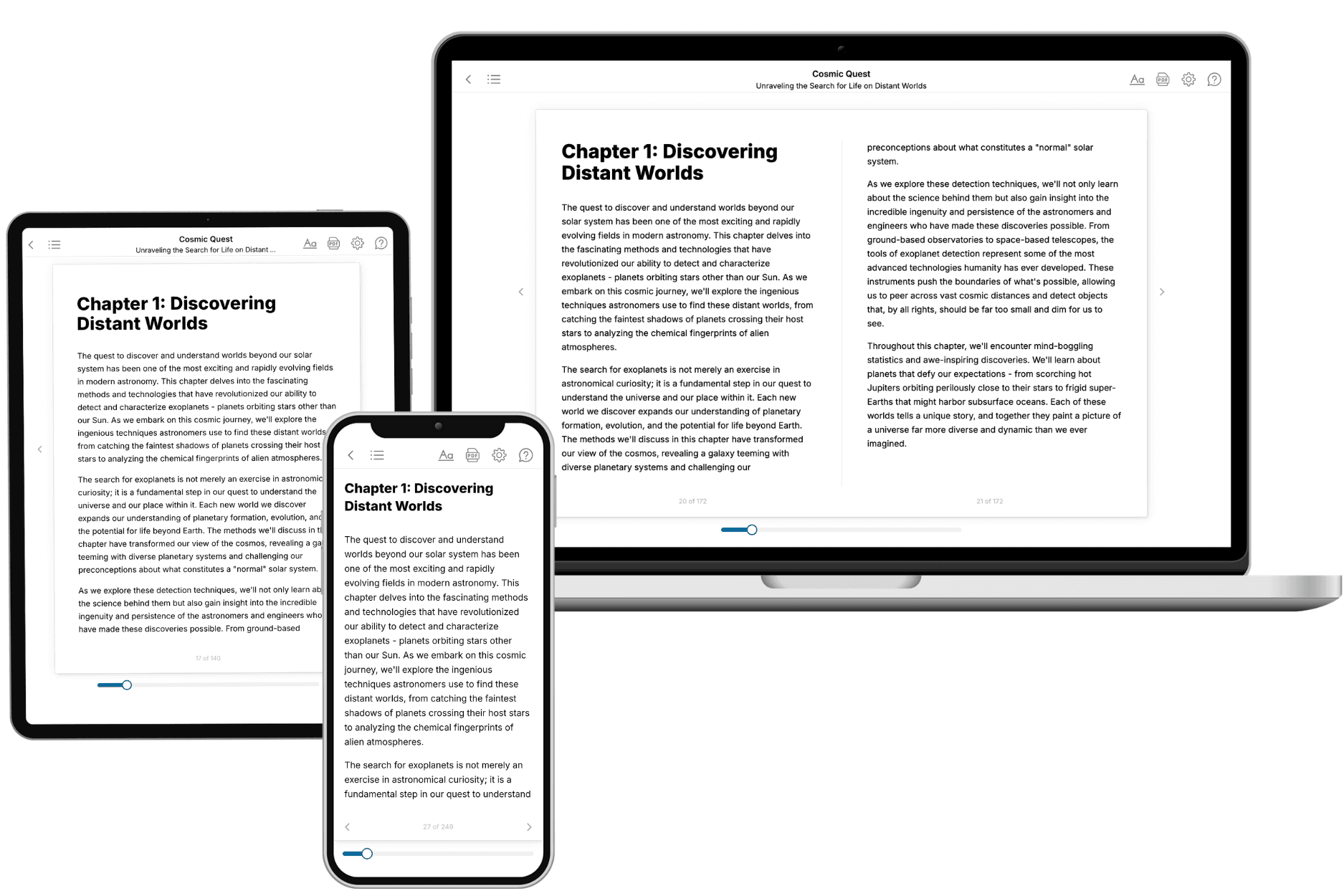
TailoredRead creates complete, full-length nonfiction ebooks, written specifically for you. Tell us what you want to learn and why, and TailoredRead writes you a complete ebook on it, with charts, tables, and diagrams throughout. Read it online, on Kindle, or on any e-reader, or download it as a PDF or EPUB. Every book is written fresh the day you order it.
- How is the book tailored to me?
Before anything is written, you answer a few short questions about your goals, your background, and the topics you care about. Your book is then planned around your answers: written at your level, focused on your goals, and covering the topics you chose, instead of the one-size-fits-all book a store sells everyone.
- Will it read like generic AI content?
No. Your book isn't a chat transcript: it's planned chapter by chapter before a single word is written, told in a clear book voice, and explains ideas visually with charts, tables, and diagrams. After writing, every book goes through an editorial pass that polishes chapters so the book reads consistent from start to finish. Judge for yourself: browse thousands of sample books on our Explore Books page.
- How accurate is the content?
Our AI first checks whether your subject needs live research. Niche and fast-moving subjects are researched before writing, and the book plan and chapters are grounded in what it finds. After writing, every book goes through a quality pass that checks its facts and consistency, and researched books list their sources in a Notes section at the back.
- How long is the book?
You choose the length: Comprehensive (250-300 pages), Detailed (150-200 pages), Essential (70-100 pages), or Short (30-50 pages).
- Does the book include visuals?
Yes. Every book includes charts, tables, and diagrams: timelines, checklists, step-by-step guides, decision trees, comparison tables, matrices, and bar charts. A typical book includes dozens of these visual elements.
- Can I read it on Kindle? What formats can I download?
Yes. Every book can be read in our online reader or downloaded as a PDF or EPUB. The EPUB can be opened with Kindle, Apple Books, Kobo, and any e-reader. The Commercial and Author licenses also include an editable Word (DOCX) and Markdown download.
- How much does it cost?
About the price of a regular ebook. The exact price depends on your book's length and complexity, from $2 for the shortest books to $35 for the most comprehensive, and it's shown when you review your book, before you commit to anything. Each book is a one-time purchase, yours to keep, no subscription. Licenses that let you share, teach, or publish your book range from $35.99 to $49.99.
- Can I preview the book before purchasing?
Before you pay, you'll see what your book will cover: the title, a detailed description, the estimated length, and the complete chapter-by-chapter table of contents, so you know what you're getting before you decide. The full text itself is written after you purchase.
- How long does it take to create a book?
About 10 minutes. You can start reading the opening chapters while the rest is still being written.